Ethics and Issues Report: Impact of Social Conditioning on Conscience

Verified

Added on  2022/10/09

|4
|723
|32
Report
AI Summary
This report examines the significant impact of social conditioning on an individual's conscience, specifically focusing on the belief that wealth equates to success and respect. The author details how this belief, rooted in their upbringing and societal observations, has influenced their perceptions and behaviors, including a strong drive to accumulate wealth. The report then connects this experience to utilitarianism, an ethical theory that prioritizes the greatest good, and argues that this aspect of their conscience is unethical due to its disregard for the dignity of those with less financial means and its potential to justify unethical actions in the pursuit of wealth. The report concludes by emphasizing the importance of ethical considerations beyond financial gain.
Document Page
Running head: ETHICS AND ISSUES 1
Ethics and Issues
Name
Institutional
tabler-icon-diamond-filled.svg

Paraphrase This Document

Need a fresh take? Get an instant paraphrase of this document with our AI Paraphraser
Document Page
ETHICS AND ISSUES 2
ETHICS AND ISSUES
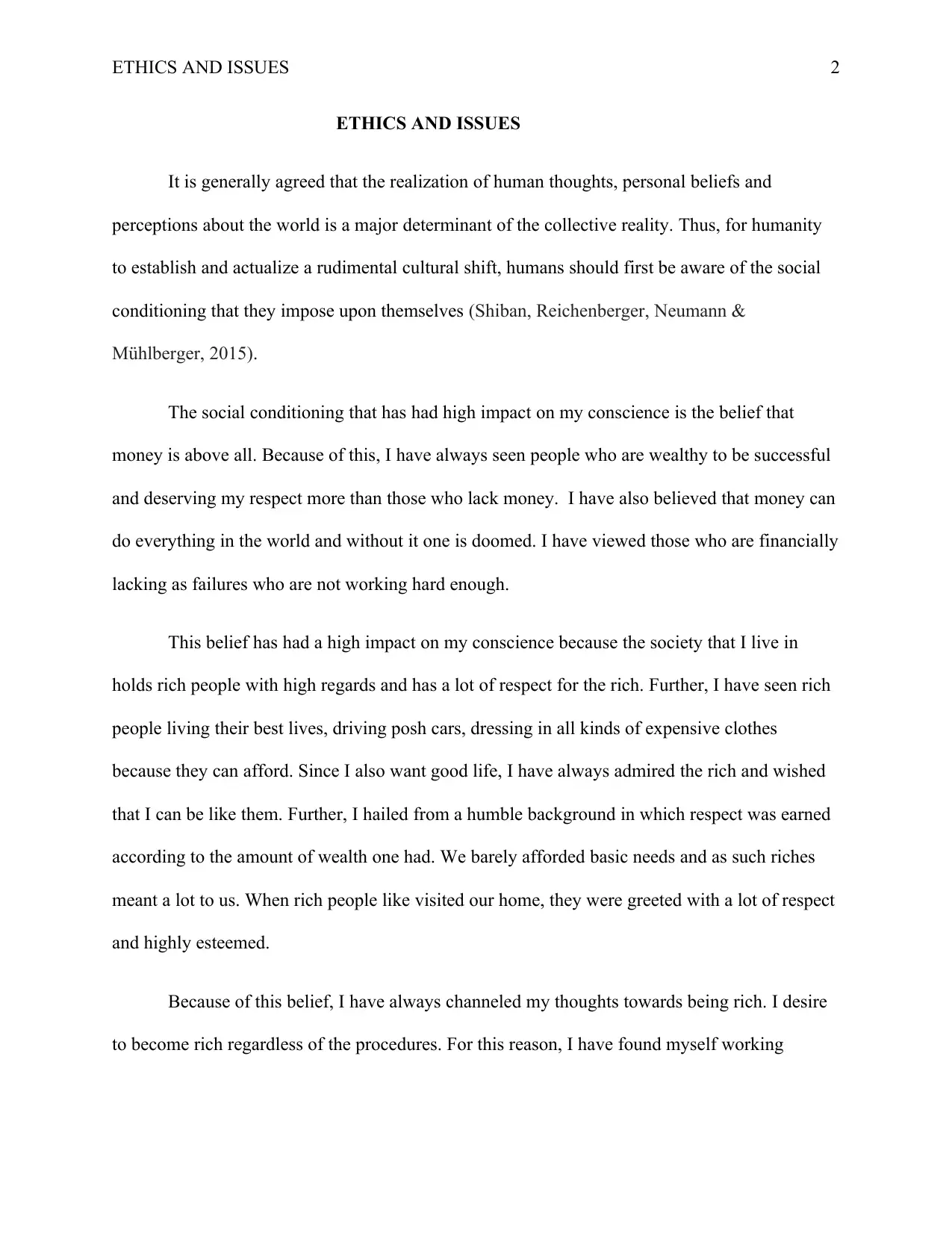
It is generally agreed that the realization of human thoughts, personal beliefs and
perceptions about the world is a major determinant of the collective reality. Thus, for humanity
to establish and actualize a rudimental cultural shift, humans should first be aware of the social
conditioning that they impose upon themselves (Shiban, Reichenberger, Neumann &
Mühlberger, 2015).
The social conditioning that has had high impact on my conscience is the belief that
money is above all. Because of this, I have always seen people who are wealthy to be successful
and deserving my respect more than those who lack money. I have also believed that money can
do everything in the world and without it one is doomed. I have viewed those who are financially
lacking as failures who are not working hard enough.
This belief has had a high impact on my conscience because the society that I live in
holds rich people with high regards and has a lot of respect for the rich. Further, I have seen rich
people living their best lives, driving posh cars, dressing in all kinds of expensive clothes
because they can afford. Since I also want good life, I have always admired the rich and wished
that I can be like them. Further, I hailed from a humble background in which respect was earned
according to the amount of wealth one had. We barely afforded basic needs and as such riches
meant a lot to us. When rich people like visited our home, they were greeted with a lot of respect
and highly esteemed.
Because of this belief, I have always channeled my thoughts towards being rich. I desire
to become rich regardless of the procedures. For this reason, I have found myself working
Document Page
ETHICS AND ISSUES 3
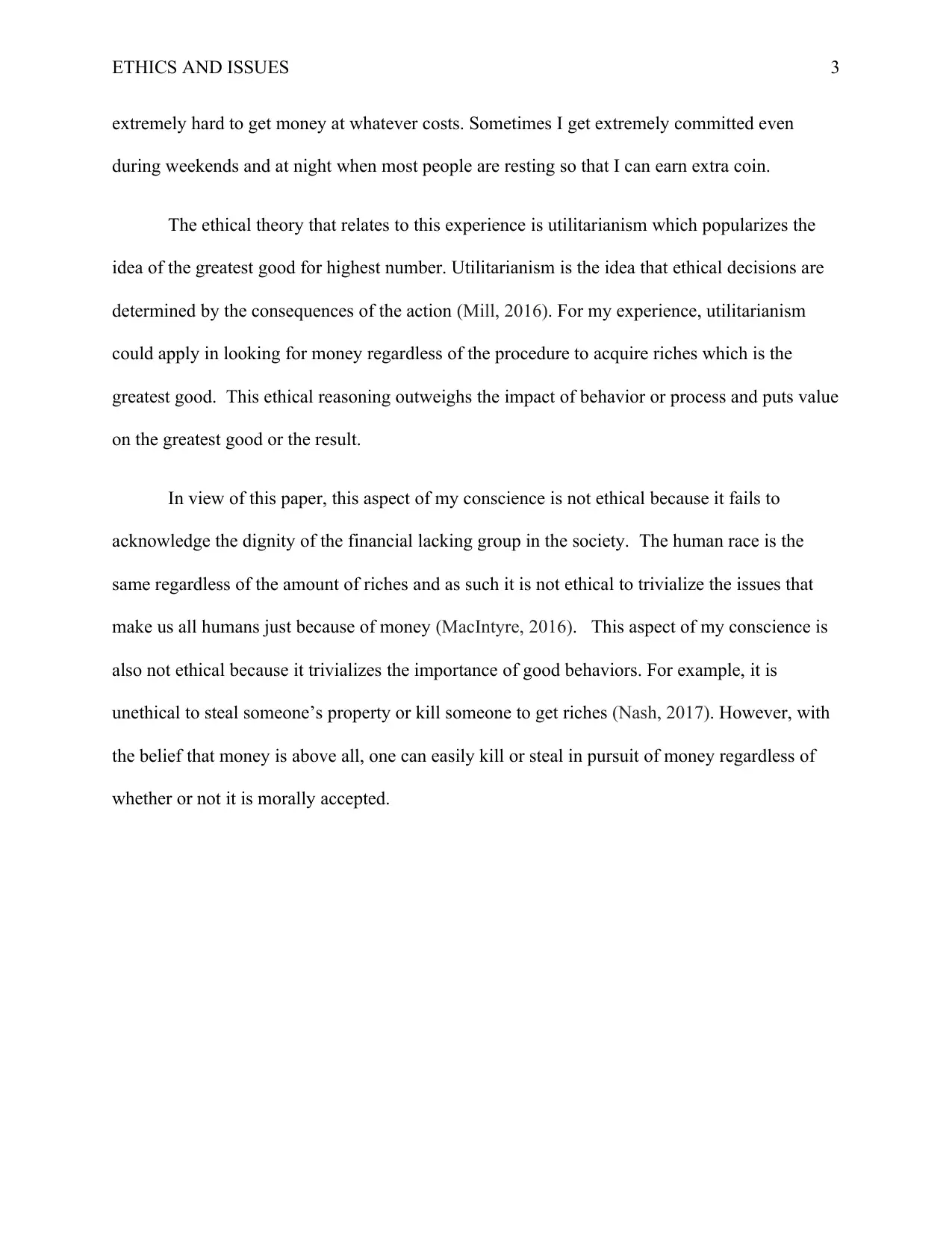
extremely hard to get money at whatever costs. Sometimes I get extremely committed even
during weekends and at night when most people are resting so that I can earn extra coin.
The ethical theory that relates to this experience is utilitarianism which popularizes the
idea of the greatest good for highest number. Utilitarianism is the idea that ethical decisions are
determined by the consequences of the action (Mill, 2016). For my experience, utilitarianism
could apply in looking for money regardless of the procedure to acquire riches which is the
greatest good. This ethical reasoning outweighs the impact of behavior or process and puts value
on the greatest good or the result.
In view of this paper, this aspect of my conscience is not ethical because it fails to
acknowledge the dignity of the financial lacking group in the society. The human race is the
same regardless of the amount of riches and as such it is not ethical to trivialize the issues that
make us all humans just because of money (MacIntyre, 2016). This aspect of my conscience is
also not ethical because it trivializes the importance of good behaviors. For example, it is
unethical to steal someone’s property or kill someone to get riches (Nash, 2017). However, with
the belief that money is above all, one can easily kill or steal in pursuit of money regardless of
whether or not it is morally accepted.
Document Page
ETHICS AND ISSUES 4
References
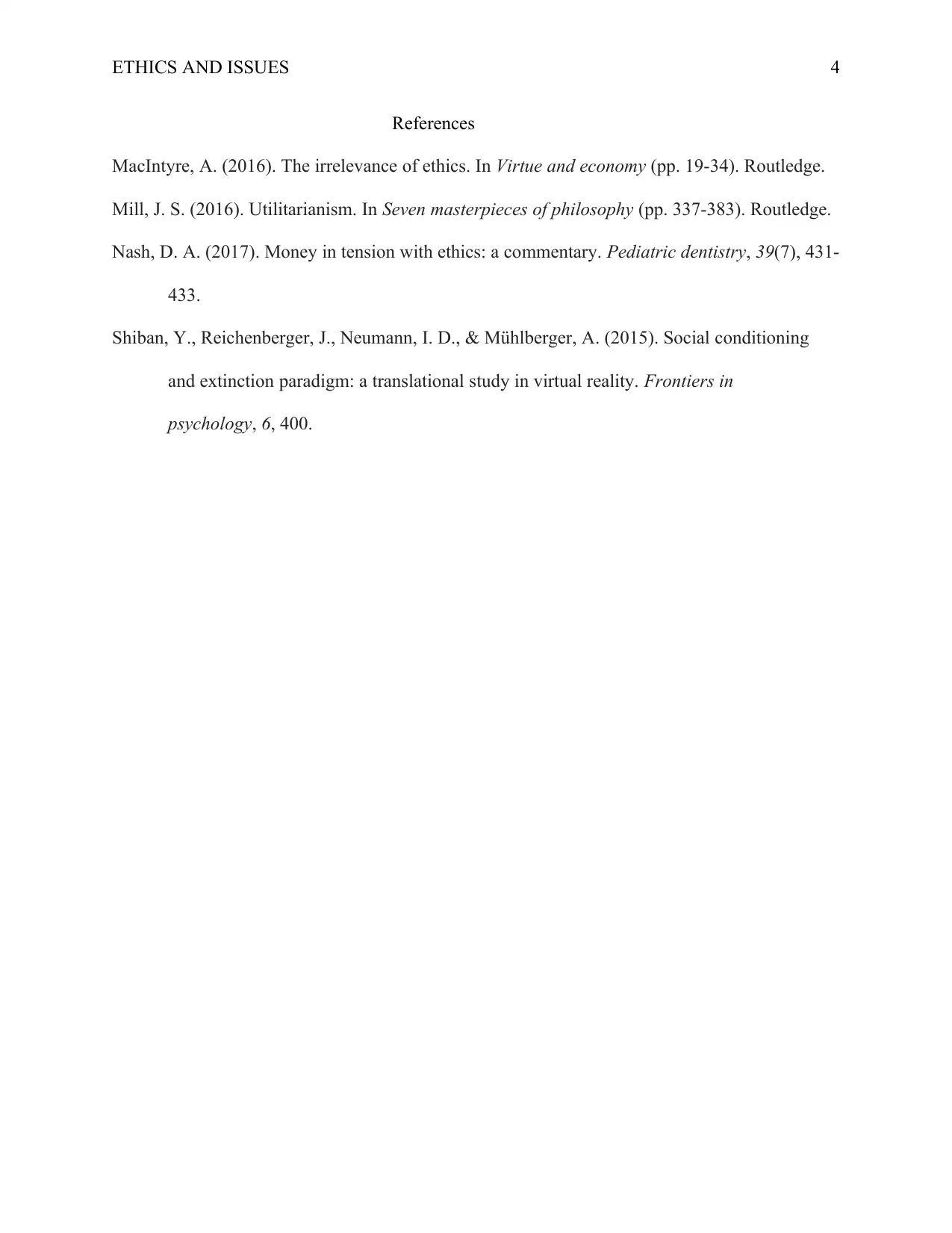
MacIntyre, A. (2016). The irrelevance of ethics. In Virtue and economy (pp. 19-34). Routledge.
Mill, J. S. (2016). Utilitarianism. In Seven masterpieces of philosophy (pp. 337-383). Routledge.
Nash, D. A. (2017). Money in tension with ethics: a commentary. Pediatric dentistry, 39(7), 431-
433.
Shiban, Y., Reichenberger, J., Neumann, I. D., & Mühlberger, A. (2015). Social conditioning
and extinction paradigm: a translational study in virtual reality. Frontiers in
psychology, 6, 400.
chevron_up_icon
1 out of 4
circle_padding
hide_on_mobile
zoom_out_icon
[object Object]