Ethical Dilemmas in Software Development: A Case Study Report
VerifiedAdded on 2022/09/08
|8
|1921
|21
Report
AI Summary
This report provides a comprehensive analysis of ethical issues within the software development lifecycle, using a case study to illustrate the consequences of prioritizing speed and profit over data security and professional conduct. The report examines a scenario where a software company faces a critical decision: releasing a product early without necessary security measures or delaying the release to ensure data protection. The analysis explores violations of the Australian Computer Society Code of Professional Conduct, focusing on the prioritization of public interests, professional integrity, and the quality of life for software users. The report highlights the ethical conflicts between developers, project managers, and clients, emphasizing the importance of strict regulations and ethical guidelines to prevent data breaches, protect user information, and maintain professional standards. The conclusion recommends implementing strict company regulations on software development practices to prevent future ethical violations and protect stakeholders.
Running Head: ETHICS IN INFORMATION TECHNOLOGY 1
ETHICS IN INFORMATION TECHNOLOGY
Student Name
Institution
Course
Date
ETHICS IN INFORMATION TECHNOLOGY
Student Name
Institution
Course
Date
Paraphrase This Document
Need a fresh take? Get an instant paraphrase of this document with our AI Paraphraser

ETHICS IN INFORMATION TECHNOLOGY 2
Ethics in Information Technology
Introduction
In the modern world, business organizations have highly been disrupted and driven by
software solutions. Right from startup companies to multinational organizations, software
solutions are running almost everything done in those organizations. This technological
evolution has completely changed how organizations operate today, as the race heats up with
business organizations striving to be the market leaders of the next best products and services.
For instance, technology-based companies such as YouTube and Facebook are and will continue
to have profound impacts in modern society through their distinct ways of shaping how people
create, share and consume content. As a result of the important role of software in modern
businesses, rogue incidents such as controversial videos and exposure of user information have
great impacts on modern society (Leicester, 2016). The rush to meet deadlines and sell products
has been a major issue that makes delivery teams to overlook security, integration and important
performance tests that could help developers to avoid or eliminate some of the flaws in software
and other issues. This has led to bad software going rogue on public hands. This paper
scrutinizes the ethical dilemma in a software development life cycle that later erupted to cause
damages to the organization's reputation.
Video 1: Delivering Willis Software Early without Encryption Vs Delaying the Software
The main ethical dilemma, in this case, is the decision by the company to rush and deliver
a software product early without the implementation of necessary security measures of the
software or delaying the software but deliver it with all security measures fully implemented.
Ethics in Information Technology
Introduction
In the modern world, business organizations have highly been disrupted and driven by
software solutions. Right from startup companies to multinational organizations, software
solutions are running almost everything done in those organizations. This technological
evolution has completely changed how organizations operate today, as the race heats up with
business organizations striving to be the market leaders of the next best products and services.
For instance, technology-based companies such as YouTube and Facebook are and will continue
to have profound impacts in modern society through their distinct ways of shaping how people
create, share and consume content. As a result of the important role of software in modern
businesses, rogue incidents such as controversial videos and exposure of user information have
great impacts on modern society (Leicester, 2016). The rush to meet deadlines and sell products
has been a major issue that makes delivery teams to overlook security, integration and important
performance tests that could help developers to avoid or eliminate some of the flaws in software
and other issues. This has led to bad software going rogue on public hands. This paper
scrutinizes the ethical dilemma in a software development life cycle that later erupted to cause
damages to the organization's reputation.
Video 1: Delivering Willis Software Early without Encryption Vs Delaying the Software
The main ethical dilemma, in this case, is the decision by the company to rush and deliver
a software product early without the implementation of necessary security measures of the
software or delaying the software but deliver it with all security measures fully implemented.

ETHICS IN INFORMATION TECHNOLOGY 3
From the case description, the client insists on the early delivery of the software without the
consideration of the necessary security measures. The developer company has its team members
divided over the issue. Some perceive the delay as harmful to the company because the client
won’t be happy and may not consider it in the future while there are others who can foresee the
dangers of releasing the software without the necessary security measures. Based on the case
description, the client for the software in question has been portrayed as a company that is
dealing with personal customer information. Considering how modern businesses are run today,
personal information of the consumers has turned out to be the new oil in the digital world
(Witzleb, 2018). This is because everything runs on data. But while businesses that collect and
process consumer data are increasingly becoming valuable and powerful, this has made them
vulnerable to the threat of hacking and data breach. This clearly indicates that releasing the
software in question without the implementing of the necessary security measures will expose
the client company to a risk of a data breach.
Video 2: Prioritizing Information Security of Users vs Delivering Willis Software Early
As a company that deals with personal information, failure to prioritize the security of the
software was expected to cost the company more than the time it could have waited for the
software to be completed with its security features intact. This is in consideration of the fact that
Australia has privacy laws and regulations which protect the privacy of individuals against how
agencies and organizations use their data. The individual information which the company was
putting into the risk by rushing to have the software released before security features were intact
could include credit and debit card details as well as the bank details of its customers. This would
definitely lead to heavy losses in case the software was hacked (Burmeister, 2017). Also, if the
From the case description, the client insists on the early delivery of the software without the
consideration of the necessary security measures. The developer company has its team members
divided over the issue. Some perceive the delay as harmful to the company because the client
won’t be happy and may not consider it in the future while there are others who can foresee the
dangers of releasing the software without the necessary security measures. Based on the case
description, the client for the software in question has been portrayed as a company that is
dealing with personal customer information. Considering how modern businesses are run today,
personal information of the consumers has turned out to be the new oil in the digital world
(Witzleb, 2018). This is because everything runs on data. But while businesses that collect and
process consumer data are increasingly becoming valuable and powerful, this has made them
vulnerable to the threat of hacking and data breach. This clearly indicates that releasing the
software in question without the implementing of the necessary security measures will expose
the client company to a risk of a data breach.
Video 2: Prioritizing Information Security of Users vs Delivering Willis Software Early
As a company that deals with personal information, failure to prioritize the security of the
software was expected to cost the company more than the time it could have waited for the
software to be completed with its security features intact. This is in consideration of the fact that
Australia has privacy laws and regulations which protect the privacy of individuals against how
agencies and organizations use their data. The individual information which the company was
putting into the risk by rushing to have the software released before security features were intact
could include credit and debit card details as well as the bank details of its customers. This would
definitely lead to heavy losses in case the software was hacked (Burmeister, 2017). Also, if the
⊘ This is a preview!⊘
Do you want full access?
Subscribe today to unlock all pages.

Trusted by 1+ million students worldwide

ETHICS IN INFORMATION TECHNOLOGY 4
personal information was to land on the hands of third party organizations and used for
advertisement and promotion purposes, the company was also liable under the Privacy Act 1988.
This act had been introduced to protect and promote the privacy of individual data and also to
regulate Australian agencies and business organizations with a large turnover on how to handle
personal information.
Australian Computer Society Code of Professional Conduct
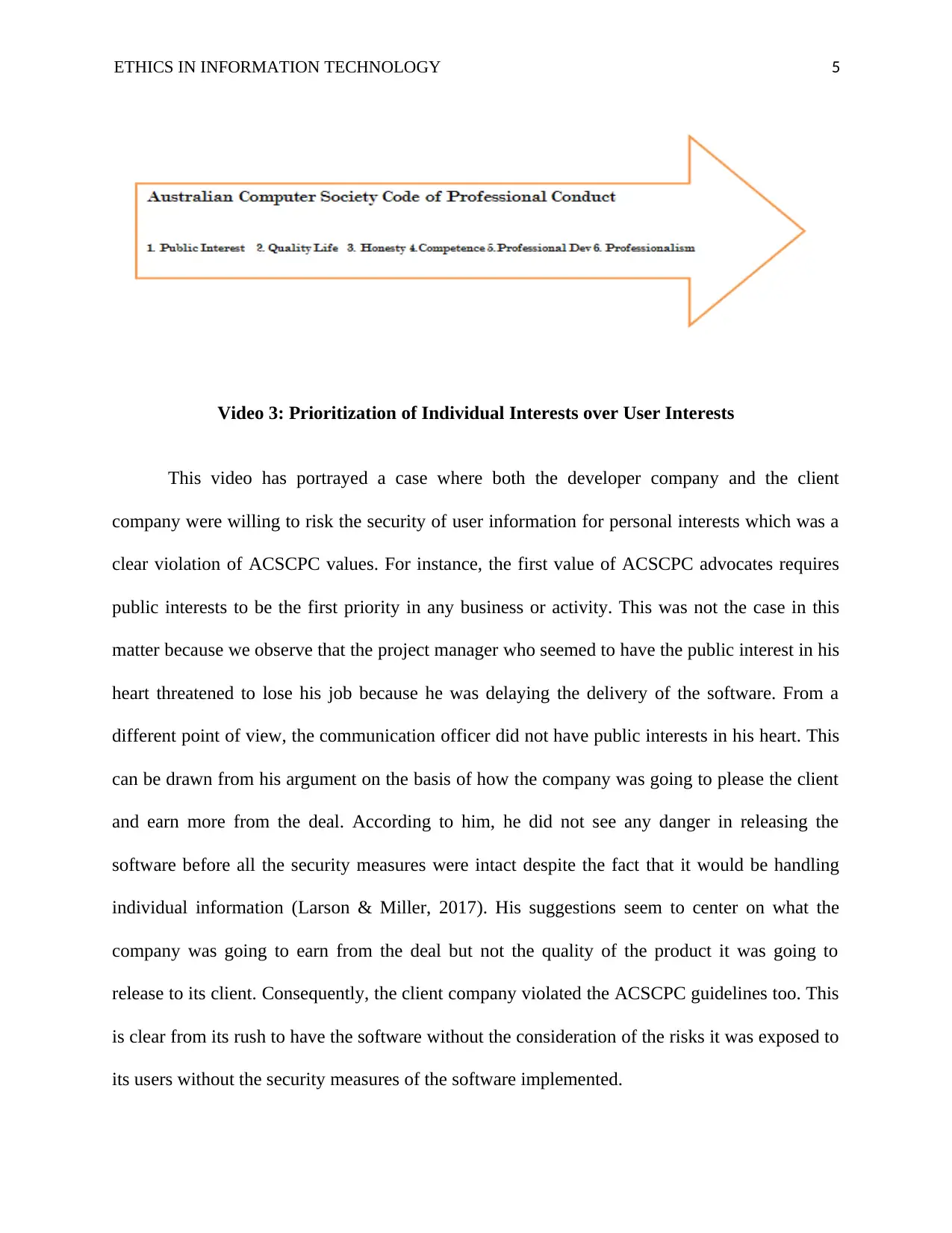
According to the Australian Computer Society Code of Professional Conduct (ACSCPC),
technological companies must uphold and advance dignity, effectiveness and the honour of being
professional. In additional to acting within the guidelines of the law, technological companies are
supposed to prioritize public interests by striving to ensure that the interests of the public are
above personal and business interests. Companies should also enhance the quality of life by
striving to ensure that the quality of life of those affected by their work, products and services is
enhanced (Lurie & Mark, 2016). Computer companies are also required to carry out their
activities in an honest and competence way. This will entail representing their knowledge,
products, services and skills in an honest way as well as working in a competent and diligent
manner. Lastly, the act requires technology companies to be professional in nature. This will be
achieved through enhanced integrity and respect to the development team and staff members
personal information was to land on the hands of third party organizations and used for
advertisement and promotion purposes, the company was also liable under the Privacy Act 1988.
This act had been introduced to protect and promote the privacy of individual data and also to
regulate Australian agencies and business organizations with a large turnover on how to handle
personal information.
Australian Computer Society Code of Professional Conduct
According to the Australian Computer Society Code of Professional Conduct (ACSCPC),
technological companies must uphold and advance dignity, effectiveness and the honour of being
professional. In additional to acting within the guidelines of the law, technological companies are
supposed to prioritize public interests by striving to ensure that the interests of the public are
above personal and business interests. Companies should also enhance the quality of life by
striving to ensure that the quality of life of those affected by their work, products and services is
enhanced (Lurie & Mark, 2016). Computer companies are also required to carry out their
activities in an honest and competence way. This will entail representing their knowledge,
products, services and skills in an honest way as well as working in a competent and diligent
manner. Lastly, the act requires technology companies to be professional in nature. This will be
achieved through enhanced integrity and respect to the development team and staff members
Paraphrase This Document
Need a fresh take? Get an instant paraphrase of this document with our AI Paraphraser

ETHICS IN INFORMATION TECHNOLOGY 5
Video 3: Prioritization of Individual Interests over User Interests
This video has portrayed a case where both the developer company and the client
company were willing to risk the security of user information for personal interests which was a
clear violation of ACSCPC values. For instance, the first value of ACSCPC advocates requires
public interests to be the first priority in any business or activity. This was not the case in this
matter because we observe that the project manager who seemed to have the public interest in his
heart threatened to lose his job because he was delaying the delivery of the software. From a
different point of view, the communication officer did not have public interests in his heart. This
can be drawn from his argument on the basis of how the company was going to please the client
and earn more from the deal. According to him, he did not see any danger in releasing the
software before all the security measures were intact despite the fact that it would be handling
individual information (Larson & Miller, 2017). His suggestions seem to center on what the
company was going to earn from the deal but not the quality of the product it was going to
release to its client. Consequently, the client company violated the ACSCPC guidelines too. This
is clear from its rush to have the software without the consideration of the risks it was exposed to
its users without the security measures of the software implemented.
Video 3: Prioritization of Individual Interests over User Interests
This video has portrayed a case where both the developer company and the client
company were willing to risk the security of user information for personal interests which was a
clear violation of ACSCPC values. For instance, the first value of ACSCPC advocates requires
public interests to be the first priority in any business or activity. This was not the case in this
matter because we observe that the project manager who seemed to have the public interest in his
heart threatened to lose his job because he was delaying the delivery of the software. From a
different point of view, the communication officer did not have public interests in his heart. This
can be drawn from his argument on the basis of how the company was going to please the client
and earn more from the deal. According to him, he did not see any danger in releasing the
software before all the security measures were intact despite the fact that it would be handling
individual information (Larson & Miller, 2017). His suggestions seem to center on what the
company was going to earn from the deal but not the quality of the product it was going to
release to its client. Consequently, the client company violated the ACSCPC guidelines too. This
is clear from its rush to have the software without the consideration of the risks it was exposed to
its users without the security measures of the software implemented.

ETHICS IN INFORMATION TECHNOLOGY 6
The developer company violated ACSCPC’s value that requires a company to ensure that
its products or services enhance the quality of life of those who use its products or services.
According to this value, companies should strive to enhance the quality of life of those affected
by their work. Although some of the developer company employees were sober in the initial
stages when the client company decided to rush the release of the software by arguing that it
would risk the personal information of the customers, the rest of the employees were more
concerned about what they were going to realize from the deal rather than the risk they were
exposed to the users of the software (Flores & de Meira, 2019). The client company did not
uphold the quality of life value also because it exposed its customer’s information by rushing the
release of the software before the security measures were fully implemented.
Video 4: Developer Company Accepting to Release the Software without Encryption
The developer company did not adhere to the professional development value of the
ACSCPC by agreeing to release the software before the security measures could be
implemented. Although some of the employees tried very hard to ensure that the process was
professional, they ended up violating the value when they accepted to release the software. This
was not professional development because the incomplete software was expected to affect the
client company negatively. Despite the pressure to deliver, the developer company should have
maintained their stand as professionals to avoid the consequences which later befall the client
company. Lastly, both the developer and client company were not professional as advocated by
the Australian Computer Society Code of Professional Conduct (Flores & de Meira, 2019).
Despite the pressure from the client company, the developer company should have considered it
unprofessional and decline to release the software before the implementation of the security
The developer company violated ACSCPC’s value that requires a company to ensure that
its products or services enhance the quality of life of those who use its products or services.
According to this value, companies should strive to enhance the quality of life of those affected
by their work. Although some of the developer company employees were sober in the initial
stages when the client company decided to rush the release of the software by arguing that it
would risk the personal information of the customers, the rest of the employees were more
concerned about what they were going to realize from the deal rather than the risk they were
exposed to the users of the software (Flores & de Meira, 2019). The client company did not
uphold the quality of life value also because it exposed its customer’s information by rushing the
release of the software before the security measures were fully implemented.
Video 4: Developer Company Accepting to Release the Software without Encryption
The developer company did not adhere to the professional development value of the
ACSCPC by agreeing to release the software before the security measures could be
implemented. Although some of the employees tried very hard to ensure that the process was
professional, they ended up violating the value when they accepted to release the software. This
was not professional development because the incomplete software was expected to affect the
client company negatively. Despite the pressure to deliver, the developer company should have
maintained their stand as professionals to avoid the consequences which later befall the client
company. Lastly, both the developer and client company were not professional as advocated by
the Australian Computer Society Code of Professional Conduct (Flores & de Meira, 2019).
Despite the pressure from the client company, the developer company should have considered it
unprofessional and decline to release the software before the implementation of the security
⊘ This is a preview!⊘
Do you want full access?
Subscribe today to unlock all pages.

Trusted by 1+ million students worldwide

ETHICS IN INFORMATION TECHNOLOGY 7
measures. On the other hand, the client company acted unprofessionally by demanding the
release of the software before security measures was fully implemented knowing that it dealt
with individual information that could be easily compromised.
Conclusion
Based on the analysis above it is clear that the damage which the project manager
predicted occurred because there were no strict regulations on software development best
practices in the company. I would recommend the enactment of strict regulations within the
company on how software development should be done. This is clearly based on the fact that the
project manager ended up giving in to the pressure of his seniors because of the threats of being
sacked if he failed to comply with their demands (Leicester, 2016). If there were strict
regulations in the company regarding the best practices in software development, the project
manager would have had enough protection on his stand and the damage which was witnessed
later would have been prevented. Having strict regulations would have also deterred the
communication manager from interfering with the software development process which was the
mandate of the project manager.
measures. On the other hand, the client company acted unprofessionally by demanding the
release of the software before security measures was fully implemented knowing that it dealt
with individual information that could be easily compromised.
Conclusion
Based on the analysis above it is clear that the damage which the project manager
predicted occurred because there were no strict regulations on software development best
practices in the company. I would recommend the enactment of strict regulations within the
company on how software development should be done. This is clearly based on the fact that the
project manager ended up giving in to the pressure of his seniors because of the threats of being
sacked if he failed to comply with their demands (Leicester, 2016). If there were strict
regulations in the company regarding the best practices in software development, the project
manager would have had enough protection on his stand and the damage which was witnessed
later would have been prevented. Having strict regulations would have also deterred the
communication manager from interfering with the software development process which was the
mandate of the project manager.
Paraphrase This Document
Need a fresh take? Get an instant paraphrase of this document with our AI Paraphraser

ETHICS IN INFORMATION TECHNOLOGY 8
References
Burmeister, O. K. (2017). Professional ethics in the information age. Journal of Information,
Communication and Ethics in Society, 15(4), 348-356.
Flores, F. F. S., & de Meira, S. R. L. (2019, April). Houston, we may have a problem: Results of
an exploratory inquiry on software developers’ knowledge about Codes of Ethics.
In 2019 IEEE International Systems Conference (SysCon) (pp. 1-6). IEEE.
Larson, D. K., & Miller, K. W. (2017). Action ethics for a software development class. ACM
Inroads, 8(1), 38-42.
Leicester, N. (2016). Ethics in the IT Profession: Does a Code of Ethics have an Effect on
Professional Behaviour?.
Lurie, Y., & Mark, S. (2016). Professional ethics of software engineers: An ethical
framework. Science and engineering ethics, 22(2), 417-434.
Witzleb, N. (2018). Determinations Under the Privacy Act 1988 (Cth) As a Privacy Remedy.
References
Burmeister, O. K. (2017). Professional ethics in the information age. Journal of Information,
Communication and Ethics in Society, 15(4), 348-356.
Flores, F. F. S., & de Meira, S. R. L. (2019, April). Houston, we may have a problem: Results of
an exploratory inquiry on software developers’ knowledge about Codes of Ethics.
In 2019 IEEE International Systems Conference (SysCon) (pp. 1-6). IEEE.
Larson, D. K., & Miller, K. W. (2017). Action ethics for a software development class. ACM
Inroads, 8(1), 38-42.
Leicester, N. (2016). Ethics in the IT Profession: Does a Code of Ethics have an Effect on
Professional Behaviour?.
Lurie, Y., & Mark, S. (2016). Professional ethics of software engineers: An ethical
framework. Science and engineering ethics, 22(2), 417-434.
Witzleb, N. (2018). Determinations Under the Privacy Act 1988 (Cth) As a Privacy Remedy.
1 out of 8
Related Documents
Your All-in-One AI-Powered Toolkit for Academic Success.
+13062052269
info@desklib.com
Available 24*7 on WhatsApp / Email
Unlock your academic potential
Copyright © 2020–2025 A2Z Services. All Rights Reserved. Developed and managed by ZUCOL.