Analyzing Information Technology Ethics in Elementary Education

Verified

Added on  2023/06/10

|8
|1895
|84
Essay
AI Summary
This essay delves into the ethical considerations surrounding the integration of information technology in elementary education. It highlights both the positive and negative impacts of technology, such as the enhancement of learning through customized educational experiences and the potential for resource diversion and distraction. The essay also discusses how technology can modify the roles of teachers and students, increase technical knowledge, and facilitate the distribution of learning materials. Ultimately, it emphasizes the need for a balanced approach to technology adoption in elementary schools, ensuring that it complements traditional learning methods and promotes overall student development. Desklib provides this assignment solution and many other resources for students.
Document Page
Information Technology Ethics
Name of the student:
Name of the university:
Author note:
tabler-icon-diamond-filled.svg

Paraphrase This Document

Need a fresh take? Get an instant paraphrase of this document with our AI Paraphraser
Document Page
1Information Technology Ethics
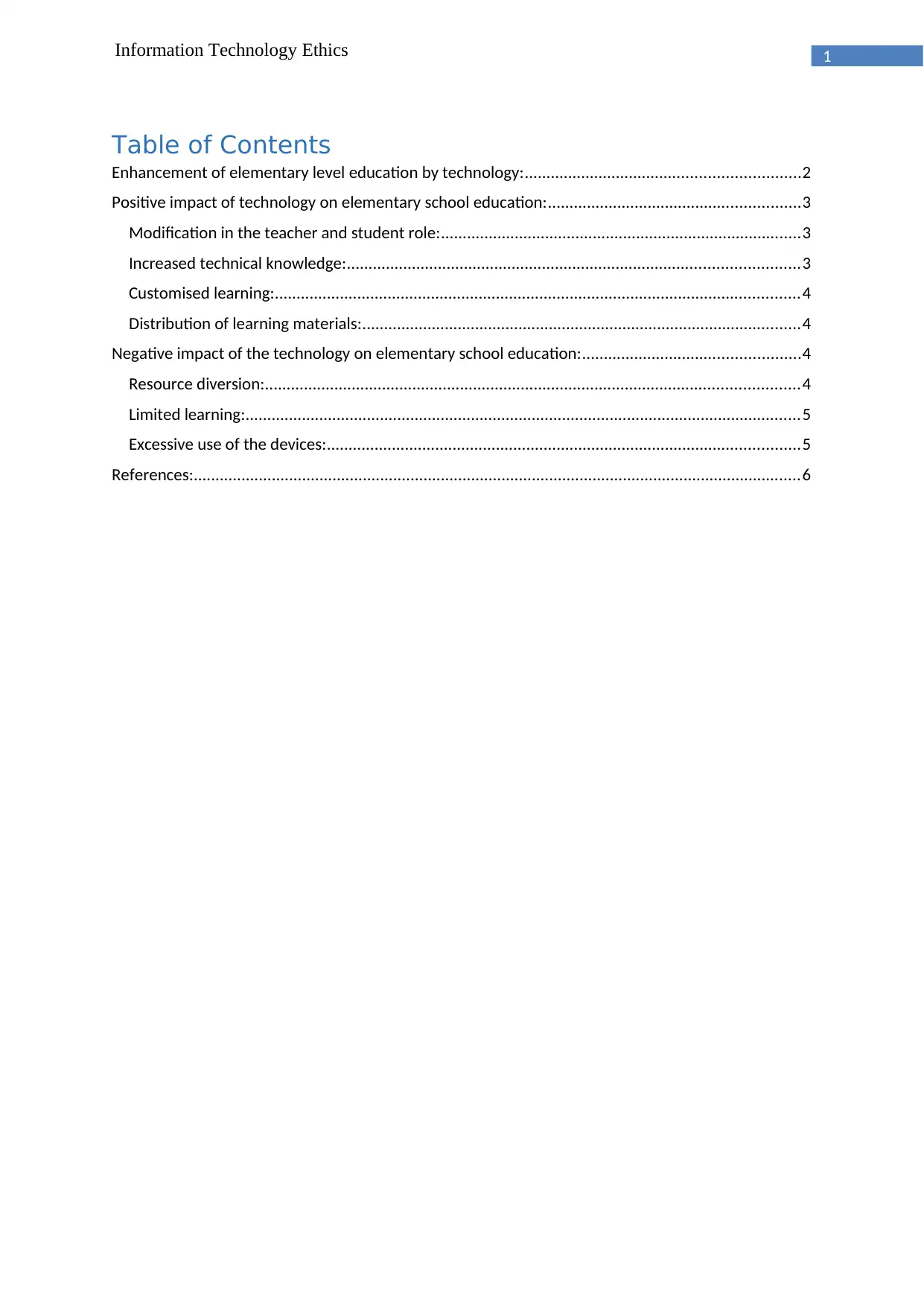
Table of Contents
Enhancement of elementary level education by technology:...............................................................2
Positive impact of technology on elementary school education:..........................................................3
Modification in the teacher and student role:...................................................................................3
Increased technical knowledge:........................................................................................................3
Customised learning:.........................................................................................................................4
Distribution of learning materials:.....................................................................................................4
Negative impact of the technology on elementary school education:..................................................4
Resource diversion:...........................................................................................................................4
Limited learning:................................................................................................................................5
Excessive use of the devices:.............................................................................................................5
References:............................................................................................................................................6
Document Page
2Information Technology Ethics
Enhancement of elementary level education by technology:
The advancement of the technology has not only influenced the day to day activities,
it has enhanced activities across various sectors. Among these, one sector that has already
been benefited with the introduction of the technology, is the educational sector and the
sector is full of scope as far as the enhancement of the quality of the teaching and learning is
concerned (Berg et al., 2015). The education provided in the elementary school should focus
on the fun based learning as the students in the elementary school loves to learn through
playing. It will improve the cognitive, emotional, physical, sensory, reflective,
communication and social developments of the student.
The problem with the traditional educational model is that it is not always effective
for fun based learning. Students these days loves to use technology. Additionally, with the
help of the technology, it is possible for the teacher to engage more with the students as the
technology attracts them more than the traditional approach of the teaching (Ertmer et al.,
2015). Although the traditional educational system has been for a long time, before the
technology has been introduced in the educational sector, the technology based learning has
been started to gain attention and it is also being loved by the student as well as the teaching
community. As part of the technology based learning many online games, storytelling apps,
and online tools has been introduced in the curriculum and it has been successful in attracting
students, much more than the traditional one (Sandholtz , 2014). Another factor that makes
the technology based learning apart is the concept of one to one learning. With the help of the
technical devices like tablets, desktop computer, smart phones, it is possible to design the
personalised learning for effective learning.
Nowadays, the technological devices are very common in the households. There are
many online tools that has been introduced in the classroom for better communication
Document Page
3Information Technology Ethics
between the teacher and student. Earlier, when there were no such tools, it was quite difficult
for the students to connect with the teachers outside the classroom (Brown & Warschauer ,
2014). Now, it is possible, not only for the students, but for the parents as well to
communicate with the teachers anywhere anytime regarding the education of the children.
This makes it possible for the parents to assess the learning of the children and provide
guidance accordingly to make it sure that the children is learning properly.
To summarise, it can be said that the introduction of the technology has not only made
the teaching and learning effective for the teacher and students , it has enhanced the
educational system in the elementary school (Evertson , 2015).
Positive impact of technology on elementary school education:
Modification in the teacher and student role:
Whenever, the students are taking the help of the technology for communicating with
the teachers, it demands active participation of the students. However in the traditional
educational system, the communication, largely being one way, does not attract the student
much. However, the technology makes it possible for the students to decide how the
information is obtained, manipulated and displayed. The role of the teachers has also been
changed as in the modern technology powered education, they are no longer the centre of the
communication providing information, rather they facilitate , set project , provides guidelines
and resources across several groups of students (Uluyol & Şahin, 2016). It is possible for the
teachers to provide suggestion and monitor students’ activities, even when there is large
number of students or groups involved.
Increased technical knowledge:
The student, when introduced to the technology at the elementary level, develops
interest for the technology which will help them to learn advanced technology in the future as
tabler-icon-diamond-filled.svg

Paraphrase This Document

Need a fresh take? Get an instant paraphrase of this document with our AI Paraphraser
Document Page
4Information Technology Ethics
required in the workplace. The ability to use technology in the elementary level will train the
students to take technology based projects whenever required for higher studies (Turkle ,
2017).
Customised learning:
It is not possible for every students in the classroom to follow same learning style as
different student learn differently. Some students pick up the concept much faster than others,
while some needs time. Now it is not possible for the teacher to give attention to each and
every student within the short duration of the class (Shamir-Inbal & Blau , 2016). However,
with the help of the online learning, the students will be able to learn at their own pace. It will
ensure that the students are learning properly as per their ability.
Distribution of learning materials:
Additionally the teachers will be able to circulate information about the study
materials, home works, assignment, class tests among the students much more conveniently.
All that is need is to create a common portal for the students where the information will be
circulated. This information will be even available for the parents to access and assist the
students in preparation of the homework (Blackwell, Lauricella & Wartella , 2014).
Negative impact of the technology on elementary school education:
Resource diversion:
The cost of introducing smart learning in the classroom is quite expensive. In order to
make up for the cost, the school authority might eliminate some valuable program like music
or arts which is also very necessary for ensuring overall development of the
students(DePaolis & Williford , 2015). Now in order to get accustomed with the technology
the teacher needs training. The time taken for training the teachers will actually take the time
Document Page
5Information Technology Ethics
which the teachers would be able to devote in teaching the students in their respective
subjects.
Limited learning:
One thing should be noted, although students are much more interested in learning
through technology, interest or enthusiasm does not necessarily converts to learning. While
embracing the digital learning, the following factors should be taken into consideration
(Archer et al., 2014):
Electronics texts are less interactive than traditional printed textbook , thus limiting
the learning in some case
Electronic text are harder to browse
The experience of the learning depends on the quality of the device as well as internet
connection , thus the learning is not same for all like in the traditional teaching and
learning
Excessive use of the devices:
Although the devices like tablets and computers are helpful for learning purpose, the
students can easily get distracted by these devices (Cochran-Smith, 2015). As the paper is
about the students of the elementary level, one of the main problem about their education is
the lack of attention. In addition to that, they are much more interested in cartoon, games and
staff like that. Now withy those devices, students can easily get access to these things which
will surely distract them from learning their classroom course.
Document Page
6Information Technology Ethics
References:
Archer, K., Savage, R., Sanghera-Sidhu, S., Wood, E., Gottardo, A., & Chen, V. (2014).
Examining the effectiveness of technology use in classrooms: A tertiary meta-
analysis. Computers & Education, 78, 140-149.
Berg, S., Benz, C. R., Lasley, T. J., & Daniel Raisch, C. (2015). Exemplary technology use in
elementary classrooms. Journal of Research on Computing in Education, 31(2), 111-
122.
Blackwell, C. K., Lauricella, A. R., & Wartella, E. (2014). Factors influencing digital
technology use in early childhood education. Computers & Education, 77, 82-90.
Brown, D., & Warschauer, M. (2014). From the university to the elementary classroom:
Students’ experiences in learning to integrate technology in instruction. Journal of
Technology and Teacher Education, 14(3), 599-621.
Cochran-Smith, M. (2015). Word processing and writing in elementary classrooms: A critical
review of related literature. Review of Educational Research, 61(1), 107-155.
DePaolis, K., & Williford, A. (2015, June). The nature and prevalence of cyber victimization
among elementary school children. In Child & Youth Care Forum (Vol. 44, No. 3, pp.
377-393). Springer US.
Ertmer, P. A., Paul, A., Molly, L., Eva, R., & Denise, W. (2015). Examining teachers’ beliefs
about the role of technology in the elementary classroom. Journal of research on
Computing in Education, 32(1), 54-72.
Evertson, C. M. (2015). Classroom management for elementary teachers. Allyn & Bacon, A
Division of Simon & Schuster, Inc., 160 Gould Street, Needham Heights, MA 02194..
tabler-icon-diamond-filled.svg

Paraphrase This Document

Need a fresh take? Get an instant paraphrase of this document with our AI Paraphraser
Document Page
7Information Technology Ethics
Sandholtz, J. H. (2014). Teaching with technology: Creating student-centered classrooms.
Teachers College Press, Teachers College, Columbia University, 1234 Amsterdam
Ave., New York, NY 10027.
Shamir-Inbal, T., & Blau, I. (2016). Developing digital wisdom by students and teachers: the
impact of integrating tablet computers on learning and pedagogy in an elementary
school. Journal of Educational Computing Research, 54(7), 967-996.
Turkle, S. (2017). How computers change the way we think. In Law and Society Approaches
to Cyberspace (pp. 3-7). Routledge.
Uluyol, Ç., & Şahin, S. (2016). Elementary school teachers' ICT use in the classroom and
their motivators for using ICT. British Journal of Educational Technology, 47(1), 65-
75.
chevron_up_icon
1 out of 8
circle_padding
hide_on_mobile
zoom_out_icon
[object Object]