Ethics Discussions: Exploring Ethical Theories and Case Studies

Verified

Added on  2022/08/12

|5
|1266
|30
Discussion Board Post
AI Summary
This assignment presents a series of discussions on ethical theories and their applications. The discussions cover a range of topics, including Sandel's views on justice, freedom, and virtue; Plato's allegory of the cave and its implications for education; Kant's deontological ethics and its contrast with utilitarianism, illustrated by the bombing of Japan; and the ethical considerations in the Chloe Wilson case and social responsibility. The student explores different philosophical perspectives, analyzes arguments, and applies ethical principles to real-world scenarios, providing a comprehensive overview of key concepts in moral philosophy.
Document Page
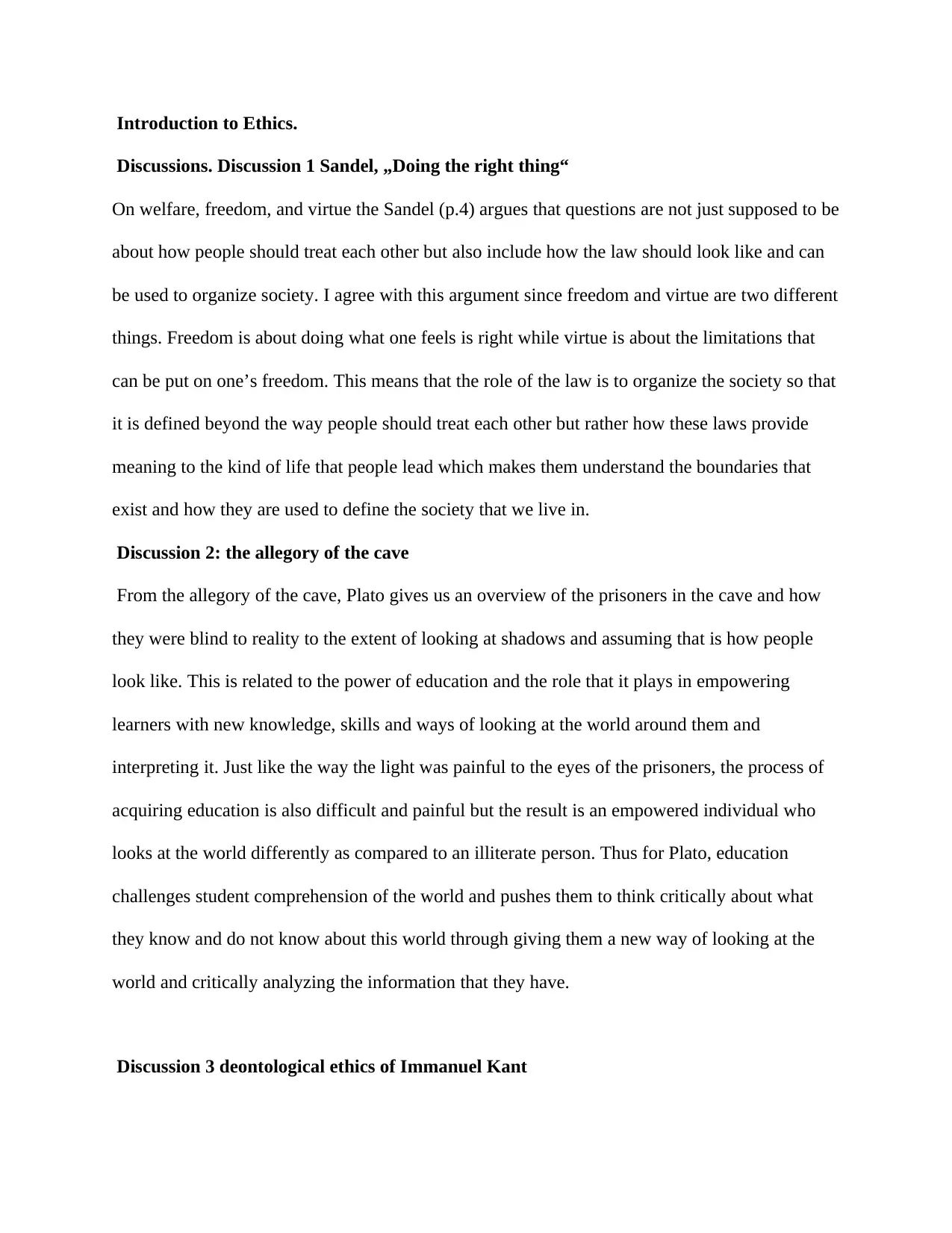
Introduction to Ethics.
Discussions. Discussion 1 Sandel, „Doing the right thing“
On welfare, freedom, and virtue the Sandel (p.4) argues that questions are not just supposed to be
about how people should treat each other but also include how the law should look like and can
be used to organize society. I agree with this argument since freedom and virtue are two different
things. Freedom is about doing what one feels is right while virtue is about the limitations that
can be put on one’s freedom. This means that the role of the law is to organize the society so that
it is defined beyond the way people should treat each other but rather how these laws provide
meaning to the kind of life that people lead which makes them understand the boundaries that
exist and how they are used to define the society that we live in.
Discussion 2: the allegory of the cave
From the allegory of the cave, Plato gives us an overview of the prisoners in the cave and how
they were blind to reality to the extent of looking at shadows and assuming that is how people
look like. This is related to the power of education and the role that it plays in empowering
learners with new knowledge, skills and ways of looking at the world around them and
interpreting it. Just like the way the light was painful to the eyes of the prisoners, the process of
acquiring education is also difficult and painful but the result is an empowered individual who
looks at the world differently as compared to an illiterate person. Thus for Plato, education
challenges student comprehension of the world and pushes them to think critically about what
they know and do not know about this world through giving them a new way of looking at the
world and critically analyzing the information that they have.
Discussion 3 deontological ethics of Immanuel Kant
tabler-icon-diamond-filled.svg

Paraphrase This Document

Need a fresh take? Get an instant paraphrase of this document with our AI Paraphraser
Document Page
According to Holyoak & Powell (2016) suggests that Kant rejected Utilitarianism because the
moral philosophy that he developed is based on the logic of duty or deontology. This is different
from utilitarianism that seemed to favor the use of an act over duty. This makes utilitarianism
more pragmatic and only focused on maximizing the pleasures that one is supposed to derive
from an action. This means that for utilitarian’s the circumstances keep on changing so that the
utilities can be maximized which ignores the permanent objective values of duty that are
supposed to be resected no matter what (Bowden, 2019). In this case, Kant’s philosophy is a
move away from situational thinking to a way of action that is duty-based regardless of the
circumstances that exist (Staveren, 2017). To justify his opposition to utilitarianism, he proposed
three maxims that must be obeyed no matter what circumstances. Maxim one requires one to act
accordingly in a way that makes the maxim a universal law. Which means that one is supposed
to act in the same way that they would have acted even if the situation changed. The second
maxim is to act in a way that treats humanity not as a means to an end, but always at the same
time as an end. This means that personhood is supposed to be used as the highest value that
needs to be upheld always. The third maxim is the idea of the will of every rational being as a
universally legislating will. Meaning that human being has free will that allows them to act
accordingly no matter the situation. These three maxims do not work in line with the utilitarian
approach that is for maximum pleasure.
Discussion 5: Bombing of Japan
Seligmann (2008) presents different arguments on the bombing of Hiroshima and Nagasaki but I
believe the argument that the bombing stopped war is the greatest since even if many people died
at once, more lives were saved from future deaths. This is based on the utilitarian approach
which focusses on the utilities that the bombing of the two cities. Here, utilities were maximized
Document Page
since the innocent lives of the people that died were used as sacrifices for the greater good. Thus
I support the argument that the bombing ended the war since Japan generals were no willing to
surrender unconditionally. However, the argument that Japan could have surrendered even
without the bombing is the weaker argument since the time that it could have taken to end the
war could not be determined. From the article, it means that the war could have waged on as the
other powers wait for Japan to surrender.
Discussion 6: Chloe Wilson Case study
Deontology ethics requires one to observe the moral obligation that they are charged with
regardless of the circumstances that exist (Holyoak & Powell, 2016). This means that Ben should
move away from situational thinking and rather use the permanent value of duty that is supposed
to be respected by giving her the score that she was supposed to receive based on the fact that
she left a burden of the assignment to him. Since there is a justification for giving some students
A’s while others B’s then the same moral obligation that was used to give the above grades
should be applied in giving Natalie the grade that she deserves regardless of the outcome.
Discussion 7: social responsibility
The argument of social responsibility can be argued from different standpoints that people look
at it. Many have argued that the corporation exists for profits only and should not be bothered by
society. However, social responsibility is something different as opposed to the Friedman (2009)
thesis which suggests that businesses are only supposed to engage in activities that maximize
profits as long as they are operating within the limits. However, despite operating within the
limits, there are harms towards the society that cannot be avoided and cannot be accounted for
since they exist as indirect. In this case, the role of social responsibility is to deal with these
business harms and roles that the business is supposed to play. Therefore, to argue against social
Document Page
responsibility is not the best way since it leads most businesses to not caring about the needs of
society.
tabler-icon-diamond-filled.svg

Paraphrase This Document

Need a fresh take? Get an instant paraphrase of this document with our AI Paraphraser
Document Page
References
Bowden, P. (2019). In Defense of Utilitarianism. SSRN Electronic Journal, 5(3).
Friedman, M. (2009). The Social Responsibility of Business is to Increase Its Profits. In N. E.
Tom L. Beauchamp, In Ethical Theory and Business. New Jersey: Pearson.
Holyoak, K. J., & Powell, D. (2016). Deontological Coherence: A Framework for Commonsense
Moral Reasoning. Psychological Bulletin, 42(11), 1179–1203.
Seligmann, M. (2008, August). The alternatives to bombing Hiroshima were not morally superio.
The Guardian.
Staveren, I. v. (2017). Beyond Utilitarianism and Deontology: Ethics in Economics. Review of
Political Economy, 19(1), 21-35.
chevron_up_icon
1 out of 5
circle_padding
hide_on_mobile
zoom_out_icon
[object Object]