Development and Social Change: Ethnicity and Racial Conflict Analysis
VerifiedAdded on 2023/06/11
|16
|4774
|470
Essay
AI Summary
This essay explores the significant impediments to development in poor countries caused by ethnic and racial conflicts. It examines how globalization and trans-nationalism contribute to these conflicts, particularly in developing nations where the protection of religious, racial, and ethnic groups is prioritized. The discussion covers various perspectives on the impacts of race and ethnicity conflicts, including internalized, interpersonal, and systematic racism, using case studies from Australia and Africa to illustrate these points. The essay highlights how racial discrimination affects mental health, access to resources, and overall societal well-being, ultimately hindering economic development and social progress. It concludes that addressing racial and ethnic conflicts is crucial for fostering unity and promoting sustainable development in these nations, which is often undermined by the biases and inequalities stemming from such conflicts. Desklib offers similar solved assignments for students.
Running head: DEVELOPMENT AND SOCIAL CHANGE
Development and Social Change
Name of the Student:
Name of the University:
Author Note:
Development and Social Change
Name of the Student:
Name of the University:
Author Note:

Paraphrase This Document
Need a fresh take? Get an instant paraphrase of this document with our AI Paraphraser
1
DEVELOPMENT AND SOCIAL CHANGE
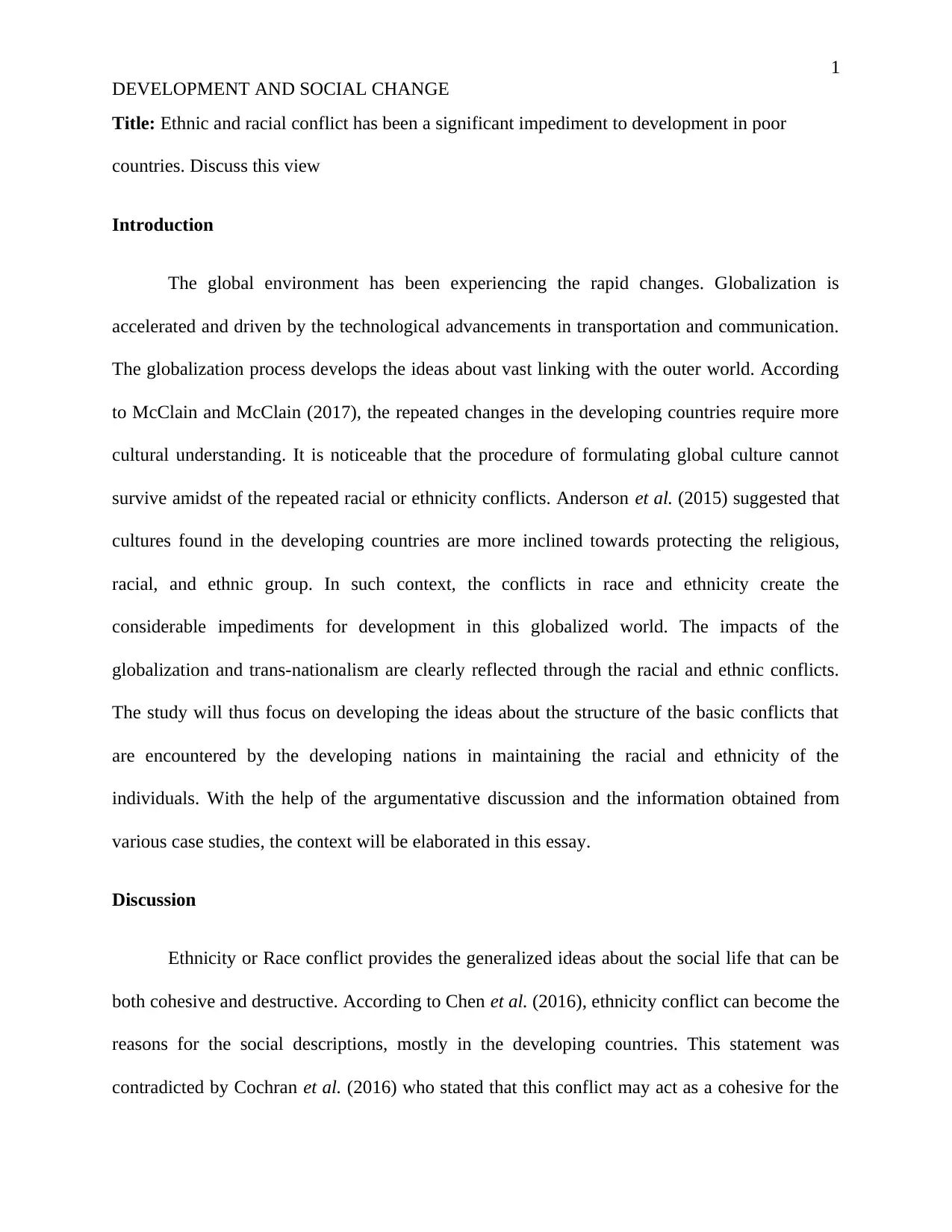
Title: Ethnic and racial conflict has been a significant impediment to development in poor
countries. Discuss this view
Introduction
The global environment has been experiencing the rapid changes. Globalization is
accelerated and driven by the technological advancements in transportation and communication.
The globalization process develops the ideas about vast linking with the outer world. According
to McClain and McClain (2017), the repeated changes in the developing countries require more
cultural understanding. It is noticeable that the procedure of formulating global culture cannot
survive amidst of the repeated racial or ethnicity conflicts. Anderson et al. (2015) suggested that
cultures found in the developing countries are more inclined towards protecting the religious,
racial, and ethnic group. In such context, the conflicts in race and ethnicity create the
considerable impediments for development in this globalized world. The impacts of the
globalization and trans-nationalism are clearly reflected through the racial and ethnic conflicts.
The study will thus focus on developing the ideas about the structure of the basic conflicts that
are encountered by the developing nations in maintaining the racial and ethnicity of the
individuals. With the help of the argumentative discussion and the information obtained from
various case studies, the context will be elaborated in this essay.
Discussion
Ethnicity or Race conflict provides the generalized ideas about the social life that can be
both cohesive and destructive. According to Chen et al. (2016), ethnicity conflict can become the
reasons for the social descriptions, mostly in the developing countries. This statement was
contradicted by Cochran et al. (2016) who stated that this conflict may act as a cohesive for the
DEVELOPMENT AND SOCIAL CHANGE
Title: Ethnic and racial conflict has been a significant impediment to development in poor
countries. Discuss this view
Introduction
The global environment has been experiencing the rapid changes. Globalization is
accelerated and driven by the technological advancements in transportation and communication.
The globalization process develops the ideas about vast linking with the outer world. According
to McClain and McClain (2017), the repeated changes in the developing countries require more
cultural understanding. It is noticeable that the procedure of formulating global culture cannot
survive amidst of the repeated racial or ethnicity conflicts. Anderson et al. (2015) suggested that
cultures found in the developing countries are more inclined towards protecting the religious,
racial, and ethnic group. In such context, the conflicts in race and ethnicity create the
considerable impediments for development in this globalized world. The impacts of the
globalization and trans-nationalism are clearly reflected through the racial and ethnic conflicts.
The study will thus focus on developing the ideas about the structure of the basic conflicts that
are encountered by the developing nations in maintaining the racial and ethnicity of the
individuals. With the help of the argumentative discussion and the information obtained from
various case studies, the context will be elaborated in this essay.
Discussion
Ethnicity or Race conflict provides the generalized ideas about the social life that can be
both cohesive and destructive. According to Chen et al. (2016), ethnicity conflict can become the
reasons for the social descriptions, mostly in the developing countries. This statement was
contradicted by Cochran et al. (2016) who stated that this conflict may act as a cohesive for the
2
DEVELOPMENT AND SOCIAL CHANGE
others. The sociologists have discussed numerous perspectives in defining the impacts of the race
and ethnicity conflicts over the past 50 years. It has even emphasized on the diverse aspects of
the integrative and destructive nature of the social process. In many cases, it has been observed
that the functional theorists tend to develop insights regarding the negative forces whereas the
conflict theorists created the positive views regarding this conflicting scenario. This conflict is
presented as a challenge for the status quo that generally brings the fundamental social change.
On the other hand, Delgado and Stefancic (2017) described that development of any nation
depends on the social changes and improvement of the perceptive values of the surroundings. It
is to be indicated that the understanding of the ethnicity is the necessary components to diminish
the conflicts emerge due to the racial and ethnic differences.
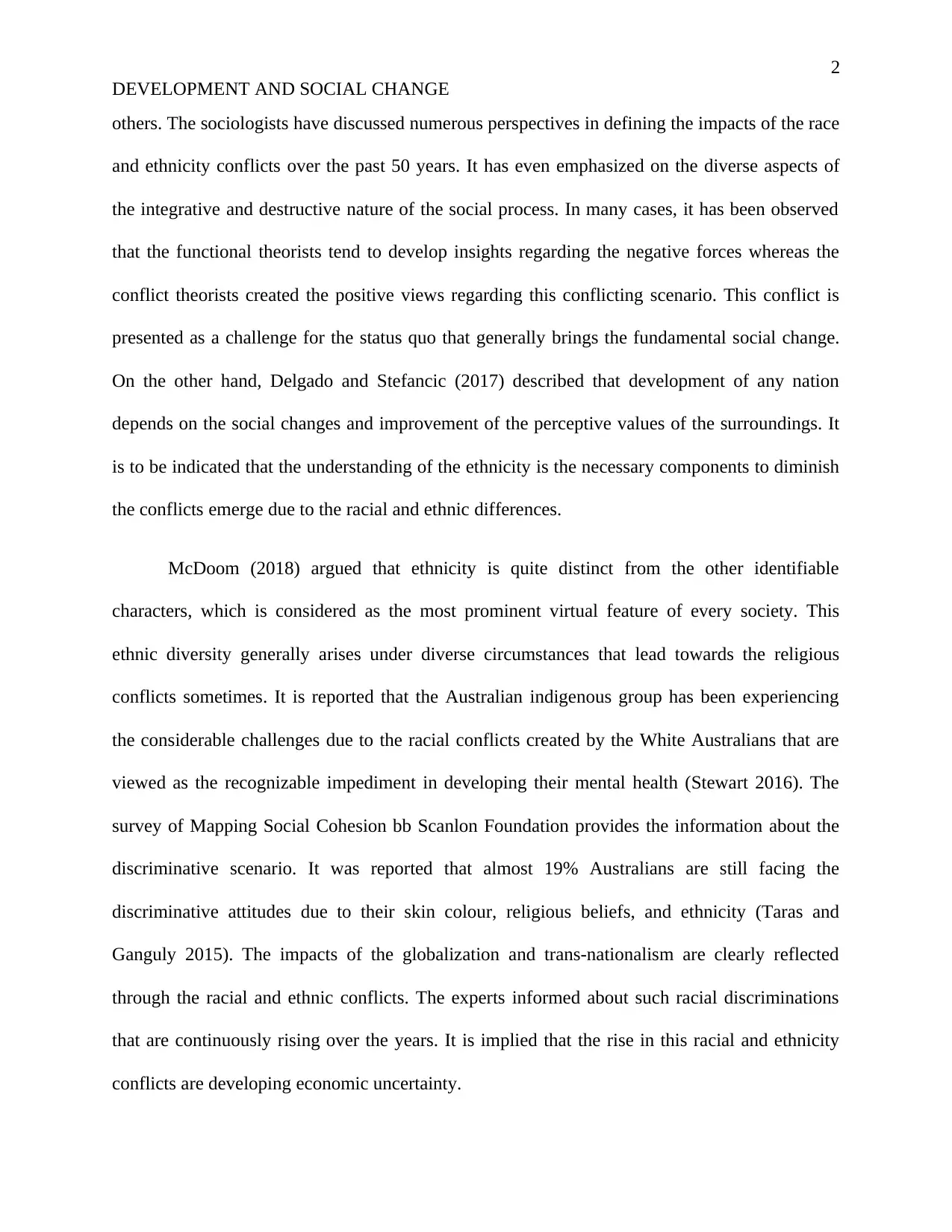
McDoom (2018) argued that ethnicity is quite distinct from the other identifiable
characters, which is considered as the most prominent virtual feature of every society. This
ethnic diversity generally arises under diverse circumstances that lead towards the religious
conflicts sometimes. It is reported that the Australian indigenous group has been experiencing
the considerable challenges due to the racial conflicts created by the White Australians that are
viewed as the recognizable impediment in developing their mental health (Stewart 2016). The
survey of Mapping Social Cohesion bb Scanlon Foundation provides the information about the
discriminative scenario. It was reported that almost 19% Australians are still facing the
discriminative attitudes due to their skin colour, religious beliefs, and ethnicity (Taras and
Ganguly 2015). The impacts of the globalization and trans-nationalism are clearly reflected
through the racial and ethnic conflicts. The experts informed about such racial discriminations
that are continuously rising over the years. It is implied that the rise in this racial and ethnicity
conflicts are developing economic uncertainty.
DEVELOPMENT AND SOCIAL CHANGE
others. The sociologists have discussed numerous perspectives in defining the impacts of the race
and ethnicity conflicts over the past 50 years. It has even emphasized on the diverse aspects of
the integrative and destructive nature of the social process. In many cases, it has been observed
that the functional theorists tend to develop insights regarding the negative forces whereas the
conflict theorists created the positive views regarding this conflicting scenario. This conflict is
presented as a challenge for the status quo that generally brings the fundamental social change.
On the other hand, Delgado and Stefancic (2017) described that development of any nation
depends on the social changes and improvement of the perceptive values of the surroundings. It
is to be indicated that the understanding of the ethnicity is the necessary components to diminish
the conflicts emerge due to the racial and ethnic differences.
McDoom (2018) argued that ethnicity is quite distinct from the other identifiable
characters, which is considered as the most prominent virtual feature of every society. This
ethnic diversity generally arises under diverse circumstances that lead towards the religious
conflicts sometimes. It is reported that the Australian indigenous group has been experiencing
the considerable challenges due to the racial conflicts created by the White Australians that are
viewed as the recognizable impediment in developing their mental health (Stewart 2016). The
survey of Mapping Social Cohesion bb Scanlon Foundation provides the information about the
discriminative scenario. It was reported that almost 19% Australians are still facing the
discriminative attitudes due to their skin colour, religious beliefs, and ethnicity (Taras and
Ganguly 2015). The impacts of the globalization and trans-nationalism are clearly reflected
through the racial and ethnic conflicts. The experts informed about such racial discriminations
that are continuously rising over the years. It is implied that the rise in this racial and ethnicity
conflicts are developing economic uncertainty.
⊘ This is a preview!⊘
Do you want full access?
Subscribe today to unlock all pages.

Trusted by 1+ million students worldwide
3
DEVELOPMENT AND SOCIAL CHANGE
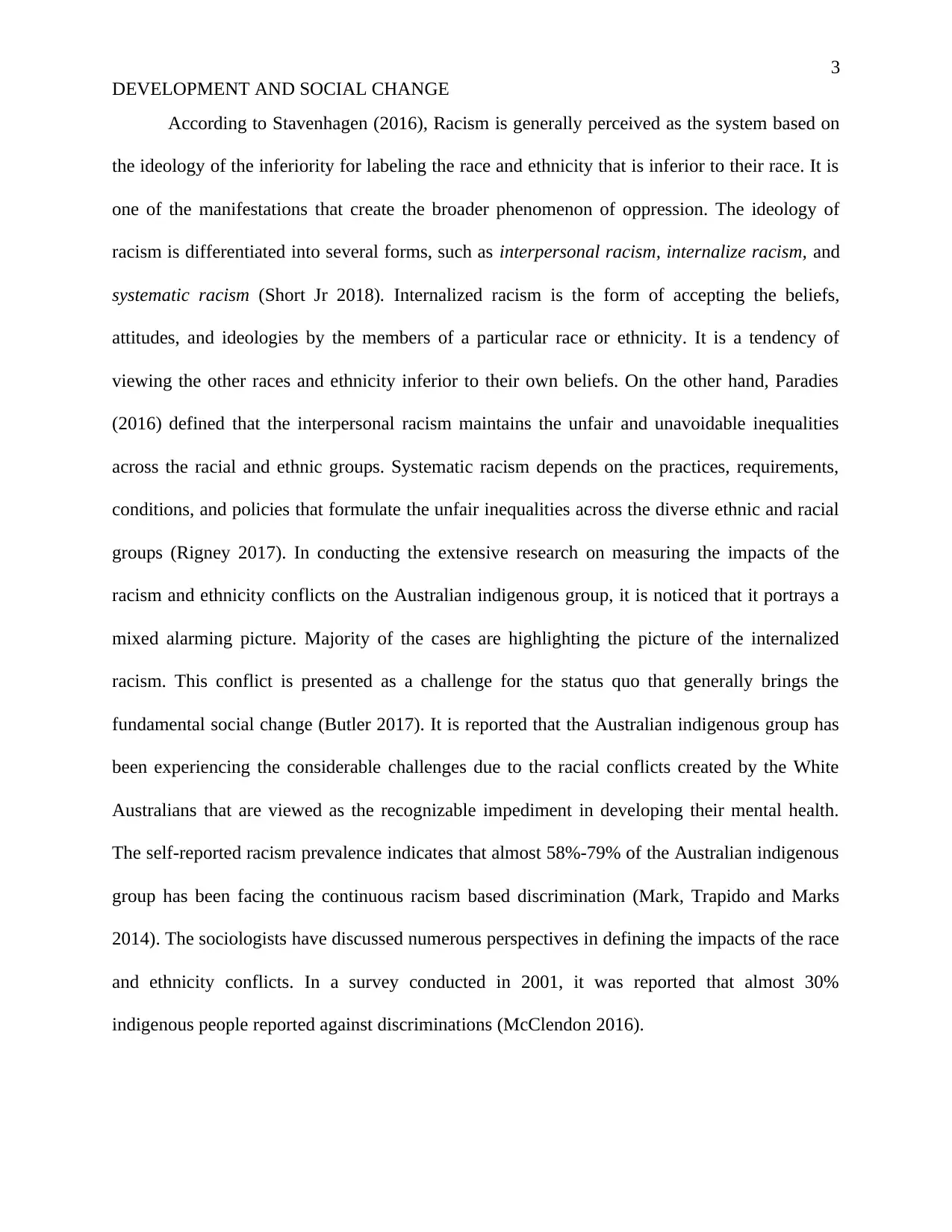
According to Stavenhagen (2016), Racism is generally perceived as the system based on
the ideology of the inferiority for labeling the race and ethnicity that is inferior to their race. It is
one of the manifestations that create the broader phenomenon of oppression. The ideology of
racism is differentiated into several forms, such as interpersonal racism, internalize racism, and
systematic racism (Short Jr 2018). Internalized racism is the form of accepting the beliefs,
attitudes, and ideologies by the members of a particular race or ethnicity. It is a tendency of
viewing the other races and ethnicity inferior to their own beliefs. On the other hand, Paradies
(2016) defined that the interpersonal racism maintains the unfair and unavoidable inequalities
across the racial and ethnic groups. Systematic racism depends on the practices, requirements,
conditions, and policies that formulate the unfair inequalities across the diverse ethnic and racial
groups (Rigney 2017). In conducting the extensive research on measuring the impacts of the
racism and ethnicity conflicts on the Australian indigenous group, it is noticed that it portrays a
mixed alarming picture. Majority of the cases are highlighting the picture of the internalized
racism. This conflict is presented as a challenge for the status quo that generally brings the
fundamental social change (Butler 2017). It is reported that the Australian indigenous group has
been experiencing the considerable challenges due to the racial conflicts created by the White
Australians that are viewed as the recognizable impediment in developing their mental health.
The self-reported racism prevalence indicates that almost 58%-79% of the Australian indigenous
group has been facing the continuous racism based discrimination (Mark, Trapido and Marks
2014). The sociologists have discussed numerous perspectives in defining the impacts of the race
and ethnicity conflicts. In a survey conducted in 2001, it was reported that almost 30%
indigenous people reported against discriminations (McClendon 2016).
DEVELOPMENT AND SOCIAL CHANGE
According to Stavenhagen (2016), Racism is generally perceived as the system based on
the ideology of the inferiority for labeling the race and ethnicity that is inferior to their race. It is
one of the manifestations that create the broader phenomenon of oppression. The ideology of
racism is differentiated into several forms, such as interpersonal racism, internalize racism, and
systematic racism (Short Jr 2018). Internalized racism is the form of accepting the beliefs,
attitudes, and ideologies by the members of a particular race or ethnicity. It is a tendency of
viewing the other races and ethnicity inferior to their own beliefs. On the other hand, Paradies
(2016) defined that the interpersonal racism maintains the unfair and unavoidable inequalities
across the racial and ethnic groups. Systematic racism depends on the practices, requirements,
conditions, and policies that formulate the unfair inequalities across the diverse ethnic and racial
groups (Rigney 2017). In conducting the extensive research on measuring the impacts of the
racism and ethnicity conflicts on the Australian indigenous group, it is noticed that it portrays a
mixed alarming picture. Majority of the cases are highlighting the picture of the internalized
racism. This conflict is presented as a challenge for the status quo that generally brings the
fundamental social change (Butler 2017). It is reported that the Australian indigenous group has
been experiencing the considerable challenges due to the racial conflicts created by the White
Australians that are viewed as the recognizable impediment in developing their mental health.
The self-reported racism prevalence indicates that almost 58%-79% of the Australian indigenous
group has been facing the continuous racism based discrimination (Mark, Trapido and Marks
2014). The sociologists have discussed numerous perspectives in defining the impacts of the race
and ethnicity conflicts. In a survey conducted in 2001, it was reported that almost 30%
indigenous people reported against discriminations (McClendon 2016).
Paraphrase This Document
Need a fresh take? Get an instant paraphrase of this document with our AI Paraphraser
4
DEVELOPMENT AND SOCIAL CHANGE
It is described that this racial conflicts identified in Australia affects the development of
the mental health of the indigenous people in a much significant way. The pathways from the
racism to the ill-health of indigenous people often include the various aspects. It is reported that
due to the racial differences, the indigenous group are prevented from gaining access to the
societal resources that are required for the improvements of their health (Adhikari 2017). It may
include many aspects, such as employment, housing, medical care, education, and societal
support. This discrimination or the conflicts against race has been increasing the exposure to the
risks factors associated with the ill-health of this group of people. McClain and McClain (2017)
defined that the direct impacts created due to the racial discriminations are leading towards the
racially motivated physical assault. This motif is given rise to the riskier scenario for the health
of the indigenous group in Australia. The adverse effects of the continuous racial conflicts are
increasing the negative emotions and stress that contribute much significantly towards mental ill-
health. The extensive research on this factor provides the insights that the people belong to the
indigenous group has the less access to the required medical care than the people from the non-
indigenous group (Anderson et al. 2015). This discrimination is observed all across the nation.
Another case example describes the disastrous effects of the racism conflicts in a
developing country like Africa. It is noticeable that despite living peacefully in the
neighborhood, the Africans face the ethnicity conflicts in many segments. Many instances are
highlighting the destructive scenario for the South Africans that emerged due to the racial and
ethnicity conflicts (Chen et al. 2016). The violent scenario created due to such conflicts was one
of the probable reasons for the collapse of Yugoslavia after excluding from the Soviet Union.
The complex dynamics of the racial and ethnic conflicts are viewed in this case scenario of the
South Africa and Yugoslavia. It is noticeable that the extensive research on the racial and
DEVELOPMENT AND SOCIAL CHANGE
It is described that this racial conflicts identified in Australia affects the development of
the mental health of the indigenous people in a much significant way. The pathways from the
racism to the ill-health of indigenous people often include the various aspects. It is reported that
due to the racial differences, the indigenous group are prevented from gaining access to the
societal resources that are required for the improvements of their health (Adhikari 2017). It may
include many aspects, such as employment, housing, medical care, education, and societal
support. This discrimination or the conflicts against race has been increasing the exposure to the
risks factors associated with the ill-health of this group of people. McClain and McClain (2017)
defined that the direct impacts created due to the racial discriminations are leading towards the
racially motivated physical assault. This motif is given rise to the riskier scenario for the health
of the indigenous group in Australia. The adverse effects of the continuous racial conflicts are
increasing the negative emotions and stress that contribute much significantly towards mental ill-
health. The extensive research on this factor provides the insights that the people belong to the
indigenous group has the less access to the required medical care than the people from the non-
indigenous group (Anderson et al. 2015). This discrimination is observed all across the nation.
Another case example describes the disastrous effects of the racism conflicts in a
developing country like Africa. It is noticeable that despite living peacefully in the
neighborhood, the Africans face the ethnicity conflicts in many segments. Many instances are
highlighting the destructive scenario for the South Africans that emerged due to the racial and
ethnicity conflicts (Chen et al. 2016). The violent scenario created due to such conflicts was one
of the probable reasons for the collapse of Yugoslavia after excluding from the Soviet Union.
The complex dynamics of the racial and ethnic conflicts are viewed in this case scenario of the
South Africa and Yugoslavia. It is noticeable that the extensive research on the racial and
5
DEVELOPMENT AND SOCIAL CHANGE
ethnicity divisions have shifted towards understanding the process of ethno-genesis, which is the
perpetuation and construction of the ethnic boundaries. It is already stated that the conflict is
conceptualized as a challenge for the status quo that generally brings the fundamental social
change. The impacts of the globalization and trans-nationalism are clearly reflected through the
racial and ethnic conflicts.
The racial minority groups have been feeling the political and economic disadvantages
that are persisting across the globe. It is pointed out that the inequality and such racial conflicts
are affecting the minority population more specifically. After the completion of the colonialism
in Africa, there was the significant clamor of nationalism was observed in this country. Cochran
et al. (2016) stated that there was the significant rise visible in the alignment of the ethnic
nationalities all across the country. It is identified that the emerging racial conflicts within a state
tend to spread the neighboring power that protects the interests of the minority group. In Kenya,
the people suffered thee economic crisis that was formulated due to the racial conflicts. In
developing countries, the development of the human capitals and important infrastructure is the
base of economic development. The emergence of the racial or ethnicity complexity can prevent
such practices and affect the views towards development. The economic development is
generally based on the policies that aim to improve the human lives. It has even emphasized on
the diverse aspects of the integrative and destructive nature of the social process (Delgado and
Stefancic 2017). In many cases, it has been observed that the functional theorists tend to develop
insights regarding the negative forces whereas the conflict theorists created the positive views
regarding this conflicting scenario. The welfare of the human beings is thus necessary for
making such improvements towards development.
DEVELOPMENT AND SOCIAL CHANGE
ethnicity divisions have shifted towards understanding the process of ethno-genesis, which is the
perpetuation and construction of the ethnic boundaries. It is already stated that the conflict is
conceptualized as a challenge for the status quo that generally brings the fundamental social
change. The impacts of the globalization and trans-nationalism are clearly reflected through the
racial and ethnic conflicts.
The racial minority groups have been feeling the political and economic disadvantages
that are persisting across the globe. It is pointed out that the inequality and such racial conflicts
are affecting the minority population more specifically. After the completion of the colonialism
in Africa, there was the significant clamor of nationalism was observed in this country. Cochran
et al. (2016) stated that there was the significant rise visible in the alignment of the ethnic
nationalities all across the country. It is identified that the emerging racial conflicts within a state
tend to spread the neighboring power that protects the interests of the minority group. In Kenya,
the people suffered thee economic crisis that was formulated due to the racial conflicts. In
developing countries, the development of the human capitals and important infrastructure is the
base of economic development. The emergence of the racial or ethnicity complexity can prevent
such practices and affect the views towards development. The economic development is
generally based on the policies that aim to improve the human lives. It has even emphasized on
the diverse aspects of the integrative and destructive nature of the social process (Delgado and
Stefancic 2017). In many cases, it has been observed that the functional theorists tend to develop
insights regarding the negative forces whereas the conflict theorists created the positive views
regarding this conflicting scenario. The welfare of the human beings is thus necessary for
making such improvements towards development.
⊘ This is a preview!⊘
Do you want full access?
Subscribe today to unlock all pages.
Trusted by 1+ million students worldwide
6
DEVELOPMENT AND SOCIAL CHANGE
The instances gathered from the diverse perspectives of the scholars create the insightful
ideas about the impact of racial conflicts and ethnic discrimination. According to McDoom
(2018), the emergence of the ethnic diversity generally arises under diverse circumstances that
lead towards the religious conflicts sometimes. In many cases, it has been observed that the
functional theorists tend to develop insights regarding the negative forces whereas the conflict
theorists created the positive views regarding this conflicting scenario. It is noticeable that the
procedure of formulating global culture cannot survive amidst of the repeated racial or ethnicity
conflicts (Stewart 2016). The developing countries focus on developing their human capital in
the most specific way to respond back to the global changes. However, the conflicting scenario
noticeable in the diverse racial group affects the unity that generally leads towards the
destruction. Moreover, this biasness even affects the mental health of the people who belong to
the minor racial group. The case studies also reflect the adverse effects formed due to the racial
and ethnic conflicts in the poor countries. The research conducted among the people who have
been experiencing the racial conflicts is sometimes highlighting the devastating scenario that is
perceived as the impediments. The obstruction created due to the racial conflicts is sometimes
affects the livelihood of the people that creates the overall impacts on the nation.
Racial and ethnic conflicts are one of the most significant reasons to anticipate social
development. In social scenario especially among the under developed World ethnicity and racial
conflict is increasing dividing people. A gap between the poor and rich is already created due to
racial barrier. As a result, it ultimately destroys the harmonic growth of society. Despite the
progress of globalization, science, culture and technology the society still does not go beyond
racism, tribalism, nationalism and colonialism. Around 22 million refugees are still there all over
the World who was bound to sacrifice their residence due to nationalistic war (abc.net.au 2018).
DEVELOPMENT AND SOCIAL CHANGE
The instances gathered from the diverse perspectives of the scholars create the insightful
ideas about the impact of racial conflicts and ethnic discrimination. According to McDoom
(2018), the emergence of the ethnic diversity generally arises under diverse circumstances that
lead towards the religious conflicts sometimes. In many cases, it has been observed that the
functional theorists tend to develop insights regarding the negative forces whereas the conflict
theorists created the positive views regarding this conflicting scenario. It is noticeable that the
procedure of formulating global culture cannot survive amidst of the repeated racial or ethnicity
conflicts (Stewart 2016). The developing countries focus on developing their human capital in
the most specific way to respond back to the global changes. However, the conflicting scenario
noticeable in the diverse racial group affects the unity that generally leads towards the
destruction. Moreover, this biasness even affects the mental health of the people who belong to
the minor racial group. The case studies also reflect the adverse effects formed due to the racial
and ethnic conflicts in the poor countries. The research conducted among the people who have
been experiencing the racial conflicts is sometimes highlighting the devastating scenario that is
perceived as the impediments. The obstruction created due to the racial conflicts is sometimes
affects the livelihood of the people that creates the overall impacts on the nation.
Racial and ethnic conflicts are one of the most significant reasons to anticipate social
development. In social scenario especially among the under developed World ethnicity and racial
conflict is increasing dividing people. A gap between the poor and rich is already created due to
racial barrier. As a result, it ultimately destroys the harmonic growth of society. Despite the
progress of globalization, science, culture and technology the society still does not go beyond
racism, tribalism, nationalism and colonialism. Around 22 million refugees are still there all over
the World who was bound to sacrifice their residence due to nationalistic war (abc.net.au 2018).
Paraphrase This Document
Need a fresh take? Get an instant paraphrase of this document with our AI Paraphraser
7
DEVELOPMENT AND SOCIAL CHANGE
As a result, they had to face immense challenges in getting a roof and leading a healthy life.
Mark, Trapido and Marks (2014) opined that these kinds of people at that time for deprived of in
receiving a proper response from community people. They had to tolerate inhuman humility
from the private firm owner for earning bread and butter. However, with the gradual increase of
refugees the rate of slavery was spreading enormously. They did not get enough scope and
opportunity to show off their skills and talents. Due to lack of social barrier and economic
constraints those people fail to fulfill their educational goals and objectives. Ultimately, it is
highly affecting in community development and social culture.
As per the opinion of McClendon (2016), slavery at the time of colonial era became a
threat where 10 millions of people were killed and enslaved due to their racial background and
color. AFL indigenous star Eddie Betts’ banana throwing incident has created enormous
response in society. A women viewer while enjoying the game suddenly threw a banana towards
Betts by accusing him monkey. In reaction to this incident the AFL star was raised his voice by
saying “It makes me and my family ... and the Aboriginal people feel as if we are outcast in
our own country and that's a very sad thing” (abc.net.au 2018). This kind of incident is actually
damaging the society in developing culture. In order to render a social growth society needs to
follow anti-discrimination with the help of which people belonging to different racial
backgrounds and attitudes should get equal respect and dignity. In this kind of situation, society
would not have to face challenges in developing community. As per the opinion of numerous
eminent scholars it is observed that ethnic and racial discrimination is highly maintained within
business organizations. Adhikari (2017) stated that large number of business organizations is
there which do not give opportunities to that indigenous group of people due to their color.
Especially women have to keep their mind under curtain. Women belonging to this group are not
DEVELOPMENT AND SOCIAL CHANGE
As a result, they had to face immense challenges in getting a roof and leading a healthy life.
Mark, Trapido and Marks (2014) opined that these kinds of people at that time for deprived of in
receiving a proper response from community people. They had to tolerate inhuman humility
from the private firm owner for earning bread and butter. However, with the gradual increase of
refugees the rate of slavery was spreading enormously. They did not get enough scope and
opportunity to show off their skills and talents. Due to lack of social barrier and economic
constraints those people fail to fulfill their educational goals and objectives. Ultimately, it is
highly affecting in community development and social culture.
As per the opinion of McClendon (2016), slavery at the time of colonial era became a
threat where 10 millions of people were killed and enslaved due to their racial background and
color. AFL indigenous star Eddie Betts’ banana throwing incident has created enormous
response in society. A women viewer while enjoying the game suddenly threw a banana towards
Betts by accusing him monkey. In reaction to this incident the AFL star was raised his voice by
saying “It makes me and my family ... and the Aboriginal people feel as if we are outcast in
our own country and that's a very sad thing” (abc.net.au 2018). This kind of incident is actually
damaging the society in developing culture. In order to render a social growth society needs to
follow anti-discrimination with the help of which people belonging to different racial
backgrounds and attitudes should get equal respect and dignity. In this kind of situation, society
would not have to face challenges in developing community. As per the opinion of numerous
eminent scholars it is observed that ethnic and racial discrimination is highly maintained within
business organizations. Adhikari (2017) stated that large number of business organizations is
there which do not give opportunities to that indigenous group of people due to their color.
Especially women have to keep their mind under curtain. Women belonging to this group are not
8
DEVELOPMENT AND SOCIAL CHANGE
allowed to expose their skills and talents outside the World. Automatically there is creating a
huge gap between the “have’s and have’s not”.
After the incident of banana throwing the Australian society was divided in two
primarily. Mamdani (2018) opined that one individual group belonging to indigenous
background strictly decided to participate in social cultural and developmental program. On the
other hand, another group of people started to ignore the existence of those indigenous people
while conducting any social activity. This kind of consequence has left entire negative effect on
social development. Due to cultural and psychological barrier two groups of people cannot
communicate with each other. The people who actually needs and desires assistance in
developing their competency and getting a social recognition are highly neglected. Reich (2017)
stated that society becomes divided into two categories called civilized group and uncivilized
group. There are two specific reasons due to which society is divided into two major categories.
These primarily include cultural barrier and psychological barrier. Rich people always tend to
dominate poor in exposing their mental skill and horizon. Automatically, social development is
getting affected day by day.
After evaluating the case study of Guyana it is observed that political instability and race
riot are the two most significant occurrences that made the country unsafe and under developed.
Bolin and Kurtz (2018) stated that despite having immense natural resources, talented personnel
and managerial capacity the country is going towards destruction day by day. Large numbers of
organizations are there who tend to follow immense racial discrimination while appointing
employees. The managers of Guyana do not believe in equilibrium. In this kind of situation,
people having different cultural backgrounds or aboriginal groups have to face challenges in
being associated with the organization. Educational institutions are not exceptional to that.
DEVELOPMENT AND SOCIAL CHANGE
allowed to expose their skills and talents outside the World. Automatically there is creating a
huge gap between the “have’s and have’s not”.
After the incident of banana throwing the Australian society was divided in two
primarily. Mamdani (2018) opined that one individual group belonging to indigenous
background strictly decided to participate in social cultural and developmental program. On the
other hand, another group of people started to ignore the existence of those indigenous people
while conducting any social activity. This kind of consequence has left entire negative effect on
social development. Due to cultural and psychological barrier two groups of people cannot
communicate with each other. The people who actually needs and desires assistance in
developing their competency and getting a social recognition are highly neglected. Reich (2017)
stated that society becomes divided into two categories called civilized group and uncivilized
group. There are two specific reasons due to which society is divided into two major categories.
These primarily include cultural barrier and psychological barrier. Rich people always tend to
dominate poor in exposing their mental skill and horizon. Automatically, social development is
getting affected day by day.
After evaluating the case study of Guyana it is observed that political instability and race
riot are the two most significant occurrences that made the country unsafe and under developed.
Bolin and Kurtz (2018) stated that despite having immense natural resources, talented personnel
and managerial capacity the country is going towards destruction day by day. Large numbers of
organizations are there who tend to follow immense racial discrimination while appointing
employees. The managers of Guyana do not believe in equilibrium. In this kind of situation,
people having different cultural backgrounds or aboriginal groups have to face challenges in
being associated with the organization. Educational institutions are not exceptional to that.
⊘ This is a preview!⊘
Do you want full access?
Subscribe today to unlock all pages.
Trusted by 1+ million students worldwide
9
DEVELOPMENT AND SOCIAL CHANGE
Mendelberg (2017) opined that administrators while giving opportunity to an aboriginal people
within institutions show their biasness in taking admission. As a result, large numbers of people
are there who cannot continue their educational journey for a long due to ethnic and racial
conflict. Consequently, racial riot began based on which the country is losing its assets and
resources day by day. Numerous young and talented people are leaving the country and
maintaining their study in abroad. Safety and security in Guyana has become a major issue. In
this kind of situation, the existing business organizations belonging to Guyana are not getting
any efficient human resource for providing good services within organization.
Numerous eminent scholars have provided their own opinion on how racial and ethnicity
is leaving a major impact in destroying social harmony. As statistics says stated by Hilson and
Laing (2017), most of the developed countries are constituted with ethnic diversity. They tend to
maintain equality among the people of diverse cultural backgrounds and attitudes. In this kind of
situation, people belonging to society can share their thoughts and views with each other. This
kind of discussion enhances the mental skill and competency of an individual. Employees of
various geographical backgrounds and attitudes can get equal priority and response from the
human resource managers. As a result, the employability opportunity in those developed
countries is very high. People belonging to those countries do not spend their life being jobless.
It ultimately enhances the economic growth of the country. Forsyth, Hall and Carter (2015)
stated that community developers can get the opportunity in making participative decision
regarding the development of society.
On the other hand, ethnic and racial conflict is possessed with major negative effect on
the development of society. Vasciannie (2017) opined that society after maintaining an ethnic
conflict cannot maintain a proper social event effectively where the people of diverse cultural
DEVELOPMENT AND SOCIAL CHANGE
Mendelberg (2017) opined that administrators while giving opportunity to an aboriginal people
within institutions show their biasness in taking admission. As a result, large numbers of people
are there who cannot continue their educational journey for a long due to ethnic and racial
conflict. Consequently, racial riot began based on which the country is losing its assets and
resources day by day. Numerous young and talented people are leaving the country and
maintaining their study in abroad. Safety and security in Guyana has become a major issue. In
this kind of situation, the existing business organizations belonging to Guyana are not getting
any efficient human resource for providing good services within organization.
Numerous eminent scholars have provided their own opinion on how racial and ethnicity
is leaving a major impact in destroying social harmony. As statistics says stated by Hilson and
Laing (2017), most of the developed countries are constituted with ethnic diversity. They tend to
maintain equality among the people of diverse cultural backgrounds and attitudes. In this kind of
situation, people belonging to society can share their thoughts and views with each other. This
kind of discussion enhances the mental skill and competency of an individual. Employees of
various geographical backgrounds and attitudes can get equal priority and response from the
human resource managers. As a result, the employability opportunity in those developed
countries is very high. People belonging to those countries do not spend their life being jobless.
It ultimately enhances the economic growth of the country. Forsyth, Hall and Carter (2015)
stated that community developers can get the opportunity in making participative decision
regarding the development of society.
On the other hand, ethnic and racial conflict is possessed with major negative effect on
the development of society. Vasciannie (2017) opined that society after maintaining an ethnic
conflict cannot maintain a proper social event effectively where the people of diverse cultural
Paraphrase This Document
Need a fresh take? Get an instant paraphrase of this document with our AI Paraphraser
10
DEVELOPMENT AND SOCIAL CHANGE
backgrounds and attitudes can participate. On the other hand, due to linguistic barrier diverse
cultural people fail to communicate with each other properly. Automatically this kind of racial
gap is indirectly demolishing a social rhythm. People are getting deprived of participating in
community development. As a result, society is divided into both civilized and uncivilized
people. In this kind of situation, it is very much difficult for society in rendering proper
development. It ultimately hampers educational process as well as economic growth of the
country.
It is found from the case study that Safety and security in Guyana has become a major
issue. In this kind of situation, the existing business organizations belonging to Guyana are not
getting any efficient human resource for providing good services within organization. However,
in order to avoid racial and ethnic conflict large numbers of non-profit organizations have taken
initiatives. They have organized social events where people from diverse cultural backgrounds
have to participate. Edwards (2016) stated that the purpose of this specific social event is to
maintain unity among the people of various cultural backgrounds and attitudes. In this very
specific event social people from every background would get the scope to share their own
opinion regarding the event. Effective interaction is one of the most significant ways of social
harmony and overcoming ethnic barrier. Premdas (2016) opined that the volunteers can provide
effective training and development session on communication skill, professional competency.
With the help of those training and development session the people having linguistic barriers
would be able to overcome their personal problem. They would be able to interact with high
profile properly. Effective communication automatically reduces a gap on the society that was
created due to racial conflict.
DEVELOPMENT AND SOCIAL CHANGE
backgrounds and attitudes can participate. On the other hand, due to linguistic barrier diverse
cultural people fail to communicate with each other properly. Automatically this kind of racial
gap is indirectly demolishing a social rhythm. People are getting deprived of participating in
community development. As a result, society is divided into both civilized and uncivilized
people. In this kind of situation, it is very much difficult for society in rendering proper
development. It ultimately hampers educational process as well as economic growth of the
country.
It is found from the case study that Safety and security in Guyana has become a major
issue. In this kind of situation, the existing business organizations belonging to Guyana are not
getting any efficient human resource for providing good services within organization. However,
in order to avoid racial and ethnic conflict large numbers of non-profit organizations have taken
initiatives. They have organized social events where people from diverse cultural backgrounds
have to participate. Edwards (2016) stated that the purpose of this specific social event is to
maintain unity among the people of various cultural backgrounds and attitudes. In this very
specific event social people from every background would get the scope to share their own
opinion regarding the event. Effective interaction is one of the most significant ways of social
harmony and overcoming ethnic barrier. Premdas (2016) opined that the volunteers can provide
effective training and development session on communication skill, professional competency.
With the help of those training and development session the people having linguistic barriers
would be able to overcome their personal problem. They would be able to interact with high
profile properly. Effective communication automatically reduces a gap on the society that was
created due to racial conflict.
11
DEVELOPMENT AND SOCIAL CHANGE
On the other hand, the government should focus on implementing some of the most
effective regulations and act on every country. The acts include anti-discrimination act, gender
equality act, health and safety act. Lee, Kim and Phillips (2015) opined that especially business
organizations and educational institutions should focus on maintaining these acts at the
workplace properly. While recruiting employees human resource managers should not show their
biased attitude. People from diver cultural backgrounds should get equal priority and response
from the recruiters. On the other hand, in case of facing health issue the organizational managers
should not create any discrimination. Every individual employee should be treated with proper
care and affection by maintaining health and safety act.
Conclusion:
The entire study has provided detailed overview on how racial and ethnic conflict leaves
major impact on the overall social development. Despite the progress of globalization, science,
culture and technology the society still does not go beyond racism, tribalism, nationalism and
colonialism. The study has critically analyzed that due to lack of social barrier and economic
constraints those people fail to fulfill their educational goals and objectives. Ultimately, it is
highly affecting in community development and social culture. As per the opinion of numerous
eminent scholars it is observed that ethnic and racial discrimination is highly maintained within
business organizations. Due to cultural and psychological barrier two groups of people cannot
communicate with each other. The people who actually needs and desires assistance in
developing their competency and getting a social recognition are highly neglected. In this very
specific study, an effective case study on Guyana is conducted.
DEVELOPMENT AND SOCIAL CHANGE
On the other hand, the government should focus on implementing some of the most
effective regulations and act on every country. The acts include anti-discrimination act, gender
equality act, health and safety act. Lee, Kim and Phillips (2015) opined that especially business
organizations and educational institutions should focus on maintaining these acts at the
workplace properly. While recruiting employees human resource managers should not show their
biased attitude. People from diver cultural backgrounds should get equal priority and response
from the recruiters. On the other hand, in case of facing health issue the organizational managers
should not create any discrimination. Every individual employee should be treated with proper
care and affection by maintaining health and safety act.
Conclusion:
The entire study has provided detailed overview on how racial and ethnic conflict leaves
major impact on the overall social development. Despite the progress of globalization, science,
culture and technology the society still does not go beyond racism, tribalism, nationalism and
colonialism. The study has critically analyzed that due to lack of social barrier and economic
constraints those people fail to fulfill their educational goals and objectives. Ultimately, it is
highly affecting in community development and social culture. As per the opinion of numerous
eminent scholars it is observed that ethnic and racial discrimination is highly maintained within
business organizations. Due to cultural and psychological barrier two groups of people cannot
communicate with each other. The people who actually needs and desires assistance in
developing their competency and getting a social recognition are highly neglected. In this very
specific study, an effective case study on Guyana is conducted.
⊘ This is a preview!⊘
Do you want full access?
Subscribe today to unlock all pages.
Trusted by 1+ million students worldwide

1 out of 16


Related Documents


Your All-in-One AI-Powered Toolkit for Academic Success.
+13062052269
info@desklib.com
Available 24*7 on WhatsApp / Email
![[object Object]](/_next/static/media/star-bottom.7253800d.svg)
Unlock your academic potential
Copyright © 2020–2025 A2Z Services. All Rights Reserved. Developed and managed by ZUCOL.