Development and Social Change: Ethnic and Racial Conflict Analysis
VerifiedAdded on 2023/06/11
|16
|4652
|463
Essay
AI Summary
This essay provides an in-depth analysis of ethnic and racial conflicts as significant impediments to development in poor countries, highlighting that politicized ethnicity undermines national unity and socio-economic progress. It explores how colonialism contributes to these conflicts by exploiting group isolation, leading to clashes over cultural autonomy, financial resources, and political power. Empirical studies reveal that while interdependence can break down social barriers and foster economic integration, ethnic identity and discord are on the rise, increasing demands on states for equitable resource allocation and political representation. The essay further discusses how ethnic considerations influence socio-economic and political attitudes, potentially escalating into violent conflicts that negatively impact investment, productivity, and overall economic growth. It also examines the role of government transparency, ethnic inequality, discrimination, and the manipulation of ethnic identities in exacerbating these conflicts, using examples from African nations like Kenya and European countries dealing with migrant populations. The analysis incorporates various theoretical perspectives, including primordialist, instrumentalist, and constructivist accounts, to provide a comprehensive understanding of the origins and dynamics of ethnic and racial conflicts and their detrimental effects on national development. The essay concludes by emphasizing that conflict outcomes depend on how people manage them and their attitudes towards conflicting parties, suggesting that positive change and development can arise if conflicts are addressed effectively.
Running head: DEVELOPMENT AND SOCIAL CHANGE
Development and Social Change
Name of the Student
Name of the University
Author Note
Development and Social Change
Name of the Student
Name of the University
Author Note

Paraphrase This Document
Need a fresh take? Get an instant paraphrase of this document with our AI Paraphraser
1DEVELOPMENT AND SOCIAL CHANGE
Topic-Ethnic and racial conflict has been a significant impediment to development in
poor countries
Introduction -
The essay aims at presenting an intensive analysis of ethnic and racial clash in the
nations. It is certain that cultural and racial conflict always remain as an ongoing issue and
the remedies are yet to be modified. Politicised ethnicity remains unfavourable to national
unity and socio-economic development. Colonialism is the is significant factor that creates
these ethnic conflicts which could further compound to inter-ethnic conflict by capitalising on
the isolation of the groups (Mosco2014)
Some fundamental conflict patterns might include the differences in the demand for
cultural autonomy, differences in the financial conditions and authority and conflicts between
rival ethnic groups. The purpose of this discussion is to investigate and analyse the ethnic
conflict, which remains as the barrier to the development of the nations.
Empirical Analysis
Healey,Stepnick and O'Brien (2018) performed a study and mentioned that the
dependence of the diverse people on one another have resulted to a breakdown of many
social barriers, which allows for more wide economic integration. In the developing nations
social barriers affects the lifestyle of the people in the form of race or ethnicity and negatively
influencing the standard of living. On the other side, Taras and Ganguly (2015) commented
that ethnic identity and discord remain on the rise with several ethnic groups, which places an
increasing demand on the states for a more appropriate and fair share of resources as well as
political power. A study conducted by Freeman (2015), reveal the fact that people have been
considering issues through ethnic lens as well as advocating policies that are placed towards
serving the interest of people of their own ethnic groups instead of the entire nations of multi-
Topic-Ethnic and racial conflict has been a significant impediment to development in
poor countries
Introduction -
The essay aims at presenting an intensive analysis of ethnic and racial clash in the
nations. It is certain that cultural and racial conflict always remain as an ongoing issue and
the remedies are yet to be modified. Politicised ethnicity remains unfavourable to national
unity and socio-economic development. Colonialism is the is significant factor that creates
these ethnic conflicts which could further compound to inter-ethnic conflict by capitalising on
the isolation of the groups (Mosco2014)
Some fundamental conflict patterns might include the differences in the demand for
cultural autonomy, differences in the financial conditions and authority and conflicts between
rival ethnic groups. The purpose of this discussion is to investigate and analyse the ethnic
conflict, which remains as the barrier to the development of the nations.
Empirical Analysis
Healey,Stepnick and O'Brien (2018) performed a study and mentioned that the
dependence of the diverse people on one another have resulted to a breakdown of many
social barriers, which allows for more wide economic integration. In the developing nations
social barriers affects the lifestyle of the people in the form of race or ethnicity and negatively
influencing the standard of living. On the other side, Taras and Ganguly (2015) commented
that ethnic identity and discord remain on the rise with several ethnic groups, which places an
increasing demand on the states for a more appropriate and fair share of resources as well as
political power. A study conducted by Freeman (2015), reveal the fact that people have been
considering issues through ethnic lens as well as advocating policies that are placed towards
serving the interest of people of their own ethnic groups instead of the entire nations of multi-
2DEVELOPMENT AND SOCIAL CHANGE
ethnic groups. In addition to this, the members of ethnic group have been asserting their
ethnic identity in some matters that pertain to the state and the economy; this could often
make unreasonable political and economic demands for such group. Such demands made
primarily out of ethnic consideration and for whatever reasons, rapidly becoming a relevant
focus for people’s socio-economic and politico attitude. Gerstle (2017) mentioned that such
demands and scenario could lead to violent ethnic conflict in most of the developing nations
and particularly this has an adverse impact on the investment as well as productivity affecting
overall national financial economic growth. On the contrary, Kritz (2015) mentioned that
ethnic division in developing states tend to become more evident and pronounced than the
developed nations.
A study conducted by Sinatti and Horst (2015) stated that ethnicity is not restricted to
underdeveloped or developing nations but it may be found in the developed nations. Denny
and Walter (2014) mentioned that the activities that are planned by the communities have
helped in the development of the ethnic and cultural aspects of the nation. So, it is worth
mentioning that the notion of ethnicity has been defined with multiple piece of ideas, which is
probably a reason for cultural clashes in the nations. Downman (2017) mentioned the fact
that the incident of ethnic and racial clash usually occur in African nations. Alesina,
Michalopoulos and Papaioannou (2016) stated that the modern or urban African state now
have become a product of Europe. Therefore, the clash occur between the existing state of
Africa and the state of European culture of Africa. Tahir (2017) argued that ethnicity could
go beyond the skin colour or physical characteristics, language, dance and other practices.
According to Carter (2017), the future political development of any nation depends on
the trust of population in an honest as well as efficient government and in the economic
success of their state. So, it can be mentioned that lack of transparency in the government
structure and biased political grounds adds a bit of oxygen to fire of racial clash. As put
ethnic groups. In addition to this, the members of ethnic group have been asserting their
ethnic identity in some matters that pertain to the state and the economy; this could often
make unreasonable political and economic demands for such group. Such demands made
primarily out of ethnic consideration and for whatever reasons, rapidly becoming a relevant
focus for people’s socio-economic and politico attitude. Gerstle (2017) mentioned that such
demands and scenario could lead to violent ethnic conflict in most of the developing nations
and particularly this has an adverse impact on the investment as well as productivity affecting
overall national financial economic growth. On the contrary, Kritz (2015) mentioned that
ethnic division in developing states tend to become more evident and pronounced than the
developed nations.
A study conducted by Sinatti and Horst (2015) stated that ethnicity is not restricted to
underdeveloped or developing nations but it may be found in the developed nations. Denny
and Walter (2014) mentioned that the activities that are planned by the communities have
helped in the development of the ethnic and cultural aspects of the nation. So, it is worth
mentioning that the notion of ethnicity has been defined with multiple piece of ideas, which is
probably a reason for cultural clashes in the nations. Downman (2017) mentioned the fact
that the incident of ethnic and racial clash usually occur in African nations. Alesina,
Michalopoulos and Papaioannou (2016) stated that the modern or urban African state now
have become a product of Europe. Therefore, the clash occur between the existing state of
Africa and the state of European culture of Africa. Tahir (2017) argued that ethnicity could
go beyond the skin colour or physical characteristics, language, dance and other practices.
According to Carter (2017), the future political development of any nation depends on
the trust of population in an honest as well as efficient government and in the economic
success of their state. So, it can be mentioned that lack of transparency in the government
structure and biased political grounds adds a bit of oxygen to fire of racial clash. As put
⊘ This is a preview!⊘
Do you want full access?
Subscribe today to unlock all pages.

Trusted by 1+ million students worldwide
3DEVELOPMENT AND SOCIAL CHANGE
forward by Goldstone (2018), ethnic inequality remains widespread and drag and significant
drag on the international economy. In addition, Koubiet al. (2014) also mentioned that ethnic
inequality such as the political as well as economic disadvantage observed by racial minority
groups- it stays across the world. Carter (2017) stated that discrimination is not only unfair, it
is rather an obstacle in the world economic development and it will go by itself. Leff (2014)
mentioned that inequality could affect two major groups of ethnic minority population.
As put forward by Mac Ginty and Williams (2016), ethnic identities manipulation has
now become a barrier which tears Kenya apart and inability of Kenyan people to mix up
ethnic identities into nation’s structure, which deteriorate the situation. It is comprehensible
that Kenya like many other nations in Africa is a multi-ethnic society living peacefully for
many years but the recent scenario in Kenya shows that the dominant ethnic groups form a
significant political issue within the nation. For example, the recent dominant ethnic remain
on the forefront in dealing with the political power. Such situation leads into fighting to
control the state or the community. Carr and Haynes (2015) raised this issue and mentioned
that the situation sourced the anger, resentment and the aggressive competitiveness that
overlooked the general good of the whole nation.
According to Mensah and Williams (2015), racial discrimination plays a big role in
fuelling the clash among the communities. The economic and political issues caused by
cultural discrimination are not restricted to conflict in Africa. It is particularly identified that
most of the European nations, new migrants tend to work in insecure or in a more
exploitative conditions. Oliveira and Murphy (2015) mentioned that in UK there is a 12% gap
of employment between white British and ethnic minority people. Similarly, Koubiet al.
(2014) mentioned that work and pension demonstrate a jobless of rate of 45% in 2013
particularly for the young black Pakistani and Bangladeshi labours, with the percentage
around 19% for white people.
forward by Goldstone (2018), ethnic inequality remains widespread and drag and significant
drag on the international economy. In addition, Koubiet al. (2014) also mentioned that ethnic
inequality such as the political as well as economic disadvantage observed by racial minority
groups- it stays across the world. Carter (2017) stated that discrimination is not only unfair, it
is rather an obstacle in the world economic development and it will go by itself. Leff (2014)
mentioned that inequality could affect two major groups of ethnic minority population.
As put forward by Mac Ginty and Williams (2016), ethnic identities manipulation has
now become a barrier which tears Kenya apart and inability of Kenyan people to mix up
ethnic identities into nation’s structure, which deteriorate the situation. It is comprehensible
that Kenya like many other nations in Africa is a multi-ethnic society living peacefully for
many years but the recent scenario in Kenya shows that the dominant ethnic groups form a
significant political issue within the nation. For example, the recent dominant ethnic remain
on the forefront in dealing with the political power. Such situation leads into fighting to
control the state or the community. Carr and Haynes (2015) raised this issue and mentioned
that the situation sourced the anger, resentment and the aggressive competitiveness that
overlooked the general good of the whole nation.
According to Mensah and Williams (2015), racial discrimination plays a big role in
fuelling the clash among the communities. The economic and political issues caused by
cultural discrimination are not restricted to conflict in Africa. It is particularly identified that
most of the European nations, new migrants tend to work in insecure or in a more
exploitative conditions. Oliveira and Murphy (2015) mentioned that in UK there is a 12% gap
of employment between white British and ethnic minority people. Similarly, Koubiet al.
(2014) mentioned that work and pension demonstrate a jobless of rate of 45% in 2013
particularly for the young black Pakistani and Bangladeshi labours, with the percentage
around 19% for white people.
Paraphrase This Document
Need a fresh take? Get an instant paraphrase of this document with our AI Paraphraser
4DEVELOPMENT AND SOCIAL CHANGE
Alternatively, it is also identified that Europe has a regional human rights framework,
which is unparalleled in the world. Notwithstanding, the debate over the origin of racism tend
to suffer from a lack of clarity over the term. People tend to conflate recent forms of racism
with earlier sort of ethnic as well as national conflict. It is identified that there are several
debates over the origins of racism often suffer from a lack of clarity over the terms associated
with the concepts. In most of the cases, ethno-national conflict owe to the conflict over the
land as well as the strategic resources. In this context, Sinatti and Horst (2015) commented
that there are some scenarios where ethnicity and nationalism were harnessed to wars
between the religious empires; for instance Muslim Turks, Catholic Austro-Hungarians.
Mosco (2014) particularly highlighted the fact that “imagined communities”, “ethnic
identity”as well as “ethno-nationalism” remains as the major source of conflict within such
empires with the increase of “print capitalism”.
On the other side, Lopreato and Crippen (2018) mentioned about another probable
source of racism, which is the misunderstanding of Charles Darwin’s theories of evolution.
Hence, some individuals took Darwin’s theories in a particular manner to indicate that some
“races” are more civilized and there must be some biological framework for the differences.
Simultaneously, they appeal to biological theories of moral as well as intellectual traits to
justify racial oppression. In this context, Morning(2014) commented that ethnic minorities
and different culture in one nation may often be used as a “scapegoat” for the majority at the
time of financial crisis. The author of this article has provided an example that in 1997,
“Human Rights Watch” revealed that United Kingdom has the broadest level of racially-
motivated violence as well as harassment in Western Europe and this issue is becoming
worse.
For over a decade, the issue of immigration have been the headlines in United
Kingdom and the nature of such discussion hold clear racial dimension and hostility to
Alternatively, it is also identified that Europe has a regional human rights framework,
which is unparalleled in the world. Notwithstanding, the debate over the origin of racism tend
to suffer from a lack of clarity over the term. People tend to conflate recent forms of racism
with earlier sort of ethnic as well as national conflict. It is identified that there are several
debates over the origins of racism often suffer from a lack of clarity over the terms associated
with the concepts. In most of the cases, ethno-national conflict owe to the conflict over the
land as well as the strategic resources. In this context, Sinatti and Horst (2015) commented
that there are some scenarios where ethnicity and nationalism were harnessed to wars
between the religious empires; for instance Muslim Turks, Catholic Austro-Hungarians.
Mosco (2014) particularly highlighted the fact that “imagined communities”, “ethnic
identity”as well as “ethno-nationalism” remains as the major source of conflict within such
empires with the increase of “print capitalism”.
On the other side, Lopreato and Crippen (2018) mentioned about another probable
source of racism, which is the misunderstanding of Charles Darwin’s theories of evolution.
Hence, some individuals took Darwin’s theories in a particular manner to indicate that some
“races” are more civilized and there must be some biological framework for the differences.
Simultaneously, they appeal to biological theories of moral as well as intellectual traits to
justify racial oppression. In this context, Morning(2014) commented that ethnic minorities
and different culture in one nation may often be used as a “scapegoat” for the majority at the
time of financial crisis. The author of this article has provided an example that in 1997,
“Human Rights Watch” revealed that United Kingdom has the broadest level of racially-
motivated violence as well as harassment in Western Europe and this issue is becoming
worse.
For over a decade, the issue of immigration have been the headlines in United
Kingdom and the nature of such discussion hold clear racial dimension and hostility to
5DEVELOPMENT AND SOCIAL CHANGE
Eastern Europeans. Conversely, Mosco (2014) mentioned that ethnic conflict can also be
taken as the conflict that take place between ethnic minorities and majorities. Hence, Healey,
Stepnick and O'Brien (2018) mentioned that such conflicts tend to become flexible and they
can be arranged for particular time period but it often relapse after few moments. This
particularly take place because the parties involved in such conflicts prevents the satisfaction
of each other’s basic needs. On the other side, the minorities could believe that their identity
is not properly recognized that they are given fewer opportunities for the growth and
development and sometimes their existence are challenged.
A large percentage of people on the other hand could perceive the minorities as the
barrier to the security. A study conducted by Sinatti and Horst (2015), the term ethnic conflict
itself remains as the contradiction –not the conflict is ethnic but the ethnic conflict involves at
least one conflict which is organized around the ethnic identity of its members. It can also be
considered as the form of civic clash within the state boundaries at the time when one of the
warning parties is engaged and organized along ethnic lines. For instance, the conflict in
Northern Ireland, Kosovo, Cyprus, Kashmir and Republic of Congo and the violence in the
Sudan are all, in one way or another ethnic conflicts.
Nonetheless, Sachariew (2016) commend that conflicts are nether relevant or nor it is
harmful by themselves; so the outcome of such conflict is usually measured upon the
opinions of conflicts, the way people deal with conflict and the attitudes towards the
conflicting parties. Thus, if people are able to deal with the conflicts, they can gain
advantages from their own potential for a change; it might bring back a positive change or
development in the lives of the community. On the context of racial clash, Coakley (2018)
also mentioned that Race in America is not actually about the fight between the opposing side
but long as well as drawn out work by which the black people and other minorities were used
for the value. According to the principles of primordialist account ethnic group and
Eastern Europeans. Conversely, Mosco (2014) mentioned that ethnic conflict can also be
taken as the conflict that take place between ethnic minorities and majorities. Hence, Healey,
Stepnick and O'Brien (2018) mentioned that such conflicts tend to become flexible and they
can be arranged for particular time period but it often relapse after few moments. This
particularly take place because the parties involved in such conflicts prevents the satisfaction
of each other’s basic needs. On the other side, the minorities could believe that their identity
is not properly recognized that they are given fewer opportunities for the growth and
development and sometimes their existence are challenged.
A large percentage of people on the other hand could perceive the minorities as the
barrier to the security. A study conducted by Sinatti and Horst (2015), the term ethnic conflict
itself remains as the contradiction –not the conflict is ethnic but the ethnic conflict involves at
least one conflict which is organized around the ethnic identity of its members. It can also be
considered as the form of civic clash within the state boundaries at the time when one of the
warning parties is engaged and organized along ethnic lines. For instance, the conflict in
Northern Ireland, Kosovo, Cyprus, Kashmir and Republic of Congo and the violence in the
Sudan are all, in one way or another ethnic conflicts.
Nonetheless, Sachariew (2016) commend that conflicts are nether relevant or nor it is
harmful by themselves; so the outcome of such conflict is usually measured upon the
opinions of conflicts, the way people deal with conflict and the attitudes towards the
conflicting parties. Thus, if people are able to deal with the conflicts, they can gain
advantages from their own potential for a change; it might bring back a positive change or
development in the lives of the community. On the context of racial clash, Coakley (2018)
also mentioned that Race in America is not actually about the fight between the opposing side
but long as well as drawn out work by which the black people and other minorities were used
for the value. According to the principles of primordialist account ethnic group and
⊘ This is a preview!⊘
Do you want full access?
Subscribe today to unlock all pages.
Trusted by 1+ million students worldwide
6DEVELOPMENT AND SOCIAL CHANGE
nationalities exist because there are different tradition of belief and action towards primordial
objects such as biological features and particularly the territorial location. It is further
identified that primordialsst accounts depend on the strong ties among the members of ethnic
group. Hence, Mohammadzadeh (2016) raised the fact that such bonding could make it
possible for the ethnic group to consider with respect to the family resemblance. On the other
side, Omi and Winant (2014) mentioned that instrumentalists account gained the prominence
in 1960 in the developed nation like United State, ethnic persistence in what was supposed to
have been an effective melting pot and this emerging theory tends to demand for an explained
persistence as the outcome of the community leaders who embrace their cultural groups as
the site of mass mobilization in their competition for power and resources. This happens
because they found them more effective than the social classes. So, in such ethnic
identification, ethnicity and race are considered as the instrumental means to accomplish
particular ends.
Furthermore, Denny and Walter (2014) mentioned about the constructive accounts
which means a set of accounts tend to emphasize on the importance of society constructed
nature of ethnic group. The major proponents of this account indicate Rwanda as an example
sine the Tuts/Hutu distinction was codified by Belgian colonial power in the 1930s based on
the cattle ownership, physical measurement and church records (Van Den Brandt and
Longman 2017). Her, the identity card were issued and the documents played the role in the
Genocide of 1994. It is further identified that the scholars of ethnic conflict as well as the
civil wars have provided the theories that draw insight from all traditional schools of thought.
In the Geography of Ethnic violence, for example, Ayot (2018) demonstrated how ethnic
group settlement patterns issue indivisibility as well as show concern with precedent setting
could lead rational actors to escalate a violence. Roshwald (2016) used a synthetically model
developed on Relative deprivation that attention to discrimination ideas, they categorized to
nationalities exist because there are different tradition of belief and action towards primordial
objects such as biological features and particularly the territorial location. It is further
identified that primordialsst accounts depend on the strong ties among the members of ethnic
group. Hence, Mohammadzadeh (2016) raised the fact that such bonding could make it
possible for the ethnic group to consider with respect to the family resemblance. On the other
side, Omi and Winant (2014) mentioned that instrumentalists account gained the prominence
in 1960 in the developed nation like United State, ethnic persistence in what was supposed to
have been an effective melting pot and this emerging theory tends to demand for an explained
persistence as the outcome of the community leaders who embrace their cultural groups as
the site of mass mobilization in their competition for power and resources. This happens
because they found them more effective than the social classes. So, in such ethnic
identification, ethnicity and race are considered as the instrumental means to accomplish
particular ends.
Furthermore, Denny and Walter (2014) mentioned about the constructive accounts
which means a set of accounts tend to emphasize on the importance of society constructed
nature of ethnic group. The major proponents of this account indicate Rwanda as an example
sine the Tuts/Hutu distinction was codified by Belgian colonial power in the 1930s based on
the cattle ownership, physical measurement and church records (Van Den Brandt and
Longman 2017). Her, the identity card were issued and the documents played the role in the
Genocide of 1994. It is further identified that the scholars of ethnic conflict as well as the
civil wars have provided the theories that draw insight from all traditional schools of thought.
In the Geography of Ethnic violence, for example, Ayot (2018) demonstrated how ethnic
group settlement patterns issue indivisibility as well as show concern with precedent setting
could lead rational actors to escalate a violence. Roshwald (2016) used a synthetically model
developed on Relative deprivation that attention to discrimination ideas, they categorized to
Paraphrase This Document
Need a fresh take? Get an instant paraphrase of this document with our AI Paraphraser
7DEVELOPMENT AND SOCIAL CHANGE
political, cultural and economic discrimination. Here, this relative deprivation remains as the
lack of resources to sustain the diet, activities and amenities that an individual or group are
accustomed to or it is approved in the society to which they belong. It is further identified that
measuring relative deprivation could allow an objective comparison between the situation of
individuals and the group compare to the rest of the society. Koubiet al. (2014) also raised the
fact that relative deprivation could also insist on the individual experience of discontent when
being deprived of something to which one believes oneself to be entitled but insisting on the
perspectives of individuals make objectives measurement more challenging.
political, cultural and economic discrimination. Here, this relative deprivation remains as the
lack of resources to sustain the diet, activities and amenities that an individual or group are
accustomed to or it is approved in the society to which they belong. It is further identified that
measuring relative deprivation could allow an objective comparison between the situation of
individuals and the group compare to the rest of the society. Koubiet al. (2014) also raised the
fact that relative deprivation could also insist on the individual experience of discontent when
being deprived of something to which one believes oneself to be entitled but insisting on the
perspectives of individuals make objectives measurement more challenging.
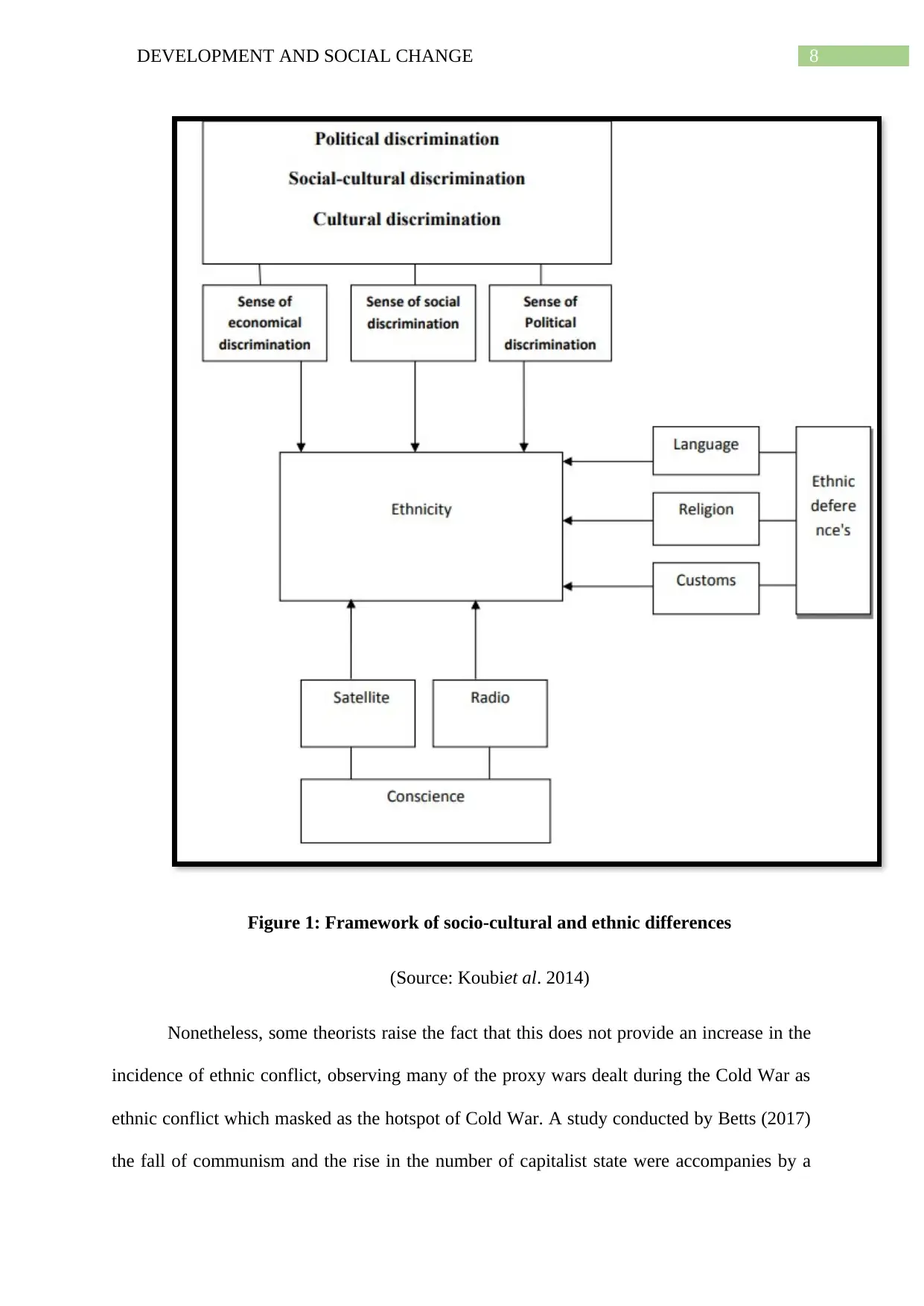
8DEVELOPMENT AND SOCIAL CHANGE
Figure 1: Framework of socio-cultural and ethnic differences
(Source: Koubiet al. 2014)
Nonetheless, some theorists raise the fact that this does not provide an increase in the
incidence of ethnic conflict, observing many of the proxy wars dealt during the Cold War as
ethnic conflict which masked as the hotspot of Cold War. A study conducted by Betts (2017)
the fall of communism and the rise in the number of capitalist state were accompanies by a
Figure 1: Framework of socio-cultural and ethnic differences
(Source: Koubiet al. 2014)
Nonetheless, some theorists raise the fact that this does not provide an increase in the
incidence of ethnic conflict, observing many of the proxy wars dealt during the Cold War as
ethnic conflict which masked as the hotspot of Cold War. A study conducted by Betts (2017)
the fall of communism and the rise in the number of capitalist state were accompanies by a
⊘ This is a preview!⊘
Do you want full access?
Subscribe today to unlock all pages.
Trusted by 1+ million students worldwide
9DEVELOPMENT AND SOCIAL CHANGE
state of decrease in the total warfare. Sinatti and Horst (2015) mentioned that to place ethnic
disagreement into proper perspectives; thereby it is necessary to refer to varied sort of
situations in which racial groups communicate within a broader framework. However, before
this, it could be necessary to deliver suitable definition of cultural groups as the term is
particularly utilized instead of loosely in the existing studies. Bormann, Cederman and Vogt
(2017) mentioned that the term “ethic clash” particularly covers a large range of situations. In
addition, it could be argued that the ethnic conflict in the groups of people for identifying
each other may include colour, race, religion, national origin and language. It is also found in
the study that colour, race, religion, national origin and language are the variables in
identifying each individuals in the group in ethnic pattern. In addition to this, the scholars
usually make the differentiation between inter-ethnic relationships, even though there are
several borderline cases. The following are some of the cases involving the ethnic conflicts:
The conflict in the Northern Ireland indicates long historical roots of conflicts
between the majority of Protestants who would like to stay linked to Britain as well as the
minority of Catholics, who wish to join the republic of Ireland and they go back to the
sixteenth century (Viggiani 2014). Hence, Wolff (2017) mentioned that Irish nationalist
Catholic observed that they have been conventionally separated from the dominant group of
Protestants. Hence, this partition of Ireland have been decided upon by British in 1920 were
failed to resolve this protracted clash (De Fazio 2016). On the other side, the conflict of Sri
Lanka has gone through many phases and here the minority Tamils were differentiated by
religion and language from a large percentage of “Buddhist Sinhalese” are widely
concentrated in the northeast of island, where this community settled over two thousand years
back (Imtiyaz and Mohamed-Saleem 2015). At the time of the independence, the Sinhalese
community observed that Tamils observe disproportionate political and economic privilege
from British and create influence to change the situation (Biziouras 2014). Firstly, they did
state of decrease in the total warfare. Sinatti and Horst (2015) mentioned that to place ethnic
disagreement into proper perspectives; thereby it is necessary to refer to varied sort of
situations in which racial groups communicate within a broader framework. However, before
this, it could be necessary to deliver suitable definition of cultural groups as the term is
particularly utilized instead of loosely in the existing studies. Bormann, Cederman and Vogt
(2017) mentioned that the term “ethic clash” particularly covers a large range of situations. In
addition, it could be argued that the ethnic conflict in the groups of people for identifying
each other may include colour, race, religion, national origin and language. It is also found in
the study that colour, race, religion, national origin and language are the variables in
identifying each individuals in the group in ethnic pattern. In addition to this, the scholars
usually make the differentiation between inter-ethnic relationships, even though there are
several borderline cases. The following are some of the cases involving the ethnic conflicts:
The conflict in the Northern Ireland indicates long historical roots of conflicts
between the majority of Protestants who would like to stay linked to Britain as well as the
minority of Catholics, who wish to join the republic of Ireland and they go back to the
sixteenth century (Viggiani 2014). Hence, Wolff (2017) mentioned that Irish nationalist
Catholic observed that they have been conventionally separated from the dominant group of
Protestants. Hence, this partition of Ireland have been decided upon by British in 1920 were
failed to resolve this protracted clash (De Fazio 2016). On the other side, the conflict of Sri
Lanka has gone through many phases and here the minority Tamils were differentiated by
religion and language from a large percentage of “Buddhist Sinhalese” are widely
concentrated in the northeast of island, where this community settled over two thousand years
back (Imtiyaz and Mohamed-Saleem 2015). At the time of the independence, the Sinhalese
community observed that Tamils observe disproportionate political and economic privilege
from British and create influence to change the situation (Biziouras 2014). Firstly, they did
Paraphrase This Document
Need a fresh take? Get an instant paraphrase of this document with our AI Paraphraser
10DEVELOPMENT AND SOCIAL CHANGE
not accept the citizenship to most of the Indian Tamil labourers and then developed a
Sinhala-only language policy and recognized University entrance requirement (Lee and
Reade 2015).
Another significant case is that Sandinsta revolution of 1997 in Nicaragua, after a
long years of guerrilla warfare, gained success in taking over a bloody thirty-year dictatorship
and the development of a famous revolutionary government (Fraser, Fisher and Arce 2014).
This issue brought them into direct conflict with Miskito and other indigenous people of
Atlantic Coast- region which has never been integrated into centralized political structure of
Nicaragua. As put forward by Faber (2017), the flagship publication of the World Bank
indicate that there is a lot to say about the violence. Hence, Fraser, Fisher and Arce (2014)
argued that the clash is not just about the reason for poverty among; it may remain as the
primary cause. This means that the nations are prey to violence are often trapped in it.
Another significant case is that in Spain’s Basque region, the nation of Euzkadi, the regional
nationalism come out as the political force in the ninetieth century, after the central Spanish
government destroyed the long-standing legal institutions. This phase of time also talk about
the incipient industrialization bough about the migration as well as increasing class conflict.
During this Franco Dictorship, the Basque language as well as other ethnic expression were
overwhelmed. Sullivan (2015) particularly mentioned that this Basque nationalism increased
and by 1970’s a military separatist firm using terrorist tactics, which is known as ETA ruled
the field for years. Basque not only adhere to its conventional institutions but also to their
language as well as consider themselves to remain racially distinct from other Spaniards. It is
further observed that in spite of the guarantee of the regional autonomy provided for new
Spanish constitutions as well as regional autonomy, the regional effects of the economic
deficiency have increased the sympathy among the population for the nationalist movement
and it gains supports from the nationalistmovement.
not accept the citizenship to most of the Indian Tamil labourers and then developed a
Sinhala-only language policy and recognized University entrance requirement (Lee and
Reade 2015).
Another significant case is that Sandinsta revolution of 1997 in Nicaragua, after a
long years of guerrilla warfare, gained success in taking over a bloody thirty-year dictatorship
and the development of a famous revolutionary government (Fraser, Fisher and Arce 2014).
This issue brought them into direct conflict with Miskito and other indigenous people of
Atlantic Coast- region which has never been integrated into centralized political structure of
Nicaragua. As put forward by Faber (2017), the flagship publication of the World Bank
indicate that there is a lot to say about the violence. Hence, Fraser, Fisher and Arce (2014)
argued that the clash is not just about the reason for poverty among; it may remain as the
primary cause. This means that the nations are prey to violence are often trapped in it.
Another significant case is that in Spain’s Basque region, the nation of Euzkadi, the regional
nationalism come out as the political force in the ninetieth century, after the central Spanish
government destroyed the long-standing legal institutions. This phase of time also talk about
the incipient industrialization bough about the migration as well as increasing class conflict.
During this Franco Dictorship, the Basque language as well as other ethnic expression were
overwhelmed. Sullivan (2015) particularly mentioned that this Basque nationalism increased
and by 1970’s a military separatist firm using terrorist tactics, which is known as ETA ruled
the field for years. Basque not only adhere to its conventional institutions but also to their
language as well as consider themselves to remain racially distinct from other Spaniards. It is
further observed that in spite of the guarantee of the regional autonomy provided for new
Spanish constitutions as well as regional autonomy, the regional effects of the economic
deficiency have increased the sympathy among the population for the nationalist movement
and it gains supports from the nationalistmovement.
11DEVELOPMENT AND SOCIAL CHANGE
Conclusion
The above-mentioned discussion helps to understand the fact that racial and ethnic
clash is not a contemporary issue, the nations both developed and developing nations have
faced the challenge of maintaining peace, as the ethnic and racial clash had a strong impact
on the society and people. The scholars have particularly talked about the fact that due to
increasing number of ethnic and communal group, differences among people with respect to
ethnicity, race and the perspective of both of this variables. The authors have also mentioned
that it is now increasingly identified the discrimination against the black have been slowly but
declining over the last century in some of the nations. Furthermore, the religion is often
referred as a “conflict- inducting cleavage” and there seem to be some fairly-cut historical
cases where religion have played a great role.
Conclusion
The above-mentioned discussion helps to understand the fact that racial and ethnic
clash is not a contemporary issue, the nations both developed and developing nations have
faced the challenge of maintaining peace, as the ethnic and racial clash had a strong impact
on the society and people. The scholars have particularly talked about the fact that due to
increasing number of ethnic and communal group, differences among people with respect to
ethnicity, race and the perspective of both of this variables. The authors have also mentioned
that it is now increasingly identified the discrimination against the black have been slowly but
declining over the last century in some of the nations. Furthermore, the religion is often
referred as a “conflict- inducting cleavage” and there seem to be some fairly-cut historical
cases where religion have played a great role.
⊘ This is a preview!⊘
Do you want full access?
Subscribe today to unlock all pages.
Trusted by 1+ million students worldwide

1 out of 16


Related Documents


Your All-in-One AI-Powered Toolkit for Academic Success.
+13062052269
info@desklib.com
Available 24*7 on WhatsApp / Email
![[object Object]](/_next/static/media/star-bottom.7253800d.svg)
Unlock your academic potential
Copyright © 2020–2025 A2Z Services. All Rights Reserved. Developed and managed by ZUCOL.