EU Law: Analysis of Trade Barriers Affecting Amoy Foods Ltd.
VerifiedAdded on 2023/06/07
|20
|9024
|315
Report
AI Summary
This report delves into the intricacies of EU law concerning the free movement of goods, particularly focusing on potential trade barriers imposed by member states. It examines the challenges faced by Amoy Foods Ltd., a French producer of food products based on Jamaican recipes, as it seeks to export its 'Spicy Caribbean Chicken' to other EU member states. The analysis addresses three specific issues: Spanish legislation requiring random testing of food products in biodegradable wrapping, Polish legislation mandating separate aisles for food products containing alcohol, and Finnish legislation prohibiting the use of national flags on packaging unless the product is made in that country. The report discusses the relevant EU legal principles, including Article 169(1) of the Treaty on the Functioning of the European Union, and considers whether these national laws constitute unlawful restrictions on the free movement of goods within the EU's internal market. This document is available on Desklib, a platform offering study tools and solved assignments for students.
Candidate Number: Click here to enter text.
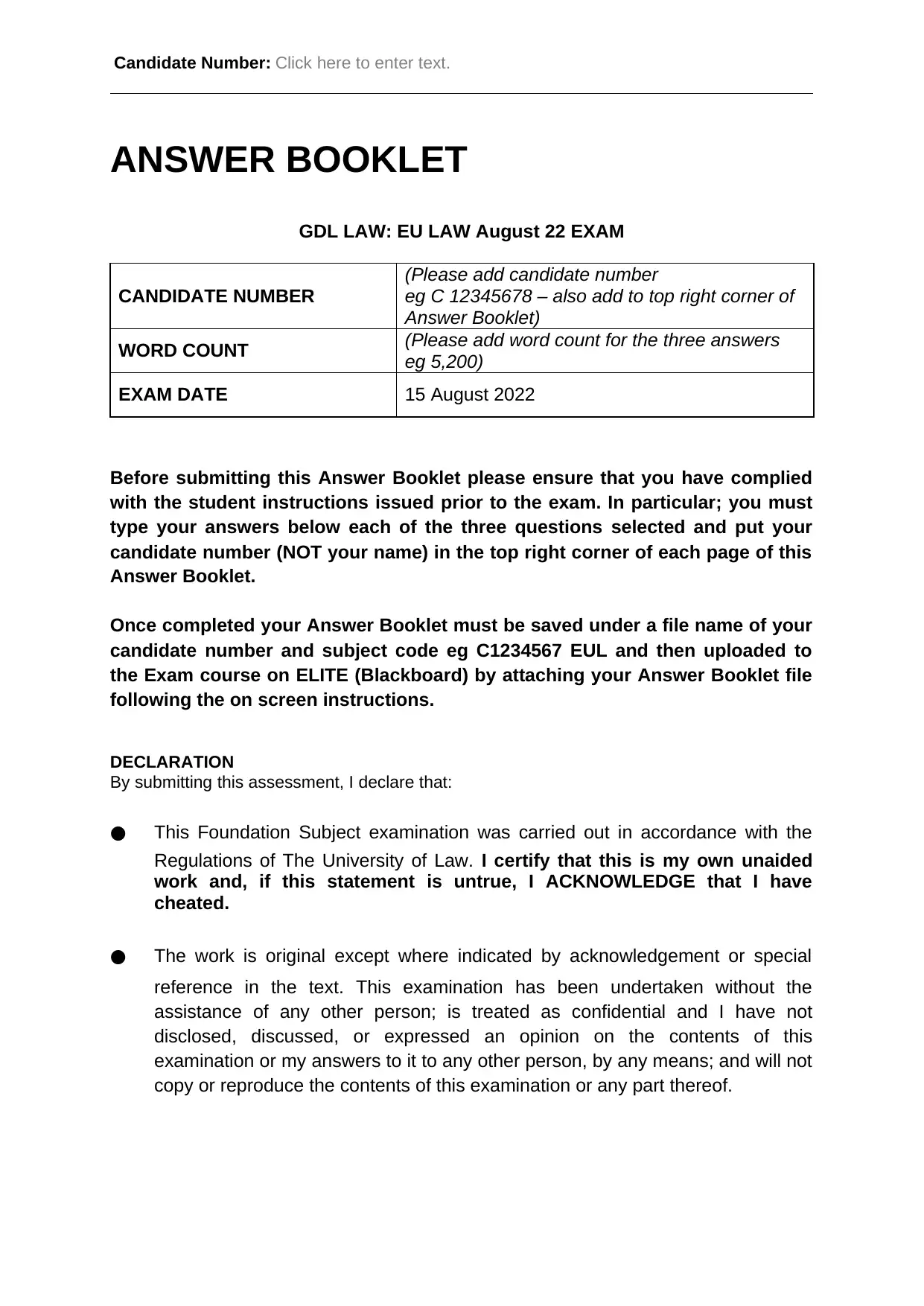
ANSWER BOOKLET
GDL LAW: EU LAW August 22 EXAM
CANDIDATE NUMBER
(Please add candidate number
eg C 12345678 – also add to top right corner of
Answer Booklet)
WORD COUNT (Please add word count for the three answers
eg 5,200)
EXAM DATE 15 August 2022
Before submitting this Answer Booklet please ensure that you have complied
with the student instructions issued prior to the exam. In particular; you must
type your answers below each of the three questions selected and put your
candidate number (NOT your name) in the top right corner of each page of this
Answer Booklet.
Once completed your Answer Booklet must be saved under a file name of your
candidate number and subject code eg C1234567 EUL and then uploaded to
the Exam course on ELITE (Blackboard) by attaching your Answer Booklet file
following the on screen instructions.
DECLARATION
By submitting this assessment, I declare that:
● This Foundation Subject examination was carried out in accordance with the
Regulations of The University of Law. I certify that this is my own unaided
work and, if this statement is untrue, I ACKNOWLEDGE that I have
cheated.
● The work is original except where indicated by acknowledgement or special
reference in the text. This examination has been undertaken without the
assistance of any other person; is treated as confidential and I have not
disclosed, discussed, or expressed an opinion on the contents of this
examination or my answers to it to any other person, by any means; and will not
copy or reproduce the contents of this examination or any part thereof.
ANSWER BOOKLET
GDL LAW: EU LAW August 22 EXAM
CANDIDATE NUMBER
(Please add candidate number
eg C 12345678 – also add to top right corner of
Answer Booklet)
WORD COUNT (Please add word count for the three answers
eg 5,200)
EXAM DATE 15 August 2022
Before submitting this Answer Booklet please ensure that you have complied
with the student instructions issued prior to the exam. In particular; you must
type your answers below each of the three questions selected and put your
candidate number (NOT your name) in the top right corner of each page of this
Answer Booklet.
Once completed your Answer Booklet must be saved under a file name of your
candidate number and subject code eg C1234567 EUL and then uploaded to
the Exam course on ELITE (Blackboard) by attaching your Answer Booklet file
following the on screen instructions.
DECLARATION
By submitting this assessment, I declare that:
● This Foundation Subject examination was carried out in accordance with the
Regulations of The University of Law. I certify that this is my own unaided
work and, if this statement is untrue, I ACKNOWLEDGE that I have
cheated.
● The work is original except where indicated by acknowledgement or special
reference in the text. This examination has been undertaken without the
assistance of any other person; is treated as confidential and I have not
disclosed, discussed, or expressed an opinion on the contents of this
examination or my answers to it to any other person, by any means; and will not
copy or reproduce the contents of this examination or any part thereof.

Paraphrase This Document
Need a fresh take? Get an instant paraphrase of this document with our AI Paraphraser
Candidate Number: Click here to enter text.
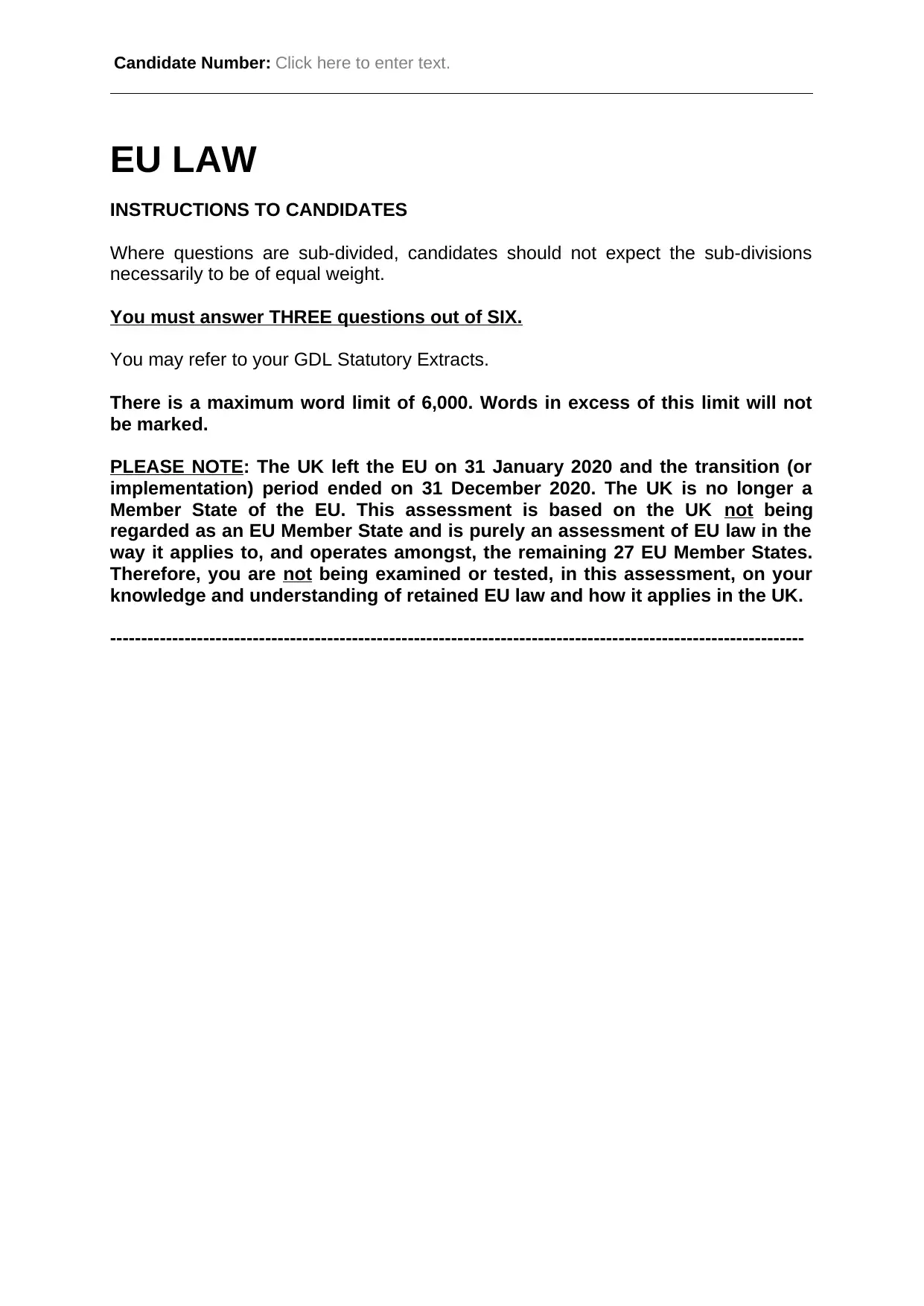
EU LAW
INSTRUCTIONS TO CANDIDATES
Where questions are sub-divided, candidates should not expect the sub-divisions
necessarily to be of equal weight.
You must answer THREE questions out of SIX.
You may refer to your GDL Statutory Extracts.
There is a maximum word limit of 6,000. Words in excess of this limit will not
be marked.
PLEASE NOTE: The UK left the EU on 31 January 2020 and the transition (or
implementation) period ended on 31 December 2020. The UK is no longer a
Member State of the EU. This assessment is based on the UK not being
regarded as an EU Member State and is purely an assessment of EU law in the
way it applies to, and operates amongst, the remaining 27 EU Member States.
Therefore, you are not being examined or tested, in this assessment, on your
knowledge and understanding of retained EU law and how it applies in the UK.
----------------------------------------------------------------------------------------------------------------
EU LAW
INSTRUCTIONS TO CANDIDATES
Where questions are sub-divided, candidates should not expect the sub-divisions
necessarily to be of equal weight.
You must answer THREE questions out of SIX.
You may refer to your GDL Statutory Extracts.
There is a maximum word limit of 6,000. Words in excess of this limit will not
be marked.
PLEASE NOTE: The UK left the EU on 31 January 2020 and the transition (or
implementation) period ended on 31 December 2020. The UK is no longer a
Member State of the EU. This assessment is based on the UK not being
regarded as an EU Member State and is purely an assessment of EU law in the
way it applies to, and operates amongst, the remaining 27 EU Member States.
Therefore, you are not being examined or tested, in this assessment, on your
knowledge and understanding of retained EU law and how it applies in the UK.
----------------------------------------------------------------------------------------------------------------
Candidate Number: Click here to enter text.
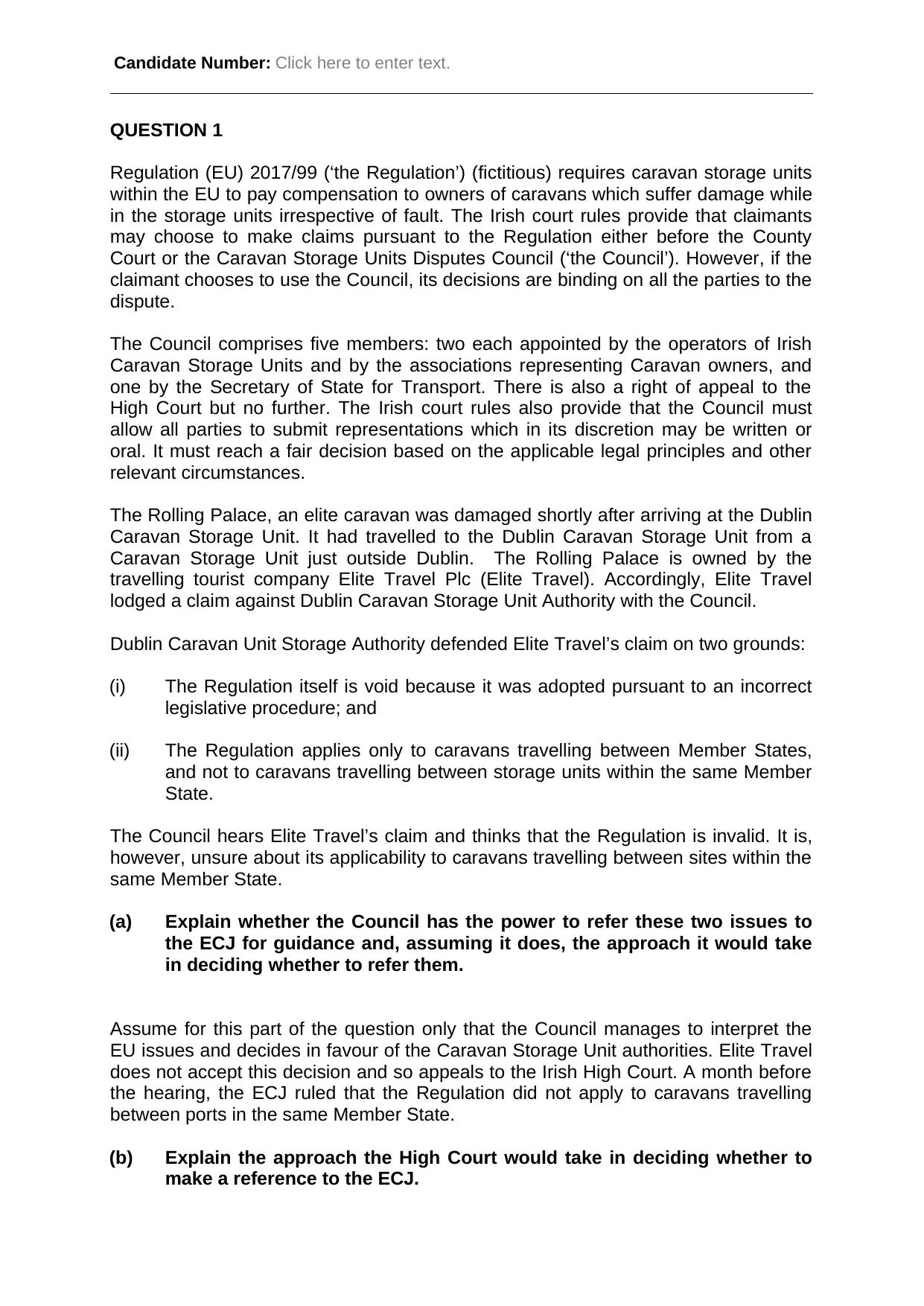
QUESTION 1
Regulation (EU) 2017/99 (‘the Regulation’) (fictitious) requires caravan storage units
within the EU to pay compensation to owners of caravans which suffer damage while
in the storage units irrespective of fault. The Irish court rules provide that claimants
may choose to make claims pursuant to the Regulation either before the County
Court or the Caravan Storage Units Disputes Council (‘the Council’). However, if the
claimant chooses to use the Council, its decisions are binding on all the parties to the
dispute.
The Council comprises five members: two each appointed by the operators of Irish
Caravan Storage Units and by the associations representing Caravan owners, and
one by the Secretary of State for Transport. There is also a right of appeal to the
High Court but no further. The Irish court rules also provide that the Council must
allow all parties to submit representations which in its discretion may be written or
oral. It must reach a fair decision based on the applicable legal principles and other
relevant circumstances.
The Rolling Palace, an elite caravan was damaged shortly after arriving at the Dublin
Caravan Storage Unit. It had travelled to the Dublin Caravan Storage Unit from a
Caravan Storage Unit just outside Dublin. The Rolling Palace is owned by the
travelling tourist company Elite Travel Plc (Elite Travel). Accordingly, Elite Travel
lodged a claim against Dublin Caravan Storage Unit Authority with the Council.
Dublin Caravan Unit Storage Authority defended Elite Travel’s claim on two grounds:
(i) The Regulation itself is void because it was adopted pursuant to an incorrect
legislative procedure; and
(ii) The Regulation applies only to caravans travelling between Member States,
and not to caravans travelling between storage units within the same Member
State.
The Council hears Elite Travel’s claim and thinks that the Regulation is invalid. It is,
however, unsure about its applicability to caravans travelling between sites within the
same Member State.
(a) Explain whether the Council has the power to refer these two issues to
the ECJ for guidance and, assuming it does, the approach it would take
in deciding whether to refer them.
Assume for this part of the question only that the Council manages to interpret the
EU issues and decides in favour of the Caravan Storage Unit authorities. Elite Travel
does not accept this decision and so appeals to the Irish High Court. A month before
the hearing, the ECJ ruled that the Regulation did not apply to caravans travelling
between ports in the same Member State.
(b) Explain the approach the High Court would take in deciding whether to
make a reference to the ECJ.
QUESTION 1
Regulation (EU) 2017/99 (‘the Regulation’) (fictitious) requires caravan storage units
within the EU to pay compensation to owners of caravans which suffer damage while
in the storage units irrespective of fault. The Irish court rules provide that claimants
may choose to make claims pursuant to the Regulation either before the County
Court or the Caravan Storage Units Disputes Council (‘the Council’). However, if the
claimant chooses to use the Council, its decisions are binding on all the parties to the
dispute.
The Council comprises five members: two each appointed by the operators of Irish
Caravan Storage Units and by the associations representing Caravan owners, and
one by the Secretary of State for Transport. There is also a right of appeal to the
High Court but no further. The Irish court rules also provide that the Council must
allow all parties to submit representations which in its discretion may be written or
oral. It must reach a fair decision based on the applicable legal principles and other
relevant circumstances.
The Rolling Palace, an elite caravan was damaged shortly after arriving at the Dublin
Caravan Storage Unit. It had travelled to the Dublin Caravan Storage Unit from a
Caravan Storage Unit just outside Dublin. The Rolling Palace is owned by the
travelling tourist company Elite Travel Plc (Elite Travel). Accordingly, Elite Travel
lodged a claim against Dublin Caravan Storage Unit Authority with the Council.
Dublin Caravan Unit Storage Authority defended Elite Travel’s claim on two grounds:
(i) The Regulation itself is void because it was adopted pursuant to an incorrect
legislative procedure; and
(ii) The Regulation applies only to caravans travelling between Member States,
and not to caravans travelling between storage units within the same Member
State.
The Council hears Elite Travel’s claim and thinks that the Regulation is invalid. It is,
however, unsure about its applicability to caravans travelling between sites within the
same Member State.
(a) Explain whether the Council has the power to refer these two issues to
the ECJ for guidance and, assuming it does, the approach it would take
in deciding whether to refer them.
Assume for this part of the question only that the Council manages to interpret the
EU issues and decides in favour of the Caravan Storage Unit authorities. Elite Travel
does not accept this decision and so appeals to the Irish High Court. A month before
the hearing, the ECJ ruled that the Regulation did not apply to caravans travelling
between ports in the same Member State.
(b) Explain the approach the High Court would take in deciding whether to
make a reference to the ECJ.
⊘ This is a preview!⊘
Do you want full access?
Subscribe today to unlock all pages.

Trusted by 1+ million students worldwide

Candidate Number: Click here to enter text.
Paraphrase This Document
Need a fresh take? Get an instant paraphrase of this document with our AI Paraphraser

Candidate Number: Click here to enter text.
>>>>>>>>>>>>>>>>>>>>>>>>>>>>>>>>>>>>>>>>>>>>>>>>>>>>>>>>>>>>>>>>
TYPE YOUR ANSWER HERE
>>>>>>>>>>>>>>>>>>>>>>>>>>>>>>>>>>>>>>>>>>>>>>>>>>>>>>>>>>>>>>>>
TYPE YOUR ANSWER HERE
Candidate Number: Click here to enter text.
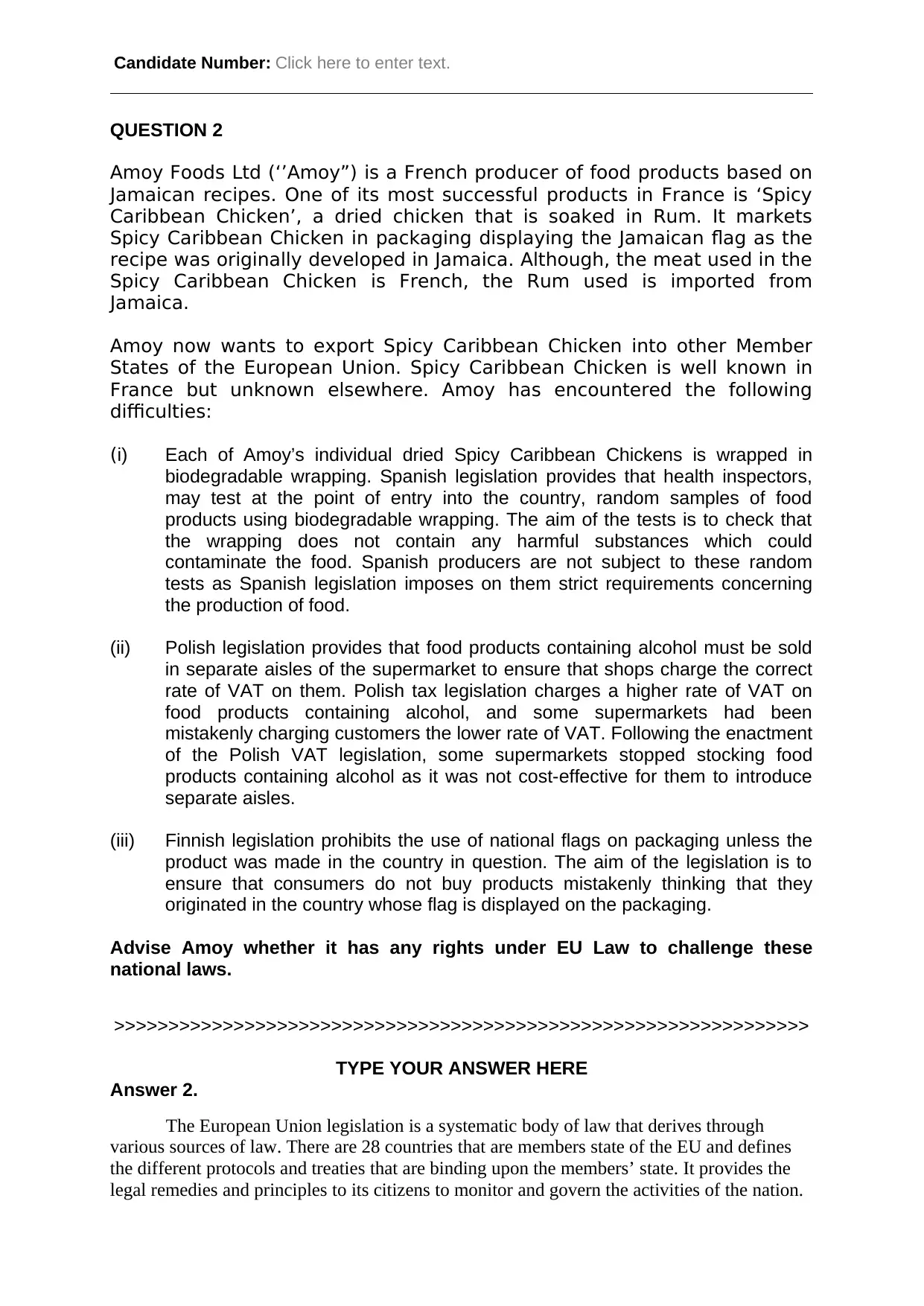
QUESTION 2
Amoy Foods Ltd (‘’Amoy”) is a French producer of food products based on
Jamaican recipes. One of its most successful products in France is ‘Spicy
Caribbean Chicken’, a dried chicken that is soaked in Rum. It markets
Spicy Caribbean Chicken in packaging displaying the Jamaican flag as the
recipe was originally developed in Jamaica. Although, the meat used in the
Spicy Caribbean Chicken is French, the Rum used is imported from
Jamaica.
Amoy now wants to export Spicy Caribbean Chicken into other Member
States of the European Union. Spicy Caribbean Chicken is well known in
France but unknown elsewhere. Amoy has encountered the following
difficulties:
(i) Each of Amoy’s individual dried Spicy Caribbean Chickens is wrapped in
biodegradable wrapping. Spanish legislation provides that health inspectors,
may test at the point of entry into the country, random samples of food
products using biodegradable wrapping. The aim of the tests is to check that
the wrapping does not contain any harmful substances which could
contaminate the food. Spanish producers are not subject to these random
tests as Spanish legislation imposes on them strict requirements concerning
the production of food.
(ii) Polish legislation provides that food products containing alcohol must be sold
in separate aisles of the supermarket to ensure that shops charge the correct
rate of VAT on them. Polish tax legislation charges a higher rate of VAT on
food products containing alcohol, and some supermarkets had been
mistakenly charging customers the lower rate of VAT. Following the enactment
of the Polish VAT legislation, some supermarkets stopped stocking food
products containing alcohol as it was not cost-effective for them to introduce
separate aisles.
(iii) Finnish legislation prohibits the use of national flags on packaging unless the
product was made in the country in question. The aim of the legislation is to
ensure that consumers do not buy products mistakenly thinking that they
originated in the country whose flag is displayed on the packaging.
Advise Amoy whether it has any rights under EU Law to challenge these
national laws.
>>>>>>>>>>>>>>>>>>>>>>>>>>>>>>>>>>>>>>>>>>>>>>>>>>>>>>>>>>>>>>>>
TYPE YOUR ANSWER HERE
Answer 2.
The European Union legislation is a systematic body of law that derives through
various sources of law. There are 28 countries that are members state of the EU and defines
the different protocols and treaties that are binding upon the members’ state. It provides the
legal remedies and principles to its citizens to monitor and govern the activities of the nation.
QUESTION 2
Amoy Foods Ltd (‘’Amoy”) is a French producer of food products based on
Jamaican recipes. One of its most successful products in France is ‘Spicy
Caribbean Chicken’, a dried chicken that is soaked in Rum. It markets
Spicy Caribbean Chicken in packaging displaying the Jamaican flag as the
recipe was originally developed in Jamaica. Although, the meat used in the
Spicy Caribbean Chicken is French, the Rum used is imported from
Jamaica.
Amoy now wants to export Spicy Caribbean Chicken into other Member
States of the European Union. Spicy Caribbean Chicken is well known in
France but unknown elsewhere. Amoy has encountered the following
difficulties:
(i) Each of Amoy’s individual dried Spicy Caribbean Chickens is wrapped in
biodegradable wrapping. Spanish legislation provides that health inspectors,
may test at the point of entry into the country, random samples of food
products using biodegradable wrapping. The aim of the tests is to check that
the wrapping does not contain any harmful substances which could
contaminate the food. Spanish producers are not subject to these random
tests as Spanish legislation imposes on them strict requirements concerning
the production of food.
(ii) Polish legislation provides that food products containing alcohol must be sold
in separate aisles of the supermarket to ensure that shops charge the correct
rate of VAT on them. Polish tax legislation charges a higher rate of VAT on
food products containing alcohol, and some supermarkets had been
mistakenly charging customers the lower rate of VAT. Following the enactment
of the Polish VAT legislation, some supermarkets stopped stocking food
products containing alcohol as it was not cost-effective for them to introduce
separate aisles.
(iii) Finnish legislation prohibits the use of national flags on packaging unless the
product was made in the country in question. The aim of the legislation is to
ensure that consumers do not buy products mistakenly thinking that they
originated in the country whose flag is displayed on the packaging.
Advise Amoy whether it has any rights under EU Law to challenge these
national laws.
>>>>>>>>>>>>>>>>>>>>>>>>>>>>>>>>>>>>>>>>>>>>>>>>>>>>>>>>>>>>>>>>
TYPE YOUR ANSWER HERE
Answer 2.
The European Union legislation is a systematic body of law that derives through
various sources of law. There are 28 countries that are members state of the EU and defines
the different protocols and treaties that are binding upon the members’ state. It provides the
legal remedies and principles to its citizens to monitor and govern the activities of the nation.
⊘ This is a preview!⊘
Do you want full access?
Subscribe today to unlock all pages.
Trusted by 1+ million students worldwide
Candidate Number: Click here to enter text.
The International treaty on European Union laid down 37 protocols to secure the fundamental
and legal right of the individual. The hierarchy of legislation has played significant role in
European Union legislation. The UK membership in EU had enforced many statutory
frameworks to give effect to the EU law (Bruetschy, 2019). Also, EU courts plays crucial role
in enforcing the rights and obligation of the citizens. Most of the European legislation and
Directives principles are framed with the help of Ordinary legislative procedure that give legal
effect to the Bill presented before the European Parliament.
The food safety requirements and standards is criticised due to many tariff barriers and other
factors are highly affecting the exporting of product in the member state. However, the EU
laws gives prior importance to the right of the consumers so, that their faith on the legislation
remain secured.
According to the fact of the case, Amoy Foods Ltd., is a French producer and mostly prepared
food products in relation to Jamaican recipes. The “Spicy Caribbean Chicken” is famous food
product of France and popular among the natives. Now, Amoy has decided to export their
food products in the Spicy Caribbean Chicken to other member States of the European Union
due to which they have to legally comply with the statutory compliance of that countries. But
they are facing challenges to food safety measures that are compulsory to supply and export
the product in the member States. The first difficulties deal with the biodegradable use of
wrappers of Spicy Caribbean Chickens (Lavelli, 2021). Another barrier is polish legislation
that required use of separate aisles of the supermarket to charge appropriate VAT on food
products. The last and third challenges is use of national flags on the products that is contrary
to displayed on the packaging.
The radical change in the development of food industry has increased the demand of the food
safety legislation in the European countries. The unique legal system of European legislation
had analysed the need of the strict statutory requirements for the protection of the right of the
consumer. The globalisation of many industries in relation to food production required the
primary safety and quality of the food products. The initialisation of 21st century has followed
the principle of harmonisation of food law to facilitate quality and nutritional food products in
the market. It also provides legislation in relation to export of food commodities across the
member states. The International body on trade and commerce, World Trade Organisation
allows all the member states to become signatory authority of the international agreements to
strategies the policies regarding the food production and its marketing. Also, EU institutions
plays pivotal role in ensuring the safe and healthy food products in the market so that its
consumption can be safe for human body. The protection of natives is the paramount
objective of the European legal system. It secures the general interest of the consumers,
including their safety, health and interest, and imparting knowledge in relation to promote the
security of an individual. According to Article 169(1) of the Treaty on Functioning of the
European Union, obliged the members states to ensure the high level of protection to their
consumers and maintain all the food standards while producing a product in the market. It
minimises the health risk and reduce the use of unhygienic and harmful use of chemicals in
the food item that may endanger the life of the individual.
Food law is an issue of public concern and incudes right of the citizens. However, it is
important for the food manufacturer to produce and use the high standards policies to
maintain safety while manufacturing a product (Buncic, Alban and Blagojevic, 2019). The
Authority of European Food Safety is authorised to assess the risk involves in nay food items
and manage the risk through independent body of the European Commission. Also, EU is
original member of the Treaty of the Rome, 1957 that has a characteristic of economic
transactions. It creates a common market for the business organisation where they are free to
export their products in the market without any barrier and challenges that may arise before
the food producer. The free movement of goods are also relevant for the supply of food items
in other members states. The EU legislation main purpose of harmonising the market through
The International treaty on European Union laid down 37 protocols to secure the fundamental
and legal right of the individual. The hierarchy of legislation has played significant role in
European Union legislation. The UK membership in EU had enforced many statutory
frameworks to give effect to the EU law (Bruetschy, 2019). Also, EU courts plays crucial role
in enforcing the rights and obligation of the citizens. Most of the European legislation and
Directives principles are framed with the help of Ordinary legislative procedure that give legal
effect to the Bill presented before the European Parliament.
The food safety requirements and standards is criticised due to many tariff barriers and other
factors are highly affecting the exporting of product in the member state. However, the EU
laws gives prior importance to the right of the consumers so, that their faith on the legislation
remain secured.
According to the fact of the case, Amoy Foods Ltd., is a French producer and mostly prepared
food products in relation to Jamaican recipes. The “Spicy Caribbean Chicken” is famous food
product of France and popular among the natives. Now, Amoy has decided to export their
food products in the Spicy Caribbean Chicken to other member States of the European Union
due to which they have to legally comply with the statutory compliance of that countries. But
they are facing challenges to food safety measures that are compulsory to supply and export
the product in the member States. The first difficulties deal with the biodegradable use of
wrappers of Spicy Caribbean Chickens (Lavelli, 2021). Another barrier is polish legislation
that required use of separate aisles of the supermarket to charge appropriate VAT on food
products. The last and third challenges is use of national flags on the products that is contrary
to displayed on the packaging.
The radical change in the development of food industry has increased the demand of the food
safety legislation in the European countries. The unique legal system of European legislation
had analysed the need of the strict statutory requirements for the protection of the right of the
consumer. The globalisation of many industries in relation to food production required the
primary safety and quality of the food products. The initialisation of 21st century has followed
the principle of harmonisation of food law to facilitate quality and nutritional food products in
the market. It also provides legislation in relation to export of food commodities across the
member states. The International body on trade and commerce, World Trade Organisation
allows all the member states to become signatory authority of the international agreements to
strategies the policies regarding the food production and its marketing. Also, EU institutions
plays pivotal role in ensuring the safe and healthy food products in the market so that its
consumption can be safe for human body. The protection of natives is the paramount
objective of the European legal system. It secures the general interest of the consumers,
including their safety, health and interest, and imparting knowledge in relation to promote the
security of an individual. According to Article 169(1) of the Treaty on Functioning of the
European Union, obliged the members states to ensure the high level of protection to their
consumers and maintain all the food standards while producing a product in the market. It
minimises the health risk and reduce the use of unhygienic and harmful use of chemicals in
the food item that may endanger the life of the individual.
Food law is an issue of public concern and incudes right of the citizens. However, it is
important for the food manufacturer to produce and use the high standards policies to
maintain safety while manufacturing a product (Buncic, Alban and Blagojevic, 2019). The
Authority of European Food Safety is authorised to assess the risk involves in nay food items
and manage the risk through independent body of the European Commission. Also, EU is
original member of the Treaty of the Rome, 1957 that has a characteristic of economic
transactions. It creates a common market for the business organisation where they are free to
export their products in the market without any barrier and challenges that may arise before
the food producer. The free movement of goods are also relevant for the supply of food items
in other members states. The EU legislation main purpose of harmonising the market through
Paraphrase This Document
Need a fresh take? Get an instant paraphrase of this document with our AI Paraphraser
Candidate Number: Click here to enter text.
national standards are create barriers for the Amoy for expanding their business in other
countries. According to Article 191 of the TEFU prevents the exploitation use of environment
that may not only affect the society but also the heath of the individual.
The difficulties faced by the Amoy are subjected to certain food law requirements that are
important while producing and exporting the food items I the market. These restrictions are
subjected to tracing and assessment of food standards whether followed by the Amoy. The
risk assessment through food chain is crucial for the health purpose of the consumers. The
general food Law regulation defines the procedure for tracing the follow food and ingredients
through each stage of production, processing, and distribution of commodities in the market.
The traceability of product is important for providing accurate information to the consumer.
Secondly, it gives detailed information to the importer to identify the product and the origin of
the country (Busetti, 2019). The aim of General food law is to promote trade, safety and
health of the consumers and protection of the animal and the environment.
Therefore, the EU food law increasingly supports the ‘consumer’s rights’ The EU legislation
promotes the safety of the consumers and provide tort litigation against the defective food
items that risk the human body and health. The free movement of goods within the European
legislation is one of the founding factors of the single market and represents the core of the
establishment of the European Union. Also, European Union legislation has guaranteed
uniform protection of the consumer, the environment and energy resources through the free
movement of goods within the Union. To this end, an integrated strategy has been developed
to ensure a high level of health safety through consistent measures and adequate control and
risk assessment procedure.
REFERENCES
Bruetschy, C., 2019, August. The EU regulatory framework on genetically modified
organisms (GMOs). In Transgenic research (Vol. 28, No. 2, pp. 169-174). Springer
International
Lavelli, V., 2021. Circular food supply chains–Impact on value addition and safety. Trends in
Food Science & Technology, 114, pp.323-332.
Buncic, S., Alban, L. and Blagojevic, B., 2019. From traditional meat inspection to
development of meat safety assurance programs in pig abattoirs–The European
situation. Food Control, 106, p.106705.
Busetti, S., 2019. A theory-based evaluation of food waste policy: Evidence from Italy. Food
policy, 88, p.101749.
Georgiou, S., Rheinberger, C.M. and Vainio, M., 2018. Benefit-cost analysis in EU chemicals
legislation: Experiences from over 100 REACH applications for authorisation. Journal of
Benefit-Cost Analysis, 9(1), pp.181-204.
van der Mei, A.P. and van Ooij, E., 2022. The judicial finetuning of the EU rules determining
the applicable social security legislation. Maastricht Journal of European and Comparative
Law, 29(1), pp.132-155.
national standards are create barriers for the Amoy for expanding their business in other
countries. According to Article 191 of the TEFU prevents the exploitation use of environment
that may not only affect the society but also the heath of the individual.
The difficulties faced by the Amoy are subjected to certain food law requirements that are
important while producing and exporting the food items I the market. These restrictions are
subjected to tracing and assessment of food standards whether followed by the Amoy. The
risk assessment through food chain is crucial for the health purpose of the consumers. The
general food Law regulation defines the procedure for tracing the follow food and ingredients
through each stage of production, processing, and distribution of commodities in the market.
The traceability of product is important for providing accurate information to the consumer.
Secondly, it gives detailed information to the importer to identify the product and the origin of
the country (Busetti, 2019). The aim of General food law is to promote trade, safety and
health of the consumers and protection of the animal and the environment.
Therefore, the EU food law increasingly supports the ‘consumer’s rights’ The EU legislation
promotes the safety of the consumers and provide tort litigation against the defective food
items that risk the human body and health. The free movement of goods within the European
legislation is one of the founding factors of the single market and represents the core of the
establishment of the European Union. Also, European Union legislation has guaranteed
uniform protection of the consumer, the environment and energy resources through the free
movement of goods within the Union. To this end, an integrated strategy has been developed
to ensure a high level of health safety through consistent measures and adequate control and
risk assessment procedure.
REFERENCES
Bruetschy, C., 2019, August. The EU regulatory framework on genetically modified
organisms (GMOs). In Transgenic research (Vol. 28, No. 2, pp. 169-174). Springer
International
Lavelli, V., 2021. Circular food supply chains–Impact on value addition and safety. Trends in
Food Science & Technology, 114, pp.323-332.
Buncic, S., Alban, L. and Blagojevic, B., 2019. From traditional meat inspection to
development of meat safety assurance programs in pig abattoirs–The European
situation. Food Control, 106, p.106705.
Busetti, S., 2019. A theory-based evaluation of food waste policy: Evidence from Italy. Food
policy, 88, p.101749.
Georgiou, S., Rheinberger, C.M. and Vainio, M., 2018. Benefit-cost analysis in EU chemicals
legislation: Experiences from over 100 REACH applications for authorisation. Journal of
Benefit-Cost Analysis, 9(1), pp.181-204.
van der Mei, A.P. and van Ooij, E., 2022. The judicial finetuning of the EU rules determining
the applicable social security legislation. Maastricht Journal of European and Comparative
Law, 29(1), pp.132-155.
Candidate Number: Click here to enter text.
QUESTION 3
School Union have contacted you in relation to two potential claims. The claims
relate to Nadim and Joy.
Nadim is a teacher at Edgington Independent secondary school, a private school and
Joy is a teacher at Lightwoods secondary school, a state run school in the adjacent
town. Both schools are in Ireland.
Both Nadim and Joy have been suffering from severe headaches and neckaches.
The initial medical advice that they have each received indicates that their condition
is linked to prolonged use of computer screens which has been as a result of
teaching classes online and marking all the students’ assignments online.
Both have indicated that it is not unusual for them to spend between five and seven
hours per working day in front of their computer screens.
Directive 2019/23 states that
‘Computer operators shall not be required to use a computer screen for a period of
time in excess of six hours in any working day.’ In addition, Article 4 of the Directive
stated that the Directive should be implemented by the Member States by 30
December last year.
You have established that the EU Directive has not yet been implemented in Ireland.
You have, however, found that the only potentially relevant national legislation dates
from the 1990s. Whilst the legislation relates to computer usage it does not cover
how long typists can be required to use computers without a break.
Advise if Nadim and Joy will be able to rely directly or otherwise on the
provisions of the EU Directive 2019/23?
>>>>>>>>>>>>>>>>>>>>>>>>>>>>>>>>>>>>>>>>>>>>>>>>>>>>>>>>>>>>>>>>
TYPE YOUR ANSWER HERE
Answer 3.
Aims of the Directive
The Directive marks a breakthrough over the thought, and the brand new policies will
encompass, inter alia, the advent of reporting mechanisms throughout all enterprise
sectors inside each non-public businesses and public institutions. The Directive
additionally givessafety in opposition to dismissal, demotion and different varieties of
retaliation with the aidof using the employer. All of this is meant to reinforce
whistleblowing as a precious detection
and compliance mechanism(Lombardi, R., et al., 2021).
For economic offerings, a place in which whistleblowing measures are greateordinary
QUESTION 3
School Union have contacted you in relation to two potential claims. The claims
relate to Nadim and Joy.
Nadim is a teacher at Edgington Independent secondary school, a private school and
Joy is a teacher at Lightwoods secondary school, a state run school in the adjacent
town. Both schools are in Ireland.
Both Nadim and Joy have been suffering from severe headaches and neckaches.
The initial medical advice that they have each received indicates that their condition
is linked to prolonged use of computer screens which has been as a result of
teaching classes online and marking all the students’ assignments online.
Both have indicated that it is not unusual for them to spend between five and seven
hours per working day in front of their computer screens.
Directive 2019/23 states that
‘Computer operators shall not be required to use a computer screen for a period of
time in excess of six hours in any working day.’ In addition, Article 4 of the Directive
stated that the Directive should be implemented by the Member States by 30
December last year.
You have established that the EU Directive has not yet been implemented in Ireland.
You have, however, found that the only potentially relevant national legislation dates
from the 1990s. Whilst the legislation relates to computer usage it does not cover
how long typists can be required to use computers without a break.
Advise if Nadim and Joy will be able to rely directly or otherwise on the
provisions of the EU Directive 2019/23?
>>>>>>>>>>>>>>>>>>>>>>>>>>>>>>>>>>>>>>>>>>>>>>>>>>>>>>>>>>>>>>>>
TYPE YOUR ANSWER HERE
Answer 3.
Aims of the Directive
The Directive marks a breakthrough over the thought, and the brand new policies will
encompass, inter alia, the advent of reporting mechanisms throughout all enterprise
sectors inside each non-public businesses and public institutions. The Directive
additionally givessafety in opposition to dismissal, demotion and different varieties of
retaliation with the aidof using the employer. All of this is meant to reinforce
whistleblowing as a precious detection
and compliance mechanism(Lombardi, R., et al., 2021).
For economic offerings, a place in which whistleblowing measures are greateordinary
⊘ This is a preview!⊘
Do you want full access?
Subscribe today to unlock all pages.
Trusted by 1+ million students worldwide
Candidate Number: Click here to enter text.
because of current requirements, this Directive pushes the scope of
presentinsurance plentysimilarly. It additionally gives you on regulatory and
supervisory policymakers’ ambitions
that companies embed a deeper compliance and undertaking culture. Whether this
Directive,
i.e. requiring implementation via way of means of person EU Member States instead
oftaking impact withinside the shape of an EU Regulation, will gain its meant and as
analternative transformative targets or as a substitute simply reason companies to
take a fewsimple compliance motion and replace regulations stays to be seen.
Equally, the Directivedoes now no longer—in comparison to exercise and regulation
withinside the United
States—cater for the capacity of whistleblowers to acquire monetary rewards for
blowing thewhistle on wrongdoing. It is manageable that a few EU Member States
withinside the EU’slegislative movements may also pick to behave
unilaterally(Aboltins, R. and Blumberga, D.,
2019)
The Directive’s guidelines will practice to all employers as some distance as safety in
opposition to retaliation is involved in addition to the cappotential to record to able
government in self belief wherein inner whistleblowing channels are compromised or
couldn't fairly be anticipated to paintings properly. (Blumberga, D., 2019)
Additionally, all establishments with as a minimum 50 employees (even though this
thresholddoes now no longer observe to the ones companies which are withinside
the scope of law andthematic regions set out in Annex 1) or with an annual turnover
or overall property of greater
than €10 million may be required to installation inner procedures for whistleblower
reporting.The duty to installation such reporting mechanisms and channels for
whistleblowers will
follow to all monetary offerings corporations and companies susceptible to cash
laundering orterrorist financing, regardless of their length or turnover. Micro- and
small agencies might be
exempt from the guidelines on putting a reporting mechanism. However, Member
States may
also in addition expand the policies to small groups in precise sectors. In
summary,theDirective will cowl a extensive variety of economic offerings companies
and differentmarketplace participants. This should translate into elevated preliminary
prices in phrases ofreviewing current regulations or drafting new rules in addition to
documenting howcompliance with the brand new responsibilities is evidenced and
the way that is monitoredand audited. While the brand new Directive targets to
lessen fragmentation with the aid ofusing introducing minimal EU-extensive
standards, there may be a chance that rules andstrategies throughout affected
companies will stay fragmented in spite of elevated notunusualplace responsibilities
and standards. (Lachapelle, A., 2022)
What sort of disclosures can be covered?
The Directive, just like the concept, relates to whistleblower safety while breaches of
EU
regulation are said. Breaches of countrywide measures continue to be a country wide
matter.
Leaving apart the cappotential for confusion for people looking to file a breach,
whistleblowers will hence be entitled now no longer most effective to reveal facts
because of current requirements, this Directive pushes the scope of
presentinsurance plentysimilarly. It additionally gives you on regulatory and
supervisory policymakers’ ambitions
that companies embed a deeper compliance and undertaking culture. Whether this
Directive,
i.e. requiring implementation via way of means of person EU Member States instead
oftaking impact withinside the shape of an EU Regulation, will gain its meant and as
analternative transformative targets or as a substitute simply reason companies to
take a fewsimple compliance motion and replace regulations stays to be seen.
Equally, the Directivedoes now no longer—in comparison to exercise and regulation
withinside the United
States—cater for the capacity of whistleblowers to acquire monetary rewards for
blowing thewhistle on wrongdoing. It is manageable that a few EU Member States
withinside the EU’slegislative movements may also pick to behave
unilaterally(Aboltins, R. and Blumberga, D.,
2019)
The Directive’s guidelines will practice to all employers as some distance as safety in
opposition to retaliation is involved in addition to the cappotential to record to able
government in self belief wherein inner whistleblowing channels are compromised or
couldn't fairly be anticipated to paintings properly. (Blumberga, D., 2019)
Additionally, all establishments with as a minimum 50 employees (even though this
thresholddoes now no longer observe to the ones companies which are withinside
the scope of law andthematic regions set out in Annex 1) or with an annual turnover
or overall property of greater
than €10 million may be required to installation inner procedures for whistleblower
reporting.The duty to installation such reporting mechanisms and channels for
whistleblowers will
follow to all monetary offerings corporations and companies susceptible to cash
laundering orterrorist financing, regardless of their length or turnover. Micro- and
small agencies might be
exempt from the guidelines on putting a reporting mechanism. However, Member
States may
also in addition expand the policies to small groups in precise sectors. In
summary,theDirective will cowl a extensive variety of economic offerings companies
and differentmarketplace participants. This should translate into elevated preliminary
prices in phrases ofreviewing current regulations or drafting new rules in addition to
documenting howcompliance with the brand new responsibilities is evidenced and
the way that is monitoredand audited. While the brand new Directive targets to
lessen fragmentation with the aid ofusing introducing minimal EU-extensive
standards, there may be a chance that rules andstrategies throughout affected
companies will stay fragmented in spite of elevated notunusualplace responsibilities
and standards. (Lachapelle, A., 2022)
What sort of disclosures can be covered?
The Directive, just like the concept, relates to whistleblower safety while breaches of
EU
regulation are said. Breaches of countrywide measures continue to be a country wide
matter.
Leaving apart the cappotential for confusion for people looking to file a breach,
whistleblowers will hence be entitled now no longer most effective to reveal facts
Paraphrase This Document
Need a fresh take? Get an instant paraphrase of this document with our AI Paraphraser
Candidate Number: Click here to enter text.
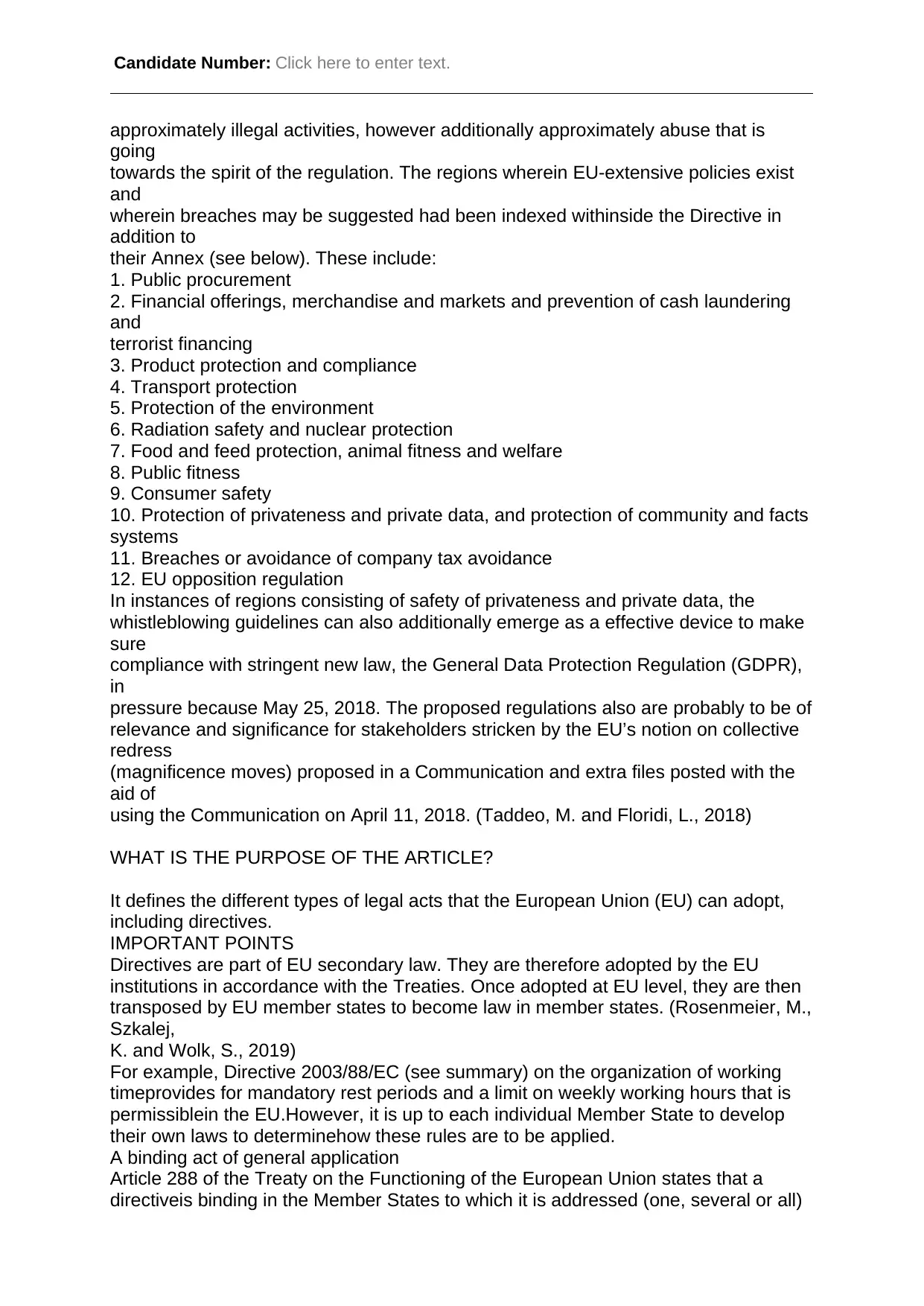
approximately illegal activities, however additionally approximately abuse that is
going
towards the spirit of the regulation. The regions wherein EU-extensive policies exist
and
wherein breaches may be suggested had been indexed withinside the Directive in
addition to
their Annex (see below). These include:
1. Public procurement
2. Financial offerings, merchandise and markets and prevention of cash laundering
and
terrorist financing
3. Product protection and compliance
4. Transport protection
5. Protection of the environment
6. Radiation safety and nuclear protection
7. Food and feed protection, animal fitness and welfare
8. Public fitness
9. Consumer safety
10. Protection of privateness and private data, and protection of community and facts
systems
11. Breaches or avoidance of company tax avoidance
12. EU opposition regulation
In instances of regions consisting of safety of privateness and private data, the
whistleblowing guidelines can also additionally emerge as a effective device to make
sure
compliance with stringent new law, the General Data Protection Regulation (GDPR),
in
pressure because May 25, 2018. The proposed regulations also are probably to be of
relevance and significance for stakeholders stricken by the EU’s notion on collective
redress
(magnificence moves) proposed in a Communication and extra files posted with the
aid of
using the Communication on April 11, 2018. (Taddeo, M. and Floridi, L., 2018)
WHAT IS THE PURPOSE OF THE ARTICLE?
It defines the different types of legal acts that the European Union (EU) can adopt,
including directives.
IMPORTANT POINTS
Directives are part of EU secondary law. They are therefore adopted by the EU
institutions in accordance with the Treaties. Once adopted at EU level, they are then
transposed by EU member states to become law in member states. (Rosenmeier, M.,
Szkalej,
K. and Wolk, S., 2019)
For example, Directive 2003/88/EC (see summary) on the organization of working
timeprovides for mandatory rest periods and a limit on weekly working hours that is
permissiblein the EU.However, it is up to each individual Member State to develop
their own laws to determinehow these rules are to be applied.
A binding act of general application
Article 288 of the Treaty on the Functioning of the European Union states that a
directiveis binding in the Member States to which it is addressed (one, several or all)
approximately illegal activities, however additionally approximately abuse that is
going
towards the spirit of the regulation. The regions wherein EU-extensive policies exist
and
wherein breaches may be suggested had been indexed withinside the Directive in
addition to
their Annex (see below). These include:
1. Public procurement
2. Financial offerings, merchandise and markets and prevention of cash laundering
and
terrorist financing
3. Product protection and compliance
4. Transport protection
5. Protection of the environment
6. Radiation safety and nuclear protection
7. Food and feed protection, animal fitness and welfare
8. Public fitness
9. Consumer safety
10. Protection of privateness and private data, and protection of community and facts
systems
11. Breaches or avoidance of company tax avoidance
12. EU opposition regulation
In instances of regions consisting of safety of privateness and private data, the
whistleblowing guidelines can also additionally emerge as a effective device to make
sure
compliance with stringent new law, the General Data Protection Regulation (GDPR),
in
pressure because May 25, 2018. The proposed regulations also are probably to be of
relevance and significance for stakeholders stricken by the EU’s notion on collective
redress
(magnificence moves) proposed in a Communication and extra files posted with the
aid of
using the Communication on April 11, 2018. (Taddeo, M. and Floridi, L., 2018)
WHAT IS THE PURPOSE OF THE ARTICLE?
It defines the different types of legal acts that the European Union (EU) can adopt,
including directives.
IMPORTANT POINTS
Directives are part of EU secondary law. They are therefore adopted by the EU
institutions in accordance with the Treaties. Once adopted at EU level, they are then
transposed by EU member states to become law in member states. (Rosenmeier, M.,
Szkalej,
K. and Wolk, S., 2019)
For example, Directive 2003/88/EC (see summary) on the organization of working
timeprovides for mandatory rest periods and a limit on weekly working hours that is
permissiblein the EU.However, it is up to each individual Member State to develop
their own laws to determinehow these rules are to be applied.
A binding act of general application
Article 288 of the Treaty on the Functioning of the European Union states that a
directiveis binding in the Member States to which it is addressed (one, several or all)
Candidate Number: Click here to enter text.
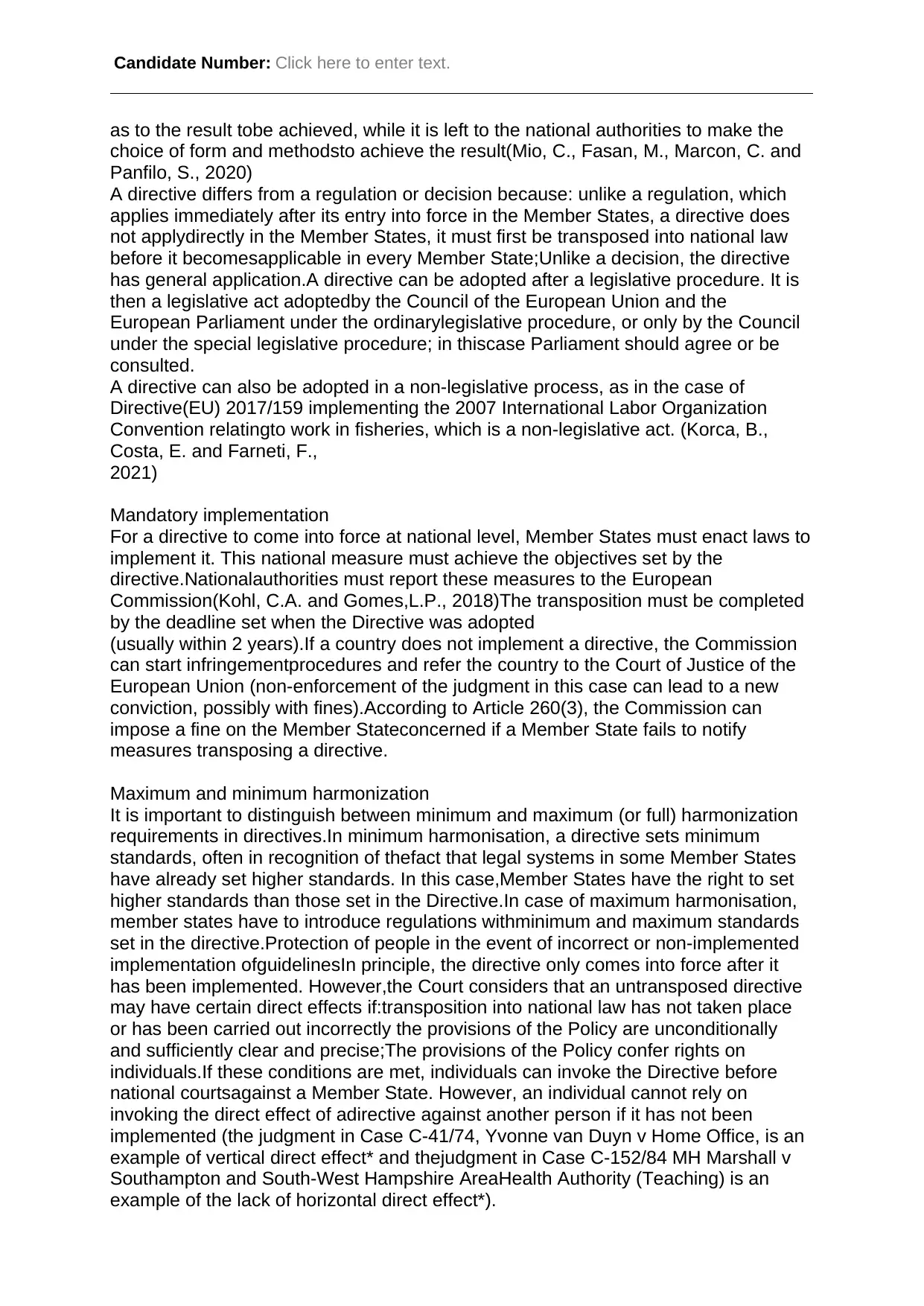
as to the result tobe achieved, while it is left to the national authorities to make the
choice of form and methodsto achieve the result(Mio, C., Fasan, M., Marcon, C. and
Panfilo, S., 2020)
A directive differs from a regulation or decision because: unlike a regulation, which
applies immediately after its entry into force in the Member States, a directive does
not applydirectly in the Member States, it must first be transposed into national law
before it becomesapplicable in every Member State;Unlike a decision, the directive
has general application.A directive can be adopted after a legislative procedure. It is
then a legislative act adoptedby the Council of the European Union and the
European Parliament under the ordinarylegislative procedure, or only by the Council
under the special legislative procedure; in thiscase Parliament should agree or be
consulted.
A directive can also be adopted in a non-legislative process, as in the case of
Directive(EU) 2017/159 implementing the 2007 International Labor Organization
Convention relatingto work in fisheries, which is a non-legislative act. (Korca, B.,
Costa, E. and Farneti, F.,
2021)
Mandatory implementation
For a directive to come into force at national level, Member States must enact laws to
implement it. This national measure must achieve the objectives set by the
directive.Nationalauthorities must report these measures to the European
Commission(Kohl, C.A. and Gomes,L.P., 2018)The transposition must be completed
by the deadline set when the Directive was adopted
(usually within 2 years).If a country does not implement a directive, the Commission
can start infringementprocedures and refer the country to the Court of Justice of the
European Union (non-enforcement of the judgment in this case can lead to a new
conviction, possibly with fines).According to Article 260(3), the Commission can
impose a fine on the Member Stateconcerned if a Member State fails to notify
measures transposing a directive.
Maximum and minimum harmonization
It is important to distinguish between minimum and maximum (or full) harmonization
requirements in directives.In minimum harmonisation, a directive sets minimum
standards, often in recognition of thefact that legal systems in some Member States
have already set higher standards. In this case,Member States have the right to set
higher standards than those set in the Directive.In case of maximum harmonisation,
member states have to introduce regulations withminimum and maximum standards
set in the directive.Protection of people in the event of incorrect or non-implemented
implementation ofguidelinesIn principle, the directive only comes into force after it
has been implemented. However,the Court considers that an untransposed directive
may have certain direct effects if:transposition into national law has not taken place
or has been carried out incorrectly the provisions of the Policy are unconditionally
and sufficiently clear and precise;The provisions of the Policy confer rights on
individuals.If these conditions are met, individuals can invoke the Directive before
national courtsagainst a Member State. However, an individual cannot rely on
invoking the direct effect of adirective against another person if it has not been
implemented (the judgment in Case C-41/74, Yvonne van Duyn v Home Office, is an
example of vertical direct effect* and thejudgment in Case C-152/84 MH Marshall v
Southampton and South-West Hampshire AreaHealth Authority (Teaching) is an
example of the lack of horizontal direct effect*).
as to the result tobe achieved, while it is left to the national authorities to make the
choice of form and methodsto achieve the result(Mio, C., Fasan, M., Marcon, C. and
Panfilo, S., 2020)
A directive differs from a regulation or decision because: unlike a regulation, which
applies immediately after its entry into force in the Member States, a directive does
not applydirectly in the Member States, it must first be transposed into national law
before it becomesapplicable in every Member State;Unlike a decision, the directive
has general application.A directive can be adopted after a legislative procedure. It is
then a legislative act adoptedby the Council of the European Union and the
European Parliament under the ordinarylegislative procedure, or only by the Council
under the special legislative procedure; in thiscase Parliament should agree or be
consulted.
A directive can also be adopted in a non-legislative process, as in the case of
Directive(EU) 2017/159 implementing the 2007 International Labor Organization
Convention relatingto work in fisheries, which is a non-legislative act. (Korca, B.,
Costa, E. and Farneti, F.,
2021)
Mandatory implementation
For a directive to come into force at national level, Member States must enact laws to
implement it. This national measure must achieve the objectives set by the
directive.Nationalauthorities must report these measures to the European
Commission(Kohl, C.A. and Gomes,L.P., 2018)The transposition must be completed
by the deadline set when the Directive was adopted
(usually within 2 years).If a country does not implement a directive, the Commission
can start infringementprocedures and refer the country to the Court of Justice of the
European Union (non-enforcement of the judgment in this case can lead to a new
conviction, possibly with fines).According to Article 260(3), the Commission can
impose a fine on the Member Stateconcerned if a Member State fails to notify
measures transposing a directive.
Maximum and minimum harmonization
It is important to distinguish between minimum and maximum (or full) harmonization
requirements in directives.In minimum harmonisation, a directive sets minimum
standards, often in recognition of thefact that legal systems in some Member States
have already set higher standards. In this case,Member States have the right to set
higher standards than those set in the Directive.In case of maximum harmonisation,
member states have to introduce regulations withminimum and maximum standards
set in the directive.Protection of people in the event of incorrect or non-implemented
implementation ofguidelinesIn principle, the directive only comes into force after it
has been implemented. However,the Court considers that an untransposed directive
may have certain direct effects if:transposition into national law has not taken place
or has been carried out incorrectly the provisions of the Policy are unconditionally
and sufficiently clear and precise;The provisions of the Policy confer rights on
individuals.If these conditions are met, individuals can invoke the Directive before
national courtsagainst a Member State. However, an individual cannot rely on
invoking the direct effect of adirective against another person if it has not been
implemented (the judgment in Case C-41/74, Yvonne van Duyn v Home Office, is an
example of vertical direct effect* and thejudgment in Case C-152/84 MH Marshall v
Southampton and South-West Hampshire AreaHealth Authority (Teaching) is an
example of the lack of horizontal direct effect*).
⊘ This is a preview!⊘
Do you want full access?
Subscribe today to unlock all pages.
Trusted by 1+ million students worldwide

1 out of 20


Related Documents


Your All-in-One AI-Powered Toolkit for Academic Success.
+13062052269
info@desklib.com
Available 24*7 on WhatsApp / Email
![[object Object]](/_next/static/media/star-bottom.7253800d.svg)
Unlock your academic potential
Copyright © 2020–2026 A2Z Services. All Rights Reserved. Developed and managed by ZUCOL.