EU Law 2018: Preliminary Reference Procedure Constraints and Issues
VerifiedAdded on 2021/04/21
|13
|3332
|34
Essay
AI Summary
This essay analyzes the preliminary reference procedure in EU Law, focusing on the constraints imposed by the reluctance of national courts and the Court of Justice of the European Union (CJEU). It explores the procedure under Article 267 of the Treaty on the Functioning of the European Union (TFEU), highlighting its role in ensuring uniform interpretation of EU law. The essay discusses the limitations of the procedure, including the gatekeeper role of national courts, the non-contentious nature of the process, and the varying degrees of engagement from national constitutional courts. Case law, such as Foglia v Novello and Rheinmühlen-Düsseldorf v. Einfuhr- und Vorratsstelle für Getreide und Futtermittel, is used to illustrate these constraints. The essay also examines the reluctance of national courts to make preliminary references, citing statistical data and behavioral explanations, such as judicial jealously and the desire to maintain authority. The essay concludes by emphasizing the importance of mutual assistance between the CJEU and national courts, despite the challenges and imperfections in the process.


Paraphrase This Document
Need a fresh take? Get an instant paraphrase of this document with our AI Paraphraser
EU Law 2
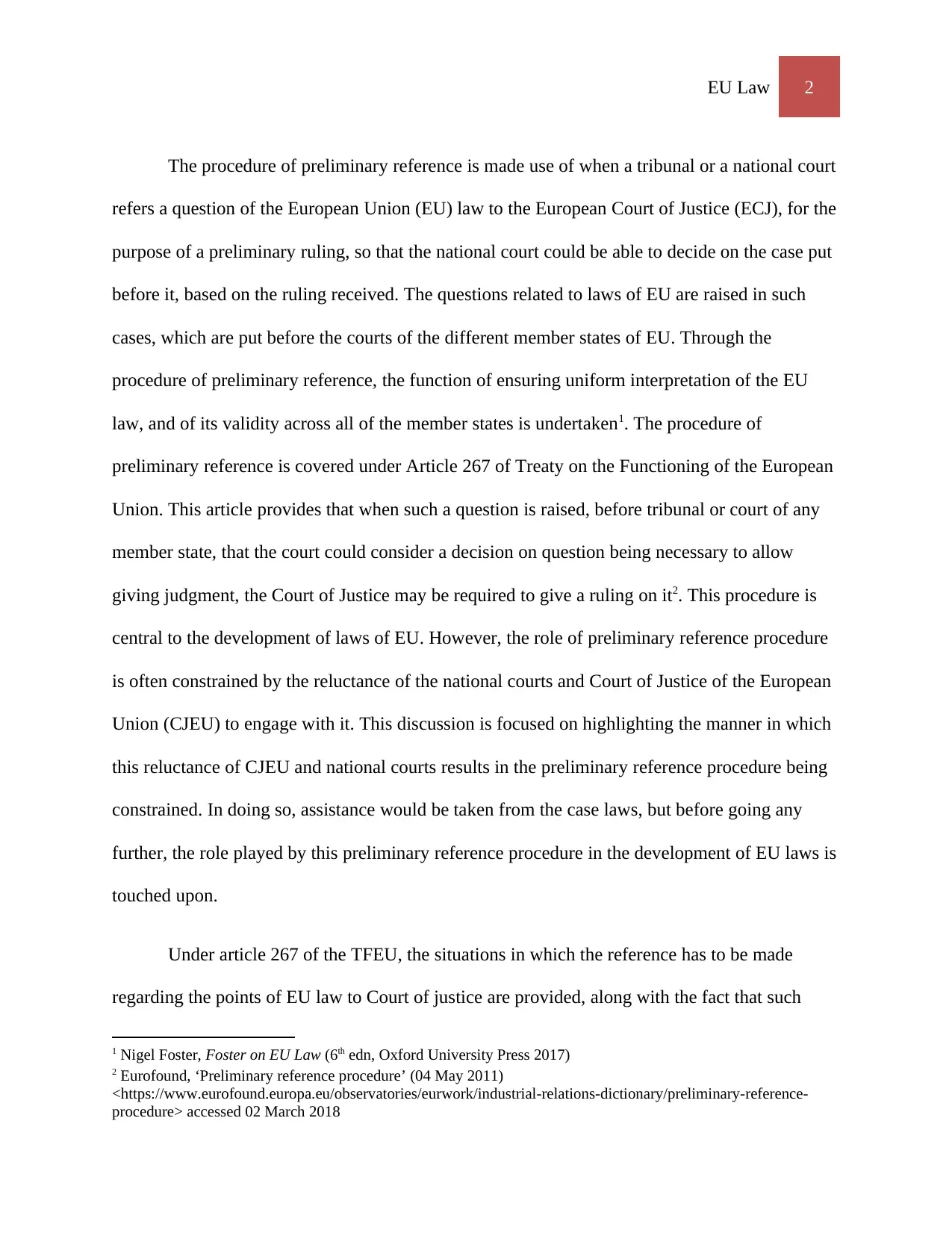
The procedure of preliminary reference is made use of when a tribunal or a national court
refers a question of the European Union (EU) law to the European Court of Justice (ECJ), for the
purpose of a preliminary ruling, so that the national court could be able to decide on the case put
before it, based on the ruling received. The questions related to laws of EU are raised in such
cases, which are put before the courts of the different member states of EU. Through the
procedure of preliminary reference, the function of ensuring uniform interpretation of the EU
law, and of its validity across all of the member states is undertaken1. The procedure of
preliminary reference is covered under Article 267 of Treaty on the Functioning of the European
Union. This article provides that when such a question is raised, before tribunal or court of any
member state, that the court could consider a decision on question being necessary to allow
giving judgment, the Court of Justice may be required to give a ruling on it2. This procedure is
central to the development of laws of EU. However, the role of preliminary reference procedure
is often constrained by the reluctance of the national courts and Court of Justice of the European
Union (CJEU) to engage with it. This discussion is focused on highlighting the manner in which
this reluctance of CJEU and national courts results in the preliminary reference procedure being
constrained. In doing so, assistance would be taken from the case laws, but before going any
further, the role played by this preliminary reference procedure in the development of EU laws is
touched upon.
Under article 267 of the TFEU, the situations in which the reference has to be made
regarding the points of EU law to Court of justice are provided, along with the fact that such
1 Nigel Foster, Foster on EU Law (6th edn, Oxford University Press 2017)
2 Eurofound, ‘Preliminary reference procedure’ (04 May 2011)
<https://www.eurofound.europa.eu/observatories/eurwork/industrial-relations-dictionary/preliminary-reference-
procedure> accessed 02 March 2018
The procedure of preliminary reference is made use of when a tribunal or a national court
refers a question of the European Union (EU) law to the European Court of Justice (ECJ), for the
purpose of a preliminary ruling, so that the national court could be able to decide on the case put
before it, based on the ruling received. The questions related to laws of EU are raised in such
cases, which are put before the courts of the different member states of EU. Through the
procedure of preliminary reference, the function of ensuring uniform interpretation of the EU
law, and of its validity across all of the member states is undertaken1. The procedure of
preliminary reference is covered under Article 267 of Treaty on the Functioning of the European
Union. This article provides that when such a question is raised, before tribunal or court of any
member state, that the court could consider a decision on question being necessary to allow
giving judgment, the Court of Justice may be required to give a ruling on it2. This procedure is
central to the development of laws of EU. However, the role of preliminary reference procedure
is often constrained by the reluctance of the national courts and Court of Justice of the European
Union (CJEU) to engage with it. This discussion is focused on highlighting the manner in which
this reluctance of CJEU and national courts results in the preliminary reference procedure being
constrained. In doing so, assistance would be taken from the case laws, but before going any
further, the role played by this preliminary reference procedure in the development of EU laws is
touched upon.
Under article 267 of the TFEU, the situations in which the reference has to be made
regarding the points of EU law to Court of justice are provided, along with the fact that such
1 Nigel Foster, Foster on EU Law (6th edn, Oxford University Press 2017)
2 Eurofound, ‘Preliminary reference procedure’ (04 May 2011)
<https://www.eurofound.europa.eu/observatories/eurwork/industrial-relations-dictionary/preliminary-reference-
procedure> accessed 02 March 2018
EU Law 3
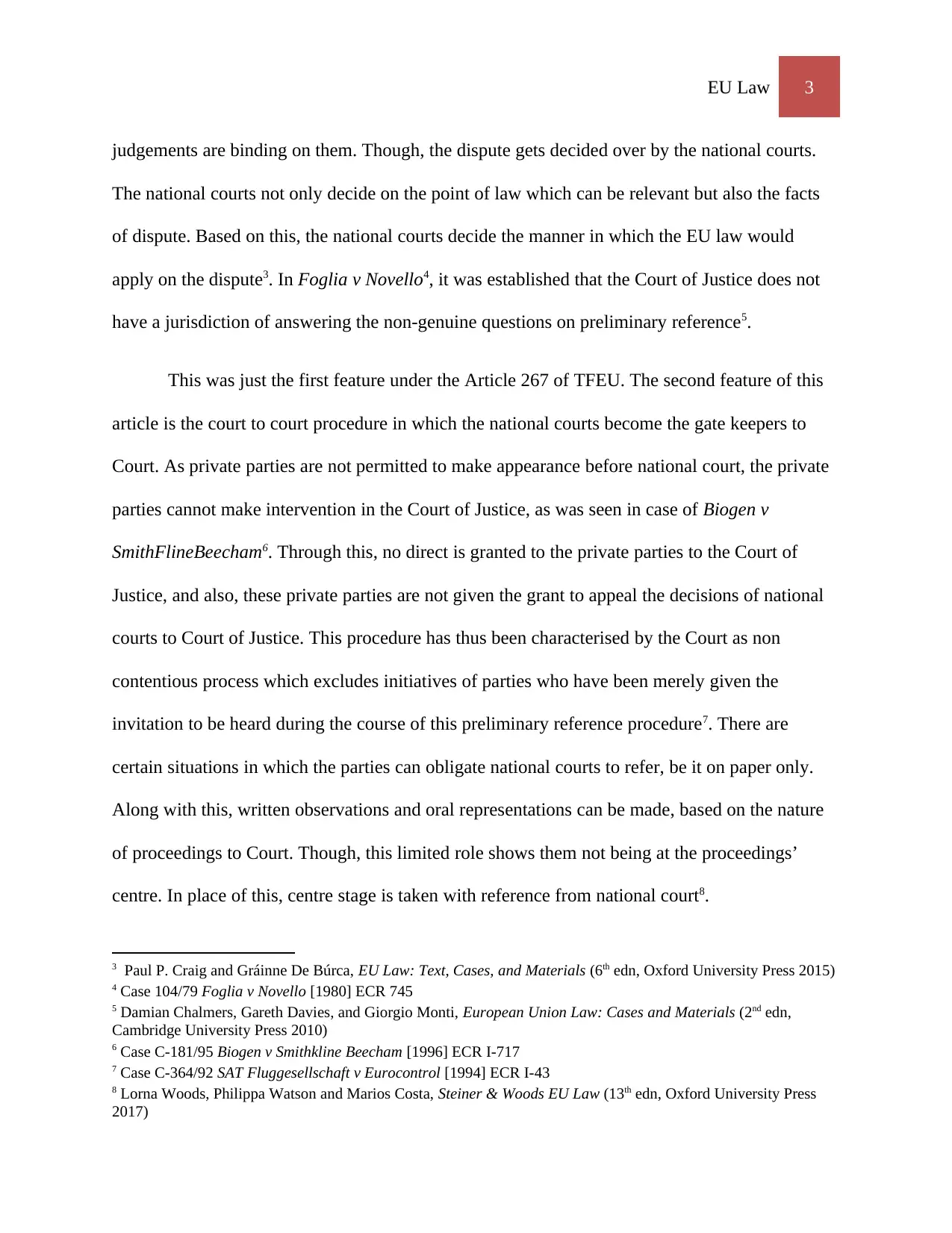
judgements are binding on them. Though, the dispute gets decided over by the national courts.
The national courts not only decide on the point of law which can be relevant but also the facts
of dispute. Based on this, the national courts decide the manner in which the EU law would
apply on the dispute3. In Foglia v Novello4, it was established that the Court of Justice does not
have a jurisdiction of answering the non-genuine questions on preliminary reference5.
This was just the first feature under the Article 267 of TFEU. The second feature of this
article is the court to court procedure in which the national courts become the gate keepers to
Court. As private parties are not permitted to make appearance before national court, the private
parties cannot make intervention in the Court of Justice, as was seen in case of Biogen v
SmithFlineBeecham6. Through this, no direct is granted to the private parties to the Court of
Justice, and also, these private parties are not given the grant to appeal the decisions of national
courts to Court of Justice. This procedure has thus been characterised by the Court as non
contentious process which excludes initiatives of parties who have been merely given the
invitation to be heard during the course of this preliminary reference procedure7. There are
certain situations in which the parties can obligate national courts to refer, be it on paper only.
Along with this, written observations and oral representations can be made, based on the nature
of proceedings to Court. Though, this limited role shows them not being at the proceedings’
centre. In place of this, centre stage is taken with reference from national court8.
3 Paul P. Craig and Gráinne De Búrca, EU Law: Text, Cases, and Materials (6th edn, Oxford University Press 2015)
4 Case 104/79 Foglia v Novello [1980] ECR 745
5 Damian Chalmers, Gareth Davies, and Giorgio Monti, European Union Law: Cases and Materials (2nd edn,
Cambridge University Press 2010)
6 Case C-181/95 Biogen v Smithkline Beecham [1996] ECR I-717
7 Case C-364/92 SAT Fluggesellschaft v Eurocontrol [1994] ECR I-43
8 Lorna Woods, Philippa Watson and Marios Costa, Steiner & Woods EU Law (13th edn, Oxford University Press
2017)
judgements are binding on them. Though, the dispute gets decided over by the national courts.
The national courts not only decide on the point of law which can be relevant but also the facts
of dispute. Based on this, the national courts decide the manner in which the EU law would
apply on the dispute3. In Foglia v Novello4, it was established that the Court of Justice does not
have a jurisdiction of answering the non-genuine questions on preliminary reference5.
This was just the first feature under the Article 267 of TFEU. The second feature of this
article is the court to court procedure in which the national courts become the gate keepers to
Court. As private parties are not permitted to make appearance before national court, the private
parties cannot make intervention in the Court of Justice, as was seen in case of Biogen v
SmithFlineBeecham6. Through this, no direct is granted to the private parties to the Court of
Justice, and also, these private parties are not given the grant to appeal the decisions of national
courts to Court of Justice. This procedure has thus been characterised by the Court as non
contentious process which excludes initiatives of parties who have been merely given the
invitation to be heard during the course of this preliminary reference procedure7. There are
certain situations in which the parties can obligate national courts to refer, be it on paper only.
Along with this, written observations and oral representations can be made, based on the nature
of proceedings to Court. Though, this limited role shows them not being at the proceedings’
centre. In place of this, centre stage is taken with reference from national court8.
3 Paul P. Craig and Gráinne De Búrca, EU Law: Text, Cases, and Materials (6th edn, Oxford University Press 2015)
4 Case 104/79 Foglia v Novello [1980] ECR 745
5 Damian Chalmers, Gareth Davies, and Giorgio Monti, European Union Law: Cases and Materials (2nd edn,
Cambridge University Press 2010)
6 Case C-181/95 Biogen v Smithkline Beecham [1996] ECR I-717
7 Case C-364/92 SAT Fluggesellschaft v Eurocontrol [1994] ECR I-43
8 Lorna Woods, Philippa Watson and Marios Costa, Steiner & Woods EU Law (13th edn, Oxford University Press
2017)
⊘ This is a preview!⊘
Do you want full access?
Subscribe today to unlock all pages.

Trusted by 1+ million students worldwide
EU Law 4
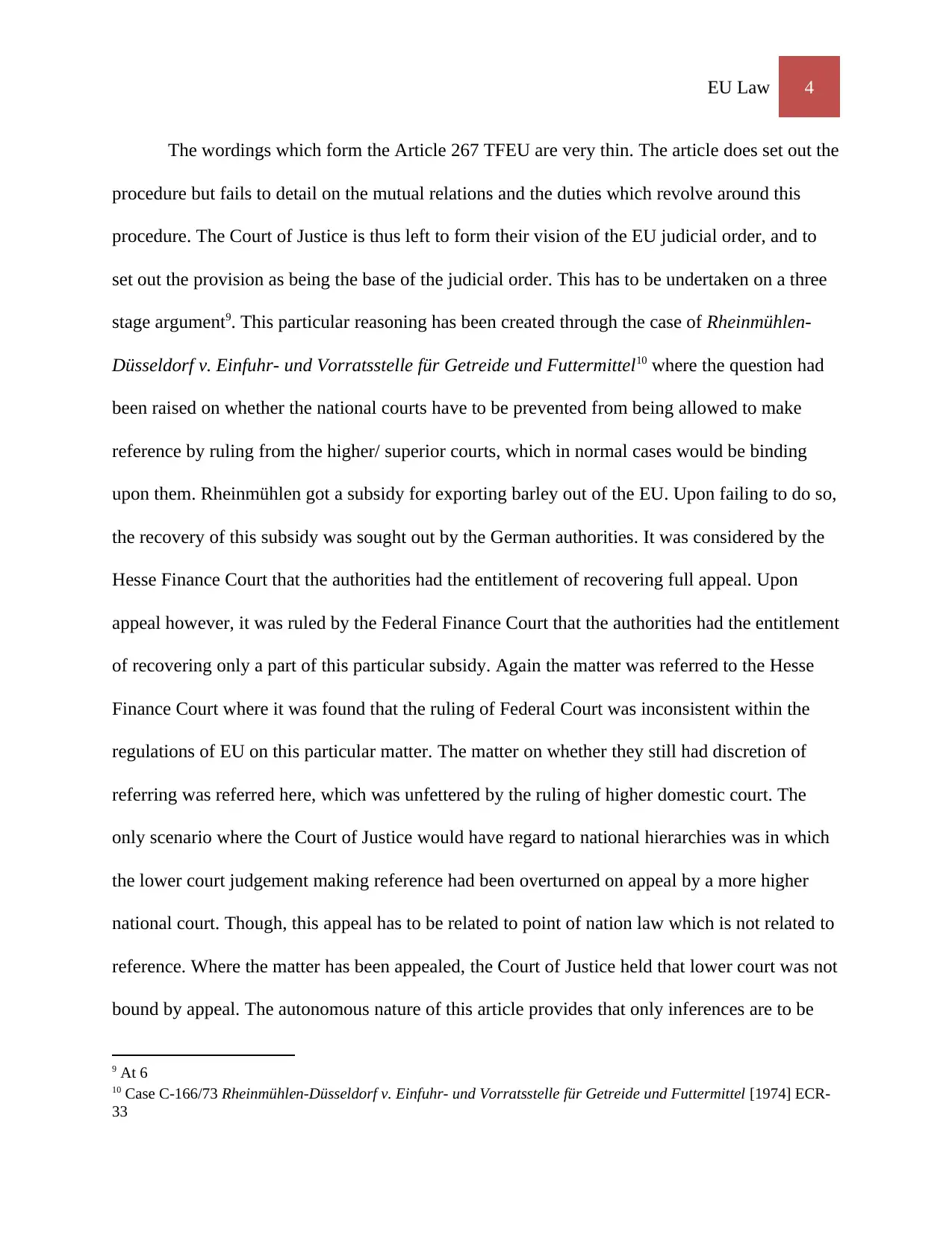
The wordings which form the Article 267 TFEU are very thin. The article does set out the
procedure but fails to detail on the mutual relations and the duties which revolve around this
procedure. The Court of Justice is thus left to form their vision of the EU judicial order, and to
set out the provision as being the base of the judicial order. This has to be undertaken on a three
stage argument9. This particular reasoning has been created through the case of Rheinmühlen-
Düsseldorf v. Einfuhr- und Vorratsstelle für Getreide und Futtermittel10 where the question had
been raised on whether the national courts have to be prevented from being allowed to make
reference by ruling from the higher/ superior courts, which in normal cases would be binding
upon them. Rheinmühlen got a subsidy for exporting barley out of the EU. Upon failing to do so,
the recovery of this subsidy was sought out by the German authorities. It was considered by the
Hesse Finance Court that the authorities had the entitlement of recovering full appeal. Upon
appeal however, it was ruled by the Federal Finance Court that the authorities had the entitlement
of recovering only a part of this particular subsidy. Again the matter was referred to the Hesse
Finance Court where it was found that the ruling of Federal Court was inconsistent within the
regulations of EU on this particular matter. The matter on whether they still had discretion of
referring was referred here, which was unfettered by the ruling of higher domestic court. The
only scenario where the Court of Justice would have regard to national hierarchies was in which
the lower court judgement making reference had been overturned on appeal by a more higher
national court. Though, this appeal has to be related to point of nation law which is not related to
reference. Where the matter has been appealed, the Court of Justice held that lower court was not
bound by appeal. The autonomous nature of this article provides that only inferences are to be
9 At 6
10 Case C-166/73 Rheinmühlen-Düsseldorf v. Einfuhr- und Vorratsstelle für Getreide und Futtermittel [1974] ECR-
33
The wordings which form the Article 267 TFEU are very thin. The article does set out the
procedure but fails to detail on the mutual relations and the duties which revolve around this
procedure. The Court of Justice is thus left to form their vision of the EU judicial order, and to
set out the provision as being the base of the judicial order. This has to be undertaken on a three
stage argument9. This particular reasoning has been created through the case of Rheinmühlen-
Düsseldorf v. Einfuhr- und Vorratsstelle für Getreide und Futtermittel10 where the question had
been raised on whether the national courts have to be prevented from being allowed to make
reference by ruling from the higher/ superior courts, which in normal cases would be binding
upon them. Rheinmühlen got a subsidy for exporting barley out of the EU. Upon failing to do so,
the recovery of this subsidy was sought out by the German authorities. It was considered by the
Hesse Finance Court that the authorities had the entitlement of recovering full appeal. Upon
appeal however, it was ruled by the Federal Finance Court that the authorities had the entitlement
of recovering only a part of this particular subsidy. Again the matter was referred to the Hesse
Finance Court where it was found that the ruling of Federal Court was inconsistent within the
regulations of EU on this particular matter. The matter on whether they still had discretion of
referring was referred here, which was unfettered by the ruling of higher domestic court. The
only scenario where the Court of Justice would have regard to national hierarchies was in which
the lower court judgement making reference had been overturned on appeal by a more higher
national court. Though, this appeal has to be related to point of nation law which is not related to
reference. Where the matter has been appealed, the Court of Justice held that lower court was not
bound by appeal. The autonomous nature of this article provides that only inferences are to be
9 At 6
10 Case C-166/73 Rheinmühlen-Düsseldorf v. Einfuhr- und Vorratsstelle für Getreide und Futtermittel [1974] ECR-
33
Paraphrase This Document
Need a fresh take? Get an instant paraphrase of this document with our AI Paraphraser
EU Law 5
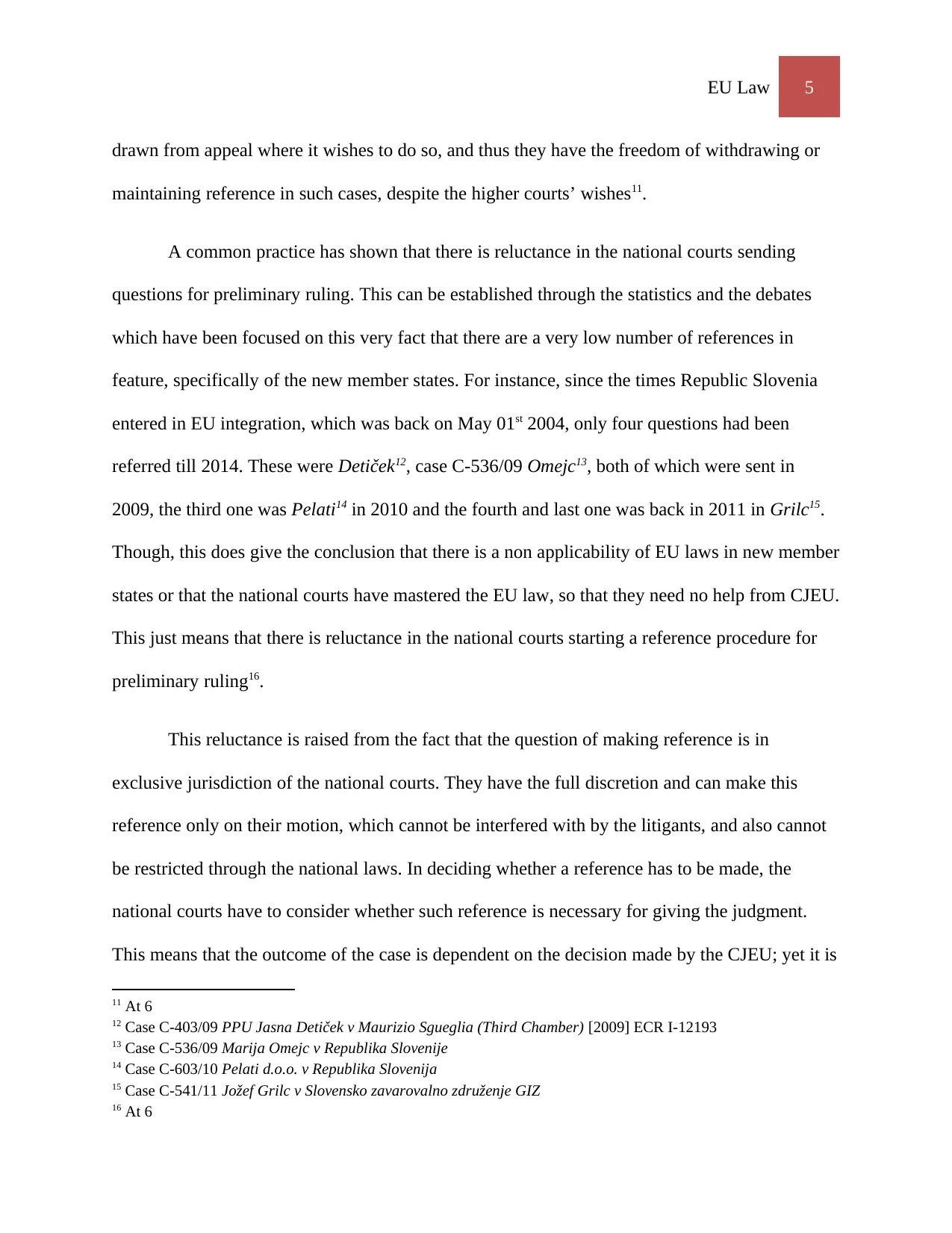
drawn from appeal where it wishes to do so, and thus they have the freedom of withdrawing or
maintaining reference in such cases, despite the higher courts’ wishes11.
A common practice has shown that there is reluctance in the national courts sending
questions for preliminary ruling. This can be established through the statistics and the debates
which have been focused on this very fact that there are a very low number of references in
feature, specifically of the new member states. For instance, since the times Republic Slovenia
entered in EU integration, which was back on May 01st 2004, only four questions had been
referred till 2014. These were Detiček12, case C-536/09 Omejc13, both of which were sent in
2009, the third one was Pelati14 in 2010 and the fourth and last one was back in 2011 in Grilc15.
Though, this does give the conclusion that there is a non applicability of EU laws in new member
states or that the national courts have mastered the EU law, so that they need no help from CJEU.
This just means that there is reluctance in the national courts starting a reference procedure for
preliminary ruling16.
This reluctance is raised from the fact that the question of making reference is in
exclusive jurisdiction of the national courts. They have the full discretion and can make this
reference only on their motion, which cannot be interfered with by the litigants, and also cannot
be restricted through the national laws. In deciding whether a reference has to be made, the
national courts have to consider whether such reference is necessary for giving the judgment.
This means that the outcome of the case is dependent on the decision made by the CJEU; yet it is
11 At 6
12 Case C-403/09 PPU Jasna Detiček v Maurizio Sgueglia (Third Chamber) [2009] ECR I-12193
13 Case C-536/09 Marija Omejc v Republika Slovenije
14 Case C-603/10 Pelati d.o.o. v Republika Slovenija
15 Case C-541/11 Jožef Grilc v Slovensko zavarovalno združenje GIZ
16 At 6
drawn from appeal where it wishes to do so, and thus they have the freedom of withdrawing or
maintaining reference in such cases, despite the higher courts’ wishes11.
A common practice has shown that there is reluctance in the national courts sending
questions for preliminary ruling. This can be established through the statistics and the debates
which have been focused on this very fact that there are a very low number of references in
feature, specifically of the new member states. For instance, since the times Republic Slovenia
entered in EU integration, which was back on May 01st 2004, only four questions had been
referred till 2014. These were Detiček12, case C-536/09 Omejc13, both of which were sent in
2009, the third one was Pelati14 in 2010 and the fourth and last one was back in 2011 in Grilc15.
Though, this does give the conclusion that there is a non applicability of EU laws in new member
states or that the national courts have mastered the EU law, so that they need no help from CJEU.
This just means that there is reluctance in the national courts starting a reference procedure for
preliminary ruling16.
This reluctance is raised from the fact that the question of making reference is in
exclusive jurisdiction of the national courts. They have the full discretion and can make this
reference only on their motion, which cannot be interfered with by the litigants, and also cannot
be restricted through the national laws. In deciding whether a reference has to be made, the
national courts have to consider whether such reference is necessary for giving the judgment.
This means that the outcome of the case is dependent on the decision made by the CJEU; yet it is
11 At 6
12 Case C-403/09 PPU Jasna Detiček v Maurizio Sgueglia (Third Chamber) [2009] ECR I-12193
13 Case C-536/09 Marija Omejc v Republika Slovenije
14 Case C-603/10 Pelati d.o.o. v Republika Slovenija
15 Case C-541/11 Jožef Grilc v Slovensko zavarovalno združenje GIZ
16 At 6
EU Law 6
accepted that such a necessity is present even when the verdict is conclusive merely potentially17.
There is no need of a reference to get an answer on a question, despite the question being
anything the outcome of the case is not affected, as was seen in CILFIT v Ministry of Health18.
The decision on the matter of which stage in a proceeding should such a question be referred for
preliminary ruling to CJEU is based on the consideration of procedural economy, along with the
efficiency being weight by national courts, instead of the same being done by the CJEU and an
example of this is Pretore di Salo v Persons Unknown 19.
The national constitutional courts also resist the law version of EU regarding the
supremacy of the EU law. The primacy law version for EU law is still of unconditional primacy
and being absolute. This means that all the EU law which has been adopted validly, has to take
precedence over the laws of the nation and this includes the national constitutional laws. Further,
the national courts are under the obligation of the EU law to dis-apply or set aside the conflicting
measures of the laws of the nation, which includes its constitutional law20. Exclusive jurisdiction
is claimed by the Court of Justice on EU law validity and on declaring the EU law measures
invalid. Owing to these reasons, the preliminary ruling reference has to be made by the national
courts21. Where this primacy is not present, there would be no uniform application of EU law,
and each member state would adopt their version of EU laws. This logic is very compelling from
the perspective of EU. Though, this EU law logic is not so much compelling for the national
courts, due to the reason that their national constitution is the only and the ultimate base of
17 Edita Turičnik, ‘Preliminary Reference Procedure – The Right, The Duty And Exceptions’ (2014) 1(1)
Intereulaweast
18 Case 283/81 CILFIT v Ministry of Health [1982] ECR 3415
19 Case 14/86 Pretore di Salo v Persons Unknown [1987] ECR 2545
20 Case 6/64 Costa v. ENEL, EU:C:1964:66; Case 106/77 Simmenthal, EU:C:1978:49.
21 Case 314/85 Foto-Frost, EU:C:1987:452.
accepted that such a necessity is present even when the verdict is conclusive merely potentially17.
There is no need of a reference to get an answer on a question, despite the question being
anything the outcome of the case is not affected, as was seen in CILFIT v Ministry of Health18.
The decision on the matter of which stage in a proceeding should such a question be referred for
preliminary ruling to CJEU is based on the consideration of procedural economy, along with the
efficiency being weight by national courts, instead of the same being done by the CJEU and an
example of this is Pretore di Salo v Persons Unknown 19.
The national constitutional courts also resist the law version of EU regarding the
supremacy of the EU law. The primacy law version for EU law is still of unconditional primacy
and being absolute. This means that all the EU law which has been adopted validly, has to take
precedence over the laws of the nation and this includes the national constitutional laws. Further,
the national courts are under the obligation of the EU law to dis-apply or set aside the conflicting
measures of the laws of the nation, which includes its constitutional law20. Exclusive jurisdiction
is claimed by the Court of Justice on EU law validity and on declaring the EU law measures
invalid. Owing to these reasons, the preliminary ruling reference has to be made by the national
courts21. Where this primacy is not present, there would be no uniform application of EU law,
and each member state would adopt their version of EU laws. This logic is very compelling from
the perspective of EU. Though, this EU law logic is not so much compelling for the national
courts, due to the reason that their national constitution is the only and the ultimate base of
17 Edita Turičnik, ‘Preliminary Reference Procedure – The Right, The Duty And Exceptions’ (2014) 1(1)
Intereulaweast
18 Case 283/81 CILFIT v Ministry of Health [1982] ECR 3415
19 Case 14/86 Pretore di Salo v Persons Unknown [1987] ECR 2545
20 Case 6/64 Costa v. ENEL, EU:C:1964:66; Case 106/77 Simmenthal, EU:C:1978:49.
21 Case 314/85 Foto-Frost, EU:C:1987:452.
⊘ This is a preview!⊘
Do you want full access?
Subscribe today to unlock all pages.
Trusted by 1+ million students worldwide
EU Law 7
providing legitimacy. There is a lack of acceptance of the EU law by the national courts for
giving precedence to the EU law over the primary legislation, a number of them reject the
unconditional primacy and absolute validity of EU law over national laws. The reasoning for this
is simple; as the base of this primacy is covered under the constitution, they are limited by this
very limitation and thus the EU could not be allowed to do something which the constitution bars
national authorities from undertaking. As a result of this, the EU law cannot breach the
constitution, particularly its core provisions22.
The majority of national or the constitutional courts have avoided making the reference
for preliminary ruling and there are a number of reasons for this, both in the legal arguments, as
well as, in the behavioural explanations. The legal arguments refusal can be seen in the example
of the Spanish, Italian and French courts refusing to go for preliminary ruling. There has been a
denial by the Italian constitutional Court that it is not qualified as a tribunal or court in sense of
the article 267 of TFEU as it only exercises the functions surrounding the constitutional review,
which guaranteed that there was observance of constitution in the Italian state, institutions and
sub state bodies. In the same manner, the French Constitutional Council did not consider itself as
being an ordinary court of EU law owing to its peculiar position in the legal order of France and
the atypical competency of reviewing the statutes only outside any controversy case, and a priori.
They also act under strict and short time periods which excludes reference to Court of Justice.
There is also the conception of strict division between their obligations of reviewing the
legislation’s constitutionnalité and that to review the conventionnalité of the ordinary court,
which resulted in it being highly unlikely to making reference, which left this matter to the
22 Monica Claes, The Validity And Primacy Of EU Law And The ‘Cooperative Relationship’ Between National
Constitutional Courts And The Court Of Justice Of The European Union (2016) 23 MJ 1
providing legitimacy. There is a lack of acceptance of the EU law by the national courts for
giving precedence to the EU law over the primary legislation, a number of them reject the
unconditional primacy and absolute validity of EU law over national laws. The reasoning for this
is simple; as the base of this primacy is covered under the constitution, they are limited by this
very limitation and thus the EU could not be allowed to do something which the constitution bars
national authorities from undertaking. As a result of this, the EU law cannot breach the
constitution, particularly its core provisions22.
The majority of national or the constitutional courts have avoided making the reference
for preliminary ruling and there are a number of reasons for this, both in the legal arguments, as
well as, in the behavioural explanations. The legal arguments refusal can be seen in the example
of the Spanish, Italian and French courts refusing to go for preliminary ruling. There has been a
denial by the Italian constitutional Court that it is not qualified as a tribunal or court in sense of
the article 267 of TFEU as it only exercises the functions surrounding the constitutional review,
which guaranteed that there was observance of constitution in the Italian state, institutions and
sub state bodies. In the same manner, the French Constitutional Council did not consider itself as
being an ordinary court of EU law owing to its peculiar position in the legal order of France and
the atypical competency of reviewing the statutes only outside any controversy case, and a priori.
They also act under strict and short time periods which excludes reference to Court of Justice.
There is also the conception of strict division between their obligations of reviewing the
legislation’s constitutionnalité and that to review the conventionnalité of the ordinary court,
which resulted in it being highly unlikely to making reference, which left this matter to the
22 Monica Claes, The Validity And Primacy Of EU Law And The ‘Cooperative Relationship’ Between National
Constitutional Courts And The Court Of Justice Of The European Union (2016) 23 MJ 1
Paraphrase This Document
Need a fresh take? Get an instant paraphrase of this document with our AI Paraphraser
EU Law 8
ordinary courts. The Spanish constitutional tribunal also put the same argument. Coming to the
behavioural explanations, these are related to the judicial jealously, judicial ego and the courts
being pretty much protection of the position which they hold in the highest court of land.
Apparently, the courts have shown reluctance in making reference as doing so would be deemed
as a voluntary subjection to the external court’s authority as it would assume that the sender of
such a question would deem themselves bound to such an answer. The national courts would
want to avoid such a situation from taking place23.
The theme of Article 267 is to create a spirit of mutual assistance in between the CJEU
and the national courts. Yet, this is threatened by a number of imperfections, which include the
incomprehensive judgments, the unacceptable delays and the extra costs. As a result of this, the
highest courts of UK have been wary in making a preliminary ruling reference to CJEU as have
been seen observed by Kenny24 and Rasmussen25. In 2012, the average length of preliminary
ruling procedure had been 15.7 months. An example of these factors being considered can be
found in the consideration of English Courts in the matter of Abbey National Plc &Ors v The
Office of Fair Trading26. In this case, it was held that the public interest in context of solving the
dispute was outweighed heavily from the need of making the preliminary ruling reference27.
23 J.H.H. Weiler, ‘Judicial Ego’, (2011) 9 International Journal of Constitutional Law 1
24 Mel Kenny, ‘Options between Legislative Intervention and Judicial Collaboration: Improving the Effectiveness
and Coherence of EU law?’ (2012) 63(4) Northern Ireland Legal Quarterly 435
25 Hjalte Rasmussen, 'Remedying the Crumbling EC Judicial System ' (2000) 37(5) Common Market Law Review
1071
26 Abbey National Plc &Ors v The Office of Fair Trading [2009] UKSC 6
27 Monika Kirilova Kirova, ‘An Analysis of the Relationship between National Courts and the Court of Justice of the
European Union – Shifting from Cooperation to Superiority’ (June 2016)
<https://queenspoliticalreview.files.wordpress.com/2014/06/240_cjeu_eu-final-04-04-2014.pdf> accessed 02 May
2018
ordinary courts. The Spanish constitutional tribunal also put the same argument. Coming to the
behavioural explanations, these are related to the judicial jealously, judicial ego and the courts
being pretty much protection of the position which they hold in the highest court of land.
Apparently, the courts have shown reluctance in making reference as doing so would be deemed
as a voluntary subjection to the external court’s authority as it would assume that the sender of
such a question would deem themselves bound to such an answer. The national courts would
want to avoid such a situation from taking place23.
The theme of Article 267 is to create a spirit of mutual assistance in between the CJEU
and the national courts. Yet, this is threatened by a number of imperfections, which include the
incomprehensive judgments, the unacceptable delays and the extra costs. As a result of this, the
highest courts of UK have been wary in making a preliminary ruling reference to CJEU as have
been seen observed by Kenny24 and Rasmussen25. In 2012, the average length of preliminary
ruling procedure had been 15.7 months. An example of these factors being considered can be
found in the consideration of English Courts in the matter of Abbey National Plc &Ors v The
Office of Fair Trading26. In this case, it was held that the public interest in context of solving the
dispute was outweighed heavily from the need of making the preliminary ruling reference27.
23 J.H.H. Weiler, ‘Judicial Ego’, (2011) 9 International Journal of Constitutional Law 1
24 Mel Kenny, ‘Options between Legislative Intervention and Judicial Collaboration: Improving the Effectiveness
and Coherence of EU law?’ (2012) 63(4) Northern Ireland Legal Quarterly 435
25 Hjalte Rasmussen, 'Remedying the Crumbling EC Judicial System ' (2000) 37(5) Common Market Law Review
1071
26 Abbey National Plc &Ors v The Office of Fair Trading [2009] UKSC 6
27 Monika Kirilova Kirova, ‘An Analysis of the Relationship between National Courts and the Court of Justice of the
European Union – Shifting from Cooperation to Superiority’ (June 2016)
<https://queenspoliticalreview.files.wordpress.com/2014/06/240_cjeu_eu-final-04-04-2014.pdf> accessed 02 May
2018
EU Law 9
There have been some studies on the referral pattern of the national courts. The
environmental disputes study in UK depicted that the courts of UK refrained from submitting the
reference where they wanted to safeguard their domestic policy against the CJEU’s engagement
as it was expected to result in negative results for their domestic policy. The study undertaken by
Wind showed that the Swedish and the Danish judges felt a political pressure from their
superiors, owing to which, there was reluctance from submitting to the preliminary reference.
There was a hesitation amongst these judges to refer any matter to CJEU where the case was
related to the national sensitive policies, for instance the social rights. The willingness of the
courts plays a key role in the court making reference, along with the conclusion from the studies
mentioned above in the UK, Sweden and Denmark showing refusal of submitting reference to
take place in cases where reference had to be submitted, or where the nation courts simply
refused to apply the legislations of EU in a correct manner. An example of this can be cited in
the HS2 case28. This case was presented before the Supreme Court of UK, where the Supreme
Court refused to make submission to the CJEU for the preliminary reference and also rejected
the argument based complaint on the opinion of Advocate General Kokott and Advocate General
Sharpston. This was because the arguments which stemmed from the opinion of the two
advocate generals had not been endorsed by CJEU; and so, a reference could not be made for
preliminary reference. A lack of supervision mechanism monitoring the refusal of national courts
for preliminary reference is a breach of EU laws, and this leaves a lot of scope for the possible
non-compliances by the national courts of the EU laws, thus beating the purpose of bringing
uniformity in the EU laws across the member states29.
28 R (HS2 Action Alliance Ltd) v Secretary of State for transport [2014] UKSC 3
29 J.M.R. van Casteren, ‘Who Is Watching the Courts? Supervising the Preliminary Ruling Procedure’ (Tilburg
University, 8 July 2016) <http://arno.uvt.nl/show.cgi?fid=142166> accessed 02 May 2018
There have been some studies on the referral pattern of the national courts. The
environmental disputes study in UK depicted that the courts of UK refrained from submitting the
reference where they wanted to safeguard their domestic policy against the CJEU’s engagement
as it was expected to result in negative results for their domestic policy. The study undertaken by
Wind showed that the Swedish and the Danish judges felt a political pressure from their
superiors, owing to which, there was reluctance from submitting to the preliminary reference.
There was a hesitation amongst these judges to refer any matter to CJEU where the case was
related to the national sensitive policies, for instance the social rights. The willingness of the
courts plays a key role in the court making reference, along with the conclusion from the studies
mentioned above in the UK, Sweden and Denmark showing refusal of submitting reference to
take place in cases where reference had to be submitted, or where the nation courts simply
refused to apply the legislations of EU in a correct manner. An example of this can be cited in
the HS2 case28. This case was presented before the Supreme Court of UK, where the Supreme
Court refused to make submission to the CJEU for the preliminary reference and also rejected
the argument based complaint on the opinion of Advocate General Kokott and Advocate General
Sharpston. This was because the arguments which stemmed from the opinion of the two
advocate generals had not been endorsed by CJEU; and so, a reference could not be made for
preliminary reference. A lack of supervision mechanism monitoring the refusal of national courts
for preliminary reference is a breach of EU laws, and this leaves a lot of scope for the possible
non-compliances by the national courts of the EU laws, thus beating the purpose of bringing
uniformity in the EU laws across the member states29.
28 R (HS2 Action Alliance Ltd) v Secretary of State for transport [2014] UKSC 3
29 J.M.R. van Casteren, ‘Who Is Watching the Courts? Supervising the Preliminary Ruling Procedure’ (Tilburg
University, 8 July 2016) <http://arno.uvt.nl/show.cgi?fid=142166> accessed 02 May 2018
⊘ This is a preview!⊘
Do you want full access?
Subscribe today to unlock all pages.
Trusted by 1+ million students worldwide
EU Law 10
Hence, from the discussion which had been undertaken in this essay, it can be concluded
that the Article 267 of the TFEU provides a key principle, where the national courts are required
to make reference for preliminary ruling, in order to attain clarity on a matter of EU law. This
article ensures that the law of EU is applied in a uniform manner across all the member states.
But where the national courts and even the CJEU for that matter fail in making this reference, the
purpose of this article is not met. This means that there is an uneven applicability of EU laws.
This reluctance is based on varied reasons. Further, this reluctance is not only present in the
common courts of the member states, but also in the national constitutional courts. This was
established not only through the case laws, but also from the statistical data. This requires a
mechanism to be put in place, which can stop the national courts from evading their duty of
referring a matter for preliminary ruling in a compulsory manner.
Hence, from the discussion which had been undertaken in this essay, it can be concluded
that the Article 267 of the TFEU provides a key principle, where the national courts are required
to make reference for preliminary ruling, in order to attain clarity on a matter of EU law. This
article ensures that the law of EU is applied in a uniform manner across all the member states.
But where the national courts and even the CJEU for that matter fail in making this reference, the
purpose of this article is not met. This means that there is an uneven applicability of EU laws.
This reluctance is based on varied reasons. Further, this reluctance is not only present in the
common courts of the member states, but also in the national constitutional courts. This was
established not only through the case laws, but also from the statistical data. This requires a
mechanism to be put in place, which can stop the national courts from evading their duty of
referring a matter for preliminary ruling in a compulsory manner.
Paraphrase This Document
Need a fresh take? Get an instant paraphrase of this document with our AI Paraphraser
EU Law 11
Bibliography
Primary Sources
Cases
Abbey National Plc &Ors v The Office of Fair Trading [2009] UKSC 6
R (HS2 Action Alliance Ltd) v Secretary of State for transport [2014] UKSC 3
EU legislation and cases
Case 104/79 Foglia v Novello [1980] ECR 745
Case 14/86 Pretore di Salo v Persons Unknown [1987] ECR 2545
Case 283/81 CILFIT v Ministry of Health [1982] ECR 3415
Case 314/85 Foto-Frost, EU:C:1987:452.
Case 6/64 Costa v. ENEL, EU:C:1964:66; Case 106/77 Simmenthal, EU:C:1978:49.
Case C-166/73 Rheinmühlen-Düsseldorf v. Einfuhr- und Vorratsstelle für Getreide und
Futtermittel [1974] ECR-33
Case C-181/95 Biogen v Smithkline Beecham [1996] ECR I-717
Case C-364/92 SAT Fluggesellschaft v Eurocontrol [1994] ECR I-43
Case C-403/09 PPU Jasna Detiček v Maurizio Sgueglia (Third Chamber) [2009] ECR I-12193
Case C-536/09 Marija Omejc v Republika Slovenije
Bibliography
Primary Sources
Cases
Abbey National Plc &Ors v The Office of Fair Trading [2009] UKSC 6
R (HS2 Action Alliance Ltd) v Secretary of State for transport [2014] UKSC 3
EU legislation and cases
Case 104/79 Foglia v Novello [1980] ECR 745
Case 14/86 Pretore di Salo v Persons Unknown [1987] ECR 2545
Case 283/81 CILFIT v Ministry of Health [1982] ECR 3415
Case 314/85 Foto-Frost, EU:C:1987:452.
Case 6/64 Costa v. ENEL, EU:C:1964:66; Case 106/77 Simmenthal, EU:C:1978:49.
Case C-166/73 Rheinmühlen-Düsseldorf v. Einfuhr- und Vorratsstelle für Getreide und
Futtermittel [1974] ECR-33
Case C-181/95 Biogen v Smithkline Beecham [1996] ECR I-717
Case C-364/92 SAT Fluggesellschaft v Eurocontrol [1994] ECR I-43
Case C-403/09 PPU Jasna Detiček v Maurizio Sgueglia (Third Chamber) [2009] ECR I-12193
Case C-536/09 Marija Omejc v Republika Slovenije
EU Law 12
Case C-541/11 Jožef Grilc v Slovensko zavarovalno združenje GIZ
Case C-603/10 Pelati d.o.o. v Republika Slovenija
Secondary Sources
Books
Chalmers D, Davies G, and Monti G, European Union Law: Cases and Materials (2nd edn,
Cambridge University Press 2010)
Craig PP and Búrca GD, EU Law: Text, Cases, and Materials (6th edn, Oxford University Press
2015)
Foster N, Foster on EU Law (6th edn, Oxford University Press 2017)
Woods L, Watson P and Costa M, Steiner & Woods EU Law (13th edn, Oxford University Press
2017)
Journal articles
Claes M, The Validity And Primacy Of EU Law And The ‘Cooperative Relationship’ Between
National Constitutional Courts And The Court Of Justice Of The European Union (2016) 23 MJ
1
Kenny M, ‘Options between Legislative Intervention and Judicial Collaboration: Improving the
Effectiveness and Coherence of EU law?’ (2012) 63(4) Northern Ireland Legal Quarterly 435
Rasmussen H, ‘Remedying the Crumbling EC Judicial System ' (2000) 37(5) Common Market
Law Review 1071
Case C-541/11 Jožef Grilc v Slovensko zavarovalno združenje GIZ
Case C-603/10 Pelati d.o.o. v Republika Slovenija
Secondary Sources
Books
Chalmers D, Davies G, and Monti G, European Union Law: Cases and Materials (2nd edn,
Cambridge University Press 2010)
Craig PP and Búrca GD, EU Law: Text, Cases, and Materials (6th edn, Oxford University Press
2015)
Foster N, Foster on EU Law (6th edn, Oxford University Press 2017)
Woods L, Watson P and Costa M, Steiner & Woods EU Law (13th edn, Oxford University Press
2017)
Journal articles
Claes M, The Validity And Primacy Of EU Law And The ‘Cooperative Relationship’ Between
National Constitutional Courts And The Court Of Justice Of The European Union (2016) 23 MJ
1
Kenny M, ‘Options between Legislative Intervention and Judicial Collaboration: Improving the
Effectiveness and Coherence of EU law?’ (2012) 63(4) Northern Ireland Legal Quarterly 435
Rasmussen H, ‘Remedying the Crumbling EC Judicial System ' (2000) 37(5) Common Market
Law Review 1071
⊘ This is a preview!⊘
Do you want full access?
Subscribe today to unlock all pages.
Trusted by 1+ million students worldwide

1 out of 13


Related Documents


Your All-in-One AI-Powered Toolkit for Academic Success.
+13062052269
info@desklib.com
Available 24*7 on WhatsApp / Email
![[object Object]](/_next/static/media/star-bottom.7253800d.svg)
Unlock your academic potential
Copyright © 2020–2026 A2Z Services. All Rights Reserved. Developed and managed by ZUCOL.