A POSTnote on the EU's Nutrition and Health Claims (NHC) Policy
VerifiedAdded on 2023/04/23
|5
|2593
|242
Report
AI Summary
This report provides a critical evaluation of the European Union's Nutrition and Health Claims (NHC) policy, specifically Regulation 1924/2006, in the form of a briefing document for Members of Parliament. It covers the historical background of NHC, the aims of the regulation to ensure truthful and scientifically valid food claims, and the different types of claims permitted under Articles 13.1, 13.5, and 14. The document details the evaluation process of evidence by the European Food Safety Authority, the application submission process for acquiring authorization for health claims, and the strengths and limitations of the NHC regulation, including concerns about the 'Generally Acceptable Scientific Evidence' (GAS) criteria. The report references various studies and official journals to support its analysis and arguments, highlighting the importance of informed consumer decision-making and positive health outcomes within the EU.


Paraphrase This Document
Need a fresh take? Get an instant paraphrase of this document with our AI Paraphraser
NUTRITIONAL AND HEALTH
CLAIMS BY THE NHC POLICYWith the onset of advancementsin science,
technology and globalisation, nations worldwide are
currently encountering dynamic changes in lifestyle
behaviorswith an increased inclination towards
consumption of processed, packaged and convenient
foods (Crinoet al. 2018). Appropriate nutritional
labeling lies at the forefront in providing guidance to
consumers during selection offoods via outlining
the key the presence of key nutrients(Mhurchuet al.
2018). Recent emergencein trends towards
overweightand obesity among 51.6% of the
European Union’s (EU) population,as reported by
the EuropeanCommission,have driven food
manufacturing companies to outline nutritional and
health claimson the labels of their respective
products(Devliegeret al. 2016). The nutritional and
health claims ofthe EU’s 1924/2006 Regulations
aims to evaluate, appraise and monitor the scientific
basis underlying such nutritional and health claims
(J. van buul and Brouns2015).
Historical Background
The nutritionaland health claims by the
EU’s 1924/2006 Regulation was formulated in the
year 2006, with the objective of ensuring the
scientificvalidity underlyingnutritionalclaims
highlighted in food labels via assessmentof its
clarity and accuracy with reference to scientific
research(McGettigan, Kerr and McCann 2017).
Nutritionalare the key drivers of consumer food
purchasingand hence, customersare at an
increased risk of negative health outcomes due to
consumption of foods with unsubstantiated claims.
Hence,the NHC policy aims to provide protection
to consumers as wellas their health from such
fraudulent food consumption (Scholey and
Pritchard 2016).
Due to the increased inclination towards
conveniencefood consumption,food manufacturer
must aim to formulate nutritionally balanced food
Thus, the need for encouraginginnovative food
production coupled with provision ofa fair competing
platform among manufacturers,outline the rationale
behind the history of the NHC policy developmen
(Ballco and de-Magistris 2018).Hence,for the purpose
of policy development,the European Commission (E
produced a ‘NutritionalClaims and FunctionalClaims
Discussion Paper’,followed by which a proposal ens
concerning legislation ofthe Regulation.The proposal
was followed by views from over 90 stakeholders
industrial and consumer groups resulting in acqu
of parliamentary votes on 3rd June 2005.Following the
inclusion of nutritional profiles and required proc
for authorisation,the second votingsession in the
European Parliament was conducted in 16th May 2006
resulting in the finallegislation ofthe nutritionaland
health 1924/2006 Regulations(Khedkar, Bröring and
Ciliberti2017).
Summary Points: Key Words
•A health claim implies the presence of a posi
association between a nutrient and health
characteristics such as growth,development and
disease reduction (Delcouret al.2016).
•A nutritional claim implies the presenceof
advantageous nutritious characteristics in a f
such as ‘low cholesterol’, ‘low fat’ or ‘low calo
‘high in antioxidants’ (Hiekeet al.2016).
•A nutritionallabel encompasses key informati
on nutritionalcompositionand key nutrient
availability in a food item(Mayhew et al. 2016).
CLAIMS BY THE NHC POLICYWith the onset of advancementsin science,
technology and globalisation, nations worldwide are
currently encountering dynamic changes in lifestyle
behaviorswith an increased inclination towards
consumption of processed, packaged and convenient
foods (Crinoet al. 2018). Appropriate nutritional
labeling lies at the forefront in providing guidance to
consumers during selection offoods via outlining
the key the presence of key nutrients(Mhurchuet al.
2018). Recent emergencein trends towards
overweightand obesity among 51.6% of the
European Union’s (EU) population,as reported by
the EuropeanCommission,have driven food
manufacturing companies to outline nutritional and
health claimson the labels of their respective
products(Devliegeret al. 2016). The nutritional and
health claims ofthe EU’s 1924/2006 Regulations
aims to evaluate, appraise and monitor the scientific
basis underlying such nutritional and health claims
(J. van buul and Brouns2015).
Historical Background
The nutritionaland health claims by the
EU’s 1924/2006 Regulation was formulated in the
year 2006, with the objective of ensuring the
scientificvalidity underlyingnutritionalclaims
highlighted in food labels via assessmentof its
clarity and accuracy with reference to scientific
research(McGettigan, Kerr and McCann 2017).
Nutritionalare the key drivers of consumer food
purchasingand hence, customersare at an
increased risk of negative health outcomes due to
consumption of foods with unsubstantiated claims.
Hence,the NHC policy aims to provide protection
to consumers as wellas their health from such
fraudulent food consumption (Scholey and
Pritchard 2016).
Due to the increased inclination towards
conveniencefood consumption,food manufacturer
must aim to formulate nutritionally balanced food
Thus, the need for encouraginginnovative food
production coupled with provision ofa fair competing
platform among manufacturers,outline the rationale
behind the history of the NHC policy developmen
(Ballco and de-Magistris 2018).Hence,for the purpose
of policy development,the European Commission (E
produced a ‘NutritionalClaims and FunctionalClaims
Discussion Paper’,followed by which a proposal ens
concerning legislation ofthe Regulation.The proposal
was followed by views from over 90 stakeholders
industrial and consumer groups resulting in acqu
of parliamentary votes on 3rd June 2005.Following the
inclusion of nutritional profiles and required proc
for authorisation,the second votingsession in the
European Parliament was conducted in 16th May 2006
resulting in the finallegislation ofthe nutritionaland
health 1924/2006 Regulations(Khedkar, Bröring and
Ciliberti2017).
Summary Points: Key Words
•A health claim implies the presence of a posi
association between a nutrient and health
characteristics such as growth,development and
disease reduction (Delcouret al.2016).
•A nutritional claim implies the presenceof
advantageous nutritious characteristics in a f
such as ‘low cholesterol’, ‘low fat’ or ‘low calo
‘high in antioxidants’ (Hiekeet al.2016).
•A nutritionallabel encompasses key informati
on nutritionalcompositionand key nutrient
availability in a food item(Mayhew et al. 2016).
Aims of the Regulation
The NHC nutritionaland health claims1924/2006
Regulations underwent implementation in 2006 with
the aim to ensure thatthe claims on nutrition and
health highlighted in food retailed in the EU were
truthful and in possession of underlying evidence and
researchedevaluated by credible academic and
scientific expertise(Mitić and Gligorijević2015). Hence,
the aims of the regulation are(Hiekeet al. 2016):
•To monitor the truthfulness,clarity and scientific
validity of nutritional food claims to prevent consumer
deception.
•To ensure thatstandardisation in good’s movement
and uniformity in competition
•To encouragenutritionalinnovation and scientific
accuracy in food manufacturing
Considering the same,the 1924/2006 Regulation was
formulated with the foundationalrationale and
objective of dictating consumer food selections through
inform decision making paving the way for the overall
fulfillment ofpositive health outcomes for the public
(Benson et al. 2018).
Types of Claims
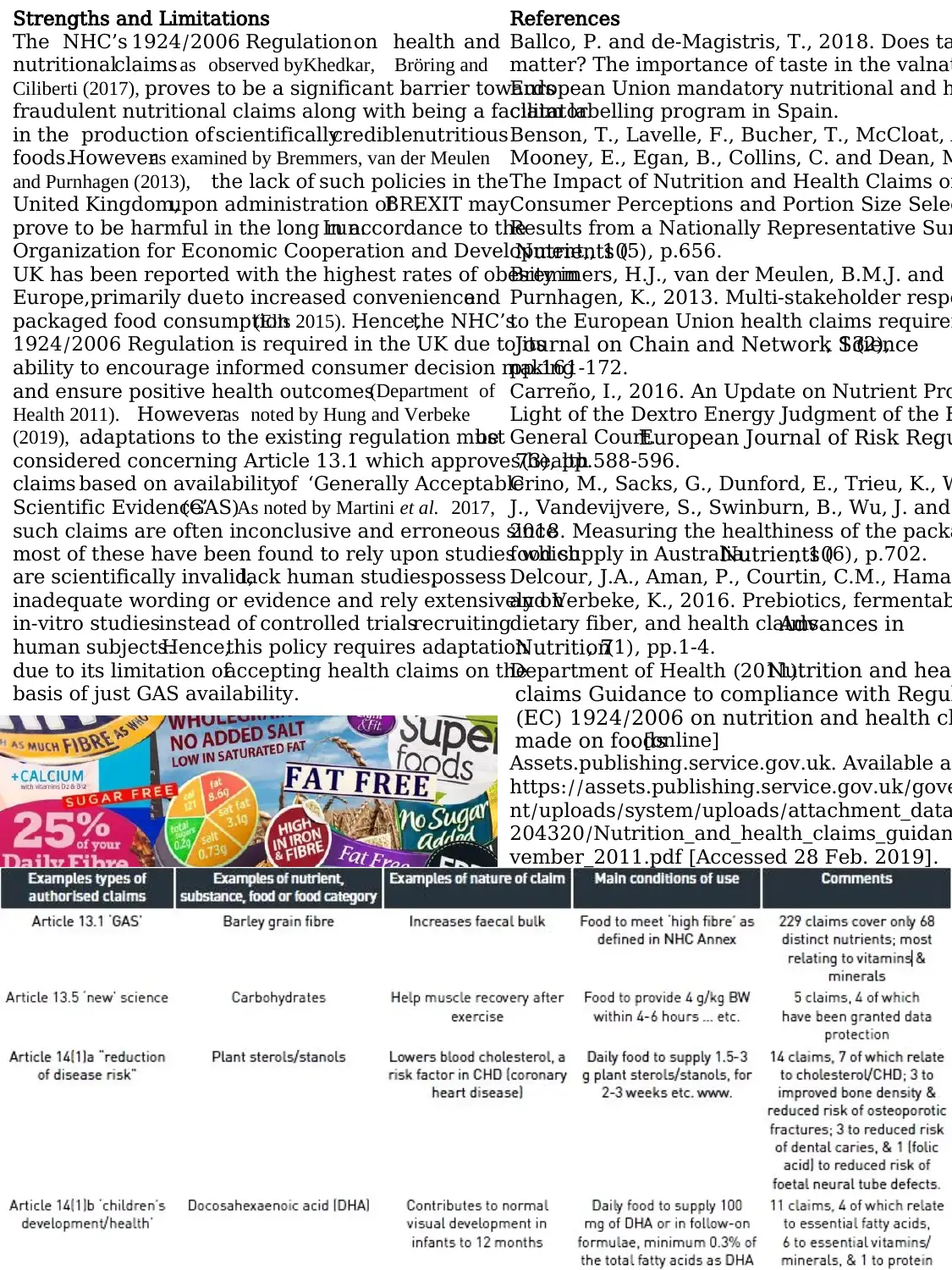
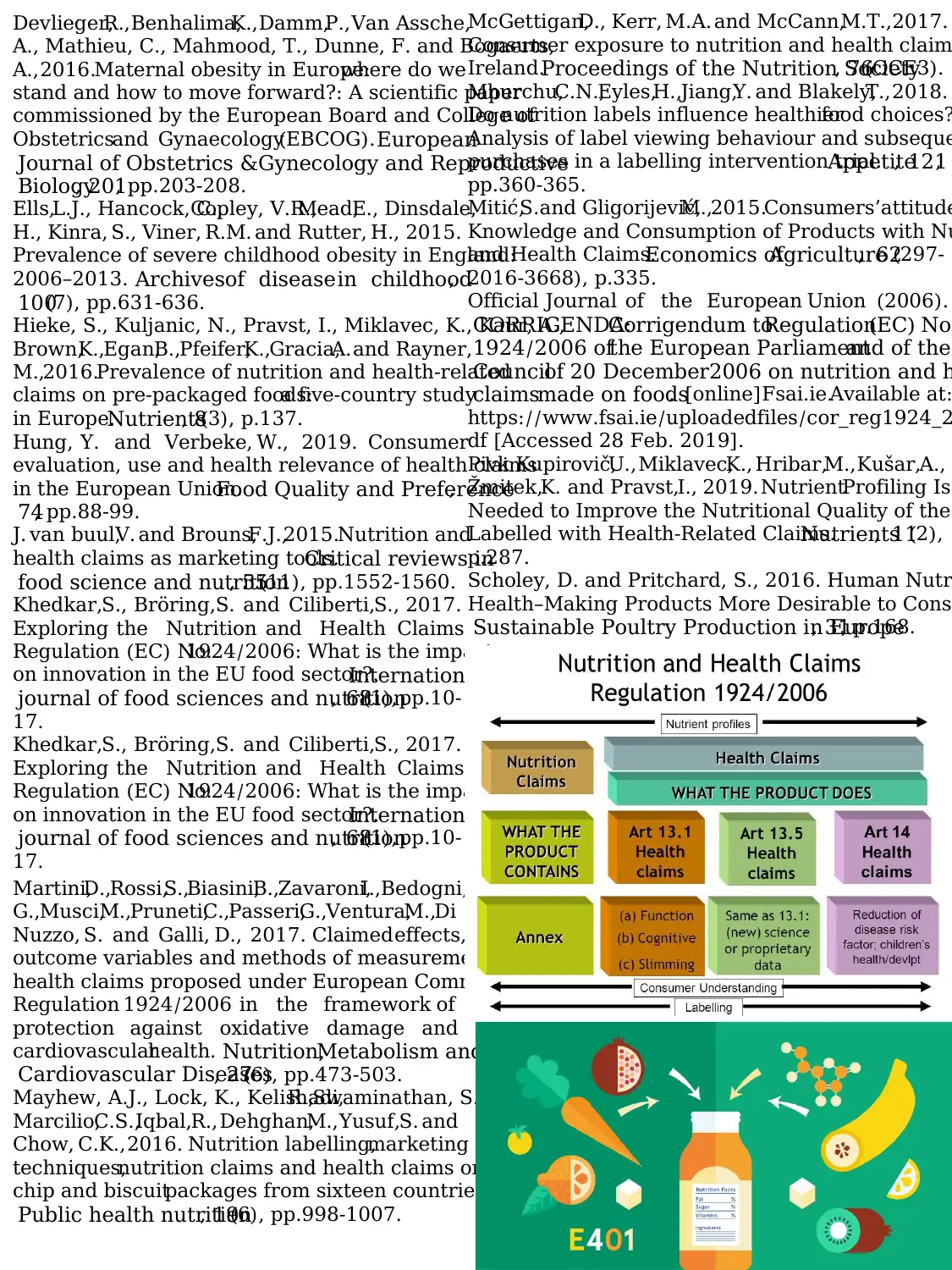
In accordance to Articles 13.1,13.5 and 14(Official
Journal of the European Union 2006):
•Foods which contain a health claim outlining the
beneficialrole of an ingredient in development,
growth,enhancementof psychologicalor behavioral
function and alterations in body composition can be
considered acceptableif they have been generally
validated by a scientific community and are
understandable by consumers.
•Foods with health claims which aim to incorporate
novel nutritionalclaims within existing scientific
information mustaim to include requestsfor the
protection of proprietary data.
•Foods with health claims dictating the benefits ofa
componentin the eradicationof a disease and
improvement in the development and growth of a child,
are acceptableafter acquiringauthorisation to an
authority of national competence.
Evaluation of Evidence
The evaluation of the scientific evidence is cond
by the EuropeanFood Safety Authority which
monitors based on(Carreño2016):
•How clearly is the food,nutrientand health claim
defined? For example: If a food states that it co
specific components to help in weight loss,then the
claim must clearly define the biochemical mech
which result in weight loss.
•How explicitly defined are the benefits of the h
claim for the purpose of improving the health o
targeted population? Hence,as noted above,the food
must scientificallyjustify why and how its
components are specifically beneficialto the target
(for example: weight loss in adult population).
•Is there a presence of and what is the nature o
effectrelationship and is the health claim valida
with human-based studies of significant rigor, s
validity and biologicalplausibility? Hence,the above
food must specify the relationshipbetweenthe
nutritionalcomponentand pathology ofobesity by
using researches which are scholarly,peer reviewed
and have been tested on human subjects of the
population, that is adults., who are obese.
Process of Application Submission
In accordance to Article 15,for the application of
acquiring authorisation for the usage of a scientif
credible health claim(Official Journal of the European
Union 2006):
•An application must be submitted to a Member o
authority of nationalcompetence,which must include
contact details of the applicant the nutrient or he
claim in question,copies ofscholarly peer reviewed
articles scientificallyvalidatingthe claim and an
indication of proprietary information.
•The concerned Member will acknowledgethe
application within 14 days of reception, followed
issuance ofnotification to memberstates and the
national Authority for further verification.
The NHC nutritionaland health claims1924/2006
Regulations underwent implementation in 2006 with
the aim to ensure thatthe claims on nutrition and
health highlighted in food retailed in the EU were
truthful and in possession of underlying evidence and
researchedevaluated by credible academic and
scientific expertise(Mitić and Gligorijević2015). Hence,
the aims of the regulation are(Hiekeet al. 2016):
•To monitor the truthfulness,clarity and scientific
validity of nutritional food claims to prevent consumer
deception.
•To ensure thatstandardisation in good’s movement
and uniformity in competition
•To encouragenutritionalinnovation and scientific
accuracy in food manufacturing
Considering the same,the 1924/2006 Regulation was
formulated with the foundationalrationale and
objective of dictating consumer food selections through
inform decision making paving the way for the overall
fulfillment ofpositive health outcomes for the public
(Benson et al. 2018).
Types of Claims
In accordance to Articles 13.1,13.5 and 14(Official
Journal of the European Union 2006):
•Foods which contain a health claim outlining the
beneficialrole of an ingredient in development,
growth,enhancementof psychologicalor behavioral
function and alterations in body composition can be
considered acceptableif they have been generally
validated by a scientific community and are
understandable by consumers.
•Foods with health claims which aim to incorporate
novel nutritionalclaims within existing scientific
information mustaim to include requestsfor the
protection of proprietary data.
•Foods with health claims dictating the benefits ofa
componentin the eradicationof a disease and
improvement in the development and growth of a child,
are acceptableafter acquiringauthorisation to an
authority of national competence.
Evaluation of Evidence
The evaluation of the scientific evidence is cond
by the EuropeanFood Safety Authority which
monitors based on(Carreño2016):
•How clearly is the food,nutrientand health claim
defined? For example: If a food states that it co
specific components to help in weight loss,then the
claim must clearly define the biochemical mech
which result in weight loss.
•How explicitly defined are the benefits of the h
claim for the purpose of improving the health o
targeted population? Hence,as noted above,the food
must scientificallyjustify why and how its
components are specifically beneficialto the target
(for example: weight loss in adult population).
•Is there a presence of and what is the nature o
effectrelationship and is the health claim valida
with human-based studies of significant rigor, s
validity and biologicalplausibility? Hence,the above
food must specify the relationshipbetweenthe
nutritionalcomponentand pathology ofobesity by
using researches which are scholarly,peer reviewed
and have been tested on human subjects of the
population, that is adults., who are obese.
Process of Application Submission
In accordance to Article 15,for the application of
acquiring authorisation for the usage of a scientif
credible health claim(Official Journal of the European
Union 2006):
•An application must be submitted to a Member o
authority of nationalcompetence,which must include
contact details of the applicant the nutrient or he
claim in question,copies ofscholarly peer reviewed
articles scientificallyvalidatingthe claim and an
indication of proprietary information.
•The concerned Member will acknowledgethe
application within 14 days of reception, followed
issuance ofnotification to memberstates and the
national Authority for further verification.
⊘ This is a preview!⊘
Do you want full access?
Subscribe today to unlock all pages.

Trusted by 1+ million students worldwide
Strengths and Limitations
The NHC’s 1924/2006 Regulationon health and
nutritionalclaims as observed byKhedkar, Bröring and
Ciliberti (2017), proves to be a significant barrier towards
fraudulent nutritional claims along with being a facilitator
in the production ofscientificallycrediblenutritious
foods.Howeveras examined by Bremmers, van der Meulen
and Purnhagen (2013), the lack of such policies in the
United Kingdom,upon administration ofBREXIT may
prove to be harmful in the long run.In accordance to the
Organization for Economic Cooperation and Development,
UK has been reported with the highest rates of obesity in
Europe,primarily dueto increased convenienceand
packaged food consumption(Ells 2015). Hence,the NHC’s
1924/2006 Regulation is required in the UK due to its
ability to encourage informed consumer decision making
and ensure positive health outcomes(Department of
Health 2011). Howeveras noted by Hung and Verbeke
(2019), adaptations to the existing regulation mustbe
considered concerning Article 13.1 which approves health
claims based on availabilityof ‘Generally Acceptable
Scientific Evidence’(GAS)As noted by Martini et al. 2017,
such claims are often inconclusive and erroneous since
most of these have been found to rely upon studies which
are scientifically invalid,lack human studies,possess
inadequate wording or evidence and rely extensively on
in-vitro studiesinstead of controlled trialsrecruiting
human subjects.Hence,this policy requires adaptation
due to its limitation ofaccepting health claims on the
basis of just GAS availability.
References
Ballco, P. and de-Magistris, T., 2018. Does ta
matter? The importance of taste in the valnat
European Union mandatory nutritional and h
claim labelling program in Spain.
Benson, T., Lavelle, F., Bucher, T., McCloat, A
Mooney, E., Egan, B., Collins, C. and Dean, M
The Impact of Nutrition and Health Claims on
Consumer Perceptions and Portion Size Selec
Results from a Nationally Representative Sur
Nutrients, 10(5), p.656.
Bremmers, H.J., van der Meulen, B.M.J. and
Purnhagen, K., 2013. Multi-stakeholder respo
to the European Union health claims requirem
Journal on Chain and Network Science, 13(2),
pp.161-172.
Carreño, I., 2016. An Update on Nutrient Pro
Light of the Dextro Energy Judgment of the E
General Court.European Journal of Risk Regu,
7(3), pp.588-596.
Crino, M., Sacks, G., Dunford, E., Trieu, K., W
J., Vandevijvere, S., Swinburn, B., Wu, J. and
2018. Measuring the healthiness of the packa
food supply in Australia.Nutrients, 10(6), p.702.
Delcour, J.A., Aman, P., Courtin, C.M., Hamak
and Verbeke, K., 2016. Prebiotics, fermentab
dietary fiber, and health claims.Advances in
Nutrition, 7(1), pp.1-4.
Department of Health (2011).Nutrition and heal
claims Guidance to compliance with Regul
(EC) 1924/2006 on nutrition and health cl
made on foods. [online]
Assets.publishing.service.gov.uk. Available at
https://assets.publishing.service.gov.uk/gove
nt/uploads/system/uploads/attachment_data
204320/Nutrition_and_health_claims_guidan
vember_2011.pdf [Accessed 28 Feb. 2019].
The NHC’s 1924/2006 Regulationon health and
nutritionalclaims as observed byKhedkar, Bröring and
Ciliberti (2017), proves to be a significant barrier towards
fraudulent nutritional claims along with being a facilitator
in the production ofscientificallycrediblenutritious
foods.Howeveras examined by Bremmers, van der Meulen
and Purnhagen (2013), the lack of such policies in the
United Kingdom,upon administration ofBREXIT may
prove to be harmful in the long run.In accordance to the
Organization for Economic Cooperation and Development,
UK has been reported with the highest rates of obesity in
Europe,primarily dueto increased convenienceand
packaged food consumption(Ells 2015). Hence,the NHC’s
1924/2006 Regulation is required in the UK due to its
ability to encourage informed consumer decision making
and ensure positive health outcomes(Department of
Health 2011). Howeveras noted by Hung and Verbeke
(2019), adaptations to the existing regulation mustbe
considered concerning Article 13.1 which approves health
claims based on availabilityof ‘Generally Acceptable
Scientific Evidence’(GAS)As noted by Martini et al. 2017,
such claims are often inconclusive and erroneous since
most of these have been found to rely upon studies which
are scientifically invalid,lack human studies,possess
inadequate wording or evidence and rely extensively on
in-vitro studiesinstead of controlled trialsrecruiting
human subjects.Hence,this policy requires adaptation
due to its limitation ofaccepting health claims on the
basis of just GAS availability.
References
Ballco, P. and de-Magistris, T., 2018. Does ta
matter? The importance of taste in the valnat
European Union mandatory nutritional and h
claim labelling program in Spain.
Benson, T., Lavelle, F., Bucher, T., McCloat, A
Mooney, E., Egan, B., Collins, C. and Dean, M
The Impact of Nutrition and Health Claims on
Consumer Perceptions and Portion Size Selec
Results from a Nationally Representative Sur
Nutrients, 10(5), p.656.
Bremmers, H.J., van der Meulen, B.M.J. and
Purnhagen, K., 2013. Multi-stakeholder respo
to the European Union health claims requirem
Journal on Chain and Network Science, 13(2),
pp.161-172.
Carreño, I., 2016. An Update on Nutrient Pro
Light of the Dextro Energy Judgment of the E
General Court.European Journal of Risk Regu,
7(3), pp.588-596.
Crino, M., Sacks, G., Dunford, E., Trieu, K., W
J., Vandevijvere, S., Swinburn, B., Wu, J. and
2018. Measuring the healthiness of the packa
food supply in Australia.Nutrients, 10(6), p.702.
Delcour, J.A., Aman, P., Courtin, C.M., Hamak
and Verbeke, K., 2016. Prebiotics, fermentab
dietary fiber, and health claims.Advances in
Nutrition, 7(1), pp.1-4.
Department of Health (2011).Nutrition and heal
claims Guidance to compliance with Regul
(EC) 1924/2006 on nutrition and health cl
made on foods. [online]
Assets.publishing.service.gov.uk. Available at
https://assets.publishing.service.gov.uk/gove
nt/uploads/system/uploads/attachment_data
204320/Nutrition_and_health_claims_guidan
vember_2011.pdf [Accessed 28 Feb. 2019].
Paraphrase This Document
Need a fresh take? Get an instant paraphrase of this document with our AI Paraphraser
Devlieger,R.,Benhalima,K.,Damm,P.,Van Assche,
A., Mathieu, C., Mahmood, T., Dunne, F. and Bogaerts,
A.,2016.Maternal obesity in Europe:where do we
stand and how to move forward?: A scientific paper
commissioned by the European Board and College of
Obstetricsand Gynaecology(EBCOG).European
Journal of Obstetrics &Gynecology and Reproductive
Biology, 201, pp.203-208.
Ells,L.J., Hancock, C.,Copley, V.R.,Mead,E., Dinsdale,
H., Kinra, S., Viner, R.M. and Rutter, H., 2015.
Prevalence of severe childhood obesity in England:
2006–2013. Archivesof diseasein childhood,
100(7), pp.631-636.
Hieke, S., Kuljanic, N., Pravst, I., Miklavec, K., Kaur, A.,
Brown,K.,Egan,B.,Pfeifer,K.,Gracia,A.and Rayner,
M.,2016.Prevalence of nutrition and health-related
claims on pre-packaged foods:a five-country study
in Europe.Nutrients, 8(3), p.137.
Hung, Y. and Verbeke, W., 2019. Consumer
evaluation, use and health relevance of health claims
in the European Union.Food Quality and Preference,
74, pp.88-99.
J. van buul,V. and Brouns,F.J.,2015.Nutrition and
health claims as marketing tools.Critical reviews in
food science and nutrition, 55(11), pp.1552-1560.
Khedkar,S., Bröring,S. and Ciliberti,S., 2017.
Exploring the Nutrition and Health Claims
Regulation (EC) No.1924/2006: What is the impact
on innovation in the EU food sector?.International
journal of food sciences and nutrition, 68(1),pp.10-
17.
Khedkar,S., Bröring,S. and Ciliberti,S., 2017.
Exploring the Nutrition and Health Claims
Regulation (EC) No.1924/2006: What is the impact
on innovation in the EU food sector?.International
journal of food sciences and nutrition, 68(1),pp.10-
17.
Martini,D.,Rossi,S.,Biasini,B.,Zavaroni,I.,Bedogni,
G.,Musci,M.,Pruneti,C.,Passeri,G.,Ventura,M.,Di
Nuzzo, S. and Galli, D., 2017. Claimedeffects,
outcome variables and methods of measurement for
health claims proposed under European Community
Regulation 1924/2006 in the framework of
protection against oxidative damage and
cardiovascularhealth. Nutrition,Metabolism and
Cardiovascular Diseases, 27(6), pp.473-503.
Mayhew, A.J., Lock, K., Kelishadi,R.,Swaminathan, S.,
Marcilio,C.S.,Iqbal,R.,Dehghan,M.,Yusuf,S. and
Chow, C.K.,2016. Nutrition labelling,marketing
techniques,nutrition claims and health claims on
chip and biscuitpackages from sixteen countries.
Public health nutrition, 19(6), pp.998-1007.
McGettigan,D., Kerr, M.A. and McCann,M.T.,2017.
Consumer exposure to nutrition and health claim
Ireland.Proceedings of the Nutrition Society, 76(OCE3).
Mhurchu,C.N.,Eyles,H.,Jiang,Y. and Blakely,T.,2018.
Do nutrition labels influence healthierfood choices?
Analysis of label viewing behaviour and subseque
purchases in a labelling intervention trial.Appetite, 121,
pp.360-365.
Mitić,S.and Gligorijević,M.,2015.Consumers’attitude
Knowledge and Consumption of Products with Nu
and Health Claims.Economics ofAgriculture, 62(297-
2016-3668), p.335.
Official Journal of the European Union (2006).
CORRIGENDA:Corrigendum toRegulation(EC) No
1924/2006 ofthe European Parliamentand of the
Councilof 20 December2006 on nutrition and h
claimsmade on foods. [online]Fsai.ie.Available at:
https://www.fsai.ie/uploadedfiles/cor_reg1924_2
df [Accessed 28 Feb. 2019].
Pivk Kupirovič,U.,Miklavec,K., Hribar,M.,Kušar,A.,
Žmitek,K. and Pravst,I., 2019.NutrientProfiling Is
Needed to Improve the Nutritional Quality of the
Labelled with Health-Related Claims.Nutrients, 11(2),
p.287.
Scholey, D. and Pritchard, S., 2016. Human Nutr
Health–Making Products More Desirable to Consu
Sustainable Poultry Production in Europe, 31, p.168.
A., Mathieu, C., Mahmood, T., Dunne, F. and Bogaerts,
A.,2016.Maternal obesity in Europe:where do we
stand and how to move forward?: A scientific paper
commissioned by the European Board and College of
Obstetricsand Gynaecology(EBCOG).European
Journal of Obstetrics &Gynecology and Reproductive
Biology, 201, pp.203-208.
Ells,L.J., Hancock, C.,Copley, V.R.,Mead,E., Dinsdale,
H., Kinra, S., Viner, R.M. and Rutter, H., 2015.
Prevalence of severe childhood obesity in England:
2006–2013. Archivesof diseasein childhood,
100(7), pp.631-636.
Hieke, S., Kuljanic, N., Pravst, I., Miklavec, K., Kaur, A.,
Brown,K.,Egan,B.,Pfeifer,K.,Gracia,A.and Rayner,
M.,2016.Prevalence of nutrition and health-related
claims on pre-packaged foods:a five-country study
in Europe.Nutrients, 8(3), p.137.
Hung, Y. and Verbeke, W., 2019. Consumer
evaluation, use and health relevance of health claims
in the European Union.Food Quality and Preference,
74, pp.88-99.
J. van buul,V. and Brouns,F.J.,2015.Nutrition and
health claims as marketing tools.Critical reviews in
food science and nutrition, 55(11), pp.1552-1560.
Khedkar,S., Bröring,S. and Ciliberti,S., 2017.
Exploring the Nutrition and Health Claims
Regulation (EC) No.1924/2006: What is the impact
on innovation in the EU food sector?.International
journal of food sciences and nutrition, 68(1),pp.10-
17.
Khedkar,S., Bröring,S. and Ciliberti,S., 2017.
Exploring the Nutrition and Health Claims
Regulation (EC) No.1924/2006: What is the impact
on innovation in the EU food sector?.International
journal of food sciences and nutrition, 68(1),pp.10-
17.
Martini,D.,Rossi,S.,Biasini,B.,Zavaroni,I.,Bedogni,
G.,Musci,M.,Pruneti,C.,Passeri,G.,Ventura,M.,Di
Nuzzo, S. and Galli, D., 2017. Claimedeffects,
outcome variables and methods of measurement for
health claims proposed under European Community
Regulation 1924/2006 in the framework of
protection against oxidative damage and
cardiovascularhealth. Nutrition,Metabolism and
Cardiovascular Diseases, 27(6), pp.473-503.
Mayhew, A.J., Lock, K., Kelishadi,R.,Swaminathan, S.,
Marcilio,C.S.,Iqbal,R.,Dehghan,M.,Yusuf,S. and
Chow, C.K.,2016. Nutrition labelling,marketing
techniques,nutrition claims and health claims on
chip and biscuitpackages from sixteen countries.
Public health nutrition, 19(6), pp.998-1007.
McGettigan,D., Kerr, M.A. and McCann,M.T.,2017.
Consumer exposure to nutrition and health claim
Ireland.Proceedings of the Nutrition Society, 76(OCE3).
Mhurchu,C.N.,Eyles,H.,Jiang,Y. and Blakely,T.,2018.
Do nutrition labels influence healthierfood choices?
Analysis of label viewing behaviour and subseque
purchases in a labelling intervention trial.Appetite, 121,
pp.360-365.
Mitić,S.and Gligorijević,M.,2015.Consumers’attitude
Knowledge and Consumption of Products with Nu
and Health Claims.Economics ofAgriculture, 62(297-
2016-3668), p.335.
Official Journal of the European Union (2006).
CORRIGENDA:Corrigendum toRegulation(EC) No
1924/2006 ofthe European Parliamentand of the
Councilof 20 December2006 on nutrition and h
claimsmade on foods. [online]Fsai.ie.Available at:
https://www.fsai.ie/uploadedfiles/cor_reg1924_2
df [Accessed 28 Feb. 2019].
Pivk Kupirovič,U.,Miklavec,K., Hribar,M.,Kušar,A.,
Žmitek,K. and Pravst,I., 2019.NutrientProfiling Is
Needed to Improve the Nutritional Quality of the
Labelled with Health-Related Claims.Nutrients, 11(2),
p.287.
Scholey, D. and Pritchard, S., 2016. Human Nutr
Health–Making Products More Desirable to Consu
Sustainable Poultry Production in Europe, 31, p.168.

1 out of 5


Your All-in-One AI-Powered Toolkit for Academic Success.
+13062052269
info@desklib.com
Available 24*7 on WhatsApp / Email
![[object Object]](/_next/static/media/star-bottom.7253800d.svg)
Unlock your academic potential
Copyright © 2020–2026 A2Z Services. All Rights Reserved. Developed and managed by ZUCOL.