Report on Operations Management in the Context of Euro Tunnel
VerifiedAdded on 2020/01/28
|11
|3380
|72
Report
AI Summary
This report provides a detailed analysis of the operations management practices within Euro Tunnel, focusing on key aspects such as operational functions, process models, and strategic implementations. The report begins by highlighting the importance of operational management in the context of Euro Tunnel, emphasizing its role in coordinating activities, assigning tasks, and assessing overall performance. It then delves into the specific operational functions of Euro Tunnel, including customer satisfaction and service provision, followed by an examination of the process model employed. The report further explores the significance of the three Es (effectiveness, economy, and efficiency) and the impact of balancing cost minimization with quality maximization. It assesses the application of linear programming and critical path analysis, evaluating the necessity of operational planning and controlling. Finally, the report outlines clearly defined operational outcomes and justifies the use of quality management techniques in the given scenario, offering a comprehensive overview of Euro Tunnel's operational strategies.
OPERATIONS
MANAGEMENT
IN
BUSINESS
MANAGEMENT
IN
BUSINESS

Paraphrase This Document
Need a fresh take? Get an instant paraphrase of this document with our AI Paraphraser
TABLE OF CONTENTS
INTRODUCTION............................................................................................................................1
TASK 1............................................................................................................................................1
1.1 Importance of operational management in context of Euro Tunnel......................................1
1.2 Operational functions of Euro tunnel....................................................................................2
1.3 Process model of operational management used by Euro Tunnel.........................................2
TASK 2............................................................................................................................................3
2.1 Significance of three ES .......................................................................................................3
2.2 Impact of the tension between cost minimization and quality maximization.......................3
2.3 Significance of five performance objectives.........................................................................4
TASK 3............................................................................................................................................4
3.1 Assessment of linear programming and critical path............................................................4
3.2 Evaluating critical path analysis and network planning .......................................................5
3.3 Necessity of operational planning and controlling................................................................5
TASK 4............................................................................................................................................6
4.1 Setting clearly defined operational outcomes........................................................................6
4.2 Producing network plan of the activities and analysing critical path ..................................6
4.3 Justifying the quality management techniques for the given scenario..................................8
CONCLUSION................................................................................................................................8
REFERENCES.................................................................................................................................9
INTRODUCTION............................................................................................................................1
TASK 1............................................................................................................................................1
1.1 Importance of operational management in context of Euro Tunnel......................................1
1.2 Operational functions of Euro tunnel....................................................................................2
1.3 Process model of operational management used by Euro Tunnel.........................................2
TASK 2............................................................................................................................................3
2.1 Significance of three ES .......................................................................................................3
2.2 Impact of the tension between cost minimization and quality maximization.......................3
2.3 Significance of five performance objectives.........................................................................4
TASK 3............................................................................................................................................4
3.1 Assessment of linear programming and critical path............................................................4
3.2 Evaluating critical path analysis and network planning .......................................................5
3.3 Necessity of operational planning and controlling................................................................5
TASK 4............................................................................................................................................6
4.1 Setting clearly defined operational outcomes........................................................................6
4.2 Producing network plan of the activities and analysing critical path ..................................6
4.3 Justifying the quality management techniques for the given scenario..................................8
CONCLUSION................................................................................................................................8
REFERENCES.................................................................................................................................9
INTRODUCTION
Operational management is determined as one of the main activity for accomplishing
better set of results and desired objectives. This process is based on managing the flow, structure
and direction of the entire business operations in an effective manner (Griffin, 2013). The
management of the organisation is highly liable to execute the business task as per structured and
instructed by the operational management aspects. The report is based on the understanding of
the operations in the context of Euro Tunnel which is an 50 km underwater train tunnel that
connects UK and France.
TASK 1
1.1 Importance of operational management in context of Euro Tunnel
It is witnessed that the main purpose of an organisation is to conduct the entire business
operations in a stated format in order to achieve greater form of objectives and results. The
process of operational management defines a strategical structure of overcoming the operations
specified by the business and accordingly gain the market share and establish strong market
position. In that context, it is necessary for an organisation like Euro Tunnel to implement better
structure of executing and managing the business operations (Benjaafar, Li and Daskin, 2013).
The business is based on providing services to the public for moving them and their belongings
between France and UK. Thus, it is necessary for the organisation to generate the information
about the effectiveness of operational management which are: Coordinating activities – The structuring of operational management is based on
strategical aspects which address each and every technique in an effective way. that are
The structure is to be followed by the human resources of the organisation for conducting
their business operations. Determining task to their employees – It facilitates the business person and their staff
members in assigning the work and addressing the results required from the allotted
tasks.
Better assessment – It is determined that operation management process is highly
facilitative for the enterprise as it describes their entire functioning which includes
working activities starting from allocating the best resources and executing the whole set
of operation (Brown, Bessant and Lamming, 2013).
Operational management is determined as one of the main activity for accomplishing
better set of results and desired objectives. This process is based on managing the flow, structure
and direction of the entire business operations in an effective manner (Griffin, 2013). The
management of the organisation is highly liable to execute the business task as per structured and
instructed by the operational management aspects. The report is based on the understanding of
the operations in the context of Euro Tunnel which is an 50 km underwater train tunnel that
connects UK and France.
TASK 1
1.1 Importance of operational management in context of Euro Tunnel
It is witnessed that the main purpose of an organisation is to conduct the entire business
operations in a stated format in order to achieve greater form of objectives and results. The
process of operational management defines a strategical structure of overcoming the operations
specified by the business and accordingly gain the market share and establish strong market
position. In that context, it is necessary for an organisation like Euro Tunnel to implement better
structure of executing and managing the business operations (Benjaafar, Li and Daskin, 2013).
The business is based on providing services to the public for moving them and their belongings
between France and UK. Thus, it is necessary for the organisation to generate the information
about the effectiveness of operational management which are: Coordinating activities – The structuring of operational management is based on
strategical aspects which address each and every technique in an effective way. that are
The structure is to be followed by the human resources of the organisation for conducting
their business operations. Determining task to their employees – It facilitates the business person and their staff
members in assigning the work and addressing the results required from the allotted
tasks.
Better assessment – It is determined that operation management process is highly
facilitative for the enterprise as it describes their entire functioning which includes
working activities starting from allocating the best resources and executing the whole set
of operation (Brown, Bessant and Lamming, 2013).
⊘ This is a preview!⊘
Do you want full access?
Subscribe today to unlock all pages.

Trusted by 1+ million students worldwide
1.2 Operational functions of Euro tunnel
An organisation is generally focused on offering better and effective products or services
in their targeted market for achieving greater set of results. Addition to this, an enterprise is also
aimed on completing better functions and activities that are related with the targeted customer of
the organisation. In that context, Euro tunnel has also some specific operations which are to be
effectively managed by their employees and other workforces in order to gain proper reports.
Moreover, the following are the main operational functions of Euro Tunnel:
Customer's satisfaction – The cited company is highly aimed on providing effective and
high quality services to their customers in order to gain high form of satisfaction. For
this, they have implemented various techniques and processes that includes business
strategy, marketing and operational management (Becker, Kugeler and Rosemann, 2013).
They have created various teams in each department for helping the customers and entire
public for reducing the level of issues and unhappiness from the services offered by Euro
Tunnel.
Providing various services – It has been addressed that Euro Tunnel offers many
services and operations that includes train services for travellers, carriages services for
passenger vehicles, freight vehicles, etc.
1.3 Process model of operational management used by Euro Tunnel
Process model of Euro Tunnel Input – In the prior stage operational management model adopted by the cited firm, the
team is directed to obtain the entire information about the customers, the number of
passengers, their belongings and other related operations (La Rosa and et.al., 2011). The
team is required to give a specific and unique token number to them which specify the
section or seat that is booked for them. Processing – In this stage, the team needs to place all the passengers and their belongings
at a particular area and assign their section in the train. After filling up the entire section,
the train moves for the particular destination and needs to take off on the train. During the
journey, the staff of the train needs to give proper services and facilities to the
passengers.
2
An organisation is generally focused on offering better and effective products or services
in their targeted market for achieving greater set of results. Addition to this, an enterprise is also
aimed on completing better functions and activities that are related with the targeted customer of
the organisation. In that context, Euro tunnel has also some specific operations which are to be
effectively managed by their employees and other workforces in order to gain proper reports.
Moreover, the following are the main operational functions of Euro Tunnel:
Customer's satisfaction – The cited company is highly aimed on providing effective and
high quality services to their customers in order to gain high form of satisfaction. For
this, they have implemented various techniques and processes that includes business
strategy, marketing and operational management (Becker, Kugeler and Rosemann, 2013).
They have created various teams in each department for helping the customers and entire
public for reducing the level of issues and unhappiness from the services offered by Euro
Tunnel.
Providing various services – It has been addressed that Euro Tunnel offers many
services and operations that includes train services for travellers, carriages services for
passenger vehicles, freight vehicles, etc.
1.3 Process model of operational management used by Euro Tunnel
Process model of Euro Tunnel Input – In the prior stage operational management model adopted by the cited firm, the
team is directed to obtain the entire information about the customers, the number of
passengers, their belongings and other related operations (La Rosa and et.al., 2011). The
team is required to give a specific and unique token number to them which specify the
section or seat that is booked for them. Processing – In this stage, the team needs to place all the passengers and their belongings
at a particular area and assign their section in the train. After filling up the entire section,
the train moves for the particular destination and needs to take off on the train. During the
journey, the staff of the train needs to give proper services and facilities to the
passengers.
2
Paraphrase This Document
Need a fresh take? Get an instant paraphrase of this document with our AI Paraphraser
Output – In the end, the train should reach on the destination at right time. It is necessary
that the cited organisation should maintain the level of safety and security for the entire
passengers and their belongings.
TASK 2
2.1 Significance of three ES
It can be stated that effective analysis play very important role in getting aware of the
concept associated with the three major E's. Furthermore, businesses are able to grow and
develop in desired manner by focusing upon three E;s which are effectiveness, economy and
efficiency (Ramezani, Bashiri and Tavakkoli-Moghaddam, 2013). The above mentioned factors
also play significant role in creating need and demand of a particular product tor service in
marketplace. The elements are mentioned below as:
Economy- The main objective of this element is to lower down cost of production so that
customers can be offered with services and product at convenient prices. This can be
done by developing healthy relationship with suppliers and encouraging them to supply
products at low cost.
Effectiveness- It is another important element which lay emphasis on enhancing the
overall effectiveness of process of production. The rationale why effectiveness is
considered as important is that it helps companies in meeting need and demand of
customer in the best possible manner (Sapolsky, 2013).
Efficiency- This element allows businesses to focus on strategies through which they can
lower down their cost of operations and time regrading the same. Along with this, it
efficiency also allows companies to minimize their wastage.
2.2 Impact of the tension between cost minimization and quality maximization
In order to sustain and stay competitive in long run, companies now seek for ways
throughout which they can minimize cots of productions and maximize quality of their products
and services. It can be expressed that such kind of equations support businesses in attracting
more customers and getting competitive advantage over other market players. The tension
between the above mentioned two different aspects is from traditional times. Sometimes
companies are not able to determine whether they should go for cost minimization or should
adopt strategy of quality maximization. Lowering down cost means that low prices raw material
3
that the cited organisation should maintain the level of safety and security for the entire
passengers and their belongings.
TASK 2
2.1 Significance of three ES
It can be stated that effective analysis play very important role in getting aware of the
concept associated with the three major E's. Furthermore, businesses are able to grow and
develop in desired manner by focusing upon three E;s which are effectiveness, economy and
efficiency (Ramezani, Bashiri and Tavakkoli-Moghaddam, 2013). The above mentioned factors
also play significant role in creating need and demand of a particular product tor service in
marketplace. The elements are mentioned below as:
Economy- The main objective of this element is to lower down cost of production so that
customers can be offered with services and product at convenient prices. This can be
done by developing healthy relationship with suppliers and encouraging them to supply
products at low cost.
Effectiveness- It is another important element which lay emphasis on enhancing the
overall effectiveness of process of production. The rationale why effectiveness is
considered as important is that it helps companies in meeting need and demand of
customer in the best possible manner (Sapolsky, 2013).
Efficiency- This element allows businesses to focus on strategies through which they can
lower down their cost of operations and time regrading the same. Along with this, it
efficiency also allows companies to minimize their wastage.
2.2 Impact of the tension between cost minimization and quality maximization
In order to sustain and stay competitive in long run, companies now seek for ways
throughout which they can minimize cots of productions and maximize quality of their products
and services. It can be expressed that such kind of equations support businesses in attracting
more customers and getting competitive advantage over other market players. The tension
between the above mentioned two different aspects is from traditional times. Sometimes
companies are not able to determine whether they should go for cost minimization or should
adopt strategy of quality maximization. Lowering down cost means that low prices raw material
3
and machines will be used for production. This will reduce cost but on the same hand it will
lower down quality (Grant, 2012). Businesses will be able to enhance their profit margin but they
wont be able to attract customer. On the side, focusing on quality maximization will attract more
customers but lower down the profit margin.
2.3 Significance of five performance objectives
The significance of five performance objective are mentioned below as.;
Cost- Offering products and services at low prices will support business to attract more
and more customers and thus will result in increasing sales and profits. Companies should
seek for process and strategies that deliver low cost of operations.
Dependability- In order to carry out effective and smooth flow of operations and
activities, businesses functions are required to depend on each other.
Flexibility- flexible production and operations system offer firms with an opportunity to
make changes as and when they are required (Gruman and Saks, 2011). This supports
businesses in making modification in products and services as per changing customer
demand in marketplace (Zhu, 2014).
Quality- In the present scenario, companies are required to focus on strategies and
process which enhance quality of products. High quality creates satisfaction among
customer and also encourages them to stay loyal.
Speed- Businesses are required to ensure that speed of their process and systems are
effective and good. This supports them in delivering products and services on time and
attract customers. Low speed of delivery will dissatisfy customers and encourage them to
choose competitors product and services
TASK 3
3.1 Assessment of linear programming and critical path
Linear programming method is a mathematical tool to develop a significant impact on the
business operations and efficiency for the business unit. This project management tool focuses
on cost minimization and profit maximization for the business. This technique helps the
organization in creating the effective understanding of the limited variables of production
(Kacar, Irdem and Uzsoy, 2012). Application of this method helps the company in creating a
significant and well defined impact and business growth. It focuses on optimum utilization of the
4
lower down quality (Grant, 2012). Businesses will be able to enhance their profit margin but they
wont be able to attract customer. On the side, focusing on quality maximization will attract more
customers but lower down the profit margin.
2.3 Significance of five performance objectives
The significance of five performance objective are mentioned below as.;
Cost- Offering products and services at low prices will support business to attract more
and more customers and thus will result in increasing sales and profits. Companies should
seek for process and strategies that deliver low cost of operations.
Dependability- In order to carry out effective and smooth flow of operations and
activities, businesses functions are required to depend on each other.
Flexibility- flexible production and operations system offer firms with an opportunity to
make changes as and when they are required (Gruman and Saks, 2011). This supports
businesses in making modification in products and services as per changing customer
demand in marketplace (Zhu, 2014).
Quality- In the present scenario, companies are required to focus on strategies and
process which enhance quality of products. High quality creates satisfaction among
customer and also encourages them to stay loyal.
Speed- Businesses are required to ensure that speed of their process and systems are
effective and good. This supports them in delivering products and services on time and
attract customers. Low speed of delivery will dissatisfy customers and encourage them to
choose competitors product and services
TASK 3
3.1 Assessment of linear programming and critical path
Linear programming method is a mathematical tool to develop a significant impact on the
business operations and efficiency for the business unit. This project management tool focuses
on cost minimization and profit maximization for the business. This technique helps the
organization in creating the effective understanding of the limited variables of production
(Kacar, Irdem and Uzsoy, 2012). Application of this method helps the company in creating a
significant and well defined impact and business growth. It focuses on optimum utilization of the
4
⊘ This is a preview!⊘
Do you want full access?
Subscribe today to unlock all pages.
Trusted by 1+ million students worldwide
resources. The application the tool in the resent market scenario will help the company in
analysing the significant factors for enhancing growth and development aspects of the company.
Three elements that determine the result, are variables, objective function and the constraint. It
will help the company in creating and effective development measures in the company. It will
also help the company in developing a competitive edge for the business unit in the present
market situation.
3.2 Evaluating critical path analysis and network planning
Critical Path Analysis (CPA) can be defined a process of planning which is followed by
business venture step by step. It also comprises set of activities which focuses on completing the
project at specific time period. Scheduled network analsyis can be a technique which can be used
in order to measure the schedule flexibility and also the critical path of the project (Zareei and
et.al., 2011). Further, the analysis so described is considered as the longest course in the project
schedule network diagram. Some major points of CPA are:
It shows the activities order which has to be taken.
It shows the activities which are completed and activities which are going to take place at
the once
It shows considering activities which can be undertaken simultaneously in order to reduce
overall time taken for the completion of the project
CPA tries to set out single activities which helps in preparing and developing larger
projects (Critical Path Analysis, 2015.).
3.3 Necessity of operational planning and controlling
The following are the needs of operational planning and controlling which is generally
essential for the Euro Tunnel that are: Engineering – It has been defined that operational management is highly significant for
an organisation like Euro tunnel in accomplishing their business operations. However, the
necessity of the operational management is stated by the strategical working and advance
engineering approaches used in the process (Scheer, 2012). In order to gain maximum
benefits from the business functional and structural activities, an individual has to
maintain a system of controlling, managing and planning the managerial actions and
performance that are to be witnesses by the company.
5
analysing the significant factors for enhancing growth and development aspects of the company.
Three elements that determine the result, are variables, objective function and the constraint. It
will help the company in creating and effective development measures in the company. It will
also help the company in developing a competitive edge for the business unit in the present
market situation.
3.2 Evaluating critical path analysis and network planning
Critical Path Analysis (CPA) can be defined a process of planning which is followed by
business venture step by step. It also comprises set of activities which focuses on completing the
project at specific time period. Scheduled network analsyis can be a technique which can be used
in order to measure the schedule flexibility and also the critical path of the project (Zareei and
et.al., 2011). Further, the analysis so described is considered as the longest course in the project
schedule network diagram. Some major points of CPA are:
It shows the activities order which has to be taken.
It shows the activities which are completed and activities which are going to take place at
the once
It shows considering activities which can be undertaken simultaneously in order to reduce
overall time taken for the completion of the project
CPA tries to set out single activities which helps in preparing and developing larger
projects (Critical Path Analysis, 2015.).
3.3 Necessity of operational planning and controlling
The following are the needs of operational planning and controlling which is generally
essential for the Euro Tunnel that are: Engineering – It has been defined that operational management is highly significant for
an organisation like Euro tunnel in accomplishing their business operations. However, the
necessity of the operational management is stated by the strategical working and advance
engineering approaches used in the process (Scheer, 2012). In order to gain maximum
benefits from the business functional and structural activities, an individual has to
maintain a system of controlling, managing and planning the managerial actions and
performance that are to be witnesses by the company.
5
Paraphrase This Document
Need a fresh take? Get an instant paraphrase of this document with our AI Paraphraser
Finance – Operational management is highly advantageous and productive for the
company in allocating the sources of funds that are to be addressed for executing the
entire business operations. It is essential to determine a particular amount or defining a
specific corporate budget, in that case, it assists the management team in taking decisions
and actions over a particular area or department in the organisation (Peng and Lai,2012).
TASK 4
4.1 Setting clearly defined operational outcomes
Operational outcomes for attaining well defined business results are significant in the
present market scenario. The operations of channel tunnel as per the given scenario is highly in
effective and unmanaged for the organization. This creates a significant impact on the consumer
and traveller experience in the economy. In addition to this the operational inefficiencies of the
business unit has resulted in delaying travellers and passengers for the business as well. Layout
refers to the process of transforming services which helps in attaining well defined results for the
business unit. For the given situation hybrid layout planning will be implemented by the business
unit which helps the company in attaining effective and well defined results (Benjaafar, Li and
Daskin, 2013). It will focus on integrating the overall process of the company to ensure
minimizing activity overlapping in the organisation. The organization in this system will
integrate the business process to attain the business outcome and consumer satisfaction. The
hybrid layout of the process will focus on analysing the individual process of every department
of the business and will finally focus on attaining the organizational efficiency for the business
unit. The process and facility layout for the business will closely examined in the stated measure
(Ramezani, Bashiri and Tavakkoli-Moghaddam, 2013).
4.2 Producing network plan of the activities and analysing critical path
Network planning plays a significant role in analysing the business issues and attaining
effective results for the same. It helps the business unit in creating a well defined impact on
managing business operations and attaining favourable results for the organization. The given
case mentions effective means of planning measures for attaining high growth and development
aspects in the company (Sapolsky, 2013). The case analysis of channel tunnels reveals the
ineffectiveness of organisational operations. For effectively attaining the travel results for brown
6
company in allocating the sources of funds that are to be addressed for executing the
entire business operations. It is essential to determine a particular amount or defining a
specific corporate budget, in that case, it assists the management team in taking decisions
and actions over a particular area or department in the organisation (Peng and Lai,2012).
TASK 4
4.1 Setting clearly defined operational outcomes
Operational outcomes for attaining well defined business results are significant in the
present market scenario. The operations of channel tunnel as per the given scenario is highly in
effective and unmanaged for the organization. This creates a significant impact on the consumer
and traveller experience in the economy. In addition to this the operational inefficiencies of the
business unit has resulted in delaying travellers and passengers for the business as well. Layout
refers to the process of transforming services which helps in attaining well defined results for the
business unit. For the given situation hybrid layout planning will be implemented by the business
unit which helps the company in attaining effective and well defined results (Benjaafar, Li and
Daskin, 2013). It will focus on integrating the overall process of the company to ensure
minimizing activity overlapping in the organisation. The organization in this system will
integrate the business process to attain the business outcome and consumer satisfaction. The
hybrid layout of the process will focus on analysing the individual process of every department
of the business and will finally focus on attaining the organizational efficiency for the business
unit. The process and facility layout for the business will closely examined in the stated measure
(Ramezani, Bashiri and Tavakkoli-Moghaddam, 2013).
4.2 Producing network plan of the activities and analysing critical path
Network planning plays a significant role in analysing the business issues and attaining
effective results for the same. It helps the business unit in creating a well defined impact on
managing business operations and attaining favourable results for the organization. The given
case mentions effective means of planning measures for attaining high growth and development
aspects in the company (Sapolsky, 2013). The case analysis of channel tunnels reveals the
ineffectiveness of organisational operations. For effectively attaining the travel results for brown
6
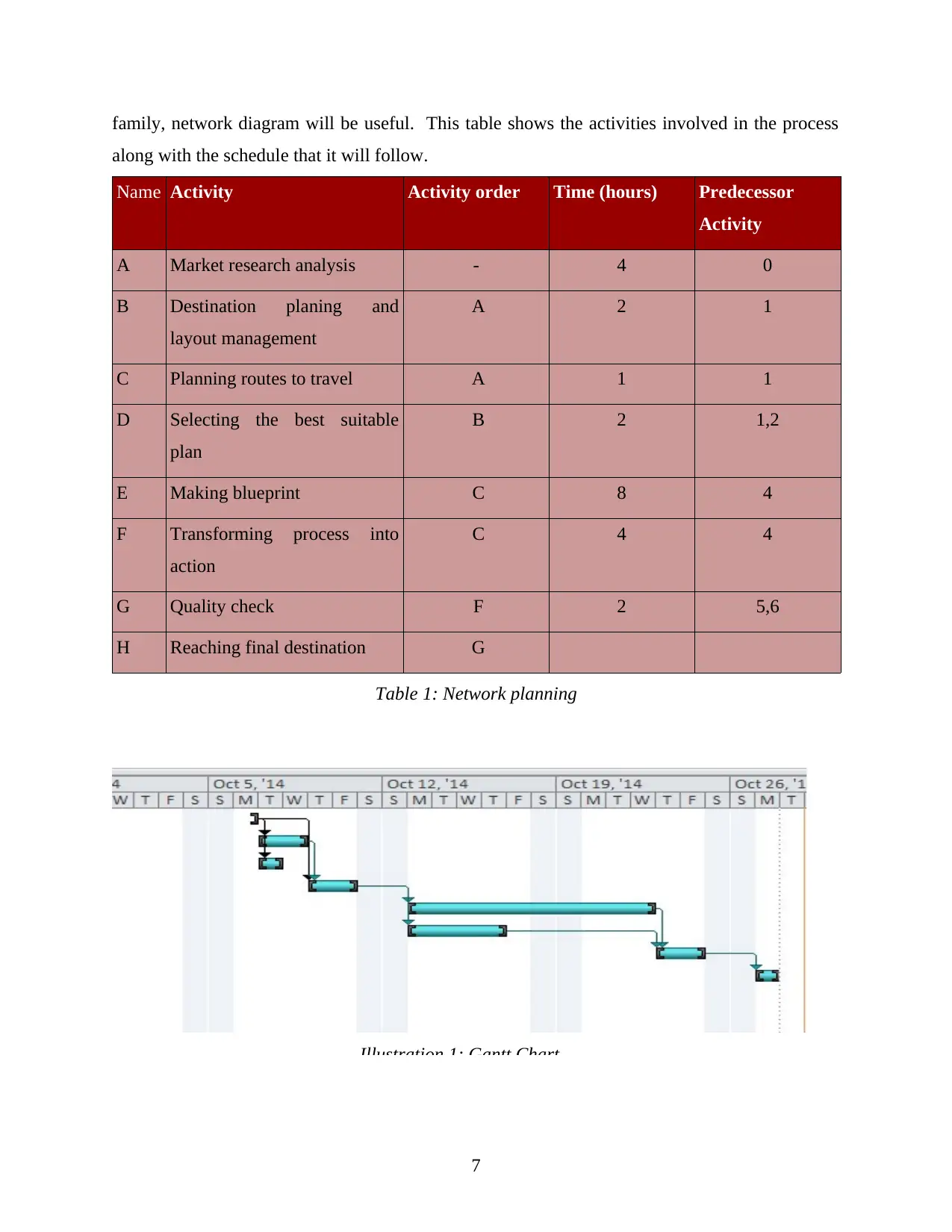
family, network diagram will be useful. This table shows the activities involved in the process
along with the schedule that it will follow.
Name Activity Activity order Time (hours) Predecessor
Activity
A Market research analysis - 4 0
B Destination planing and
layout management
A 2 1
C Planning routes to travel A 1 1
D Selecting the best suitable
plan
B 2 1,2
E Making blueprint C 8 4
F Transforming process into
action
C 4 4
G Quality check F 2 5,6
H Reaching final destination G
Table 1: Network planning
Illustration 1: Gantt Chart
7
along with the schedule that it will follow.
Name Activity Activity order Time (hours) Predecessor
Activity
A Market research analysis - 4 0
B Destination planing and
layout management
A 2 1
C Planning routes to travel A 1 1
D Selecting the best suitable
plan
B 2 1,2
E Making blueprint C 8 4
F Transforming process into
action
C 4 4
G Quality check F 2 5,6
H Reaching final destination G
Table 1: Network planning
Illustration 1: Gantt Chart
7
⊘ This is a preview!⊘
Do you want full access?
Subscribe today to unlock all pages.
Trusted by 1+ million students worldwide
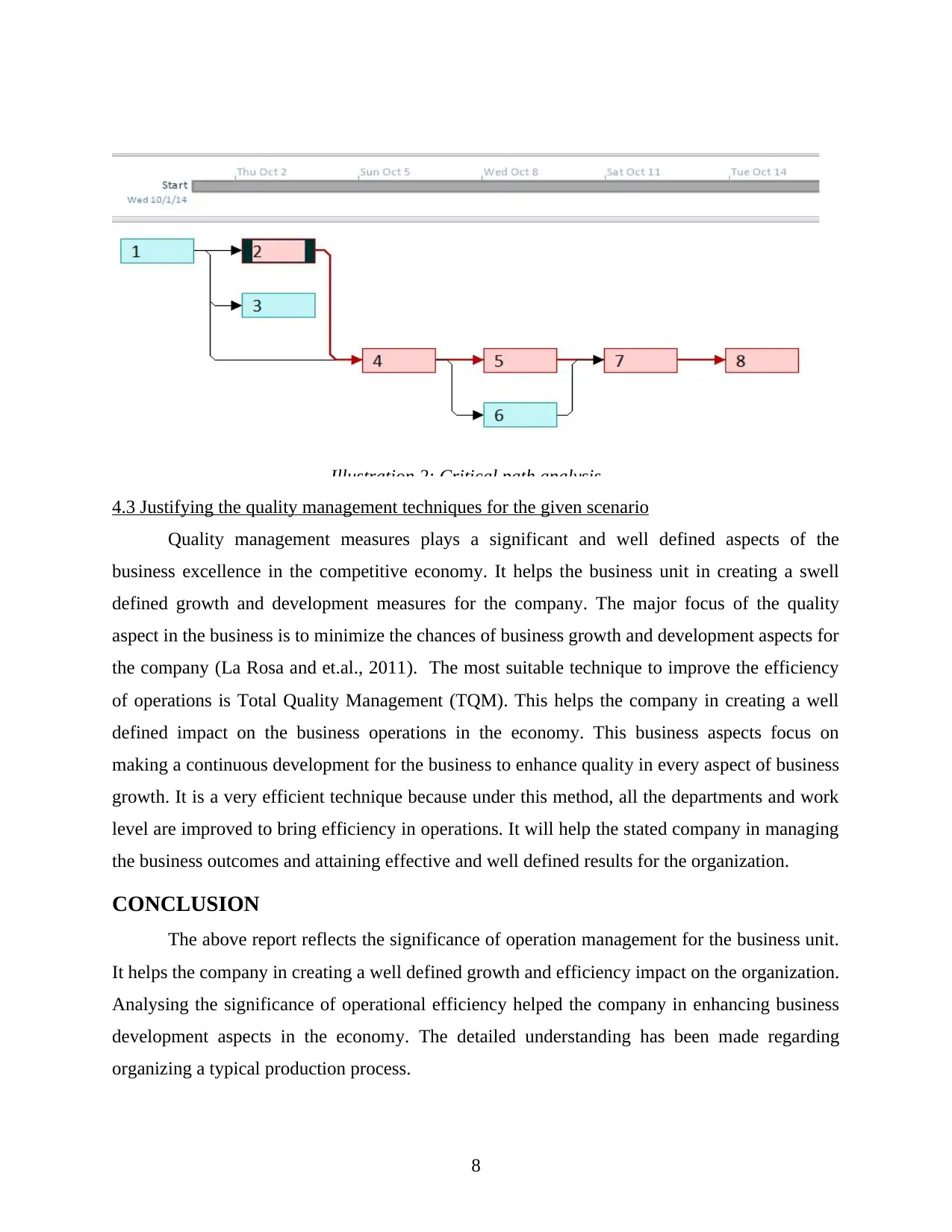
Illustration 2: Critical path analysis
4.3 Justifying the quality management techniques for the given scenario
Quality management measures plays a significant and well defined aspects of the
business excellence in the competitive economy. It helps the business unit in creating a swell
defined growth and development measures for the company. The major focus of the quality
aspect in the business is to minimize the chances of business growth and development aspects for
the company (La Rosa and et.al., 2011). The most suitable technique to improve the efficiency
of operations is Total Quality Management (TQM). This helps the company in creating a well
defined impact on the business operations in the economy. This business aspects focus on
making a continuous development for the business to enhance quality in every aspect of business
growth. It is a very efficient technique because under this method, all the departments and work
level are improved to bring efficiency in operations. It will help the stated company in managing
the business outcomes and attaining effective and well defined results for the organization.
CONCLUSION
The above report reflects the significance of operation management for the business unit.
It helps the company in creating a well defined growth and efficiency impact on the organization.
Analysing the significance of operational efficiency helped the company in enhancing business
development aspects in the economy. The detailed understanding has been made regarding
organizing a typical production process.
8
4.3 Justifying the quality management techniques for the given scenario
Quality management measures plays a significant and well defined aspects of the
business excellence in the competitive economy. It helps the business unit in creating a swell
defined growth and development measures for the company. The major focus of the quality
aspect in the business is to minimize the chances of business growth and development aspects for
the company (La Rosa and et.al., 2011). The most suitable technique to improve the efficiency
of operations is Total Quality Management (TQM). This helps the company in creating a well
defined impact on the business operations in the economy. This business aspects focus on
making a continuous development for the business to enhance quality in every aspect of business
growth. It is a very efficient technique because under this method, all the departments and work
level are improved to bring efficiency in operations. It will help the stated company in managing
the business outcomes and attaining effective and well defined results for the organization.
CONCLUSION
The above report reflects the significance of operation management for the business unit.
It helps the company in creating a well defined growth and efficiency impact on the organization.
Analysing the significance of operational efficiency helped the company in enhancing business
development aspects in the economy. The detailed understanding has been made regarding
organizing a typical production process.
8
Paraphrase This Document
Need a fresh take? Get an instant paraphrase of this document with our AI Paraphraser
REFERENCES
Journals and books
Becker, J., Kugeler, M. and Rosemann, M., 2013. Process management: a guide for the design of
business processes. Springer Science & Business Media.
Benjaafar, S., Li, Y. and Daskin, M., 2013. Carbon footprint and the management of supply
chains: Insights from simple models. Automation Science and Engineering, IEEE
Transactions on. 10(1). pp. 99-116.
Brown, S., Bessant, J. R. and Lamming, R., 2013. Strategic operations management. Routledge.
Grant, A. M., 2012. Leading with meaning: Beneficiary contact, prosocial impact, and the
performance effects of transformational leadership. Academy of Management Journal.
55(2). pp. 458-476.
Griffin, R., 2013. Fundamentals of management. Cengage Learning.
Gruman, J. A. and Saks, A. M., 2011. Performance management and employee engagement.
Human Resource Management Review. 21(2). pp. 123-136.
Kacar, N. B., Irdem, D. F. and Uzsoy, R., 2012. An experimental comparison of production
planning using clearing functions and iterative linear programming-simulation algorithms.
Semiconductor Manufacturing, IEEE Transactions on. 25(1). pp. 104-117.
La Rosa, M. and et.al., 2011. APROMORE: An advanced process model repository. Expert
Systems with Applications. 38(6). pp. 7029-7040.
Peng, D. X. and Lai, F., 2012. Using partial least squares in operations management research: A
practical guideline and summary of past research. Journal of Operations Management.
30(6). pp. 467-480.
Ramezani, M., Bashiri, M. and Tavakkoli-Moghaddam, R., 2013. A new multi-objective
stochastic model for a forward/reverse logistic network design with responsiveness and
quality level. Applied Mathematical Modelling. 37(1). pp. 328-344.
Sapolsky, H. M., 2013. Polaris System Development. Harvard University Press.
Scheer, A. W., 2012. Business process engineering: reference models for industrial enterprises.
Springer Science & Business Media.
Zareei, A. and et.al., 2011. A new approach for solving fuzzy critical path problem using analysis
of events. Expert Systems with Applications. 38(1). pp. 87-93.
Zhu, J., 2014. Quantitative models for performance evaluation and benchmarking: data
envelopment analysis with spreadsheets. 13th ed. Springer.
Online
Critical Path Analysis. 2015. [Online]. Available through :
<http://beta.tutor2u.net/business/reference/critical-path-analysis>. [Accessed on 30th June
2016].
Journals and books
Becker, J., Kugeler, M. and Rosemann, M., 2013. Process management: a guide for the design of
business processes. Springer Science & Business Media.
Benjaafar, S., Li, Y. and Daskin, M., 2013. Carbon footprint and the management of supply
chains: Insights from simple models. Automation Science and Engineering, IEEE
Transactions on. 10(1). pp. 99-116.
Brown, S., Bessant, J. R. and Lamming, R., 2013. Strategic operations management. Routledge.
Grant, A. M., 2012. Leading with meaning: Beneficiary contact, prosocial impact, and the
performance effects of transformational leadership. Academy of Management Journal.
55(2). pp. 458-476.
Griffin, R., 2013. Fundamentals of management. Cengage Learning.
Gruman, J. A. and Saks, A. M., 2011. Performance management and employee engagement.
Human Resource Management Review. 21(2). pp. 123-136.
Kacar, N. B., Irdem, D. F. and Uzsoy, R., 2012. An experimental comparison of production
planning using clearing functions and iterative linear programming-simulation algorithms.
Semiconductor Manufacturing, IEEE Transactions on. 25(1). pp. 104-117.
La Rosa, M. and et.al., 2011. APROMORE: An advanced process model repository. Expert
Systems with Applications. 38(6). pp. 7029-7040.
Peng, D. X. and Lai, F., 2012. Using partial least squares in operations management research: A
practical guideline and summary of past research. Journal of Operations Management.
30(6). pp. 467-480.
Ramezani, M., Bashiri, M. and Tavakkoli-Moghaddam, R., 2013. A new multi-objective
stochastic model for a forward/reverse logistic network design with responsiveness and
quality level. Applied Mathematical Modelling. 37(1). pp. 328-344.
Sapolsky, H. M., 2013. Polaris System Development. Harvard University Press.
Scheer, A. W., 2012. Business process engineering: reference models for industrial enterprises.
Springer Science & Business Media.
Zareei, A. and et.al., 2011. A new approach for solving fuzzy critical path problem using analysis
of events. Expert Systems with Applications. 38(1). pp. 87-93.
Zhu, J., 2014. Quantitative models for performance evaluation and benchmarking: data
envelopment analysis with spreadsheets. 13th ed. Springer.
Online
Critical Path Analysis. 2015. [Online]. Available through :
<http://beta.tutor2u.net/business/reference/critical-path-analysis>. [Accessed on 30th June
2016].

1 out of 11


Related Documents


Your All-in-One AI-Powered Toolkit for Academic Success.
+13062052269
info@desklib.com
Available 24*7 on WhatsApp / Email
![[object Object]](/_next/static/media/star-bottom.7253800d.svg)
Unlock your academic potential
Copyright © 2020–2026 A2Z Services. All Rights Reserved. Developed and managed by ZUCOL.