European Enlightenment: Comparing French and British Monarchies

Verified

Added on  2019/09/23

|4
|604
|218
Essay
AI Summary
This essay delves into the Enlightenment period in Europe, examining its impact on both France and Britain. It begins by defining the Enlightenment as a philosophical and intellectual movement, emphasizing its focus on reason and the scientific method. The essay then compares the absolute monarchy in France, particularly under Louis XIV, with the constitutional monarchy in Britain. It highlights how Louis XIV centralized power and addressed financial issues, while Britain's system streamlined governance and supported scientific inquiry. The essay also discusses the influence of Enlightenment philosophers like Montesquieu and Voltaire on both countries, emphasizing their contributions to concepts such as the separation of powers and individual rights. Overall, the essay argues that the Enlightenment brought significant positive changes to Europe, shaping political and social landscapes through philosophical ideals and governmental reforms.
Document Page
THE ENLIGHTENMENT IN EUROPE
tabler-icon-diamond-filled.svg

Paraphrase This Document

Need a fresh take? Get an instant paraphrase of this document with our AI Paraphraser
Document Page
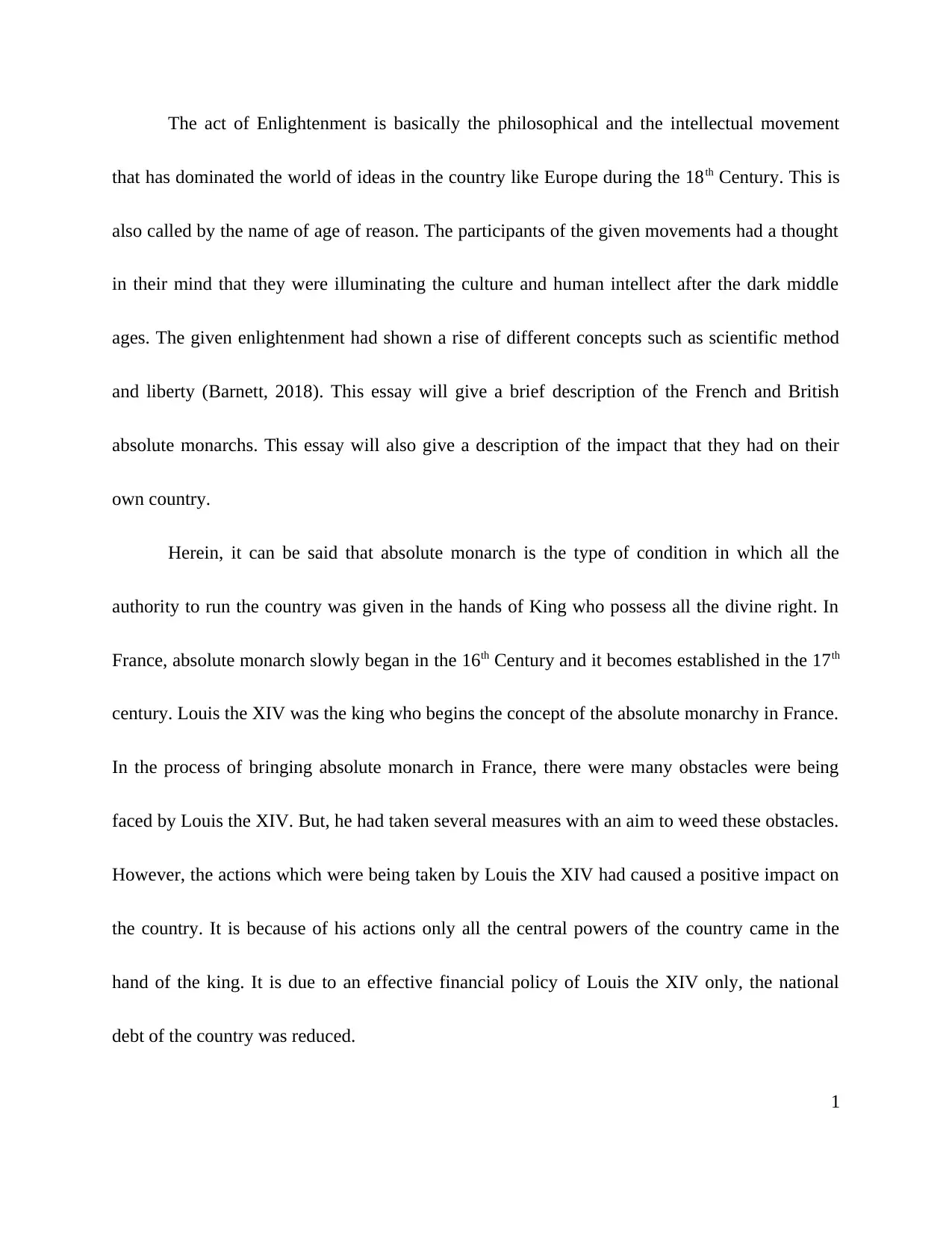
The act of Enlightenment is basically the philosophical and the intellectual movement
that has dominated the world of ideas in the country like Europe during the 18th Century. This is
also called by the name of age of reason. The participants of the given movements had a thought
in their mind that they were illuminating the culture and human intellect after the dark middle
ages. The given enlightenment had shown a rise of different concepts such as scientific method
and liberty (Barnett, 2018). This essay will give a brief description of the French and British
absolute monarchs. This essay will also give a description of the impact that they had on their
own country.
Herein, it can be said that absolute monarch is the type of condition in which all the
authority to run the country was given in the hands of King who possess all the divine right. In
France, absolute monarch slowly began in the 16th Century and it becomes established in the 17th
century. Louis the XIV was the king who begins the concept of the absolute monarchy in France.
In the process of bringing absolute monarch in France, there were many obstacles were being
faced by Louis the XIV. But, he had taken several measures with an aim to weed these obstacles.
However, the actions which were being taken by Louis the XIV had caused a positive impact on
the country. It is because of his actions only all the central powers of the country came in the
hand of the king. It is due to an effective financial policy of Louis the XIV only, the national
debt of the country was reduced.
1
Document Page
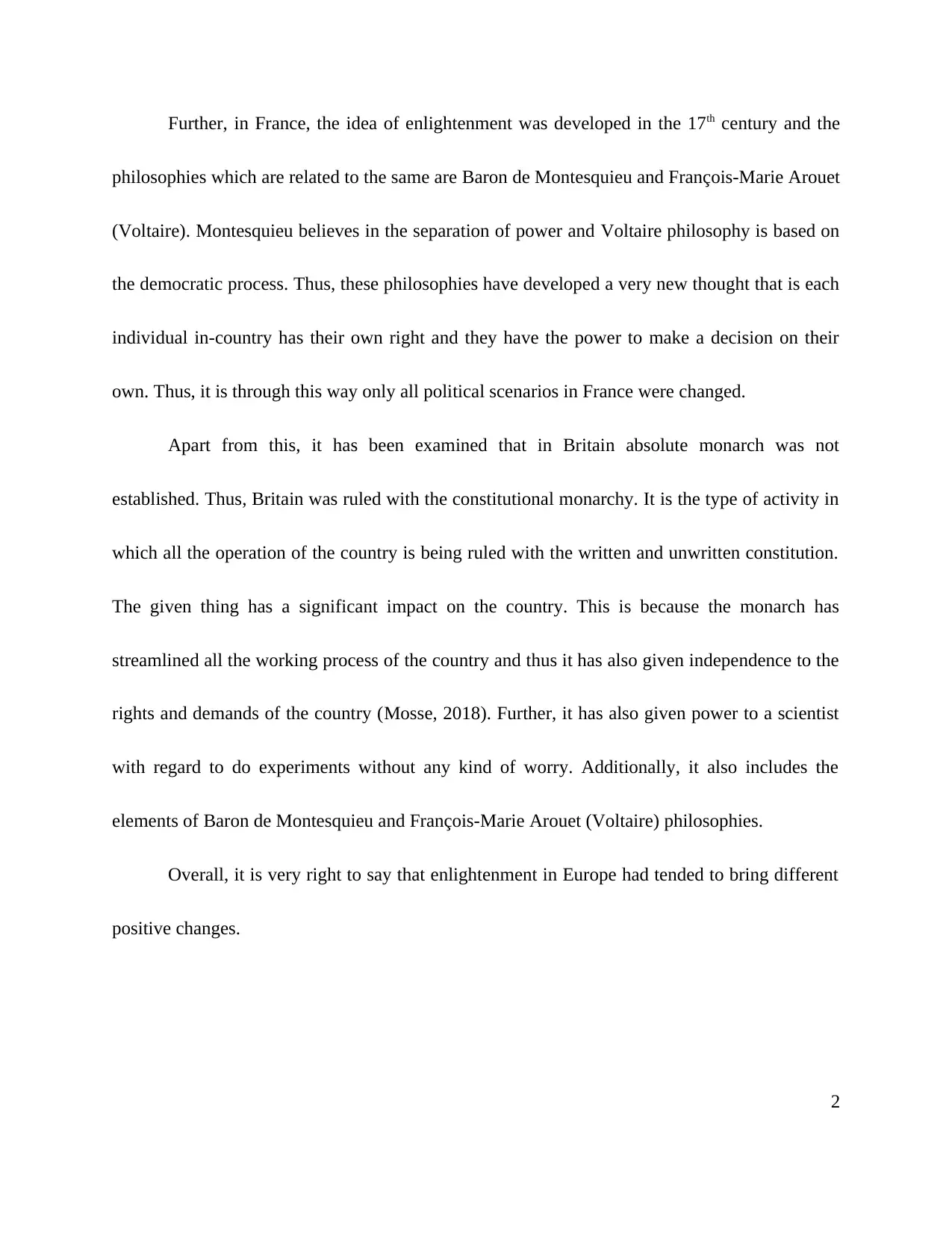
Further, in France, the idea of enlightenment was developed in the 17th century and the
philosophies which are related to the same are Baron de Montesquieu and François-Marie Arouet
(Voltaire). Montesquieu believes in the separation of power and Voltaire philosophy is based on
the democratic process. Thus, these philosophies have developed a very new thought that is each
individual in-country has their own right and they have the power to make a decision on their
own. Thus, it is through this way only all political scenarios in France were changed.
Apart from this, it has been examined that in Britain absolute monarch was not
established. Thus, Britain was ruled with the constitutional monarchy. It is the type of activity in
which all the operation of the country is being ruled with the written and unwritten constitution.
The given thing has a significant impact on the country. This is because the monarch has
streamlined all the working process of the country and thus it has also given independence to the
rights and demands of the country (Mosse, 2018). Further, it has also given power to a scientist
with regard to do experiments without any kind of worry. Additionally, it also includes the
elements of Baron de Montesquieu and François-Marie Arouet (Voltaire) philosophies.
Overall, it is very right to say that enlightenment in Europe had tended to bring different
positive changes.
2
Document Page
REFERENCE
Barnett, Stephen J. "The Enlightenment and religion: The myths of modernity." (2018).
Mosse, George. The culture of Western Europe: the nineteenth and twentieth centuries.
Routledge, 2018.
3
chevron_up_icon
1 out of 4
circle_padding
hide_on_mobile
zoom_out_icon
[object Object]