A Comprehensive Look at Gastronomy and the History of European Food
VerifiedAdded on 2023/06/10
|10
|3685
|374
Essay
AI Summary
This essay provides a comprehensive overview of gastronomy, defining it as the study of the relationship between food and culture. It emphasizes the importance of gastronomy in preserving cultural heritage, boosting local economies through food tourism, and fostering cross-cultural understanding. The essay then delves into the history of European gastronomy, tracing its evolution from Roman times through the medieval period, the influence of French cuisine, and the rise of restaurants and food tourism. It also discusses the impact of globalization and the emergence of nouvelle cuisine, as well as the increasing popularity of fast food. The essay highlights key influencers and significant changes in European eating habits over the centuries.
GASTRONOMY

Paraphrase This Document
Need a fresh take? Get an instant paraphrase of this document with our AI Paraphraser
Gastronomy is defined as the study of the relationship between food and culture which is
considered as the art of preparing. It is related with serving delicious food, sciences of good
eating and the various cooking styles adopted in different regions all over the world. It is the
overall collaboration of food and heritage which explains the importance of different food
products in a particular region. This phenomenon is studied by many people in order to gain
knowledge about the different aspects and concepts of different regions and countries. It is
reflected by the difference in their food and eating habits which explains their overall tradition.
The current essay will explain the definition of gastronomy, its importance, the history of
European Gastronomy in the current and past context, key influencers and influences of
gastronomy.
Definition of Gastronomy
Gastronomy is referred as the art and science of consuming good food in order to
increase satisfaction. It includes experiencing different food sand tastes in order to summarize
which foods go well together. It is considered as the study of food and culture and how different
factors may play a vital role in defining the taste of food in different regions. It is related to the
research about compiling menus and finding the most appropriate foods which may be suitable
according to the customers preferences (Aguilera, 2018). It is the practice of preparing, serving
and cooking different beverages and foods to meet the varying needs of tourists and guests from
different countries around the world. Tourists may travel to various places in order to explore
different foods and tastes which have a major influence on them.
The gastronomy may be a significant factor in order to evaluate the important cultures
and structures in various countries which may influence the tastes and preferences of customers
in order to enhance their overall experience. Gastronomy is an effective phenomenon which
reflects the significance of food in relation with the cultural heritage of a particular location and
all the important factors which are associated wit it. Various researches have shown that the
quality of food is a major part of the gastronomic experience. It is a psychological requirement
for the human beings which may have an impact on the people who are associated with the food-
tourism industry. The gastronomy may have a major impact in attracting tourists from various
parts of the world in order to explore different areas which have a major impact on the economy
considered as the art of preparing. It is related with serving delicious food, sciences of good
eating and the various cooking styles adopted in different regions all over the world. It is the
overall collaboration of food and heritage which explains the importance of different food
products in a particular region. This phenomenon is studied by many people in order to gain
knowledge about the different aspects and concepts of different regions and countries. It is
reflected by the difference in their food and eating habits which explains their overall tradition.
The current essay will explain the definition of gastronomy, its importance, the history of
European Gastronomy in the current and past context, key influencers and influences of
gastronomy.
Definition of Gastronomy
Gastronomy is referred as the art and science of consuming good food in order to
increase satisfaction. It includes experiencing different food sand tastes in order to summarize
which foods go well together. It is considered as the study of food and culture and how different
factors may play a vital role in defining the taste of food in different regions. It is related to the
research about compiling menus and finding the most appropriate foods which may be suitable
according to the customers preferences (Aguilera, 2018). It is the practice of preparing, serving
and cooking different beverages and foods to meet the varying needs of tourists and guests from
different countries around the world. Tourists may travel to various places in order to explore
different foods and tastes which have a major influence on them.
The gastronomy may be a significant factor in order to evaluate the important cultures
and structures in various countries which may influence the tastes and preferences of customers
in order to enhance their overall experience. Gastronomy is an effective phenomenon which
reflects the significance of food in relation with the cultural heritage of a particular location and
all the important factors which are associated wit it. Various researches have shown that the
quality of food is a major part of the gastronomic experience. It is a psychological requirement
for the human beings which may have an impact on the people who are associated with the food-
tourism industry. The gastronomy may have a major impact in attracting tourists from various
parts of the world in order to explore different areas which have a major impact on the economy
of that region. There are many tourism sectors like transportation, cafes, restaurants etc. that have
identified the significance of gastronomic offerings. They have tried to use their unique dishes
and beverages as source of attraction in order to differentiate various brands and increase their
existing market share in the industry.
Importance of Gastronomy
Gastronomy is a crucial aspect of the tourism which may have a major impact in
spreading awareness about the different foods and beverages of a region to all over the world. It
is helpful in increasing the historical importance of the particular tastes of a place in order to
explore new and unique foods and beverages of different regions (Belasco and Scranton eds
2002). The art of preparing, cooking and serving tasty food to individuals is considered as
gastronomy which has a positive impact in increasing the popularity of food available in
different places. It may have a significant impact on the overall success of a region and may
provide many opportunities to the local vendors and shop owners in order to increase their
business to various places.
Gastronomy plays a major role in uplifting the economic conditions of any region or
country. This aspect is being highly popular in the world as people reallocate in order to
experience different food products of various regions. It may be helpful for the particular region
to improve their current economic condition and experience positive changes in their wealth. The
tourists who visit places may spend money in that particular region and increase their overall
economy which is a positive aspect for the under developed country for managing their practices
in the region. Gastronomy is a major attraction for various people and it may encourage them to
visit different places and gain a better knowledge of the different food products that are special in
their culture.
Gastronomy is important as the small business owners in various places may get
benefited with the phenomenon. Starting a food business does not require much investment from
the owner in comparison to other businesses. It may be an effective way to increase the current
economic condition of an area. It is beneficial for the small businesses to open food carts, trucks
etc. as they require less investment and labour (Croce and Perri, 2010). It may be useful in
reducing the poverty in different regions and increase business opportunities that the currently
available to people. As the business will increase the employment opportunities that are available
identified the significance of gastronomic offerings. They have tried to use their unique dishes
and beverages as source of attraction in order to differentiate various brands and increase their
existing market share in the industry.
Importance of Gastronomy
Gastronomy is a crucial aspect of the tourism which may have a major impact in
spreading awareness about the different foods and beverages of a region to all over the world. It
is helpful in increasing the historical importance of the particular tastes of a place in order to
explore new and unique foods and beverages of different regions (Belasco and Scranton eds
2002). The art of preparing, cooking and serving tasty food to individuals is considered as
gastronomy which has a positive impact in increasing the popularity of food available in
different places. It may have a significant impact on the overall success of a region and may
provide many opportunities to the local vendors and shop owners in order to increase their
business to various places.
Gastronomy plays a major role in uplifting the economic conditions of any region or
country. This aspect is being highly popular in the world as people reallocate in order to
experience different food products of various regions. It may be helpful for the particular region
to improve their current economic condition and experience positive changes in their wealth. The
tourists who visit places may spend money in that particular region and increase their overall
economy which is a positive aspect for the under developed country for managing their practices
in the region. Gastronomy is a major attraction for various people and it may encourage them to
visit different places and gain a better knowledge of the different food products that are special in
their culture.
Gastronomy is important as the small business owners in various places may get
benefited with the phenomenon. Starting a food business does not require much investment from
the owner in comparison to other businesses. It may be an effective way to increase the current
economic condition of an area. It is beneficial for the small businesses to open food carts, trucks
etc. as they require less investment and labour (Croce and Perri, 2010). It may be useful in
reducing the poverty in different regions and increase business opportunities that the currently
available to people. As the business will increase the employment opportunities that are available
⊘ This is a preview!⊘
Do you want full access?
Subscribe today to unlock all pages.

Trusted by 1+ million students worldwide
to people will also increase in order to develop the overall economy of different regions. The
government may also encourage the business openers to increase their business which will
provide better opportunity to the population in order to gain job opportunities in the tourism
sector.
It may be helpful in the overall development of the area as the governments may give
more consideration to make effective changes in the overall development of the area. It is helpful
in retaining the significance of several places which may get decayed (Carlsen and Charters eds
2006). In order to attract more tourists to a particular region different governments are focusing
on managing the beauty ion their regions which may be helpful in order to increase the
engagement of tourists. This may be an important factor as gastronomy contributes to the
environmental development of particular places and may provide various options to people on
order to gain benefit.
With the help if gastronomy, people may be able to gain an understanding of different
traditions, people and values that are significant in various areas. It may be helpful in the
exchange of ideas and beliefs of different people from various countries which may have a
significant impact on the mindset of different people (Charters, 2006). This exchange may be
helpful in improving the stability ion the environment and provide better assistance to the people
for gaining better understanding of different ways to live life and conduct practices. It may be
helpful for the tourists to learn different languages, understand a variety of religions and the
important elements that are helpful in maintain the stability in the environment.
History of European Gastronomy from the beginning of the human era to the present situation
The Europeans have been one of the oldest civilizations in the world and there are
different types of dishes and beverage that are consumed in the Europe which reflects their
tradition and heritage. The European food have been evolved over a period and has been able to
reflect the significance of the values and beliefs that are adopted by the Europeans in their food.
In the Roman times, stewing and boiling the meat was preferred in order to prepare their food as
the same and fat was conserved for the Gods (Yu and Sun, 2019). These methods were preferred
over roasting by the Romans as they had a taste for well developed and rich food products,
various sweet and sour sauces made of hey and mixed spices and various seasoning were
preferred in order to enhance the flavour of food. They only used olive oil in the preparation of
government may also encourage the business openers to increase their business which will
provide better opportunity to the population in order to gain job opportunities in the tourism
sector.
It may be helpful in the overall development of the area as the governments may give
more consideration to make effective changes in the overall development of the area. It is helpful
in retaining the significance of several places which may get decayed (Carlsen and Charters eds
2006). In order to attract more tourists to a particular region different governments are focusing
on managing the beauty ion their regions which may be helpful in order to increase the
engagement of tourists. This may be an important factor as gastronomy contributes to the
environmental development of particular places and may provide various options to people on
order to gain benefit.
With the help if gastronomy, people may be able to gain an understanding of different
traditions, people and values that are significant in various areas. It may be helpful in the
exchange of ideas and beliefs of different people from various countries which may have a
significant impact on the mindset of different people (Charters, 2006). This exchange may be
helpful in improving the stability ion the environment and provide better assistance to the people
for gaining better understanding of different ways to live life and conduct practices. It may be
helpful for the tourists to learn different languages, understand a variety of religions and the
important elements that are helpful in maintain the stability in the environment.
History of European Gastronomy from the beginning of the human era to the present situation
The Europeans have been one of the oldest civilizations in the world and there are
different types of dishes and beverage that are consumed in the Europe which reflects their
tradition and heritage. The European food have been evolved over a period and has been able to
reflect the significance of the values and beliefs that are adopted by the Europeans in their food.
In the Roman times, stewing and boiling the meat was preferred in order to prepare their food as
the same and fat was conserved for the Gods (Yu and Sun, 2019). These methods were preferred
over roasting by the Romans as they had a taste for well developed and rich food products,
various sweet and sour sauces made of hey and mixed spices and various seasoning were
preferred in order to enhance the flavour of food. They only used olive oil in the preparation of
Paraphrase This Document
Need a fresh take? Get an instant paraphrase of this document with our AI Paraphraser
their food due its several benefits and better taste. The best quality oil and other condiments were
used by the Romans in order to prepare and enjoy their food which gave them satisfaction.
In the medieval times, meat was an essential part of the meal of the Europeans and had a
significant place in their food. The most popular dishes were roasted and boiled meat or fish
preparations which were generally liked by the majority of population. It was common to prepare
them with the use of light and acidulated sauces which have a unique taste in the food items
(Seyitoğlu and Ivanov, 2020). A variety of common spices like cloves, cinnamon, ginger,
nutmeg etc. were commonly used in order to enhance the flavour of the dishes. It reflects the
significance which were given by the people in the medieval period to various ingredients in
order to prepare their food items for daily consumption.
In the 17th and 18th century, the French cuisine became popular among the Europeans and
had gained massive popularity among the general population. The natural foods and beverages
were promoted in order to manage the negative impact of eating m,eat and fish dishes on a
regular basis. Various vegetarian dishes were also becoming popular in the region and the people
were exploring new options in order to ensure good health and fitness. The vegetables like
mushrooms, peas, cauliflower etc. were preferred by the Europeans and it gained popularity
(Rojas-Rivas and et.al., 2020). There was still a majority of population which was dependent on
the meat products in order to survive and the change was slowly and gradually arising. The foods
from different places and tradition started gaining popularity in Europe which had a major
impact in the eating habits of people.
The cuisine classique is the traditional part of the European cuisine which is a mixture of
local dishes and various unique recipes. Different new basics were innovated by the cuisines
classics which are still used in the recent era. Like mirepoix, demi-glace and espagnole etc. In
the 18th and 19th centuries the restaurants and luxury hotels became a trend where people used to
visit in order to enjoy delicious food. As the auto-mobiles were available in the 20th century, the
tourism sector flourished. The people were able to travel to farther places and enjoy new and
unique dishes and beverages (Carlsen and Charters, 2008). This process has been helpful in
establishing the cultural exchange between people which has been beneficial in order to
understand different traditions. It had a major upliftment in the economic conditions of the
regions and had a significant impact on the overall engagement of people towards exploring new
tastes and cuisines. The regional cuisine of the countries were starting to be given their due
used by the Romans in order to prepare and enjoy their food which gave them satisfaction.
In the medieval times, meat was an essential part of the meal of the Europeans and had a
significant place in their food. The most popular dishes were roasted and boiled meat or fish
preparations which were generally liked by the majority of population. It was common to prepare
them with the use of light and acidulated sauces which have a unique taste in the food items
(Seyitoğlu and Ivanov, 2020). A variety of common spices like cloves, cinnamon, ginger,
nutmeg etc. were commonly used in order to enhance the flavour of the dishes. It reflects the
significance which were given by the people in the medieval period to various ingredients in
order to prepare their food items for daily consumption.
In the 17th and 18th century, the French cuisine became popular among the Europeans and
had gained massive popularity among the general population. The natural foods and beverages
were promoted in order to manage the negative impact of eating m,eat and fish dishes on a
regular basis. Various vegetarian dishes were also becoming popular in the region and the people
were exploring new options in order to ensure good health and fitness. The vegetables like
mushrooms, peas, cauliflower etc. were preferred by the Europeans and it gained popularity
(Rojas-Rivas and et.al., 2020). There was still a majority of population which was dependent on
the meat products in order to survive and the change was slowly and gradually arising. The foods
from different places and tradition started gaining popularity in Europe which had a major
impact in the eating habits of people.
The cuisine classique is the traditional part of the European cuisine which is a mixture of
local dishes and various unique recipes. Different new basics were innovated by the cuisines
classics which are still used in the recent era. Like mirepoix, demi-glace and espagnole etc. In
the 18th and 19th centuries the restaurants and luxury hotels became a trend where people used to
visit in order to enjoy delicious food. As the auto-mobiles were available in the 20th century, the
tourism sector flourished. The people were able to travel to farther places and enjoy new and
unique dishes and beverages (Carlsen and Charters, 2008). This process has been helpful in
establishing the cultural exchange between people which has been beneficial in order to
understand different traditions. It had a major upliftment in the economic conditions of the
regions and had a significant impact on the overall engagement of people towards exploring new
tastes and cuisines. The regional cuisine of the countries were starting to be given their due
importance and respect as the tourists who visited the places wanted to taste the significant
dishes of the particular area. Small vendors and business started to open various carts and shops
in order to provide the tourists with the experience of these aspects in order to expand the
knowledge of the important foods in the country.
The nouvelle cuisine is the recent cooking methods and approaches that are followed by
the cooks and chefs in order to prepare the dishes. The chefs are using new and effective
techniques in order to prepare new and innovative dishes which may be beneficial in order to
attract people. There have been inclusion of various ingredients from different regions in order to
amplify the taste of the dishes and provide customers with a better experience in order to gain
advantage (de Albuquerque Meneguel, Mundet and Aulet, 2019). The recipes and ingredients of
the nouvelle cuisine and the cuisine classique were still identical but as the time evolved,
significant change in the tastes was identified in both the methods of food preparation. There
were aspects of various cuisines and ideas from different regions which were mixed with the
modern form of food preparation.
It happened after the globalization period where the whole world was moving to different
places and people were modifying the living and food activities of various places. The popularity
of junk and fast food became massive and people started consuming these dishes on a regular
basis. As these items are appetizing, attractive and wholesome, people started to enjoy these
food items, and they have become a signifiant part of the regular diet of the Europeans. It
became an industry revolution and had an influence over the cultural and heritage of the Europe.
These advancements in the diet of the people may have been due to the several changes
that have been arisen due to the travel activities of tourists to various places (De Jong and et.al.,
2018). After this introduction, there have been several fusions that have taken place in both the
cultures. The new food products have been prepared with the primitive cooking methods in order
to combine the taste of the both the traditions and develop a unique taste. The intervention of
different tastes in the European cuisine has provided the chefs with various unique and different
ingredients which are special in their style of cooking and have an important part in the food
preparation process.
The evolution of food from different period and stages had a major impact on the eating
habits and food preferences of the general population. It has made several changes in the
decision making of people in order to explore new places and understand the heritage and culture
dishes of the particular area. Small vendors and business started to open various carts and shops
in order to provide the tourists with the experience of these aspects in order to expand the
knowledge of the important foods in the country.
The nouvelle cuisine is the recent cooking methods and approaches that are followed by
the cooks and chefs in order to prepare the dishes. The chefs are using new and effective
techniques in order to prepare new and innovative dishes which may be beneficial in order to
attract people. There have been inclusion of various ingredients from different regions in order to
amplify the taste of the dishes and provide customers with a better experience in order to gain
advantage (de Albuquerque Meneguel, Mundet and Aulet, 2019). The recipes and ingredients of
the nouvelle cuisine and the cuisine classique were still identical but as the time evolved,
significant change in the tastes was identified in both the methods of food preparation. There
were aspects of various cuisines and ideas from different regions which were mixed with the
modern form of food preparation.
It happened after the globalization period where the whole world was moving to different
places and people were modifying the living and food activities of various places. The popularity
of junk and fast food became massive and people started consuming these dishes on a regular
basis. As these items are appetizing, attractive and wholesome, people started to enjoy these
food items, and they have become a signifiant part of the regular diet of the Europeans. It
became an industry revolution and had an influence over the cultural and heritage of the Europe.
These advancements in the diet of the people may have been due to the several changes
that have been arisen due to the travel activities of tourists to various places (De Jong and et.al.,
2018). After this introduction, there have been several fusions that have taken place in both the
cultures. The new food products have been prepared with the primitive cooking methods in order
to combine the taste of the both the traditions and develop a unique taste. The intervention of
different tastes in the European cuisine has provided the chefs with various unique and different
ingredients which are special in their style of cooking and have an important part in the food
preparation process.
The evolution of food from different period and stages had a major impact on the eating
habits and food preferences of the general population. It has made several changes in the
decision making of people in order to explore new places and understand the heritage and culture
⊘ This is a preview!⊘
Do you want full access?
Subscribe today to unlock all pages.
Trusted by 1+ million students worldwide
of the particular place in order to gain understanding of the unique tastes and flavours of the
region (Mouritsen, Rhatigan and Pérez-Lloréns, 2018). These practices have shown the European
cuisine have seen a change in their cooking and serving style which has been due to the
intervention of various cultures and tradition. The chefs have been able to prepare new and
unique dishes with the help of the ingredients and recipes which has been available to them.
Key influencers of gastronomy
There are various factors which may have a significant influence over the gastronomy
and have made several changes in the way people cook and serve their food to the population.
There are various psychological aspects which have a major impact on the choices of individuals
in order to consume their favourite foods. The aspects such as stress, mood and preferences of
consumers may influence their patterns of consuming and reacting towards certain foods. This
may have a major impact on the gastronomy and may encourage the chefs to make effective
changes in their preparation in order to satisfy their customers and gain advantage by fulfilling
their crucial needs (Gillespie, 2001). The social determinants such as the cultural difference,
influence of social class may impact the choices of consumers towards particular foods and
beverages.
As the people from higher society may consider food preparation from costlier
restaurants which may satisfy their need but people from lower backgrounds may be satisfied
with the local vendors. This difference may create a difference in the food choices of the people
as some might like the traditional dishes and some may attract towards the new dishes that have
been developed by the cooks (Hjalager and Richards eds., 2011). It may have a major impact on
the satisfaction levels of the consumers after experiencing their favourite foods and beverages.
The economic factors may also be considered in order to understand the influence of money in
the gastronomy. The cost of the food is one of the primary determinants which have a major
impact on its popularity as the people may tend to buy the food products which are available at
economical prices. The different meal patterns of various consumers may also affect their eating
habits and bring changes in the way people used top prepare dishes in order to reflect their
particular heritage.
region (Mouritsen, Rhatigan and Pérez-Lloréns, 2018). These practices have shown the European
cuisine have seen a change in their cooking and serving style which has been due to the
intervention of various cultures and tradition. The chefs have been able to prepare new and
unique dishes with the help of the ingredients and recipes which has been available to them.
Key influencers of gastronomy
There are various factors which may have a significant influence over the gastronomy
and have made several changes in the way people cook and serve their food to the population.
There are various psychological aspects which have a major impact on the choices of individuals
in order to consume their favourite foods. The aspects such as stress, mood and preferences of
consumers may influence their patterns of consuming and reacting towards certain foods. This
may have a major impact on the gastronomy and may encourage the chefs to make effective
changes in their preparation in order to satisfy their customers and gain advantage by fulfilling
their crucial needs (Gillespie, 2001). The social determinants such as the cultural difference,
influence of social class may impact the choices of consumers towards particular foods and
beverages.
As the people from higher society may consider food preparation from costlier
restaurants which may satisfy their need but people from lower backgrounds may be satisfied
with the local vendors. This difference may create a difference in the food choices of the people
as some might like the traditional dishes and some may attract towards the new dishes that have
been developed by the cooks (Hjalager and Richards eds., 2011). It may have a major impact on
the satisfaction levels of the consumers after experiencing their favourite foods and beverages.
The economic factors may also be considered in order to understand the influence of money in
the gastronomy. The cost of the food is one of the primary determinants which have a major
impact on its popularity as the people may tend to buy the food products which are available at
economical prices. The different meal patterns of various consumers may also affect their eating
habits and bring changes in the way people used top prepare dishes in order to reflect their
particular heritage.
Paraphrase This Document
Need a fresh take? Get an instant paraphrase of this document with our AI Paraphraser
Key influences and gastronomy
Gastronomy has a major influence on the tourism sector and has been one of the major
contributors in the development of the overall performance of the sector. People travel from
farther places in order to experience the unique tastes which are available in different places.
Tourists are excited in order to gain knowledge about the traditional importance of different
foods and cultures which has been a major boost for different economies in the world. It is a
crucial part of the tourism sector and has contributed towards the development of the economic
condition of under developed nations (Hall and Gossling eds 2009). Gastronomy may have a
strong influence over the economic stability of different countries as food is a major attraction
for attracting people towards the country. This phenomenon has gained major success in past few
years and has been an important part of the development strategy of the countries in order to gain
competitive advantage in the industries.
Various small vendors have been able to expand their business and convert new
opportunities with the development of this sector and it has a major contribution in increasing the
job opportunities that are available with the general population. The gastronomy has a strong
influence in improving the living conditions of various people by providing them with work and
make them able to earn money. It has motivated new players to open restaurants and cafes in
several places in order top gain advantage, people from remote villages may be able to gain
advantage with the help of advancements in the tourism sector (Hall and Sharpies, 2008). The
gastronomy is a special aspect which have an importance in creating value for the people who
are connected with it as it requires less investment than the other business and may give better
returns, This may have a positive impact on the overall upliftment of the society and improve the
business practices of the country.
On the basis of the above essay it has been concluded that gastronomy is a wide
phenomenon which has been effective in order to understand the traditional importance of a
region by connecting it with their food and beverages. Gastronomy is an important aspect of
gaining an understanding of different food behaviours and preferences of various people in
different regions. It has been helpful in providing economic balance to various countries and
regions by uplifting their tourism industry. The food products available at different places has a
connection with the past and traditions of the society and it reflects the values and believes which
are inherited in the region. This phenomenon has been important for various sectors and
Gastronomy has a major influence on the tourism sector and has been one of the major
contributors in the development of the overall performance of the sector. People travel from
farther places in order to experience the unique tastes which are available in different places.
Tourists are excited in order to gain knowledge about the traditional importance of different
foods and cultures which has been a major boost for different economies in the world. It is a
crucial part of the tourism sector and has contributed towards the development of the economic
condition of under developed nations (Hall and Gossling eds 2009). Gastronomy may have a
strong influence over the economic stability of different countries as food is a major attraction
for attracting people towards the country. This phenomenon has gained major success in past few
years and has been an important part of the development strategy of the countries in order to gain
competitive advantage in the industries.
Various small vendors have been able to expand their business and convert new
opportunities with the development of this sector and it has a major contribution in increasing the
job opportunities that are available with the general population. The gastronomy has a strong
influence in improving the living conditions of various people by providing them with work and
make them able to earn money. It has motivated new players to open restaurants and cafes in
several places in order top gain advantage, people from remote villages may be able to gain
advantage with the help of advancements in the tourism sector (Hall and Sharpies, 2008). The
gastronomy is a special aspect which have an importance in creating value for the people who
are connected with it as it requires less investment than the other business and may give better
returns, This may have a positive impact on the overall upliftment of the society and improve the
business practices of the country.
On the basis of the above essay it has been concluded that gastronomy is a wide
phenomenon which has been effective in order to understand the traditional importance of a
region by connecting it with their food and beverages. Gastronomy is an important aspect of
gaining an understanding of different food behaviours and preferences of various people in
different regions. It has been helpful in providing economic balance to various countries and
regions by uplifting their tourism industry. The food products available at different places has a
connection with the past and traditions of the society and it reflects the values and believes which
are inherited in the region. This phenomenon has been important for various sectors and

underdeveloped countries to grow and increase the economy and provide business and
employment opportunities to people. It is a popular area specially among the tourists which have
encouraged them to visit different places and gain understanding of its significance.
employment opportunities to people. It is a popular area specially among the tourists which have
encouraged them to visit different places and gain understanding of its significance.
⊘ This is a preview!⊘
Do you want full access?
Subscribe today to unlock all pages.
Trusted by 1+ million students worldwide
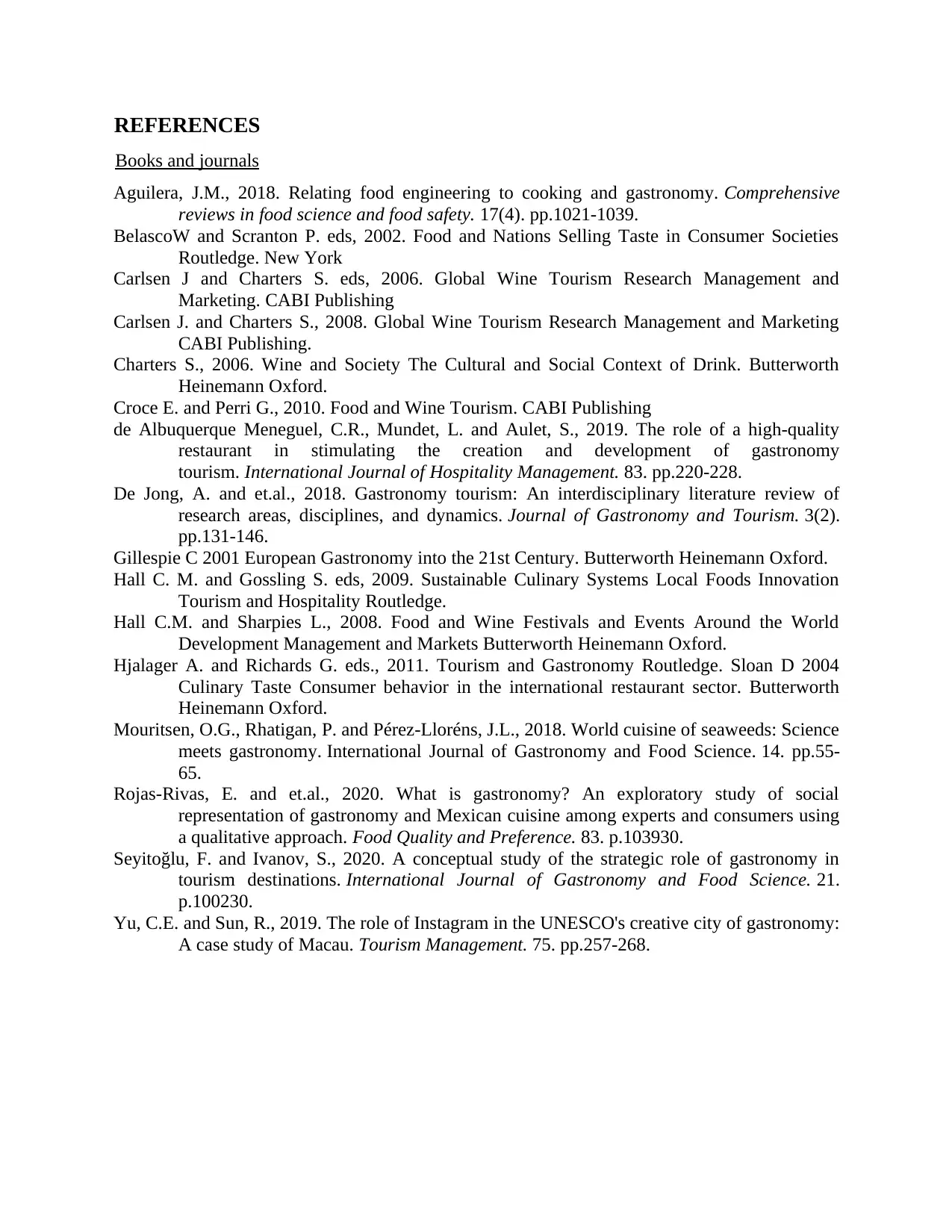
REFERENCES
Books and journals
Aguilera, J.M., 2018. Relating food engineering to cooking and gastronomy. Comprehensive
reviews in food science and food safety. 17(4). pp.1021-1039.
BelascoW and Scranton P. eds, 2002. Food and Nations Selling Taste in Consumer Societies
Routledge. New York
Carlsen J and Charters S. eds, 2006. Global Wine Tourism Research Management and
Marketing. CABI Publishing
Carlsen J. and Charters S., 2008. Global Wine Tourism Research Management and Marketing
CABI Publishing.
Charters S., 2006. Wine and Society The Cultural and Social Context of Drink. Butterworth
Heinemann Oxford.
Croce E. and Perri G., 2010. Food and Wine Tourism. CABI Publishing
de Albuquerque Meneguel, C.R., Mundet, L. and Aulet, S., 2019. The role of a high-quality
restaurant in stimulating the creation and development of gastronomy
tourism. International Journal of Hospitality Management. 83. pp.220-228.
De Jong, A. and et.al., 2018. Gastronomy tourism: An interdisciplinary literature review of
research areas, disciplines, and dynamics. Journal of Gastronomy and Tourism. 3(2).
pp.131-146.
Gillespie C 2001 European Gastronomy into the 21st Century. Butterworth Heinemann Oxford.
Hall C. M. and Gossling S. eds, 2009. Sustainable Culinary Systems Local Foods Innovation
Tourism and Hospitality Routledge.
Hall C.M. and Sharpies L., 2008. Food and Wine Festivals and Events Around the World
Development Management and Markets Butterworth Heinemann Oxford.
Hjalager A. and Richards G. eds., 2011. Tourism and Gastronomy Routledge. Sloan D 2004
Culinary Taste Consumer behavior in the international restaurant sector. Butterworth
Heinemann Oxford.
Mouritsen, O.G., Rhatigan, P. and Pérez-Lloréns, J.L., 2018. World cuisine of seaweeds: Science
meets gastronomy. International Journal of Gastronomy and Food Science. 14. pp.55-
65.
Rojas-Rivas, E. and et.al., 2020. What is gastronomy? An exploratory study of social
representation of gastronomy and Mexican cuisine among experts and consumers using
a qualitative approach. Food Quality and Preference. 83. p.103930.
Seyitoğlu, F. and Ivanov, S., 2020. A conceptual study of the strategic role of gastronomy in
tourism destinations. International Journal of Gastronomy and Food Science. 21.
p.100230.
Yu, C.E. and Sun, R., 2019. The role of Instagram in the UNESCO's creative city of gastronomy:
A case study of Macau. Tourism Management. 75. pp.257-268.
Books and journals
Aguilera, J.M., 2018. Relating food engineering to cooking and gastronomy. Comprehensive
reviews in food science and food safety. 17(4). pp.1021-1039.
BelascoW and Scranton P. eds, 2002. Food and Nations Selling Taste in Consumer Societies
Routledge. New York
Carlsen J and Charters S. eds, 2006. Global Wine Tourism Research Management and
Marketing. CABI Publishing
Carlsen J. and Charters S., 2008. Global Wine Tourism Research Management and Marketing
CABI Publishing.
Charters S., 2006. Wine and Society The Cultural and Social Context of Drink. Butterworth
Heinemann Oxford.
Croce E. and Perri G., 2010. Food and Wine Tourism. CABI Publishing
de Albuquerque Meneguel, C.R., Mundet, L. and Aulet, S., 2019. The role of a high-quality
restaurant in stimulating the creation and development of gastronomy
tourism. International Journal of Hospitality Management. 83. pp.220-228.
De Jong, A. and et.al., 2018. Gastronomy tourism: An interdisciplinary literature review of
research areas, disciplines, and dynamics. Journal of Gastronomy and Tourism. 3(2).
pp.131-146.
Gillespie C 2001 European Gastronomy into the 21st Century. Butterworth Heinemann Oxford.
Hall C. M. and Gossling S. eds, 2009. Sustainable Culinary Systems Local Foods Innovation
Tourism and Hospitality Routledge.
Hall C.M. and Sharpies L., 2008. Food and Wine Festivals and Events Around the World
Development Management and Markets Butterworth Heinemann Oxford.
Hjalager A. and Richards G. eds., 2011. Tourism and Gastronomy Routledge. Sloan D 2004
Culinary Taste Consumer behavior in the international restaurant sector. Butterworth
Heinemann Oxford.
Mouritsen, O.G., Rhatigan, P. and Pérez-Lloréns, J.L., 2018. World cuisine of seaweeds: Science
meets gastronomy. International Journal of Gastronomy and Food Science. 14. pp.55-
65.
Rojas-Rivas, E. and et.al., 2020. What is gastronomy? An exploratory study of social
representation of gastronomy and Mexican cuisine among experts and consumers using
a qualitative approach. Food Quality and Preference. 83. p.103930.
Seyitoğlu, F. and Ivanov, S., 2020. A conceptual study of the strategic role of gastronomy in
tourism destinations. International Journal of Gastronomy and Food Science. 21.
p.100230.
Yu, C.E. and Sun, R., 2019. The role of Instagram in the UNESCO's creative city of gastronomy:
A case study of Macau. Tourism Management. 75. pp.257-268.

1 out of 10


Related Documents


Your All-in-One AI-Powered Toolkit for Academic Success.
+13062052269
info@desklib.com
Available 24*7 on WhatsApp / Email
![[object Object]](/_next/static/media/star-bottom.7253800d.svg)
Unlock your academic potential
Copyright © 2020–2026 A2Z Services. All Rights Reserved. Developed and managed by ZUCOL.