Microeconomics Report: Market Structure, Strategy, and Retail Analysis
VerifiedAdded on 2020/05/16
|28
|5771
|87
Report
AI Summary
This report delves into microeconomic principles, focusing on market structure and its influence on business strategy. The analysis centers on the oligopoly market structure, particularly within the European retail sector, and utilizes the Bertrand model to examine price competition and its limitations. The report explores strategic interactions, including the concepts of result matrices, dominant strategies, and Nash equilibrium (including dominant, mixed, and maximum variants). Furthermore, the report addresses the dynamics of repeated games, sequential games, and competition based on prices and quantities. The Cournot model is also discussed. Product differentiation is considered, with the isolation curve, graphical interpretations, and algebraic deductions, and the Stakelberg equilibrium are also analyzed. The report concludes with an assessment of the Bertrand model's limitations and offers strategic business management recommendations.

Microeconomics 1
Running Head: MICRO-ECONOMICS
Market Structure and Business Strategy
Running Head: MICRO-ECONOMICS
Market Structure and Business Strategy

Paraphrase This Document
Need a fresh take? Get an instant paraphrase of this document with our AI Paraphraser
Microeconomics 2
Table of Contents
Introduction......................................................................................................................................4
Reason for choosing sector/ model..................................................................................................5
Limitations and potentials of model in business decision making..................................................6
Hypothesis of model....................................................................................................................6
Variables considered....................................................................................................................7
Qualitative conclusion..................................................................................................................7
Design and implementation of strategic business management...................................................9
Application of microeconomic theory.............................................................................................9
Identification of Market...............................................................................................................9
Sectors of Economic Activity....................................................................................................11
Profitability of Sectors...............................................................................................................12
Market Structure Measurement..................................................................................................13
Determinants of Market Structure..............................................................................................13
Impact of Market Structure on the Intensity of Competition and Profitability of Sector..........14
Factors that Affecting Competition and linking to the Business Strategy.................................14
Strategic interaction.......................................................................................................................16
Concept of results matrix and numerical example.....................................................................16
Dominant strategy concept and numerical example..................................................................16
Explanation of the 'prisoner's dilemma' using a numerical example and the business examples
....................................................................................................................................................17
Concept of Nash equilibrium with numerical example.............................................................17
Concept of maximin equilibrium and numerical example.........................................................18
Explanation of multiple Nash equilibrium using examples numerical and business.................18
Explanation of the equilibrium in mixed strategies: numerical example and algebra deduction
....................................................................................................................................................19
Hypothesis of repeated games: numerical example; concept of taco-to-taco; use of retroactive
induction to solve the problem of the last play, and illustration with business case.................19
Hypothesis of sequential games:................................................................................................20
Hypothesis of competition in prices:.........................................................................................20
Hypothesis of Competition over quantities:...............................................................................20
Table of Contents
Introduction......................................................................................................................................4
Reason for choosing sector/ model..................................................................................................5
Limitations and potentials of model in business decision making..................................................6
Hypothesis of model....................................................................................................................6
Variables considered....................................................................................................................7
Qualitative conclusion..................................................................................................................7
Design and implementation of strategic business management...................................................9
Application of microeconomic theory.............................................................................................9
Identification of Market...............................................................................................................9
Sectors of Economic Activity....................................................................................................11
Profitability of Sectors...............................................................................................................12
Market Structure Measurement..................................................................................................13
Determinants of Market Structure..............................................................................................13
Impact of Market Structure on the Intensity of Competition and Profitability of Sector..........14
Factors that Affecting Competition and linking to the Business Strategy.................................14
Strategic interaction.......................................................................................................................16
Concept of results matrix and numerical example.....................................................................16
Dominant strategy concept and numerical example..................................................................16
Explanation of the 'prisoner's dilemma' using a numerical example and the business examples
....................................................................................................................................................17
Concept of Nash equilibrium with numerical example.............................................................17
Concept of maximin equilibrium and numerical example.........................................................18
Explanation of multiple Nash equilibrium using examples numerical and business.................18
Explanation of the equilibrium in mixed strategies: numerical example and algebra deduction
....................................................................................................................................................19
Hypothesis of repeated games: numerical example; concept of taco-to-taco; use of retroactive
induction to solve the problem of the last play, and illustration with business case.................19
Hypothesis of sequential games:................................................................................................20
Hypothesis of competition in prices:.........................................................................................20
Hypothesis of Competition over quantities:...............................................................................20
Microeconomics 3
Using the Bertrand model and the Cournot model in cases where price-based strategies (short-
term decisions) and strategies focusing on the capacity to be installed (long-term decisions) are
adopted,......................................................................................................................................21
Hypothesis of product differentiation:.......................................................................................21
Similarity and difference from the Cournot model....................................................................21
Definition of Isolation Curve, Graphical Interpretation and Algebraic Deduction...................22
Nash-Stakelberg Equilibrium - Graphical Interpretation...........................................................23
Stakelberg Equilibrium - Algebraic Deduction.........................................................................24
Stakelberg Model - Limitation...................................................................................................24
Conclusions:..................................................................................................................................24
References......................................................................................................................................26
Using the Bertrand model and the Cournot model in cases where price-based strategies (short-
term decisions) and strategies focusing on the capacity to be installed (long-term decisions) are
adopted,......................................................................................................................................21
Hypothesis of product differentiation:.......................................................................................21
Similarity and difference from the Cournot model....................................................................21
Definition of Isolation Curve, Graphical Interpretation and Algebraic Deduction...................22
Nash-Stakelberg Equilibrium - Graphical Interpretation...........................................................23
Stakelberg Equilibrium - Algebraic Deduction.........................................................................24
Stakelberg Model - Limitation...................................................................................................24
Conclusions:..................................................................................................................................24
References......................................................................................................................................26
⊘ This is a preview!⊘
Do you want full access?
Subscribe today to unlock all pages.

Trusted by 1+ million students worldwide
Microeconomics 4
Introduction
The main purpose of this report is to demonstrate the critical reflection over the microeconomic
concepts in context to the market structure and business strategy. The oligopoly market structure
is the theme of this report in which the European retail market is analyzed with reference to the
limitations of the Bertrand model. In addition to this, microeconomics theory is also applied with
reference to the market structure to adding the value in profitability of business. On the other
hand, strategic interaction is also evaluated with respect to the result and dominant strategy. In
context to this, the Nash equilibrium is also analyzed with context to the variant aspects as
dominant, mixed and maximum. Along with this, the repetitive playing position is also assessed.
Apart from this, the European market is also evaluated with respect to the different market
changes. As, the European retail market is growing with the rapid force so the analysis can easily
be linked to the market demand and supply function.
Introduction
The main purpose of this report is to demonstrate the critical reflection over the microeconomic
concepts in context to the market structure and business strategy. The oligopoly market structure
is the theme of this report in which the European retail market is analyzed with reference to the
limitations of the Bertrand model. In addition to this, microeconomics theory is also applied with
reference to the market structure to adding the value in profitability of business. On the other
hand, strategic interaction is also evaluated with respect to the result and dominant strategy. In
context to this, the Nash equilibrium is also analyzed with context to the variant aspects as
dominant, mixed and maximum. Along with this, the repetitive playing position is also assessed.
Apart from this, the European market is also evaluated with respect to the different market
changes. As, the European retail market is growing with the rapid force so the analysis can easily
be linked to the market demand and supply function.
Paraphrase This Document
Need a fresh take? Get an instant paraphrase of this document with our AI Paraphraser
Microeconomics 5
Reason for choosing sector/ model
From the economic aspect, there are several models which pertain to different concepts and
ideology in context to determine the impact of model on the perspective market structure. The
main reason behind the chosen of model Bertrand is to effectively address the market structure
and its impact on the perspective economic outlook. Along with this, it is also selected because
of analyzing the market with respect to the pricing and quantity of the product as the firms
determines that the price of the product would remain constant but the market structure is a
factor that directly affects the decision making of product. Further, the quantitative and
numerical assumptions can also be done in significant manner so that the competition in the
market can easily be considered. This model is also valuable for the oligopolistic competition in
the concerned market. From this application of this method, the pricing competition can
effectively be assessed (Danzon and Nicholson, 2012). With this, it is also beneficial in context
to the logical arguments in concern to the market structure and pricing strategy and the several
situations are also assessed for the equilibrium aspect. In order to assess the paying capacity of
concerned customers, how much they can pay for the particular price setting by the organization
for its product. However, the pricing concern of the product is evaluated to deliver the costing
and earnings for the product of business.
Apart from this, the retail industry is also chosen because it is one of the fast growing statuses in
the perspective economy. In addition to this, price is a major aspect in this industry so the model
can easily be reviewed to apply and draw better results from the conclusion of concerned
theories of the model (Jamison, 2013).
Reason for choosing sector/ model
From the economic aspect, there are several models which pertain to different concepts and
ideology in context to determine the impact of model on the perspective market structure. The
main reason behind the chosen of model Bertrand is to effectively address the market structure
and its impact on the perspective economic outlook. Along with this, it is also selected because
of analyzing the market with respect to the pricing and quantity of the product as the firms
determines that the price of the product would remain constant but the market structure is a
factor that directly affects the decision making of product. Further, the quantitative and
numerical assumptions can also be done in significant manner so that the competition in the
market can easily be considered. This model is also valuable for the oligopolistic competition in
the concerned market. From this application of this method, the pricing competition can
effectively be assessed (Danzon and Nicholson, 2012). With this, it is also beneficial in context
to the logical arguments in concern to the market structure and pricing strategy and the several
situations are also assessed for the equilibrium aspect. In order to assess the paying capacity of
concerned customers, how much they can pay for the particular price setting by the organization
for its product. However, the pricing concern of the product is evaluated to deliver the costing
and earnings for the product of business.
Apart from this, the retail industry is also chosen because it is one of the fast growing statuses in
the perspective economy. In addition to this, price is a major aspect in this industry so the model
can easily be reviewed to apply and draw better results from the conclusion of concerned
theories of the model (Jamison, 2013).
Microeconomics 6
Limitations and potentials of model in business decision making
The major assumption of this model that the price of competitive firm will be same for long time
by due to some economic situation, price of the product is reduced; this is the major limitations
of this model. In addition to this, the non- price competition is not addressed in this model.
Further, the capacity constraint is ignored, in the situation where the single firm might not be
able to fulfil the supply for overall market (Policonomics, 2017). On the other hand, the classical
model is only focused on the pure strategy Nash equilibrium. Further, the price war is avoided by
the firms which impose the boundary on its assumptions. The generation of higher sales depends
on the barrier of entry in the market. Dynamic competition is also the limitation of company in
which the competition in the repeated price might also lead towards the higher marginal cost
than the equilibrium.
In context to the potential of the model in relation to making the decision, it might be effective to
earn the profit from the duopoly market. It is also potential because of its pure strategies in
relation to binary entry system. If there is positive sunk cost than the potential customers might
increases due to the higher price concern of the competitors.
Hypothesis of model
From the assumptions of the model, the Bertrand model is hypothesized as that the price of the
homogeneous product of competitors will not increase and remain constant. It is also a
hypothesis of the model that Bertrand model is better for the duopoly market as the predications
cannot be made accurately and the assumptions depends on the particular industry (Hss, 2011).
Under this model, it is also predicted that the duopoly is enforceable for the cost structure in
which it, pushes to get down the costs to the marginal cost.
Limitations and potentials of model in business decision making
The major assumption of this model that the price of competitive firm will be same for long time
by due to some economic situation, price of the product is reduced; this is the major limitations
of this model. In addition to this, the non- price competition is not addressed in this model.
Further, the capacity constraint is ignored, in the situation where the single firm might not be
able to fulfil the supply for overall market (Policonomics, 2017). On the other hand, the classical
model is only focused on the pure strategy Nash equilibrium. Further, the price war is avoided by
the firms which impose the boundary on its assumptions. The generation of higher sales depends
on the barrier of entry in the market. Dynamic competition is also the limitation of company in
which the competition in the repeated price might also lead towards the higher marginal cost
than the equilibrium.
In context to the potential of the model in relation to making the decision, it might be effective to
earn the profit from the duopoly market. It is also potential because of its pure strategies in
relation to binary entry system. If there is positive sunk cost than the potential customers might
increases due to the higher price concern of the competitors.
Hypothesis of model
From the assumptions of the model, the Bertrand model is hypothesized as that the price of the
homogeneous product of competitors will not increase and remain constant. It is also a
hypothesis of the model that Bertrand model is better for the duopoly market as the predications
cannot be made accurately and the assumptions depends on the particular industry (Hss, 2011).
Under this model, it is also predicted that the duopoly is enforceable for the cost structure in
which it, pushes to get down the costs to the marginal cost.
⊘ This is a preview!⊘
Do you want full access?
Subscribe today to unlock all pages.
Trusted by 1+ million students worldwide
Microeconomics 7
Variables considered
The Bertrand model is based on the pricing structure which is an imperative concern for the
business to maintain the price constant and change it over the rivalries actions towards the
decreasing the price to hold the higher price. In relation to this, the price is a variable that might
dilutes the measurement of profits and sales of the product as well. On the other hand, market
structure is another variable which is considered in order to gain the higher profits from the
perspective market (Carmona, 2013). Further, the oligopoly is stated as the strategic variable as
compare to the output. Demand function is also a variable attribute for the Bertrand model which
is focused on the dynamics of concerned market.
Qualitative conclusion
(Source: Damme, 2012)
Variables considered
The Bertrand model is based on the pricing structure which is an imperative concern for the
business to maintain the price constant and change it over the rivalries actions towards the
decreasing the price to hold the higher price. In relation to this, the price is a variable that might
dilutes the measurement of profits and sales of the product as well. On the other hand, market
structure is another variable which is considered in order to gain the higher profits from the
perspective market (Carmona, 2013). Further, the oligopoly is stated as the strategic variable as
compare to the output. Demand function is also a variable attribute for the Bertrand model which
is focused on the dynamics of concerned market.
Qualitative conclusion
(Source: Damme, 2012)
Paraphrase This Document
Need a fresh take? Get an instant paraphrase of this document with our AI Paraphraser
Microeconomics 8
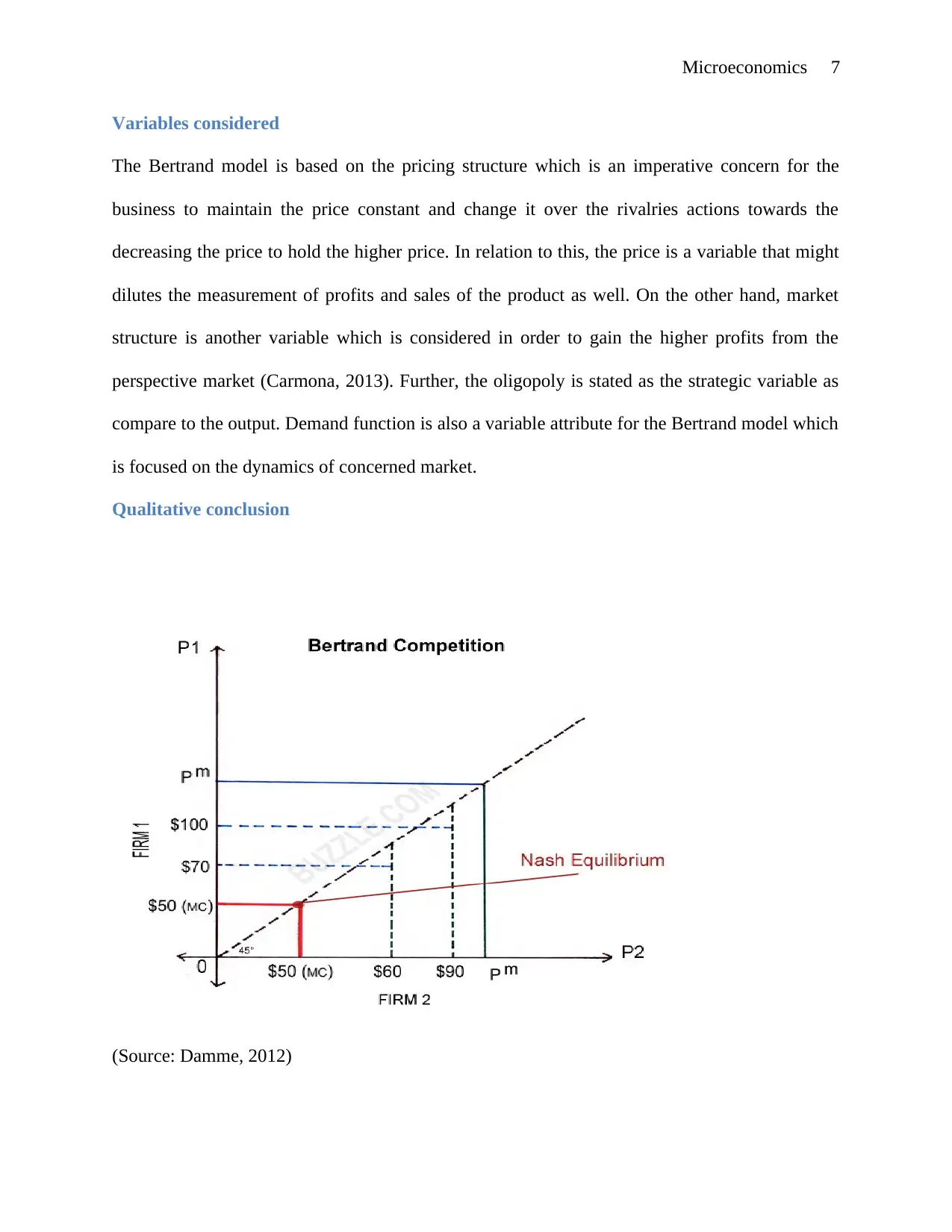
From the above graphical instructions of Bertrand competition model, it is analyzed that the
Nash equilibrium is the situation where the marginal cost for the two firms are equal. On the
other hand, above the Nash equilibrium point, the pricing of the product might not be equal due
to the market structure and factors affecting to the competition.
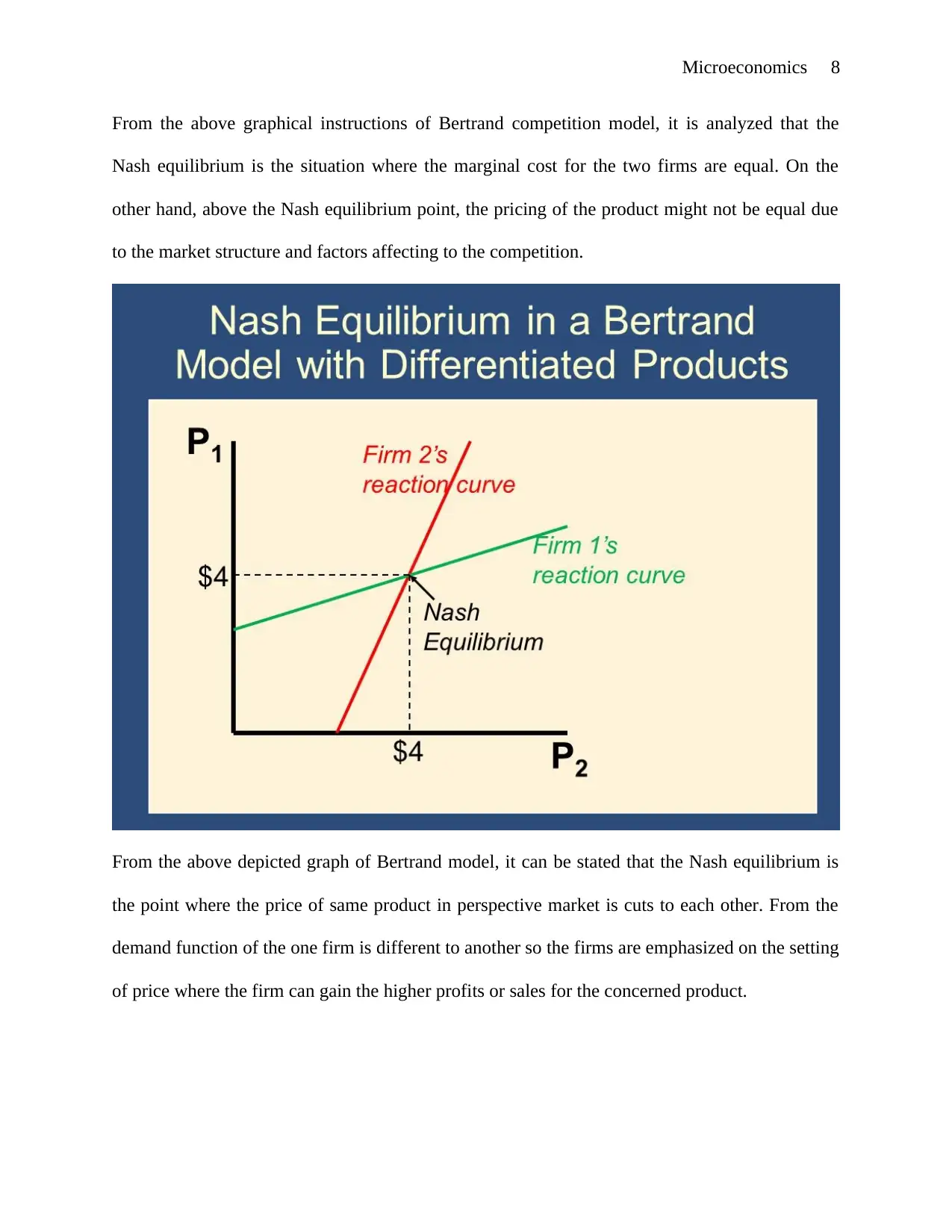
From the above depicted graph of Bertrand model, it can be stated that the Nash equilibrium is
the point where the price of same product in perspective market is cuts to each other. From the
demand function of the one firm is different to another so the firms are emphasized on the setting
of price where the firm can gain the higher profits or sales for the concerned product.
From the above graphical instructions of Bertrand competition model, it is analyzed that the
Nash equilibrium is the situation where the marginal cost for the two firms are equal. On the
other hand, above the Nash equilibrium point, the pricing of the product might not be equal due
to the market structure and factors affecting to the competition.
From the above depicted graph of Bertrand model, it can be stated that the Nash equilibrium is
the point where the price of same product in perspective market is cuts to each other. From the
demand function of the one firm is different to another so the firms are emphasized on the setting
of price where the firm can gain the higher profits or sales for the concerned product.
Microeconomics 9
Design and implementation of strategic business management
Strategic business management is relatively crucial for the organization to take the productive
decisions in order to attain the desired goals and objectives. From the perspective model, the firm
can build the valuable design for its actions through which the firm can also gain the competitive
advantages. From the review of market structure, firm can build the strategy by which it can sell
out the competitive and homogeneous product. In addition to this, the linkage or integration of
model can provide the support to firm in competing the concerned rivals. The business should
make the pricing strategy to lure the customers from the market. The constant pricing might
affect the long term profit for the firm so the business should focus on the quantity them product
as this model would be effective to ensure the price competition.
Application of microeconomic theory
Microeconomics deals with the imputing economic decisions with respect to the individual firm
and organization in which all the relevant measures are determined. In relation to this, there are
several theories and models have been established in relation to take protective decisions and
measures against the market failure and irrational behavior.
Identification of Market
The retail market of Europe has lot of business opportunities for the multinational companies for
obtain extra ordinary growth of sales and profitability. The market that is identified most suitable
for retail business is retail market of Germany. Germany holds the 20% purchasing power of
whole Europe. The market size of this European country is more than 80 million inhabitants. At
the same time, the retail market of this country has a turnover of 512 billion EUR, which is also a
factor of attraction (Berlin, 2016). In this context, Germany can be considered as a suitable place
for investment in the retail industry.
Design and implementation of strategic business management
Strategic business management is relatively crucial for the organization to take the productive
decisions in order to attain the desired goals and objectives. From the perspective model, the firm
can build the valuable design for its actions through which the firm can also gain the competitive
advantages. From the review of market structure, firm can build the strategy by which it can sell
out the competitive and homogeneous product. In addition to this, the linkage or integration of
model can provide the support to firm in competing the concerned rivals. The business should
make the pricing strategy to lure the customers from the market. The constant pricing might
affect the long term profit for the firm so the business should focus on the quantity them product
as this model would be effective to ensure the price competition.
Application of microeconomic theory
Microeconomics deals with the imputing economic decisions with respect to the individual firm
and organization in which all the relevant measures are determined. In relation to this, there are
several theories and models have been established in relation to take protective decisions and
measures against the market failure and irrational behavior.
Identification of Market
The retail market of Europe has lot of business opportunities for the multinational companies for
obtain extra ordinary growth of sales and profitability. The market that is identified most suitable
for retail business is retail market of Germany. Germany holds the 20% purchasing power of
whole Europe. The market size of this European country is more than 80 million inhabitants. At
the same time, the retail market of this country has a turnover of 512 billion EUR, which is also a
factor of attraction (Berlin, 2016). In this context, Germany can be considered as a suitable place
for investment in the retail industry.
⊘ This is a preview!⊘
Do you want full access?
Subscribe today to unlock all pages.
Trusted by 1+ million students worldwide
Microeconomics 10
There are different fundamental dimensions that define the category as well as products. One of
the examples of such dimension is OPEC. The OPEC stands for Organization of Petroleum
Exporting Countries. This way, OPEC defines geographical limitation particular criteria, which
petroleum exporting countries. A Chinese product is also a key word that defines products as
well as specifies the geographical boundaries of products. Islamic Banking is also a fundamental
dimension that defined specific kinds of banking products along with their geographical limits of
the markets.
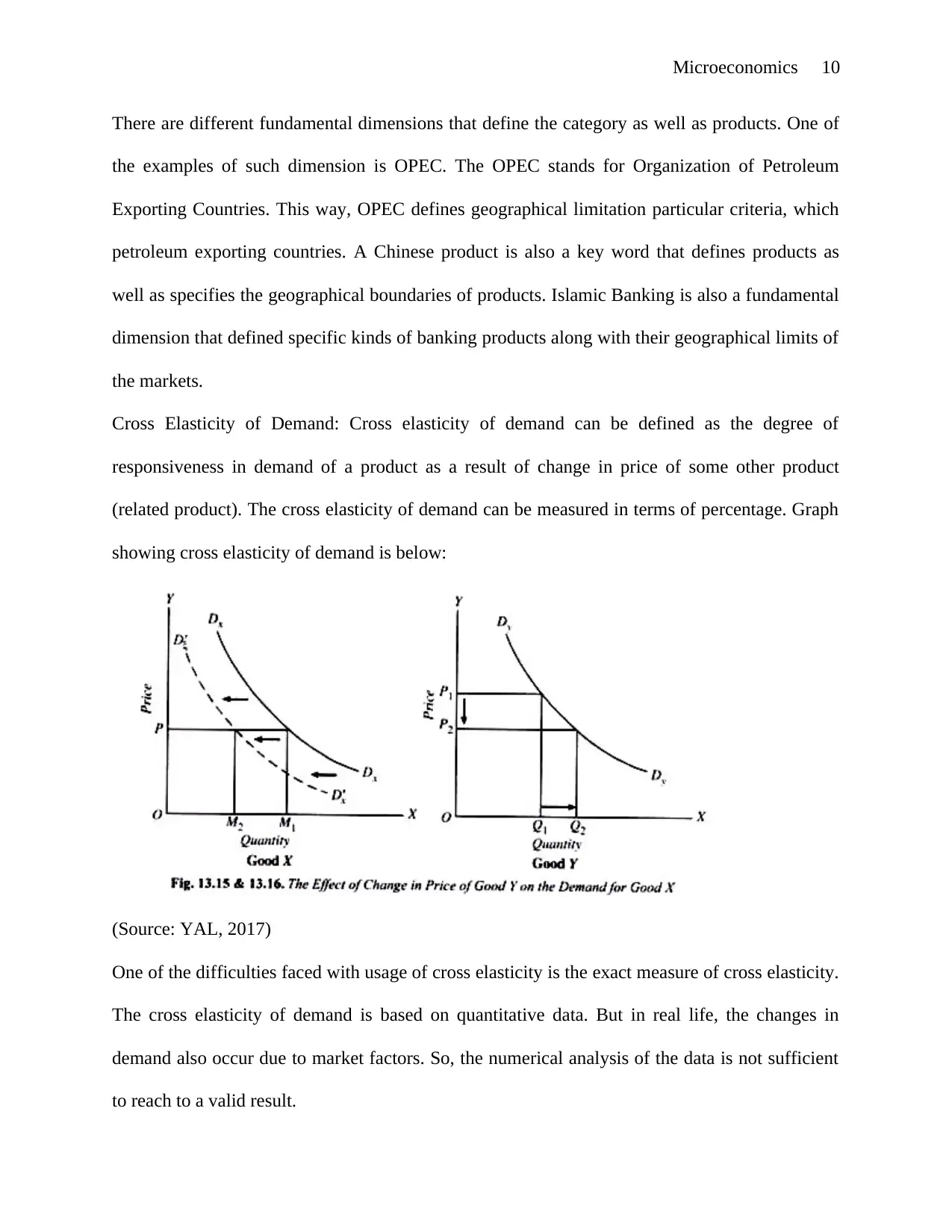
Cross Elasticity of Demand: Cross elasticity of demand can be defined as the degree of
responsiveness in demand of a product as a result of change in price of some other product
(related product). The cross elasticity of demand can be measured in terms of percentage. Graph
showing cross elasticity of demand is below:
(Source: YAL, 2017)
One of the difficulties faced with usage of cross elasticity is the exact measure of cross elasticity.
The cross elasticity of demand is based on quantitative data. But in real life, the changes in
demand also occur due to market factors. So, the numerical analysis of the data is not sufficient
to reach to a valid result.
There are different fundamental dimensions that define the category as well as products. One of
the examples of such dimension is OPEC. The OPEC stands for Organization of Petroleum
Exporting Countries. This way, OPEC defines geographical limitation particular criteria, which
petroleum exporting countries. A Chinese product is also a key word that defines products as
well as specifies the geographical boundaries of products. Islamic Banking is also a fundamental
dimension that defined specific kinds of banking products along with their geographical limits of
the markets.
Cross Elasticity of Demand: Cross elasticity of demand can be defined as the degree of
responsiveness in demand of a product as a result of change in price of some other product
(related product). The cross elasticity of demand can be measured in terms of percentage. Graph
showing cross elasticity of demand is below:
(Source: YAL, 2017)
One of the difficulties faced with usage of cross elasticity is the exact measure of cross elasticity.
The cross elasticity of demand is based on quantitative data. But in real life, the changes in
demand also occur due to market factors. So, the numerical analysis of the data is not sufficient
to reach to a valid result.
Paraphrase This Document
Need a fresh take? Get an instant paraphrase of this document with our AI Paraphraser
Microeconomics 11
Price Correlation can be defined as the degree of extent to which changes in price of one product
occurs due to change in price of another product. The price correlation can be positive or
negative. Positive correlation means, the change in price of one product would result in same
direction (increase or decrease) as the change occurred in price of another product. In case of
negative correlation, the inverse effect is seen on price with any change (increase or decrease) in
price of another product. The difficulties faced with the application of price correlation are that
sometimes it fails in providing accurate results or estimations due to influence of external
environmental factors.
Trade flows can be defined as the international purchase and selling of products and services
among different nations across globe. The data of trade flows are helpful in the measurement of
balance of trade of a nation (WTO, 2017). The formula used for measurement of balance trade is
“balance of trade = exports – imports”.
Sectors of Economic Activity
There are different tools or logic of markets that differentiates a market from common markets.
In context of focus of market, there is difference in terms of exchange value, scarcity of products
and resources, market and state governance, etc.
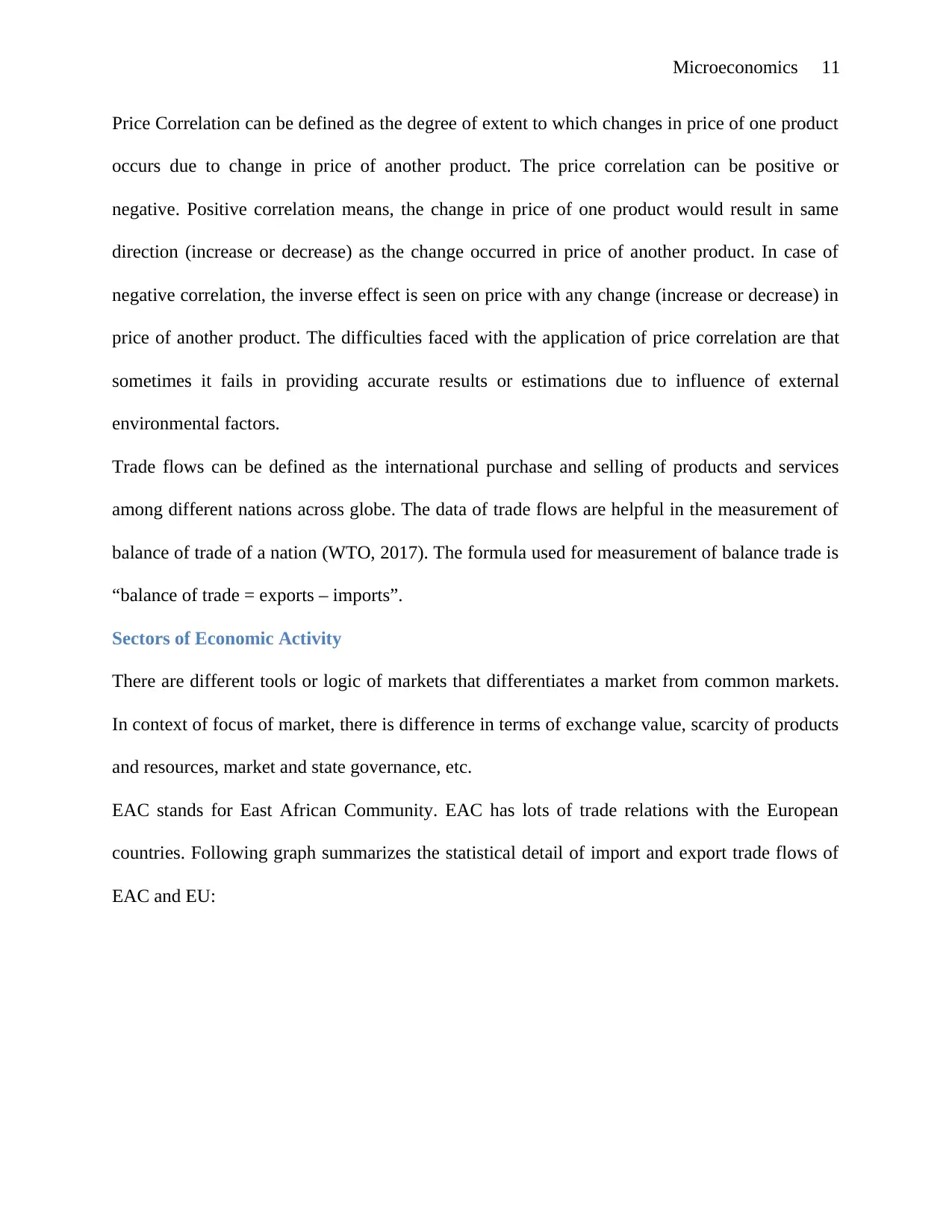
EAC stands for East African Community. EAC has lots of trade relations with the European
countries. Following graph summarizes the statistical detail of import and export trade flows of
EAC and EU:
Price Correlation can be defined as the degree of extent to which changes in price of one product
occurs due to change in price of another product. The price correlation can be positive or
negative. Positive correlation means, the change in price of one product would result in same
direction (increase or decrease) as the change occurred in price of another product. In case of
negative correlation, the inverse effect is seen on price with any change (increase or decrease) in
price of another product. The difficulties faced with the application of price correlation are that
sometimes it fails in providing accurate results or estimations due to influence of external
environmental factors.
Trade flows can be defined as the international purchase and selling of products and services
among different nations across globe. The data of trade flows are helpful in the measurement of
balance of trade of a nation (WTO, 2017). The formula used for measurement of balance trade is
“balance of trade = exports – imports”.
Sectors of Economic Activity
There are different tools or logic of markets that differentiates a market from common markets.
In context of focus of market, there is difference in terms of exchange value, scarcity of products
and resources, market and state governance, etc.
EAC stands for East African Community. EAC has lots of trade relations with the European
countries. Following graph summarizes the statistical detail of import and export trade flows of
EAC and EU:
Microeconomics 12
(Source: European Commission, 2017)
There are different advantages of conducting a strategic analysis of an organization. It enables
the organization to survive in the long run. The strategic analysis also helps increase the
credibility of the organization in the eyes of banks and financial institutions. This way, it helps
the organization in meeting funding needs efficiently (Aaker and McLoughlin, 2010). Strategic
analysis is also beneficial to explore the opportunities and threats present in the market.
Profitability of Sectors
According to Porter’s Five Force Analysis model, there are five determinants of profitability and
business opportunity at a market. Name of these determinants involves current competition in the
market, bargain power of suppliers, bargain power of customers, threat of new entrant, threat of
substitute etc. The porter’s five force analysis of German retail market is as below:
Name of Determinant Value
Existing Rivalry High
Bargaining power of buyers High
Bargaining power of supplier Low
Threat of new entrants Medium
(Source: European Commission, 2017)
There are different advantages of conducting a strategic analysis of an organization. It enables
the organization to survive in the long run. The strategic analysis also helps increase the
credibility of the organization in the eyes of banks and financial institutions. This way, it helps
the organization in meeting funding needs efficiently (Aaker and McLoughlin, 2010). Strategic
analysis is also beneficial to explore the opportunities and threats present in the market.
Profitability of Sectors
According to Porter’s Five Force Analysis model, there are five determinants of profitability and
business opportunity at a market. Name of these determinants involves current competition in the
market, bargain power of suppliers, bargain power of customers, threat of new entrant, threat of
substitute etc. The porter’s five force analysis of German retail market is as below:
Name of Determinant Value
Existing Rivalry High
Bargaining power of buyers High
Bargaining power of supplier Low
Threat of new entrants Medium
⊘ This is a preview!⊘
Do you want full access?
Subscribe today to unlock all pages.
Trusted by 1+ million students worldwide

1 out of 28


Your All-in-One AI-Powered Toolkit for Academic Success.
+13062052269
info@desklib.com
Available 24*7 on WhatsApp / Email
![[object Object]](/_next/static/media/star-bottom.7253800d.svg)
Unlock your academic potential
Copyright © 2020–2026 A2Z Services. All Rights Reserved. Developed and managed by ZUCOL.