Global Transportation: Comparing European and North American Systems

Verified

Added on  2020/05/08

|4
|476
|435
Report
AI Summary
This report provides a comparative analysis of the European and North American transportation systems. The author highlights the similarities, such as established infrastructure and the use of distribution hubs, and the differences, including the impact of tariffs, taxes, and market focus. The report also examines the impact of transportation costs on global trade, emphasizing how the economic growth in Europe has led to increased truck usage for cross-border trade, while North America relies on air and ship transport due to its geographical location. The report references specific sources to support the arguments presented, offering a comprehensive overview of the subject.
Document Page
Running head: GLOBAL TRANSPORTATION // 18382 1
Global Transportation // 18382
Name
Institution
tabler-icon-diamond-filled.svg

Paraphrase This Document

Need a fresh take? Get an instant paraphrase of this document with our AI Paraphraser
Document Page
GLOBAL TRANSPORTATION // 18382 2
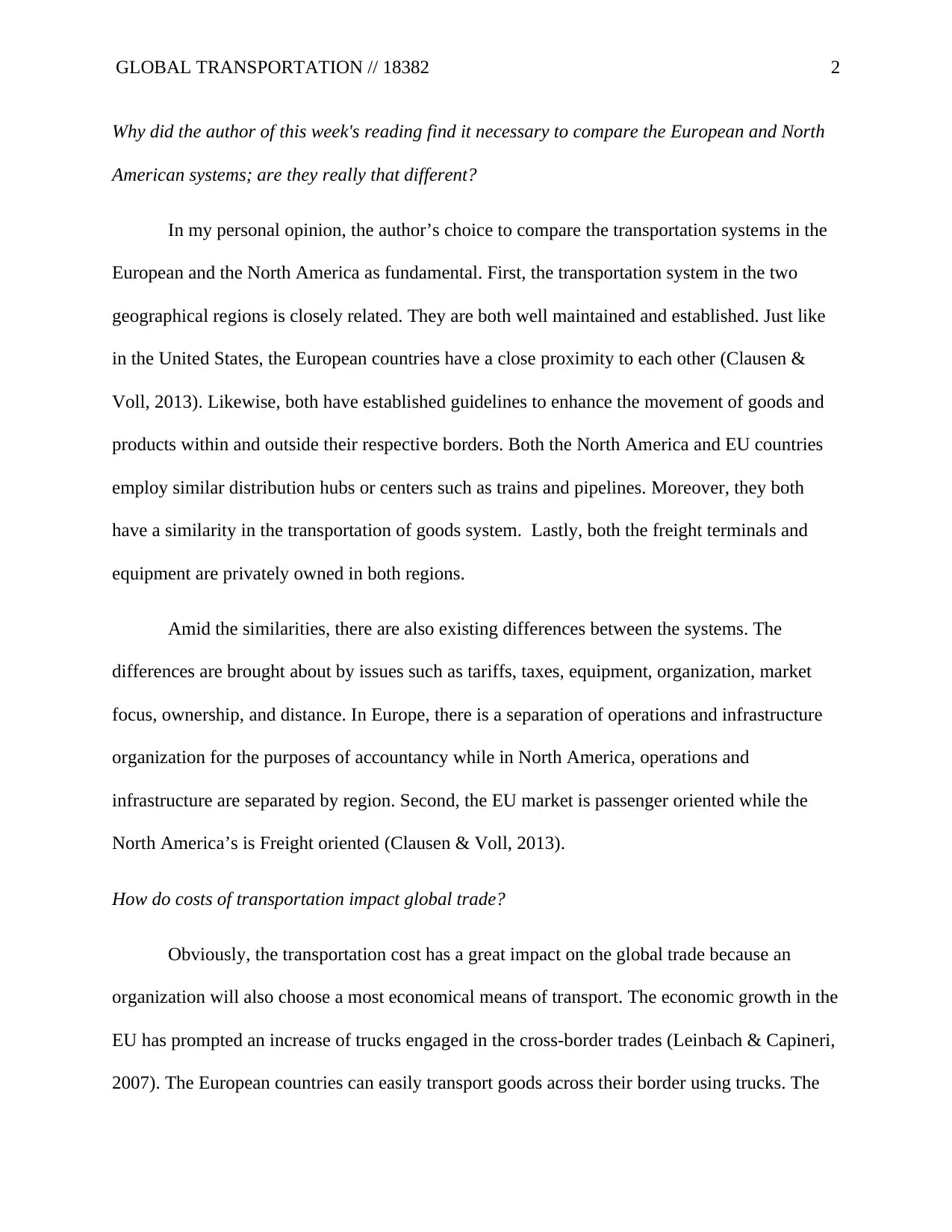
Why did the author of this week's reading find it necessary to compare the European and North
American systems; are they really that different?
In my personal opinion, the author’s choice to compare the transportation systems in the
European and the North America as fundamental. First, the transportation system in the two
geographical regions is closely related. They are both well maintained and established. Just like
in the United States, the European countries have a close proximity to each other (Clausen &
Voll, 2013). Likewise, both have established guidelines to enhance the movement of goods and
products within and outside their respective borders. Both the North America and EU countries
employ similar distribution hubs or centers such as trains and pipelines. Moreover, they both
have a similarity in the transportation of goods system. Lastly, both the freight terminals and
equipment are privately owned in both regions.
Amid the similarities, there are also existing differences between the systems. The
differences are brought about by issues such as tariffs, taxes, equipment, organization, market
focus, ownership, and distance. In Europe, there is a separation of operations and infrastructure
organization for the purposes of accountancy while in North America, operations and
infrastructure are separated by region. Second, the EU market is passenger oriented while the
North America’s is Freight oriented (Clausen & Voll, 2013).
How do costs of transportation impact global trade?
Obviously, the transportation cost has a great impact on the global trade because an
organization will also choose a most economical means of transport. The economic growth in the
EU has prompted an increase of trucks engaged in the cross-border trades (Leinbach & Capineri,
2007). The European countries can easily transport goods across their border using trucks. The
Document Page
GLOBAL TRANSPORTATION // 18382 3
trend can easily endanger the use of other modes of transport like air and water. However, North
America can only use air and ship travels to move goods internationally. Trucks cannot be used
because the region is surrounded by the Oceans (Leinbach & Capineri, 2007).
Document Page
GLOBAL TRANSPORTATION // 18382 4
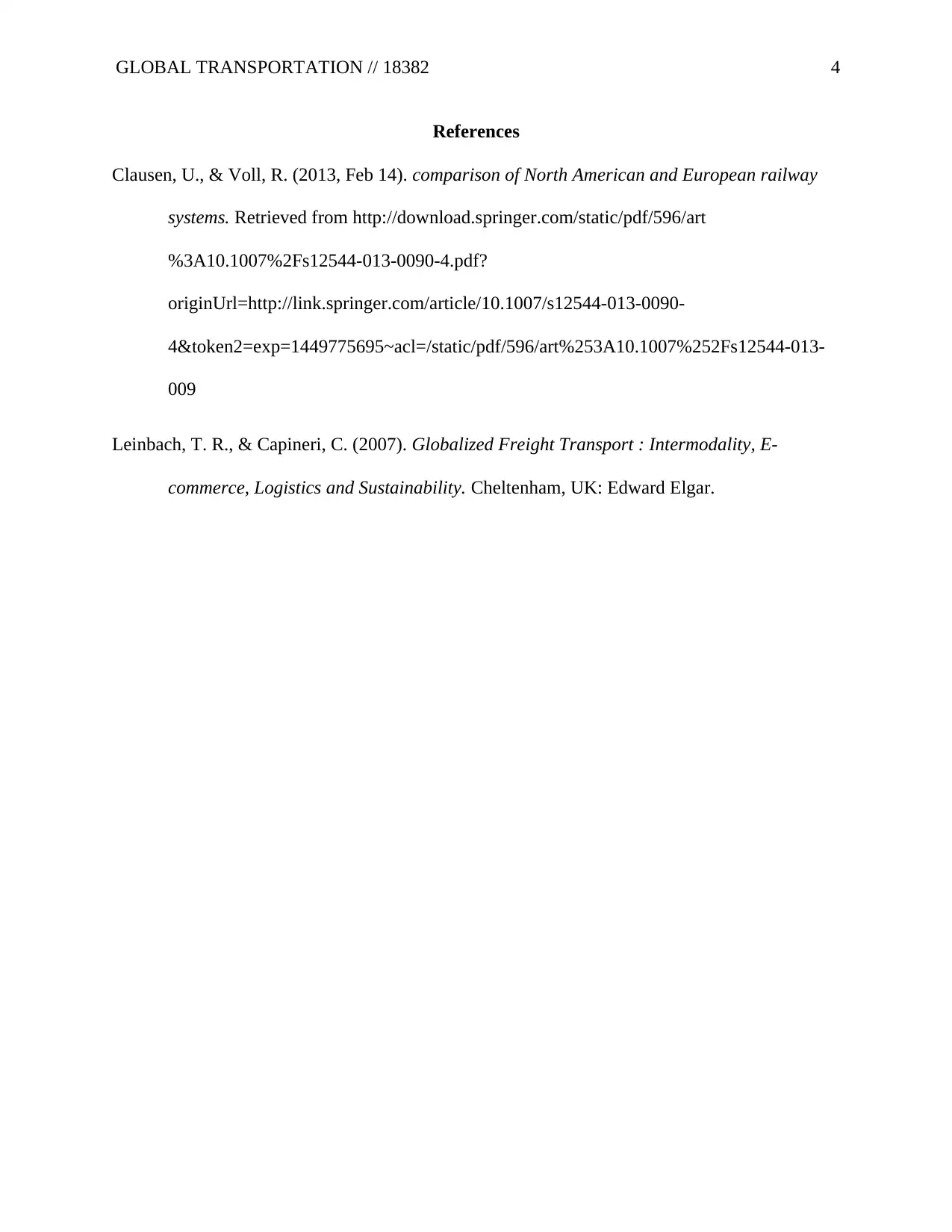
References
Clausen, U., & Voll, R. (2013, Feb 14). comparison of North American and European railway
systems. Retrieved from http://download.springer.com/static/pdf/596/art
%3A10.1007%2Fs12544-013-0090-4.pdf?
originUrl=http://link.springer.com/article/10.1007/s12544-013-0090-
4&token2=exp=1449775695~acl=/static/pdf/596/art%253A10.1007%252Fs12544-013-
009
Leinbach, T. R., & Capineri, C. (2007). Globalized Freight Transport : Intermodality, E-
commerce, Logistics and Sustainability. Cheltenham, UK: Edward Elgar.
chevron_up_icon
1 out of 4
circle_padding
hide_on_mobile
zoom_out_icon
[object Object]