Euthanasia: An Ethical and Legal Analysis of End-of-Life Care

Verified

Added on  2021/04/21

|11
|2298
|114
Report
AI Summary
This report provides a comprehensive analysis of euthanasia, exploring its ethical, legal, and societal implications. It begins by outlining the ethical principles in healthcare, including autonomy, beneficence, non-maleficence, and justice, and how these principles relate to end-of-life decisions. The report differentiates between active and passive euthanasia, discussing the debates surrounding each form, including physician-assisted suicide and the withdrawal of medical assistance. It examines the concept of human dignity and the right to die, along with the impact of euthanasia on society and healthcare systems. The report also touches on national and international perspectives, including legal frameworks in various countries, such as the Netherlands and Australia, and the ethical dilemmas that arise in the implementation of euthanasia laws. It concludes by emphasizing the importance of respecting individual rights and the need for careful consideration of the moral and legal complexities surrounding end-of-life care.
Document Page
Running head: EUTHANASIA
Euthanasia
Name of the student
University name
Author’s note
tabler-icon-diamond-filled.svg

Paraphrase This Document

Need a fresh take? Get an instant paraphrase of this document with our AI Paraphraser
Document Page
1EUTHANASIA
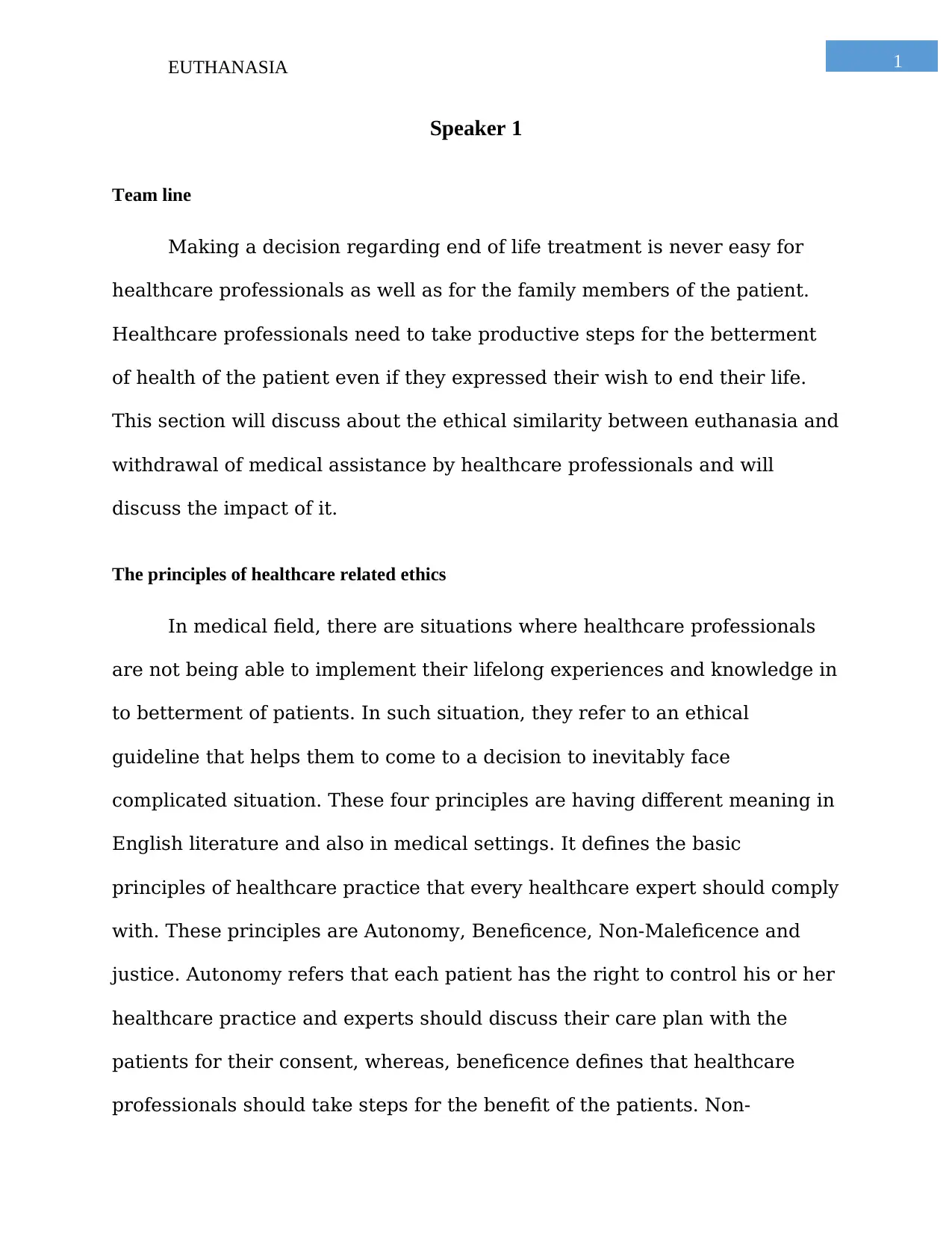
Speaker 1
Team line
Making a decision regarding end of life treatment is never easy for
healthcare professionals as well as for the family members of the patient.
Healthcare professionals need to take productive steps for the betterment
of health of the patient even if they expressed their wish to end their life.
This section will discuss about the ethical similarity between euthanasia and
withdrawal of medical assistance by healthcare professionals and will
discuss the impact of it.
The principles of healthcare related ethics
In medical field, there are situations where healthcare professionals
are not being able to implement their lifelong experiences and knowledge in
to betterment of patients. In such situation, they refer to an ethical
guideline that helps them to come to a decision to inevitably face
complicated situation. These four principles are having different meaning in
English literature and also in medical settings. It defines the basic
principles of healthcare practice that every healthcare expert should comply
with. These principles are Autonomy, Beneficence, Non-Maleficence and
justice. Autonomy refers that each patient has the right to control his or her
healthcare practice and experts should discuss their care plan with the
patients for their consent, whereas, beneficence defines that healthcare
professionals should take steps for the benefit of the patients. Non-
Document Page
2EUTHANASIA
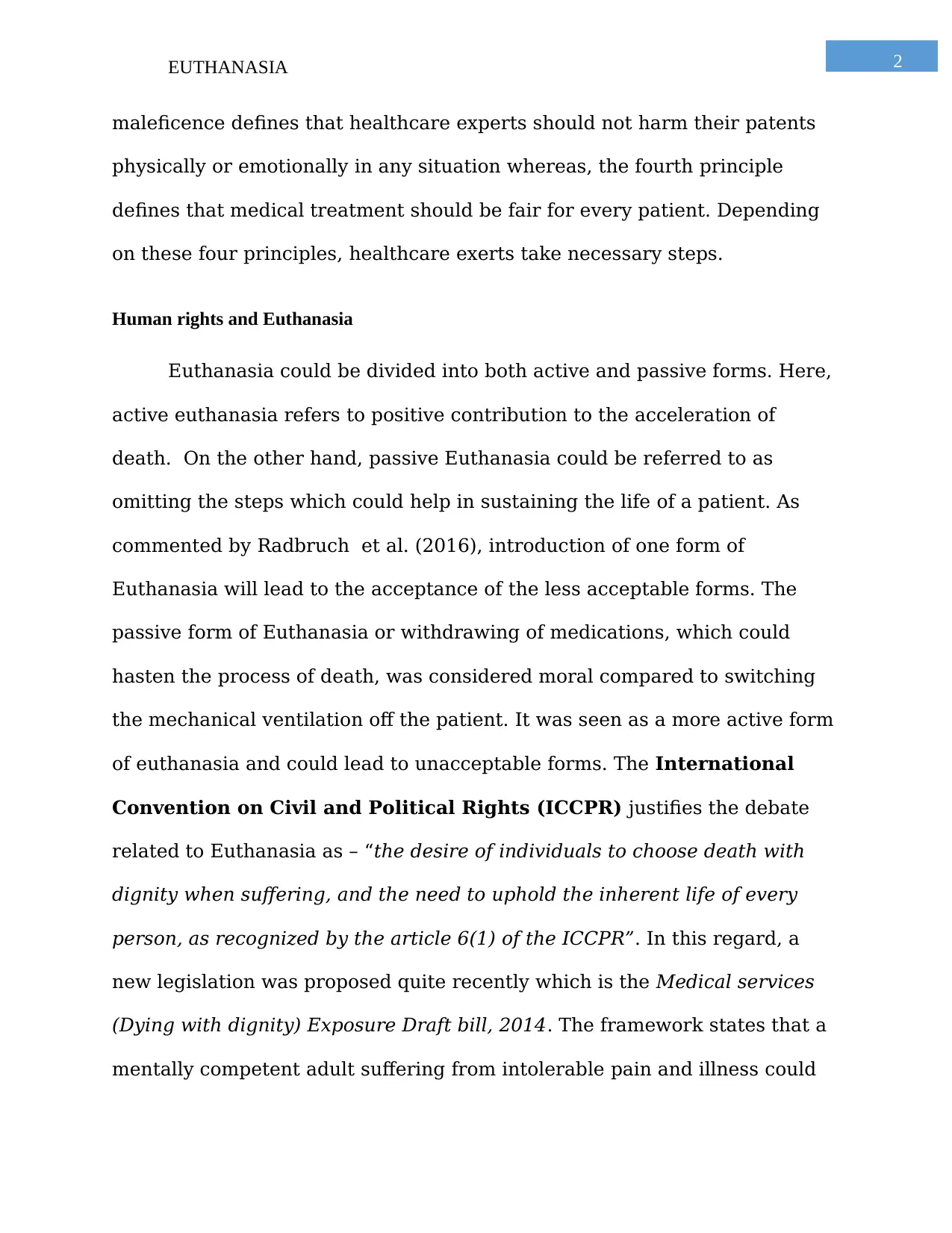
maleficence defines that healthcare experts should not harm their patents
physically or emotionally in any situation whereas, the fourth principle
defines that medical treatment should be fair for every patient. Depending
on these four principles, healthcare exerts take necessary steps.
Human rights and Euthanasia
Euthanasia could be divided into both active and passive forms. Here,
active euthanasia refers to positive contribution to the acceleration of
death. On the other hand, passive Euthanasia could be referred to as
omitting the steps which could help in sustaining the life of a patient. As
commented by Radbruch et al. (2016), introduction of one form of
Euthanasia will lead to the acceptance of the less acceptable forms. The
passive form of Euthanasia or withdrawing of medications, which could
hasten the process of death, was considered moral compared to switching
the mechanical ventilation off the patient. It was seen as a more active form
of euthanasia and could lead to unacceptable forms. The International
Convention on Civil and Political Rights (ICCPR) justifies the debate
related to Euthanasia as – “the desire of individuals to choose death with
dignity when suffering, and the need to uphold the inherent life of every
person, as recognized by the article 6(1) of the ICCPR”. In this regard, a
new legislation was proposed quite recently which is the Medical services
(Dying with dignity) Exposure Draft bill, 2014. The framework states that a
mentally competent adult suffering from intolerable pain and illness could
Document Page
3EUTHANASIA
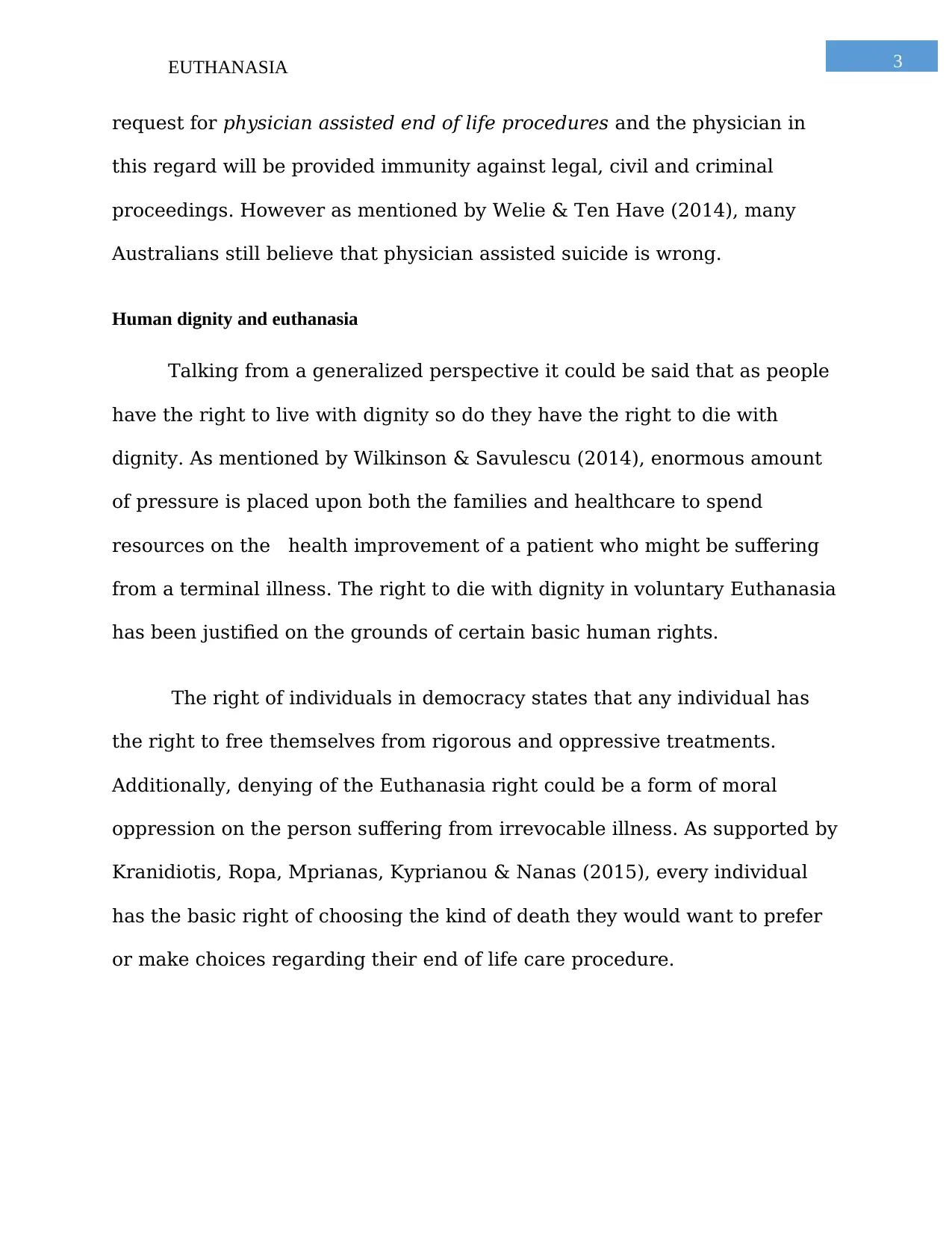
request for physician assisted end of life procedures and the physician in
this regard will be provided immunity against legal, civil and criminal
proceedings. However as mentioned by Welie & Ten Have (2014), many
Australians still believe that physician assisted suicide is wrong.
Human dignity and euthanasia
Talking from a generalized perspective it could be said that as people
have the right to live with dignity so do they have the right to die with
dignity. As mentioned by Wilkinson & Savulescu (2014), enormous amount
of pressure is placed upon both the families and healthcare to spend
resources on the health improvement of a patient who might be suffering
from a terminal illness. The right to die with dignity in voluntary Euthanasia
has been justified on the grounds of certain basic human rights.
The right of individuals in democracy states that any individual has
the right to free themselves from rigorous and oppressive treatments.
Additionally, denying of the Euthanasia right could be a form of moral
oppression on the person suffering from irrevocable illness. As supported by
Kranidiotis, Ropa, Mprianas, Kyprianou & Nanas (2015), every individual
has the basic right of choosing the kind of death they would want to prefer
or make choices regarding their end of life care procedure.
tabler-icon-diamond-filled.svg

Paraphrase This Document

Need a fresh take? Get an instant paraphrase of this document with our AI Paraphraser
Document Page
4EUTHANASIA
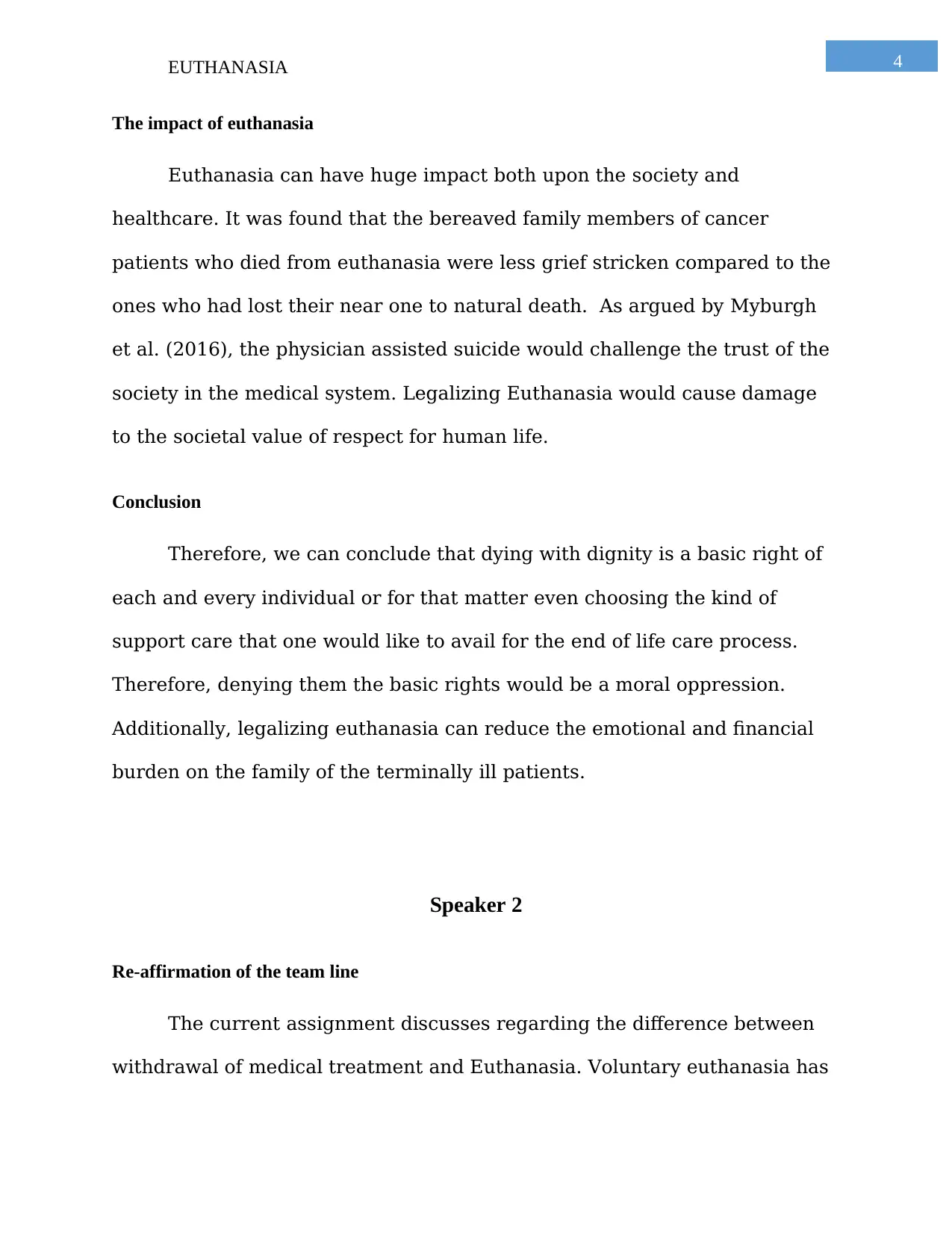
The impact of euthanasia
Euthanasia can have huge impact both upon the society and
healthcare. It was found that the bereaved family members of cancer
patients who died from euthanasia were less grief stricken compared to the
ones who had lost their near one to natural death. As argued by Myburgh
et al. (2016), the physician assisted suicide would challenge the trust of the
society in the medical system. Legalizing Euthanasia would cause damage
to the societal value of respect for human life.
Conclusion
Therefore, we can conclude that dying with dignity is a basic right of
each and every individual or for that matter even choosing the kind of
support care that one would like to avail for the end of life care process.
Therefore, denying them the basic rights would be a moral oppression.
Additionally, legalizing euthanasia can reduce the emotional and financial
burden on the family of the terminally ill patients.
Speaker 2
Re-affirmation of the team line
The current assignment discusses regarding the difference between
withdrawal of medical treatment and Euthanasia. Voluntary euthanasia has
Document Page
5EUTHANASIA
been legalized for providing the opportunity of dignified death for patients
suffering from terminal illness. As commented by De Lima et al. (2017), the
process is supported by a number of specific guidelines. However, there
exists a very thin line between both the active and passive forms of
Euthanasia.
Rebuttal
The differential perception to active and passive euthanasia is mostly
guided by the societal norms. Many are of the opinion that physician
assisted Euthanasia can challenge or harm the basic ethics of the medical
profession. On the other end voluntary euthanasia has been seen to reduce
the emotional and financial burden of the family members of the patient
(Myburgh et al., 2016). The hurdle which lies over here is with respect to
the legalizing of active and passive Euthanasia. Both are aimed towards
reducing the pain inflicted upon the patient. However, the active form
requires more deliberate approach on the end of the physician to end the
life of the patient (Johnstone, 2013). This has been referred to as declining
the moral code of conduct. Thus, opposing the previous view mention needs
to be made that there lays little or no difference between the active and
passive forms of euthanasia as both are done with the due consent of the
patient.
Document Page
6EUTHANASIA
National and international issues on Euthanasia
End of life care can be defined as the every possible intervention that
is meant for the patient’s good in their end of the life situation. However,
the definition of patient’s good is different for each patient and healthcare
exerts and is much beyond the biomedical notions (Fletcher, 2015). The
biomedical aspect defines patient’s good by making them physically and
emotionally sound. However, ethical dilemma is one of the major concerns
affecting the implementation and practice of Euthanasia worldwide. In the
year 2002, Netherlands became the first country to legalize Euthanasia.
However, the Netherlands jurisdiction ensured that the demand for
Euthanasia must be given in full consciousness by the patient ("Euthanasia
and assisted suicide laws around the world", 2018). In 2005, France
introduced the concept of the right to be ‘left to die’ that allowed doctors to
limit or stop medicine which was used to artificially prolong life in the
patients. In the year 2013, 300 terminally ill Americans were prescribed
lethal medications ("Euthanasia and assisted suicide laws around the
world", 2018). The only Australian jurisdiction where active voluntary
Euthanasia is permissible is the northern territory. Victoria became the first
Australian states to legalize physician assisted dying. Therefore, under any
condition there are a lot of legal hurdles which needs to be crossed before
the law for Euthanasia is actually implemented (Andorno, 2014).
tabler-icon-diamond-filled.svg

Paraphrase This Document

Need a fresh take? Get an instant paraphrase of this document with our AI Paraphraser
Document Page
7EUTHANASIA
How euthanasia cares about the human dignity
Euthanasia has been related with the right to dignified death. There
are many who are in the midst of a terminal disease and going through
unbearable pain. It becomes emotionally oppressive for the family members
of the patient to see their near and dear ones go through such pain. As
supported by Benhabib (2013), someone lying in their death bed has
potentially lost all hope to life. Therefore, the patients have often been seen
to request the physicians to aid them with the process of death as they are
no longer able to bear the unbearable pain. Therefore, physician assisted
active Euthanasia can help the patients in choosing a dignified manner of
death.
Euthanasia and its ethical grounds
Euthanasia is often disputed as there are many schools of thought
who considers physician assisted end to life of a patient illegal or medically
not acceptable. Additionally, there is a misnomer regarding the different
forms of Euthanasia. Though, there lies little or no difference between the
two forms of Euthanasia. In other words, both are aimed towards reducing
the grievances of the terminally ill patient and hence lies little or no
difference between them. However, as supported by Boudreau & Somerville
(2013), active euthanasia has not been legalized due to lawful concerns.
This is because placing too much power on the hand of the physician can
Document Page
8EUTHANASIA
result in future risks where the offences committed by a medical
professional can be refuted on the grounds of voluntary euthanasia.
Conclusion
Therefore, the confusion still lies with respect to the moral
implications of Euthanasia. Though, legalized partly in certain sections of
the country there are still limitations regarding the practice and
implementation of Euthanasia. This is because many Australians would still
prefer providing lethal injections to their loved ones rather than shutting off
the mechanical ventilator.
References
Andorno, R. (2014). Human dignity and human rights. In Handbook of
Global Bioethics (pp. 45-57). Springer Netherlands, 85-105.
Benhabib, S. (2013). Dignity in adversity: Human rights in troubled times.
New Jersey: John Wiley & Sons, 115-207.
Boudreau, J. D., & Somerville, M. A. (2013). Euthanasia is not medical
treatment. British medical bulletin, 106(1), 104-125.
De Lima, L., Woodruff, R., Pettus, K., Downing, J., Buitrago, R., Munyoro, E.,
... & Radbruch, L. (2017). International association for hospice and
Document Page
9EUTHANASIA
palliative care position statement: Euthanasia and physician-assisted
suicide. Journal of palliative medicine, 20(1), 8-14.
Euthanasia and assisted suicide laws around the world. (2018). the
Guardian. Retrieved 25 March 2018, from
https://www.theguardian.com/society/2014/jul/17/euthanasia-assisted-
suicide-laws-world
Fletcher, J. F. (2015). Morals and Medicine: the moral problems of the
patient's right to know the truth, contraception, artificial
insemination, sterilization, euthanasia. London: Princeton University
Press, 65-88.
Johnstone, M. J. (2013). Metaphors, stigma and the ‘Alzheimerization’of the
euthanasia debate. Dementia, 12(4), 377-393.
Kranidiotis, G., Ropa, J., Mprianas, J., Kyprianou, T., & Nanas, S. (2015).
Attitudes towards euthanasia among Greek intensive care unit
physicians and nurses. Heart & Lung: The Journal of Acute and
Critical Care, 44(3), 260-263.
Myburgh, J., Abillama, F., Chiumello, D., Dobb, G., Jacobe, S., Kleinpell,
R., ... & Torra, L. B. (2016). End-of-life care in the intensive care unit:
Report from the Task Force of World Federation of Societies of
Intensive and Critical Care Medicine. Journal of critical care, 34, 125-
130.
tabler-icon-diamond-filled.svg

Paraphrase This Document

Need a fresh take? Get an instant paraphrase of this document with our AI Paraphraser
Document Page
10EUTHANASIA
Radbruch, L., Leget, C., Bahr, P., Müller-Busch, C., Ellershaw, J., de Conno,
F., ... & board members of the EAPC. (2016). Euthanasia and
physician-assisted suicide: a white paper from the European
Association for Palliative Care. Palliative medicine, 30(2), 104-116.
Welie, J. V., & Ten Have, H. A. (2014). The ethics of forgoing life-sustaining
treatment: theoretical considerations and clinical decision
making. Multidisciplinary respiratory medicine, 9(1), 14.
Wilkinson, D., & Savulescu, J. (2014). A costly separation between
withdrawing and withholding treatment in intensive
care. Bioethics, 28(3), 127-137.
chevron_up_icon
1 out of 11
circle_padding
hide_on_mobile
zoom_out_icon
[object Object]