Facilitating Change in Health and Social Care: A Comprehensive Report
VerifiedAdded on 2020/09/03
|12
|4135
|34
Report
AI Summary
This report comprehensively examines change management within health and social care services, focusing on the factors driving change, strategies for evaluating recent changes, and the principles of effective change management. The report explores both internal and external factors, such as political, economic, social, technological, and legal influences, highlighting their impact on service delivery. It delves into the methods for measuring the impact of changes, including questionnaires, interviews, and the PDCA method, while also assessing the responses of services to these changes. Furthermore, the report analyzes the effects of changes on various stakeholders, including government, families, patients, and medical services, providing a detailed overview of how these changes reshape healthcare and social care practices. Finally, the report concludes with an overview of change management principles and the planning and monitoring of changes within the health and social care sector.
Facilitating change
in health and social
care
in health and social
care

Paraphrase This Document
Need a fresh take? Get an instant paraphrase of this document with our AI Paraphraser
Table of Contents
INTRODUCTION...........................................................................................................................1
TASK 1 ...........................................................................................................................................1
1.1 Key factors driving change in health and social care services..............................................1
1.2 Factors that are effective in presenting challenges to health and social care services..........2
TASK 2 ...........................................................................................................................................3
2.1 Strategy and criteria for measuring recent changes in health and social care.......................3
2.2 The impact measurement of recent changes in health and social care services....................4
2.3 Evaluation of the impact of recent changes in the sector of health and social care.............5
2.4 Responses of services to recent changes...............................................................................6
TASK 3............................................................................................................................................6
3.1 Principles of change management.........................................................................................6
3.2 Planning changes in health and social care...........................................................................7
3.3 Monitor changes in social and health care............................................................................8
CONCLUSION .............................................................................................................................9
REFERENCES..............................................................................................................................10
INTRODUCTION...........................................................................................................................1
TASK 1 ...........................................................................................................................................1
1.1 Key factors driving change in health and social care services..............................................1
1.2 Factors that are effective in presenting challenges to health and social care services..........2
TASK 2 ...........................................................................................................................................3
2.1 Strategy and criteria for measuring recent changes in health and social care.......................3
2.2 The impact measurement of recent changes in health and social care services....................4
2.3 Evaluation of the impact of recent changes in the sector of health and social care.............5
2.4 Responses of services to recent changes...............................................................................6
TASK 3............................................................................................................................................6
3.1 Principles of change management.........................................................................................6
3.2 Planning changes in health and social care...........................................................................7
3.3 Monitor changes in social and health care............................................................................8
CONCLUSION .............................................................................................................................9
REFERENCES..............................................................................................................................10
INTRODUCTION
Change is defined to be efforts undertaken by an organisation to transform the services
which are offered to consumers (Braveman, Egerter and Williams, 2011). It is carried out to
make organisation more future oriented. It is incorporated due to external factors which enforce
change in the organisation. National health services is main organisation which cater needs of
health and social care to people. Health and social care services are integrated so that local
bodies work with national authorities so that they reach can be expanded. The changes which are
employed are in domain of legislation, economic and political changes. This assignment focuses
on understanding factors that drive change in an organisation. Evaluation of recent changes that
took place in the health and social care services. Principles of change management will be
analysed at the end of this assignment.
TASK 1
1.1 Key factors driving change in health and social care services
In this modern scenario each individual is more concern about their health and security.
There are different factors which can be considered as the driving forces in the sector of health
and social care (Antheunis, Tates and Nieboer, 2013). This sector is widely focused on serving
high quality goods and services to their potential customers in order to satisfying their needs and
wants. This sector is driven through many internal as well as external components such as
political, economical, social and technological factor are some external elements. In United
Kingdom national health care, government and its bodies are widely engaged in implementing
better and effective medical facilities for people. There are various important factors that are
directly impacts of health care sector, in which some are described as under:
Political Factors: Government of country plays vast role in developing policies and
procedures in which various political parties are engaged. Each policy and procedures are
politically motivated as these are more effective and efficient for government. Priorities are
change due to change arises in government as political parties are run by the direction of
different leaders or parties like labour, conservative party etc.
Economic Factor: The economic factor has a huge impact on the sector of health and
social care , in this various elements such as funding for health care organisation, tax rates,
supply chain, wages payment, impact of supply chain from the economy and inflation rates.
Government strategies like austerity activities are helpful in causing change. LSAG is a big
1
Change is defined to be efforts undertaken by an organisation to transform the services
which are offered to consumers (Braveman, Egerter and Williams, 2011). It is carried out to
make organisation more future oriented. It is incorporated due to external factors which enforce
change in the organisation. National health services is main organisation which cater needs of
health and social care to people. Health and social care services are integrated so that local
bodies work with national authorities so that they reach can be expanded. The changes which are
employed are in domain of legislation, economic and political changes. This assignment focuses
on understanding factors that drive change in an organisation. Evaluation of recent changes that
took place in the health and social care services. Principles of change management will be
analysed at the end of this assignment.
TASK 1
1.1 Key factors driving change in health and social care services
In this modern scenario each individual is more concern about their health and security.
There are different factors which can be considered as the driving forces in the sector of health
and social care (Antheunis, Tates and Nieboer, 2013). This sector is widely focused on serving
high quality goods and services to their potential customers in order to satisfying their needs and
wants. This sector is driven through many internal as well as external components such as
political, economical, social and technological factor are some external elements. In United
Kingdom national health care, government and its bodies are widely engaged in implementing
better and effective medical facilities for people. There are various important factors that are
directly impacts of health care sector, in which some are described as under:
Political Factors: Government of country plays vast role in developing policies and
procedures in which various political parties are engaged. Each policy and procedures are
politically motivated as these are more effective and efficient for government. Priorities are
change due to change arises in government as political parties are run by the direction of
different leaders or parties like labour, conservative party etc.
Economic Factor: The economic factor has a huge impact on the sector of health and
social care , in this various elements such as funding for health care organisation, tax rates,
supply chain, wages payment, impact of supply chain from the economy and inflation rates.
Government strategies like austerity activities are helpful in causing change. LSAG is a big
1
⊘ This is a preview!⊘
Do you want full access?
Subscribe today to unlock all pages.

Trusted by 1+ million students worldwide
health care sector and runs a number of residential care and other services for people who are
facing mental issues. Any kind of change in economic policy has impacted on health care sector.
Social Factor: It is significantly based on changing policy and how people of society
react on changes. The major reason of causing social issue are increasing population,
demographic changes and growth in some diseases among a community (Barr, 2013). If people
of society accept the changes than it will helpful in serving products and services at wide area
and in the case of negative response the changes will face objection.
Technological Factor: The change in technological sector arises due to advancement in
computerised recording system, assistive technologies and medical innovation. The changes in
this sector happens at regular basis as technologies develop vastly. LSAG is widely concern on
adopting new technologies in order to providing fast and significant treatment to their clients and
patients.
Legal Factor: Government is responsible for legal changes as any kind of change in legal
laws will moving forward towards a drastic change in health and social care sector.
Internal factors such as change in firms structure, processes, leadership, management,
attitude and behaviour of employees has also a vast impact on organisational performance, so
that each health care sector is focused on taking effective actions in order to attaining goals and
objectives in efficient manner.
1.2 Factors that are effective in presenting challenges to health and social care services.
Issues and problems are uncertain in nature and there are various key factors that present
challenges to health and social care services. Manager of Local Sanctuary Action Group face
various barriers which are arises in driving the firm into a change environment. These type of
factors assist many changes within an organisation (Battilana, 2011). These key factors are
evaluated as under: Culture Factor: Culture is the most essential factor that directly impacts on the whole
society and business processes. People from different culture follows various values and
ethics and its helps in describing the living standard and tradition of region. Technological factors: In this modern era technological advancement appears at regular
basis as in medial sector various new and innovative technologies are used in order to
providing effective and fast services to their potential customers. As a residential care
home LSAG adopt various innovative tools such as X-Rays, MRI scans, CT scans, such
2
facing mental issues. Any kind of change in economic policy has impacted on health care sector.
Social Factor: It is significantly based on changing policy and how people of society
react on changes. The major reason of causing social issue are increasing population,
demographic changes and growth in some diseases among a community (Barr, 2013). If people
of society accept the changes than it will helpful in serving products and services at wide area
and in the case of negative response the changes will face objection.
Technological Factor: The change in technological sector arises due to advancement in
computerised recording system, assistive technologies and medical innovation. The changes in
this sector happens at regular basis as technologies develop vastly. LSAG is widely concern on
adopting new technologies in order to providing fast and significant treatment to their clients and
patients.
Legal Factor: Government is responsible for legal changes as any kind of change in legal
laws will moving forward towards a drastic change in health and social care sector.
Internal factors such as change in firms structure, processes, leadership, management,
attitude and behaviour of employees has also a vast impact on organisational performance, so
that each health care sector is focused on taking effective actions in order to attaining goals and
objectives in efficient manner.
1.2 Factors that are effective in presenting challenges to health and social care services.
Issues and problems are uncertain in nature and there are various key factors that present
challenges to health and social care services. Manager of Local Sanctuary Action Group face
various barriers which are arises in driving the firm into a change environment. These type of
factors assist many changes within an organisation (Battilana, 2011). These key factors are
evaluated as under: Culture Factor: Culture is the most essential factor that directly impacts on the whole
society and business processes. People from different culture follows various values and
ethics and its helps in describing the living standard and tradition of region. Technological factors: In this modern era technological advancement appears at regular
basis as in medial sector various new and innovative technologies are used in order to
providing effective and fast services to their potential customers. As a residential care
home LSAG adopt various innovative tools such as X-Rays, MRI scans, CT scans, such
2
Paraphrase This Document
Need a fresh take? Get an instant paraphrase of this document with our AI Paraphraser
tools are helpful in leading various health care sector towards rendering better and
effective services.
Budge: In development of health care sector budge plays most effective role as it is
required for each organisation to maintain their budget in order to gaining growth.
Government allocate limited amount of budget for health care organisation. In the
development stage organisation needs to have enough funds and capital to spend on
employee recruitment and training and maintaining organisational activities in effective
and efficient manner.
TASK 2
2.1 Strategy and criteria for measuring recent changes in health and social care.
Collection of data is the most essential term in measuring recent changes and its effect on
organisational performance (Lober and Flowers, 2011, August). The patients who are mentally
disabled are relocated into residential care home or supporting communities are created for this
purpose are closed. The management board in government are required a complete feedback that
are related with the process of moving clients and patients in to communities. Data has to be
gathered through various resources which are described as below:
Questionnaire: This can be considerer as the most effective way to gather data and information
in this various questions are prepared that are related with the process of relocation of mental
disabled people. The question of questionnaire will provide signifiant review about the patients
and the relationship of community.
Personal interview: It is also an important tool of data collection which is conducted one on one
people. It ensure about the proper measurement of changing behaviour and attitude mental
disabled people.
PDCA Method:
3
effective services.
Budge: In development of health care sector budge plays most effective role as it is
required for each organisation to maintain their budget in order to gaining growth.
Government allocate limited amount of budget for health care organisation. In the
development stage organisation needs to have enough funds and capital to spend on
employee recruitment and training and maintaining organisational activities in effective
and efficient manner.
TASK 2
2.1 Strategy and criteria for measuring recent changes in health and social care.
Collection of data is the most essential term in measuring recent changes and its effect on
organisational performance (Lober and Flowers, 2011, August). The patients who are mentally
disabled are relocated into residential care home or supporting communities are created for this
purpose are closed. The management board in government are required a complete feedback that
are related with the process of moving clients and patients in to communities. Data has to be
gathered through various resources which are described as below:
Questionnaire: This can be considerer as the most effective way to gather data and information
in this various questions are prepared that are related with the process of relocation of mental
disabled people. The question of questionnaire will provide signifiant review about the patients
and the relationship of community.
Personal interview: It is also an important tool of data collection which is conducted one on one
people. It ensure about the proper measurement of changing behaviour and attitude mental
disabled people.
PDCA Method:
3
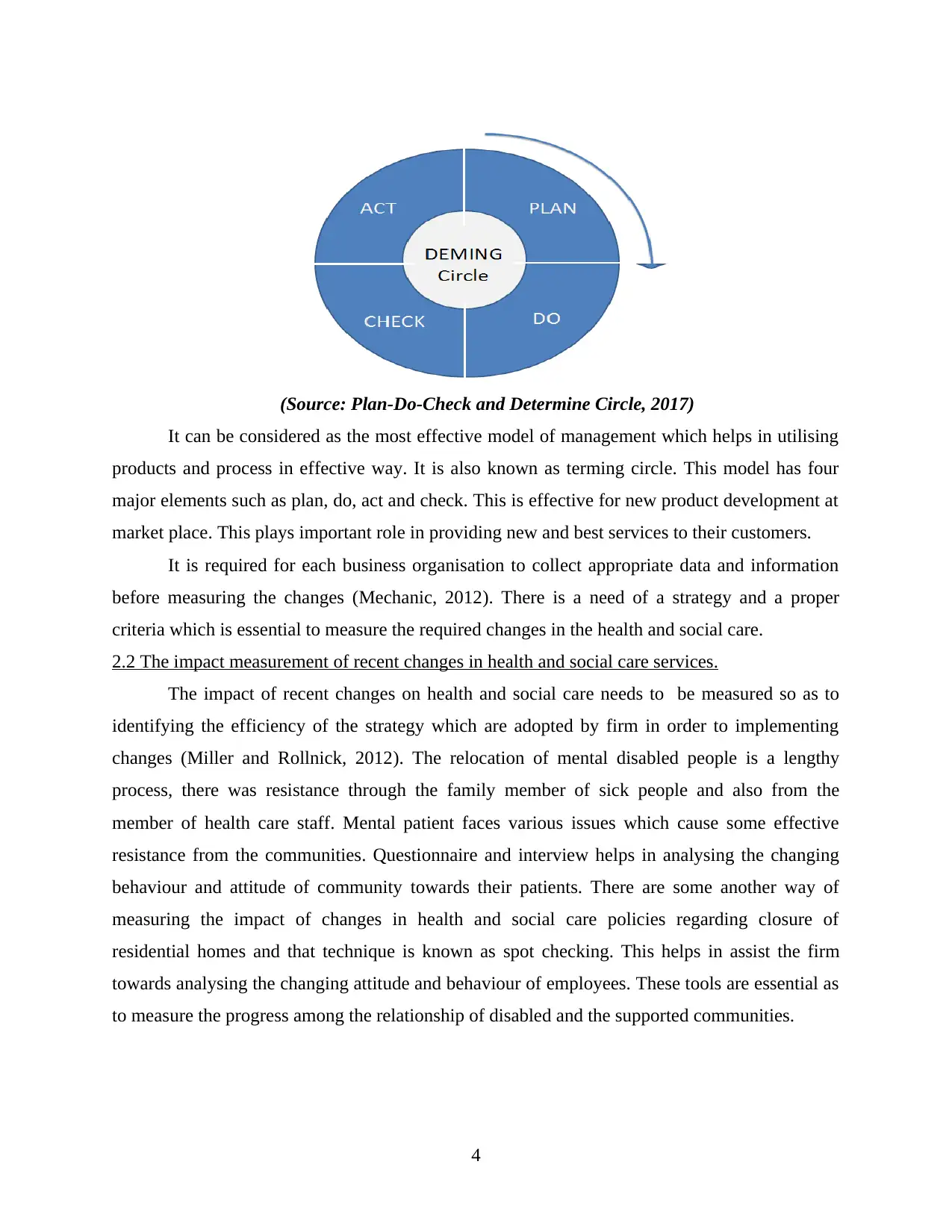
(Source: Plan-Do-Check and Determine Circle, 2017)
It can be considered as the most effective model of management which helps in utilising
products and process in effective way. It is also known as terming circle. This model has four
major elements such as plan, do, act and check. This is effective for new product development at
market place. This plays important role in providing new and best services to their customers.
It is required for each business organisation to collect appropriate data and information
before measuring the changes (Mechanic, 2012). There is a need of a strategy and a proper
criteria which is essential to measure the required changes in the health and social care.
2.2 The impact measurement of recent changes in health and social care services.
The impact of recent changes on health and social care needs to be measured so as to
identifying the efficiency of the strategy which are adopted by firm in order to implementing
changes (Miller and Rollnick, 2012). The relocation of mental disabled people is a lengthy
process, there was resistance through the family member of sick people and also from the
member of health care staff. Mental patient faces various issues which cause some effective
resistance from the communities. Questionnaire and interview helps in analysing the changing
behaviour and attitude of community towards their patients. There are some another way of
measuring the impact of changes in health and social care policies regarding closure of
residential homes and that technique is known as spot checking. This helps in assist the firm
towards analysing the changing attitude and behaviour of employees. These tools are essential as
to measure the progress among the relationship of disabled and the supported communities.
4
It can be considered as the most effective model of management which helps in utilising
products and process in effective way. It is also known as terming circle. This model has four
major elements such as plan, do, act and check. This is effective for new product development at
market place. This plays important role in providing new and best services to their customers.
It is required for each business organisation to collect appropriate data and information
before measuring the changes (Mechanic, 2012). There is a need of a strategy and a proper
criteria which is essential to measure the required changes in the health and social care.
2.2 The impact measurement of recent changes in health and social care services.
The impact of recent changes on health and social care needs to be measured so as to
identifying the efficiency of the strategy which are adopted by firm in order to implementing
changes (Miller and Rollnick, 2012). The relocation of mental disabled people is a lengthy
process, there was resistance through the family member of sick people and also from the
member of health care staff. Mental patient faces various issues which cause some effective
resistance from the communities. Questionnaire and interview helps in analysing the changing
behaviour and attitude of community towards their patients. There are some another way of
measuring the impact of changes in health and social care policies regarding closure of
residential homes and that technique is known as spot checking. This helps in assist the firm
towards analysing the changing attitude and behaviour of employees. These tools are essential as
to measure the progress among the relationship of disabled and the supported communities.
4
⊘ This is a preview!⊘
Do you want full access?
Subscribe today to unlock all pages.
Trusted by 1+ million students worldwide
Survey: An effective and proper formate of survey helps in analysing the impact of
recent changes in the sector of health and social care (Riekert, Ockene and Pbert, 2013). This can
be accumulated through applying various methods such as personal interview, questionnaire etc.
Complaint procedure: This is the widely applied by health and social care sector as it
helps in identifying the weaknesses of firm through taking view points of patients and clients,
their family members and various stakeholders. A proper and systematic structure helps in
making effective solution of problems.
Suggestion: This appears after measuring the performance of firm, the higher authority
and management department provide some suggestion in order to establish changes that are
beneficial for firm or its growth.
2.3 Evaluation of the impact of recent changes in the sector of health and social care.
It is required for each business organisation to analyse the impact of present changes that
are implemented in the health care sector (Munn-Giddings and Winter, 2013). Any kind of
change in medical sector may assist to a direct influence on patients. These change in the case is
about the relocation of disabled people from residential homes that have been closed. The
changes also has a huge impact on various other parties like, patients, government, industry and
families. Some essential impacts are evaluated as under:
Government: Changes in health care sector are promoted by government, the decision of
closing residual home was taken by government. Such kind of changes arises through a
supportive initiative that helps in providing support to the learning disability individual living in
the society.
Families: the recent changes in the health and social care of building a new community
based accommodation impacts the service user in the best possible manner. The management has
ensured that they are better off with newest circumstance of institution and should eliminate the
feeling of them being abolished from the family which is a major perceptions.
Patients: these are the people who are impacted directly by changes introduced in the
market. The organisation possessing mental disorders are to be provided with community based
together which means they are placed together to fulfil their medical and social needs at the same
place. They will be provided with a supportive environment and will be provided with better
qualitative services.
5
recent changes in the sector of health and social care (Riekert, Ockene and Pbert, 2013). This can
be accumulated through applying various methods such as personal interview, questionnaire etc.
Complaint procedure: This is the widely applied by health and social care sector as it
helps in identifying the weaknesses of firm through taking view points of patients and clients,
their family members and various stakeholders. A proper and systematic structure helps in
making effective solution of problems.
Suggestion: This appears after measuring the performance of firm, the higher authority
and management department provide some suggestion in order to establish changes that are
beneficial for firm or its growth.
2.3 Evaluation of the impact of recent changes in the sector of health and social care.
It is required for each business organisation to analyse the impact of present changes that
are implemented in the health care sector (Munn-Giddings and Winter, 2013). Any kind of
change in medical sector may assist to a direct influence on patients. These change in the case is
about the relocation of disabled people from residential homes that have been closed. The
changes also has a huge impact on various other parties like, patients, government, industry and
families. Some essential impacts are evaluated as under:
Government: Changes in health care sector are promoted by government, the decision of
closing residual home was taken by government. Such kind of changes arises through a
supportive initiative that helps in providing support to the learning disability individual living in
the society.
Families: the recent changes in the health and social care of building a new community
based accommodation impacts the service user in the best possible manner. The management has
ensured that they are better off with newest circumstance of institution and should eliminate the
feeling of them being abolished from the family which is a major perceptions.
Patients: these are the people who are impacted directly by changes introduced in the
market. The organisation possessing mental disorders are to be provided with community based
together which means they are placed together to fulfil their medical and social needs at the same
place. They will be provided with a supportive environment and will be provided with better
qualitative services.
5
Paraphrase This Document
Need a fresh take? Get an instant paraphrase of this document with our AI Paraphraser
Medical services: The manner in which medical services will be provided will see a
change as well. The government have to redefine an approach through which patients with
mental illness are treated (Richard and Shea, 2011). More resources are to be allocated in this
sector so that their status can be enhanced.
2.4 Responses of services to recent changes
The major changes which took place in the organisation are abolishing of Local
Sanctuary Action group and moving people towards new community based accommodation.
This major changes have incorporated changes in type and quality of services which are being
offered to consumers. There is a vital need for employees who are competent in performing the
tasks. The existing employees are to provided with training and education so that they are able to
provide improved level of services (Moss, 2017). The borough council who supervised this
change informed that there is lesser employee engagement. Which means that they are to be
motivated to perform their jobs with maximum efforts. Employees are needs to be provided with
benefits and rewards so that they performance at an ideal rate. The CQC also have informed
Tower hamlets to enhance quality of services which is to be offered to patients. So it has become
crucial to uplift the service quality so that it can match standards established by the government.
There are changes in the policies and regulations of the institution which can be termed as ideal
response to alteration in the environment of the organisation. The policies adopted should suit to
newer circumstances of the company.
TASK 3
3.1 Principles of change management
Principles are defined to be the tools and tactics which help an organisation incorporate
changes in business functioning. The local sanctuary Action group is looking to incorporate
changes in business operations by providing community based accommodation to people with
mental health issues. The main principles of change management are:
Lead with culture: The most crucial principle while leading change is to lead with
culture. The first task of the manager while facilitating change in the health and social care is to
ensure that change is supported by culture of an organisation. The maximum chances of failure
arises when the leaders fail to garner support from the culture of an organisation. LSAG is going
through a major transformation in such a case it is essential to draw energy and bring forward the
change supporting elements.
6
change as well. The government have to redefine an approach through which patients with
mental illness are treated (Richard and Shea, 2011). More resources are to be allocated in this
sector so that their status can be enhanced.
2.4 Responses of services to recent changes
The major changes which took place in the organisation are abolishing of Local
Sanctuary Action group and moving people towards new community based accommodation.
This major changes have incorporated changes in type and quality of services which are being
offered to consumers. There is a vital need for employees who are competent in performing the
tasks. The existing employees are to provided with training and education so that they are able to
provide improved level of services (Moss, 2017). The borough council who supervised this
change informed that there is lesser employee engagement. Which means that they are to be
motivated to perform their jobs with maximum efforts. Employees are needs to be provided with
benefits and rewards so that they performance at an ideal rate. The CQC also have informed
Tower hamlets to enhance quality of services which is to be offered to patients. So it has become
crucial to uplift the service quality so that it can match standards established by the government.
There are changes in the policies and regulations of the institution which can be termed as ideal
response to alteration in the environment of the organisation. The policies adopted should suit to
newer circumstances of the company.
TASK 3
3.1 Principles of change management
Principles are defined to be the tools and tactics which help an organisation incorporate
changes in business functioning. The local sanctuary Action group is looking to incorporate
changes in business operations by providing community based accommodation to people with
mental health issues. The main principles of change management are:
Lead with culture: The most crucial principle while leading change is to lead with
culture. The first task of the manager while facilitating change in the health and social care is to
ensure that change is supported by culture of an organisation. The maximum chances of failure
arises when the leaders fail to garner support from the culture of an organisation. LSAG is going
through a major transformation in such a case it is essential to draw energy and bring forward the
change supporting elements.
6
Binding of rational and emotion factor: To facilitate change employees are to be
touched upon emotional and rational grounds. Along with the rational factors of providing health
and social care, employees are to be reached in an emotional manner as well. Fostering of
emotional connection between employees and employers help in facilitation of change in
organisation (Campbell, 2014).
Change in the way of thinking: Change in an organisation cannot be introduced without
redefining the manner in which employees think. The decisions are to be formulated which are
visible to employees which introduce new measures of taking up tasks. It is the duty of leaders to
incorporate differentiated ways of carrying out a task.
Employee engagement: It is essential to engage employees in the matters concerning
change. Communication acts a powerful tool which is helpful in making a sustained transition in
the organisation (Happell and et al., 2012). It is the only manner through which change can be
incorporated in an organisation.
Start at the top: It is essential to introduce changes in the management at first. The
acceptance of change in management will help in taking decision and policies in an transformed
manner. The another reason for the same is that it is essential to take consent from all the
executives before its incorporation in the institutions.
3.2 Planning changes in health and social care
To incorporate changes in the health and social care it is essential to identify and evaluate
various crucial components concerning the organisation. The change which is carried out in this
assessment is closure of residential homes and move them to a community based
accommodation. It is necessary to plan this change ideally as attempts in this sector have failed
miserably earlier. The major consideration while planning a change are as follows:
Stakeholder analysis: Stakeholder analysis aims to identify the impact of change on the
concerned parties. The major stakeholders in this change are patients, families, employees and
borough council. There are people which are supporting the change where are some are against
it. It is the duty of a concerned manager to plan a change keeping interest and views of the
parties affected with the change. Gathering consent of the change is a major task which is to be
carried out by the management.
Consultation: It is the first change which is carried out in London Borough Council. This
institution can take help from council to plan a change for this organisation. The council can
7
touched upon emotional and rational grounds. Along with the rational factors of providing health
and social care, employees are to be reached in an emotional manner as well. Fostering of
emotional connection between employees and employers help in facilitation of change in
organisation (Campbell, 2014).
Change in the way of thinking: Change in an organisation cannot be introduced without
redefining the manner in which employees think. The decisions are to be formulated which are
visible to employees which introduce new measures of taking up tasks. It is the duty of leaders to
incorporate differentiated ways of carrying out a task.
Employee engagement: It is essential to engage employees in the matters concerning
change. Communication acts a powerful tool which is helpful in making a sustained transition in
the organisation (Happell and et al., 2012). It is the only manner through which change can be
incorporated in an organisation.
Start at the top: It is essential to introduce changes in the management at first. The
acceptance of change in management will help in taking decision and policies in an transformed
manner. The another reason for the same is that it is essential to take consent from all the
executives before its incorporation in the institutions.
3.2 Planning changes in health and social care
To incorporate changes in the health and social care it is essential to identify and evaluate
various crucial components concerning the organisation. The change which is carried out in this
assessment is closure of residential homes and move them to a community based
accommodation. It is necessary to plan this change ideally as attempts in this sector have failed
miserably earlier. The major consideration while planning a change are as follows:
Stakeholder analysis: Stakeholder analysis aims to identify the impact of change on the
concerned parties. The major stakeholders in this change are patients, families, employees and
borough council. There are people which are supporting the change where are some are against
it. It is the duty of a concerned manager to plan a change keeping interest and views of the
parties affected with the change. Gathering consent of the change is a major task which is to be
carried out by the management.
Consultation: It is the first change which is carried out in London Borough Council. This
institution can take help from council to plan a change for this organisation. The council can
7
⊘ This is a preview!⊘
Do you want full access?
Subscribe today to unlock all pages.
Trusted by 1+ million students worldwide
provide areas of improvement which are to be considered by a manager. The organisation can
look up to external organisation who specialise in planning changes and implementing the same
in the institution (Johnson, 2011).
Communication: it is another major tool which is to be employed by the change
management team. A communication channel needs to be developed so that concerned parties
are to be informed about the change about to take place and analyse their opinions of the same.
The development of communication skills of employees help in serving patients with mental
disorders. The management of the institutions have to make efforts to strengthen communication
channel fro the purpose of its transformation.
CQC: it is a public body which aims to enhance quality of services in health and social
care provided to patients. While planning a change in the health and social care segment it is
essential for a person to follow the norms and regulation so to avoid legal trouble. The new
planned community based accommodation should conform with the quality standards laid down
by CQC (Kauth and et al., 2011).
3.3 Monitor changes in social and health care
It is essential to monitor the changes in health and social care so that it can be ascertained
whether transformation have achieved its objectives or not. In this sector, service user will be
able to avail better and improved facilities. The changes which were taken place in an institution
were closing residential homes and introduce new community based accommodation for the
patients with mental disorders. The several tools which help in measuring changes in satisfaction
of consumers are as follows:
Customer feedbacks: this is the most important manner through satisfaction of customers
can be derived. Through this monitoring techniques a management will be able to identify the
changes which were projected and which were realised (Kitson and et al., 2013). Customer are
at the receiving end of the services of the institution. They are the best judge to services of the
organisation. It is essential to know whether service user are satisfied with the services or not. If
not, the necessary changes are to be incorporated again.
Questionnaires: these are a set of questions which are provided to consumers to avail
their valuable feedback (Kulig and Williams, 2011). It cover variety of questions on grounds of
service quality and staff behaviour with the patients. The questions are in a manner provides the
areas which are to be addressed in order to provide an ideal experience.
8
look up to external organisation who specialise in planning changes and implementing the same
in the institution (Johnson, 2011).
Communication: it is another major tool which is to be employed by the change
management team. A communication channel needs to be developed so that concerned parties
are to be informed about the change about to take place and analyse their opinions of the same.
The development of communication skills of employees help in serving patients with mental
disorders. The management of the institutions have to make efforts to strengthen communication
channel fro the purpose of its transformation.
CQC: it is a public body which aims to enhance quality of services in health and social
care provided to patients. While planning a change in the health and social care segment it is
essential for a person to follow the norms and regulation so to avoid legal trouble. The new
planned community based accommodation should conform with the quality standards laid down
by CQC (Kauth and et al., 2011).
3.3 Monitor changes in social and health care
It is essential to monitor the changes in health and social care so that it can be ascertained
whether transformation have achieved its objectives or not. In this sector, service user will be
able to avail better and improved facilities. The changes which were taken place in an institution
were closing residential homes and introduce new community based accommodation for the
patients with mental disorders. The several tools which help in measuring changes in satisfaction
of consumers are as follows:
Customer feedbacks: this is the most important manner through satisfaction of customers
can be derived. Through this monitoring techniques a management will be able to identify the
changes which were projected and which were realised (Kitson and et al., 2013). Customer are
at the receiving end of the services of the institution. They are the best judge to services of the
organisation. It is essential to know whether service user are satisfied with the services or not. If
not, the necessary changes are to be incorporated again.
Questionnaires: these are a set of questions which are provided to consumers to avail
their valuable feedback (Kulig and Williams, 2011). It cover variety of questions on grounds of
service quality and staff behaviour with the patients. The questions are in a manner provides the
areas which are to be addressed in order to provide an ideal experience.
8
Paraphrase This Document
Need a fresh take? Get an instant paraphrase of this document with our AI Paraphraser
Observation: it is defined to be other measure through which changes can be monitored
in context of an institution. This task is provided to CQC which prepares a report on the kind of
services which are offered to public. It helps in manifesting issues which were not paid special
emphasis. This technique help in boosting morale of the employees if the report turned out to be
positive.
CONCLUSION
From the above mentioned report it has been concluded that the changes in health and
social care sector plays effective role in country or its people. The facility of health and social
care needs to be available for each individual who are belongs to different geographical area.
This represents some challenges such as resistance to change and level of tolerance and
acceptability. Change has a vast impact on organisational performance as it helps in analysing
the current performance through applying various tools and techniques in order to mkoving
forward towards right direction.
9
in context of an institution. This task is provided to CQC which prepares a report on the kind of
services which are offered to public. It helps in manifesting issues which were not paid special
emphasis. This technique help in boosting morale of the employees if the report turned out to be
positive.
CONCLUSION
From the above mentioned report it has been concluded that the changes in health and
social care sector plays effective role in country or its people. The facility of health and social
care needs to be available for each individual who are belongs to different geographical area.
This represents some challenges such as resistance to change and level of tolerance and
acceptability. Change has a vast impact on organisational performance as it helps in analysing
the current performance through applying various tools and techniques in order to mkoving
forward towards right direction.
9
REFERENCES
Books and journal
Antheunis, M. L., Tates, K. and Nieboer, T. E., 2013. Patients’ and health professionals’ use of
social media in health care: Motives, barriers and expectations. Patient education and
counseling, 92(3). pp.426-431.
Barr, H., 2013. Toward a theoretical framework for interprofessional education. Journal of
interprofessional care. 27(1). pp.4-9.
Battilana, J., 2011. The enabling role of social position in diverging from the institutional status
quo: Evidence from the UK National Health Service. Organization Science, 22(4),
pp.817-834.
Braveman, P., Egerter, S. and Williams, D. R., 2011. The social determinants of health: coming
of age. Annual review of public health. 32, pp.381-398.
Campbell, C., 2014. Community mobilisation in the 21st century: Updating our theory of social
change?. Journal of Health Psychology. 19(1), pp.46-59.
Happell, B and et al., 2012. Should we or shouldn't we? Mental health nurses' views on physical
health care of mental health consumers. International journal of mental health nursing.
21(3), pp.202-210.
Johnson, M. O., 2011. The shifting landscape of health care: toward a model of health care
empowerment. American Journal of Public Health. 101(2), pp.265-270.
Kauth, M.R. And et al., 2011. Facilitating practice changes in mental health clinics: A guide for
implementation development in health care systems. Psychological services. 8(1), p.36.
Kitson, A. and et al., 2013. What are the core elements of patient‐centred care? A narrative
review and synthesis of the literature from health policy, medicine and nursing. Journal
of advanced nursing. 69(1), pp.4-15.
Kulig, J. C. and Williams, A. M. eds., 2011. Health in rural Canada. UBC Press.
Lober, W. B. and Flowers, J. L., 2011, August. Consumer empowerment in health care amid the
internet and social media. In Seminars in Oncology Nursing (Vol. 27, No. 3, pp. 169-
182). WB Saunders.
Mechanic, D., 2012. Seizing opportunities under the Affordable Care Act for transforming the
mental and behavioral health system. Health Affairs. 31(2). pp.376-382.
Miller, W. R. and Rollnick, S., 2012. Motivational interviewing: Helping people change.
Guilford press.
Moss, B., 2017.Communication skills in health and social care. Sage.
Munn-Giddings, C. and Winter, R., 2013. A handbook for action research in health and social
care. Routledge.
Richard, A. A. and Shea, K., 2011. Delineation of self‐care and associated concepts. Journal of
Nursing Scholarship. 43(3), pp.255-264.
Riekert, K. A., Ockene, J. K. and Pbert, L. eds., 2013. The handbook of health behavior change.
Springer Publishing Company.
10
Books and journal
Antheunis, M. L., Tates, K. and Nieboer, T. E., 2013. Patients’ and health professionals’ use of
social media in health care: Motives, barriers and expectations. Patient education and
counseling, 92(3). pp.426-431.
Barr, H., 2013. Toward a theoretical framework for interprofessional education. Journal of
interprofessional care. 27(1). pp.4-9.
Battilana, J., 2011. The enabling role of social position in diverging from the institutional status
quo: Evidence from the UK National Health Service. Organization Science, 22(4),
pp.817-834.
Braveman, P., Egerter, S. and Williams, D. R., 2011. The social determinants of health: coming
of age. Annual review of public health. 32, pp.381-398.
Campbell, C., 2014. Community mobilisation in the 21st century: Updating our theory of social
change?. Journal of Health Psychology. 19(1), pp.46-59.
Happell, B and et al., 2012. Should we or shouldn't we? Mental health nurses' views on physical
health care of mental health consumers. International journal of mental health nursing.
21(3), pp.202-210.
Johnson, M. O., 2011. The shifting landscape of health care: toward a model of health care
empowerment. American Journal of Public Health. 101(2), pp.265-270.
Kauth, M.R. And et al., 2011. Facilitating practice changes in mental health clinics: A guide for
implementation development in health care systems. Psychological services. 8(1), p.36.
Kitson, A. and et al., 2013. What are the core elements of patient‐centred care? A narrative
review and synthesis of the literature from health policy, medicine and nursing. Journal
of advanced nursing. 69(1), pp.4-15.
Kulig, J. C. and Williams, A. M. eds., 2011. Health in rural Canada. UBC Press.
Lober, W. B. and Flowers, J. L., 2011, August. Consumer empowerment in health care amid the
internet and social media. In Seminars in Oncology Nursing (Vol. 27, No. 3, pp. 169-
182). WB Saunders.
Mechanic, D., 2012. Seizing opportunities under the Affordable Care Act for transforming the
mental and behavioral health system. Health Affairs. 31(2). pp.376-382.
Miller, W. R. and Rollnick, S., 2012. Motivational interviewing: Helping people change.
Guilford press.
Moss, B., 2017.Communication skills in health and social care. Sage.
Munn-Giddings, C. and Winter, R., 2013. A handbook for action research in health and social
care. Routledge.
Richard, A. A. and Shea, K., 2011. Delineation of self‐care and associated concepts. Journal of
Nursing Scholarship. 43(3), pp.255-264.
Riekert, K. A., Ockene, J. K. and Pbert, L. eds., 2013. The handbook of health behavior change.
Springer Publishing Company.
10
⊘ This is a preview!⊘
Do you want full access?
Subscribe today to unlock all pages.
Trusted by 1+ million students worldwide

1 out of 12


Related Documents


Your All-in-One AI-Powered Toolkit for Academic Success.
+13062052269
info@desklib.com
Available 24*7 on WhatsApp / Email
![[object Object]](/_next/static/media/star-bottom.7253800d.svg)
Unlock your academic potential
Copyright © 2020–2026 A2Z Services. All Rights Reserved. Developed and managed by ZUCOL.