An Evaluation: The Effectiveness of the Victorian Prison System Today
VerifiedAdded on 2023/06/07
|8
|2203
|445
Essay
AI Summary
This essay critically evaluates the effectiveness of the Victorian prison system, examining factors contributing to its ineffectiveness such as societal inequalities, the failure of prisons to rehabilitate inmates, and the negative impact on families and communities. It considers neo-Marxist criticisms of the system, highlighting the role of societal factors in crime, and explores alternative approaches to incarceration, including house arrest, drug rehabilitation programs, and parole. The essay also emphasizes the importance of reintegration programs and addresses the need for social support to reduce recidivism, while acknowledging the complex challenges in reforming the criminal justice system. Desklib offers this essay as part of its collection of student-contributed assignments.
Evaluating Effectiveness of Victorian Prison System of Punishment 1
Evaluating Effectiveness of Victorian Prison System of Punishment
Student’s Name
Professor’s Name
Course Name
Date
Evaluating Effectiveness of Victorian Prison System of Punishment
Student’s Name
Professor’s Name
Course Name
Date

Paraphrase This Document
Need a fresh take? Get an instant paraphrase of this document with our AI Paraphraser
Evaluating Effectiveness of Victorian Prison System of Punishment 2
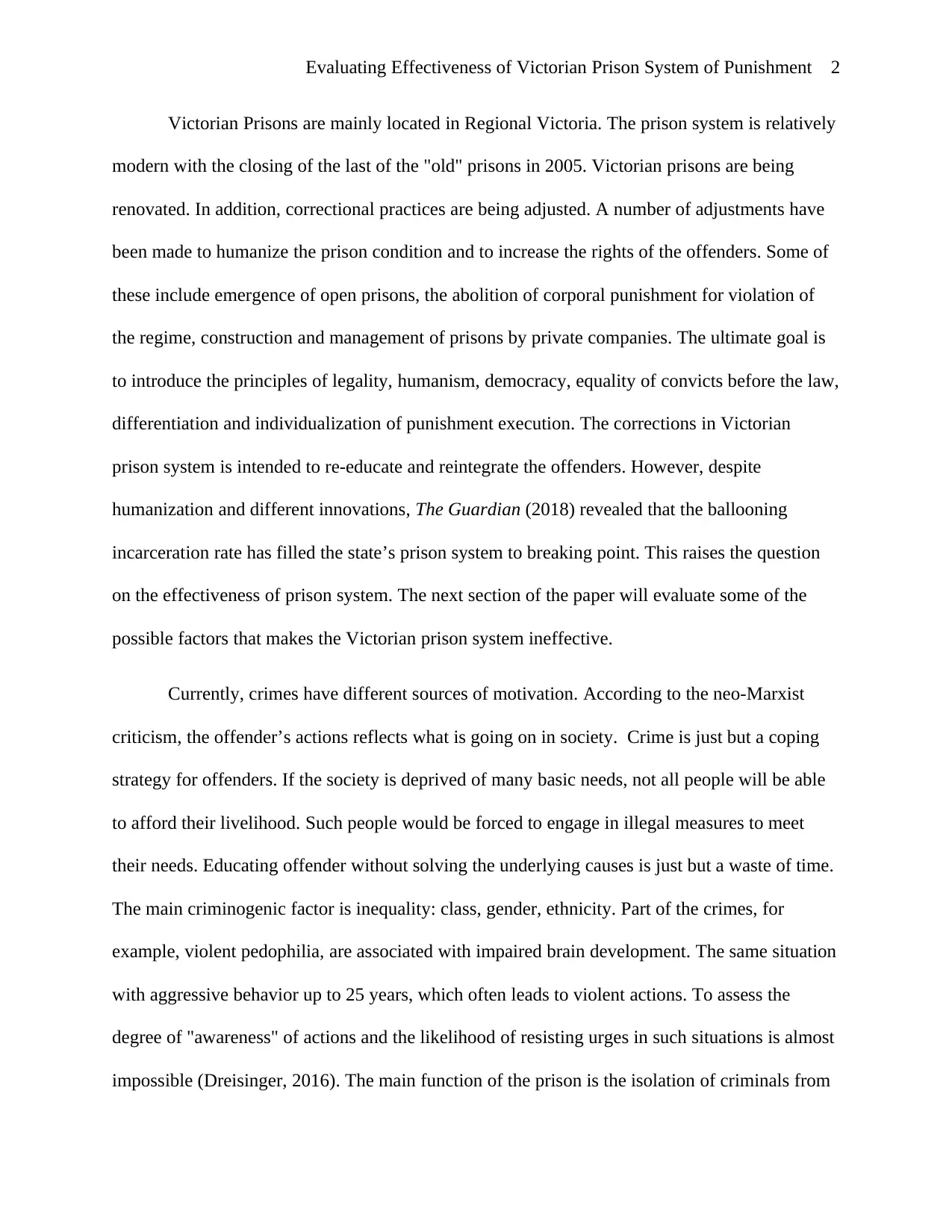
Victorian Prisons are mainly located in Regional Victoria. The prison system is relatively
modern with the closing of the last of the "old" prisons in 2005. Victorian prisons are being
renovated. In addition, correctional practices are being adjusted. A number of adjustments have
been made to humanize the prison condition and to increase the rights of the offenders. Some of
these include emergence of open prisons, the abolition of corporal punishment for violation of
the regime, construction and management of prisons by private companies. The ultimate goal is
to introduce the principles of legality, humanism, democracy, equality of convicts before the law,
differentiation and individualization of punishment execution. The corrections in Victorian
prison system is intended to re-educate and reintegrate the offenders. However, despite
humanization and different innovations, The Guardian (2018) revealed that the ballooning
incarceration rate has filled the state’s prison system to breaking point. This raises the question
on the effectiveness of prison system. The next section of the paper will evaluate some of the
possible factors that makes the Victorian prison system ineffective.
Currently, crimes have different sources of motivation. According to the neo-Marxist
criticism, the offender’s actions reflects what is going on in society. Crime is just but a coping
strategy for offenders. If the society is deprived of many basic needs, not all people will be able
to afford their livelihood. Such people would be forced to engage in illegal measures to meet
their needs. Educating offender without solving the underlying causes is just but a waste of time.
The main criminogenic factor is inequality: class, gender, ethnicity. Part of the crimes, for
example, violent pedophilia, are associated with impaired brain development. The same situation
with aggressive behavior up to 25 years, which often leads to violent actions. To assess the
degree of "awareness" of actions and the likelihood of resisting urges in such situations is almost
impossible (Dreisinger, 2016). The main function of the prison is the isolation of criminals from
Victorian Prisons are mainly located in Regional Victoria. The prison system is relatively
modern with the closing of the last of the "old" prisons in 2005. Victorian prisons are being
renovated. In addition, correctional practices are being adjusted. A number of adjustments have
been made to humanize the prison condition and to increase the rights of the offenders. Some of
these include emergence of open prisons, the abolition of corporal punishment for violation of
the regime, construction and management of prisons by private companies. The ultimate goal is
to introduce the principles of legality, humanism, democracy, equality of convicts before the law,
differentiation and individualization of punishment execution. The corrections in Victorian
prison system is intended to re-educate and reintegrate the offenders. However, despite
humanization and different innovations, The Guardian (2018) revealed that the ballooning
incarceration rate has filled the state’s prison system to breaking point. This raises the question
on the effectiveness of prison system. The next section of the paper will evaluate some of the
possible factors that makes the Victorian prison system ineffective.
Currently, crimes have different sources of motivation. According to the neo-Marxist
criticism, the offender’s actions reflects what is going on in society. Crime is just but a coping
strategy for offenders. If the society is deprived of many basic needs, not all people will be able
to afford their livelihood. Such people would be forced to engage in illegal measures to meet
their needs. Educating offender without solving the underlying causes is just but a waste of time.
The main criminogenic factor is inequality: class, gender, ethnicity. Part of the crimes, for
example, violent pedophilia, are associated with impaired brain development. The same situation
with aggressive behavior up to 25 years, which often leads to violent actions. To assess the
degree of "awareness" of actions and the likelihood of resisting urges in such situations is almost
impossible (Dreisinger, 2016). The main function of the prison is the isolation of criminals from
Evaluating Effectiveness of Victorian Prison System of Punishment 3
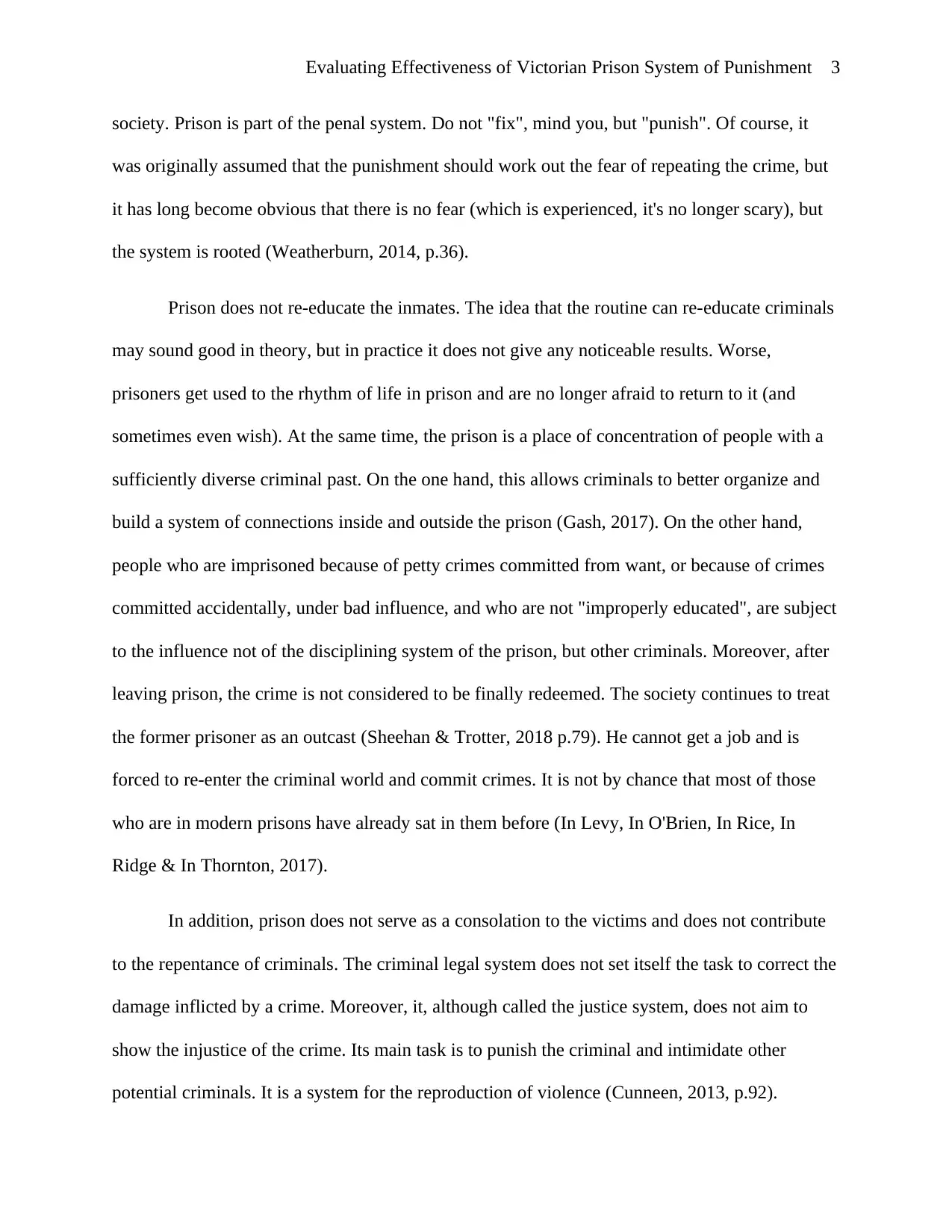
society. Prison is part of the penal system. Do not "fix", mind you, but "punish". Of course, it
was originally assumed that the punishment should work out the fear of repeating the crime, but
it has long become obvious that there is no fear (which is experienced, it's no longer scary), but
the system is rooted (Weatherburn, 2014, p.36).
Prison does not re-educate the inmates. The idea that the routine can re-educate criminals
may sound good in theory, but in practice it does not give any noticeable results. Worse,
prisoners get used to the rhythm of life in prison and are no longer afraid to return to it (and
sometimes even wish). At the same time, the prison is a place of concentration of people with a
sufficiently diverse criminal past. On the one hand, this allows criminals to better organize and
build a system of connections inside and outside the prison (Gash, 2017). On the other hand,
people who are imprisoned because of petty crimes committed from want, or because of crimes
committed accidentally, under bad influence, and who are not "improperly educated", are subject
to the influence not of the disciplining system of the prison, but other criminals. Moreover, after
leaving prison, the crime is not considered to be finally redeemed. The society continues to treat
the former prisoner as an outcast (Sheehan & Trotter, 2018 p.79). He cannot get a job and is
forced to re-enter the criminal world and commit crimes. It is not by chance that most of those
who are in modern prisons have already sat in them before (In Levy, In O'Brien, In Rice, In
Ridge & In Thornton, 2017).
In addition, prison does not serve as a consolation to the victims and does not contribute
to the repentance of criminals. The criminal legal system does not set itself the task to correct the
damage inflicted by a crime. Moreover, it, although called the justice system, does not aim to
show the injustice of the crime. Its main task is to punish the criminal and intimidate other
potential criminals. It is a system for the reproduction of violence (Cunneen, 2013, p.92).
society. Prison is part of the penal system. Do not "fix", mind you, but "punish". Of course, it
was originally assumed that the punishment should work out the fear of repeating the crime, but
it has long become obvious that there is no fear (which is experienced, it's no longer scary), but
the system is rooted (Weatherburn, 2014, p.36).
Prison does not re-educate the inmates. The idea that the routine can re-educate criminals
may sound good in theory, but in practice it does not give any noticeable results. Worse,
prisoners get used to the rhythm of life in prison and are no longer afraid to return to it (and
sometimes even wish). At the same time, the prison is a place of concentration of people with a
sufficiently diverse criminal past. On the one hand, this allows criminals to better organize and
build a system of connections inside and outside the prison (Gash, 2017). On the other hand,
people who are imprisoned because of petty crimes committed from want, or because of crimes
committed accidentally, under bad influence, and who are not "improperly educated", are subject
to the influence not of the disciplining system of the prison, but other criminals. Moreover, after
leaving prison, the crime is not considered to be finally redeemed. The society continues to treat
the former prisoner as an outcast (Sheehan & Trotter, 2018 p.79). He cannot get a job and is
forced to re-enter the criminal world and commit crimes. It is not by chance that most of those
who are in modern prisons have already sat in them before (In Levy, In O'Brien, In Rice, In
Ridge & In Thornton, 2017).
In addition, prison does not serve as a consolation to the victims and does not contribute
to the repentance of criminals. The criminal legal system does not set itself the task to correct the
damage inflicted by a crime. Moreover, it, although called the justice system, does not aim to
show the injustice of the crime. Its main task is to punish the criminal and intimidate other
potential criminals. It is a system for the reproduction of violence (Cunneen, 2013, p.92).
⊘ This is a preview!⊘
Do you want full access?
Subscribe today to unlock all pages.

Trusted by 1+ million students worldwide
Evaluating Effectiveness of Victorian Prison System of Punishment 4
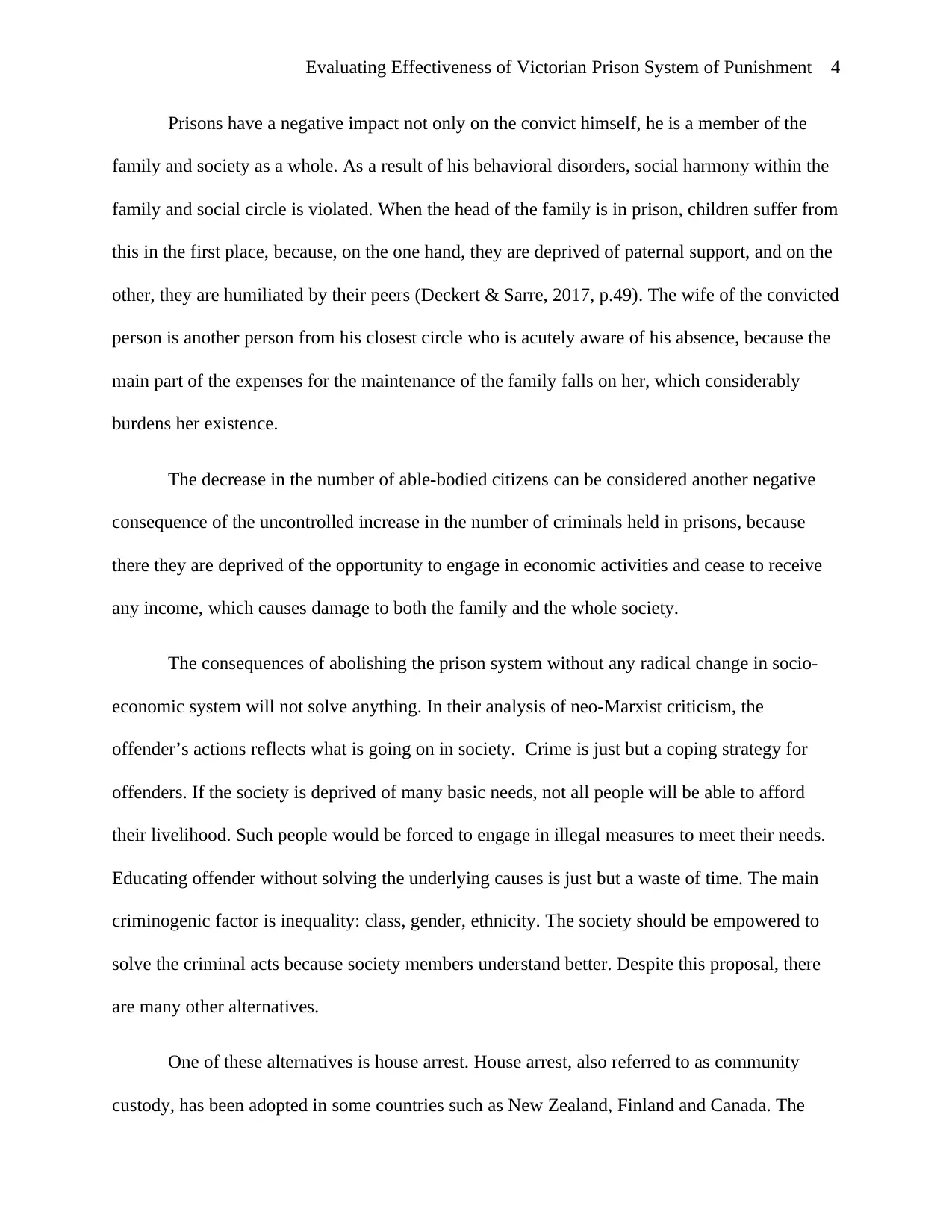
Prisons have a negative impact not only on the convict himself, he is a member of the
family and society as a whole. As a result of his behavioral disorders, social harmony within the
family and social circle is violated. When the head of the family is in prison, children suffer from
this in the first place, because, on the one hand, they are deprived of paternal support, and on the
other, they are humiliated by their peers (Deckert & Sarre, 2017, p.49). The wife of the convicted
person is another person from his closest circle who is acutely aware of his absence, because the
main part of the expenses for the maintenance of the family falls on her, which considerably
burdens her existence.
The decrease in the number of able-bodied citizens can be considered another negative
consequence of the uncontrolled increase in the number of criminals held in prisons, because
there they are deprived of the opportunity to engage in economic activities and cease to receive
any income, which causes damage to both the family and the whole society.
The consequences of abolishing the prison system without any radical change in socio-
economic system will not solve anything. In their analysis of neo-Marxist criticism, the
offender’s actions reflects what is going on in society. Crime is just but a coping strategy for
offenders. If the society is deprived of many basic needs, not all people will be able to afford
their livelihood. Such people would be forced to engage in illegal measures to meet their needs.
Educating offender without solving the underlying causes is just but a waste of time. The main
criminogenic factor is inequality: class, gender, ethnicity. The society should be empowered to
solve the criminal acts because society members understand better. Despite this proposal, there
are many other alternatives.
One of these alternatives is house arrest. House arrest, also referred to as community
custody, has been adopted in some countries such as New Zealand, Finland and Canada. The
Prisons have a negative impact not only on the convict himself, he is a member of the
family and society as a whole. As a result of his behavioral disorders, social harmony within the
family and social circle is violated. When the head of the family is in prison, children suffer from
this in the first place, because, on the one hand, they are deprived of paternal support, and on the
other, they are humiliated by their peers (Deckert & Sarre, 2017, p.49). The wife of the convicted
person is another person from his closest circle who is acutely aware of his absence, because the
main part of the expenses for the maintenance of the family falls on her, which considerably
burdens her existence.
The decrease in the number of able-bodied citizens can be considered another negative
consequence of the uncontrolled increase in the number of criminals held in prisons, because
there they are deprived of the opportunity to engage in economic activities and cease to receive
any income, which causes damage to both the family and the whole society.
The consequences of abolishing the prison system without any radical change in socio-
economic system will not solve anything. In their analysis of neo-Marxist criticism, the
offender’s actions reflects what is going on in society. Crime is just but a coping strategy for
offenders. If the society is deprived of many basic needs, not all people will be able to afford
their livelihood. Such people would be forced to engage in illegal measures to meet their needs.
Educating offender without solving the underlying causes is just but a waste of time. The main
criminogenic factor is inequality: class, gender, ethnicity. The society should be empowered to
solve the criminal acts because society members understand better. Despite this proposal, there
are many other alternatives.
One of these alternatives is house arrest. House arrest, also referred to as community
custody, has been adopted in some countries such as New Zealand, Finland and Canada. The
Paraphrase This Document
Need a fresh take? Get an instant paraphrase of this document with our AI Paraphraser
Evaluating Effectiveness of Victorian Prison System of Punishment 5
rationale for the use of home confinement is that it isolates the offender, avoids the criminogenic
effects of imprisonment and allows for relationships with the family and the community. The
regulation of house arrest can be more or less restrictive and can be used for certain categories of
offenders, usually to replace prison sentences of short or medium duration. In Finland its use is
widespread to such an extent that two thirds of those who should have entered prison were
applied these measures or alternative penalty. On the other hand, in New Zealand the application
of house arrest is less frequent, requiring both a judicial and administrative process for approval.
In Canada it applies to convictions of up to two years in prison. It has been estimated that the
application of this alternative penalty has reduced the prison population by 55,000 people (13%)
over a period of three years (Hudson & Centre for Independent Studies (N.S.W.) 2013).
At present, drug addiction is considered the most common crime in Australia, but here it
should be noted that the prison does not have any educational effect on the drug addict. The zone
is not a hospital, where it could be cured of its disease. On the contrary, communicating with
other people in a confined space, he has the opportunity to persuade them to use drugs.
The deprivation of social rights and the appointment of correctional labor can also be
attributed to punishments that replace imprisonment. Deprivation of social rights includes, for
example, the prohibition to engage in professional activities and receive payment for it, and it
can be imposed for life, as well as for a limited time (Stojkovic, 2017).
Parole is an alternative means of addressing crime. In the United States, the general use
of parole has generated serious problems in controlling compliance, which has meant that many
convicts have returned to prison for non-compliance with the conditions imposed in the
application of probation other than commission of a new crime. However, the use of electronic
systems in the United Kingdom is being effective in the control and enforcement of probation.
rationale for the use of home confinement is that it isolates the offender, avoids the criminogenic
effects of imprisonment and allows for relationships with the family and the community. The
regulation of house arrest can be more or less restrictive and can be used for certain categories of
offenders, usually to replace prison sentences of short or medium duration. In Finland its use is
widespread to such an extent that two thirds of those who should have entered prison were
applied these measures or alternative penalty. On the other hand, in New Zealand the application
of house arrest is less frequent, requiring both a judicial and administrative process for approval.
In Canada it applies to convictions of up to two years in prison. It has been estimated that the
application of this alternative penalty has reduced the prison population by 55,000 people (13%)
over a period of three years (Hudson & Centre for Independent Studies (N.S.W.) 2013).
At present, drug addiction is considered the most common crime in Australia, but here it
should be noted that the prison does not have any educational effect on the drug addict. The zone
is not a hospital, where it could be cured of its disease. On the contrary, communicating with
other people in a confined space, he has the opportunity to persuade them to use drugs.
The deprivation of social rights and the appointment of correctional labor can also be
attributed to punishments that replace imprisonment. Deprivation of social rights includes, for
example, the prohibition to engage in professional activities and receive payment for it, and it
can be imposed for life, as well as for a limited time (Stojkovic, 2017).
Parole is an alternative means of addressing crime. In the United States, the general use
of parole has generated serious problems in controlling compliance, which has meant that many
convicts have returned to prison for non-compliance with the conditions imposed in the
application of probation other than commission of a new crime. However, the use of electronic
systems in the United Kingdom is being effective in the control and enforcement of probation.
Evaluating Effectiveness of Victorian Prison System of Punishment 6
Also, the possibility of conditioning the penitentiary benefits to the good behavior of the
prisoner, for example, with its contribution to coexistence in prisons helps to reduce the prison
population.
Another most effective measure entails reintegration after serving the sentence of
imprisonment. It is known that recidivism rates are extremely high in most countries, but at the
same time, it is evidence that employment and housing are essential for effective criminal
withdrawal. In many countries a considerable effort has been made in the implementation of
social reintegration programs. In this regard, it is worth highlighting the agreements with private
companies to hire ex-convicts, under the cover of some type of insurance that offers protection to
employers.
Also, the possibility of conditioning the penitentiary benefits to the good behavior of the
prisoner, for example, with its contribution to coexistence in prisons helps to reduce the prison
population.
Another most effective measure entails reintegration after serving the sentence of
imprisonment. It is known that recidivism rates are extremely high in most countries, but at the
same time, it is evidence that employment and housing are essential for effective criminal
withdrawal. In many countries a considerable effort has been made in the implementation of
social reintegration programs. In this regard, it is worth highlighting the agreements with private
companies to hire ex-convicts, under the cover of some type of insurance that offers protection to
employers.
⊘ This is a preview!⊘
Do you want full access?
Subscribe today to unlock all pages.
Trusted by 1+ million students worldwide
Evaluating Effectiveness of Victorian Prison System of Punishment 7
List of References
Cunneen, C. (2013) Penal culture and hyperincarceration: The revival of the prison. Farnham,
Surrey ; Burlington, VT : Ashgate, pp.89-95
Davis, L M, Steele, J. L., Saunders, J. M., Miles, J N V, & Bozick, R (2013) Evaluating the
effectiveness of correctional education: A meta-analysis of programs that provide education to
incarcerated adults. Santa Monica, CA : RAND
Deckert, A, & Sarre, R (2017) The Palgrave handbook of Australian and New Zealand
criminology, crime and justice. Cham: Palgrave MacMillan, pp.47-53
Dreisinger, B. (2016) Incarceration nations: A journey to justice in prisons around the world.
New York : Other Press
Gash, T (2017) Criminal: The truth about why people do bad things. London Penguin Books
Hudson, S, & Centre for Independent Studies (N.S.W.). (2013). Panacea to prison?: Justice
reinvestment in indigenous communities. St Leonards, N.S.W: The Centre for Independent
Studies.
In Levy, R, In O'Brien, M T, In Rice, S, In Ridge, P, & In Thornton, M (2017) New directions
for law in Australia: Essays in contemporary law reform. Acton, A.C.T. : ANU Press
In Wooldredge, J, & In Smith, P (2018) The Oxford handbook of prisons and imprisonment.
New York, NY : Oxford University Press
Sheehan, R, & Trotter, C (2018) Women's transitions from prison: The post-release experience.
London [England] ; New York, New York : Routledge, pp. 79
Stojkovic, S (2017). Prisoner reentry: Critical issues and policy directions. New York Palgrave
Macmillan
List of References
Cunneen, C. (2013) Penal culture and hyperincarceration: The revival of the prison. Farnham,
Surrey ; Burlington, VT : Ashgate, pp.89-95
Davis, L M, Steele, J. L., Saunders, J. M., Miles, J N V, & Bozick, R (2013) Evaluating the
effectiveness of correctional education: A meta-analysis of programs that provide education to
incarcerated adults. Santa Monica, CA : RAND
Deckert, A, & Sarre, R (2017) The Palgrave handbook of Australian and New Zealand
criminology, crime and justice. Cham: Palgrave MacMillan, pp.47-53
Dreisinger, B. (2016) Incarceration nations: A journey to justice in prisons around the world.
New York : Other Press
Gash, T (2017) Criminal: The truth about why people do bad things. London Penguin Books
Hudson, S, & Centre for Independent Studies (N.S.W.). (2013). Panacea to prison?: Justice
reinvestment in indigenous communities. St Leonards, N.S.W: The Centre for Independent
Studies.
In Levy, R, In O'Brien, M T, In Rice, S, In Ridge, P, & In Thornton, M (2017) New directions
for law in Australia: Essays in contemporary law reform. Acton, A.C.T. : ANU Press
In Wooldredge, J, & In Smith, P (2018) The Oxford handbook of prisons and imprisonment.
New York, NY : Oxford University Press
Sheehan, R, & Trotter, C (2018) Women's transitions from prison: The post-release experience.
London [England] ; New York, New York : Routledge, pp. 79
Stojkovic, S (2017). Prisoner reentry: Critical issues and policy directions. New York Palgrave
Macmillan
Paraphrase This Document
Need a fresh take? Get an instant paraphrase of this document with our AI Paraphraser
Evaluating Effectiveness of Victorian Prison System of Punishment 8
Weatherburn, DJ. (2014) Arresting incarceration: Pathways out of indigenous imprisonment.
Canberra, ACT : Aboriginal Studies Press, pp.31-47
Financial Times (2018) The enduring scandal of England’s Victorian jails. Available from:
https://www.ft.com/content/28daea7a-fd15-11e7-9b32-d7d59aace167 [9/14/18]
The Guardian (2018) Prisons at breaking point but Australia is still addicted to incarceration.
Avaibale from: https://www.theguardian.com/australia-news/2017/dec/29/prisons-at-breaking-
point-but-australia-is-still-addicted-to-incarceration [9/14/18]
Weatherburn, DJ. (2014) Arresting incarceration: Pathways out of indigenous imprisonment.
Canberra, ACT : Aboriginal Studies Press, pp.31-47
Financial Times (2018) The enduring scandal of England’s Victorian jails. Available from:
https://www.ft.com/content/28daea7a-fd15-11e7-9b32-d7d59aace167 [9/14/18]
The Guardian (2018) Prisons at breaking point but Australia is still addicted to incarceration.
Avaibale from: https://www.theguardian.com/australia-news/2017/dec/29/prisons-at-breaking-
point-but-australia-is-still-addicted-to-incarceration [9/14/18]

1 out of 8


Related Documents


Your All-in-One AI-Powered Toolkit for Academic Success.
+13062052269
info@desklib.com
Available 24*7 on WhatsApp / Email
![[object Object]](/_next/static/media/star-bottom.7253800d.svg)
Unlock your academic potential
Copyright © 2020–2026 A2Z Services. All Rights Reserved. Developed and managed by ZUCOL.