Comprehensive Evaluation of Germany's Social Protection System

Verified

Added on  2020/12/09

|7
|1367
|379
Report
AI Summary
This report evaluates the social protection system of Germany, examining its effectiveness in addressing poverty and providing social welfare. It begins with an introduction to social protection systems and then presents statistical indicators of the social situation in Germany, including poverty rates and the Gini coefficient. The report then describes the historical development of Germany's social policy and the various social benefits provided, such as health and safety, sickness cash benefits, and unemployment benefits. An ISPA CODI matrix is employed to assess the existing social protection system in terms of inclusiveness, adequacy, respect of rights and dignity, and financial sustainability. The analysis concludes with recommendations for improvements, emphasizing the need for a more comprehensive and effective approach to social protection in Germany. The report highlights the importance of considering local needs and involving the population in the development of social policies.
Document Page
Evaluation of
Social Protection
Systems
tabler-icon-diamond-filled.svg

Paraphrase This Document

Need a fresh take? Get an instant paraphrase of this document with our AI Paraphraser
Document Page
Contents
INTRODUCTION...........................................................................................................................1
1. Germany......................................................................................................................................1
2. Social situation at Germany.........................................................................................................2
3. Evaluation through ISPA CODI matrix assessing existing social protection system.................3
4. Conclusion with recommendation...............................................................................................3
REFERENCES................................................................................................................................5
Document Page
INTRODUCTION
Social protection system consists of programs and policies that are designed to reduce
vulnerability and poverty, this is done by effective labour market, enhancing capacity to manage
economy, eliminating individuals exposed to risk, etc. (Skivenes, Barn and Pösö, 2014). For a
country to grow, it requires people have to job so that living style can be improved. The selected
country is Germany in order to convey the assignment in effective manner. This report covers,
description of social situation in the country by presenting the statistical indicators. Lastly, it also
includes make use of elements like ISPA CODI evaluation matrix in order to assess existing
social protection system at Germany.
1. Germany
In accordance with the data which was undertaken by government of Germany, it is being
identified that when compared with last decades the number of people living in poverty has
raised. Further, it is being identified that children are more likely to be poor when compared with
adults. More specifically, in the year 1965 out of 75 children 1 lived on welfare but in the year
2006 it became 1 out of 6 did. The rate of poverty at Germany differs by states ( Bode, Gardin
and Nyssens, 2011). For example, in Berlin about 30.7% of the children received welfare
payments and 15.2% of the inhabitants. Further, at Bavaria there were only 6.6% children who
were impoverished and 3.9% citizen is same condition. Due to poverty, the health conditions of
people are not in proper shape. In order to have a healthy lifestyle, it is important to make sure
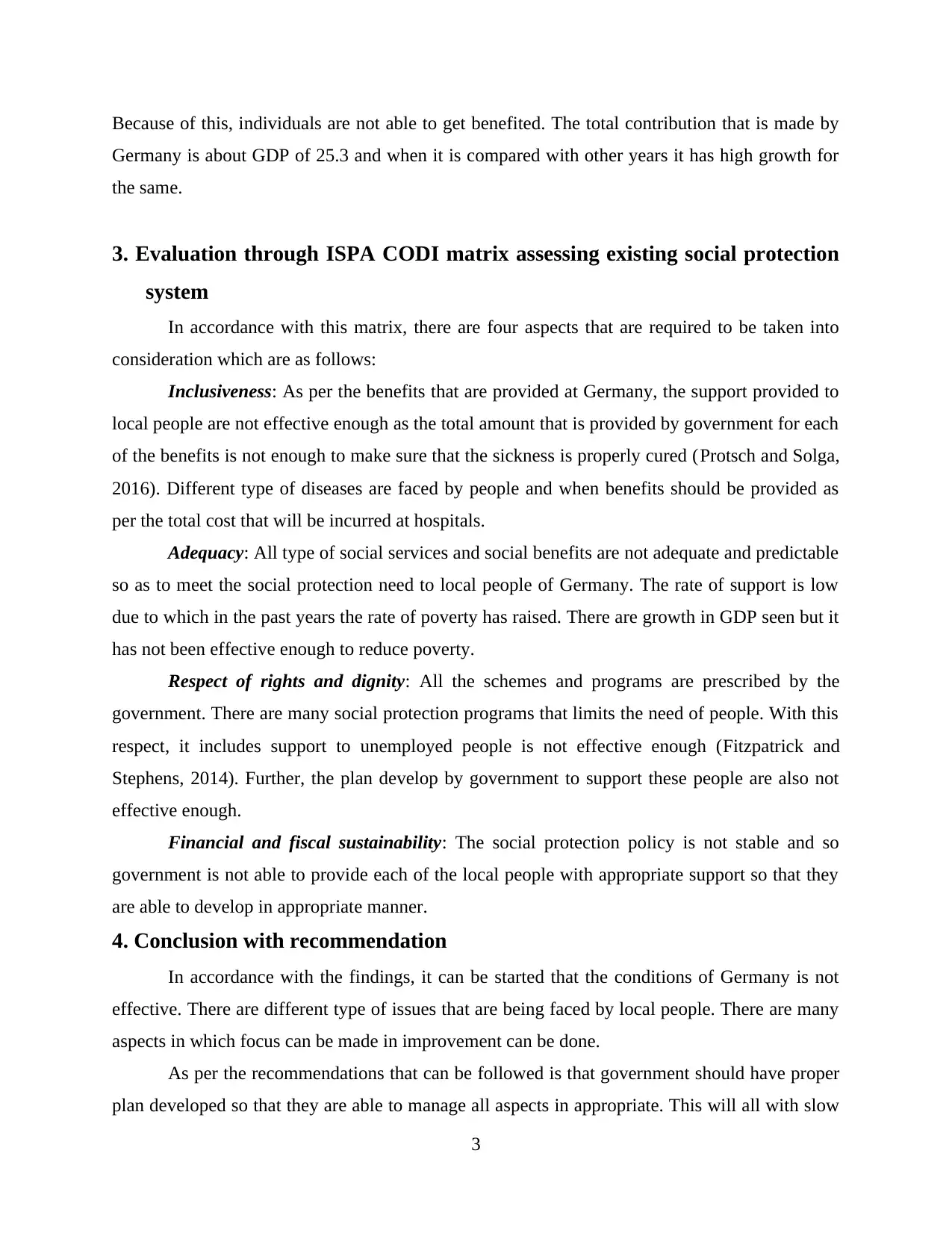
that all people are getting enough income to fulfil their basic nutrition. Below given are the Gini
coefficient of net household income before and after taxes and transfers:
1
Document Page
Figure 1: Gini coefficient of net household income
(Gini coefficient of income, 2016)
In accordance with the above figure, it can be stated that Gini before taxes and transfer is
0.49 and Gini after taxes and transfers is 0.29. This shows that the overall income that the people
of Germany get is low and so the rate of people living in poverty is raising tremendously.
2. Social situation at Germany
In the year 1871 when Germany got united, nation developed a common social policy
and common government structure. In this modern times, government of Germany provide
individuals with different type of welfare so that the issue in relation with poverty can be
reduced. With this respect, it includes health and safety, sickness cash benefits, maternity and
paternity benefits, invalidity benefits, old age pension and benefits, survivors benefits, benefits in
respect of accidents, unemployment benefits, etc. (Sacker, Worts and McDonough, 2010). There
are cash provided in most of the conditions that are provided. With this respect, when a person
working within the firm becomes unfit which could be due to sickness, then it is the
responsibility of the employer to make sure that the sick employees is provided with salary even
if he/she is sick for one week or one month. Similarly, there are other benefits that are provided
by government of Germany in which all women who are entitled to sickness insurance benefits
are entitles to benefits at the time of pregnancy and after delivery. More specifically, women are
provided with the maternity benefit of € 13 per calendar day. All these type of services are
developed at cited country but the rate of awareness to local people towards the same is low.
2
tabler-icon-diamond-filled.svg

Paraphrase This Document

Need a fresh take? Get an instant paraphrase of this document with our AI Paraphraser
Document Page
Because of this, individuals are not able to get benefited. The total contribution that is made by
Germany is about GDP of 25.3 and when it is compared with other years it has high growth for
the same.
3. Evaluation through ISPA CODI matrix assessing existing social protection
system
In accordance with this matrix, there are four aspects that are required to be taken into
consideration which are as follows:
Inclusiveness: As per the benefits that are provided at Germany, the support provided to
local people are not effective enough as the total amount that is provided by government for each
of the benefits is not enough to make sure that the sickness is properly cured (Protsch and Solga,
2016). Different type of diseases are faced by people and when benefits should be provided as
per the total cost that will be incurred at hospitals.
Adequacy: All type of social services and social benefits are not adequate and predictable
so as to meet the social protection need to local people of Germany. The rate of support is low
due to which in the past years the rate of poverty has raised. There are growth in GDP seen but it
has not been effective enough to reduce poverty.
Respect of rights and dignity: All the schemes and programs are prescribed by the
government. There are many social protection programs that limits the need of people. With this
respect, it includes support to unemployed people is not effective enough (Fitzpatrick and
Stephens, 2014). Further, the plan develop by government to support these people are also not
effective enough.
Financial and fiscal sustainability: The social protection policy is not stable and so
government is not able to provide each of the local people with appropriate support so that they
are able to develop in appropriate manner.
4. Conclusion with recommendation
In accordance with the findings, it can be started that the conditions of Germany is not
effective. There are different type of issues that are being faced by local people. There are many
aspects in which focus can be made in improvement can be done.
As per the recommendations that can be followed is that government should have proper
plan developed so that they are able to manage all aspects in appropriate. This will all with slow
3
Document Page
phase the problems can be solved and the rate of poverty can be reduced. Apart from this, in all
these conditions government should take consider from local people so that they are able to
overcome the problems in appropriate manner.
4
Document Page
REFERENCES
Bode, I., Gardin, L. and Nyssens, M., 2011. Quasi-marketisation in domiciliary care: varied
patterns, similar problems?. International Journal of Sociology and Social
Policy, 31(3/4), pp.222-235.
Fitzpatrick, S. and Stephens, M., 2014. Welfare regimes, social values and homelessness:
Comparing responses to marginalised groups in six European countries. Housing
Studies, 29(2), pp.215-234.
Protsch, P. and Solga, H., 2016. The social stratification of the German VET system. Journal of
Education and Work, 29(6), pp.637-661.
Sacker, A., Worts, D. and McDonough, P., 2010. Social influences on trajectories of self-rated
health: evidence from Britain, Germany, Denmark and the USA. Journal of
Epidemiology & Community Health, pp.jech-2009.
Skivenes, M., Barn, R. and Pösö, T. eds., 2014. Child welfare systems and migrant children: A
cross country study of policies and practice. Oxford University Press.
Online
Gini coefficient of income. 2016. [Online]. Available through: <https://www.gut-leben-in-
deutschland.de/static/LB/indicators/income/gini-coefficient-income/>.
5
chevron_up_icon
1 out of 7
circle_padding
hide_on_mobile
zoom_out_icon
[object Object]