Analyzing Event Sponsorship, Data Collection, and GDPR in the USA
VerifiedAdded on 2023/06/11
|15
|3950
|311
Report
AI Summary
This report examines event sponsorship and data collection practices in the USA, highlighting the increasing importance of personal information in the digital age. It discusses how technology has transformed event organization and sponsorship strategies, emphasizing the need for companies to gather customer feedback for better ROI. The report also explores the value of data for companies, including geographic, demographic, and behavioral insights, while differentiating between marketing and community-based sponsorship motivations. Furthermore, it addresses the legal requirements surrounding data collection, particularly the GDPR, and its impact on consumer data protection. Finally, the report considers consumer acceptance of data collection practices at events, referencing existing technologies and the willingness of consumers to trade personal information for benefits; access this comprehensive resource and more on Desklib, your go-to platform for study tools.

Event Organization in USA 1
Event Organization in USA
By [Name]
Course
Professor’s Name
Institution
Location of Institution
Date
Event Organization in USA
By [Name]
Course
Professor’s Name
Institution
Location of Institution
Date

Paraphrase This Document
Need a fresh take? Get an instant paraphrase of this document with our AI Paraphraser
Event Organization in USA 2
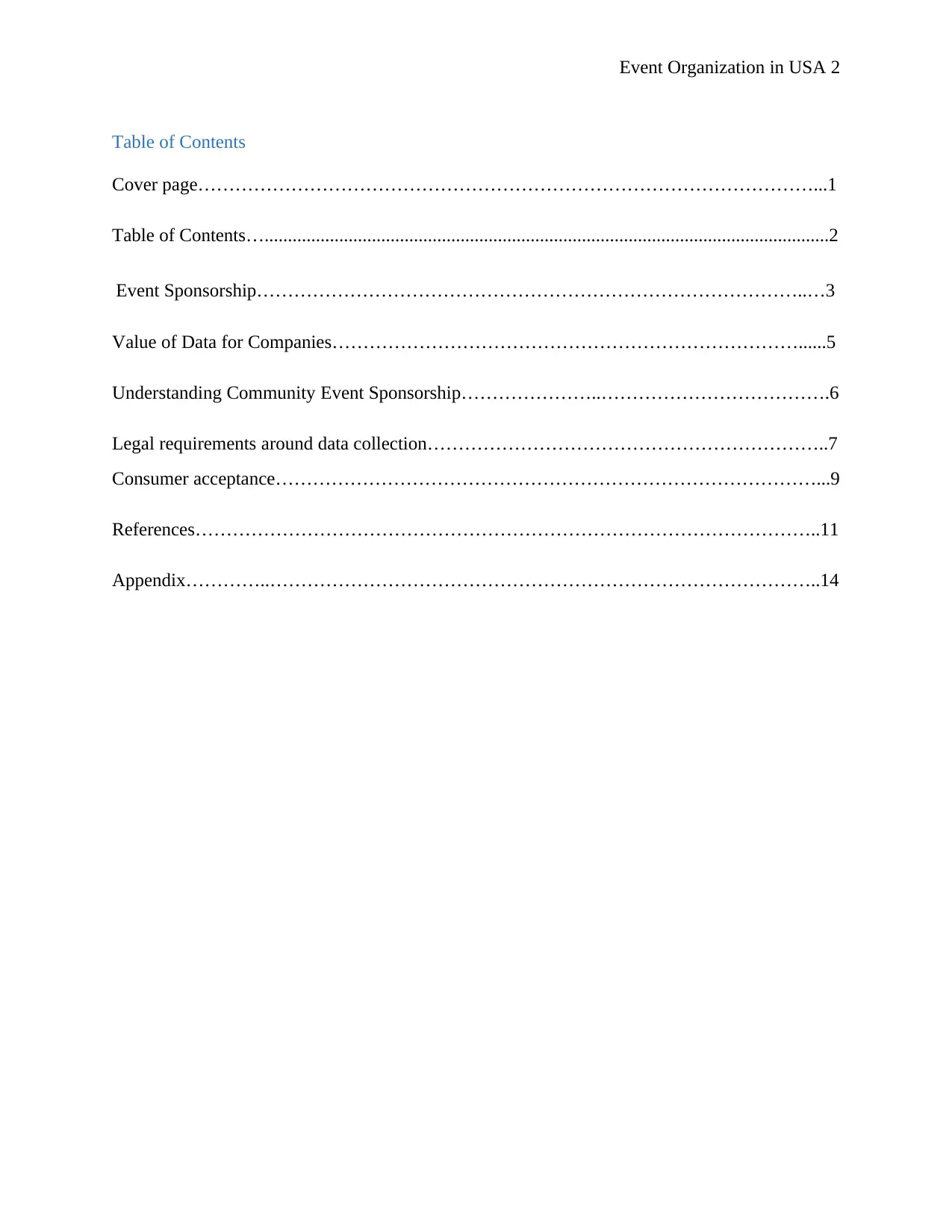
Table of Contents
Cover page………………………………………………………………………………………...1
Table of Contents….........................................................................................................................2
Event Sponsorship……………………………………………………………………………..…3
Value of Data for Companies…………………………………………………………………......5
Understanding Community Event Sponsorship…………………..……………………………….6
Legal requirements around data collection………………………………………………………..7
Consumer acceptance……………………………………………………………………………...9
References………………………………………………………………………………………..11
Appendix…………..……………………………………………………………………………..14
Table of Contents
Cover page………………………………………………………………………………………...1
Table of Contents….........................................................................................................................2
Event Sponsorship……………………………………………………………………………..…3
Value of Data for Companies…………………………………………………………………......5
Understanding Community Event Sponsorship…………………..……………………………….6
Legal requirements around data collection………………………………………………………..7
Consumer acceptance……………………………………………………………………………...9
References………………………………………………………………………………………..11
Appendix…………..……………………………………………………………………………..14
Event Organization in USA 3
Event Sponsorship
According to (Farrelly and Chew, 2016, p.78) Personal information is an important
currency in the new millennium. Technology, and access to it, has revolutionised the way in
which events are now organised. The impact is such that it has forced to change the way event
sponsorship takes place (Walraven, Bijmolt and Koning, 2014, p.142). Therefore, the future
objective for sponsorship is to establish a measurement to gather information of the effects at
present and develop new promotional offers for the future. In this context, data collection and
exploitation could be very useful in capturing such knowledge.
The way in which sponsorship is conducted has been changing because corporations are
moving towards an increased rate of diversity and have sought ‘new areas of social intrusion’ as
stated by the author (Shah, Iki, MooreHackson and Smith, 2016). Additionally, this author even
goes on to say that, due to new developments, especially those in the media sector, there may be
a shift in event sponsorship to larger events that are broadcasted. Sponsorship at events and
elsewhere enables organisations to enhance communication with their target audience in hope to
receive benefits such as: increased sales, better public image or any other kind of benefit.
According to (Carrillat, Astous, Bellavance and Eid, 2015), many companies in the USA in
recent years emphasized the need to focus more on their return on investment because this shift
in the product types which has changed over the years from ‘sell what you make’ to ‘make what
will sell’. Therefore, it is crucial for companies to gather feedback on what their customers want.
Such feedback can be gathered at sponsored events through data collecting methods. Another
tool for sponsors to measure customer wants is a feedback loop. A feedback loop as
(Vandevijvere, Williams, Tawfiq and Swinburn, 2017) states, is an evaluation kind of method
Event Sponsorship
According to (Farrelly and Chew, 2016, p.78) Personal information is an important
currency in the new millennium. Technology, and access to it, has revolutionised the way in
which events are now organised. The impact is such that it has forced to change the way event
sponsorship takes place (Walraven, Bijmolt and Koning, 2014, p.142). Therefore, the future
objective for sponsorship is to establish a measurement to gather information of the effects at
present and develop new promotional offers for the future. In this context, data collection and
exploitation could be very useful in capturing such knowledge.
The way in which sponsorship is conducted has been changing because corporations are
moving towards an increased rate of diversity and have sought ‘new areas of social intrusion’ as
stated by the author (Shah, Iki, MooreHackson and Smith, 2016). Additionally, this author even
goes on to say that, due to new developments, especially those in the media sector, there may be
a shift in event sponsorship to larger events that are broadcasted. Sponsorship at events and
elsewhere enables organisations to enhance communication with their target audience in hope to
receive benefits such as: increased sales, better public image or any other kind of benefit.
According to (Carrillat, Astous, Bellavance and Eid, 2015), many companies in the USA in
recent years emphasized the need to focus more on their return on investment because this shift
in the product types which has changed over the years from ‘sell what you make’ to ‘make what
will sell’. Therefore, it is crucial for companies to gather feedback on what their customers want.
Such feedback can be gathered at sponsored events through data collecting methods. Another
tool for sponsors to measure customer wants is a feedback loop. A feedback loop as
(Vandevijvere, Williams, Tawfiq and Swinburn, 2017) states, is an evaluation kind of method
⊘ This is a preview!⊘
Do you want full access?
Subscribe today to unlock all pages.

Trusted by 1+ million students worldwide
Event Organization in USA 4
which helps event sponsors in identification of whether they meet their objectives in regards to
the information they gather from the events.
Research in sponsorship is not going to diminish and quite imperative to the success of
sponsorship. According to studies conducted by (Getz and Page 2016), shows that out of the 80
sponsors that engaged in their research, a limited amount of these ever received relevant
feedback on their brand perception for the sponsored events they were involved in. In an ever-
growing competitive market, the author outlines how important it is for the sponsors to have
access to feedback. Also, data collection at events could certainly make it easier for sponsors to
gain that information.
There is a big gap in approach and knowledge between sponsors and sponsorship seekers. If
sponsorship seekers (events) have limited data and knowledge of their audience, they cannot
provide the sponsor with vital information, as the sponsor requires making informed decisions
surrounding the audience data. Sponsors have a limited budget, limited time and limited patience
for sponsorship seekers who do not know the audience they accommodate (Baylis, 2018). By
collecting attendees’ data in an organized manner, that knowledge gap can be bridged and hence,
sponsorship seekers can create significant value for sponsors, which also make them more
relevant for potential sponsors. All parties benefit from effective data collection and analysis.
In regards to research on sponsorship and the rationale behind it, (Friedman, Furberg,
DeMets, Reboussin and Granger, 2015) states that international comparisons should be made.
Data collection at events and use by sponsors is particularly common at events in the United
States. However, the literature on the topic in Ireland is very limited. In the applied part of this
practicum report, the situation in Ireland and the US will be explored in relation to data
collection at events.
which helps event sponsors in identification of whether they meet their objectives in regards to
the information they gather from the events.
Research in sponsorship is not going to diminish and quite imperative to the success of
sponsorship. According to studies conducted by (Getz and Page 2016), shows that out of the 80
sponsors that engaged in their research, a limited amount of these ever received relevant
feedback on their brand perception for the sponsored events they were involved in. In an ever-
growing competitive market, the author outlines how important it is for the sponsors to have
access to feedback. Also, data collection at events could certainly make it easier for sponsors to
gain that information.
There is a big gap in approach and knowledge between sponsors and sponsorship seekers. If
sponsorship seekers (events) have limited data and knowledge of their audience, they cannot
provide the sponsor with vital information, as the sponsor requires making informed decisions
surrounding the audience data. Sponsors have a limited budget, limited time and limited patience
for sponsorship seekers who do not know the audience they accommodate (Baylis, 2018). By
collecting attendees’ data in an organized manner, that knowledge gap can be bridged and hence,
sponsorship seekers can create significant value for sponsors, which also make them more
relevant for potential sponsors. All parties benefit from effective data collection and analysis.
In regards to research on sponsorship and the rationale behind it, (Friedman, Furberg,
DeMets, Reboussin and Granger, 2015) states that international comparisons should be made.
Data collection at events and use by sponsors is particularly common at events in the United
States. However, the literature on the topic in Ireland is very limited. In the applied part of this
practicum report, the situation in Ireland and the US will be explored in relation to data
collection at events.
Paraphrase This Document
Need a fresh take? Get an instant paraphrase of this document with our AI Paraphraser
Event Organization in USA 5
Value of Data for Companies
According to (Olson and Wu, 2017, p.90), the value of personal information for companies and
marketers last year was already very large and it is even more valuable now. As technology
enables companies to unify, data collected through different means is relatively effective. This
allows firms to get an ever clearer picture of who their customers are, what their preferences are
and how they behave, especially online (in some cases, even offline behaviour can be tracked,
for instance, Google Maps shows Google where and when a particular person shops and where
the person works.
The more companies know about their (potential) customers, the more they can specify and
individualize offers to customers
Another, more event-related issue for companies is outlined in the article Sponsorship in sports
marketing by (Turley and Kelley, 2015) which stated that Sponsorship campaigns do not always
achieve the anticipated degree of public awareness. For example, in this year’s World Cup taking
place in Russia, only 4 out of the event sponsors have been remembered by the public, despite
the fact that the event has drawn hundreds of thousands of fans to the stadiums. If customer data
had been gathered at the events, and companies had been given access to it, it would have been
much easier for the sponsors to follow up on attendees and reiterate their message.
Higgins (2017) and Baylis (2018) mention the most important pieces of information for sponsors
which are:
Geographic and demographic information. This is important to gain some
non-intrusive basic location information and the sector of the population
attending this event.
Value of Data for Companies
According to (Olson and Wu, 2017, p.90), the value of personal information for companies and
marketers last year was already very large and it is even more valuable now. As technology
enables companies to unify, data collected through different means is relatively effective. This
allows firms to get an ever clearer picture of who their customers are, what their preferences are
and how they behave, especially online (in some cases, even offline behaviour can be tracked,
for instance, Google Maps shows Google where and when a particular person shops and where
the person works.
The more companies know about their (potential) customers, the more they can specify and
individualize offers to customers
Another, more event-related issue for companies is outlined in the article Sponsorship in sports
marketing by (Turley and Kelley, 2015) which stated that Sponsorship campaigns do not always
achieve the anticipated degree of public awareness. For example, in this year’s World Cup taking
place in Russia, only 4 out of the event sponsors have been remembered by the public, despite
the fact that the event has drawn hundreds of thousands of fans to the stadiums. If customer data
had been gathered at the events, and companies had been given access to it, it would have been
much easier for the sponsors to follow up on attendees and reiterate their message.
Higgins (2017) and Baylis (2018) mention the most important pieces of information for sponsors
which are:
Geographic and demographic information. This is important to gain some
non-intrusive basic location information and the sector of the population
attending this event.
Event Organization in USA 6
Motivations, interests, opinions and interested usage. This would focus on
personal interest, experience and perception about the event.
Brand preference and loyalty, to focus on audiences buying behaviour and
brand preference. Important information for companies sponsoring particular
events.
Understanding Community Event Sponsorship
Despite the fact that most companies engage in sponsorship especially for marketing
reasons (where attendees’ personal data would likely be beneficial), there are other, non-
marketing reasons for sponsorship as well. Sponsoring of smaller, community-based events is
connected to the number of staff in sponsoring SME’s, this is stated by (Liu, Cohen, Vittinghoff,
Anderson, Doblecki, Bacon, Chege, Postle, Matheson, Amico, and Liegler, 2016). For example,
highly educated or culturally engaged staff in SME’s might have a personal interest in being
involved in educational and cultural events and thus petition their employer to sponsor the
respective event. In those cases, the reason behind sponsorship was not primarily a financial one
but a cultural and educational one. Many SME’s simply wanted to “give back” to their
community and tried to engage as many employees as possible. Only approximately 30% of all
SME’s that engaged in sponsorship, did so for marketing reasons. Similarly, suggestions stated
by (Findlay, 2016 ) make it well understood that many companies engage in sponsorship of
local events for reasons of being part of their community, rather than direct marketing reasons.
This shows that there are variations in what sponsoring companies hope to achieve by sponsoring
an event. It seems plausible that companies that do not primarily sponsor an event for marketing
Motivations, interests, opinions and interested usage. This would focus on
personal interest, experience and perception about the event.
Brand preference and loyalty, to focus on audiences buying behaviour and
brand preference. Important information for companies sponsoring particular
events.
Understanding Community Event Sponsorship
Despite the fact that most companies engage in sponsorship especially for marketing
reasons (where attendees’ personal data would likely be beneficial), there are other, non-
marketing reasons for sponsorship as well. Sponsoring of smaller, community-based events is
connected to the number of staff in sponsoring SME’s, this is stated by (Liu, Cohen, Vittinghoff,
Anderson, Doblecki, Bacon, Chege, Postle, Matheson, Amico, and Liegler, 2016). For example,
highly educated or culturally engaged staff in SME’s might have a personal interest in being
involved in educational and cultural events and thus petition their employer to sponsor the
respective event. In those cases, the reason behind sponsorship was not primarily a financial one
but a cultural and educational one. Many SME’s simply wanted to “give back” to their
community and tried to engage as many employees as possible. Only approximately 30% of all
SME’s that engaged in sponsorship, did so for marketing reasons. Similarly, suggestions stated
by (Findlay, 2016 ) make it well understood that many companies engage in sponsorship of
local events for reasons of being part of their community, rather than direct marketing reasons.
This shows that there are variations in what sponsoring companies hope to achieve by sponsoring
an event. It seems plausible that companies that do not primarily sponsor an event for marketing
⊘ This is a preview!⊘
Do you want full access?
Subscribe today to unlock all pages.
Trusted by 1+ million students worldwide
Event Organization in USA 7
reasons are less likely to be interested in the collection and exploitation of attendees’ personal
data. Many small companies may even lack the technological means or the time to analyse
customer data effectively.
This question of company interest in personal data will be further explored in the applied section
of this practicum report, as there is very little literature dealing with answering that question.
Legal Requirements around Data Collection
As shown above, attendees’ personal data is very vital in event sponsorship especially for
sponsors and sponsoring companies(Drachsler and Greller, 2016, p.102). However, both
sponsors and event organizers should be aware of the legal requirements around data collection
and exploitation.
EU regulation (EU) 2016/679, commonly called General Data Protection Regulation, or GDPR,
is an EU-wide regulation which took place recently in May 25, this year. This regulation was
presented in January 2012 after which various involved companies had time since then to prepare
for the comprehensive legislation that was to “affect the way Europeans work and live together”
(Regulation, 2016). The GDPR is the first law that will regulate the collection, storage and use of
personal data in the whole of the European Union (Gilbert, 2012). Under current law, each
member state can implement individual interpretations of the EU directives. This practice ended
with the introduction of the GDPR (Gilbert, 2012). The objectives of the GDPR were to put EU
consumers in control of their personal data. Additionally, more obligations were created for
companies (Rose, 2018; Gilbert, 2012). Under the GDPR, consumers had to agree explicitly to
how their data was to be used. In this case companies presented the intended use of personal data
in concise and easily understandable language as opposed to terms and conditions that are
currently often several pages long (Victor, 2013, p.523).
reasons are less likely to be interested in the collection and exploitation of attendees’ personal
data. Many small companies may even lack the technological means or the time to analyse
customer data effectively.
This question of company interest in personal data will be further explored in the applied section
of this practicum report, as there is very little literature dealing with answering that question.
Legal Requirements around Data Collection
As shown above, attendees’ personal data is very vital in event sponsorship especially for
sponsors and sponsoring companies(Drachsler and Greller, 2016, p.102). However, both
sponsors and event organizers should be aware of the legal requirements around data collection
and exploitation.
EU regulation (EU) 2016/679, commonly called General Data Protection Regulation, or GDPR,
is an EU-wide regulation which took place recently in May 25, this year. This regulation was
presented in January 2012 after which various involved companies had time since then to prepare
for the comprehensive legislation that was to “affect the way Europeans work and live together”
(Regulation, 2016). The GDPR is the first law that will regulate the collection, storage and use of
personal data in the whole of the European Union (Gilbert, 2012). Under current law, each
member state can implement individual interpretations of the EU directives. This practice ended
with the introduction of the GDPR (Gilbert, 2012). The objectives of the GDPR were to put EU
consumers in control of their personal data. Additionally, more obligations were created for
companies (Rose, 2018; Gilbert, 2012). Under the GDPR, consumers had to agree explicitly to
how their data was to be used. In this case companies presented the intended use of personal data
in concise and easily understandable language as opposed to terms and conditions that are
currently often several pages long (Victor, 2013, p.523).
Paraphrase This Document
Need a fresh take? Get an instant paraphrase of this document with our AI Paraphraser
Event Organization in USA 8
In the case of data collection through wristbands at events, consumers were told specifically
which companies were to get their information and for what purposes. For example, sponsors of
free samples got the personal information of everyone who takes the free sample for marketing
purposes (Blanke et al., 2014).
Another major change in data usage is what is often referred to as “the right to be forgotten” (e.g.
Mantelero, 2013, p. 234; Victor, 2013, p.523): Consumers have the right to demand that
companies owning their personal data delete that data at the consumers’ request.
Despite the fact that the GDPR placed additional pressure on companies which kept
customer data safe, the new regulation eases the administrative burden on companies in some
way. For that first time in the history of the European Union there was a single regulation which
governed the collection and use of personal data in all of the EU’s member states. Companies did
not have to follow different laws applicable in different countries across the EU(Gilbert, 2012).
According to EU projections, companies in the European Union saved more than €2 billion in
administrative expenses associated with observing and acting in accordance with the different
data protection laws across the Union (European Commission, 2012).
In the case of data collection through wristbands at events, consumers were told specifically
which companies were to get their information and for what purposes. For example, sponsors of
free samples got the personal information of everyone who takes the free sample for marketing
purposes (Blanke et al., 2014).
Another major change in data usage is what is often referred to as “the right to be forgotten” (e.g.
Mantelero, 2013, p. 234; Victor, 2013, p.523): Consumers have the right to demand that
companies owning their personal data delete that data at the consumers’ request.
Despite the fact that the GDPR placed additional pressure on companies which kept
customer data safe, the new regulation eases the administrative burden on companies in some
way. For that first time in the history of the European Union there was a single regulation which
governed the collection and use of personal data in all of the EU’s member states. Companies did
not have to follow different laws applicable in different countries across the EU(Gilbert, 2012).
According to EU projections, companies in the European Union saved more than €2 billion in
administrative expenses associated with observing and acting in accordance with the different
data protection laws across the Union (European Commission, 2012).
Event Organization in USA 9
Consumer Acceptance
It was shown why consumer data can be valuable for sponsors of events and a brief
overview of the GDPR was given. However, the process of data collection at events depends to a
large degree on attendees’ willingness to submit their personal data. It seems plausible that event
organizers will be slow to adopt data collection technology if that would alienate attendees. On
the basis of what kinds of data collecting devices are already used by consumers, a fear of
alienation does not seem overly justified. Two already existing devices that are used to collect
personal information were introduced by (Fai, Wakrat and Seroff, 2015, p.319). These devices’
current use indicates that many consumers are already willing to trade personal information for
benefits. Additionally, it can therefore be assumed that, adoption of tracking devices at events
(e.g. wristbands with RFID chips or QR codes) would be relatively easy. However, more
research needs to be done to confirm this assumption.
The devices introduced by this scholar were:
1. VeriChip, a small chip that is implanted in a person’s skin. It serves as a person’s ID and
stores their health information, among other things. Similar modern devices can even be
used as a payment method.
2. WozNet, a chip that consumers can wear or attach to their belongings to track them.
Users can track the location of their pets or choose to receive a notification on their phone
when their car leaves the garage.
On this note, similar tracking devices can be used at events to track who takes a free sample at
what stall or to monitor who visits a certain location on the event ground. The fact that
consumers are already willing to give away personal data on a much larger scale (e.g. skin
implants) suggests that adoption at events would be relatively easy.
Consumer Acceptance
It was shown why consumer data can be valuable for sponsors of events and a brief
overview of the GDPR was given. However, the process of data collection at events depends to a
large degree on attendees’ willingness to submit their personal data. It seems plausible that event
organizers will be slow to adopt data collection technology if that would alienate attendees. On
the basis of what kinds of data collecting devices are already used by consumers, a fear of
alienation does not seem overly justified. Two already existing devices that are used to collect
personal information were introduced by (Fai, Wakrat and Seroff, 2015, p.319). These devices’
current use indicates that many consumers are already willing to trade personal information for
benefits. Additionally, it can therefore be assumed that, adoption of tracking devices at events
(e.g. wristbands with RFID chips or QR codes) would be relatively easy. However, more
research needs to be done to confirm this assumption.
The devices introduced by this scholar were:
1. VeriChip, a small chip that is implanted in a person’s skin. It serves as a person’s ID and
stores their health information, among other things. Similar modern devices can even be
used as a payment method.
2. WozNet, a chip that consumers can wear or attach to their belongings to track them.
Users can track the location of their pets or choose to receive a notification on their phone
when their car leaves the garage.
On this note, similar tracking devices can be used at events to track who takes a free sample at
what stall or to monitor who visits a certain location on the event ground. The fact that
consumers are already willing to give away personal data on a much larger scale (e.g. skin
implants) suggests that adoption at events would be relatively easy.
⊘ This is a preview!⊘
Do you want full access?
Subscribe today to unlock all pages.
Trusted by 1+ million students worldwide
Event Organization in USA 10
According to (Rapp and Cena, 2016.), consumers demand tangible benefits from companies to
engage with them on social media which gives personal data to companies. Social media users
consequently appear to be hesitant when it comes to giving companies access to their personal
data unless they get something in return that they perceive as a real benefit. It seems plausible
that the same rationale (personal data is traded for benefits) would be employed by attendees of
events. In previous times for example, before the advancements in technology, data collection
was always a sensitive issue because it was extremely time consuming and expensive but now
that has changed because people have access to free web analytics tool and databases such as
Google analytics, Google alerts, Facebook audience insights, buzzsumo, the influencer research
and analysis tools.
According to (Rapp and Cena, 2016.), consumers demand tangible benefits from companies to
engage with them on social media which gives personal data to companies. Social media users
consequently appear to be hesitant when it comes to giving companies access to their personal
data unless they get something in return that they perceive as a real benefit. It seems plausible
that the same rationale (personal data is traded for benefits) would be employed by attendees of
events. In previous times for example, before the advancements in technology, data collection
was always a sensitive issue because it was extremely time consuming and expensive but now
that has changed because people have access to free web analytics tool and databases such as
Google analytics, Google alerts, Facebook audience insights, buzzsumo, the influencer research
and analysis tools.
Paraphrase This Document
Need a fresh take? Get an instant paraphrase of this document with our AI Paraphraser
Event Organization in USA 11
References
Baylis, C. 2018. The Sponsorship Collective, How to use Audience Data for more Sponsorship
Sales, [Online]. Available from: https://sponsorshipcollective.com/use-audience-data-
sponsorship-sales/ [Accessed 8 March, 2018].
Blanke, U., Troster, G., Franke, T. and Lukowicz, P. 2014. Capturing crowd dynamics at large
scale events using participatory gps-localization. In Intelligent Sensors, Sensor Networks and
Information Processing (ISSNIP), 2014 IEEE Ninth International Conference on (pp. 1-7).
IEEE.
Getz, D. and Page, S., 2016. Event studies: Theory, research and policy for planned events.
Routledge.
Carrillat, F.A., d'Astous, A., Bellavance, F. and Eid, F., 2015. On ‘being there’ A comparison of
the effectiveness of sporting event sponsorship among direct and indirect audiences. European
Journal of Marketing, 49(3/4), pp.621-642.
Drachsler, H. and Greller, W., 2016, April. Privacy and analytics: it's a DELICATE issue a
checklist for trusted learning analytics. In Proceedings of the sixth international conference on
learning analytics & knowledge (pp. 89-98). ACM.
European Commission, 2012. COMMISSION STAFF WORKING PAPER Impact Assessment |
Document number 52012SC0072 [Online]. Available from: http://eur-lex.europa.eu/legal-
content/GA/ALL/?uri=CELEX:52012SC0072 [Accessed 4 April 2018].
Fai, A., Wakrat, N.J. and Seroff, N., Apple Inc, 2015. Obtaining debug information from a flash
memory device. U.S. Patent 8,966,319.
References
Baylis, C. 2018. The Sponsorship Collective, How to use Audience Data for more Sponsorship
Sales, [Online]. Available from: https://sponsorshipcollective.com/use-audience-data-
sponsorship-sales/ [Accessed 8 March, 2018].
Blanke, U., Troster, G., Franke, T. and Lukowicz, P. 2014. Capturing crowd dynamics at large
scale events using participatory gps-localization. In Intelligent Sensors, Sensor Networks and
Information Processing (ISSNIP), 2014 IEEE Ninth International Conference on (pp. 1-7).
IEEE.
Getz, D. and Page, S., 2016. Event studies: Theory, research and policy for planned events.
Routledge.
Carrillat, F.A., d'Astous, A., Bellavance, F. and Eid, F., 2015. On ‘being there’ A comparison of
the effectiveness of sporting event sponsorship among direct and indirect audiences. European
Journal of Marketing, 49(3/4), pp.621-642.
Drachsler, H. and Greller, W., 2016, April. Privacy and analytics: it's a DELICATE issue a
checklist for trusted learning analytics. In Proceedings of the sixth international conference on
learning analytics & knowledge (pp. 89-98). ACM.
European Commission, 2012. COMMISSION STAFF WORKING PAPER Impact Assessment |
Document number 52012SC0072 [Online]. Available from: http://eur-lex.europa.eu/legal-
content/GA/ALL/?uri=CELEX:52012SC0072 [Accessed 4 April 2018].
Fai, A., Wakrat, N.J. and Seroff, N., Apple Inc, 2015. Obtaining debug information from a flash
memory device. U.S. Patent 8,966,319.
Event Organization in USA 12
Farrelly, R. and Chew, E., 2016. Towards a Primary Personal Information Market. In Twelfth
International Conference on Technology, Knowledge, and Society.
Findlay, R., 2016. Connecting with the Unconnected. In Gower Handbook of Internal
Communication (pp. 91-104). Routledge.
Friedman, L.M., Furberg, C.D., DeMets, D.L., Reboussin, D.M. and Granger, C.B., 2015. Data
collection and quality control. In Fundamentals of clinical trials (pp. 233-253). Springer, Cham.
Gilbert, F. 2012. European Data Protection 2.0: New Compliance Requirements in Sight - What
the Proposed EU Data Protection Regulation Means for U.S. Companies. Santa Clara High
Technology Law Journal, Vol. 28, Issue 4, pp.815-863.
Graeff Susan Harmon, T.R. 2002. Collecting and using personal data: consumers’ awareness and
concerns’, Journal of Consumer Marketing, Vol. 19, Issue 4, pp. 302-318.
Liu, A.Y., Cohen, S.E., Vittinghoff, E., Anderson, P.L., Doblecki-Lewis, S., Bacon, O., Chege,
W., Postle, B.S., Matheson, T., Amico, K.R. and Liegler, T., 2016. Preexposure prophylaxis for
HIV infection integrated with municipal-and community-based sexual health services. JAMA
internal medicine, 176(1), pp.75-84.
Mantelero, A. 2013. The EU Proposal for a General Data Protection Regulation and the roots of
the ‘right to be forgotten’. Computer Law & Security Review, Vol. 29, Issue 3, pp.229-235.
McKinsey & Company. 2018. Capturing value from your customer data | McKinsey &
Company. [Online]. Available from:
https://www.mckinsey.com/business-functions/mckinsey-analytics/our-insights/capturing-
value-from-your-customer-data. [Accessed 08 March 2018].
Farrelly, R. and Chew, E., 2016. Towards a Primary Personal Information Market. In Twelfth
International Conference on Technology, Knowledge, and Society.
Findlay, R., 2016. Connecting with the Unconnected. In Gower Handbook of Internal
Communication (pp. 91-104). Routledge.
Friedman, L.M., Furberg, C.D., DeMets, D.L., Reboussin, D.M. and Granger, C.B., 2015. Data
collection and quality control. In Fundamentals of clinical trials (pp. 233-253). Springer, Cham.
Gilbert, F. 2012. European Data Protection 2.0: New Compliance Requirements in Sight - What
the Proposed EU Data Protection Regulation Means for U.S. Companies. Santa Clara High
Technology Law Journal, Vol. 28, Issue 4, pp.815-863.
Graeff Susan Harmon, T.R. 2002. Collecting and using personal data: consumers’ awareness and
concerns’, Journal of Consumer Marketing, Vol. 19, Issue 4, pp. 302-318.
Liu, A.Y., Cohen, S.E., Vittinghoff, E., Anderson, P.L., Doblecki-Lewis, S., Bacon, O., Chege,
W., Postle, B.S., Matheson, T., Amico, K.R. and Liegler, T., 2016. Preexposure prophylaxis for
HIV infection integrated with municipal-and community-based sexual health services. JAMA
internal medicine, 176(1), pp.75-84.
Mantelero, A. 2013. The EU Proposal for a General Data Protection Regulation and the roots of
the ‘right to be forgotten’. Computer Law & Security Review, Vol. 29, Issue 3, pp.229-235.
McKinsey & Company. 2018. Capturing value from your customer data | McKinsey &
Company. [Online]. Available from:
https://www.mckinsey.com/business-functions/mckinsey-analytics/our-insights/capturing-
value-from-your-customer-data. [Accessed 08 March 2018].
⊘ This is a preview!⊘
Do you want full access?
Subscribe today to unlock all pages.
Trusted by 1+ million students worldwide

1 out of 15


Related Documents


Your All-in-One AI-Powered Toolkit for Academic Success.
+13062052269
info@desklib.com
Available 24*7 on WhatsApp / Email
![[object Object]](/_next/static/media/star-bottom.7253800d.svg)
Unlock your academic potential
Copyright © 2020–2026 A2Z Services. All Rights Reserved. Developed and managed by ZUCOL.