ERD for Schlepp-adoo Event Management

Verified

Added on  2019/09/18

|3
|990
|427
Practical Assignment
AI Summary
This practical assignment requires the creation of an Entity-Relationship Diagram (ERD) for Schlepp-adoo Event Management, a company specializing in walking and racing events. The assignment details the company's operations, including client meetings, event planning, logistics, and staff management. Students are tasked with identifying entities and their attributes, defining primary and foreign keys, and illustrating the relationships between entities with correct cardinality. The ERD should be created using software like Visio and adhere to proper notation. The assignment emphasizes the importance of correctly identifying entities, attributes, keys, and relationships to create a functional and efficient database design for the event management company. The provided business rules guide the creation of the ERD, focusing on relationships between Event Planners, events, local authorities, delegates, staff, roles, destinations, and tents.
Document Page
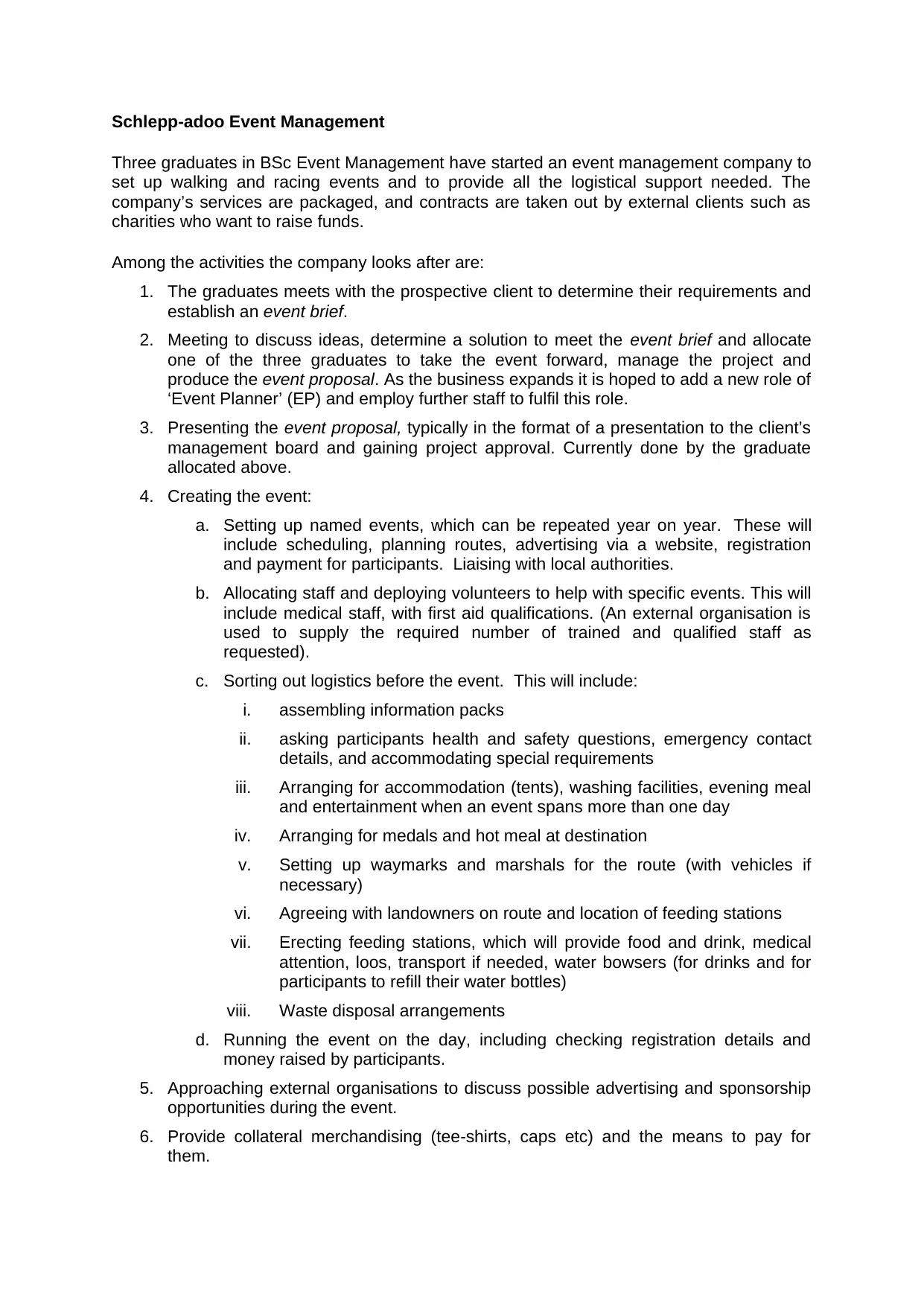
Schlepp-adoo Event Management
Three graduates in BSc Event Management have started an event management company to
set up walking and racing events and to provide all the logistical support needed. The
company’s services are packaged, and contracts are taken out by external clients such as
charities who want to raise funds.
Among the activities the company looks after are:
1. The graduates meets with the prospective client to determine their requirements and
establish an event brief.
2. Meeting to discuss ideas, determine a solution to meet the event brief and allocate
one of the three graduates to take the event forward, manage the project and
produce the event proposal. As the business expands it is hoped to add a new role of
‘Event Planner’ (EP) and employ further staff to fulfil this role.
3. Presenting the event proposal, typically in the format of a presentation to the client’s
management board and gaining project approval. Currently done by the graduate
allocated above.
4. Creating the event:
a. Setting up named events, which can be repeated year on year. These will
include scheduling, planning routes, advertising via a website, registration
and payment for participants. Liaising with local authorities.
b. Allocating staff and deploying volunteers to help with specific events. This will
include medical staff, with first aid qualifications. (An external organisation is
used to supply the required number of trained and qualified staff as
requested).
c. Sorting out logistics before the event. This will include:
i. assembling information packs
ii. asking participants health and safety questions, emergency contact
details, and accommodating special requirements
iii. Arranging for accommodation (tents), washing facilities, evening meal
and entertainment when an event spans more than one day
iv. Arranging for medals and hot meal at destination
v. Setting up waymarks and marshals for the route (with vehicles if
necessary)
vi. Agreeing with landowners on route and location of feeding stations
vii. Erecting feeding stations, which will provide food and drink, medical
attention, loos, transport if needed, water bowsers (for drinks and for
participants to refill their water bottles)
viii. Waste disposal arrangements
d. Running the event on the day, including checking registration details and
money raised by participants.
5. Approaching external organisations to discuss possible advertising and sponsorship
opportunities during the event.
6. Provide collateral merchandising (tee-shirts, caps etc) and the means to pay for
them.
tabler-icon-diamond-filled.svg

Paraphrase This Document

Need a fresh take? Get an instant paraphrase of this document with our AI Paraphraser
Document Page
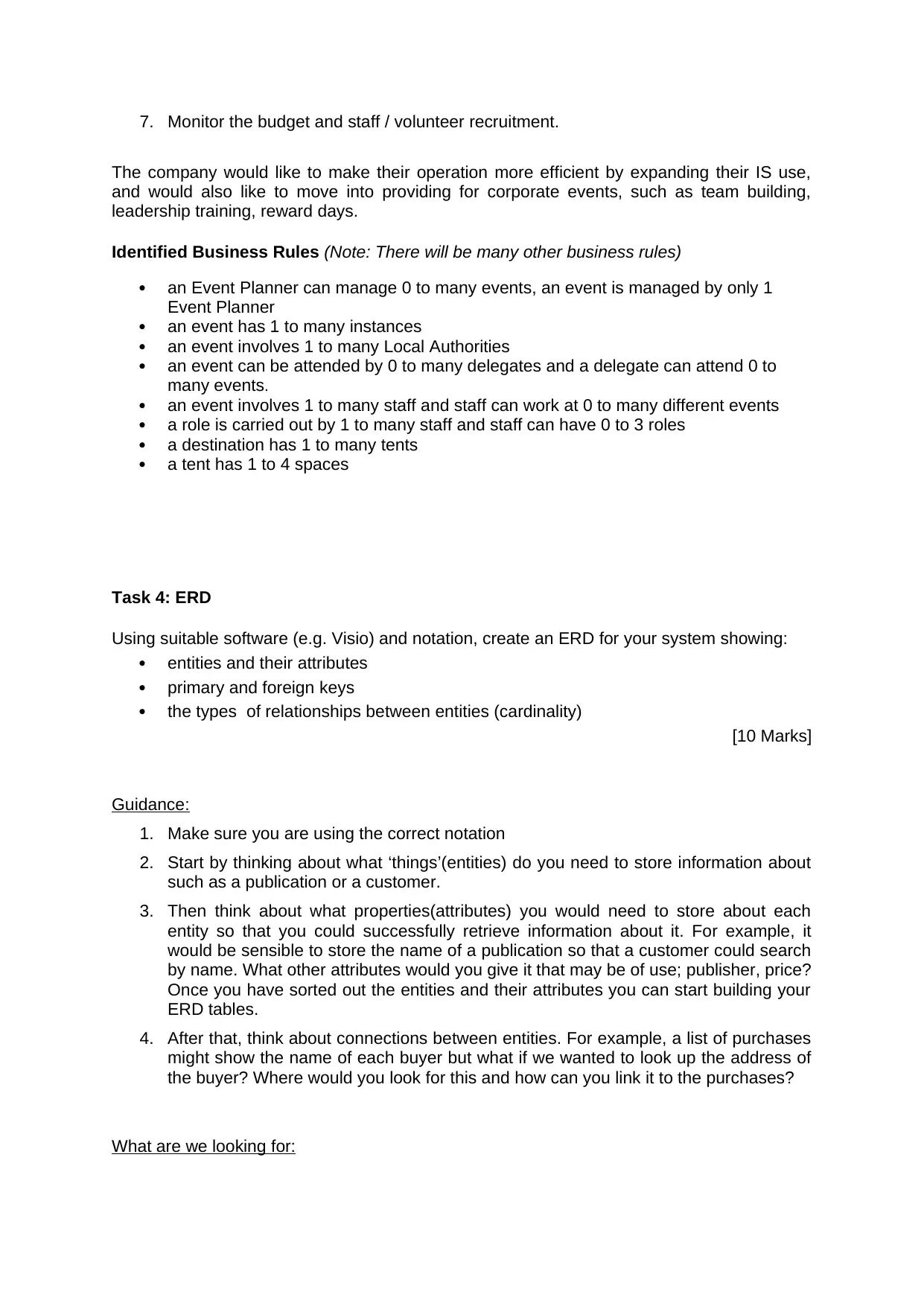
7. Monitor the budget and staff / volunteer recruitment.
The company would like to make their operation more efficient by expanding their IS use,
and would also like to move into providing for corporate events, such as team building,
leadership training, reward days.
Identified Business Rules (Note: There will be many other business rules)
an Event Planner can manage 0 to many events, an event is managed by only 1
Event Planner
an event has 1 to many instances
an event involves 1 to many Local Authorities
an event can be attended by 0 to many delegates and a delegate can attend 0 to
many events.
an event involves 1 to many staff and staff can work at 0 to many different events
a role is carried out by 1 to many staff and staff can have 0 to 3 roles
a destination has 1 to many tents
a tent has 1 to 4 spaces
Task 4: ERD
Using suitable software (e.g. Visio) and notation, create an ERD for your system showing:
entities and their attributes
primary and foreign keys
the types of relationships between entities (cardinality)
[10 Marks]
Guidance:
1. Make sure you are using the correct notation
2. Start by thinking about what ‘things’(entities) do you need to store information about
such as a publication or a customer.
3. Then think about what properties(attributes) you would need to store about each
entity so that you could successfully retrieve information about it. For example, it
would be sensible to store the name of a publication so that a customer could search
by name. What other attributes would you give it that may be of use; publisher, price?
Once you have sorted out the entities and their attributes you can start building your
ERD tables.
4. After that, think about connections between entities. For example, a list of purchases
might show the name of each buyer but what if we wanted to look up the address of
the buyer? Where would you look for this and how can you link it to the purchases?
What are we looking for:
Document Page
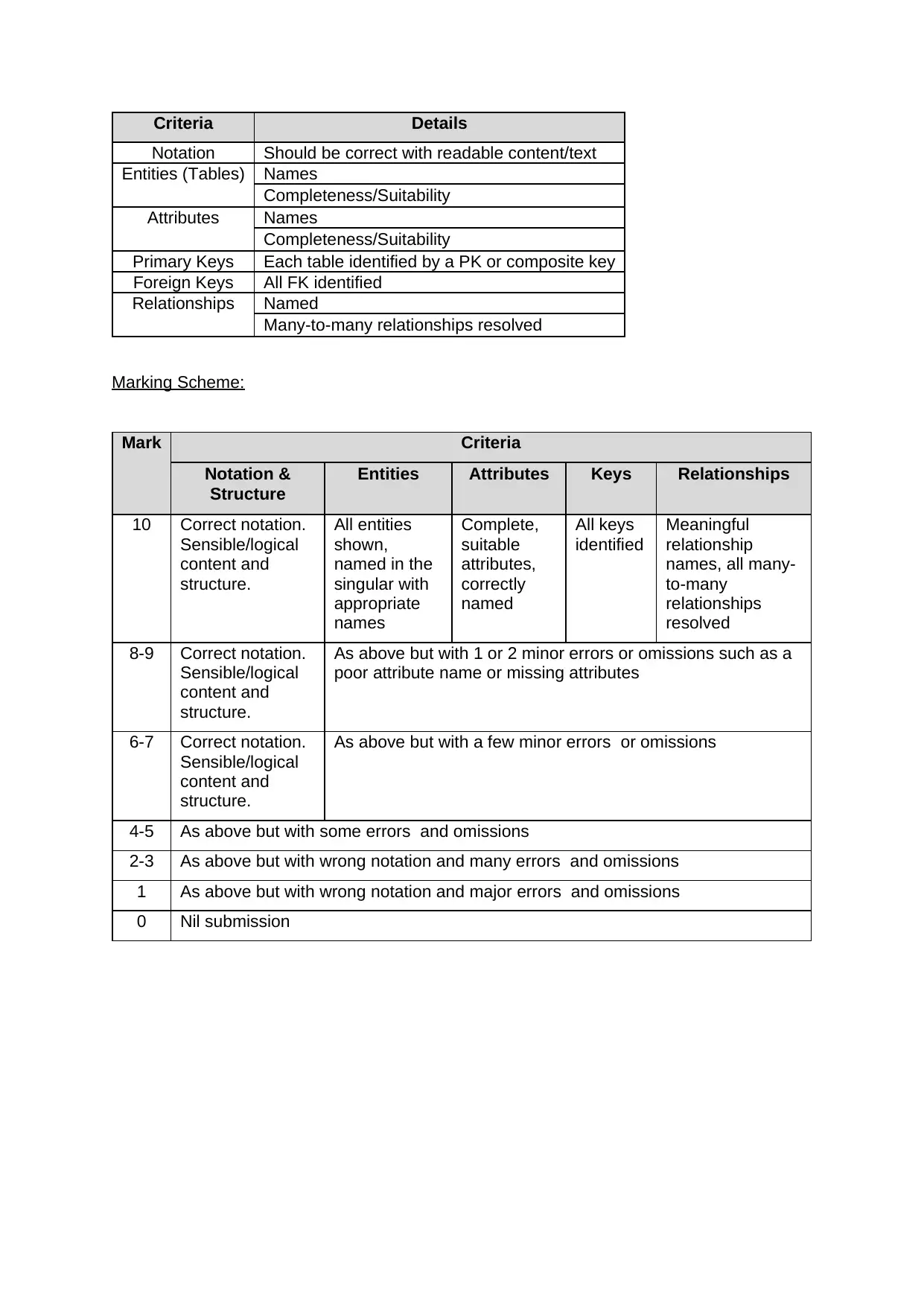
Criteria Details
Notation Should be correct with readable content/text
Entities (Tables) Names
Completeness/Suitability
Attributes Names
Completeness/Suitability
Primary Keys Each table identified by a PK or composite key
Foreign Keys All FK identified
Relationships Named
Many-to-many relationships resolved
Marking Scheme:
Mark Criteria
Notation &
Structure
Entities Attributes Keys Relationships
10 Correct notation.
Sensible/logical
content and
structure.
All entities
shown,
named in the
singular with
appropriate
names
Complete,
suitable
attributes,
correctly
named
All keys
identified
Meaningful
relationship
names, all many-
to-many
relationships
resolved
8-9 Correct notation.
Sensible/logical
content and
structure.
As above but with 1 or 2 minor errors or omissions such as a
poor attribute name or missing attributes
6-7 Correct notation.
Sensible/logical
content and
structure.
As above but with a few minor errors or omissions
4-5 As above but with some errors and omissions
2-3 As above but with wrong notation and many errors and omissions
1 As above but with wrong notation and major errors and omissions
0 Nil submission
chevron_up_icon
1 out of 3
circle_padding
hide_on_mobile
zoom_out_icon
[object Object]