Detailed Report on Event Marketing, Sponsorship, and Objectives

Verified

Added on  2023/01/19

|7
|1131
|97
Report
AI Summary
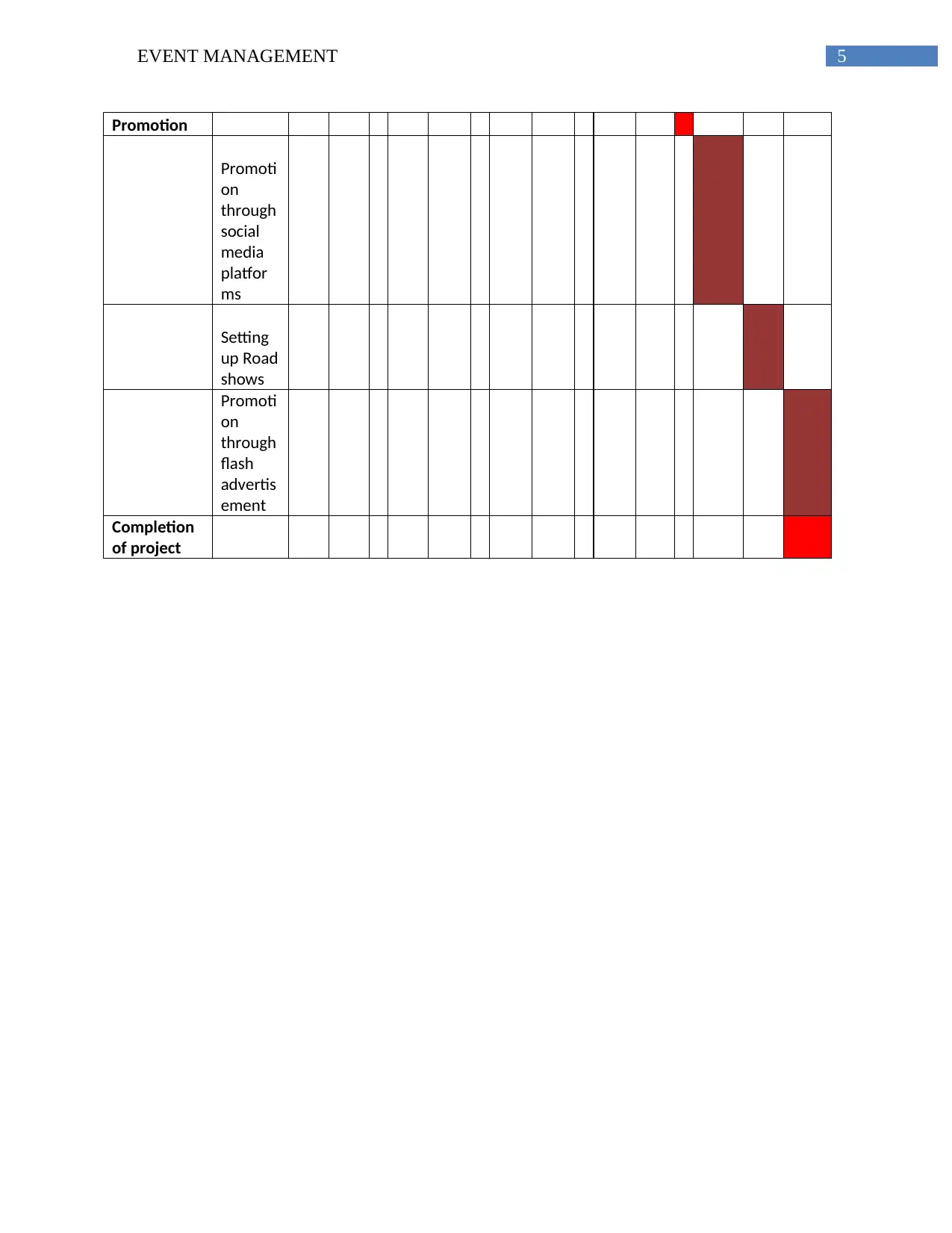
This report focuses on event marketing and sponsorship strategies, using the 2019 Rolex Australian Grand Prix as a case study. It defines marketing and sponsorship, highlighting their roles in attracting target audiences and securing financial resources. The report outlines the high-level goal of attracting race enthusiasts and details marketing and sponsorship objectives, including raising funds and promoting the event. A Gantt chart illustrates the project timeline, from target audience assessment to promotion. The report emphasizes the importance of social media and digital platforms for marketing and provides references to relevant literature on event management and marketing.
Document Page
Running head: EVENT MANAGEMENT
EVENT MANAGEMENT
Name of the student
Name of the university
Author note
tabler-icon-diamond-filled.svg

Paraphrase This Document

Need a fresh take? Get an instant paraphrase of this document with our AI Paraphraser
Document Page
1EVENT MANAGEMENT
1. Definition of Marketing and sponsorships
The marketing activities of an event assist an organizer in making the target audience
aware of the different propositions. Müller (2015) stated that the marketing initiatives that are
undertaken by the event organizers assists the same in attracting the attention of the target
visitors. On the other hand, Preuss (2015) noted that marketing initiatives that are considered by
the event organizers assists the same in introducing the concept of the event and thereby making
the same aware of the different propositions in accordance to the needs of the customers. The
marketing initiatives that are undertaken by the event organizers help the same in making the
target audience aware of the attractions and amusement of the event. In this context, marketing
design of the 2019 Rolex Australian Grand Prix, the three day event, will be assisting the
organizers in making the target audience aware of the venue and timings.
Shank and Lyberger (2014) noted that the delineation of the preferences of the target
audience in relation to the choice of the media vehicles help an organizer in facilitating the
smooth functioning of the event. On the other hand, the delineation of the different whereabouts
and assessment of the feedbacks from the target audience helps an organizer in identifying the
possible range and size of target audience (Djaballah, Hautbois and Desbordes 2015).
Marketing activities of an event supports the overall operations through the facilitating of
communication between the different stakeholder groups (Kim et al. 2015). On the other hand, it
also helps an event manager in facilitating a well structured plan.
On the other hand, facilitating sponsorships for the event help an event manager in
securing the budgetary needs of the same. An event’s operations are based on the sponsorship
activities in order to maintain the efficiency of the operations. Sponsorship operations and crowd
Document Page
2EVENT MANAGEMENT
funding provides adequate financial resources for the event managers, which supports the
systematic functioning of the tasks. On the other hand, Morgan et al. (2014) noted that the crowd
funding and sponsorship based elements also provide an event in enhancing the value. The
sponsors from different dignified organizations contribute to the brand image of the event for
supporting the activities. Therefore, sponsorships provide event managers with the privilege of
conducting systematic functioning of the tasks through effective funding measures.
2. High- level goal for the event
The overall goal for undertaking the event is to attract the attention of the interested
target audience. The goal of the event, 2019 Australian Grand Prix, is to attract the attention of
the race enthusiasts from all around the world. The goal of the event is based on providing the
target audience with an amusement that the race enthusiasts deserve and expect from the
organizers. The marketing elements of the event aimed at making the target audience aware of
the happening, the venue and time for maximizing the audience participation in the event. On the
other hand, the vast number of sponsors for the event aimed at supporting the budgetary and
financial requirements of the organizers while designing and setting the event. The social media
utilization was used for marketing and promotion for making the target audience aware of the
amusement. On the other hand, YouTube videos were streamed with the purpose of gaining
maximum amount of reach. The utilization of the digital and social media platforms in the
marketing elements aimed at maximizing the reach of audience. On the other hand, the event
organizers facilitate the sponsorship activities in order to maintain the systematic operations of
the different tasks for developing and setting the event in adherence to the amusement related
needs of the sports and racing enthusiasts.
Document Page
3EVENT MANAGEMENT
3. Objectives for Marketing and sponsorships
The objectives for marketing of the event are:
ï‚· To make the target audience aware of the venue, time and activities that will be
undertaken as a part of the event
ï‚· To gather feedbacks from the different audiences and judge the amount of expected
visitors for the event
The objectives for sponsorship of the event are:
ï‚· To raise funds for the event
ï‚· To support the value of the proposition made by the event through the brand image of
the sponsors
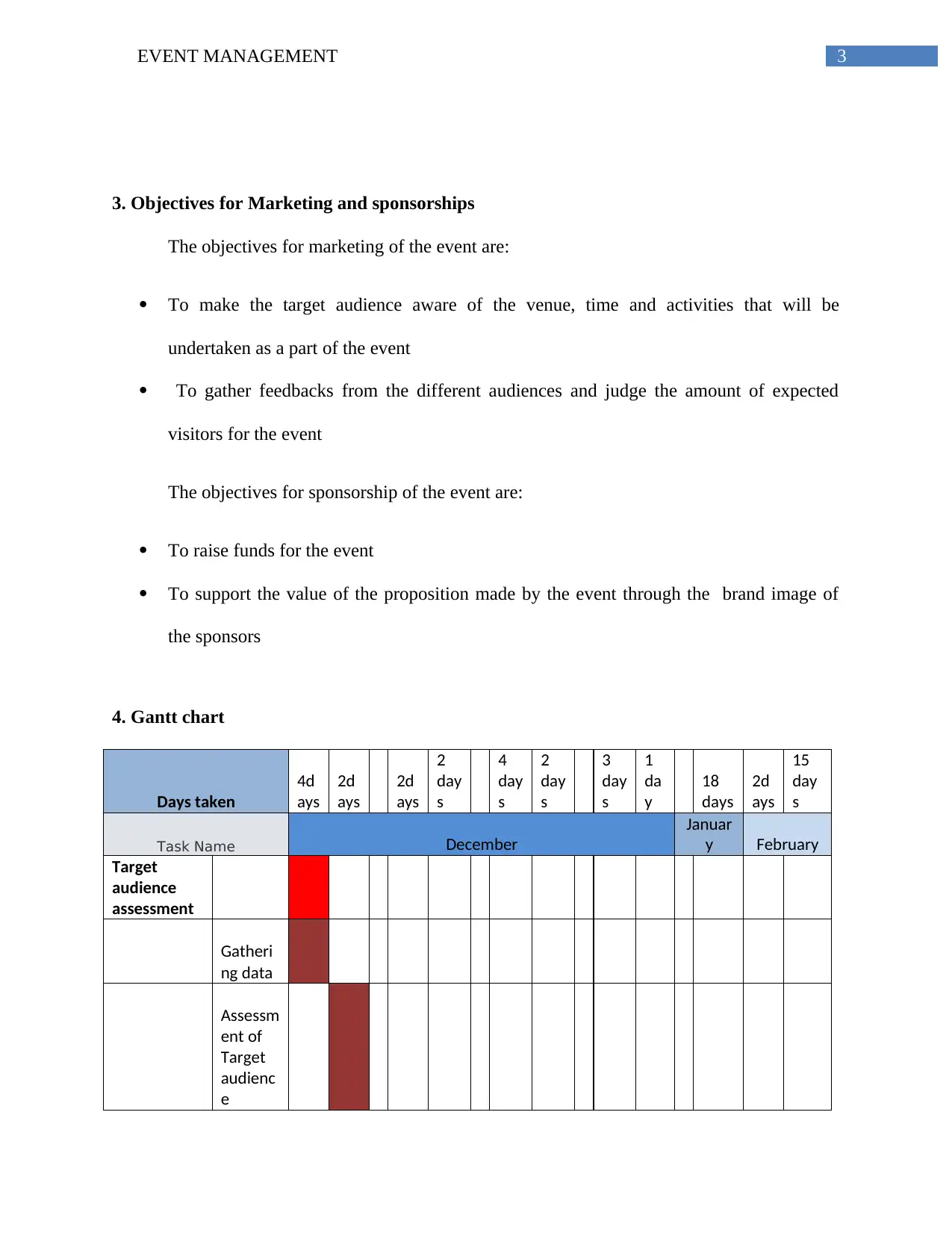
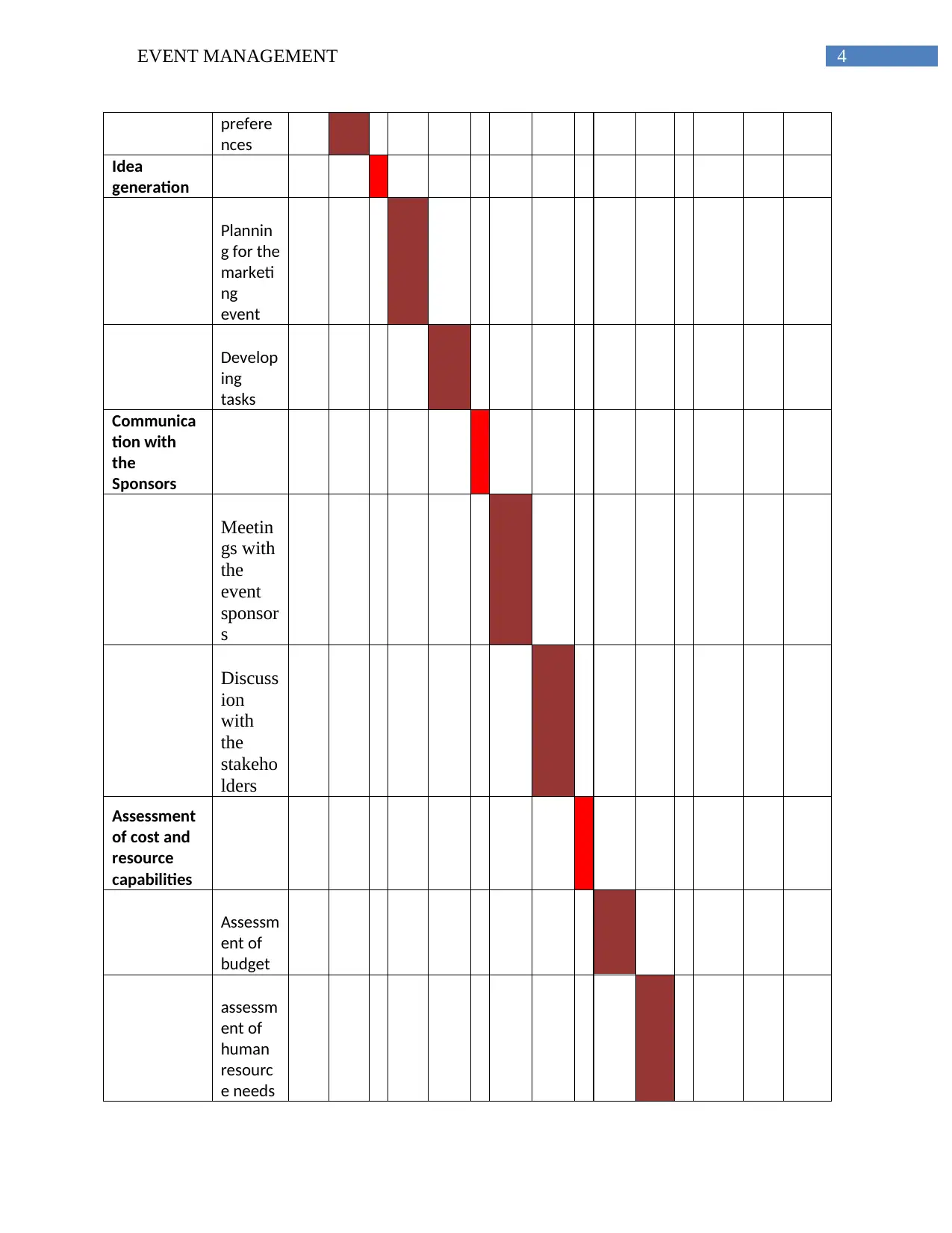
4. Gantt chart
Days taken
4d
ays
2d
ays
2d
ays
2
day
s
4
day
s
2
day
s
3
day
s
1
da
y
18
days
2d
ays
15
day
s
Task Name December
Januar
y February
Target
audience
assessment
Gatheri
ng data
Assessm
ent of
Target
audienc
e
tabler-icon-diamond-filled.svg

Paraphrase This Document

Need a fresh take? Get an instant paraphrase of this document with our AI Paraphraser
Document Page
4EVENT MANAGEMENT
prefere
nces
Idea
generation
Plannin
g for the
marketi
ng
event
Develop
ing
tasks
Communica
tion with
the
Sponsors
Meetin
gs with
the
event
sponsor
s
Discuss
ion
with
the
stakeho
lders
Assessment
of cost and
resource
capabilities
Assessm
ent of
budget
assessm
ent of
human
resourc
e needs
Document Page
5EVENT MANAGEMENT
Promotion
Promoti
on
through
social
media
platfor
ms
Setting
up Road
shows
Promoti
on
through
flash
advertis
ement
Completion
of project
Document Page
6EVENT MANAGEMENT
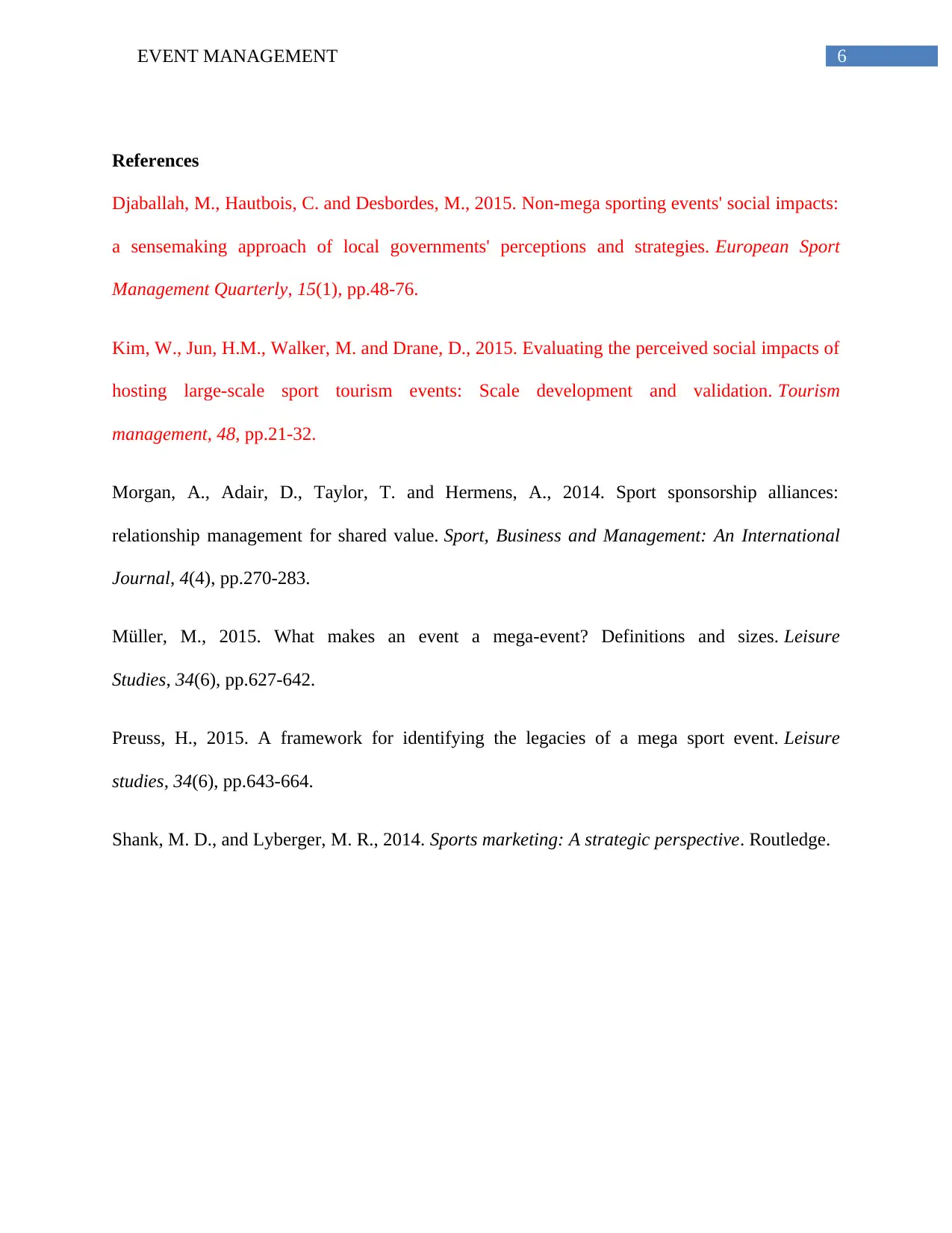
References
Djaballah, M., Hautbois, C. and Desbordes, M., 2015. Non-mega sporting events' social impacts:
a sensemaking approach of local governments' perceptions and strategies. European Sport
Management Quarterly, 15(1), pp.48-76.
Kim, W., Jun, H.M., Walker, M. and Drane, D., 2015. Evaluating the perceived social impacts of
hosting large-scale sport tourism events: Scale development and validation. Tourism
management, 48, pp.21-32.
Morgan, A., Adair, D., Taylor, T. and Hermens, A., 2014. Sport sponsorship alliances:
relationship management for shared value. Sport, Business and Management: An International
Journal, 4(4), pp.270-283.
Müller, M., 2015. What makes an event a mega-event? Definitions and sizes. Leisure
Studies, 34(6), pp.627-642.
Preuss, H., 2015. A framework for identifying the legacies of a mega sport event. Leisure
studies, 34(6), pp.643-664.
Shank, M. D., and Lyberger, M. R., 2014. Sports marketing: A strategic perspective. Routledge.
chevron_up_icon
1 out of 7
circle_padding
hide_on_mobile
zoom_out_icon
[object Object]