Critical Appraisal Report: Long-Term Indwelling Urinary Catheter Study
VerifiedAdded on 2023/06/12
|7
|1505
|253
Report
AI Summary
This report presents a critical appraisal of a qualitative study that explores the information needs of individuals living with long-term indwelling urinary catheters and the consequences of inadequate information. The appraisal examines the appropriateness of the qualitative method used, the research design, sampling methods, data collection techniques, the relationship between the researcher and participants, ethical considerations, data analysis, and the results and findings of the study. The research aimed to understand the impact of indwelling catheters on users and address the need for better information to improve their quality of life, reduce stigma, and enable them to achieve life goals. The appraisal considers the study's methodology, including thematic analysis and constant comparison, and evaluates the rigor and validity of the research process, highlighting the importance of providing patients with adequate knowledge and support.

Evidence Based Nursing Research
Student University
Student name
Date
Student University
Student name
Date
Paraphrase This Document
Need a fresh take? Get an instant paraphrase of this document with our AI Paraphraser

The aim of the research
The aim of this qualitative study was to explore the information needs of people living
with a long-term indwelling urinary catheter and the consequences for patients of inadequate
information and how these needs could be met. the study was thought important because of the
need to identify the side effects of indwelling catheters, how patients managed the side effects
with or without knowledge and how their information need could be met. the relevance of the
study is to meet the needs of the patients and improve their quality of life in enabling achievable
life goals, career goals, sex life and reduce stigma without catheter interferences.
Appropriateness of the qualitative method.
According to Raz (2000), Little is known about the varied and detailed information needs
of long-term indwelling catheter users. The qualitative methodology was the appropriate to
explore the information needs of long term indwelling catheter users. This qualitative approach
seeks insights into the problem and aids to develop hypotheses for probable quantitative
research. This qualitative research is also used to find inclinations in thought and opinion about
indwelling catheters and the problem associated with the catheters. This qualitative research
focuses on the research goal that include information about insertion of an indwelling catheter
and on outcomes of those events from the perspectives of the users. In this case, the author uses
qualitative research to understand the impact of the indwelling catheter on the users with little
information about the catheter.
The research design
The researcher sights that new medical reality of the indwelling catheter users as being
rooted within and difficult to abstract from their normal life processes and events. The author
The aim of this qualitative study was to explore the information needs of people living
with a long-term indwelling urinary catheter and the consequences for patients of inadequate
information and how these needs could be met. the study was thought important because of the
need to identify the side effects of indwelling catheters, how patients managed the side effects
with or without knowledge and how their information need could be met. the relevance of the
study is to meet the needs of the patients and improve their quality of life in enabling achievable
life goals, career goals, sex life and reduce stigma without catheter interferences.
Appropriateness of the qualitative method.
According to Raz (2000), Little is known about the varied and detailed information needs
of long-term indwelling catheter users. The qualitative methodology was the appropriate to
explore the information needs of long term indwelling catheter users. This qualitative approach
seeks insights into the problem and aids to develop hypotheses for probable quantitative
research. This qualitative research is also used to find inclinations in thought and opinion about
indwelling catheters and the problem associated with the catheters. This qualitative research
focuses on the research goal that include information about insertion of an indwelling catheter
and on outcomes of those events from the perspectives of the users. In this case, the author uses
qualitative research to understand the impact of the indwelling catheter on the users with little
information about the catheter.
The research design
The researcher sights that new medical reality of the indwelling catheter users as being
rooted within and difficult to abstract from their normal life processes and events. The author

intends to understand this as a reality rather than a hypothesis testing process. A qualitative
interpretative approach was selected, combining thematic analysis with constant comparison.
The researcher sort to pursue interpretive over positivist research because of the considerations
about exploring the information needs of people living with a long-term indwelling urinary
catheter and was therefore best way to study it.
The sampling method and recruitment
The researcher explains that a random sample of people living with indwelling catheters
were selected. Patients with more than 3 months indwelling catheters were recruited after that
random study. The author explains that the sample population with 3 months or more indwelling
were appropriate because they had them on for long enough to have experienced the
complications such as blockage, infections and leakage or a catheter being pulled off. The
discussions around the recruitment involved convenience, willingness and the availability of
knowledge about the indwelling catheter.
Data collection
According to Saint (2006), The setting for data collection was England, Wales and
Scotland. The reason for the setting was largely due to convenience and availability. The study
was conducted between 2011-2013. Data was collected through interview methods. The
interview technique was a narrative approach. Thirty-six interviews were conducted across the
three countries. The narrative approach interview method was justified because the researcher
wanted the recruited interviewees to explain their experience. The interviews were based on a
topic guide but instances of the interviewees veering off the mark were present. The forms of
data recording and storage were clear and accurate data was recorded and analyzed. The
interpretative approach was selected, combining thematic analysis with constant comparison.
The researcher sort to pursue interpretive over positivist research because of the considerations
about exploring the information needs of people living with a long-term indwelling urinary
catheter and was therefore best way to study it.
The sampling method and recruitment
The researcher explains that a random sample of people living with indwelling catheters
were selected. Patients with more than 3 months indwelling catheters were recruited after that
random study. The author explains that the sample population with 3 months or more indwelling
were appropriate because they had them on for long enough to have experienced the
complications such as blockage, infections and leakage or a catheter being pulled off. The
discussions around the recruitment involved convenience, willingness and the availability of
knowledge about the indwelling catheter.
Data collection
According to Saint (2006), The setting for data collection was England, Wales and
Scotland. The reason for the setting was largely due to convenience and availability. The study
was conducted between 2011-2013. Data was collected through interview methods. The
interview technique was a narrative approach. Thirty-six interviews were conducted across the
three countries. The narrative approach interview method was justified because the researcher
wanted the recruited interviewees to explain their experience. The interviews were based on a
topic guide but instances of the interviewees veering off the mark were present. The forms of
data recording and storage were clear and accurate data was recorded and analyzed. The
⊘ This is a preview!⊘
Do you want full access?
Subscribe today to unlock all pages.

Trusted by 1+ million students worldwide

methodology of data collection employed saturation as a tool to ensure the quality and accuracy
of data was relevant tom the study. In this phase of qualitative data collection and analysis, the
researcher continued sampling and analyzing data until all concepts of the research question
were well developed.
Relationship between the researcher and participants.
The quality of the relationship between the researcher and the participants was based on a
well demarcated role of interviewer-interviewee. The researcher, with the narrative approach
based interview, was a listener while the participants narrated their story and life experience with
the indwelling catheter. During the formulation of the research questions, to overcome potential
bias and get tones of information, the researcher opted for open ended questions that allowed
narration. There was no bias in data collection, sample recruitment and choices location. The
researcher was not vulnerable to bias through her own attitudes and qualities, social desirability
factors, and conditions of worth. The researcher engaged in in-depth conversations with the
participants. The researcher develops a profound empathy for the experiences that are embedded
within the participant's life. the researcher is dependent on the participants’ willingness not only
to take part, but also to share their experiences and thoughts about the topics in question. The
researchers well thought-out the importance of listening to the illness stories, most importantly to
show respect, but also to gain the trust of the participants, which was essential for a constructive
qualitative research encounter. In instances that the participants veered off the study question
topic, the interviewer asked objective questions to bring out the experiences only relating to the
topic of indwelling catheters.
of data was relevant tom the study. In this phase of qualitative data collection and analysis, the
researcher continued sampling and analyzing data until all concepts of the research question
were well developed.
Relationship between the researcher and participants.
The quality of the relationship between the researcher and the participants was based on a
well demarcated role of interviewer-interviewee. The researcher, with the narrative approach
based interview, was a listener while the participants narrated their story and life experience with
the indwelling catheter. During the formulation of the research questions, to overcome potential
bias and get tones of information, the researcher opted for open ended questions that allowed
narration. There was no bias in data collection, sample recruitment and choices location. The
researcher was not vulnerable to bias through her own attitudes and qualities, social desirability
factors, and conditions of worth. The researcher engaged in in-depth conversations with the
participants. The researcher develops a profound empathy for the experiences that are embedded
within the participant's life. the researcher is dependent on the participants’ willingness not only
to take part, but also to share their experiences and thoughts about the topics in question. The
researchers well thought-out the importance of listening to the illness stories, most importantly to
show respect, but also to gain the trust of the participants, which was essential for a constructive
qualitative research encounter. In instances that the participants veered off the study question
topic, the interviewer asked objective questions to bring out the experiences only relating to the
topic of indwelling catheters.
Paraphrase This Document
Need a fresh take? Get an instant paraphrase of this document with our AI Paraphraser

Ethical considerations.
Sufficient details of how the research was explained to participants to satisfy the ethical
standards are well documented in the research report. The researcher informed the potential
participants of the particulars of the study, including its duration, its activities, location, and how
much time will be required. Informed consent was explained and sort from the participants and
they willingly offered to be part of the research process. The concern on confidentiality was
sorted with the researcher promising security of data. The ethical considerations of the research
were approved by the ethical committee.
Data analysis.
There is an in-depth description of the analysis process. The thematic analysis was used.
The themes and data categories are well derived from the data collected and to presented from
the original data sample. The themes categorized included, making adjustments, nighttime
adjustment, catheter problems, support from others and intimacy and body image. Sufficient data
was sufficient to support the findings. contradictory data was taken into account, however was
too little to influence the outcome of the study. Researcher critically examined their own role
into potential bias and influence during the data collection.
Sufficient details of how the research was explained to participants to satisfy the ethical
standards are well documented in the research report. The researcher informed the potential
participants of the particulars of the study, including its duration, its activities, location, and how
much time will be required. Informed consent was explained and sort from the participants and
they willingly offered to be part of the research process. The concern on confidentiality was
sorted with the researcher promising security of data. The ethical considerations of the research
were approved by the ethical committee.
Data analysis.
There is an in-depth description of the analysis process. The thematic analysis was used.
The themes and data categories are well derived from the data collected and to presented from
the original data sample. The themes categorized included, making adjustments, nighttime
adjustment, catheter problems, support from others and intimacy and body image. Sufficient data
was sufficient to support the findings. contradictory data was taken into account, however was
too little to influence the outcome of the study. Researcher critically examined their own role
into potential bias and influence during the data collection.

Results and findings.
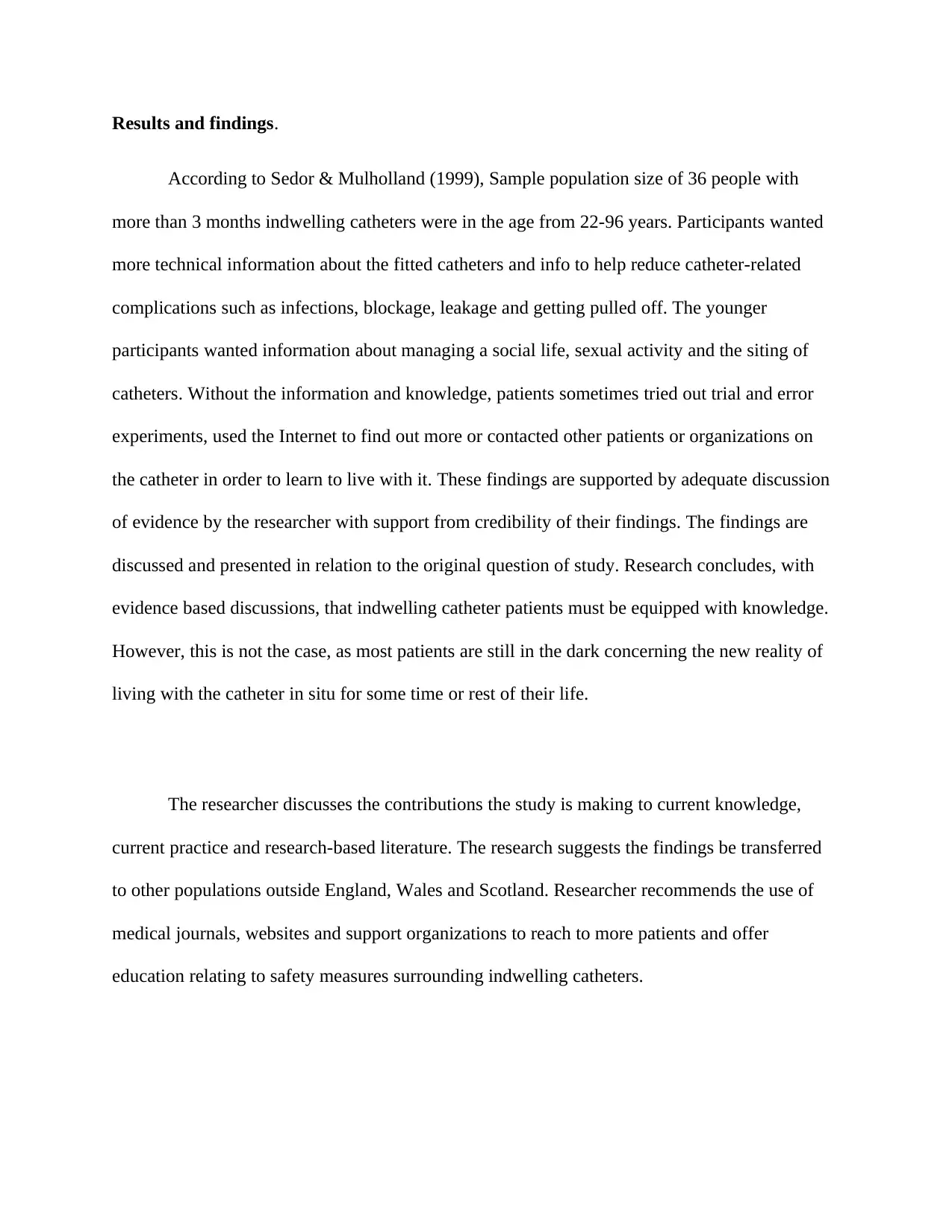
According to Sedor & Mulholland (1999), Sample population size of 36 people with
more than 3 months indwelling catheters were in the age from 22-96 years. Participants wanted
more technical information about the fitted catheters and info to help reduce catheter-related
complications such as infections, blockage, leakage and getting pulled off. The younger
participants wanted information about managing a social life, sexual activity and the siting of
catheters. Without the information and knowledge, patients sometimes tried out trial and error
experiments, used the Internet to find out more or contacted other patients or organizations on
the catheter in order to learn to live with it. These findings are supported by adequate discussion
of evidence by the researcher with support from credibility of their findings. The findings are
discussed and presented in relation to the original question of study. Research concludes, with
evidence based discussions, that indwelling catheter patients must be equipped with knowledge.
However, this is not the case, as most patients are still in the dark concerning the new reality of
living with the catheter in situ for some time or rest of their life.
The researcher discusses the contributions the study is making to current knowledge,
current practice and research-based literature. The research suggests the findings be transferred
to other populations outside England, Wales and Scotland. Researcher recommends the use of
medical journals, websites and support organizations to reach to more patients and offer
education relating to safety measures surrounding indwelling catheters.
According to Sedor & Mulholland (1999), Sample population size of 36 people with
more than 3 months indwelling catheters were in the age from 22-96 years. Participants wanted
more technical information about the fitted catheters and info to help reduce catheter-related
complications such as infections, blockage, leakage and getting pulled off. The younger
participants wanted information about managing a social life, sexual activity and the siting of
catheters. Without the information and knowledge, patients sometimes tried out trial and error
experiments, used the Internet to find out more or contacted other patients or organizations on
the catheter in order to learn to live with it. These findings are supported by adequate discussion
of evidence by the researcher with support from credibility of their findings. The findings are
discussed and presented in relation to the original question of study. Research concludes, with
evidence based discussions, that indwelling catheter patients must be equipped with knowledge.
However, this is not the case, as most patients are still in the dark concerning the new reality of
living with the catheter in situ for some time or rest of their life.
The researcher discusses the contributions the study is making to current knowledge,
current practice and research-based literature. The research suggests the findings be transferred
to other populations outside England, Wales and Scotland. Researcher recommends the use of
medical journals, websites and support organizations to reach to more patients and offer
education relating to safety measures surrounding indwelling catheters.
⊘ This is a preview!⊘
Do you want full access?
Subscribe today to unlock all pages.

Trusted by 1+ million students worldwide

References.
Sedor, J., & Mulholland, S. G. (1999). Hospital-acquired urinary tract infections associated with
the indwelling catheter. Urologic Clinics, 26(4), 821-828.
Raz, R., Schiller, D., & Nicolle, L. E. (2000). Chronic indwelling catheter replacement before
antimicrobial therapy for symptomatic urinary tract infection. The Journal of urology, 164(4),
1254-1258
Saint, S., Kaufman, S. R., Rogers, M. A., Baker, P. D., Ossenkop, K., & Lipsky, B. A. (2006).
Condom versus indwelling urinary catheters: a randomized trial. Journal of the American
Geriatrics Society, 54(7), 1055-1061.
Sedor, J., & Mulholland, S. G. (1999). Hospital-acquired urinary tract infections associated with
the indwelling catheter. Urologic Clinics, 26(4), 821-828.
Raz, R., Schiller, D., & Nicolle, L. E. (2000). Chronic indwelling catheter replacement before
antimicrobial therapy for symptomatic urinary tract infection. The Journal of urology, 164(4),
1254-1258
Saint, S., Kaufman, S. R., Rogers, M. A., Baker, P. D., Ossenkop, K., & Lipsky, B. A. (2006).
Condom versus indwelling urinary catheters: a randomized trial. Journal of the American
Geriatrics Society, 54(7), 1055-1061.
1 out of 7
Related Documents
Your All-in-One AI-Powered Toolkit for Academic Success.
+13062052269
info@desklib.com
Available 24*7 on WhatsApp / Email
Unlock your academic potential
Copyright © 2020–2026 A2Z Services. All Rights Reserved. Developed and managed by ZUCOL.