Evidence-Based Nursing: Critical Analysis of Eley et al. (2010) Study

Verified

Added on  2023/06/15

|8
|1987
|345
Report
AI Summary
This assignment provides a critical appraisal of a quantitative cohort study by Eley, Eley & Rogers-Clark (2010) investigating the reasons nursing students enter or leave the profession. The research question focuses on factors influencing these decisions, acknowledging potential bias due to its specific geographic location (Queensland). The study uses an online survey to collect data, which is then statistically analyzed. The sample includes registered nurses, enrolled nurses, and nursing students. Limitations include the inability to determine the exact number of survey recipients and self-selection bias. The findings align with previous studies, highlighting the predominance of women in the profession and the significance of factors such as interest in work and career prospects. The analysis concludes that addressing workload management and staffing levels can positively influence nurses' morale and retention. The report emphasizes that the findings can be used to formulate strategies, such as recruitment of more staff to lower workload, reduction in number of shift hours to improve their proficiency, and increase in incentives, which would directly help in reducing burnout among nurses.
Document Page
Running head: EVIDENCE BASED NURSING RESEARCH
Critical Analysis of research article
Name of the Student
Name of the University
Author Note
tabler-icon-diamond-filled.svg

Paraphrase This Document

Need a fresh take? Get an instant paraphrase of this document with our AI Paraphraser
Document Page
1EVIDENCE BASED NURSING RESEARCH
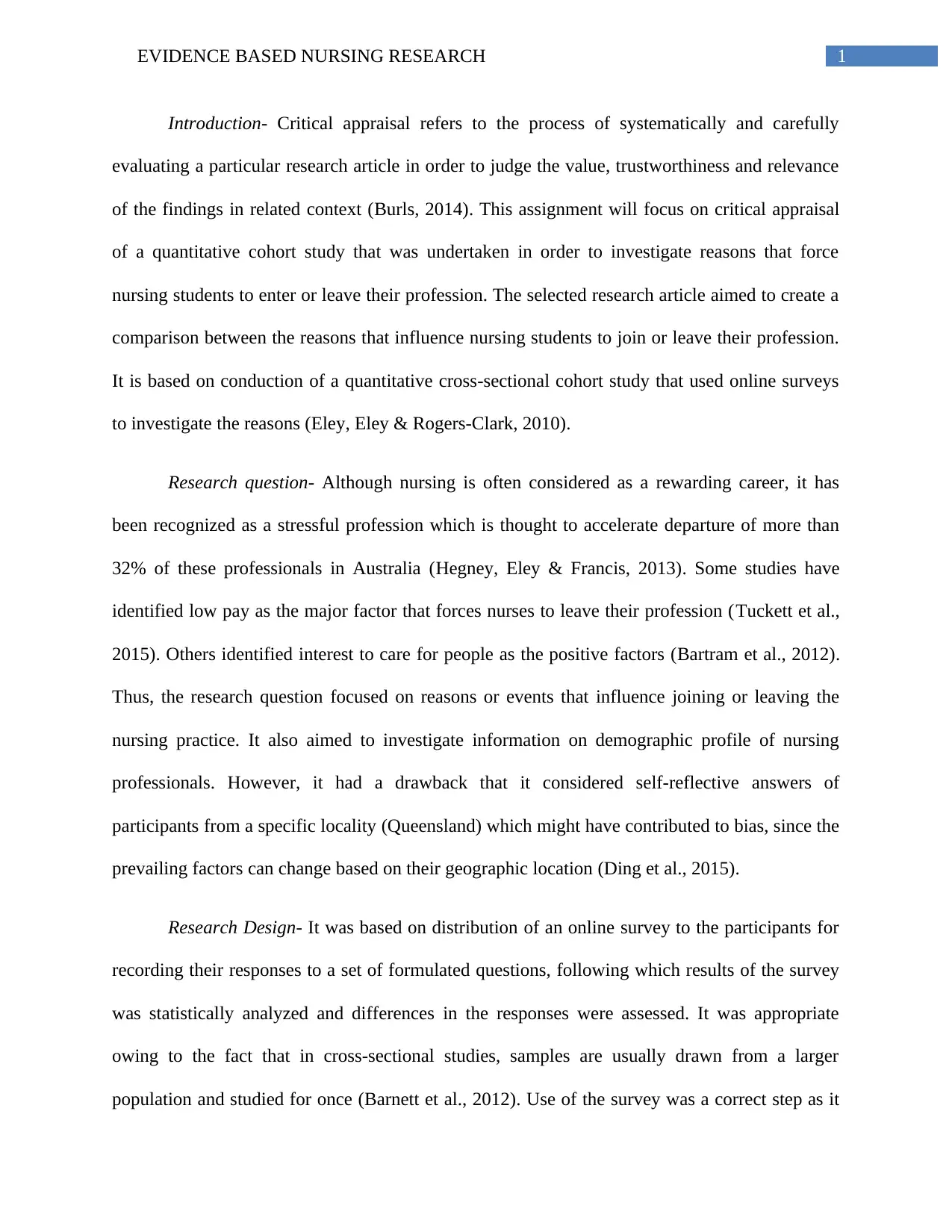
Introduction- Critical appraisal refers to the process of systematically and carefully
evaluating a particular research article in order to judge the value, trustworthiness and relevance
of the findings in related context (Burls, 2014). This assignment will focus on critical appraisal
of a quantitative cohort study that was undertaken in order to investigate reasons that force
nursing students to enter or leave their profession. The selected research article aimed to create a
comparison between the reasons that influence nursing students to join or leave their profession.
It is based on conduction of a quantitative cross-sectional cohort study that used online surveys
to investigate the reasons (Eley, Eley & Rogers-Clark, 2010).
Research question- Although nursing is often considered as a rewarding career, it has
been recognized as a stressful profession which is thought to accelerate departure of more than
32% of these professionals in Australia (Hegney, Eley & Francis, 2013). Some studies have
identified low pay as the major factor that forces nurses to leave their profession (Tuckett et al.,
2015). Others identified interest to care for people as the positive factors (Bartram et al., 2012).
Thus, the research question focused on reasons or events that influence joining or leaving the
nursing practice. It also aimed to investigate information on demographic profile of nursing
professionals. However, it had a drawback that it considered self-reflective answers of
participants from a specific locality (Queensland) which might have contributed to bias, since the
prevailing factors can change based on their geographic location (Ding et al., 2015).
Research Design- It was based on distribution of an online survey to the participants for
recording their responses to a set of formulated questions, following which results of the survey
was statistically analyzed and differences in the responses were assessed. It was appropriate
owing to the fact that in cross-sectional studies, samples are usually drawn from a larger
population and studied for once (Barnett et al., 2012). Use of the survey was a correct step as it
Document Page
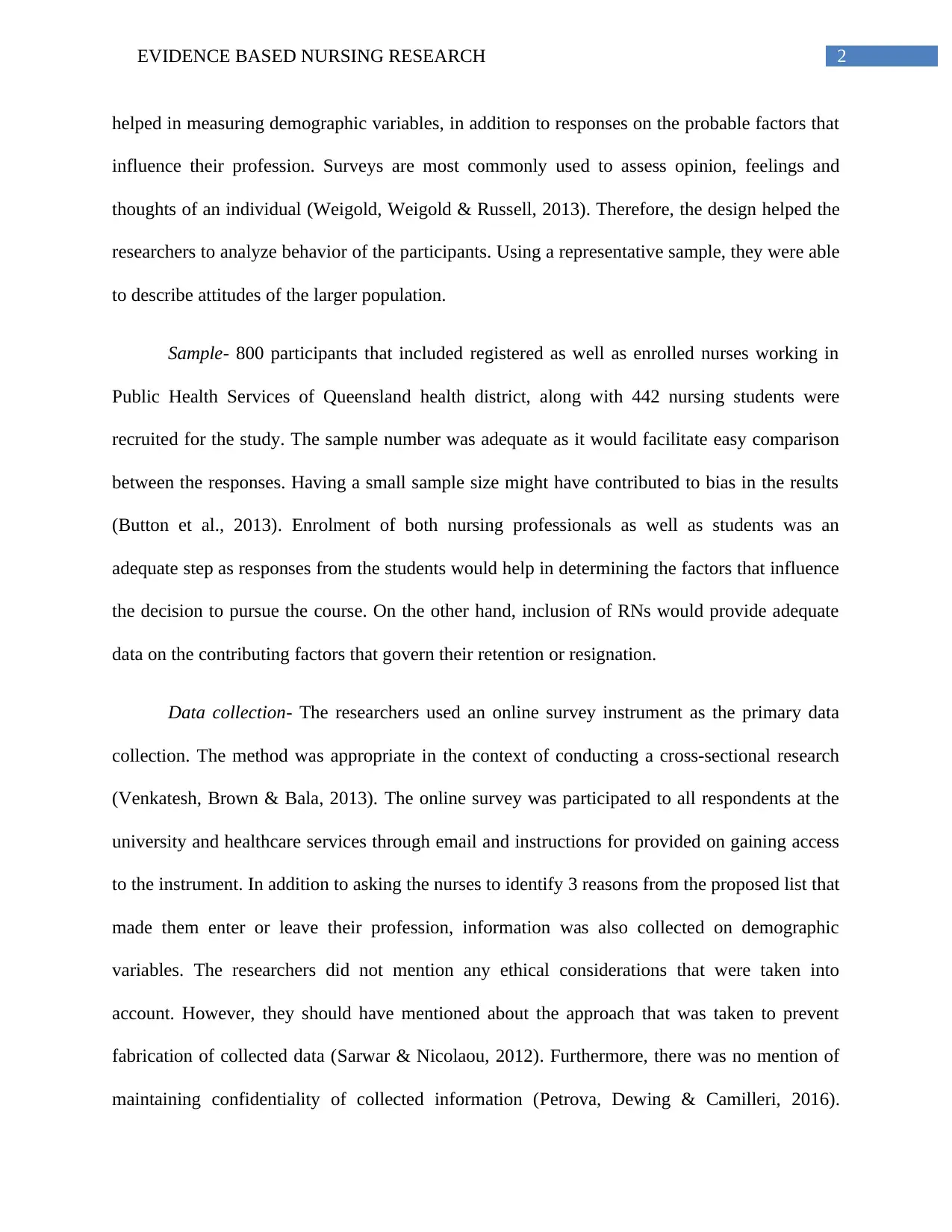
2EVIDENCE BASED NURSING RESEARCH
helped in measuring demographic variables, in addition to responses on the probable factors that
influence their profession. Surveys are most commonly used to assess opinion, feelings and
thoughts of an individual (Weigold, Weigold & Russell, 2013). Therefore, the design helped the
researchers to analyze behavior of the participants. Using a representative sample, they were able
to describe attitudes of the larger population.
Sample- 800 participants that included registered as well as enrolled nurses working in
Public Health Services of Queensland health district, along with 442 nursing students were
recruited for the study. The sample number was adequate as it would facilitate easy comparison
between the responses. Having a small sample size might have contributed to bias in the results
(Button et al., 2013). Enrolment of both nursing professionals as well as students was an
adequate step as responses from the students would help in determining the factors that influence
the decision to pursue the course. On the other hand, inclusion of RNs would provide adequate
data on the contributing factors that govern their retention or resignation.
Data collection- The researchers used an online survey instrument as the primary data
collection. The method was appropriate in the context of conducting a cross-sectional research
(Venkatesh, Brown & Bala, 2013). The online survey was participated to all respondents at the
university and healthcare services through email and instructions for provided on gaining access
to the instrument. In addition to asking the nurses to identify 3 reasons from the proposed list that
made them enter or leave their profession, information was also collected on demographic
variables. The researchers did not mention any ethical considerations that were taken into
account. However, they should have mentioned about the approach that was taken to prevent
fabrication of collected data (Sarwar & Nicolaou, 2012). Furthermore, there was no mention of
maintaining confidentiality of collected information (Petrova, Dewing & Camilleri, 2016).
Document Page
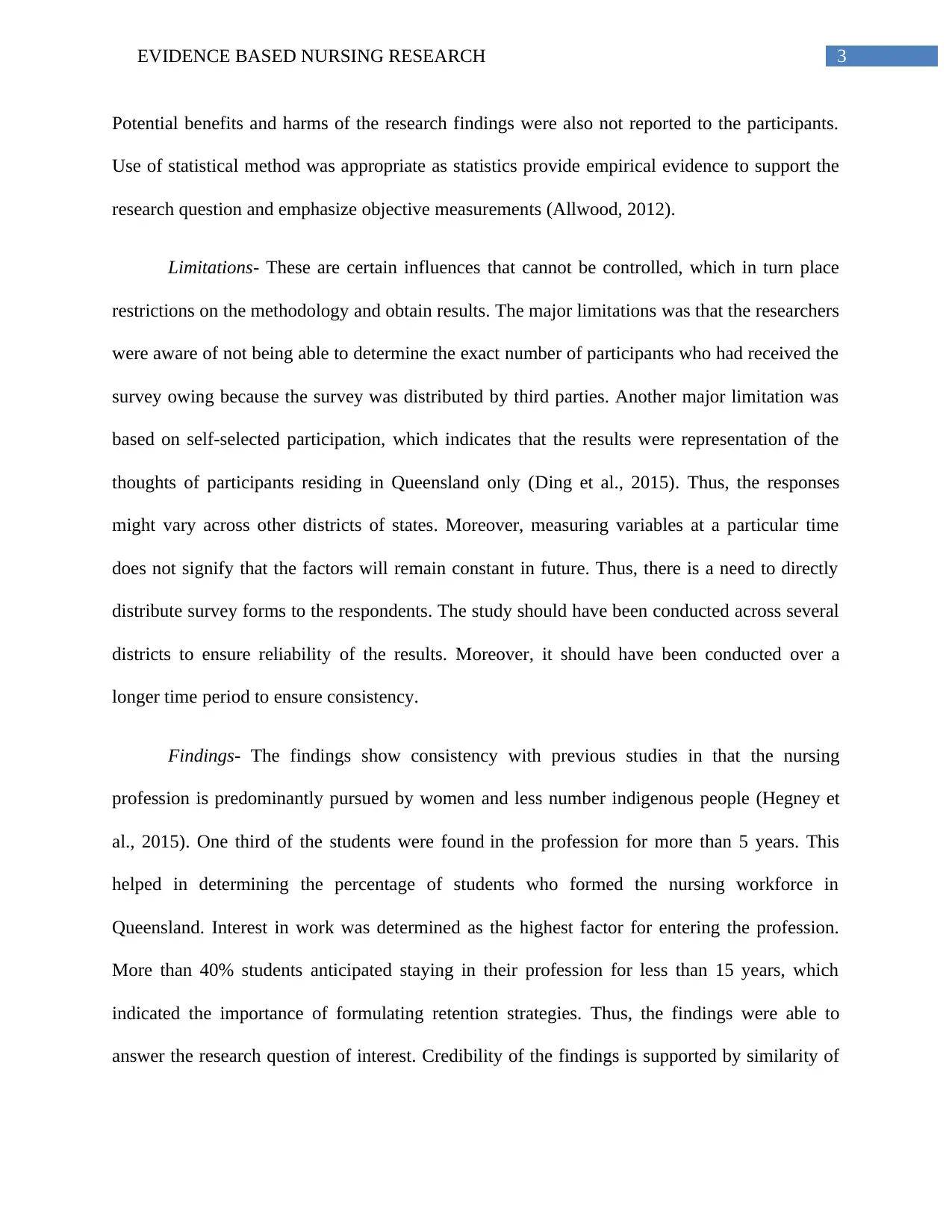
3EVIDENCE BASED NURSING RESEARCH
Potential benefits and harms of the research findings were also not reported to the participants.
Use of statistical method was appropriate as statistics provide empirical evidence to support the
research question and emphasize objective measurements (Allwood, 2012).
Limitations- These are certain influences that cannot be controlled, which in turn place
restrictions on the methodology and obtain results. The major limitations was that the researchers
were aware of not being able to determine the exact number of participants who had received the
survey owing because the survey was distributed by third parties. Another major limitation was
based on self-selected participation, which indicates that the results were representation of the
thoughts of participants residing in Queensland only (Ding et al., 2015). Thus, the responses
might vary across other districts of states. Moreover, measuring variables at a particular time
does not signify that the factors will remain constant in future. Thus, there is a need to directly
distribute survey forms to the respondents. The study should have been conducted across several
districts to ensure reliability of the results. Moreover, it should have been conducted over a
longer time period to ensure consistency.
Findings- The findings show consistency with previous studies in that the nursing
profession is predominantly pursued by women and less number indigenous people (Hegney et
al., 2015). One third of the students were found in the profession for more than 5 years. This
helped in determining the percentage of students who formed the nursing workforce in
Queensland. Interest in work was determined as the highest factor for entering the profession.
More than 40% students anticipated staying in their profession for less than 15 years, which
indicated the importance of formulating retention strategies. Thus, the findings were able to
answer the research question of interest. Credibility of the findings is supported by similarity of
tabler-icon-diamond-filled.svg

Paraphrase This Document

Need a fresh take? Get an instant paraphrase of this document with our AI Paraphraser
Document Page
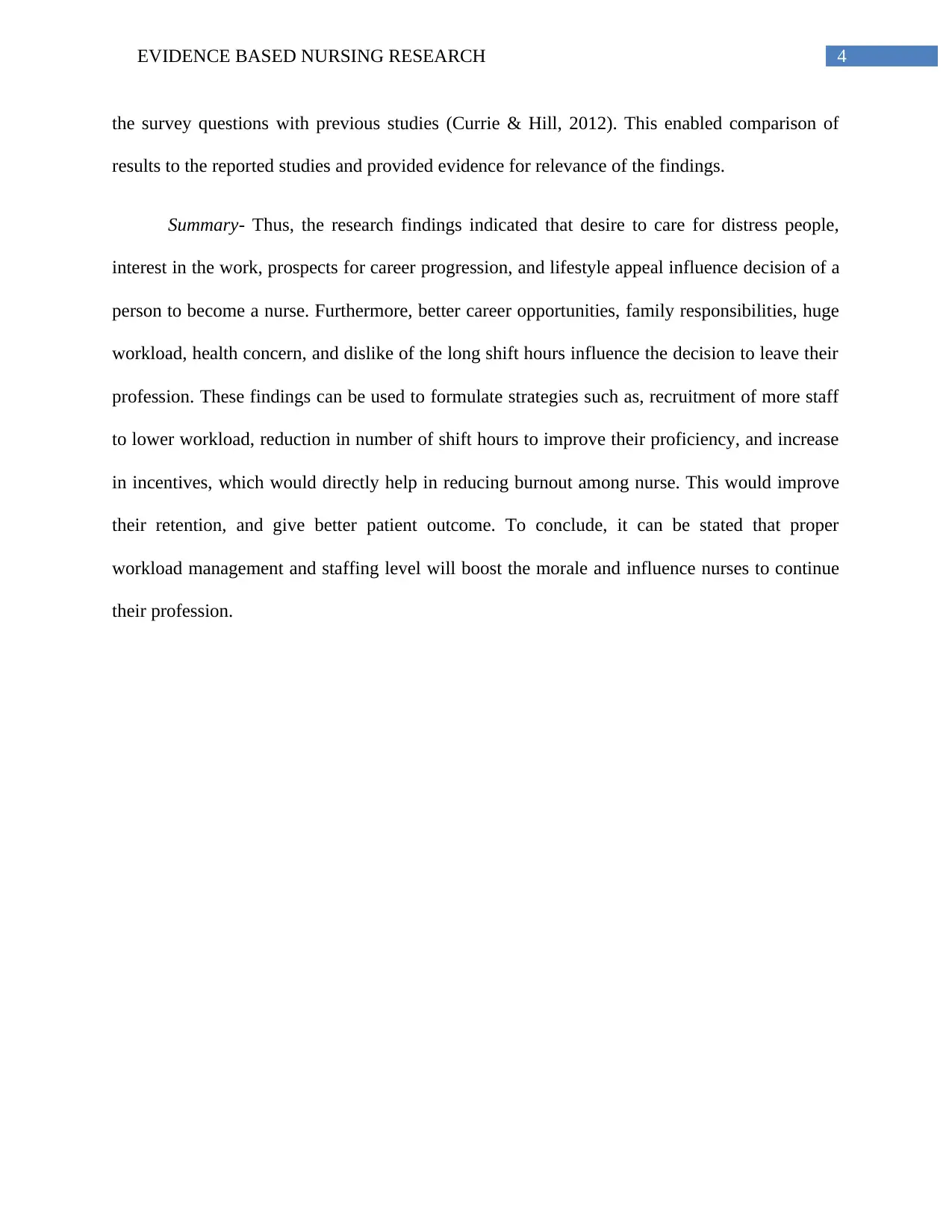
4EVIDENCE BASED NURSING RESEARCH
the survey questions with previous studies (Currie & Hill, 2012). This enabled comparison of
results to the reported studies and provided evidence for relevance of the findings.
Summary- Thus, the research findings indicated that desire to care for distress people,
interest in the work, prospects for career progression, and lifestyle appeal influence decision of a
person to become a nurse. Furthermore, better career opportunities, family responsibilities, huge
workload, health concern, and dislike of the long shift hours influence the decision to leave their
profession. These findings can be used to formulate strategies such as, recruitment of more staff
to lower workload, reduction in number of shift hours to improve their proficiency, and increase
in incentives, which would directly help in reducing burnout among nurse. This would improve
their retention, and give better patient outcome. To conclude, it can be stated that proper
workload management and staffing level will boost the morale and influence nurses to continue
their profession.
Document Page
5EVIDENCE BASED NURSING RESEARCH
References
Allwood, C. M. (2012). The distinction between qualitative and quantitative research methods is
problematic. Quality & Quantity, 46(5), 1417-1429.
Barnett, K., Mercer, S. W., Norbury, M., Watt, G., Wyke, S., & Guthrie, B. (2012).
Epidemiology of multimorbidity and implications for health care, research, and medical
education: a cross-sectional study. The Lancet, 380(9836), 37-43.
Bartram, T., Casimir, G., Djurkovic, N., Leggat, S. G., & Stanton, P. (2012). Do perceived high
performance work systems influence the relationship between emotional labour, burnout
and intention to leave? A study of Australian nurses. Journal of Advanced Nursing, 68(7),
1567-1578.
Burls, A. (2014). What is critical appraisal?. Hayward Medical Communications, 12-32.
Button, K. S., Ioannidis, J. P., Mokrysz, C., Nosek, B. A., Flint, J., Robinson, E. S., & Munafò,
M. R. (2013). Power failure: why small sample size undermines the reliability of
neuroscience. Nature Reviews Neuroscience, 14(5), 365.
Currie, E. J., & Hill, R. A. C. (2012). What are the reasons for high turnover in nursing? A
discussion of presumed causal factors and remedies. International Journal of Nursing
Studies, 49(9), 1180-1189.
Ding, C., Ma, X., Wang, Y., & Wang, Y. (2015). Exploring the influential factors in incident
clearance time: disentangling causation from self-selection bias. Accident Analysis &
Prevention, 85, 58-65.
Document Page
6EVIDENCE BASED NURSING RESEARCH
Eley, R., Eley, D., & Rogers-Clark, C. (2010). Reasons for entering and leaving nursing: an
Australian regional study. Australian Journal of Advanced Nursing, The, 28(1), 6.
Hegney, D. G., Rees, C. S., Eley, R., Osseiran-Moisson, R., & Francis, K. (2015). The
contribution of individual psychological resilience in determining the professional quality
of life of Australian nurses. Frontiers in psychology, 6, 1613.
Hegney, D., Eley, R., & Francis, K. (2013). Queensland nursing staffs' perceptions of the
preparation for practice of registered and enrolled nurses. Nurse Education
Today, 33(10), 1148-1152.
Petrova, E., Dewing, J., & Camilleri, M. (2016). Confidentiality in participatory research:
Challenges from one study. Nursing ethics, 23(4), 442-454.
Sarwar, U., & Nicolaou, M. (2012). Fraud and deceit in medical research. Journal of research in
medical sciences: the official journal of Isfahan University of Medical Sciences, 17(11),
1077.
Tuckett, A., WintersChang, P., Bogossian, F., & Wood, M. (2015). ‘Why nurses are leaving the
profession… lack of support from managers’: What nurses from an ecohort study
said. International journal of nursing practice, 21(4), 359-366.
Venkatesh, V., Brown, S. A., & Bala, H. (2013). Bridging the qualitative-quantitative divide:
Guidelines for conducting mixed methods research in information systems. MIS
quarterly, 37(1), 21-54.
tabler-icon-diamond-filled.svg

Paraphrase This Document

Need a fresh take? Get an instant paraphrase of this document with our AI Paraphraser
Document Page
7EVIDENCE BASED NURSING RESEARCH
Weigold, A., Weigold, I. K., & Russell, E. J. (2013). Examination of the equivalence of self-
report survey-based paper-and-pencil and internet data collection methods. Psychological
methods, 18(1), 53.
chevron_up_icon
1 out of 8
circle_padding
hide_on_mobile
zoom_out_icon
[object Object]