Evidence-Based Nursing Research on Hospital-Acquired Infections
VerifiedAdded on 2023/06/10
|8
|1931
|225
Report
AI Summary
This report addresses the problem of nosocomial infections, also known as hospital-acquired infections, focusing on their causes, current practices, and potential solutions through evidence-based nursing. It highlights the importance of addressing these infections due to the increasing evidence of drug resistance and the negative impact on patient health and hospital finances. The report identifies that the current practices emphasize hand hygiene, standard precautions, and environmental factors, while clinical approaches should focus on educating staff and isolating infected patients. The problem was identified as a significant health concern with negative outcomes for patients and financial implications for hospitals. The scope of the problem is vast, affecting morbidity and mortality rates, and the report utilizes the PICO framework to formulate research questions and identify relevant databases for gathering evidence, emphasizing the need for literature searches, guidelines, and clinical expertise to combat nosocomial infections effectively.
Running head: EVIDENCE BASED NURSING RESEARCH
EVIDENCE BASED NURSING RESEARCH
Name of the Student
Name of the University
Author Note
EVIDENCE BASED NURSING RESEARCH
Name of the Student
Name of the University
Author Note
Paraphrase This Document
Need a fresh take? Get an instant paraphrase of this document with our AI Paraphraser

1EVIDENCE BASED NURSING RESEARCH
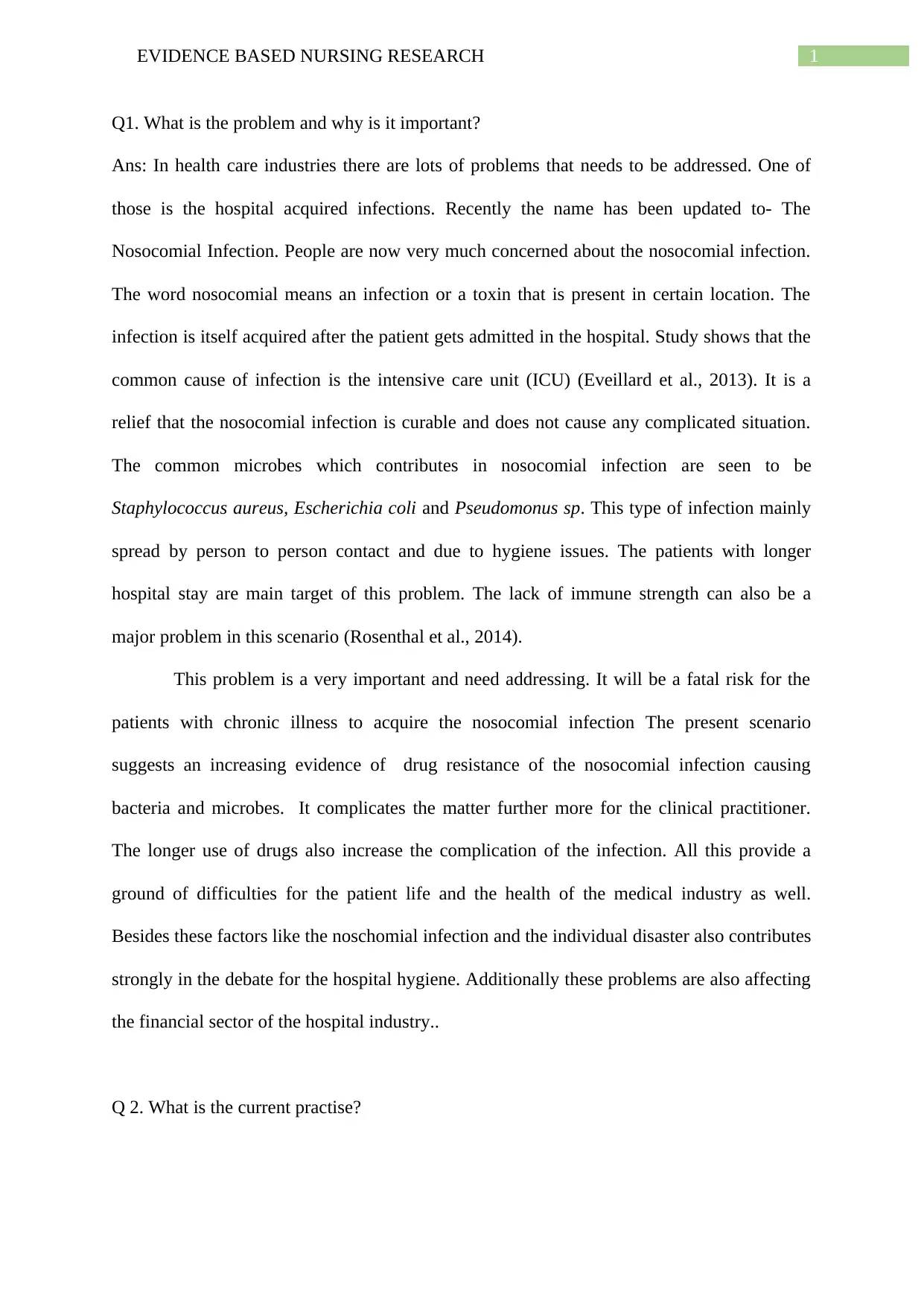
Q1. What is the problem and why is it important?
Ans: In health care industries there are lots of problems that needs to be addressed. One of
those is the hospital acquired infections. Recently the name has been updated to- The
Nosocomial Infection. People are now very much concerned about the nosocomial infection.
The word nosocomial means an infection or a toxin that is present in certain location. The
infection is itself acquired after the patient gets admitted in the hospital. Study shows that the
common cause of infection is the intensive care unit (ICU) (Eveillard et al., 2013). It is a
relief that the nosocomial infection is curable and does not cause any complicated situation.
The common microbes which contributes in nosocomial infection are seen to be
Staphylococcus aureus, Escherichia coli and Pseudomonus sp. This type of infection mainly
spread by person to person contact and due to hygiene issues. The patients with longer
hospital stay are main target of this problem. The lack of immune strength can also be a
major problem in this scenario (Rosenthal et al., 2014).
This problem is a very important and need addressing. It will be a fatal risk for the
patients with chronic illness to acquire the nosocomial infection The present scenario
suggests an increasing evidence of drug resistance of the nosocomial infection causing
bacteria and microbes. It complicates the matter further more for the clinical practitioner.
The longer use of drugs also increase the complication of the infection. All this provide a
ground of difficulties for the patient life and the health of the medical industry as well.
Besides these factors like the noschomial infection and the individual disaster also contributes
strongly in the debate for the hospital hygiene. Additionally these problems are also affecting
the financial sector of the hospital industry..
Q 2. What is the current practise?
Q1. What is the problem and why is it important?
Ans: In health care industries there are lots of problems that needs to be addressed. One of
those is the hospital acquired infections. Recently the name has been updated to- The
Nosocomial Infection. People are now very much concerned about the nosocomial infection.
The word nosocomial means an infection or a toxin that is present in certain location. The
infection is itself acquired after the patient gets admitted in the hospital. Study shows that the
common cause of infection is the intensive care unit (ICU) (Eveillard et al., 2013). It is a
relief that the nosocomial infection is curable and does not cause any complicated situation.
The common microbes which contributes in nosocomial infection are seen to be
Staphylococcus aureus, Escherichia coli and Pseudomonus sp. This type of infection mainly
spread by person to person contact and due to hygiene issues. The patients with longer
hospital stay are main target of this problem. The lack of immune strength can also be a
major problem in this scenario (Rosenthal et al., 2014).
This problem is a very important and need addressing. It will be a fatal risk for the
patients with chronic illness to acquire the nosocomial infection The present scenario
suggests an increasing evidence of drug resistance of the nosocomial infection causing
bacteria and microbes. It complicates the matter further more for the clinical practitioner.
The longer use of drugs also increase the complication of the infection. All this provide a
ground of difficulties for the patient life and the health of the medical industry as well.
Besides these factors like the noschomial infection and the individual disaster also contributes
strongly in the debate for the hospital hygiene. Additionally these problems are also affecting
the financial sector of the hospital industry..
Q 2. What is the current practise?

2EVIDENCE BASED NURSING RESEARCH
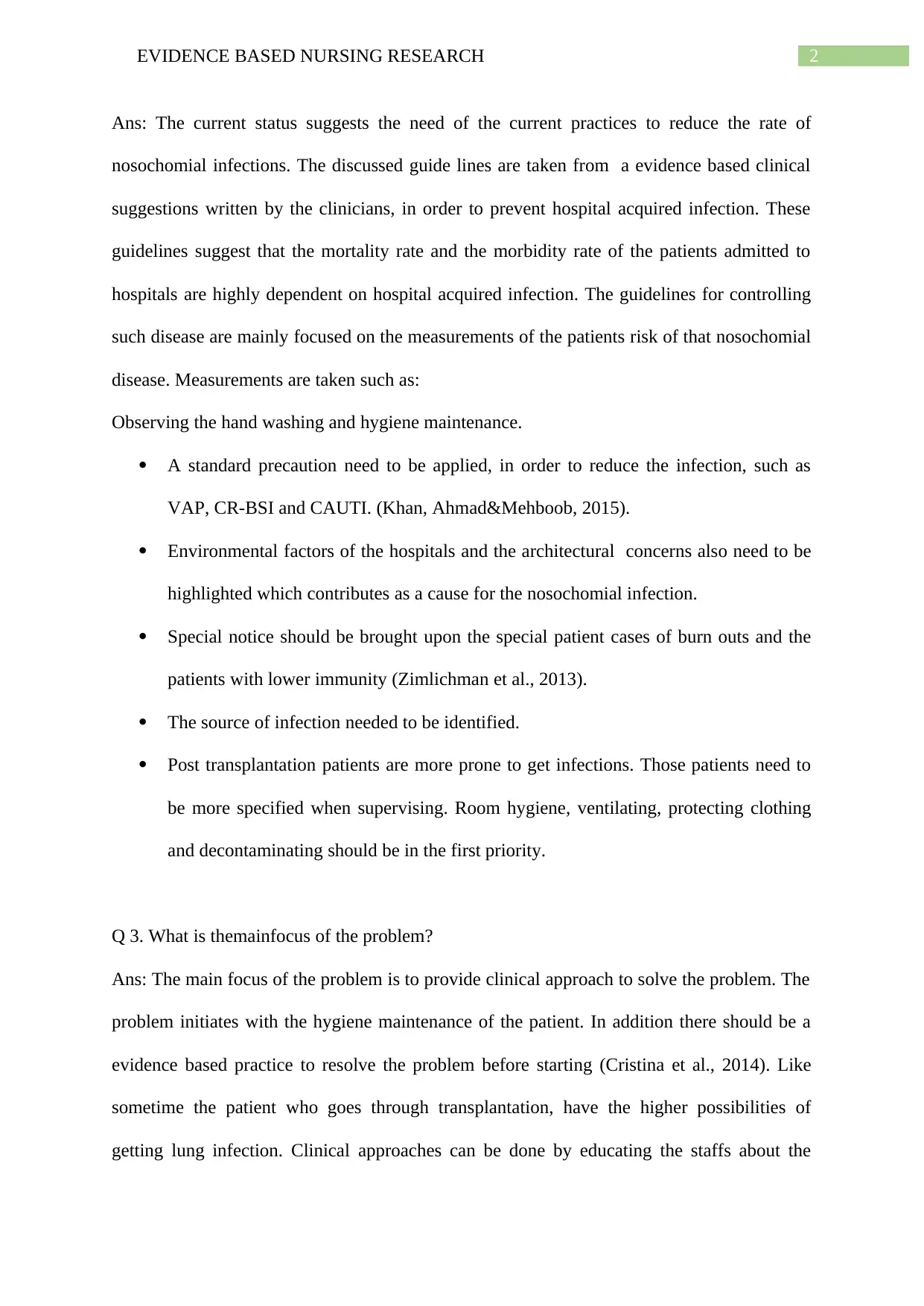
Ans: The current status suggests the need of the current practices to reduce the rate of
nosochomial infections. The discussed guide lines are taken from a evidence based clinical
suggestions written by the clinicians, in order to prevent hospital acquired infection. These
guidelines suggest that the mortality rate and the morbidity rate of the patients admitted to
hospitals are highly dependent on hospital acquired infection. The guidelines for controlling
such disease are mainly focused on the measurements of the patients risk of that nosochomial
disease. Measurements are taken such as:
Observing the hand washing and hygiene maintenance.
A standard precaution need to be applied, in order to reduce the infection, such as
VAP, CR-BSI and CAUTI. (Khan, Ahmad&Mehboob, 2015).
Environmental factors of the hospitals and the architectural concerns also need to be
highlighted which contributes as a cause for the nosochomial infection.
Special notice should be brought upon the special patient cases of burn outs and the
patients with lower immunity (Zimlichman et al., 2013).
The source of infection needed to be identified.
Post transplantation patients are more prone to get infections. Those patients need to
be more specified when supervising. Room hygiene, ventilating, protecting clothing
and decontaminating should be in the first priority.
Q 3. What is themainfocus of the problem?
Ans: The main focus of the problem is to provide clinical approach to solve the problem. The
problem initiates with the hygiene maintenance of the patient. In addition there should be a
evidence based practice to resolve the problem before starting (Cristina et al., 2014). Like
sometime the patient who goes through transplantation, have the higher possibilities of
getting lung infection. Clinical approaches can be done by educating the staffs about the
Ans: The current status suggests the need of the current practices to reduce the rate of
nosochomial infections. The discussed guide lines are taken from a evidence based clinical
suggestions written by the clinicians, in order to prevent hospital acquired infection. These
guidelines suggest that the mortality rate and the morbidity rate of the patients admitted to
hospitals are highly dependent on hospital acquired infection. The guidelines for controlling
such disease are mainly focused on the measurements of the patients risk of that nosochomial
disease. Measurements are taken such as:
Observing the hand washing and hygiene maintenance.
A standard precaution need to be applied, in order to reduce the infection, such as
VAP, CR-BSI and CAUTI. (Khan, Ahmad&Mehboob, 2015).
Environmental factors of the hospitals and the architectural concerns also need to be
highlighted which contributes as a cause for the nosochomial infection.
Special notice should be brought upon the special patient cases of burn outs and the
patients with lower immunity (Zimlichman et al., 2013).
The source of infection needed to be identified.
Post transplantation patients are more prone to get infections. Those patients need to
be more specified when supervising. Room hygiene, ventilating, protecting clothing
and decontaminating should be in the first priority.
Q 3. What is themainfocus of the problem?
Ans: The main focus of the problem is to provide clinical approach to solve the problem. The
problem initiates with the hygiene maintenance of the patient. In addition there should be a
evidence based practice to resolve the problem before starting (Cristina et al., 2014). Like
sometime the patient who goes through transplantation, have the higher possibilities of
getting lung infection. Clinical approaches can be done by educating the staffs about the
⊘ This is a preview!⊘
Do you want full access?
Subscribe today to unlock all pages.

Trusted by 1+ million students worldwide

3EVIDENCE BASED NURSING RESEARCH
possibilities of the nosochomial infection. The infection can be caused by hygiene disorders
like hand washing, taking special care of the patients with possibilities, decontaminating the
patient’s room and by separating the infected patients from others. This type of clinical trial
can minimize the rate of mortality in the patients and eventually help the patient and even the
hospital. In order to provide the clinical assessment of the specific problem, the practitioners
should avoid the specific drugs which can be resisted by the microbes. The multi-resistance
power of some microbes is becoming a challenge for hospitals (Cornejo-Juárez et al., 2015).
Q 4. How was the problem identified?
Ans: The problems are identified as a most emerging health concerns for the safety risk
management. It also raises a major concern about the negative health outcomes of the patient,
staffs and nurses. It has a huge financial concern as the problem is affecting the economic
sector of both patient and the hospital industry. There are several evidences regarding the
various approaches of different health care industry about this problem.
Q 5. What is the scope of the problem?
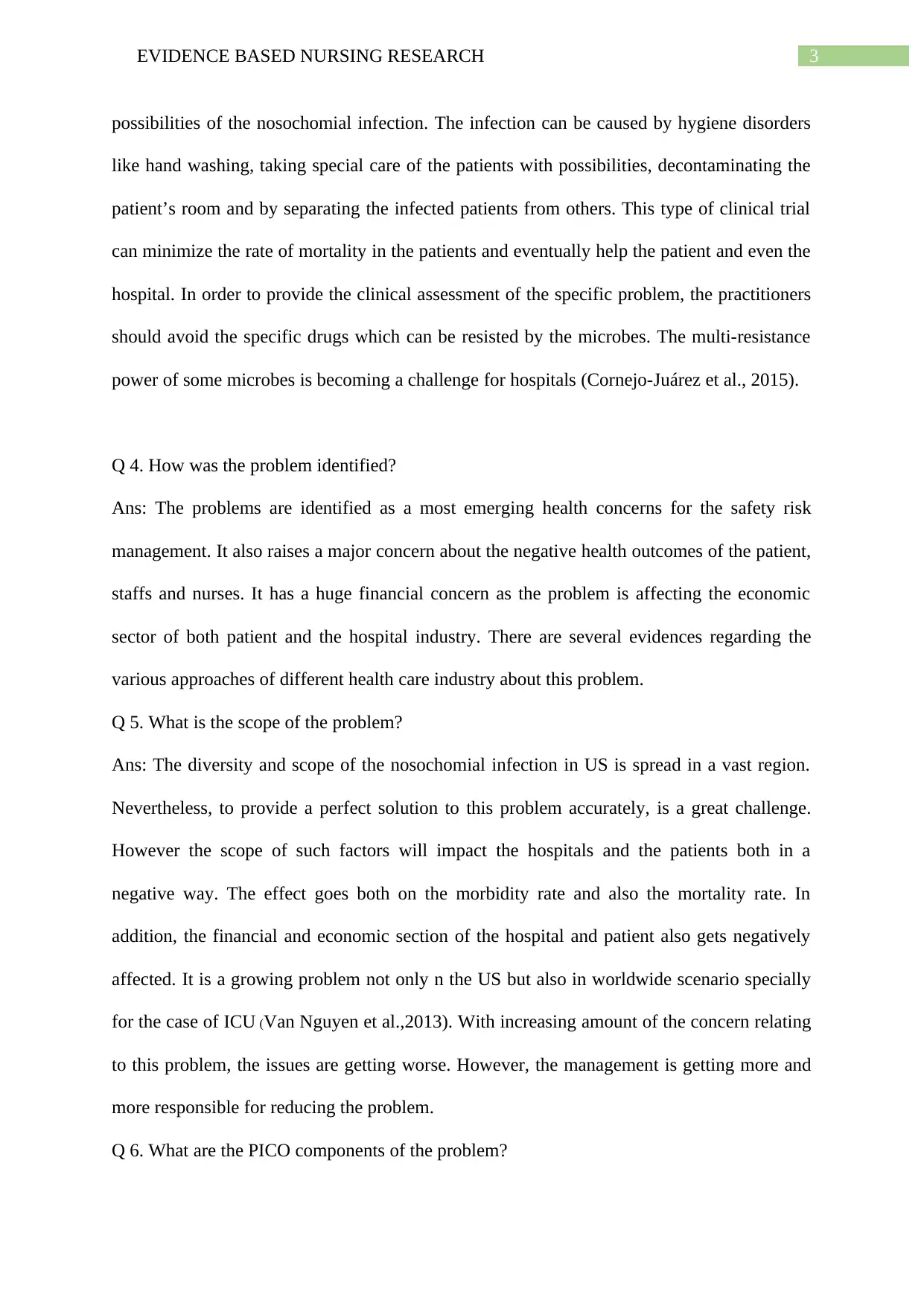
Ans: The diversity and scope of the nosochomial infection in US is spread in a vast region.
Nevertheless, to provide a perfect solution to this problem accurately, is a great challenge.
However the scope of such factors will impact the hospitals and the patients both in a
negative way. The effect goes both on the morbidity rate and also the mortality rate. In
addition, the financial and economic section of the hospital and patient also gets negatively
affected. It is a growing problem not only n the US but also in worldwide scenario specially
for the case of ICU (Van Nguyen et al.,2013). With increasing amount of the concern relating
to this problem, the issues are getting worse. However, the management is getting more and
more responsible for reducing the problem.
Q 6. What are the PICO components of the problem?
possibilities of the nosochomial infection. The infection can be caused by hygiene disorders
like hand washing, taking special care of the patients with possibilities, decontaminating the
patient’s room and by separating the infected patients from others. This type of clinical trial
can minimize the rate of mortality in the patients and eventually help the patient and even the
hospital. In order to provide the clinical assessment of the specific problem, the practitioners
should avoid the specific drugs which can be resisted by the microbes. The multi-resistance
power of some microbes is becoming a challenge for hospitals (Cornejo-Juárez et al., 2015).
Q 4. How was the problem identified?
Ans: The problems are identified as a most emerging health concerns for the safety risk
management. It also raises a major concern about the negative health outcomes of the patient,
staffs and nurses. It has a huge financial concern as the problem is affecting the economic
sector of both patient and the hospital industry. There are several evidences regarding the
various approaches of different health care industry about this problem.
Q 5. What is the scope of the problem?
Ans: The diversity and scope of the nosochomial infection in US is spread in a vast region.
Nevertheless, to provide a perfect solution to this problem accurately, is a great challenge.
However the scope of such factors will impact the hospitals and the patients both in a
negative way. The effect goes both on the morbidity rate and also the mortality rate. In
addition, the financial and economic section of the hospital and patient also gets negatively
affected. It is a growing problem not only n the US but also in worldwide scenario specially
for the case of ICU (Van Nguyen et al.,2013). With increasing amount of the concern relating
to this problem, the issues are getting worse. However, the management is getting more and
more responsible for reducing the problem.
Q 6. What are the PICO components of the problem?
Paraphrase This Document
Need a fresh take? Get an instant paraphrase of this document with our AI Paraphraser

4EVIDENCE BASED NURSING RESEARCH
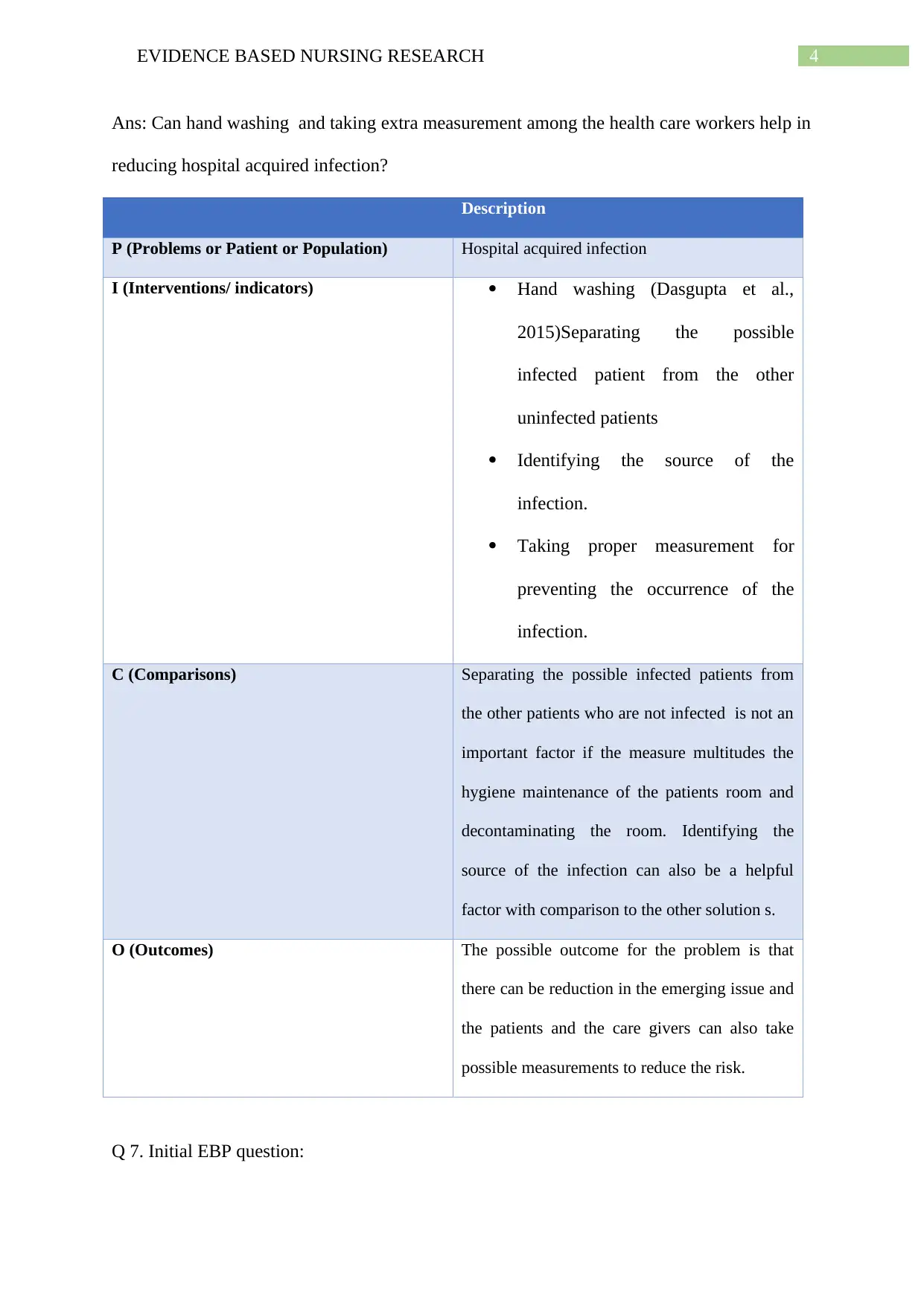
Ans: Can hand washing and taking extra measurement among the health care workers help in
reducing hospital acquired infection?
Description
P (Problems or Patient or Population) Hospital acquired infection
I (Interventions/ indicators) Hand washing (Dasgupta et al.,
2015)Separating the possible
infected patient from the other
uninfected patients
Identifying the source of the
infection.
Taking proper measurement for
preventing the occurrence of the
infection.
C (Comparisons) Separating the possible infected patients from
the other patients who are not infected is not an
important factor if the measure multitudes the
hygiene maintenance of the patients room and
decontaminating the room. Identifying the
source of the infection can also be a helpful
factor with comparison to the other solution s.
O (Outcomes) The possible outcome for the problem is that
there can be reduction in the emerging issue and
the patients and the care givers can also take
possible measurements to reduce the risk.
Q 7. Initial EBP question:
Ans: Can hand washing and taking extra measurement among the health care workers help in
reducing hospital acquired infection?
Description
P (Problems or Patient or Population) Hospital acquired infection
I (Interventions/ indicators) Hand washing (Dasgupta et al.,
2015)Separating the possible
infected patient from the other
uninfected patients
Identifying the source of the
infection.
Taking proper measurement for
preventing the occurrence of the
infection.
C (Comparisons) Separating the possible infected patients from
the other patients who are not infected is not an
important factor if the measure multitudes the
hygiene maintenance of the patients room and
decontaminating the room. Identifying the
source of the infection can also be a helpful
factor with comparison to the other solution s.
O (Outcomes) The possible outcome for the problem is that
there can be reduction in the emerging issue and
the patients and the care givers can also take
possible measurements to reduce the risk.
Q 7. Initial EBP question:

5EVIDENCE BASED NURSING RESEARCH
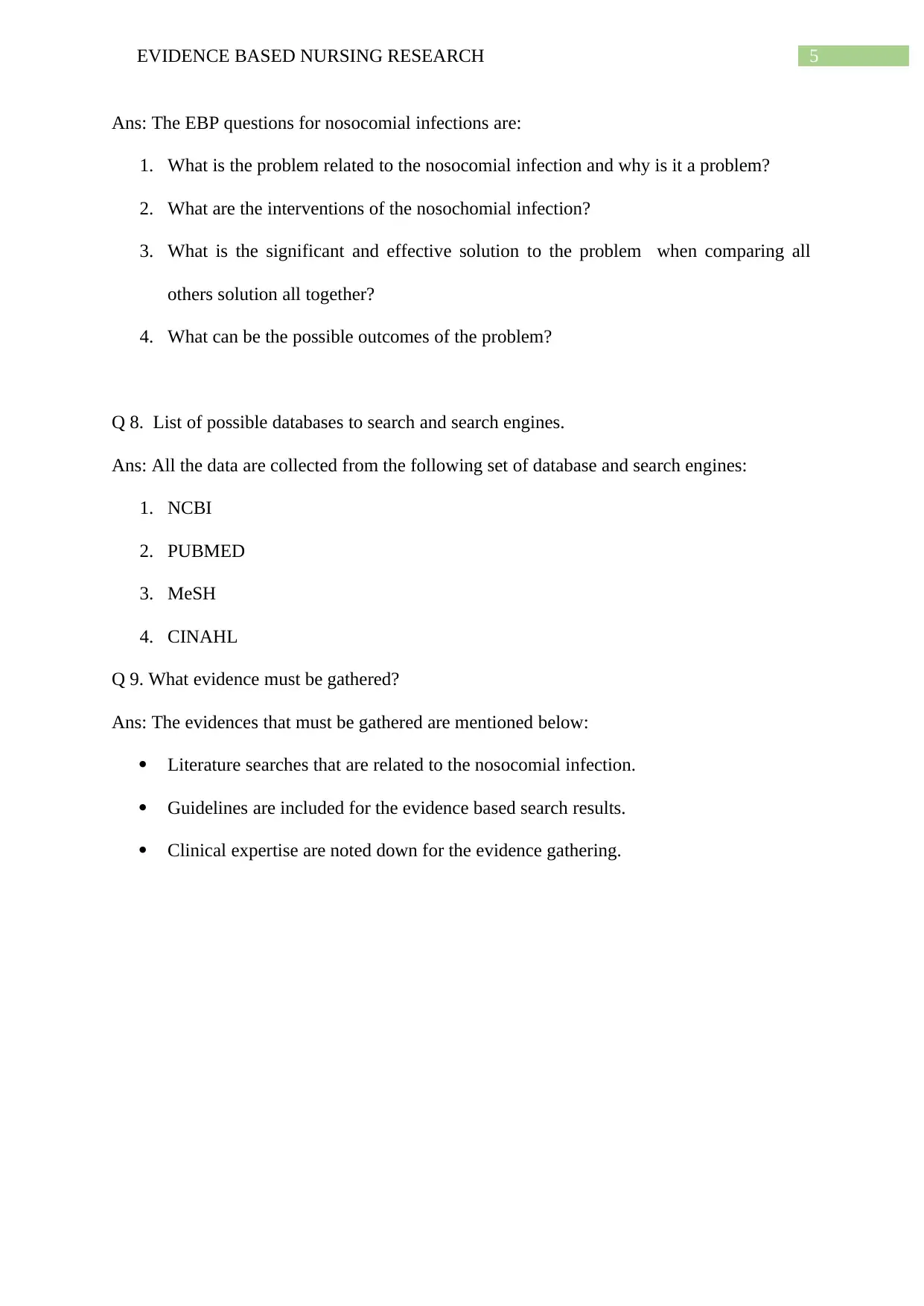
Ans: The EBP questions for nosocomial infections are:
1. What is the problem related to the nosocomial infection and why is it a problem?
2. What are the interventions of the nosochomial infection?
3. What is the significant and effective solution to the problem when comparing all
others solution all together?
4. What can be the possible outcomes of the problem?
Q 8. List of possible databases to search and search engines.
Ans: All the data are collected from the following set of database and search engines:
1. NCBI
2. PUBMED
3. MeSH
4. CINAHL
Q 9. What evidence must be gathered?
Ans: The evidences that must be gathered are mentioned below:
Literature searches that are related to the nosocomial infection.
Guidelines are included for the evidence based search results.
Clinical expertise are noted down for the evidence gathering.
Ans: The EBP questions for nosocomial infections are:
1. What is the problem related to the nosocomial infection and why is it a problem?
2. What are the interventions of the nosochomial infection?
3. What is the significant and effective solution to the problem when comparing all
others solution all together?
4. What can be the possible outcomes of the problem?
Q 8. List of possible databases to search and search engines.
Ans: All the data are collected from the following set of database and search engines:
1. NCBI
2. PUBMED
3. MeSH
4. CINAHL
Q 9. What evidence must be gathered?
Ans: The evidences that must be gathered are mentioned below:
Literature searches that are related to the nosocomial infection.
Guidelines are included for the evidence based search results.
Clinical expertise are noted down for the evidence gathering.
⊘ This is a preview!⊘
Do you want full access?
Subscribe today to unlock all pages.

Trusted by 1+ million students worldwide

6EVIDENCE BASED NURSING RESEARCH
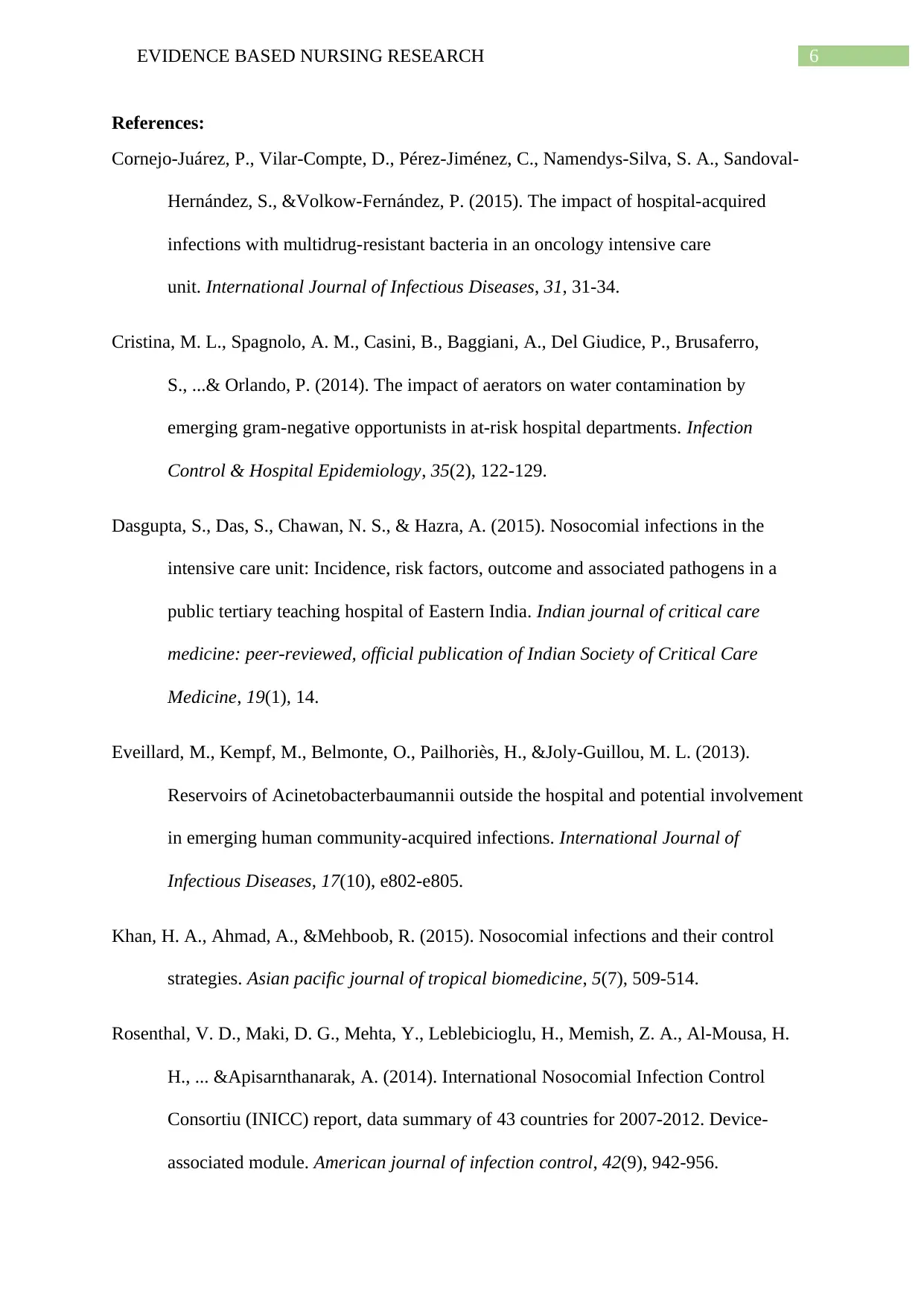
References:
Cornejo-Juárez, P., Vilar-Compte, D., Pérez-Jiménez, C., Namendys-Silva, S. A., Sandoval-
Hernández, S., &Volkow-Fernández, P. (2015). The impact of hospital-acquired
infections with multidrug-resistant bacteria in an oncology intensive care
unit. International Journal of Infectious Diseases, 31, 31-34.
Cristina, M. L., Spagnolo, A. M., Casini, B., Baggiani, A., Del Giudice, P., Brusaferro,
S., ...& Orlando, P. (2014). The impact of aerators on water contamination by
emerging gram-negative opportunists in at-risk hospital departments. Infection
Control & Hospital Epidemiology, 35(2), 122-129.
Dasgupta, S., Das, S., Chawan, N. S., & Hazra, A. (2015). Nosocomial infections in the
intensive care unit: Incidence, risk factors, outcome and associated pathogens in a
public tertiary teaching hospital of Eastern India. Indian journal of critical care
medicine: peer-reviewed, official publication of Indian Society of Critical Care
Medicine, 19(1), 14.
Eveillard, M., Kempf, M., Belmonte, O., Pailhoriès, H., &Joly-Guillou, M. L. (2013).
Reservoirs of Acinetobacterbaumannii outside the hospital and potential involvement
in emerging human community-acquired infections. International Journal of
Infectious Diseases, 17(10), e802-e805.
Khan, H. A., Ahmad, A., &Mehboob, R. (2015). Nosocomial infections and their control
strategies. Asian pacific journal of tropical biomedicine, 5(7), 509-514.
Rosenthal, V. D., Maki, D. G., Mehta, Y., Leblebicioglu, H., Memish, Z. A., Al-Mousa, H.
H., ... &Apisarnthanarak, A. (2014). International Nosocomial Infection Control
Consortiu (INICC) report, data summary of 43 countries for 2007-2012. Device-
associated module. American journal of infection control, 42(9), 942-956.
References:
Cornejo-Juárez, P., Vilar-Compte, D., Pérez-Jiménez, C., Namendys-Silva, S. A., Sandoval-
Hernández, S., &Volkow-Fernández, P. (2015). The impact of hospital-acquired
infections with multidrug-resistant bacteria in an oncology intensive care
unit. International Journal of Infectious Diseases, 31, 31-34.
Cristina, M. L., Spagnolo, A. M., Casini, B., Baggiani, A., Del Giudice, P., Brusaferro,
S., ...& Orlando, P. (2014). The impact of aerators on water contamination by
emerging gram-negative opportunists in at-risk hospital departments. Infection
Control & Hospital Epidemiology, 35(2), 122-129.
Dasgupta, S., Das, S., Chawan, N. S., & Hazra, A. (2015). Nosocomial infections in the
intensive care unit: Incidence, risk factors, outcome and associated pathogens in a
public tertiary teaching hospital of Eastern India. Indian journal of critical care
medicine: peer-reviewed, official publication of Indian Society of Critical Care
Medicine, 19(1), 14.
Eveillard, M., Kempf, M., Belmonte, O., Pailhoriès, H., &Joly-Guillou, M. L. (2013).
Reservoirs of Acinetobacterbaumannii outside the hospital and potential involvement
in emerging human community-acquired infections. International Journal of
Infectious Diseases, 17(10), e802-e805.
Khan, H. A., Ahmad, A., &Mehboob, R. (2015). Nosocomial infections and their control
strategies. Asian pacific journal of tropical biomedicine, 5(7), 509-514.
Rosenthal, V. D., Maki, D. G., Mehta, Y., Leblebicioglu, H., Memish, Z. A., Al-Mousa, H.
H., ... &Apisarnthanarak, A. (2014). International Nosocomial Infection Control
Consortiu (INICC) report, data summary of 43 countries for 2007-2012. Device-
associated module. American journal of infection control, 42(9), 942-956.
Paraphrase This Document
Need a fresh take? Get an instant paraphrase of this document with our AI Paraphraser

7EVIDENCE BASED NURSING RESEARCH
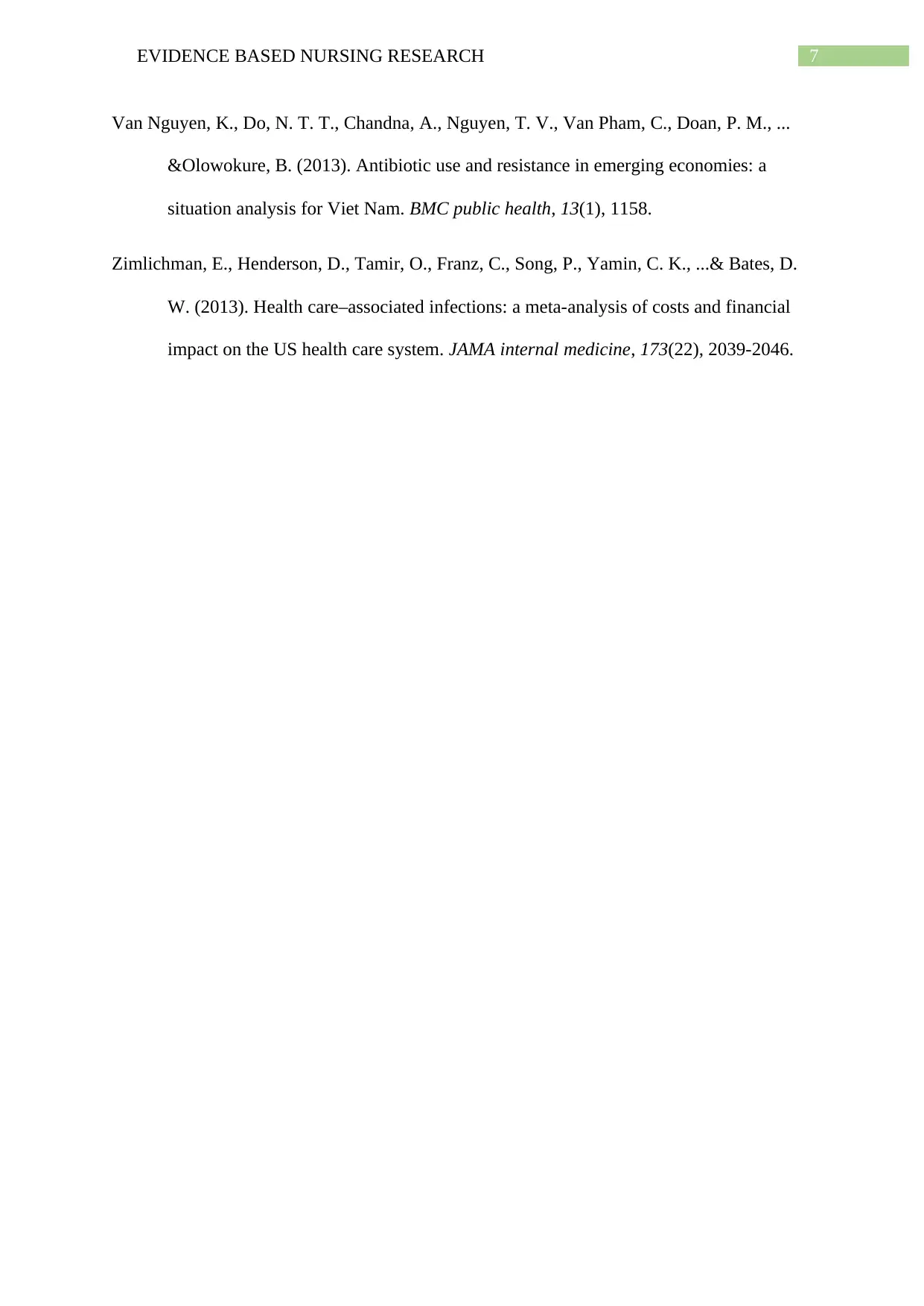
Van Nguyen, K., Do, N. T. T., Chandna, A., Nguyen, T. V., Van Pham, C., Doan, P. M., ...
&Olowokure, B. (2013). Antibiotic use and resistance in emerging economies: a
situation analysis for Viet Nam. BMC public health, 13(1), 1158.
Zimlichman, E., Henderson, D., Tamir, O., Franz, C., Song, P., Yamin, C. K., ...& Bates, D.
W. (2013). Health care–associated infections: a meta-analysis of costs and financial
impact on the US health care system. JAMA internal medicine, 173(22), 2039-2046.
Van Nguyen, K., Do, N. T. T., Chandna, A., Nguyen, T. V., Van Pham, C., Doan, P. M., ...
&Olowokure, B. (2013). Antibiotic use and resistance in emerging economies: a
situation analysis for Viet Nam. BMC public health, 13(1), 1158.
Zimlichman, E., Henderson, D., Tamir, O., Franz, C., Song, P., Yamin, C. K., ...& Bates, D.
W. (2013). Health care–associated infections: a meta-analysis of costs and financial
impact on the US health care system. JAMA internal medicine, 173(22), 2039-2046.
1 out of 8
Related Documents
Your All-in-One AI-Powered Toolkit for Academic Success.
+13062052269
info@desklib.com
Available 24*7 on WhatsApp / Email
Unlock your academic potential
Copyright © 2020–2026 A2Z Services. All Rights Reserved. Developed and managed by ZUCOL.