Evidence Based Medicine Report: Medical Support for Olympic Camp
VerifiedAdded on 2020/01/21
|6
|1467
|106
Report
AI Summary
This report provides an evidence-based analysis of the benefits and risks associated with establishing a medical and paramedical support camp for the 2018 Summer Youth Olympics in Buenos Aires. It examines the need for such a camp from a medical perspective, highlighting the importance of regular health check-ups, timely treatment of injuries, and coordinated efforts of medical professionals to enhance athlete performance. The report identifies potential risks, including increased exposure to infections and food contamination, as well as various issues such as lack of coordination, poor scheduling, ethical and legal considerations, poor staffing, and discrimination. It also explores the resource implications, including human, financial, and physical resources, and proposes a strategy for providing medical and paramedical support, emphasizing proper scheduling and staffing arrangements to ensure 24/7 availability of medical assistance. The report references several journals and online sources to support its findings.
EVIDENCE BASE
MEDICINE
MEDICINE
Paraphrase This Document
Need a fresh take? Get an instant paraphrase of this document with our AI Paraphraser

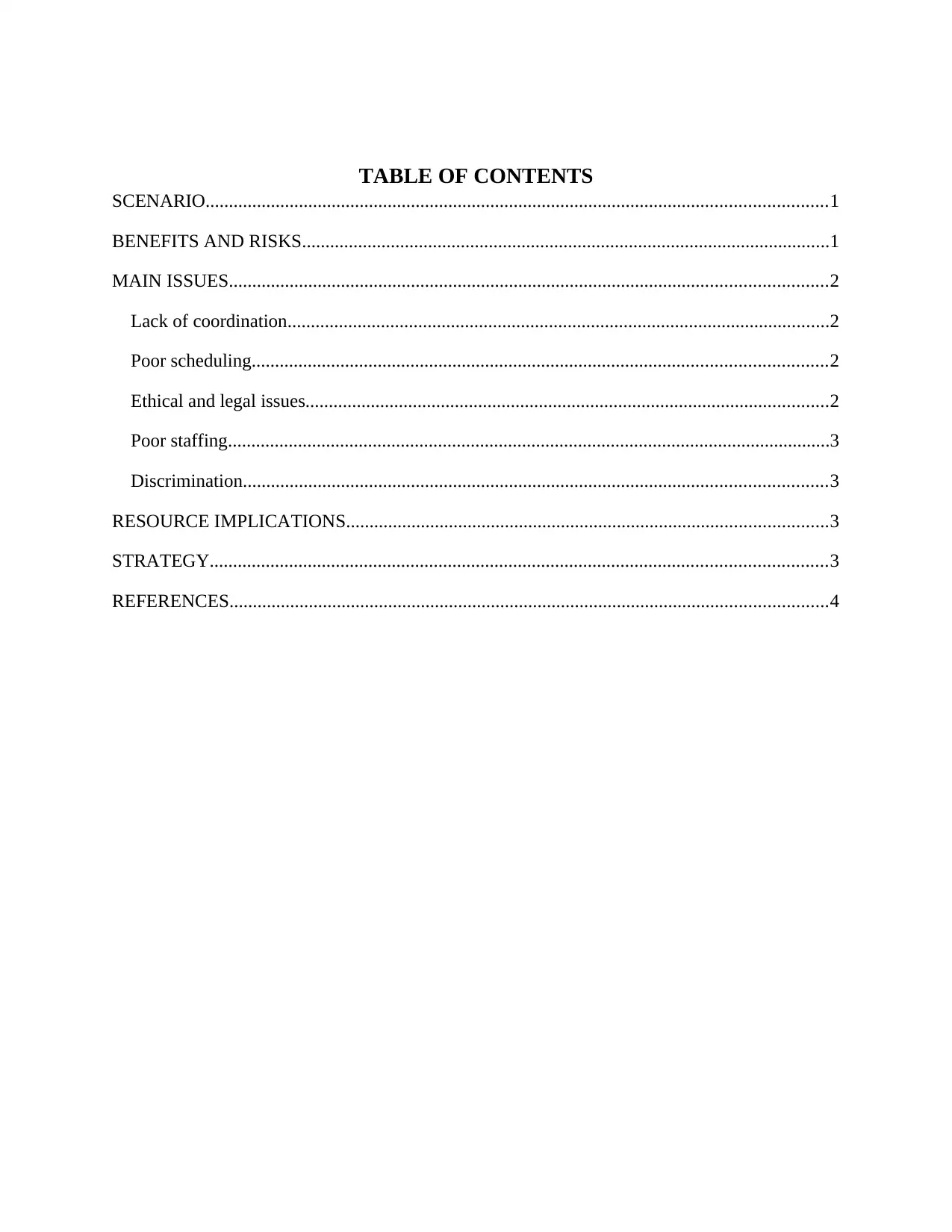
TABLE OF CONTENTS
SCENARIO.....................................................................................................................................1
BENEFITS AND RISKS.................................................................................................................1
MAIN ISSUES................................................................................................................................2
Lack of coordination....................................................................................................................2
Poor scheduling...........................................................................................................................2
Ethical and legal issues................................................................................................................2
Poor staffing.................................................................................................................................3
Discrimination.............................................................................................................................3
RESOURCE IMPLICATIONS.......................................................................................................3
STRATEGY....................................................................................................................................3
REFERENCES................................................................................................................................4
SCENARIO.....................................................................................................................................1
BENEFITS AND RISKS.................................................................................................................1
MAIN ISSUES................................................................................................................................2
Lack of coordination....................................................................................................................2
Poor scheduling...........................................................................................................................2
Ethical and legal issues................................................................................................................2
Poor staffing.................................................................................................................................3
Discrimination.............................................................................................................................3
RESOURCE IMPLICATIONS.......................................................................................................3
STRATEGY....................................................................................................................................3
REFERENCES................................................................................................................................4

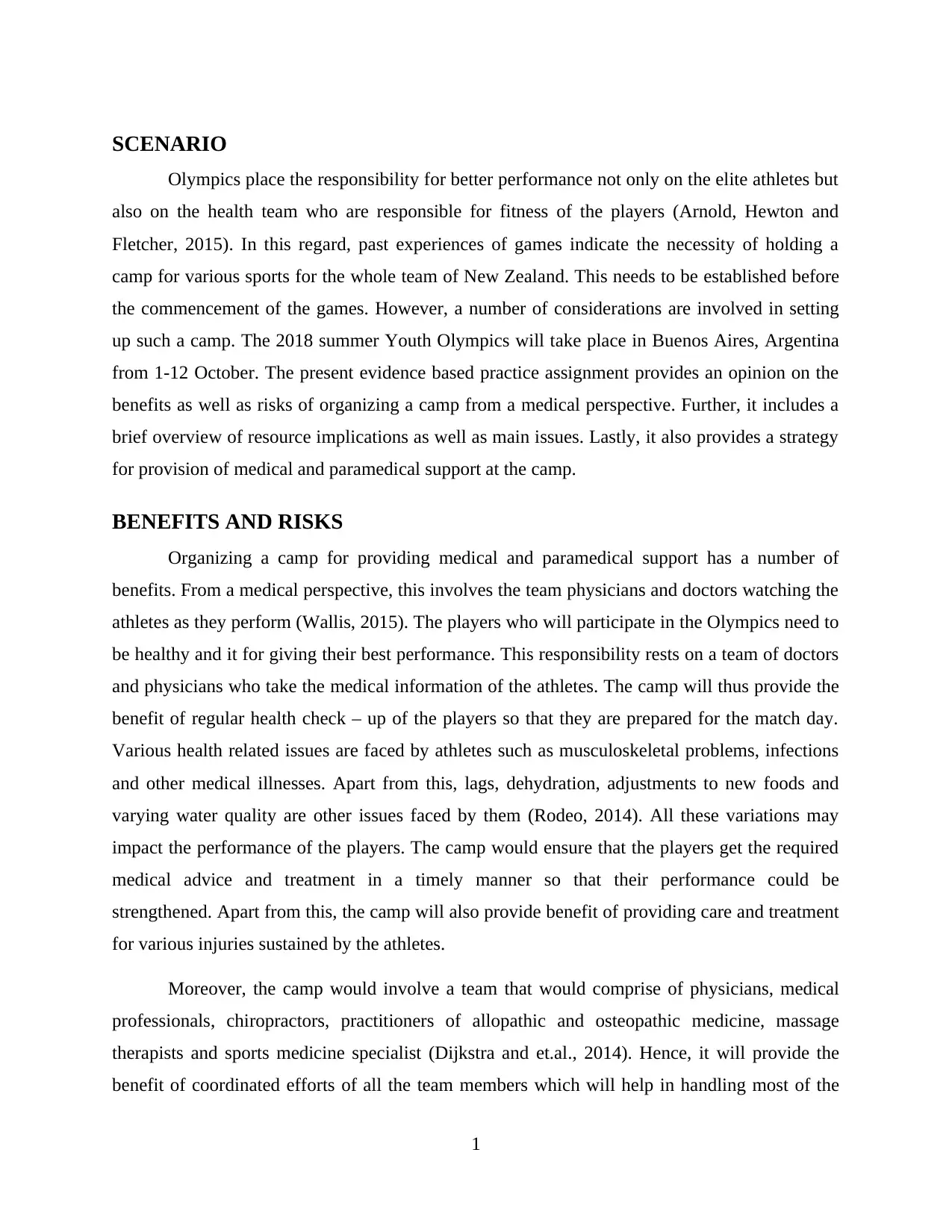
SCENARIO
Olympics place the responsibility for better performance not only on the elite athletes but
also on the health team who are responsible for fitness of the players (Arnold, Hewton and
Fletcher, 2015). In this regard, past experiences of games indicate the necessity of holding a
camp for various sports for the whole team of New Zealand. This needs to be established before
the commencement of the games. However, a number of considerations are involved in setting
up such a camp. The 2018 summer Youth Olympics will take place in Buenos Aires, Argentina
from 1-12 October. The present evidence based practice assignment provides an opinion on the
benefits as well as risks of organizing a camp from a medical perspective. Further, it includes a
brief overview of resource implications as well as main issues. Lastly, it also provides a strategy
for provision of medical and paramedical support at the camp.
BENEFITS AND RISKS
Organizing a camp for providing medical and paramedical support has a number of
benefits. From a medical perspective, this involves the team physicians and doctors watching the
athletes as they perform (Wallis, 2015). The players who will participate in the Olympics need to
be healthy and it for giving their best performance. This responsibility rests on a team of doctors
and physicians who take the medical information of the athletes. The camp will thus provide the
benefit of regular health check – up of the players so that they are prepared for the match day.
Various health related issues are faced by athletes such as musculoskeletal problems, infections
and other medical illnesses. Apart from this, lags, dehydration, adjustments to new foods and
varying water quality are other issues faced by them (Rodeo, 2014). All these variations may
impact the performance of the players. The camp would ensure that the players get the required
medical advice and treatment in a timely manner so that their performance could be
strengthened. Apart from this, the camp will also provide benefit of providing care and treatment
for various injuries sustained by the athletes.
Moreover, the camp would involve a team that would comprise of physicians, medical
professionals, chiropractors, practitioners of allopathic and osteopathic medicine, massage
therapists and sports medicine specialist (Dijkstra and et.al., 2014). Hence, it will provide the
benefit of coordinated efforts of all the team members which will help in handling most of the
1
Olympics place the responsibility for better performance not only on the elite athletes but
also on the health team who are responsible for fitness of the players (Arnold, Hewton and
Fletcher, 2015). In this regard, past experiences of games indicate the necessity of holding a
camp for various sports for the whole team of New Zealand. This needs to be established before
the commencement of the games. However, a number of considerations are involved in setting
up such a camp. The 2018 summer Youth Olympics will take place in Buenos Aires, Argentina
from 1-12 October. The present evidence based practice assignment provides an opinion on the
benefits as well as risks of organizing a camp from a medical perspective. Further, it includes a
brief overview of resource implications as well as main issues. Lastly, it also provides a strategy
for provision of medical and paramedical support at the camp.
BENEFITS AND RISKS
Organizing a camp for providing medical and paramedical support has a number of
benefits. From a medical perspective, this involves the team physicians and doctors watching the
athletes as they perform (Wallis, 2015). The players who will participate in the Olympics need to
be healthy and it for giving their best performance. This responsibility rests on a team of doctors
and physicians who take the medical information of the athletes. The camp will thus provide the
benefit of regular health check – up of the players so that they are prepared for the match day.
Various health related issues are faced by athletes such as musculoskeletal problems, infections
and other medical illnesses. Apart from this, lags, dehydration, adjustments to new foods and
varying water quality are other issues faced by them (Rodeo, 2014). All these variations may
impact the performance of the players. The camp would ensure that the players get the required
medical advice and treatment in a timely manner so that their performance could be
strengthened. Apart from this, the camp will also provide benefit of providing care and treatment
for various injuries sustained by the athletes.
Moreover, the camp would involve a team that would comprise of physicians, medical
professionals, chiropractors, practitioners of allopathic and osteopathic medicine, massage
therapists and sports medicine specialist (Dijkstra and et.al., 2014). Hence, it will provide the
benefit of coordinated efforts of all the team members which will help in handling most of the
1
⊘ This is a preview!⊘
Do you want full access?
Subscribe today to unlock all pages.

Trusted by 1+ million students worldwide

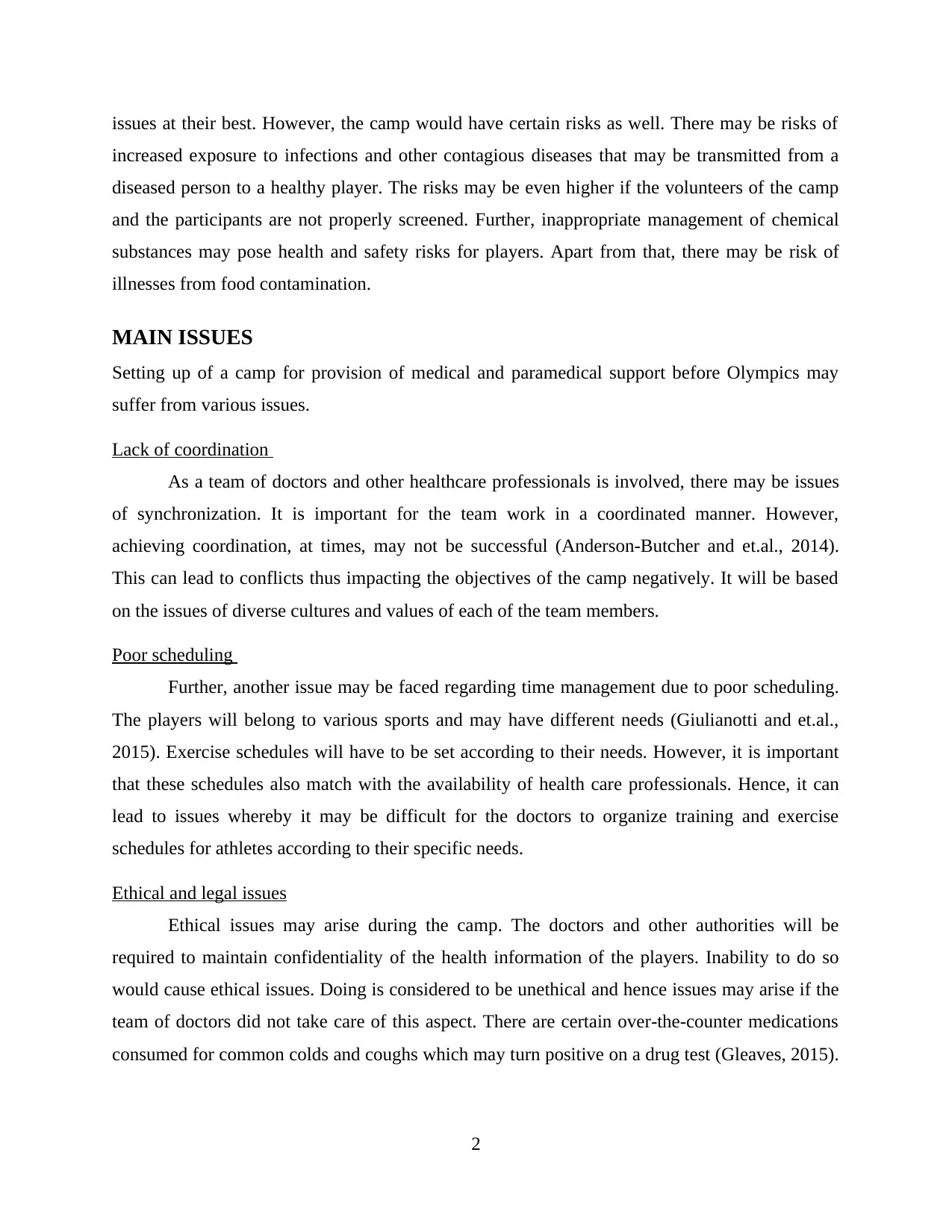
issues at their best. However, the camp would have certain risks as well. There may be risks of
increased exposure to infections and other contagious diseases that may be transmitted from a
diseased person to a healthy player. The risks may be even higher if the volunteers of the camp
and the participants are not properly screened. Further, inappropriate management of chemical
substances may pose health and safety risks for players. Apart from that, there may be risk of
illnesses from food contamination.
MAIN ISSUES
Setting up of a camp for provision of medical and paramedical support before Olympics may
suffer from various issues.
Lack of coordination
As a team of doctors and other healthcare professionals is involved, there may be issues
of synchronization. It is important for the team work in a coordinated manner. However,
achieving coordination, at times, may not be successful (Anderson-Butcher and et.al., 2014).
This can lead to conflicts thus impacting the objectives of the camp negatively. It will be based
on the issues of diverse cultures and values of each of the team members.
Poor scheduling
Further, another issue may be faced regarding time management due to poor scheduling.
The players will belong to various sports and may have different needs (Giulianotti and et.al.,
2015). Exercise schedules will have to be set according to their needs. However, it is important
that these schedules also match with the availability of health care professionals. Hence, it can
lead to issues whereby it may be difficult for the doctors to organize training and exercise
schedules for athletes according to their specific needs.
Ethical and legal issues
Ethical issues may arise during the camp. The doctors and other authorities will be
required to maintain confidentiality of the health information of the players. Inability to do so
would cause ethical issues. Doing is considered to be unethical and hence issues may arise if the
team of doctors did not take care of this aspect. There are certain over-the-counter medications
consumed for common colds and coughs which may turn positive on a drug test (Gleaves, 2015).
2
increased exposure to infections and other contagious diseases that may be transmitted from a
diseased person to a healthy player. The risks may be even higher if the volunteers of the camp
and the participants are not properly screened. Further, inappropriate management of chemical
substances may pose health and safety risks for players. Apart from that, there may be risk of
illnesses from food contamination.
MAIN ISSUES
Setting up of a camp for provision of medical and paramedical support before Olympics may
suffer from various issues.
Lack of coordination
As a team of doctors and other healthcare professionals is involved, there may be issues
of synchronization. It is important for the team work in a coordinated manner. However,
achieving coordination, at times, may not be successful (Anderson-Butcher and et.al., 2014).
This can lead to conflicts thus impacting the objectives of the camp negatively. It will be based
on the issues of diverse cultures and values of each of the team members.
Poor scheduling
Further, another issue may be faced regarding time management due to poor scheduling.
The players will belong to various sports and may have different needs (Giulianotti and et.al.,
2015). Exercise schedules will have to be set according to their needs. However, it is important
that these schedules also match with the availability of health care professionals. Hence, it can
lead to issues whereby it may be difficult for the doctors to organize training and exercise
schedules for athletes according to their specific needs.
Ethical and legal issues
Ethical issues may arise during the camp. The doctors and other authorities will be
required to maintain confidentiality of the health information of the players. Inability to do so
would cause ethical issues. Doing is considered to be unethical and hence issues may arise if the
team of doctors did not take care of this aspect. There are certain over-the-counter medications
consumed for common colds and coughs which may turn positive on a drug test (Gleaves, 2015).
2
Paraphrase This Document
Need a fresh take? Get an instant paraphrase of this document with our AI Paraphraser

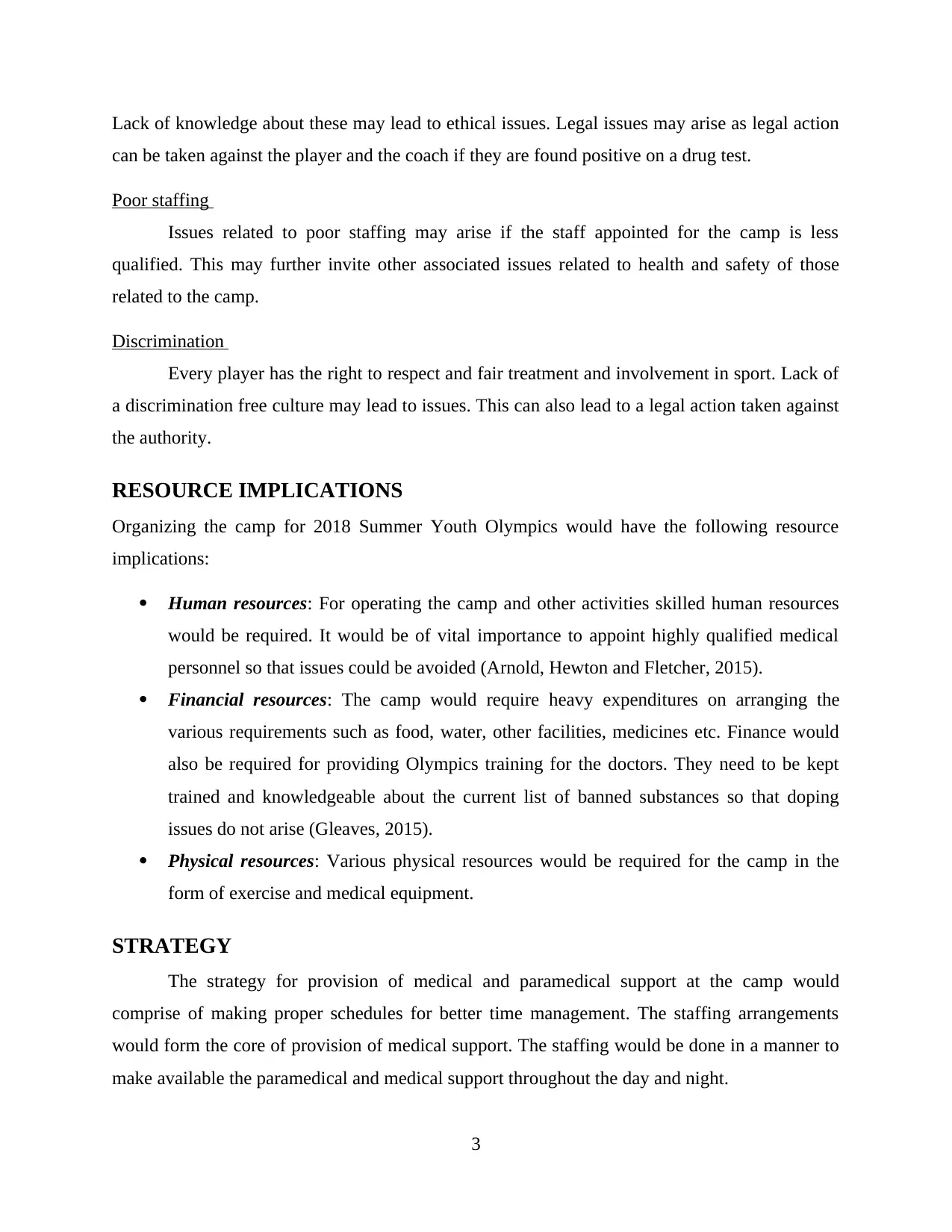
Lack of knowledge about these may lead to ethical issues. Legal issues may arise as legal action
can be taken against the player and the coach if they are found positive on a drug test.
Poor staffing
Issues related to poor staffing may arise if the staff appointed for the camp is less
qualified. This may further invite other associated issues related to health and safety of those
related to the camp.
Discrimination
Every player has the right to respect and fair treatment and involvement in sport. Lack of
a discrimination free culture may lead to issues. This can also lead to a legal action taken against
the authority.
RESOURCE IMPLICATIONS
Organizing the camp for 2018 Summer Youth Olympics would have the following resource
implications:
Human resources: For operating the camp and other activities skilled human resources
would be required. It would be of vital importance to appoint highly qualified medical
personnel so that issues could be avoided (Arnold, Hewton and Fletcher, 2015).
Financial resources: The camp would require heavy expenditures on arranging the
various requirements such as food, water, other facilities, medicines etc. Finance would
also be required for providing Olympics training for the doctors. They need to be kept
trained and knowledgeable about the current list of banned substances so that doping
issues do not arise (Gleaves, 2015).
Physical resources: Various physical resources would be required for the camp in the
form of exercise and medical equipment.
STRATEGY
The strategy for provision of medical and paramedical support at the camp would
comprise of making proper schedules for better time management. The staffing arrangements
would form the core of provision of medical support. The staffing would be done in a manner to
make available the paramedical and medical support throughout the day and night.
3
can be taken against the player and the coach if they are found positive on a drug test.
Poor staffing
Issues related to poor staffing may arise if the staff appointed for the camp is less
qualified. This may further invite other associated issues related to health and safety of those
related to the camp.
Discrimination
Every player has the right to respect and fair treatment and involvement in sport. Lack of
a discrimination free culture may lead to issues. This can also lead to a legal action taken against
the authority.
RESOURCE IMPLICATIONS
Organizing the camp for 2018 Summer Youth Olympics would have the following resource
implications:
Human resources: For operating the camp and other activities skilled human resources
would be required. It would be of vital importance to appoint highly qualified medical
personnel so that issues could be avoided (Arnold, Hewton and Fletcher, 2015).
Financial resources: The camp would require heavy expenditures on arranging the
various requirements such as food, water, other facilities, medicines etc. Finance would
also be required for providing Olympics training for the doctors. They need to be kept
trained and knowledgeable about the current list of banned substances so that doping
issues do not arise (Gleaves, 2015).
Physical resources: Various physical resources would be required for the camp in the
form of exercise and medical equipment.
STRATEGY
The strategy for provision of medical and paramedical support at the camp would
comprise of making proper schedules for better time management. The staffing arrangements
would form the core of provision of medical support. The staffing would be done in a manner to
make available the paramedical and medical support throughout the day and night.
3

REFERENCES
Journals and Books
Anderson-Butcher, D. and et.al., 2014. Maximizing youth experiences in community sport
settings: The design and impact of the LiFE sports camp. Journal of Sport
Management. 28(2). pp.236-249.
Arnold, R., Hewton, E. and Fletcher, D., 2015. Preparing our greatest team: The design and
delivery of a preparation camp for the London 2012 Olympic Games. Sport, Business
and Management: An International Journal. 5(4). pp.386-407.
Dijkstra, H. P. and et.al., 2014. Managing the health of the elite athlete: a new integrated
performance health management and coaching model. British journal of sports
medicine. 48(7). pp.523-531.
Giulianotti, R. and et.al., 2015. Sport Mega-Events and Public Opposition A Sociological Study
of the London 2012 Olympics. Journal of Sport & Social Issues. 39(2). pp.99-119.
Gleaves, J., 2015. Manufactured dope: How the 1984 US Olympic cycling team rewrote the rules
on drugs in sports. The International Journal of the History of Sport. 32(1). pp.89-107.
Wallis, M., 2015. Olympic sports medicine: The countdown to Rio. Sport Health. 33(2). p.32.
Online
Rodeo, S., 2014. Sports Medicine Staff Play Important Role at Olympic Games. [Online].
Available Through: <https://www.swimmingworldmagazine.com/news/sports-medicine-
staff-play-important-role-at-olympic-games/>. [Accessed on 9 November 2016].
4
Journals and Books
Anderson-Butcher, D. and et.al., 2014. Maximizing youth experiences in community sport
settings: The design and impact of the LiFE sports camp. Journal of Sport
Management. 28(2). pp.236-249.
Arnold, R., Hewton, E. and Fletcher, D., 2015. Preparing our greatest team: The design and
delivery of a preparation camp for the London 2012 Olympic Games. Sport, Business
and Management: An International Journal. 5(4). pp.386-407.
Dijkstra, H. P. and et.al., 2014. Managing the health of the elite athlete: a new integrated
performance health management and coaching model. British journal of sports
medicine. 48(7). pp.523-531.
Giulianotti, R. and et.al., 2015. Sport Mega-Events and Public Opposition A Sociological Study
of the London 2012 Olympics. Journal of Sport & Social Issues. 39(2). pp.99-119.
Gleaves, J., 2015. Manufactured dope: How the 1984 US Olympic cycling team rewrote the rules
on drugs in sports. The International Journal of the History of Sport. 32(1). pp.89-107.
Wallis, M., 2015. Olympic sports medicine: The countdown to Rio. Sport Health. 33(2). p.32.
Online
Rodeo, S., 2014. Sports Medicine Staff Play Important Role at Olympic Games. [Online].
Available Through: <https://www.swimmingworldmagazine.com/news/sports-medicine-
staff-play-important-role-at-olympic-games/>. [Accessed on 9 November 2016].
4
⊘ This is a preview!⊘
Do you want full access?
Subscribe today to unlock all pages.

Trusted by 1+ million students worldwide
1 out of 6
Related Documents
Your All-in-One AI-Powered Toolkit for Academic Success.
+13062052269
info@desklib.com
Available 24*7 on WhatsApp / Email
Unlock your academic potential
Copyright © 2020–2026 A2Z Services. All Rights Reserved. Developed and managed by ZUCOL.