Evidence-Based Reflection: Ethical Dilemma in Healthcare, 7315MED
VerifiedAdded on 2022/08/31
|7
|2145
|24
Essay
AI Summary
This essay is a student's evidence-based reflection on an ethical dilemma faced by a health service manager, focusing on end-of-life care. The assignment analyzes a case study of a patient in a vegetative state, exploring the ethical complexities of making decisions when the patient cannot express their wishes. The essay applies the Markkula framework for ethical decision-making, considering various approaches like utilitarianism, rights, justice, common good, and virtue ethics. The student examines conflicting viewpoints from family members and the medical team, ultimately justifying the decision to retract life support based on the patient's lack of recovery potential and the goal of alleviating suffering. The essay highlights the challenges of ethical decision-making in healthcare, particularly when legal and ethical considerations intersect, and emphasizes the importance of considering all stakeholders and available evidence.
Running head: EVIDENCE BASED REFLECTION
Evidence based reflection
Student Name
University Name
Author Note
Evidence based reflection
Student Name
University Name
Author Note
Paraphrase This Document
Need a fresh take? Get an instant paraphrase of this document with our AI Paraphraser

1
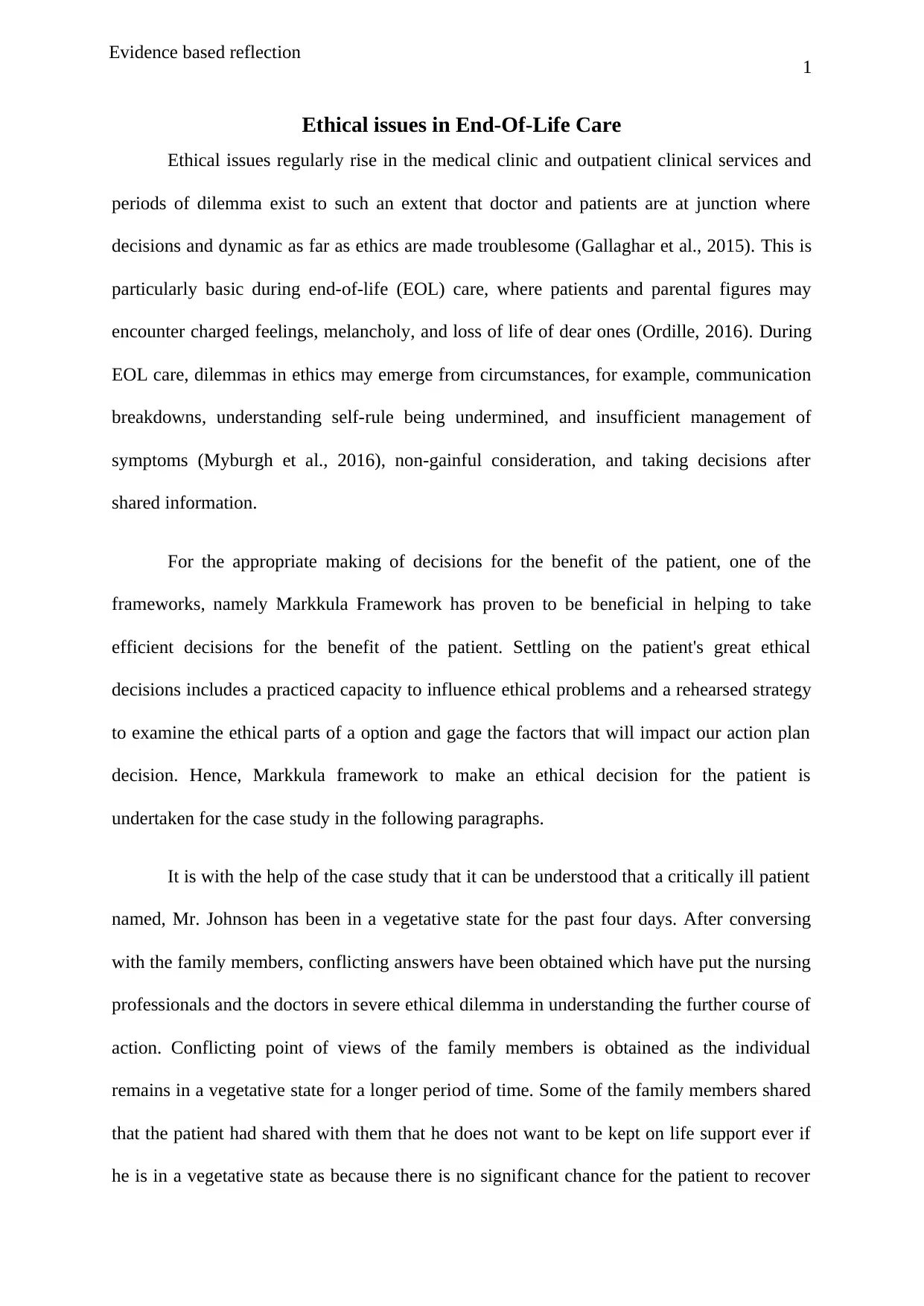
Ethical issues in End-Of-Life Care
Ethical issues regularly rise in the medical clinic and outpatient clinical services and
periods of dilemma exist to such an extent that doctor and patients are at junction where
decisions and dynamic as far as ethics are made troublesome (Gallaghar et al., 2015). This is
particularly basic during end-of-life (EOL) care, where patients and parental figures may
encounter charged feelings, melancholy, and loss of life of dear ones (Ordille, 2016). During
EOL care, dilemmas in ethics may emerge from circumstances, for example, communication
breakdowns, understanding self-rule being undermined, and insufficient management of
symptoms (Myburgh et al., 2016), non-gainful consideration, and taking decisions after
shared information.
For the appropriate making of decisions for the benefit of the patient, one of the
frameworks, namely Markkula Framework has proven to be beneficial in helping to take
efficient decisions for the benefit of the patient. Settling on the patient's great ethical
decisions includes a practiced capacity to influence ethical problems and a rehearsed strategy
to examine the ethical parts of a option and gage the factors that will impact our action plan
decision. Hence, Markkula framework to make an ethical decision for the patient is
undertaken for the case study in the following paragraphs.
It is with the help of the case study that it can be understood that a critically ill patient
named, Mr. Johnson has been in a vegetative state for the past four days. After conversing
with the family members, conflicting answers have been obtained which have put the nursing
professionals and the doctors in severe ethical dilemma in understanding the further course of
action. Conflicting point of views of the family members is obtained as the individual
remains in a vegetative state for a longer period of time. Some of the family members shared
that the patient had shared with them that he does not want to be kept on life support ever if
he is in a vegetative state as because there is no significant chance for the patient to recover
Evidence based reflection
Ethical issues in End-Of-Life Care
Ethical issues regularly rise in the medical clinic and outpatient clinical services and
periods of dilemma exist to such an extent that doctor and patients are at junction where
decisions and dynamic as far as ethics are made troublesome (Gallaghar et al., 2015). This is
particularly basic during end-of-life (EOL) care, where patients and parental figures may
encounter charged feelings, melancholy, and loss of life of dear ones (Ordille, 2016). During
EOL care, dilemmas in ethics may emerge from circumstances, for example, communication
breakdowns, understanding self-rule being undermined, and insufficient management of
symptoms (Myburgh et al., 2016), non-gainful consideration, and taking decisions after
shared information.
For the appropriate making of decisions for the benefit of the patient, one of the
frameworks, namely Markkula Framework has proven to be beneficial in helping to take
efficient decisions for the benefit of the patient. Settling on the patient's great ethical
decisions includes a practiced capacity to influence ethical problems and a rehearsed strategy
to examine the ethical parts of a option and gage the factors that will impact our action plan
decision. Hence, Markkula framework to make an ethical decision for the patient is
undertaken for the case study in the following paragraphs.
It is with the help of the case study that it can be understood that a critically ill patient
named, Mr. Johnson has been in a vegetative state for the past four days. After conversing
with the family members, conflicting answers have been obtained which have put the nursing
professionals and the doctors in severe ethical dilemma in understanding the further course of
action. Conflicting point of views of the family members is obtained as the individual
remains in a vegetative state for a longer period of time. Some of the family members shared
that the patient had shared with them that he does not want to be kept on life support ever if
he is in a vegetative state as because there is no significant chance for the patient to recover
Evidence based reflection

2
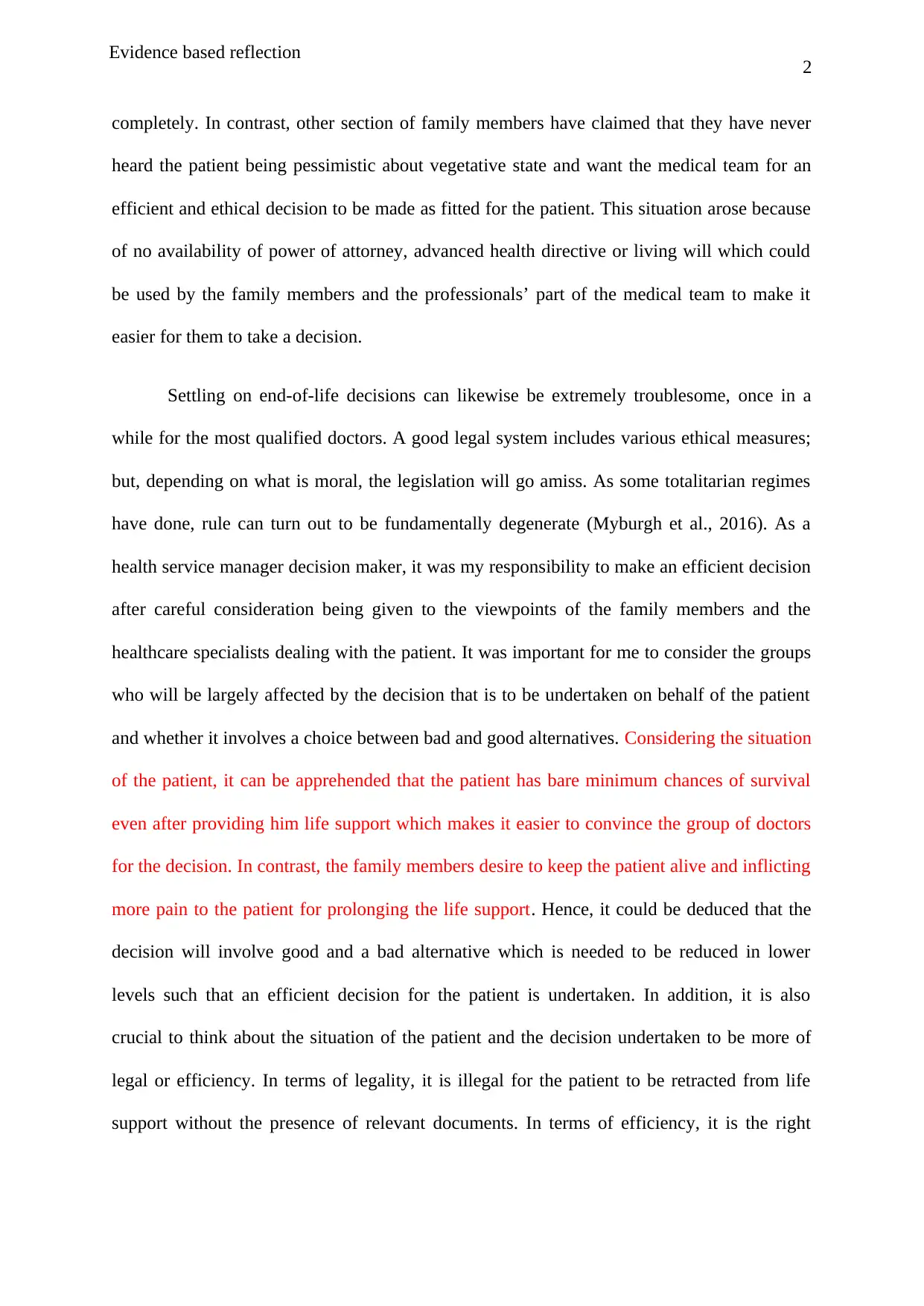
completely. In contrast, other section of family members have claimed that they have never
heard the patient being pessimistic about vegetative state and want the medical team for an
efficient and ethical decision to be made as fitted for the patient. This situation arose because
of no availability of power of attorney, advanced health directive or living will which could
be used by the family members and the professionals’ part of the medical team to make it
easier for them to take a decision.
Settling on end-of-life decisions can likewise be extremely troublesome, once in a
while for the most qualified doctors. A good legal system includes various ethical measures;
but, depending on what is moral, the legislation will go amiss. As some totalitarian regimes
have done, rule can turn out to be fundamentally degenerate (Myburgh et al., 2016). As a
health service manager decision maker, it was my responsibility to make an efficient decision
after careful consideration being given to the viewpoints of the family members and the
healthcare specialists dealing with the patient. It was important for me to consider the groups
who will be largely affected by the decision that is to be undertaken on behalf of the patient
and whether it involves a choice between bad and good alternatives. Considering the situation
of the patient, it can be apprehended that the patient has bare minimum chances of survival
even after providing him life support which makes it easier to convince the group of doctors
for the decision. In contrast, the family members desire to keep the patient alive and inflicting
more pain to the patient for prolonging the life support. Hence, it could be deduced that the
decision will involve good and a bad alternative which is needed to be reduced in lower
levels such that an efficient decision for the patient is undertaken. In addition, it is also
crucial to think about the situation of the patient and the decision undertaken to be more of
legal or efficiency. In terms of legality, it is illegal for the patient to be retracted from life
support without the presence of relevant documents. In terms of efficiency, it is the right
Evidence based reflection
completely. In contrast, other section of family members have claimed that they have never
heard the patient being pessimistic about vegetative state and want the medical team for an
efficient and ethical decision to be made as fitted for the patient. This situation arose because
of no availability of power of attorney, advanced health directive or living will which could
be used by the family members and the professionals’ part of the medical team to make it
easier for them to take a decision.
Settling on end-of-life decisions can likewise be extremely troublesome, once in a
while for the most qualified doctors. A good legal system includes various ethical measures;
but, depending on what is moral, the legislation will go amiss. As some totalitarian regimes
have done, rule can turn out to be fundamentally degenerate (Myburgh et al., 2016). As a
health service manager decision maker, it was my responsibility to make an efficient decision
after careful consideration being given to the viewpoints of the family members and the
healthcare specialists dealing with the patient. It was important for me to consider the groups
who will be largely affected by the decision that is to be undertaken on behalf of the patient
and whether it involves a choice between bad and good alternatives. Considering the situation
of the patient, it can be apprehended that the patient has bare minimum chances of survival
even after providing him life support which makes it easier to convince the group of doctors
for the decision. In contrast, the family members desire to keep the patient alive and inflicting
more pain to the patient for prolonging the life support. Hence, it could be deduced that the
decision will involve good and a bad alternative which is needed to be reduced in lower
levels such that an efficient decision for the patient is undertaken. In addition, it is also
crucial to think about the situation of the patient and the decision undertaken to be more of
legal or efficiency. In terms of legality, it is illegal for the patient to be retracted from life
support without the presence of relevant documents. In terms of efficiency, it is the right
Evidence based reflection
⊘ This is a preview!⊘
Do you want full access?
Subscribe today to unlock all pages.

Trusted by 1+ million students worldwide

3
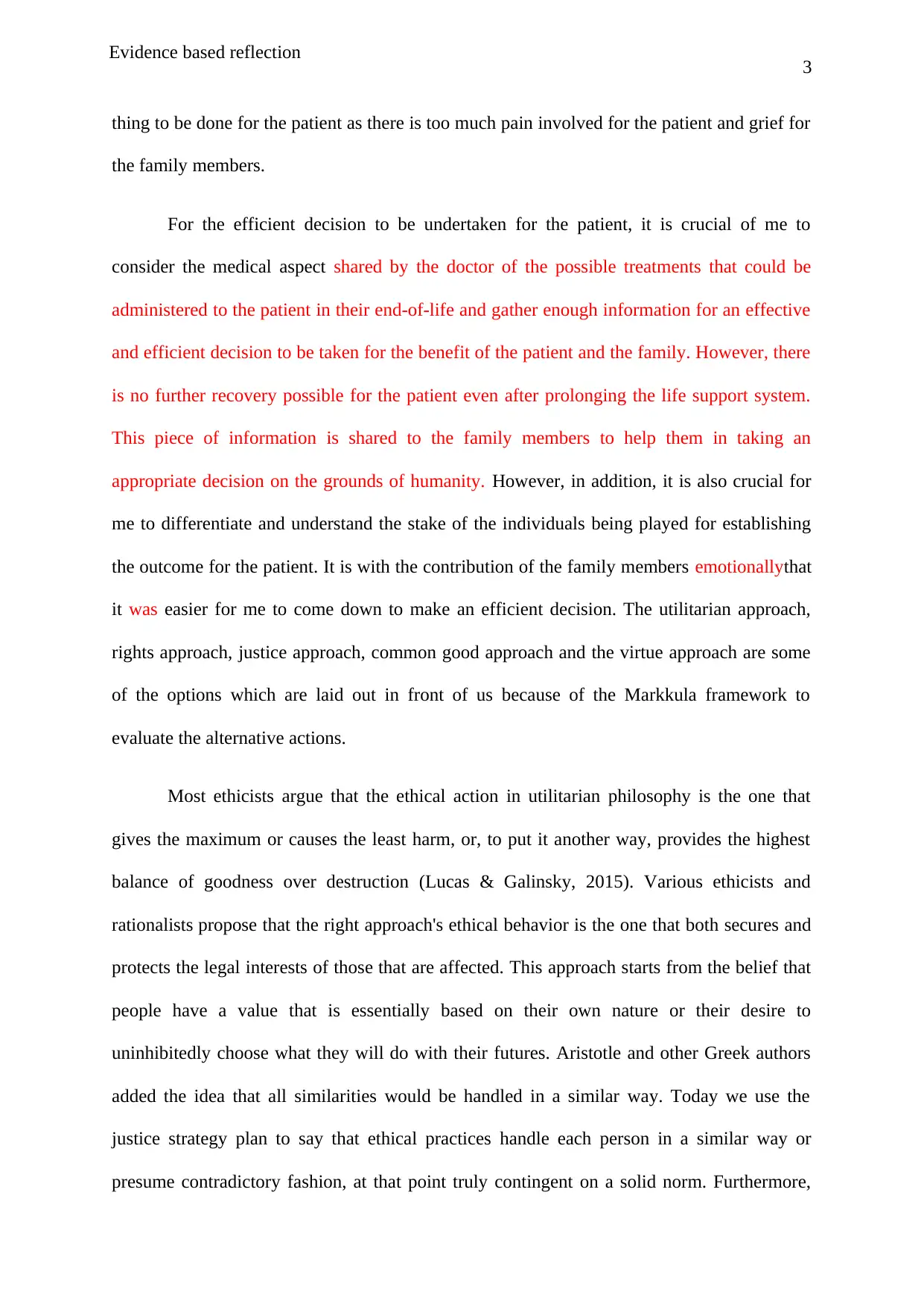
thing to be done for the patient as there is too much pain involved for the patient and grief for
the family members.
For the efficient decision to be undertaken for the patient, it is crucial of me to
consider the medical aspect shared by the doctor of the possible treatments that could be
administered to the patient in their end-of-life and gather enough information for an effective
and efficient decision to be taken for the benefit of the patient and the family. However, there
is no further recovery possible for the patient even after prolonging the life support system.
This piece of information is shared to the family members to help them in taking an
appropriate decision on the grounds of humanity. However, in addition, it is also crucial for
me to differentiate and understand the stake of the individuals being played for establishing
the outcome for the patient. It is with the contribution of the family members emotionallythat
it was easier for me to come down to make an efficient decision. The utilitarian approach,
rights approach, justice approach, common good approach and the virtue approach are some
of the options which are laid out in front of us because of the Markkula framework to
evaluate the alternative actions.
Most ethicists argue that the ethical action in utilitarian philosophy is the one that
gives the maximum or causes the least harm, or, to put it another way, provides the highest
balance of goodness over destruction (Lucas & Galinsky, 2015). Various ethicists and
rationalists propose that the right approach's ethical behavior is the one that both secures and
protects the legal interests of those that are affected. This approach starts from the belief that
people have a value that is essentially based on their own nature or their desire to
uninhibitedly choose what they will do with their futures. Aristotle and other Greek authors
added the idea that all similarities would be handled in a similar way. Today we use the
justice strategy plan to say that ethical practices handle each person in a similar way or
presume contradictory fashion, at that point truly contingent on a solid norm. Furthermore,
Evidence based reflection
thing to be done for the patient as there is too much pain involved for the patient and grief for
the family members.
For the efficient decision to be undertaken for the patient, it is crucial of me to
consider the medical aspect shared by the doctor of the possible treatments that could be
administered to the patient in their end-of-life and gather enough information for an effective
and efficient decision to be taken for the benefit of the patient and the family. However, there
is no further recovery possible for the patient even after prolonging the life support system.
This piece of information is shared to the family members to help them in taking an
appropriate decision on the grounds of humanity. However, in addition, it is also crucial for
me to differentiate and understand the stake of the individuals being played for establishing
the outcome for the patient. It is with the contribution of the family members emotionallythat
it was easier for me to come down to make an efficient decision. The utilitarian approach,
rights approach, justice approach, common good approach and the virtue approach are some
of the options which are laid out in front of us because of the Markkula framework to
evaluate the alternative actions.
Most ethicists argue that the ethical action in utilitarian philosophy is the one that
gives the maximum or causes the least harm, or, to put it another way, provides the highest
balance of goodness over destruction (Lucas & Galinsky, 2015). Various ethicists and
rationalists propose that the right approach's ethical behavior is the one that both secures and
protects the legal interests of those that are affected. This approach starts from the belief that
people have a value that is essentially based on their own nature or their desire to
uninhibitedly choose what they will do with their futures. Aristotle and other Greek authors
added the idea that all similarities would be handled in a similar way. Today we use the
justice strategy plan to say that ethical practices handle each person in a similar way or
presume contradictory fashion, at that point truly contingent on a solid norm. Furthermore,
Evidence based reflection
Paraphrase This Document
Need a fresh take? Get an instant paraphrase of this document with our AI Paraphraser

4
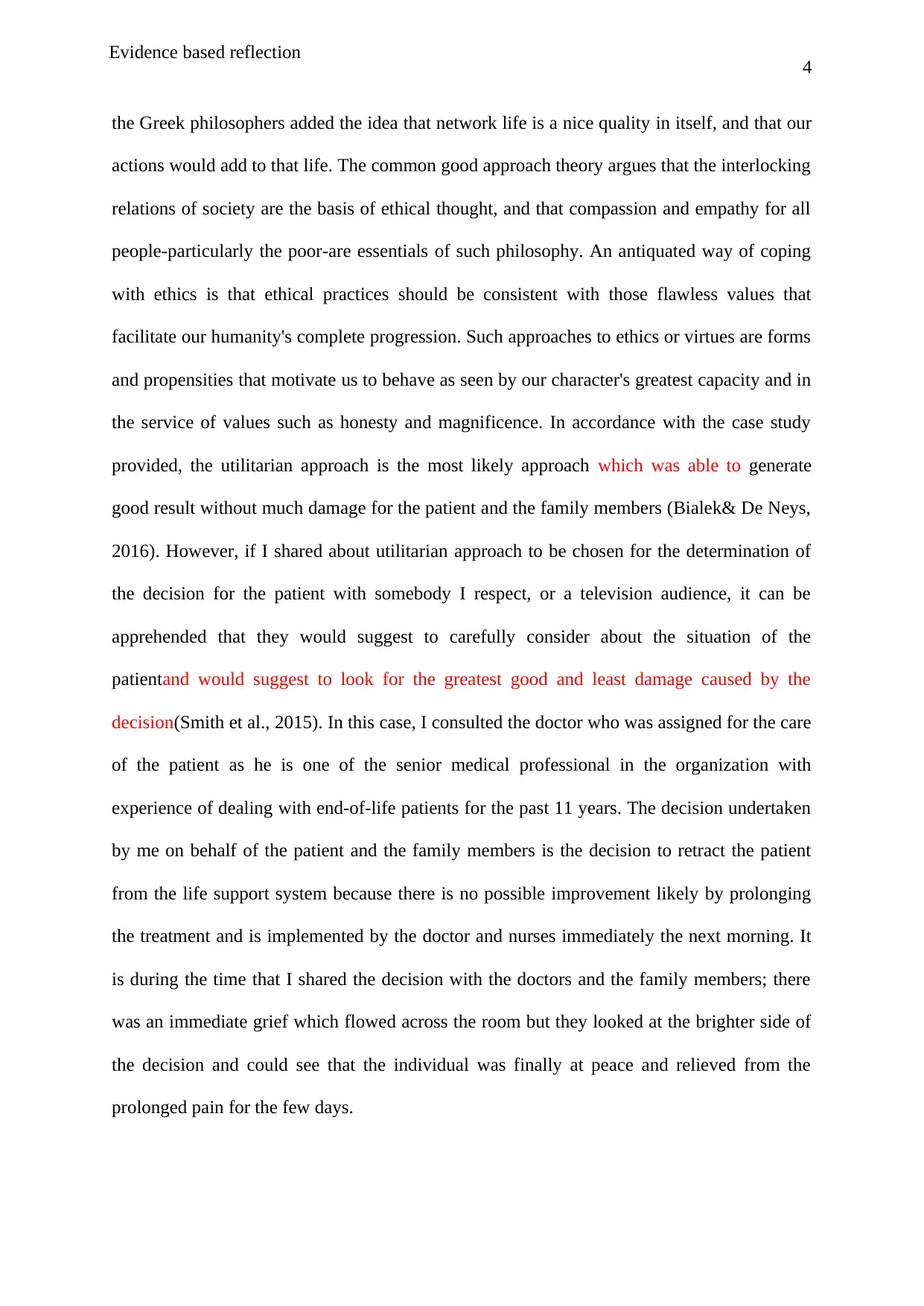
the Greek philosophers added the idea that network life is a nice quality in itself, and that our
actions would add to that life. The common good approach theory argues that the interlocking
relations of society are the basis of ethical thought, and that compassion and empathy for all
people-particularly the poor-are essentials of such philosophy. An antiquated way of coping
with ethics is that ethical practices should be consistent with those flawless values that
facilitate our humanity's complete progression. Such approaches to ethics or virtues are forms
and propensities that motivate us to behave as seen by our character's greatest capacity and in
the service of values such as honesty and magnificence. In accordance with the case study
provided, the utilitarian approach is the most likely approach which was able to generate
good result without much damage for the patient and the family members (Bialek& De Neys,
2016). However, if I shared about utilitarian approach to be chosen for the determination of
the decision for the patient with somebody I respect, or a television audience, it can be
apprehended that they would suggest to carefully consider about the situation of the
patientand would suggest to look for the greatest good and least damage caused by the
decision(Smith et al., 2015). In this case, I consulted the doctor who was assigned for the care
of the patient as he is one of the senior medical professional in the organization with
experience of dealing with end-of-life patients for the past 11 years. The decision undertaken
by me on behalf of the patient and the family members is the decision to retract the patient
from the life support system because there is no possible improvement likely by prolonging
the treatment and is implemented by the doctor and nurses immediately the next morning. It
is during the time that I shared the decision with the doctors and the family members; there
was an immediate grief which flowed across the room but they looked at the brighter side of
the decision and could see that the individual was finally at peace and relieved from the
prolonged pain for the few days.
Evidence based reflection
the Greek philosophers added the idea that network life is a nice quality in itself, and that our
actions would add to that life. The common good approach theory argues that the interlocking
relations of society are the basis of ethical thought, and that compassion and empathy for all
people-particularly the poor-are essentials of such philosophy. An antiquated way of coping
with ethics is that ethical practices should be consistent with those flawless values that
facilitate our humanity's complete progression. Such approaches to ethics or virtues are forms
and propensities that motivate us to behave as seen by our character's greatest capacity and in
the service of values such as honesty and magnificence. In accordance with the case study
provided, the utilitarian approach is the most likely approach which was able to generate
good result without much damage for the patient and the family members (Bialek& De Neys,
2016). However, if I shared about utilitarian approach to be chosen for the determination of
the decision for the patient with somebody I respect, or a television audience, it can be
apprehended that they would suggest to carefully consider about the situation of the
patientand would suggest to look for the greatest good and least damage caused by the
decision(Smith et al., 2015). In this case, I consulted the doctor who was assigned for the care
of the patient as he is one of the senior medical professional in the organization with
experience of dealing with end-of-life patients for the past 11 years. The decision undertaken
by me on behalf of the patient and the family members is the decision to retract the patient
from the life support system because there is no possible improvement likely by prolonging
the treatment and is implemented by the doctor and nurses immediately the next morning. It
is during the time that I shared the decision with the doctors and the family members; there
was an immediate grief which flowed across the room but they looked at the brighter side of
the decision and could see that the individual was finally at peace and relieved from the
prolonged pain for the few days.
Evidence based reflection

5
Conclusion
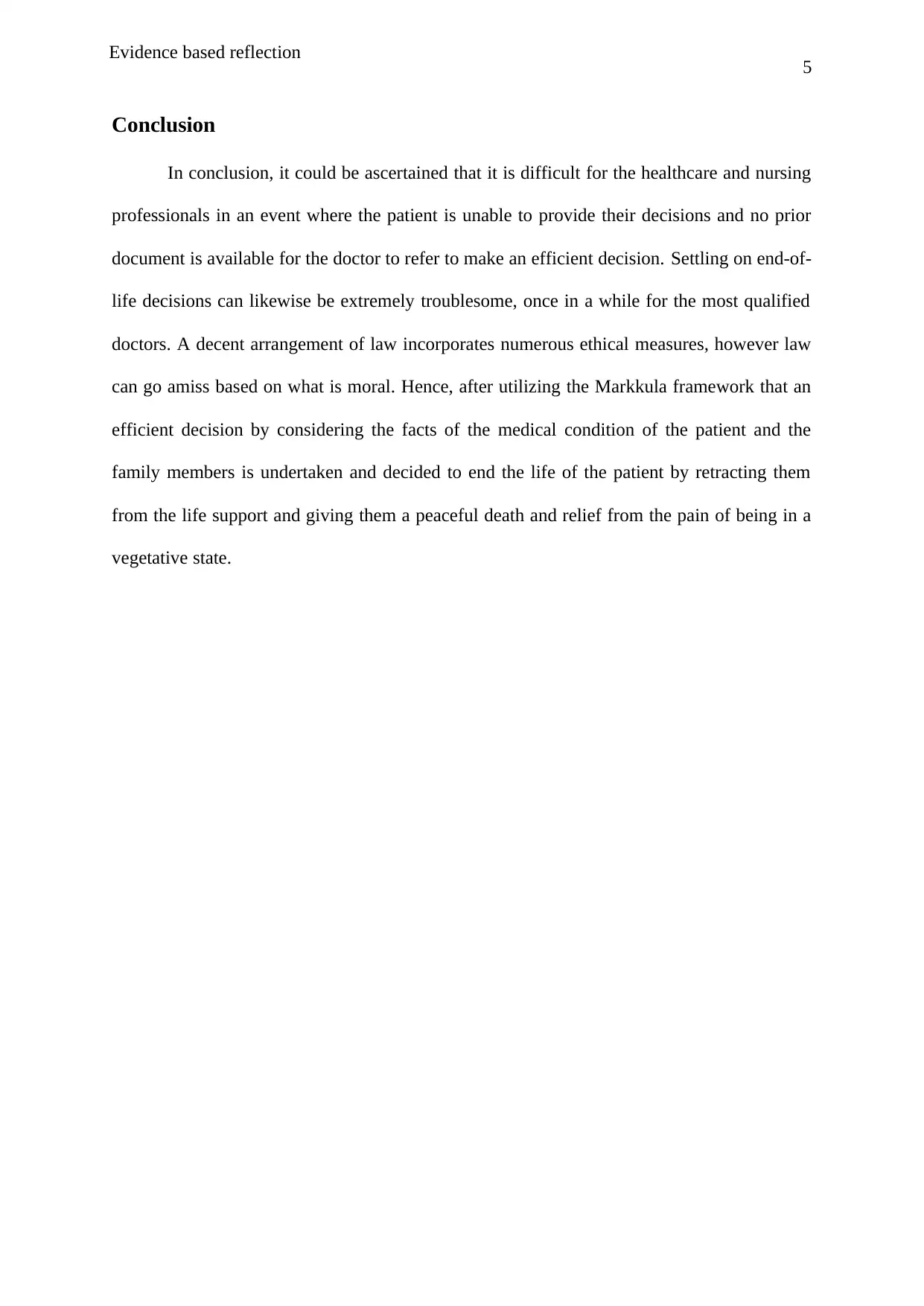
In conclusion, it could be ascertained that it is difficult for the healthcare and nursing
professionals in an event where the patient is unable to provide their decisions and no prior
document is available for the doctor to refer to make an efficient decision. Settling on end-of-
life decisions can likewise be extremely troublesome, once in a while for the most qualified
doctors. A decent arrangement of law incorporates numerous ethical measures, however law
can go amiss based on what is moral. Hence, after utilizing the Markkula framework that an
efficient decision by considering the facts of the medical condition of the patient and the
family members is undertaken and decided to end the life of the patient by retracting them
from the life support and giving them a peaceful death and relief from the pain of being in a
vegetative state.
Evidence based reflection
Conclusion
In conclusion, it could be ascertained that it is difficult for the healthcare and nursing
professionals in an event where the patient is unable to provide their decisions and no prior
document is available for the doctor to refer to make an efficient decision. Settling on end-of-
life decisions can likewise be extremely troublesome, once in a while for the most qualified
doctors. A decent arrangement of law incorporates numerous ethical measures, however law
can go amiss based on what is moral. Hence, after utilizing the Markkula framework that an
efficient decision by considering the facts of the medical condition of the patient and the
family members is undertaken and decided to end the life of the patient by retracting them
from the life support and giving them a peaceful death and relief from the pain of being in a
vegetative state.
Evidence based reflection
⊘ This is a preview!⊘
Do you want full access?
Subscribe today to unlock all pages.

Trusted by 1+ million students worldwide

6
References
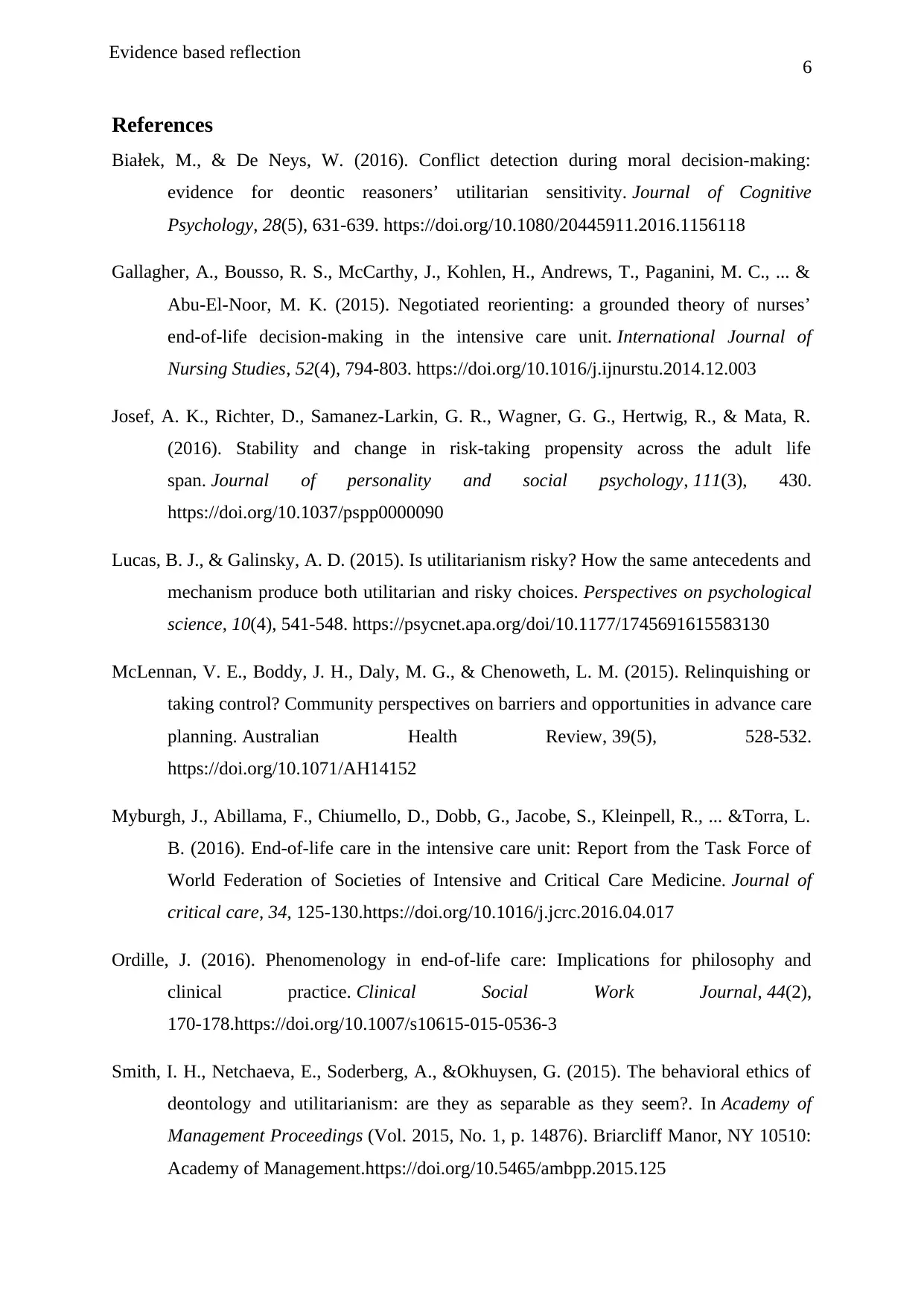
Białek, M., & De Neys, W. (2016). Conflict detection during moral decision-making:
evidence for deontic reasoners’ utilitarian sensitivity. Journal of Cognitive
Psychology, 28(5), 631-639. https://doi.org/10.1080/20445911.2016.1156118
Gallagher, A., Bousso, R. S., McCarthy, J., Kohlen, H., Andrews, T., Paganini, M. C., ... &
Abu-El-Noor, M. K. (2015). Negotiated reorienting: a grounded theory of nurses’
end-of-life decision-making in the intensive care unit. International Journal of
Nursing Studies, 52(4), 794-803. https://doi.org/10.1016/j.ijnurstu.2014.12.003
Josef, A. K., Richter, D., Samanez-Larkin, G. R., Wagner, G. G., Hertwig, R., & Mata, R.
(2016). Stability and change in risk-taking propensity across the adult life
span. Journal of personality and social psychology, 111(3), 430.
https://doi.org/10.1037/pspp0000090
Lucas, B. J., & Galinsky, A. D. (2015). Is utilitarianism risky? How the same antecedents and
mechanism produce both utilitarian and risky choices. Perspectives on psychological
science, 10(4), 541-548. https://psycnet.apa.org/doi/10.1177/1745691615583130
McLennan, V. E., Boddy, J. H., Daly, M. G., & Chenoweth, L. M. (2015). Relinquishing or
taking control? Community perspectives on barriers and opportunities in advance care
planning. Australian Health Review, 39(5), 528-532.
https://doi.org/10.1071/AH14152
Myburgh, J., Abillama, F., Chiumello, D., Dobb, G., Jacobe, S., Kleinpell, R., ... &Torra, L.
B. (2016). End-of-life care in the intensive care unit: Report from the Task Force of
World Federation of Societies of Intensive and Critical Care Medicine. Journal of
critical care, 34, 125-130.https://doi.org/10.1016/j.jcrc.2016.04.017
Ordille, J. (2016). Phenomenology in end-of-life care: Implications for philosophy and
clinical practice. Clinical Social Work Journal, 44(2),
170-178.https://doi.org/10.1007/s10615-015-0536-3
Smith, I. H., Netchaeva, E., Soderberg, A., &Okhuysen, G. (2015). The behavioral ethics of
deontology and utilitarianism: are they as separable as they seem?. In Academy of
Management Proceedings (Vol. 2015, No. 1, p. 14876). Briarcliff Manor, NY 10510:
Academy of Management.https://doi.org/10.5465/ambpp.2015.125
Evidence based reflection
References
Białek, M., & De Neys, W. (2016). Conflict detection during moral decision-making:
evidence for deontic reasoners’ utilitarian sensitivity. Journal of Cognitive
Psychology, 28(5), 631-639. https://doi.org/10.1080/20445911.2016.1156118
Gallagher, A., Bousso, R. S., McCarthy, J., Kohlen, H., Andrews, T., Paganini, M. C., ... &
Abu-El-Noor, M. K. (2015). Negotiated reorienting: a grounded theory of nurses’
end-of-life decision-making in the intensive care unit. International Journal of
Nursing Studies, 52(4), 794-803. https://doi.org/10.1016/j.ijnurstu.2014.12.003
Josef, A. K., Richter, D., Samanez-Larkin, G. R., Wagner, G. G., Hertwig, R., & Mata, R.
(2016). Stability and change in risk-taking propensity across the adult life
span. Journal of personality and social psychology, 111(3), 430.
https://doi.org/10.1037/pspp0000090
Lucas, B. J., & Galinsky, A. D. (2015). Is utilitarianism risky? How the same antecedents and
mechanism produce both utilitarian and risky choices. Perspectives on psychological
science, 10(4), 541-548. https://psycnet.apa.org/doi/10.1177/1745691615583130
McLennan, V. E., Boddy, J. H., Daly, M. G., & Chenoweth, L. M. (2015). Relinquishing or
taking control? Community perspectives on barriers and opportunities in advance care
planning. Australian Health Review, 39(5), 528-532.
https://doi.org/10.1071/AH14152
Myburgh, J., Abillama, F., Chiumello, D., Dobb, G., Jacobe, S., Kleinpell, R., ... &Torra, L.
B. (2016). End-of-life care in the intensive care unit: Report from the Task Force of
World Federation of Societies of Intensive and Critical Care Medicine. Journal of
critical care, 34, 125-130.https://doi.org/10.1016/j.jcrc.2016.04.017
Ordille, J. (2016). Phenomenology in end-of-life care: Implications for philosophy and
clinical practice. Clinical Social Work Journal, 44(2),
170-178.https://doi.org/10.1007/s10615-015-0536-3
Smith, I. H., Netchaeva, E., Soderberg, A., &Okhuysen, G. (2015). The behavioral ethics of
deontology and utilitarianism: are they as separable as they seem?. In Academy of
Management Proceedings (Vol. 2015, No. 1, p. 14876). Briarcliff Manor, NY 10510:
Academy of Management.https://doi.org/10.5465/ambpp.2015.125
Evidence based reflection
1 out of 7
Related Documents
Your All-in-One AI-Powered Toolkit for Academic Success.
+13062052269
info@desklib.com
Available 24*7 on WhatsApp / Email
Unlock your academic potential
Copyright © 2020–2026 A2Z Services. All Rights Reserved. Developed and managed by ZUCOL.