University Task A: Exploring Self-Regulation Strategies for Children

Verified

Added on  2021/04/24

|3
|666
|23
Homework Assignment
AI Summary
This assignment focuses on self-regulation in children, exploring various strategies to enhance their behavioral management and self-care skills. It emphasizes the importance of entrenching these skills early in life. The assignment delves into evidence-based approaches, including proprioceptive activities (joint compression, walking, etc.), vestibular activities (swinging, rocking), and tactile activities (vibration, massage). It highlights the research supporting the effectiveness of these methods in managing anger, promoting sensory integration, and fostering emotional regulation. References to key research studies underscore the persuasive nature of these strategies for adoption in social activities. The assignment provides a comprehensive understanding of how these sensory-based activities can contribute to children's emotional and behavioral development, supporting their ability to make meaningful associations and manage their emotions effectively.
Document Page
UNVERSITY
ASSIGNMENT
TASK A - STUDY SKILLS / BRAIN GYM
tabler-icon-diamond-filled.svg

Paraphrase This Document

Need a fresh take? Get an instant paraphrase of this document with our AI Paraphraser
Document Page
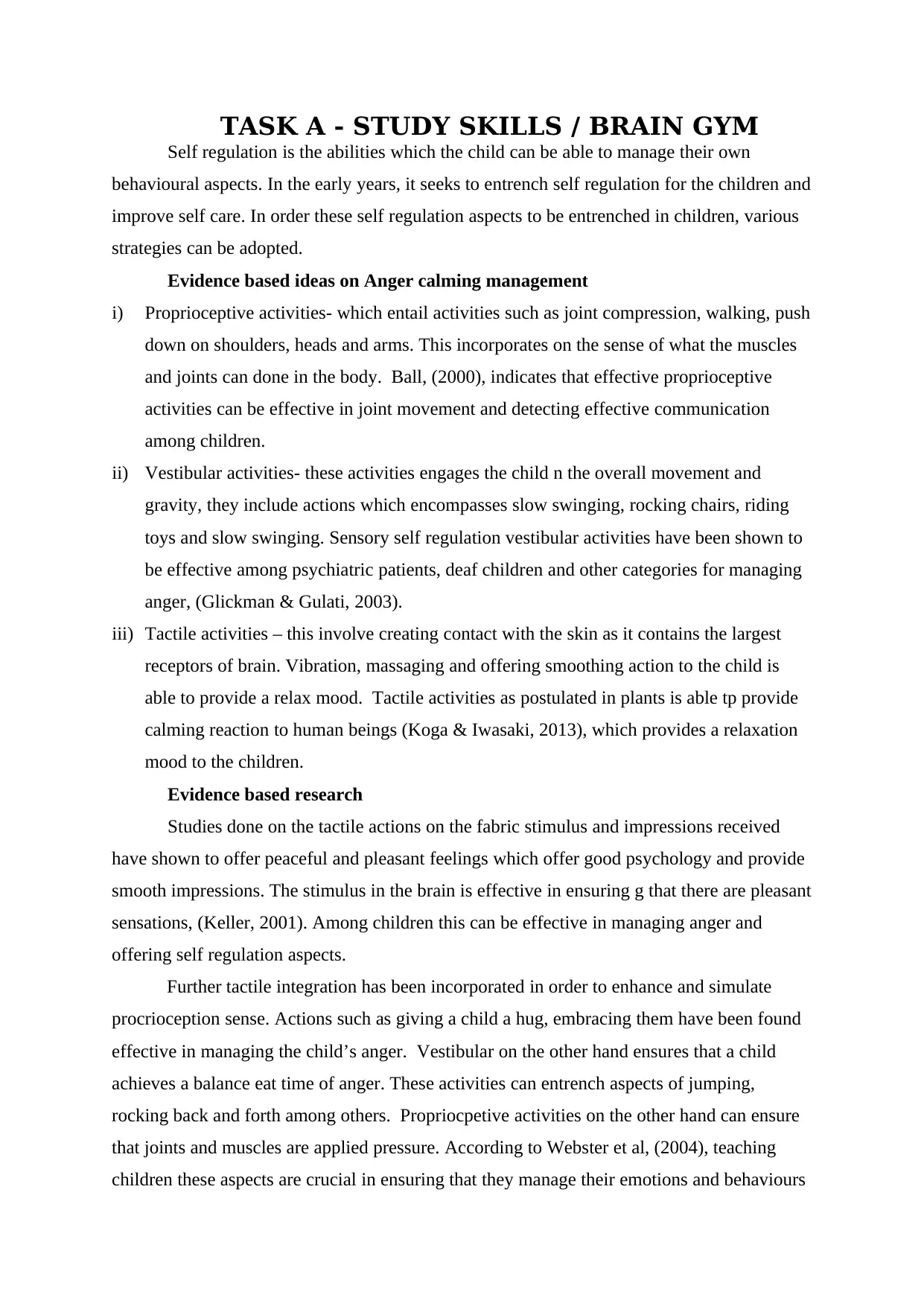
TASK A - STUDY SKILLS / BRAIN GYM
Self regulation is the abilities which the child can be able to manage their own
behavioural aspects. In the early years, it seeks to entrench self regulation for the children and
improve self care. In order these self regulation aspects to be entrenched in children, various
strategies can be adopted.
Evidence based ideas on Anger calming management
i) Proprioceptive activities- which entail activities such as joint compression, walking, push
down on shoulders, heads and arms. This incorporates on the sense of what the muscles
and joints can done in the body. Ball, (2000), indicates that effective proprioceptive
activities can be effective in joint movement and detecting effective communication
among children.
ii) Vestibular activities- these activities engages the child n the overall movement and
gravity, they include actions which encompasses slow swinging, rocking chairs, riding
toys and slow swinging. Sensory self regulation vestibular activities have been shown to
be effective among psychiatric patients, deaf children and other categories for managing
anger, (Glickman & Gulati, 2003).
iii) Tactile activities – this involve creating contact with the skin as it contains the largest
receptors of brain. Vibration, massaging and offering smoothing action to the child is
able to provide a relax mood. Tactile activities as postulated in plants is able tp provide
calming reaction to human beings (Koga & Iwasaki, 2013), which provides a relaxation
mood to the children.
Evidence based research
Studies done on the tactile actions on the fabric stimulus and impressions received
have shown to offer peaceful and pleasant feelings which offer good psychology and provide
smooth impressions. The stimulus in the brain is effective in ensuring g that there are pleasant
sensations, (Keller, 2001). Among children this can be effective in managing anger and
offering self regulation aspects.
Further tactile integration has been incorporated in order to enhance and simulate
procrioception sense. Actions such as giving a child a hug, embracing them have been found
effective in managing the child’s anger. Vestibular on the other hand ensures that a child
achieves a balance eat time of anger. These activities can entrench aspects of jumping,
rocking back and forth among others. Propriocpetive activities on the other hand can ensure
that joints and muscles are applied pressure. According to Webster et al, (2004), teaching
children these aspects are crucial in ensuring that they manage their emotions and behaviours
Document Page
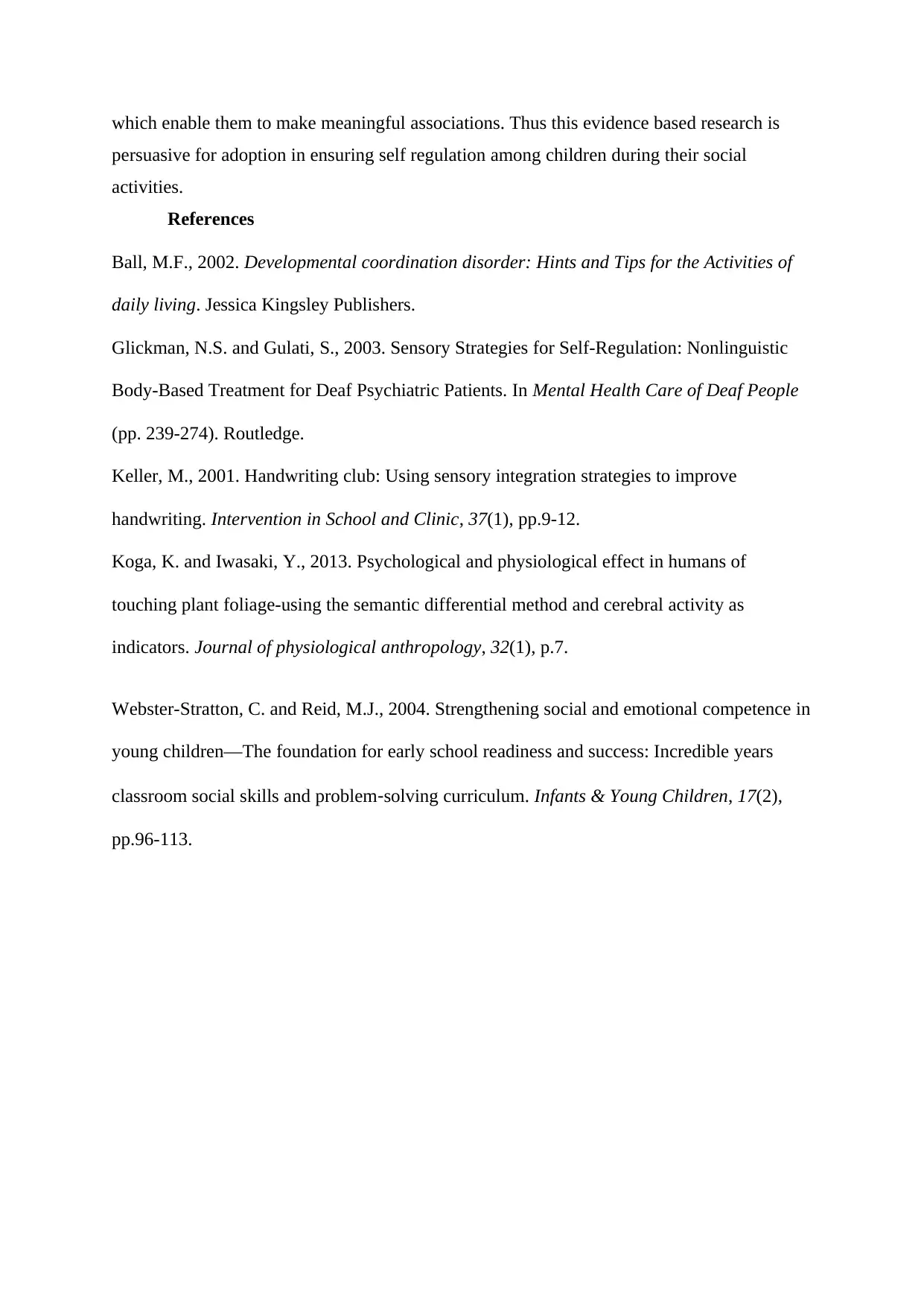
which enable them to make meaningful associations. Thus this evidence based research is
persuasive for adoption in ensuring self regulation among children during their social
activities.
References
Ball, M.F., 2002. Developmental coordination disorder: Hints and Tips for the Activities of
daily living. Jessica Kingsley Publishers.
Glickman, N.S. and Gulati, S., 2003. Sensory Strategies for Self-Regulation: Nonlinguistic
Body-Based Treatment for Deaf Psychiatric Patients. In Mental Health Care of Deaf People
(pp. 239-274). Routledge.
Keller, M., 2001. Handwriting club: Using sensory integration strategies to improve
handwriting. Intervention in School and Clinic, 37(1), pp.9-12.
Koga, K. and Iwasaki, Y., 2013. Psychological and physiological effect in humans of
touching plant foliage-using the semantic differential method and cerebral activity as
indicators. Journal of physiological anthropology, 32(1), p.7.
Webster-Stratton, C. and Reid, M.J., 2004. Strengthening social and emotional competence in
young children—The foundation for early school readiness and success: Incredible years
classroom social skills and problemsolving curriculum. Infants & Young Children, 17(2),
pp.96-113.
chevron_up_icon
1 out of 3
circle_padding
hide_on_mobile
zoom_out_icon
[object Object]