Report: Evolution of Economic Systems and Energy Transition
VerifiedAdded on 2021/05/27
|19
|5712
|26
Report
AI Summary
This report analyzes the evolution of economic systems, particularly focusing on India's transition towards renewable energy and the adoption of advanced battery systems. It examines the factors influencing the uptake of this technology, including the economic considerations of solar and battery-stored electric supply. The report highlights India's efforts to reduce its reliance on fossil fuels and the challenges it faces in this transition, such as financial burdens and international obligations. It explores the application of battery storage technologies and evaluates their economic viability, providing recommendations to overcome hurdles and achieve a greener energy future. The report emphasizes the impact of environmental policies on developing nations and the need for sustainable energy solutions. It also provides an overview of the current state of India's renewable energy sector, its goals, and the potential for growth in the battery market. The report concludes by offering insights into the future trends of this technology and its role in transforming India's energy landscape.
Running head: EVOLUTION OF ECONOMIC SYSTEM
Evolution of Economic System
Name of the student:
Name of the University:
Author note
Evolution of Economic System
Name of the student:
Name of the University:
Author note

Paraphrase This Document
Need a fresh take? Get an instant paraphrase of this document with our AI Paraphraser
1EVOLUTION OF ECONOMIC SYSTEM
Executive summary:
With ever evolving environmental situation, development of the world energy sector has been
entering into a new historical period, where the factor of production is shifting from fossil fuel to
the low carbon and cleaner resources. Considering the deteriorating situation of the world
environment due to the rise in the carbon footprint around the world, it has now become too
much important for the respective governments to look into only those factors that can provide
greener energy at the lowest externality on the environment. Developing states are the recipient
of the worst hit of the scarcity of energy resources and various international obligations has also
harmed their interest to produce more energy at a cost of the environment. Under this scenario,
countries like India has opted for advanced battery system, which are meant to provide power on
demand rather than utilizing the base load electricity. This report is meant to analyse the factors
that will affect the pace of uptake of this latest technology and provide comment on the same to
make it an efficient option for the population of the country. In addition to this, the report is
focused to study the application of the system and evaluate the economy of solar and batter
stored electric supply so as to predict the future trend of this latest technology.
As it has been found by the report that the developing nations are the worse hit by the present
situation of the environmental situation around the world under the stringent environmental
policies decided by the international bodies that are mainly operational under the whip of the
developing nation and this has forced them to move towards greener technologies. Considering
the case of the India, the report has found that the situation for the state is more panic stricken
than the other countries due to the present pressure of ever rising demand of energy under the era
of rapid growth for the nation. Though the state has been trying since decades to evolve itself as
one of the state that depends largely on the renewable energy rather than the black fuel, however
various factors has constrained its growth. To conclude, it would be idle to state that, if the
Executive summary:
With ever evolving environmental situation, development of the world energy sector has been
entering into a new historical period, where the factor of production is shifting from fossil fuel to
the low carbon and cleaner resources. Considering the deteriorating situation of the world
environment due to the rise in the carbon footprint around the world, it has now become too
much important for the respective governments to look into only those factors that can provide
greener energy at the lowest externality on the environment. Developing states are the recipient
of the worst hit of the scarcity of energy resources and various international obligations has also
harmed their interest to produce more energy at a cost of the environment. Under this scenario,
countries like India has opted for advanced battery system, which are meant to provide power on
demand rather than utilizing the base load electricity. This report is meant to analyse the factors
that will affect the pace of uptake of this latest technology and provide comment on the same to
make it an efficient option for the population of the country. In addition to this, the report is
focused to study the application of the system and evaluate the economy of solar and batter
stored electric supply so as to predict the future trend of this latest technology.
As it has been found by the report that the developing nations are the worse hit by the present
situation of the environmental situation around the world under the stringent environmental
policies decided by the international bodies that are mainly operational under the whip of the
developing nation and this has forced them to move towards greener technologies. Considering
the case of the India, the report has found that the situation for the state is more panic stricken
than the other countries due to the present pressure of ever rising demand of energy under the era
of rapid growth for the nation. Though the state has been trying since decades to evolve itself as
one of the state that depends largely on the renewable energy rather than the black fuel, however
various factors has constrained its growth. To conclude, it would be idle to state that, if the
2EVOLUTION OF ECONOMIC SYSTEM
recommendations as mentioned below can be followed, then it can easily overcome the hurdles
in front of the depicted ambitious project of the India.
recommendations as mentioned below can be followed, then it can easily overcome the hurdles
in front of the depicted ambitious project of the India.
⊘ This is a preview!⊘
Do you want full access?
Subscribe today to unlock all pages.

Trusted by 1+ million students worldwide
3EVOLUTION OF ECONOMIC SYSTEM
Table of Contents
Introduction:................................................................................................................................................4
India’s green shit towards renewable energy:..............................................................................................5
Energy storage and the factors that hamper the growth of new technology:................................................7
Storage Battery Technologies application:................................................................................................10
Balance of Systems:..................................................................................................................................11
Economy of solar and battery stored electric supply:................................................................................12
Recommendation:......................................................................................................................................12
Conclusion:................................................................................................................................................14
References:................................................................................................................................................16
Table of Contents
Introduction:................................................................................................................................................4
India’s green shit towards renewable energy:..............................................................................................5
Energy storage and the factors that hamper the growth of new technology:................................................7
Storage Battery Technologies application:................................................................................................10
Balance of Systems:..................................................................................................................................11
Economy of solar and battery stored electric supply:................................................................................12
Recommendation:......................................................................................................................................12
Conclusion:................................................................................................................................................14
References:................................................................................................................................................16
Paraphrase This Document
Need a fresh take? Get an instant paraphrase of this document with our AI Paraphraser
4EVOLUTION OF ECONOMIC SYSTEM
Introduction:
Water, food and energy are three basic elements that ensure the survival of living
organisms in the planet earth. With ever evolving environmental situation, development of the
world energy sector has been entering into a new historical period, where the factor of
production is shifting from fossil fuel to the low carbon and cleaner resources (Harper et al.,
2017). Considering the deteriorating situation of the world environment due to the rise in the
carbon footprint around the world, it has now become too much important for the respective
governments to look into only those factors that can provide greener energy at the lowest
externality on the environment. Otherwise, those days are not far, where our known planet earth
will become unknown to us and it will turn itself from an inhabitable place to a failed state
(Talwar & Mathews, 2018). Though it is a debatable matter, however, researchers has argued
that due to the historical performance of the developed nations world is now suffering from the
drastic climatic changes and owing to drastic exploitation of the natural resources like oil and
coal, energy sector around the world is suffering from the shortage of their supply (Joseph &
Shahidehpour, 2018). Being the scare resource as well as harmful for the environment,
governments of the respective nations are moving towards greener technology and renewable
energy which can revolutionize the energy sector around the world. Developing states are the
recipient of the worst hit of the scarcity of energy resources and various international obligations
has also harmed their interest to produce more energy at a cost of the environment. Under this
scenario, countries like India has opted for advanced battery system, which are meant to provide
power on demand rather than utilizing the base load electricity (Srikanth, 2018). It will produce
power from the sunlight and store the same to provide energy whenever needed and this
according to the researcher is the latest energy revolution in the world.
Introduction:
Water, food and energy are three basic elements that ensure the survival of living
organisms in the planet earth. With ever evolving environmental situation, development of the
world energy sector has been entering into a new historical period, where the factor of
production is shifting from fossil fuel to the low carbon and cleaner resources (Harper et al.,
2017). Considering the deteriorating situation of the world environment due to the rise in the
carbon footprint around the world, it has now become too much important for the respective
governments to look into only those factors that can provide greener energy at the lowest
externality on the environment. Otherwise, those days are not far, where our known planet earth
will become unknown to us and it will turn itself from an inhabitable place to a failed state
(Talwar & Mathews, 2018). Though it is a debatable matter, however, researchers has argued
that due to the historical performance of the developed nations world is now suffering from the
drastic climatic changes and owing to drastic exploitation of the natural resources like oil and
coal, energy sector around the world is suffering from the shortage of their supply (Joseph &
Shahidehpour, 2018). Being the scare resource as well as harmful for the environment,
governments of the respective nations are moving towards greener technology and renewable
energy which can revolutionize the energy sector around the world. Developing states are the
recipient of the worst hit of the scarcity of energy resources and various international obligations
has also harmed their interest to produce more energy at a cost of the environment. Under this
scenario, countries like India has opted for advanced battery system, which are meant to provide
power on demand rather than utilizing the base load electricity (Srikanth, 2018). It will produce
power from the sunlight and store the same to provide energy whenever needed and this
according to the researcher is the latest energy revolution in the world.
5EVOLUTION OF ECONOMIC SYSTEM
Considering it, this report is meant to analyse the factors that will affect the pace of
uptake of this latest technology and provide comment on the same to make it an efficient option
for the population of the country. In addition to this, the report is focused to study the application
of the system and evaluate the economy of solar and batter stored electric supply so as to predict
the future trend of this latest technology. Being the advisory framework to the Ministry of New
and Renewable Energy (MNRE) of the India, this report will provide recommendation to
transform this latest technology into an effective and trustworthy mechanism that can be utilized
as the alternative source of power in future.
India’s green shit towards renewable energy:
India is one of the developing nations that has been trying to harness the greener source
of energy since decades. Presently it is perusing green shift in its power sector at a rapid speed
across various industries with aim to reduce the dependence on the black fossil fuelled energy
economy, however financial burden on the government due to this shift is one of the main
burden, which is stopping the nation from any progress. According to the Sindhu, Nehra &
Luthra, (2016), India’s strategy to shift towards greener energy through greener power industries
utilizing the tool from the local content in the international trade arena has also been facing
hurdle in recent days that has forced the government to think for alternative measurements. It is
one of the conventional wisdom of the state to powering its industries with the same early
industrialization powers that are sourced from the black fossil fuel in the footprints of China as
the neighbouring nation has been the biggest producer of coal and coal fire electric power
(Sindhu, Nehra & Luthra, 2016). It was also assumed that following the predominant market
leader China, India will also become the next major consumer as well as producer of the fossil
fuel lead power surpassing the china with its vast stock of coal and crude oil, however, as
Considering it, this report is meant to analyse the factors that will affect the pace of
uptake of this latest technology and provide comment on the same to make it an efficient option
for the population of the country. In addition to this, the report is focused to study the application
of the system and evaluate the economy of solar and batter stored electric supply so as to predict
the future trend of this latest technology. Being the advisory framework to the Ministry of New
and Renewable Energy (MNRE) of the India, this report will provide recommendation to
transform this latest technology into an effective and trustworthy mechanism that can be utilized
as the alternative source of power in future.
India’s green shit towards renewable energy:
India is one of the developing nations that has been trying to harness the greener source
of energy since decades. Presently it is perusing green shift in its power sector at a rapid speed
across various industries with aim to reduce the dependence on the black fossil fuelled energy
economy, however financial burden on the government due to this shift is one of the main
burden, which is stopping the nation from any progress. According to the Sindhu, Nehra &
Luthra, (2016), India’s strategy to shift towards greener energy through greener power industries
utilizing the tool from the local content in the international trade arena has also been facing
hurdle in recent days that has forced the government to think for alternative measurements. It is
one of the conventional wisdom of the state to powering its industries with the same early
industrialization powers that are sourced from the black fossil fuel in the footprints of China as
the neighbouring nation has been the biggest producer of coal and coal fire electric power
(Sindhu, Nehra & Luthra, 2016). It was also assumed that following the predominant market
leader China, India will also become the next major consumer as well as producer of the fossil
fuel lead power surpassing the china with its vast stock of coal and crude oil, however, as
⊘ This is a preview!⊘
Do you want full access?
Subscribe today to unlock all pages.
Trusted by 1+ million students worldwide
6EVOLUTION OF ECONOMIC SYSTEM
shockingly as china’s economic development, India has been shifting towards greener energy at
a rampant speed (Kumar, Dubey & Sonar, 2015). As the thrust to do so lies within the
deteriorating urban air condition, which according to the research is direct outcome of the
burning of fossil fuel. In addition to this, it is off course a major reason for the recent shift of the
state towards greener energy lies within the promise made by the country’s export and
manufacturing industry of tomorrow to utilize clean and greener energy for the future economic
prosperity. According to the October 2017 review of International Energy Agency, it has been
found that India, China and the US are the foremost players, who are harnessing the greener
energy across various industries and it has been estimated that by the 2022, these countries will
produce 30% of total energy demand through the greener energy (Pegels et al., 2017).
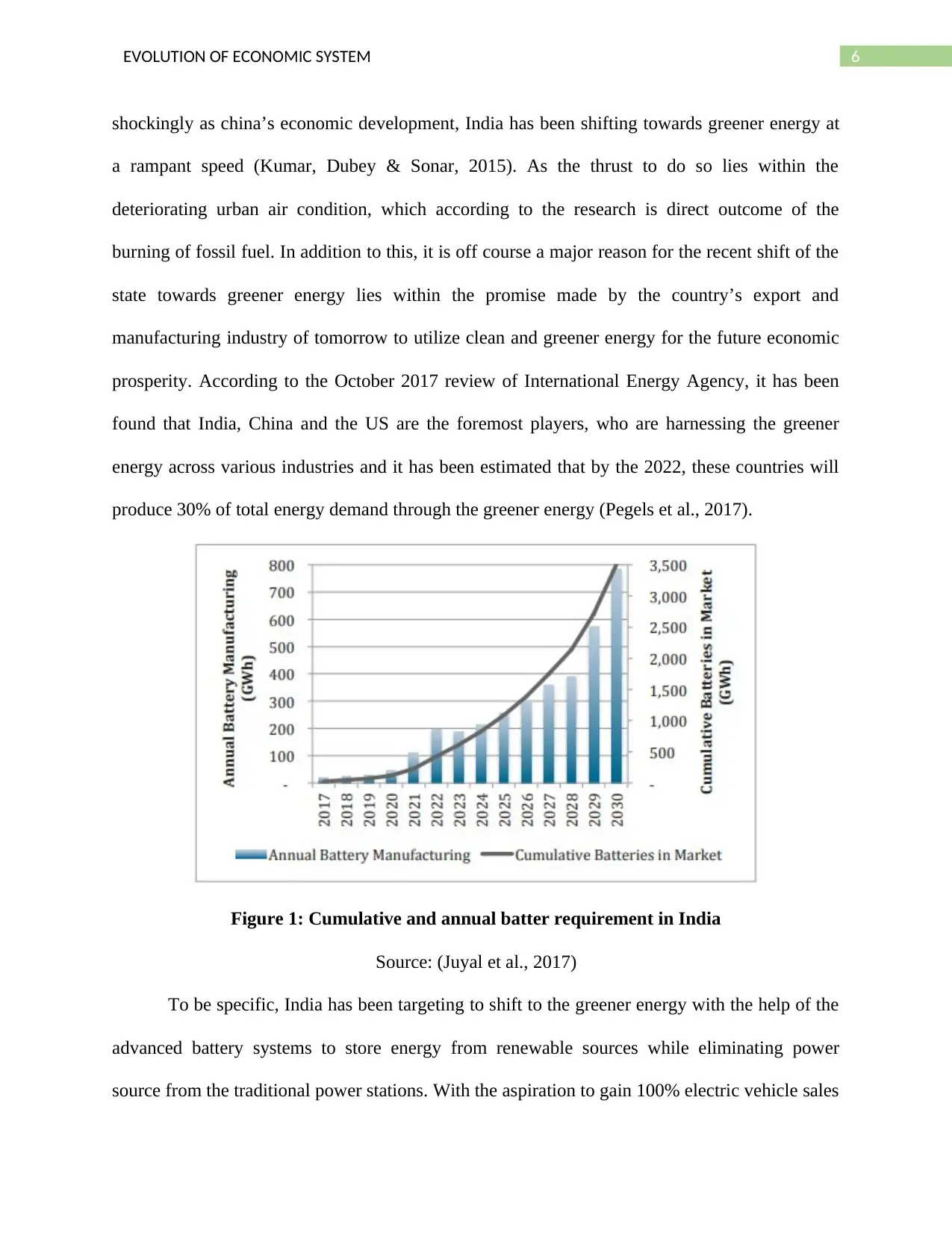
Figure 1: Cumulative and annual batter requirement in India
Source: (Juyal et al., 2017)
To be specific, India has been targeting to shift to the greener energy with the help of the
advanced battery systems to store energy from renewable sources while eliminating power
source from the traditional power stations. With the aspiration to gain 100% electric vehicle sales
shockingly as china’s economic development, India has been shifting towards greener energy at
a rampant speed (Kumar, Dubey & Sonar, 2015). As the thrust to do so lies within the
deteriorating urban air condition, which according to the research is direct outcome of the
burning of fossil fuel. In addition to this, it is off course a major reason for the recent shift of the
state towards greener energy lies within the promise made by the country’s export and
manufacturing industry of tomorrow to utilize clean and greener energy for the future economic
prosperity. According to the October 2017 review of International Energy Agency, it has been
found that India, China and the US are the foremost players, who are harnessing the greener
energy across various industries and it has been estimated that by the 2022, these countries will
produce 30% of total energy demand through the greener energy (Pegels et al., 2017).
Figure 1: Cumulative and annual batter requirement in India
Source: (Juyal et al., 2017)
To be specific, India has been targeting to shift to the greener energy with the help of the
advanced battery systems to store energy from renewable sources while eliminating power
source from the traditional power stations. With the aspiration to gain 100% electric vehicle sales
Paraphrase This Document
Need a fresh take? Get an instant paraphrase of this document with our AI Paraphraser
7EVOLUTION OF ECONOMIC SYSTEM
by the year 2030, India can rise among the top nations who manufacture storage batteries. India’s
market for the batteries is estimated to rise at 300 billion dollar by 2030 from 2017 (Safari et al.,
2018). According to the estimation, by 2030, India will be producing one third of global battery
demand it the nation achieves its aim of rapid transition as show in the figure 1. Among many
issues, cost of this advanced batteries is one of the main reason that has been hindering its
growth stage, however, Indian being into the market, it is expected that it will reduce the global
price sharply with its lower cost of production (Nagamani et al., 2015). In order to understand
the factors like price, that can hinder the growth of this latest greener technology, it is essential to
understand the basics regarding the advanced battery system. Thus, moving forward, this report
will put some light on the basics of this system, and then it will portray the Economy of solar and
battery stored electric supply in the country.
Energy storage and the factors that hamper the growth of new technology:
Since the last two decades, renewable technologies has matured to a large extent that has
been making shift in the global energy mix for the deployment across various sectors like
commercial, institutional, industrial and residential areas through the means of cost
competitiveness. This new greener energy source is bound to enhance the overall bankability of
the nation on the greener power at an affordable rate during the foreseeable future (Moallemi et
al., 2017). It is a well-known fact that both the wind and the solar technologies are infinite in
nature, however they are variable source and lacks dispatch ability in order to keep the electric
grid stable. Independent and continuous deployment of the green technologies id not highly
viable through these renewable resources unless there is a provision of energy storage that allows
to store clean wind and solar power instead of exporting it to the other place. Battery driven
energy storage system has been consistently held against investment, however cost effectiveness,
by the year 2030, India can rise among the top nations who manufacture storage batteries. India’s
market for the batteries is estimated to rise at 300 billion dollar by 2030 from 2017 (Safari et al.,
2018). According to the estimation, by 2030, India will be producing one third of global battery
demand it the nation achieves its aim of rapid transition as show in the figure 1. Among many
issues, cost of this advanced batteries is one of the main reason that has been hindering its
growth stage, however, Indian being into the market, it is expected that it will reduce the global
price sharply with its lower cost of production (Nagamani et al., 2015). In order to understand
the factors like price, that can hinder the growth of this latest greener technology, it is essential to
understand the basics regarding the advanced battery system. Thus, moving forward, this report
will put some light on the basics of this system, and then it will portray the Economy of solar and
battery stored electric supply in the country.
Energy storage and the factors that hamper the growth of new technology:
Since the last two decades, renewable technologies has matured to a large extent that has
been making shift in the global energy mix for the deployment across various sectors like
commercial, institutional, industrial and residential areas through the means of cost
competitiveness. This new greener energy source is bound to enhance the overall bankability of
the nation on the greener power at an affordable rate during the foreseeable future (Moallemi et
al., 2017). It is a well-known fact that both the wind and the solar technologies are infinite in
nature, however they are variable source and lacks dispatch ability in order to keep the electric
grid stable. Independent and continuous deployment of the green technologies id not highly
viable through these renewable resources unless there is a provision of energy storage that allows
to store clean wind and solar power instead of exporting it to the other place. Battery driven
energy storage system has been consistently held against investment, however cost effectiveness,
8EVOLUTION OF ECONOMIC SYSTEM
safe and ever evolving storage technologies of the India can change the economies of allowing
the cleaner energy power into the power generation stream (Mathur, Pandey & Roy, 2017). One
of the main reason for the change in the energy storage demand is basically driven by the
changing utility landscape of the nation that need more storage capacity to comply with the
rapidly increasing demand. Delivery of the reliable, uninterrupted and stable source of greener
energy is the ultimate need of the future generation for the survivability in the planet earth. It can
reduce the ineffectiveness of the rural areas to have electric at affordable price and allow the
government to shelf its burden of carbon footprint by a large extent (Tripathi et al., 2016). Not
only this, energy storage through the battery driven system will allow to overcast the drawback
of the sun and wind lead power generation system that fails to produce power during the dusky
or rainy season. However, how India can do this, a blue print for the same is mentioned below.
India’s ambitious plan to become one of the largest producer of the battery driven greener
energy is sub divided into three different tier according to the details provided by the MNRE.
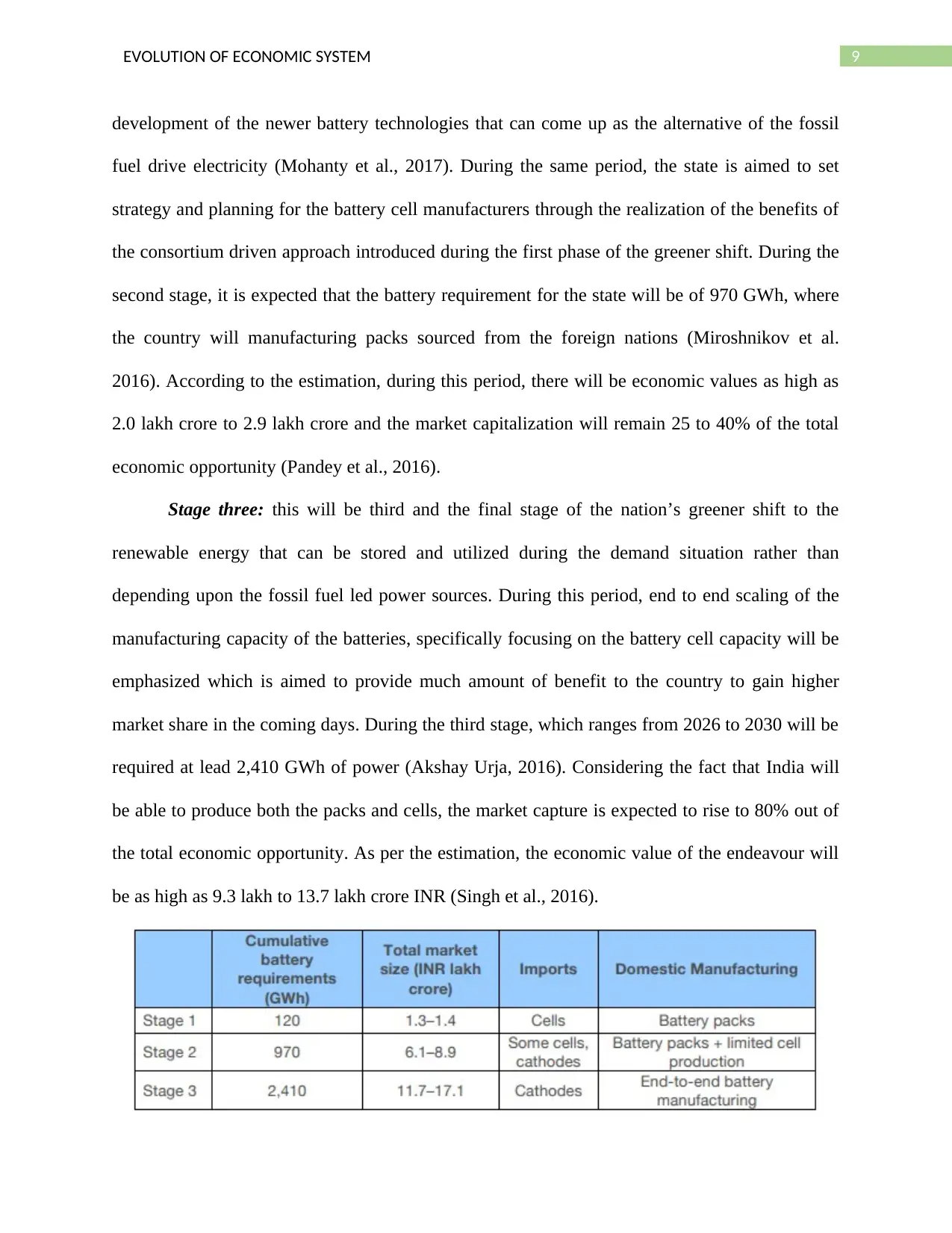
Stage one: developing the batter pack producing capacity and along with this establishing
the multi stakeholder research and development consortium in the state. India’s cumulative batter
requirement will be at 120 GWh within the time frame of 2017 to 2020 and the trajectory to
100% battery sales by the year 2030 (Talwar & Mathews, 2018). During this period, it is
assumed that India will produce battery pack from the imported cells, thus India can capture
economic opportunity through the endeavour that can range from 25 to 40$ of the total economic
opportunity through the sales of the battery. The value of the battery market of the state will be
around 0.4 lakh crore to 0.5 crore (Agarwal, Singhal & Darak, 2018).
Stage two: this period will start from 2021 and it will end by the end of the 2025 through
which, the state will develop supply chain, capitalize its investment on the research and
safe and ever evolving storage technologies of the India can change the economies of allowing
the cleaner energy power into the power generation stream (Mathur, Pandey & Roy, 2017). One
of the main reason for the change in the energy storage demand is basically driven by the
changing utility landscape of the nation that need more storage capacity to comply with the
rapidly increasing demand. Delivery of the reliable, uninterrupted and stable source of greener
energy is the ultimate need of the future generation for the survivability in the planet earth. It can
reduce the ineffectiveness of the rural areas to have electric at affordable price and allow the
government to shelf its burden of carbon footprint by a large extent (Tripathi et al., 2016). Not
only this, energy storage through the battery driven system will allow to overcast the drawback
of the sun and wind lead power generation system that fails to produce power during the dusky
or rainy season. However, how India can do this, a blue print for the same is mentioned below.
India’s ambitious plan to become one of the largest producer of the battery driven greener
energy is sub divided into three different tier according to the details provided by the MNRE.
Stage one: developing the batter pack producing capacity and along with this establishing
the multi stakeholder research and development consortium in the state. India’s cumulative batter
requirement will be at 120 GWh within the time frame of 2017 to 2020 and the trajectory to
100% battery sales by the year 2030 (Talwar & Mathews, 2018). During this period, it is
assumed that India will produce battery pack from the imported cells, thus India can capture
economic opportunity through the endeavour that can range from 25 to 40$ of the total economic
opportunity through the sales of the battery. The value of the battery market of the state will be
around 0.4 lakh crore to 0.5 crore (Agarwal, Singhal & Darak, 2018).
Stage two: this period will start from 2021 and it will end by the end of the 2025 through
which, the state will develop supply chain, capitalize its investment on the research and
⊘ This is a preview!⊘
Do you want full access?
Subscribe today to unlock all pages.
Trusted by 1+ million students worldwide
9EVOLUTION OF ECONOMIC SYSTEM
development of the newer battery technologies that can come up as the alternative of the fossil
fuel drive electricity (Mohanty et al., 2017). During the same period, the state is aimed to set
strategy and planning for the battery cell manufacturers through the realization of the benefits of
the consortium driven approach introduced during the first phase of the greener shift. During the
second stage, it is expected that the battery requirement for the state will be of 970 GWh, where
the country will manufacturing packs sourced from the foreign nations (Miroshnikov et al.
2016). According to the estimation, during this period, there will be economic values as high as
2.0 lakh crore to 2.9 lakh crore and the market capitalization will remain 25 to 40% of the total
economic opportunity (Pandey et al., 2016).
Stage three: this will be third and the final stage of the nation’s greener shift to the
renewable energy that can be stored and utilized during the demand situation rather than
depending upon the fossil fuel led power sources. During this period, end to end scaling of the
manufacturing capacity of the batteries, specifically focusing on the battery cell capacity will be
emphasized which is aimed to provide much amount of benefit to the country to gain higher
market share in the coming days. During the third stage, which ranges from 2026 to 2030 will be
required at lead 2,410 GWh of power (Akshay Urja, 2016). Considering the fact that India will
be able to produce both the packs and cells, the market capture is expected to rise to 80% out of
the total economic opportunity. As per the estimation, the economic value of the endeavour will
be as high as 9.3 lakh to 13.7 lakh crore INR (Singh et al., 2016).
development of the newer battery technologies that can come up as the alternative of the fossil
fuel drive electricity (Mohanty et al., 2017). During the same period, the state is aimed to set
strategy and planning for the battery cell manufacturers through the realization of the benefits of
the consortium driven approach introduced during the first phase of the greener shift. During the
second stage, it is expected that the battery requirement for the state will be of 970 GWh, where
the country will manufacturing packs sourced from the foreign nations (Miroshnikov et al.
2016). According to the estimation, during this period, there will be economic values as high as
2.0 lakh crore to 2.9 lakh crore and the market capitalization will remain 25 to 40% of the total
economic opportunity (Pandey et al., 2016).
Stage three: this will be third and the final stage of the nation’s greener shift to the
renewable energy that can be stored and utilized during the demand situation rather than
depending upon the fossil fuel led power sources. During this period, end to end scaling of the
manufacturing capacity of the batteries, specifically focusing on the battery cell capacity will be
emphasized which is aimed to provide much amount of benefit to the country to gain higher
market share in the coming days. During the third stage, which ranges from 2026 to 2030 will be
required at lead 2,410 GWh of power (Akshay Urja, 2016). Considering the fact that India will
be able to produce both the packs and cells, the market capture is expected to rise to 80% out of
the total economic opportunity. As per the estimation, the economic value of the endeavour will
be as high as 9.3 lakh to 13.7 lakh crore INR (Singh et al., 2016).
Paraphrase This Document
Need a fresh take? Get an instant paraphrase of this document with our AI Paraphraser
10EVOLUTION OF ECONOMIC SYSTEM
Figure 2: Summarized overview of the three stages
Source: (Juyal et al., 2017)
Figure 2 highlights the summarized overview of the finding of the three stages of the
battery driven energy source of the India. Depending upon the above mentioned forecasts by the
MNRE it can be perceived that there will be various issues arise during the implementation of
the plan, which primarily lies within the research and development, factors of production, supply
chain management, market capitalization, production cost and the overall market price of the
product. In addition to this, ability of the system to provide uninterrupted power and being
evolve itself as the alternative to the fossil fuel driven source will be key issue (Akshay Urja,
2016). In order to understand the ways to overcome the issues that the new technology is facing,
it is important to understand the technology of the same and gather knowledge regarding the
balance of the system is crucial. Next section of this report will portray the details regarding the
technology of the storage battery and its application and elaborate the details regarding the
balance of the system.
Storage Battery Technologies application:
India is one of the developing nations that suffers from the lack of electricity till in the
21st century due to the ever rising demand of the energy and its inability to harness the renewable
source of the energy completely in present date. There are more than 1.3 billion people in the
state who still not have access to the electricity (Alstone et al., 2015). Under this situation,
government of the country was forced to rethink about its energy strategies and they come up
with the solar batteries that can power the houses, industrial areas, automobiles and all the other
things that need electricity to operate. Though the wind and solar power was present in the
international market and in small numbers in the country, it was not accepted by most of the
Figure 2: Summarized overview of the three stages
Source: (Juyal et al., 2017)
Figure 2 highlights the summarized overview of the finding of the three stages of the
battery driven energy source of the India. Depending upon the above mentioned forecasts by the
MNRE it can be perceived that there will be various issues arise during the implementation of
the plan, which primarily lies within the research and development, factors of production, supply
chain management, market capitalization, production cost and the overall market price of the
product. In addition to this, ability of the system to provide uninterrupted power and being
evolve itself as the alternative to the fossil fuel driven source will be key issue (Akshay Urja,
2016). In order to understand the ways to overcome the issues that the new technology is facing,
it is important to understand the technology of the same and gather knowledge regarding the
balance of the system is crucial. Next section of this report will portray the details regarding the
technology of the storage battery and its application and elaborate the details regarding the
balance of the system.
Storage Battery Technologies application:
India is one of the developing nations that suffers from the lack of electricity till in the
21st century due to the ever rising demand of the energy and its inability to harness the renewable
source of the energy completely in present date. There are more than 1.3 billion people in the
state who still not have access to the electricity (Alstone et al., 2015). Under this situation,
government of the country was forced to rethink about its energy strategies and they come up
with the solar batteries that can power the houses, industrial areas, automobiles and all the other
things that need electricity to operate. Though the wind and solar power was present in the
international market and in small numbers in the country, it was not accepted by most of the
11EVOLUTION OF ECONOMIC SYSTEM
population of the state due to large cost of installation (Karakaya & Sriwannawit, 2015). Thus it
has become evident for the government to bring in other plans like storage battery that can
provide power all around the irrespective of the weather at a comparatively lower cost to the solo
wind or photo voltaic cell. Under this new regime photo voltaic cells come along the lithium ion
batteries that can produce electricity of 28 MW to 40 MW energy utilizing the powers from the
wind or solar energy and provide electricity to all the electric appliances irrespective of the
weather condition (Den et al., 2017). This new technology can be utilized in various field like
households, vehicles, mining sector, pumping stations, weather tracking station, Oil and gas sites
and many more, that makes it a universal alternative source of the fossil fuel driven power
supply. Thus, it is one of the renovating idea that can change the future of the country as well as
to the world.
Balance of Systems:
BOS or the Balance of System component of a grid scale energy storage is the future of
the India’s energy demand in the future. Balance of the system is the ability of the system to
store energy per unit of value and according the estimation, as the technology will grow it will
face reduction in the same (Den et al., 2017). With the higher incentive to install behind-the-
meter batteries will provide the users stability to have energy irrespective of the natural condition
and in addition to this it can provide much amount of cost benefit to the users rather than
utilizing only the front-of-meter as the source of the power. As the research and development
will enhance, India will be able to produce large scale batteries that can power up the large scale
industries and provide backup power to the same in absence of the solar or wind power. It will
maintain the balance of economy system as well as aid the country to reduce its carbon footprint.
According the estimation, during the next five year, there will be fall in the cost by the 40%,
population of the state due to large cost of installation (Karakaya & Sriwannawit, 2015). Thus it
has become evident for the government to bring in other plans like storage battery that can
provide power all around the irrespective of the weather at a comparatively lower cost to the solo
wind or photo voltaic cell. Under this new regime photo voltaic cells come along the lithium ion
batteries that can produce electricity of 28 MW to 40 MW energy utilizing the powers from the
wind or solar energy and provide electricity to all the electric appliances irrespective of the
weather condition (Den et al., 2017). This new technology can be utilized in various field like
households, vehicles, mining sector, pumping stations, weather tracking station, Oil and gas sites
and many more, that makes it a universal alternative source of the fossil fuel driven power
supply. Thus, it is one of the renovating idea that can change the future of the country as well as
to the world.
Balance of Systems:
BOS or the Balance of System component of a grid scale energy storage is the future of
the India’s energy demand in the future. Balance of the system is the ability of the system to
store energy per unit of value and according the estimation, as the technology will grow it will
face reduction in the same (Den et al., 2017). With the higher incentive to install behind-the-
meter batteries will provide the users stability to have energy irrespective of the natural condition
and in addition to this it can provide much amount of cost benefit to the users rather than
utilizing only the front-of-meter as the source of the power. As the research and development
will enhance, India will be able to produce large scale batteries that can power up the large scale
industries and provide backup power to the same in absence of the solar or wind power. It will
maintain the balance of economy system as well as aid the country to reduce its carbon footprint.
According the estimation, during the next five year, there will be fall in the cost by the 40%,
⊘ This is a preview!⊘
Do you want full access?
Subscribe today to unlock all pages.
Trusted by 1+ million students worldwide

1 out of 19


Related Documents


Your All-in-One AI-Powered Toolkit for Academic Success.
+13062052269
info@desklib.com
Available 24*7 on WhatsApp / Email
![[object Object]](/_next/static/media/star-bottom.7253800d.svg)
Unlock your academic potential
Copyright © 2020–2026 A2Z Services. All Rights Reserved. Developed and managed by ZUCOL.