Management Theory and Practice: Evolution from Industrial Era
VerifiedAdded on 2022/12/09
|9
|2780
|198
Report
AI Summary
This report provides a comprehensive overview of the evolution of management theory and practice, tracing its development from pre-industrial times through the industrial revolution and into the post-industrial era. It explores key milestones, including the emergence of management practices in ancient civilizations, the impact of the industrial revolution on the need for structured management, and the development of scientific, administrative, and bureaucratic management theories. The report also examines the contributions of prominent figures like Frederick Winslow Taylor and Henri Fayol, and the shift towards behavioral management in the post-industrial era. Furthermore, it discusses the current management practices adopted by companies like Next Plc, focusing on operational, informational, and systems approaches. The report concludes by highlighting the factors shaping future management practices, such as technological advancements, globalization, and changing social expectations.
Evolution of
Management Theory
and Practice
Management Theory
and Practice

Paraphrase This Document
Need a fresh take? Get an instant paraphrase of this document with our AI Paraphraser
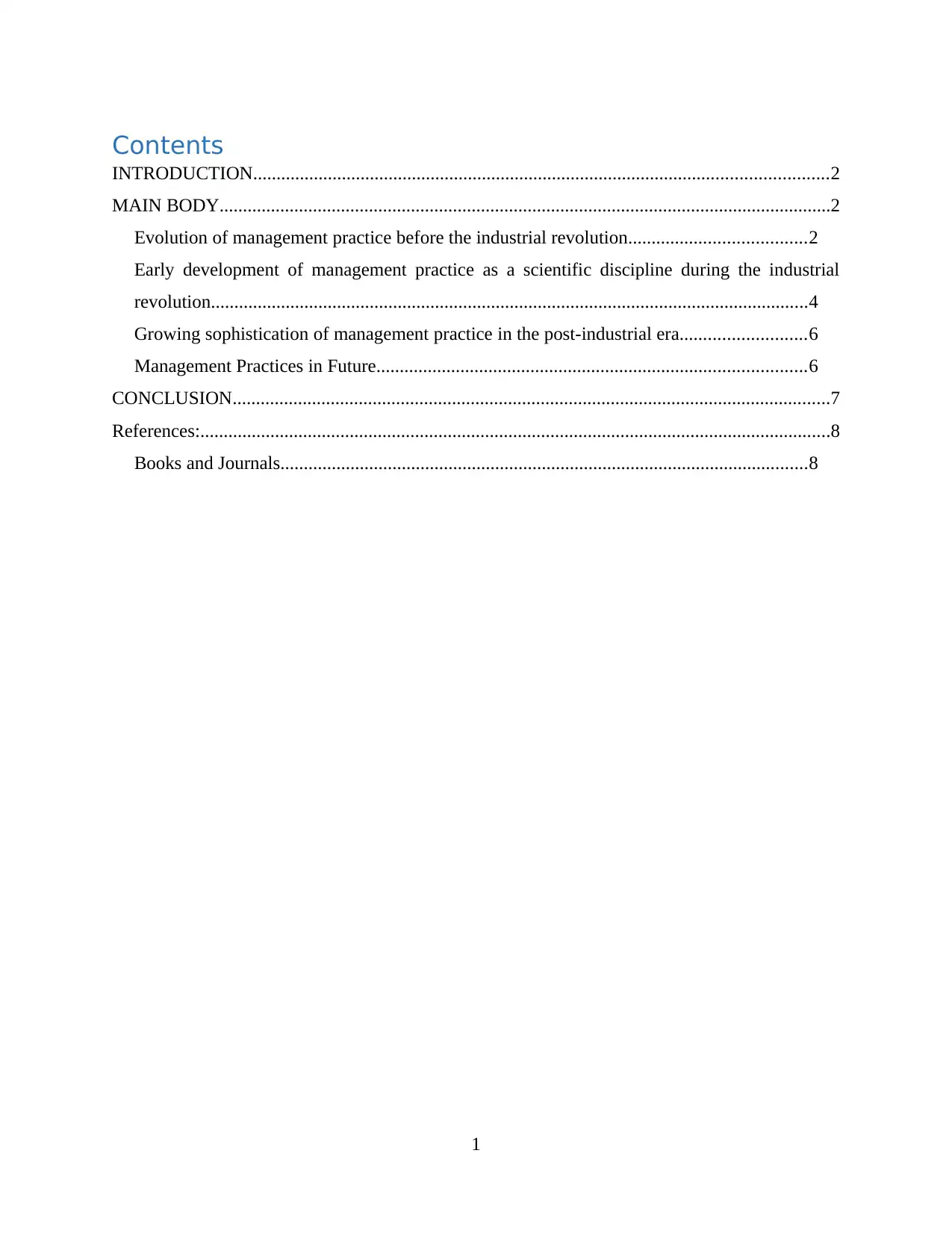
Contents
INTRODUCTION...........................................................................................................................2
MAIN BODY...................................................................................................................................2
Evolution of management practice before the industrial revolution......................................2
Early development of management practice as a scientific discipline during the industrial
revolution................................................................................................................................4
Growing sophistication of management practice in the post-industrial era...........................6
Management Practices in Future............................................................................................6
CONCLUSION................................................................................................................................7
References:.......................................................................................................................................8
Books and Journals.................................................................................................................8
1
INTRODUCTION...........................................................................................................................2
MAIN BODY...................................................................................................................................2
Evolution of management practice before the industrial revolution......................................2
Early development of management practice as a scientific discipline during the industrial
revolution................................................................................................................................4
Growing sophistication of management practice in the post-industrial era...........................6
Management Practices in Future............................................................................................6
CONCLUSION................................................................................................................................7
References:.......................................................................................................................................8
Books and Journals.................................................................................................................8
1
INTRODUCTION
In order to operate and run its business activities it is essential for each and every business firm
to have best management practices which would guide and manage the business activities in such
a way that the end result is attainment of organisational goals and objectives. Due to the industry
revolution and mass production need for managing people and process emerged out and in order
to meet such requirements new management theories and practices were developed which were
only applicable to few organisations and militaries prior to industrial revolution (Liang, Zhang
and Su, 2020). Therefore, Management Practices can be defined as the collection of ideas
suggested and recommended in order to manage the business or organisations with the set of
rules and policies. They suggest which strategy should be adopted so as to goals and objectives
of a business is obtained. Next Plc is one of the largest clothing multinational firm, established in
the year 1864, headquartered at Enderby, United Kingdom. The report covers emergence of
management practice before, during and post industrial revolution.
MAIN BODY
Emergence of management practice prior to the industrial revolution
Inception of management is can be traced back to the year 500B.C when Sumerian traders
prepared written records for commercial and government purpose. Evidently, the concept of
Management also applied to the construction of Pyramid of Egypt in Egyptian Civilization as
early as 4000-3000B.C, with millions of block and services of people. This structure can only be
built with extensive planning, organising, controlling and directing the efforts which is true
testimonial to the management practices. Roman Empire also used management practices to
manage the large Roman Empire which is clearly visible in their western military hierarchy and
public administration system (Cleland and Durning, 2019). Therefore it is evident that
management process started in the early days of men where people felt the need to live in groups.
However, Industrial revolution brought major and drastic change into the management, its
theories and practices. Industrial revolution in United Kingdom took place in the mid of 19 the
century and subsequently British people migrated to Australia and brought their wisdom in
Australia bringing an industrial revolution in Australia.
2
In order to operate and run its business activities it is essential for each and every business firm
to have best management practices which would guide and manage the business activities in such
a way that the end result is attainment of organisational goals and objectives. Due to the industry
revolution and mass production need for managing people and process emerged out and in order
to meet such requirements new management theories and practices were developed which were
only applicable to few organisations and militaries prior to industrial revolution (Liang, Zhang
and Su, 2020). Therefore, Management Practices can be defined as the collection of ideas
suggested and recommended in order to manage the business or organisations with the set of
rules and policies. They suggest which strategy should be adopted so as to goals and objectives
of a business is obtained. Next Plc is one of the largest clothing multinational firm, established in
the year 1864, headquartered at Enderby, United Kingdom. The report covers emergence of
management practice before, during and post industrial revolution.
MAIN BODY
Emergence of management practice prior to the industrial revolution
Inception of management is can be traced back to the year 500B.C when Sumerian traders
prepared written records for commercial and government purpose. Evidently, the concept of
Management also applied to the construction of Pyramid of Egypt in Egyptian Civilization as
early as 4000-3000B.C, with millions of block and services of people. This structure can only be
built with extensive planning, organising, controlling and directing the efforts which is true
testimonial to the management practices. Roman Empire also used management practices to
manage the large Roman Empire which is clearly visible in their western military hierarchy and
public administration system (Cleland and Durning, 2019). Therefore it is evident that
management process started in the early days of men where people felt the need to live in groups.
However, Industrial revolution brought major and drastic change into the management, its
theories and practices. Industrial revolution in United Kingdom took place in the mid of 19 the
century and subsequently British people migrated to Australia and brought their wisdom in
Australia bringing an industrial revolution in Australia.
2
⊘ This is a preview!⊘
Do you want full access?
Subscribe today to unlock all pages.

Trusted by 1+ million students worldwide
Evolution of Management is through is classified into four categories for the better
understanding which is as follows:
Pre Scientific Management Period: Industrial revolution which took place way
back in 18th century made a radical changes to the management. The management
of business and individual completely changed with regards to the raising capital,
management of human resources and production of goods and services (Balzer and
et. al., 2019). In order to achieve target goals successfully Entrepreneurs made
efforts for acquiring and combining numerous factors of production such as land,
labour and capital. However, ned dimension of management took place with the
efforts of two personalities which are:
Professor Charles Babbage (1729-1871) who urged the manufacturers to use science and
mathematics in the production process to be more precise and productive rather than guesswork
and suggestion and;
Robert Owens (1771-1858) Robert Owens was regarded as the father of personnel management
due to his approach based of employee welfare. He believed that employee welfare can improve
the performance level and thus introduced trade unions and cooperation along with education
and training of workers.
The classical theory: Beginning of science management can be traced back to the
last decade of 19th century where eminent personalities such as Frederick Winslow
Taylor, Emerson, and H.L. Grant contributed largely towards the development of
scientific management. During this period the major focus was on the
standardization, job content, division of labour, and a scientific approach towards
the organisation. Large enterprises and industrial revolution were taking place at
this time.
Neo-Classical theory: Evolution of management thought have come up with new
changes and modification (Shad and et. al., 2019). Neo classical theory was the
update version of classical theory which focused more on building employee
relationship at workplace which is directly proportionate to the performance level
of employees.
The Bureaucratic model : This theory was suggested by Max Weber who laid
emphasis over division of labour as per the functions of management, legal
3
understanding which is as follows:
Pre Scientific Management Period: Industrial revolution which took place way
back in 18th century made a radical changes to the management. The management
of business and individual completely changed with regards to the raising capital,
management of human resources and production of goods and services (Balzer and
et. al., 2019). In order to achieve target goals successfully Entrepreneurs made
efforts for acquiring and combining numerous factors of production such as land,
labour and capital. However, ned dimension of management took place with the
efforts of two personalities which are:
Professor Charles Babbage (1729-1871) who urged the manufacturers to use science and
mathematics in the production process to be more precise and productive rather than guesswork
and suggestion and;
Robert Owens (1771-1858) Robert Owens was regarded as the father of personnel management
due to his approach based of employee welfare. He believed that employee welfare can improve
the performance level and thus introduced trade unions and cooperation along with education
and training of workers.
The classical theory: Beginning of science management can be traced back to the
last decade of 19th century where eminent personalities such as Frederick Winslow
Taylor, Emerson, and H.L. Grant contributed largely towards the development of
scientific management. During this period the major focus was on the
standardization, job content, division of labour, and a scientific approach towards
the organisation. Large enterprises and industrial revolution were taking place at
this time.
Neo-Classical theory: Evolution of management thought have come up with new
changes and modification (Shad and et. al., 2019). Neo classical theory was the
update version of classical theory which focused more on building employee
relationship at workplace which is directly proportionate to the performance level
of employees.
The Bureaucratic model : This theory was suggested by Max Weber who laid
emphasis over division of labour as per the functions of management, legal
3
Paraphrase This Document
Need a fresh take? Get an instant paraphrase of this document with our AI Paraphraser
authority, distribution of power and hierarchy level, system of rules and selection
of employees on the basis of their skills and technical competence.
Management theories had been evolved through the writings of several writes who propose the
governance of kingdom and overall management. Many political, religious and military
organisations also offered management models such as Sun a Chinese Army General wrote
“Art of War” or Chanakya’s Arthashastra served as a basis for development of many
management theories and practices (Tourish and Craig, 2020).
Early development of management practice as a scientific discipline during the industrial
revolution
Scientific Management
Management of Science generated revolutionary ideas during the time of industrial
revolution where more emphasis were put on employee training and implementing standardized
practices with the aim of improving productivity. Frederick Winslow Taylor’s theory is called
scientific approach as he employed the techniques which he borrowed from botanist and chemist
such as observation, synthesis, rationality, logic and analysis. Before industrial revolution,
businesses were small, constituting barely 3-4 people, owners used to work closely with other
employees, However, industrial revolution changes the dynamics of workplace and owner does
not possess good relation with the employees and were working hard so as not be get fired.
Taylor, being a mechanical engineer was interested in work done in factories and mechanical
shops believed that system could be improved and came with the idea of incentive in monetary
terms.
He suggested that worker at ground level should get “a fair day’s pay for fair day’s work
and along with that believed that management and workers must cooperate and work together to
achieve an organisational goals (Martin and et. al., 2019). In the year 1909, Taylor published the
book Principles of Scientific Management where he suggested four principles which is applied to
even modern organisations, here in context of Next Plc, since then he is regarded as the father of
Scientific Management.
This principle is a replacement of earlier” rule of thumb” where workers were let
themselves to do the work the way they want. The principle suggest that look at each job
scientifically and identify the best way to perform job and the jobs must be simplified in
order to enhance productivity.
4
of employees on the basis of their skills and technical competence.
Management theories had been evolved through the writings of several writes who propose the
governance of kingdom and overall management. Many political, religious and military
organisations also offered management models such as Sun a Chinese Army General wrote
“Art of War” or Chanakya’s Arthashastra served as a basis for development of many
management theories and practices (Tourish and Craig, 2020).
Early development of management practice as a scientific discipline during the industrial
revolution
Scientific Management
Management of Science generated revolutionary ideas during the time of industrial
revolution where more emphasis were put on employee training and implementing standardized
practices with the aim of improving productivity. Frederick Winslow Taylor’s theory is called
scientific approach as he employed the techniques which he borrowed from botanist and chemist
such as observation, synthesis, rationality, logic and analysis. Before industrial revolution,
businesses were small, constituting barely 3-4 people, owners used to work closely with other
employees, However, industrial revolution changes the dynamics of workplace and owner does
not possess good relation with the employees and were working hard so as not be get fired.
Taylor, being a mechanical engineer was interested in work done in factories and mechanical
shops believed that system could be improved and came with the idea of incentive in monetary
terms.
He suggested that worker at ground level should get “a fair day’s pay for fair day’s work
and along with that believed that management and workers must cooperate and work together to
achieve an organisational goals (Martin and et. al., 2019). In the year 1909, Taylor published the
book Principles of Scientific Management where he suggested four principles which is applied to
even modern organisations, here in context of Next Plc, since then he is regarded as the father of
Scientific Management.
This principle is a replacement of earlier” rule of thumb” where workers were let
themselves to do the work the way they want. The principle suggest that look at each job
scientifically and identify the best way to perform job and the jobs must be simplified in
order to enhance productivity.
4
Hire workers as per the job role and skills required to execute job task and provide
training to work efficiently.
Monitor performance of workers at each level with proper instructions and guidance; and
provide sufficient training when needed.
And Divide the work between management and worker so that worker cam work
efficiently while management takes care of planning and training (Cobarrubias, 2019).
Administrative Management Theory
Henri Fayol was contemporary with F.W. Taylor and started his career at the age of 19 in
a French Mining company and soon become director, managing over 1000 people. He developed
the theory on the basis of examination of organisation through the perspective of managers and
as per the situation they may face. He was agree with F.W Taylor that many managers don’t
interact well with their employees, however he developed the theory which was not based on
science like Taylor, rather focused on creating an efficient organisation structure by suggesting
how a leader must interact and organise the team member. He developed those principle when he
witnessed failure of management when no one had authority to purchase a resources due to
which his mine was closed. Fourteen principles suggested by Henri Fayol were scalar chain,
remuneration of personnel, initiative, equity, authority and responsibility, unity of command,
centralization, order, and subordination of interest to general interest, stability of tenure, espirit
de corps unity of direction, discipline and division of work.
Bureaucratic Management Theory
This Bureaucratic Management theory was developed by the Max Weber who laid emphasis on
structuring the organisation in a hierarchy so that there are clear rules of governance and
understanding of who will report to whom (Crede and Harms, 2019). Max Weber believed that
all the managers in Next Plc must build chains of command, clear division of labour, strict and
consistent rules and regulations, separation of personal and organisational assets of owner,
detailed recordkeeping and documentation, selection and promotion of employees and
standardisation. Weber differs from other theorists because he realise that change in technology
can lead to a toxic workplace and can affect a morale of an employees, that is why his principle
is based on emotions and negative aspects.
5
training to work efficiently.
Monitor performance of workers at each level with proper instructions and guidance; and
provide sufficient training when needed.
And Divide the work between management and worker so that worker cam work
efficiently while management takes care of planning and training (Cobarrubias, 2019).
Administrative Management Theory
Henri Fayol was contemporary with F.W. Taylor and started his career at the age of 19 in
a French Mining company and soon become director, managing over 1000 people. He developed
the theory on the basis of examination of organisation through the perspective of managers and
as per the situation they may face. He was agree with F.W Taylor that many managers don’t
interact well with their employees, however he developed the theory which was not based on
science like Taylor, rather focused on creating an efficient organisation structure by suggesting
how a leader must interact and organise the team member. He developed those principle when he
witnessed failure of management when no one had authority to purchase a resources due to
which his mine was closed. Fourteen principles suggested by Henri Fayol were scalar chain,
remuneration of personnel, initiative, equity, authority and responsibility, unity of command,
centralization, order, and subordination of interest to general interest, stability of tenure, espirit
de corps unity of direction, discipline and division of work.
Bureaucratic Management Theory
This Bureaucratic Management theory was developed by the Max Weber who laid emphasis on
structuring the organisation in a hierarchy so that there are clear rules of governance and
understanding of who will report to whom (Crede and Harms, 2019). Max Weber believed that
all the managers in Next Plc must build chains of command, clear division of labour, strict and
consistent rules and regulations, separation of personal and organisational assets of owner,
detailed recordkeeping and documentation, selection and promotion of employees and
standardisation. Weber differs from other theorists because he realise that change in technology
can lead to a toxic workplace and can affect a morale of an employees, that is why his principle
is based on emotions and negative aspects.
5
⊘ This is a preview!⊘
Do you want full access?
Subscribe today to unlock all pages.
Trusted by 1+ million students worldwide
Growing sophistication of management practice in the post-industrial era
Post industrial revolution has brought many changes into the world and in management of
a business as well. Management of post-industrial focus on management and integration of
system into businesses rather than management of people. The prime objective of modern
management is to keep up the pace with the changes in the environment such as changes in
product and process technology, changes in methods of distribution, changes in outsourcing and
supply chain management, changes in market and changes in the methods of funding (Zhang and
et. al., 2019). Management of Next Plc is largely focused on forecasting the changes in the
market and develop a better and good quality product, process and procedures. Next Plc adopt
few of the practices post industrial revolution which are listed below: Behavioural Management Theory: Rise in complex industries and big enterprise have
given rise to the management theories focusing on the aspects of human resources.
People oriented methods were included by Next Plc in the theories and practices of
management which focus majorly on human behaviour and interpersonal needs that act as
a basis for management to motivate the employees towards the achievement of
organisational goals. It is constitute by two major theories:
Human relation theory: The theory was developed by Elton Mayo with the aim of increasing
productivity of employees making it a basis of building employee relationships. He focused on
changing working conditions at workplace such as lighting, break time and length of working
day which significantly improved the performance. However later it was realised that
performance was improves by making them feel valued and paying attention to them rather than
on working conditions.
Behavioural Science Theory: This theory combine the elements of sociology, anthropology and
psychology to identify why employees are motivated by the specific factors such as social needs,
conflicts, and self-actualization needs (Zhang, Oo and Lim, 2019).
Management Practices in Future
There are many factors which have forced the companies to opt for a recent management
theories which will help them keep a perfect balance between the management and resources at
the same time to achieve long term objectives of business. Changes in technology, globalization,
diversity, social expectation and pace of changes are the several factors which shapes the
management practices for future. Managers of Next Plc are focusing more on specific aspects of
6
Post industrial revolution has brought many changes into the world and in management of
a business as well. Management of post-industrial focus on management and integration of
system into businesses rather than management of people. The prime objective of modern
management is to keep up the pace with the changes in the environment such as changes in
product and process technology, changes in methods of distribution, changes in outsourcing and
supply chain management, changes in market and changes in the methods of funding (Zhang and
et. al., 2019). Management of Next Plc is largely focused on forecasting the changes in the
market and develop a better and good quality product, process and procedures. Next Plc adopt
few of the practices post industrial revolution which are listed below: Behavioural Management Theory: Rise in complex industries and big enterprise have
given rise to the management theories focusing on the aspects of human resources.
People oriented methods were included by Next Plc in the theories and practices of
management which focus majorly on human behaviour and interpersonal needs that act as
a basis for management to motivate the employees towards the achievement of
organisational goals. It is constitute by two major theories:
Human relation theory: The theory was developed by Elton Mayo with the aim of increasing
productivity of employees making it a basis of building employee relationships. He focused on
changing working conditions at workplace such as lighting, break time and length of working
day which significantly improved the performance. However later it was realised that
performance was improves by making them feel valued and paying attention to them rather than
on working conditions.
Behavioural Science Theory: This theory combine the elements of sociology, anthropology and
psychology to identify why employees are motivated by the specific factors such as social needs,
conflicts, and self-actualization needs (Zhang, Oo and Lim, 2019).
Management Practices in Future
There are many factors which have forced the companies to opt for a recent management
theories which will help them keep a perfect balance between the management and resources at
the same time to achieve long term objectives of business. Changes in technology, globalization,
diversity, social expectation and pace of changes are the several factors which shapes the
management practices for future. Managers of Next Plc are focusing more on specific aspects of
6
Paraphrase This Document
Need a fresh take? Get an instant paraphrase of this document with our AI Paraphraser
organisational management such as finance management, marketing management, human
resource management and operation management. By considering the distinct department
managers develops practice which help in addressing the issue in a relevant discipline (Liang,
Zhang and Su, 2020). Operation management: The prime objective of this type of theory is to ensure that
conversion of raw material into finished goods must be conducted in an efficient and
productive way. Information management: The theory will focus on the management of information
system which is helpful for Next Plc in getting right amount of information with accuracy
in decision making. Information management looks for the distinct aspects such as
collection, preservation, storage, processing and delivery of information to the tight
people at right time. System approach to management: This approach states that the Next Plc is a open
system where it gets input from suppliers, operate in an environment which include
competitors, government, and economy, firms ability to produce goods with the help of
resources, capabilities and competencies to deliver output to the customer from which
company get feedback from market in two forms; one is in the form of sales revenue and
another one is how well company is doing (Cleland and Durning, 2019).
CONCLUSION
From the above mentioned report it is being concluded and analysed that with the change
in time business and business activities have evolved over a period of time. In order to manage
and conduct operational activities it is essential for each business to opt for a best management
practices and theories which act as basis for strategy formulation which in turn help in attaining
organisational goals with the efficient and effective utilisation of resources. With the changing
environment way of doing business is changing and management practices too which contribute
towards the management of business activities in a productive way.
7
resource management and operation management. By considering the distinct department
managers develops practice which help in addressing the issue in a relevant discipline (Liang,
Zhang and Su, 2020). Operation management: The prime objective of this type of theory is to ensure that
conversion of raw material into finished goods must be conducted in an efficient and
productive way. Information management: The theory will focus on the management of information
system which is helpful for Next Plc in getting right amount of information with accuracy
in decision making. Information management looks for the distinct aspects such as
collection, preservation, storage, processing and delivery of information to the tight
people at right time. System approach to management: This approach states that the Next Plc is a open
system where it gets input from suppliers, operate in an environment which include
competitors, government, and economy, firms ability to produce goods with the help of
resources, capabilities and competencies to deliver output to the customer from which
company get feedback from market in two forms; one is in the form of sales revenue and
another one is how well company is doing (Cleland and Durning, 2019).
CONCLUSION
From the above mentioned report it is being concluded and analysed that with the change
in time business and business activities have evolved over a period of time. In order to manage
and conduct operational activities it is essential for each business to opt for a best management
practices and theories which act as basis for strategy formulation which in turn help in attaining
organisational goals with the efficient and effective utilisation of resources. With the changing
environment way of doing business is changing and management practices too which contribute
towards the management of business activities in a productive way.
7
References:
Books and Journals
Balzer, W.K., and et. al., 2019. Revolution or 30-year fad? A role for IO psychology in Lean
management. Industrial and Organizational Psychology. 12(3). pp.215-233.
Cleland, J. and Durning, S.J., 2019. Education and service: how theories can help in
understanding tensions. Medical education. 53(1). pp.42-55.
Cobarrubias, S., 2019. Mapping illegality: The i‐map and the cartopolitics of “migration
management” at a distance. Antipode. 51(3). pp.770-794.
Crede, M. and Harms, P., 2019. Questionable research practices when using confirmatory factor
analysis. Journal of Managerial Psychology.
Liang, H., Zhang, S. and Su, Y., 2020. The structure and emerging trends of construction safety
management research: a bibliometric review. International Journal of Occupational
Safety and Ergonomics. 26(3),.pp.469-488.
Martin, F., and et. al., 2019. Award-winning faculty online teaching practices: Roles and
competencies. Online Learning, 23(1), pp.184-205.
Shad, M.K., and et. al., 2019. Integrating sustainability reporting into enterprise risk management
and its relationship with business performance: A conceptual framework. Journal of
Cleaner production. 208. pp.415-425.
Tourish, D. and Craig, R., 2020. Research misconduct in business and management studies:
Causes, consequences, and possible remedies. Journal of Management Inquiry. 29(2).
pp.174-187.
Zhang, Q., Oo, B.L. and Lim, B.T.H., 2019. Drivers, motivations, and barriers to the
implementation of corporate social responsibility practices by construction
enterprises: A review. Journal of cleaner production. 210. pp.563-584.
Zhang, Y., and et. al., 2019. The influence of management innovation and technological
innovation on organization performance. a mediating role of
sustainability. Sustainability. 11(2). p.495.
8
Books and Journals
Balzer, W.K., and et. al., 2019. Revolution or 30-year fad? A role for IO psychology in Lean
management. Industrial and Organizational Psychology. 12(3). pp.215-233.
Cleland, J. and Durning, S.J., 2019. Education and service: how theories can help in
understanding tensions. Medical education. 53(1). pp.42-55.
Cobarrubias, S., 2019. Mapping illegality: The i‐map and the cartopolitics of “migration
management” at a distance. Antipode. 51(3). pp.770-794.
Crede, M. and Harms, P., 2019. Questionable research practices when using confirmatory factor
analysis. Journal of Managerial Psychology.
Liang, H., Zhang, S. and Su, Y., 2020. The structure and emerging trends of construction safety
management research: a bibliometric review. International Journal of Occupational
Safety and Ergonomics. 26(3),.pp.469-488.
Martin, F., and et. al., 2019. Award-winning faculty online teaching practices: Roles and
competencies. Online Learning, 23(1), pp.184-205.
Shad, M.K., and et. al., 2019. Integrating sustainability reporting into enterprise risk management
and its relationship with business performance: A conceptual framework. Journal of
Cleaner production. 208. pp.415-425.
Tourish, D. and Craig, R., 2020. Research misconduct in business and management studies:
Causes, consequences, and possible remedies. Journal of Management Inquiry. 29(2).
pp.174-187.
Zhang, Q., Oo, B.L. and Lim, B.T.H., 2019. Drivers, motivations, and barriers to the
implementation of corporate social responsibility practices by construction
enterprises: A review. Journal of cleaner production. 210. pp.563-584.
Zhang, Y., and et. al., 2019. The influence of management innovation and technological
innovation on organization performance. a mediating role of
sustainability. Sustainability. 11(2). p.495.
8
⊘ This is a preview!⊘
Do you want full access?
Subscribe today to unlock all pages.
Trusted by 1+ million students worldwide

1 out of 9


Related Documents


Your All-in-One AI-Powered Toolkit for Academic Success.
+13062052269
info@desklib.com
Available 24*7 on WhatsApp / Email
![[object Object]](/_next/static/media/star-bottom.7253800d.svg)
Unlock your academic potential
Copyright © 2020–2026 A2Z Services. All Rights Reserved. Developed and managed by ZUCOL.