Comprehensive Report on Organizational Changes at Excelcare Holdings
VerifiedAdded on 2020/11/23
|16
|4514
|184
Report
AI Summary
This report provides a comprehensive analysis of the organizational changes experienced by Excelcare Holdings over the past five years. It begins with an introduction to organizational change and its significance, followed by a description of the significant changes undertaken by Excelcare, including the scope and purpose of these changes. The report delves into the company's history, strategic changes, and relevant timelines, along with an examination of the forces influencing change, using PESTLE and SWOT analyses to identify internal and external factors. Academic theories of change, such as the Punctuated Equilibrium Model, Grundy's theory, Kotter's theory, and Todnem's theory, are applied to the context of Excelcare to identify types of changes and differentiate between transitional and transformational changes. The report also explores Lewin's theory of change and the forcefield model, identifying forces for and against change within Excelcare. The analysis concludes with a discussion of the largest forces driving and resisting change, offering insights into the company's strategic direction and change management strategies.

EXCEL
HOMECARE
HOMECARE

Paraphrase This Document
Need a fresh take? Get an instant paraphrase of this document with our AI Paraphraser
Table of Contents
INTRODUCTION ..........................................................................................................................1
TASK 1............................................................................................................................................1
Describing briefly significant organisational changes undergone in last 5years...................1
1.1 Scope of organisational changes......................................................................................1
1.2 Purpose of organisational changes...................................................................................1
1.3 Information regarding Excelcare about his history, strategic change, relevant time line. 2
1.4 Forces against change in Excelcare holdings and for analysis of PESTLE AND SWOT 3
2.1 Academic Theory of Change and Exelcare .....................................................................4
2.2 Identification of types of changes according to theories of change.................................5
2.3 Difference between Transitional and Transformational Change......................................6
2.4 Aim of Organisational Change regards with strategic direction .....................................6
2.5 Identification of change that organisation is experiencing ..............................................7
2.6 Lewin theory of change and Lewins Forcefield Model in context of organisation change. .7
2.7 Identification of forces for change the Excelcare.............................................................8
2.8 Force which are against the Change in Excelcare............................................................9
2.9 Forcefield model ..............................................................................................................9
2.10 Positive and Negative impacts of forcefield model......................................................10
TASK 3 .........................................................................................................................................11
3.1 Largest force can leads to change ..................................................................................11
3.2 Largest force against change of Excelcare.....................................................................11
CONCLUSION..............................................................................................................................11
REFERENCES................................................................................................................................1
.........................................................................................................................................................1
INTRODUCTION ..........................................................................................................................1
TASK 1............................................................................................................................................1
Describing briefly significant organisational changes undergone in last 5years...................1
1.1 Scope of organisational changes......................................................................................1
1.2 Purpose of organisational changes...................................................................................1
1.3 Information regarding Excelcare about his history, strategic change, relevant time line. 2
1.4 Forces against change in Excelcare holdings and for analysis of PESTLE AND SWOT 3
2.1 Academic Theory of Change and Exelcare .....................................................................4
2.2 Identification of types of changes according to theories of change.................................5
2.3 Difference between Transitional and Transformational Change......................................6
2.4 Aim of Organisational Change regards with strategic direction .....................................6
2.5 Identification of change that organisation is experiencing ..............................................7
2.6 Lewin theory of change and Lewins Forcefield Model in context of organisation change. .7
2.7 Identification of forces for change the Excelcare.............................................................8
2.8 Force which are against the Change in Excelcare............................................................9
2.9 Forcefield model ..............................................................................................................9
2.10 Positive and Negative impacts of forcefield model......................................................10
TASK 3 .........................................................................................................................................11
3.1 Largest force can leads to change ..................................................................................11
3.2 Largest force against change of Excelcare.....................................................................11
CONCLUSION..............................................................................................................................11
REFERENCES................................................................................................................................1
.........................................................................................................................................................1
INTRODUCTION
Organisation change is the process in which changes occur in structure, strategies,
technologies that affected within an organisation. A company accepts to change for developing
purpose. For modern organisation, it is versatile and adaptive for multiple changes. This report is
based on Excelcare Holdings who provides high level of care. It was founded in 2000. They used
to provide health care services to peoples of all ages. In order to ensure the services provided are
issued them in their homes. The main purpose of this assignment is to ensure changes in
programme which aiming to achieve. It is here to analyses appropriately with PESTEL and
SWOT by summarising changes in an organisation.(Benge, 2016)
TASK 1
Describing briefly significant organisational changes undergone in last 5years.
Excelcare is a large organisation which run undergone changes in health and social care
sector or hospitality and event care sector in last 5 years. The changes or types of changes which
occur in an organisation with an aim to achieve by there experiences.
1.1 Scope of organisational changes
This reporting is going to cover the organisational changes in an academic theory. Their
are various types of changes which are opt by Excelcare holdings. In this, they are intended with
the analysis by PESTEL and SWOT to determine the changes. The company distinguishes
changes in between transitional and transformational in their available resources. Excelcare
deliver services at home by supporting people. Identification is in the forces of application, that
an organisation changes trying to achieve by using internal & external analysing tool. In last
5years, they are dealing with forcefield model to identify, it is better or not. PESTEL and SWOT
is also their, to find against forces lie in Excelcare. The company is on health care which lie
changes in order to deliver services. Internal and external analysis define the changing
programme with an aim to achieve in strategic direction.
1.2 Purpose of organisational changes
This report is in order to achieve growth, which undergone by changes in an organisation.
Using of internal and external analysis is done in order to indicate the transformation occurs in
organisation. Excelcare company changes its way of working, to attract customers. The aim of
Organisation change is the process in which changes occur in structure, strategies,
technologies that affected within an organisation. A company accepts to change for developing
purpose. For modern organisation, it is versatile and adaptive for multiple changes. This report is
based on Excelcare Holdings who provides high level of care. It was founded in 2000. They used
to provide health care services to peoples of all ages. In order to ensure the services provided are
issued them in their homes. The main purpose of this assignment is to ensure changes in
programme which aiming to achieve. It is here to analyses appropriately with PESTEL and
SWOT by summarising changes in an organisation.(Benge, 2016)
TASK 1
Describing briefly significant organisational changes undergone in last 5years.
Excelcare is a large organisation which run undergone changes in health and social care
sector or hospitality and event care sector in last 5 years. The changes or types of changes which
occur in an organisation with an aim to achieve by there experiences.
1.1 Scope of organisational changes
This reporting is going to cover the organisational changes in an academic theory. Their
are various types of changes which are opt by Excelcare holdings. In this, they are intended with
the analysis by PESTEL and SWOT to determine the changes. The company distinguishes
changes in between transitional and transformational in their available resources. Excelcare
deliver services at home by supporting people. Identification is in the forces of application, that
an organisation changes trying to achieve by using internal & external analysing tool. In last
5years, they are dealing with forcefield model to identify, it is better or not. PESTEL and SWOT
is also their, to find against forces lie in Excelcare. The company is on health care which lie
changes in order to deliver services. Internal and external analysis define the changing
programme with an aim to achieve in strategic direction.
1.2 Purpose of organisational changes
This report is in order to achieve growth, which undergone by changes in an organisation.
Using of internal and external analysis is done in order to indicate the transformation occurs in
organisation. Excelcare company changes its way of working, to attract customers. The aim of
⊘ This is a preview!⊘
Do you want full access?
Subscribe today to unlock all pages.

Trusted by 1+ million students worldwide
this analysis is to bring usual form of working. Forcefield model is intended use by Excelcare for
the purpose of fast forward. This is their to help with technological changes, reducing costs,
competition with an intensity. Dynamic changes is competed on the basis of theory of Kotter and
Todnem. These theories is discussed about the changes with the purpose of developing vision,
short term wins etc. Organisation changing programmes are empowered in order to play an
active role with planned benefits. The aim of this programme is to achieve strategic direction
especially with an ability and willing-full manner. The changes is there to speed up the
production process. The services provided by Excelcare on health and social to raise the volume
of output. Changes undergone in services to customers, is their in order to extend by attracting
them.(Burkitt, and Zealley, 2015)
2
the purpose of fast forward. This is their to help with technological changes, reducing costs,
competition with an intensity. Dynamic changes is competed on the basis of theory of Kotter and
Todnem. These theories is discussed about the changes with the purpose of developing vision,
short term wins etc. Organisation changing programmes are empowered in order to play an
active role with planned benefits. The aim of this programme is to achieve strategic direction
especially with an ability and willing-full manner. The changes is there to speed up the
production process. The services provided by Excelcare on health and social to raise the volume
of output. Changes undergone in services to customers, is their in order to extend by attracting
them.(Burkitt, and Zealley, 2015)
2
Paraphrase This Document
Need a fresh take? Get an instant paraphrase of this document with our AI Paraphraser
1.3 Information regarding Excelcare about his history, strategic change, relevant time line.
Excelcare is a company which provides a wide range of domiciliary care. Recently has 33
residential and nursing homes in an organisation. It was founded in 2000, with high quality of
social and private services users. In last 5 years they has run over by providing hairdressing and
beauty saloons. The strategic changes occur on 10th September 2018 in Excelcare that offer long
term with good access in local shops. services provided in hospitality like bedrooms with single
occupancy and suited facilities. Ethelred house in maintained with a purpose of providing
nursing, houses with care and support 24 hours (Care Homes Owned by Excelcare Holdings,
2018). Changes provided by Excelcare on 31st October 2018 where Winifred dell care centre
provided top peoples for residential care. It encouraged customers to visit with family & friends
by offering outside spaces, cinema and activities suite, nail salon, library etc. (Carchiolo and et.
al., 2018). for example, as in given case, one of Excelcare’s home care branch in Milton Keynes
has been taken over by another company means buyout by another company then it leads to
major organisational changes in Excelcare's branch as after “buy out” by another company, the
equity ownership is transferred to the buying or parent company and Excelcare loses its control
over that branch, means authority and management controlling power transfers in hands of
parent company. Moreover, the customer improvement program would be redesigned in a
significant manner for the betterment of customer services and overall improvement in social
services provided by the Excelcare Ltd.
3
Excelcare is a company which provides a wide range of domiciliary care. Recently has 33
residential and nursing homes in an organisation. It was founded in 2000, with high quality of
social and private services users. In last 5 years they has run over by providing hairdressing and
beauty saloons. The strategic changes occur on 10th September 2018 in Excelcare that offer long
term with good access in local shops. services provided in hospitality like bedrooms with single
occupancy and suited facilities. Ethelred house in maintained with a purpose of providing
nursing, houses with care and support 24 hours (Care Homes Owned by Excelcare Holdings,
2018). Changes provided by Excelcare on 31st October 2018 where Winifred dell care centre
provided top peoples for residential care. It encouraged customers to visit with family & friends
by offering outside spaces, cinema and activities suite, nail salon, library etc. (Carchiolo and et.
al., 2018). for example, as in given case, one of Excelcare’s home care branch in Milton Keynes
has been taken over by another company means buyout by another company then it leads to
major organisational changes in Excelcare's branch as after “buy out” by another company, the
equity ownership is transferred to the buying or parent company and Excelcare loses its control
over that branch, means authority and management controlling power transfers in hands of
parent company. Moreover, the customer improvement program would be redesigned in a
significant manner for the betterment of customer services and overall improvement in social
services provided by the Excelcare Ltd.
3
1.4 Forces against change in Excelcare holdings and for analysis of PESTLE AND SWOT
There are some retaining forces or the forces which are against the change are examined
and for the analysation PESTEL and SWOT .
forces for change with analysation of PESTLE and SWOT
Internal Analysis
Strength
In Excelcare company provides modern and home care facilities that customers attract the
most. They are passionate about caring for others, providing comfortable environments.
Weaknesses Services provided by Excelcare are expensive, which are not affordable by everyone.
Opportunities
high quality environment attract customers in opting hospitality services. Excelcare can expand their business in different sectors and other in other countries.
Threats
Level of competition.
New entrance of Excelcare.
External Analysis
Political
Government intervenes in the economy. Excelcare has ton anticipate with future legislations and services with legal aspects.
Economic
Interest rate charges on services provided to customers may increase the profitability of
Excel care. Taxation regarding with the facilities provided in hospitality also increase the economic
feasibility of company.
Social In this, it is depended on customer belief and attitude what drives them to pursue.
Technological
It involves in services providing by Excelcare by using new ways of production. The use of technology may helps Excelcare to work fast and easily.
4
There are some retaining forces or the forces which are against the change are examined
and for the analysation PESTEL and SWOT .
forces for change with analysation of PESTLE and SWOT
Internal Analysis
Strength
In Excelcare company provides modern and home care facilities that customers attract the
most. They are passionate about caring for others, providing comfortable environments.
Weaknesses Services provided by Excelcare are expensive, which are not affordable by everyone.
Opportunities
high quality environment attract customers in opting hospitality services. Excelcare can expand their business in different sectors and other in other countries.
Threats
Level of competition.
New entrance of Excelcare.
External Analysis
Political
Government intervenes in the economy. Excelcare has ton anticipate with future legislations and services with legal aspects.
Economic
Interest rate charges on services provided to customers may increase the profitability of
Excel care. Taxation regarding with the facilities provided in hospitality also increase the economic
feasibility of company.
Social In this, it is depended on customer belief and attitude what drives them to pursue.
Technological
It involves in services providing by Excelcare by using new ways of production. The use of technology may helps Excelcare to work fast and easily.
4
⊘ This is a preview!⊘
Do you want full access?
Subscribe today to unlock all pages.
Trusted by 1+ million students worldwide
Environmental
Services provided by Excelcare with effect from utilising resources. It is depended on customers demand for that service of Excelcare.
Legal Factors
The services offer to customers are to be legal and secure.
An individuals fear: An individuals fear of failure of changes the progress of the
organisations becomes steady or decline, as if due to fear of failure thee manager doesn't
make changes regarding the market situation then it leads to failure of Excelcare.
Organisational Inertia or Apathy: Apathy can results in disruption in process of
combining in
Hostility: Hostility may be the main restraining force if it is present within the
organisation and hostility may be of competitive firm and also helps in providing the
advantage to face tough competition, but in case of Excelcare the hostility may be or may
not be present as because the organisation also providing the social services also
TASK 2
2.1 Academic Theory of Change and Exelcare
Theory of change (ToC) defines that it is the type of strategy or methodology for
planning, evaluating and participation that is used in philanthropy or not for profit motive and for
government sectors in order to promote the social change.(Hayes, 2016) Theory of change
explains the whole process of program evaluation or focus on generating knowledge about the
program whether the program is effective or not and also defines what methods are adopted in
order to make program effective. In other words, the theory of change states long term goals and
then maps backward to identify necessary preconditions and methods which helps in achieving
them.
Theory of change followed by several large organisation in order to promote brand and
for business growth. As in case of Excelcare Holdings, Excelcare holdings also follow the theory
of change for its business growth, as recently the Excelcare develops it's 33 residential and
nursing homes within organisation. Each care home within the group works to its maximum
potentials to provides excellent provides excellent personal care to its residents, also offers the
wide range of luxury services including beauty salons, cinema rooms, library, internet facilities
5
Services provided by Excelcare with effect from utilising resources. It is depended on customers demand for that service of Excelcare.
Legal Factors
The services offer to customers are to be legal and secure.
An individuals fear: An individuals fear of failure of changes the progress of the
organisations becomes steady or decline, as if due to fear of failure thee manager doesn't
make changes regarding the market situation then it leads to failure of Excelcare.
Organisational Inertia or Apathy: Apathy can results in disruption in process of
combining in
Hostility: Hostility may be the main restraining force if it is present within the
organisation and hostility may be of competitive firm and also helps in providing the
advantage to face tough competition, but in case of Excelcare the hostility may be or may
not be present as because the organisation also providing the social services also
TASK 2
2.1 Academic Theory of Change and Exelcare
Theory of change (ToC) defines that it is the type of strategy or methodology for
planning, evaluating and participation that is used in philanthropy or not for profit motive and for
government sectors in order to promote the social change.(Hayes, 2016) Theory of change
explains the whole process of program evaluation or focus on generating knowledge about the
program whether the program is effective or not and also defines what methods are adopted in
order to make program effective. In other words, the theory of change states long term goals and
then maps backward to identify necessary preconditions and methods which helps in achieving
them.
Theory of change followed by several large organisation in order to promote brand and
for business growth. As in case of Excelcare Holdings, Excelcare holdings also follow the theory
of change for its business growth, as recently the Excelcare develops it's 33 residential and
nursing homes within organisation. Each care home within the group works to its maximum
potentials to provides excellent provides excellent personal care to its residents, also offers the
wide range of luxury services including beauty salons, cinema rooms, library, internet facilities
5
Paraphrase This Document
Need a fresh take? Get an instant paraphrase of this document with our AI Paraphraser
and more. Not only this, Excelcare recently starts providing domiciliary care and provides high
quality services for social motive as well as private motive also (Martinez, 2017).
2.2 Identification of types of changes according to theories of change
Punctuated Equilibrium Model (PEM): It refers to the model of organisational change
that acts as advance theory as well as guide to managerial actions. This model comprises with
the changes in organisation, may discontinuous and simultaneous changes in all types of business
activities and not through incremental and asynchronous changes and are not tested with
longitudinal (duration or period of changes occurs) and large sample research. As in case of
Excelcare recently develops their residential care centres throughout various regions such as
London regions, Essex region, Cambridge region are to develop more centres based on income
generated from other centres. The developmental changes in business operations of this
organisation is not continuous basis so that why these changes comes under the punctuated
model (Min and Jin, 2014).
Grundy's theory of change(1993): this theory of change comprises with the three types
of changes which are as follows:
Smooth incremental: It means the slowly increment, in predictable and in systematic
way. Not fit for for facing today's competition and in case of Excelcare development the
smooth incremental prevails.
Bumpy incremental: It means increment which includes those from both the
environment in which Excelcare operate as well as the internal changes such as those
adopted to improve the working efficiency. Moreover, it involves the periodic
reorganizations that organisations go through.
Discontinuous incremental: In this increment changes are marked by rapid variations in
strategy, structure and culture, as in case of Excelcare company increment or
development based on the discontinuous incremental system.
Kotter's theory(1996): This theory of change propounded by the John P. Kotter in 1996,
which pertain 8 stages or action which an organisation like Excelcare must adopt for an effective
change. Actions are; create a sense of urgency, Build a guiding coalition, Form a strategic vision
and Initiatives, Enlist a volunteer army, Enable action by removing barriers, Generate Short term
wins, Sustain Acceleration, Institute change will occurs, are the steps for effective changes.(Paes,
E. C., and et. al., 2014)
6
quality services for social motive as well as private motive also (Martinez, 2017).
2.2 Identification of types of changes according to theories of change
Punctuated Equilibrium Model (PEM): It refers to the model of organisational change
that acts as advance theory as well as guide to managerial actions. This model comprises with
the changes in organisation, may discontinuous and simultaneous changes in all types of business
activities and not through incremental and asynchronous changes and are not tested with
longitudinal (duration or period of changes occurs) and large sample research. As in case of
Excelcare recently develops their residential care centres throughout various regions such as
London regions, Essex region, Cambridge region are to develop more centres based on income
generated from other centres. The developmental changes in business operations of this
organisation is not continuous basis so that why these changes comes under the punctuated
model (Min and Jin, 2014).
Grundy's theory of change(1993): this theory of change comprises with the three types
of changes which are as follows:
Smooth incremental: It means the slowly increment, in predictable and in systematic
way. Not fit for for facing today's competition and in case of Excelcare development the
smooth incremental prevails.
Bumpy incremental: It means increment which includes those from both the
environment in which Excelcare operate as well as the internal changes such as those
adopted to improve the working efficiency. Moreover, it involves the periodic
reorganizations that organisations go through.
Discontinuous incremental: In this increment changes are marked by rapid variations in
strategy, structure and culture, as in case of Excelcare company increment or
development based on the discontinuous incremental system.
Kotter's theory(1996): This theory of change propounded by the John P. Kotter in 1996,
which pertain 8 stages or action which an organisation like Excelcare must adopt for an effective
change. Actions are; create a sense of urgency, Build a guiding coalition, Form a strategic vision
and Initiatives, Enlist a volunteer army, Enable action by removing barriers, Generate Short term
wins, Sustain Acceleration, Institute change will occurs, are the steps for effective changes.(Paes,
E. C., and et. al., 2014)
6
Todnem theory of change(2009): This theory argues that all approaches to change are
rooted in a set values, some leads to more ethical outcomes than others. It includes that to
achieve the beneficial change, those who promote and adopt particular approaches to leadership
and change must provide big ethical clarity about the visions. This theory is followed by the
organisation like Excelcare holdings.(Parra Rondon, M., and et. al., 2014)
2.3 Difference between Transitional and Transformational Change
Basis Transitional Transformational
Meaning It pertain gradual or Continuous
process of Societal change.
It means a process of creating a
Fundamentally new system, when
ecological, economic or social
structures affects the existing system.
Nature Episodic or planned in nature. Radical or second order by nature.
Variations
in process
Unfreezing the existing
organisation
Moving to new state
Refreezing in new state
Variations or shifts in existing
Structure of organisation
workings.
Processes of business operations
like planning and strategy
making.
Culture and strategy of
operations of business.
2.4 Aim of Organisational Change regards with strategic direction
No doubt in the above statement that “ organisation's change program is aiming to
achieve the strategic direction” for an effective change and to prepare and strategic directions.
The main aim behind this is to build the internal capability which is necessary to deliver the
strategy or to reorganise the internal systems and structures for effective and efficient utilisation
of scare resources. Strategic planning process is crucial for the leadership team as it creates the
clarity about the future direction is important for staff motivation and particularly at the time of
uncertainty. As in case of Excelcare and its strategic directions for future growth are planned, as
7
rooted in a set values, some leads to more ethical outcomes than others. It includes that to
achieve the beneficial change, those who promote and adopt particular approaches to leadership
and change must provide big ethical clarity about the visions. This theory is followed by the
organisation like Excelcare holdings.(Parra Rondon, M., and et. al., 2014)
2.3 Difference between Transitional and Transformational Change
Basis Transitional Transformational
Meaning It pertain gradual or Continuous
process of Societal change.
It means a process of creating a
Fundamentally new system, when
ecological, economic or social
structures affects the existing system.
Nature Episodic or planned in nature. Radical or second order by nature.
Variations
in process
Unfreezing the existing
organisation
Moving to new state
Refreezing in new state
Variations or shifts in existing
Structure of organisation
workings.
Processes of business operations
like planning and strategy
making.
Culture and strategy of
operations of business.
2.4 Aim of Organisational Change regards with strategic direction
No doubt in the above statement that “ organisation's change program is aiming to
achieve the strategic direction” for an effective change and to prepare and strategic directions.
The main aim behind this is to build the internal capability which is necessary to deliver the
strategy or to reorganise the internal systems and structures for effective and efficient utilisation
of scare resources. Strategic planning process is crucial for the leadership team as it creates the
clarity about the future direction is important for staff motivation and particularly at the time of
uncertainty. As in case of Excelcare and its strategic directions for future growth are planned, as
7
⊘ This is a preview!⊘
Do you want full access?
Subscribe today to unlock all pages.
Trusted by 1+ million students worldwide
related with the setting up of new care centres in different regions across the country(Parra,
López and Mohamad, 2014).
2.5 Identification of change that organisation is experiencing
In an organisation the changes are made in order to make some variations in planning,
controlling, strategy planning and may be in controlling and expansion of the business for
example, as in case of Excelcare recently develops their residential care centres in various
regions like London regions, Essex region, Cambridge region etc. so the development of more
centres are in processing and depends revenues generated from the other centres. The changes in
the organisation which the organisation is experiencing, is regarding with the expansion of the
business criteria, it is the type of discontinuous increment as due to establishment of new centres
cannot be done continuously or in combined with the other business operations.
2.6 Lewin theory of change and Lewins Forcefield Model in context of organisation change
Kurt Lewin propound the model of change, which is very simple and practical model for
understanding the change process. The model pertain three stages namely, Unfreezing, Changing
and Refreezing. 'Unfreezing' defines that people resists the change, so it is important to create
awareness about the variations which is to be made and know the current level of acceptability.
The next step is 'changing' mean transitioning or moving, refers to implementing the plan which
leads to change. The third step is 'Refreezing' means act of reinforcing, stabilizing and
solidifying the new state after the implementation of variations as happened in case of Excelcare
while establishment of several centre in different regions..
Lewin Force field model pertain driving forces and restraining forces, driving forces
promote the variations and the opposite of it the restraining forces hinder the change, restraining
forces are not similar in nature as they are opposite to driving forces rather than constituting
driving forces in along themselves. The main purpose of implementing the force field model is to
investigate the balance of power, identifying the main players involves in decision making,
identify who is far and who is against change and to identify ways to influence those against
change. For example, organisations have some ambitions, goals, needs. But the fears drive
people of organisation towards or away from ambitions or goals, constitute driving forces. force
does not imply physical pressure, but refers to the broad range of internal and external influences
at a particular time (Wong, Gregory and Pacey, 2015).
8
López and Mohamad, 2014).
2.5 Identification of change that organisation is experiencing
In an organisation the changes are made in order to make some variations in planning,
controlling, strategy planning and may be in controlling and expansion of the business for
example, as in case of Excelcare recently develops their residential care centres in various
regions like London regions, Essex region, Cambridge region etc. so the development of more
centres are in processing and depends revenues generated from the other centres. The changes in
the organisation which the organisation is experiencing, is regarding with the expansion of the
business criteria, it is the type of discontinuous increment as due to establishment of new centres
cannot be done continuously or in combined with the other business operations.
2.6 Lewin theory of change and Lewins Forcefield Model in context of organisation change
Kurt Lewin propound the model of change, which is very simple and practical model for
understanding the change process. The model pertain three stages namely, Unfreezing, Changing
and Refreezing. 'Unfreezing' defines that people resists the change, so it is important to create
awareness about the variations which is to be made and know the current level of acceptability.
The next step is 'changing' mean transitioning or moving, refers to implementing the plan which
leads to change. The third step is 'Refreezing' means act of reinforcing, stabilizing and
solidifying the new state after the implementation of variations as happened in case of Excelcare
while establishment of several centre in different regions..
Lewin Force field model pertain driving forces and restraining forces, driving forces
promote the variations and the opposite of it the restraining forces hinder the change, restraining
forces are not similar in nature as they are opposite to driving forces rather than constituting
driving forces in along themselves. The main purpose of implementing the force field model is to
investigate the balance of power, identifying the main players involves in decision making,
identify who is far and who is against change and to identify ways to influence those against
change. For example, organisations have some ambitions, goals, needs. But the fears drive
people of organisation towards or away from ambitions or goals, constitute driving forces. force
does not imply physical pressure, but refers to the broad range of internal and external influences
at a particular time (Wong, Gregory and Pacey, 2015).
8
Paraphrase This Document
Need a fresh take? Get an instant paraphrase of this document with our AI Paraphraser
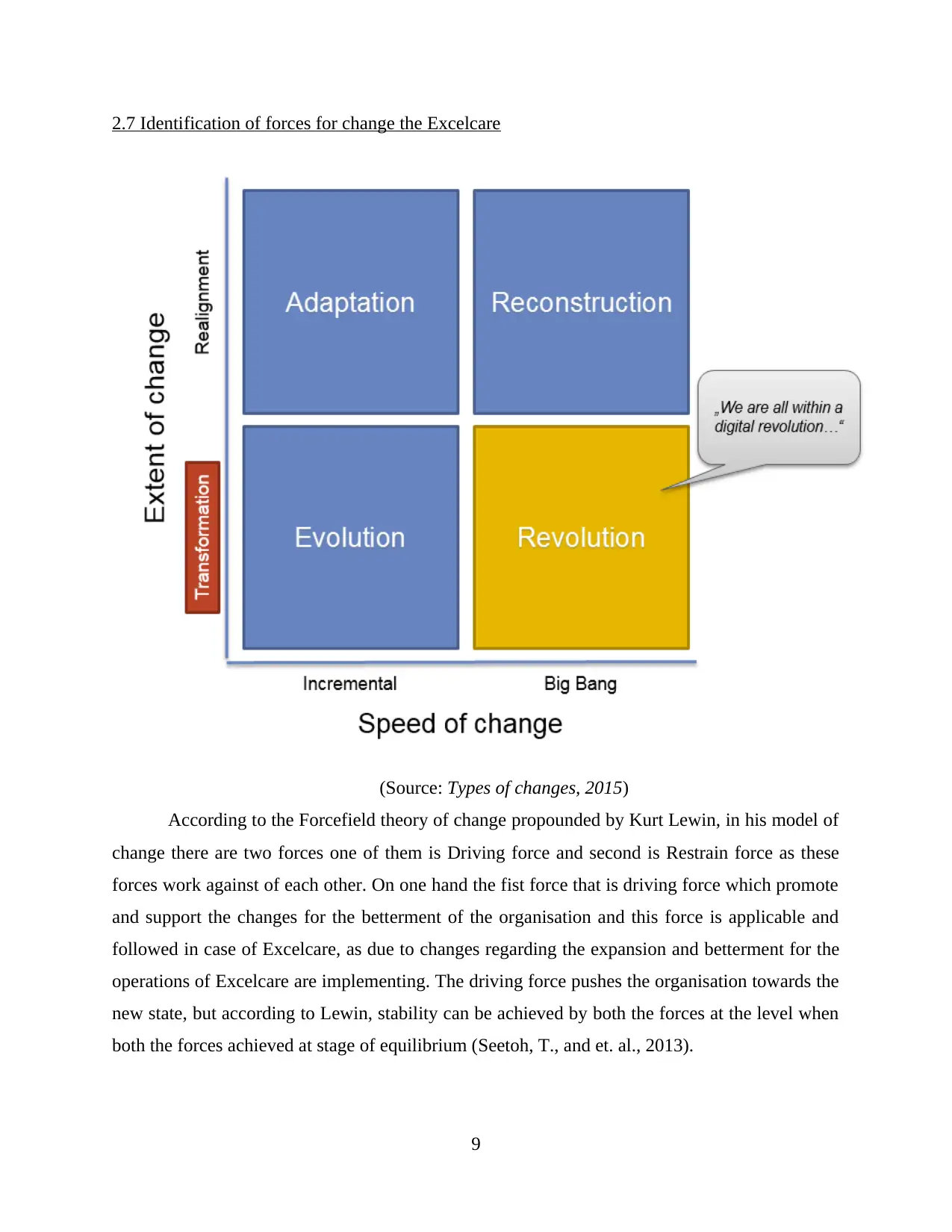
2.7 Identification of forces for change the Excelcare
(Source: Types of changes, 2015)
According to the Forcefield theory of change propounded by Kurt Lewin, in his model of
change there are two forces one of them is Driving force and second is Restrain force as these
forces work against of each other. On one hand the fist force that is driving force which promote
and support the changes for the betterment of the organisation and this force is applicable and
followed in case of Excelcare, as due to changes regarding the expansion and betterment for the
operations of Excelcare are implementing. The driving force pushes the organisation towards the
new state, but according to Lewin, stability can be achieved by both the forces at the level when
both the forces achieved at stage of equilibrium (Seetoh, T., and et. al., 2013).
9
(Source: Types of changes, 2015)
According to the Forcefield theory of change propounded by Kurt Lewin, in his model of
change there are two forces one of them is Driving force and second is Restrain force as these
forces work against of each other. On one hand the fist force that is driving force which promote
and support the changes for the betterment of the organisation and this force is applicable and
followed in case of Excelcare, as due to changes regarding the expansion and betterment for the
operations of Excelcare are implementing. The driving force pushes the organisation towards the
new state, but according to Lewin, stability can be achieved by both the forces at the level when
both the forces achieved at stage of equilibrium (Seetoh, T., and et. al., 2013).
9
2.8 Force which are against the Change in Excelcare
There are some forces which influences the performance of the business. The forces are
of restrain in nature as they are opposite to the driving forces which promote the business.
restraining forces hinder the change and the restraining forces are not similar in nature in nature
with driving forces as they works opposite to driving forces rather than constituting driving
forces in along themselves. Some of the restrain forces are as follows.
An individuals fear: An individuals fear of failure affects the progress of the
organisations as due to, if the individual belongs to the management or top level authority
then it's fear and incapability of doing effective work can leads to failure. This force can
be seen in any organisation like Excelcare holdings.
Organisational Inertia or Apathy: Apathy can results in disruption in process of
combining within the organisation for developmental change.
Hostility:planning like goals, attach the emotional value of goal and put ideas into action.
Hostility may be the main restraining force if it is present within the organisation and
hostility may be of competitive firm and also helps in providing the advantage to face
tough competition, but in case of Excelcare the hostility may be or may not be present as
because the organisation also providing the social services also(Song, and et. al., 2015).
2.9 Forcefield model
This model is based on forces in order to ensure the business responds to environment.
The analysing model determine changes in strategies. Lewin forcefield model define forces with
driving changes and then restraining it. Analysis refers to investigate and identify the power
involved in the issue, influence the target groups. They are explained in internal and external
forces for change in organisation.
Internal Forces
their effects came on increasing efficiency and competitiveness.
Conflicts occur in between departments.
External Forces:
Forces takes place in uncertain economic situations.
In organisation forces by legal and taxation policy.
Globally impact on services in workforce.
10
There are some forces which influences the performance of the business. The forces are
of restrain in nature as they are opposite to the driving forces which promote the business.
restraining forces hinder the change and the restraining forces are not similar in nature in nature
with driving forces as they works opposite to driving forces rather than constituting driving
forces in along themselves. Some of the restrain forces are as follows.
An individuals fear: An individuals fear of failure affects the progress of the
organisations as due to, if the individual belongs to the management or top level authority
then it's fear and incapability of doing effective work can leads to failure. This force can
be seen in any organisation like Excelcare holdings.
Organisational Inertia or Apathy: Apathy can results in disruption in process of
combining within the organisation for developmental change.
Hostility:planning like goals, attach the emotional value of goal and put ideas into action.
Hostility may be the main restraining force if it is present within the organisation and
hostility may be of competitive firm and also helps in providing the advantage to face
tough competition, but in case of Excelcare the hostility may be or may not be present as
because the organisation also providing the social services also(Song, and et. al., 2015).
2.9 Forcefield model
This model is based on forces in order to ensure the business responds to environment.
The analysing model determine changes in strategies. Lewin forcefield model define forces with
driving changes and then restraining it. Analysis refers to investigate and identify the power
involved in the issue, influence the target groups. They are explained in internal and external
forces for change in organisation.
Internal Forces
their effects came on increasing efficiency and competitiveness.
Conflicts occur in between departments.
External Forces:
Forces takes place in uncertain economic situations.
In organisation forces by legal and taxation policy.
Globally impact on services in workforce.
10
⊘ This is a preview!⊘
Do you want full access?
Subscribe today to unlock all pages.
Trusted by 1+ million students worldwide

1 out of 16


Related Documents


Your All-in-One AI-Powered Toolkit for Academic Success.
+13062052269
info@desklib.com
Available 24*7 on WhatsApp / Email
![[object Object]](/_next/static/media/star-bottom.7253800d.svg)
Unlock your academic potential
Copyright © 2020–2026 A2Z Services. All Rights Reserved. Developed and managed by ZUCOL.