ISO/IEC 20000 Implementation Process at ExcelIT: USQ Report
VerifiedAdded on 2023/06/15
|13
|3094
|88
Report
AI Summary
This report provides a detailed analysis of the ISO/IEC 20000 implementation process in ExcelIT, focusing on the integration of a Service Management System into ITSM to enhance service delivery. It summarizes Mr. Basu's engagement approach, highlighting the iterative model's benefits over the waterfall method, and addresses major challenges encountered during implementation, such as lack of management commitment and organizational change concerns. The report also identifies relevant ITSM processes for ExcelIT, outlines three key benefits of ISO/IEC 20000 certification, and presents a business case justifying the certification project, emphasizing improved business processes, enhanced interdepartmental relationships, and increased customer trust. The conclusion underscores the importance of ITSM and the iterative approach for successful organizational service management.
Running head: ISO/IEC 20000 IMPLEMENTATION PROCESS IN EXCELIT
ISO/IEC 20000 Implementation Process in ExcelIT
Name of the Student
Name of the University
Author Note
ISO/IEC 20000 Implementation Process in ExcelIT
Name of the Student
Name of the University
Author Note

Paraphrase This Document
Need a fresh take? Get an instant paraphrase of this document with our AI Paraphraser
1ISO/IEC 20000 IMPLEMENTATION PROCESS IN EXCELIT
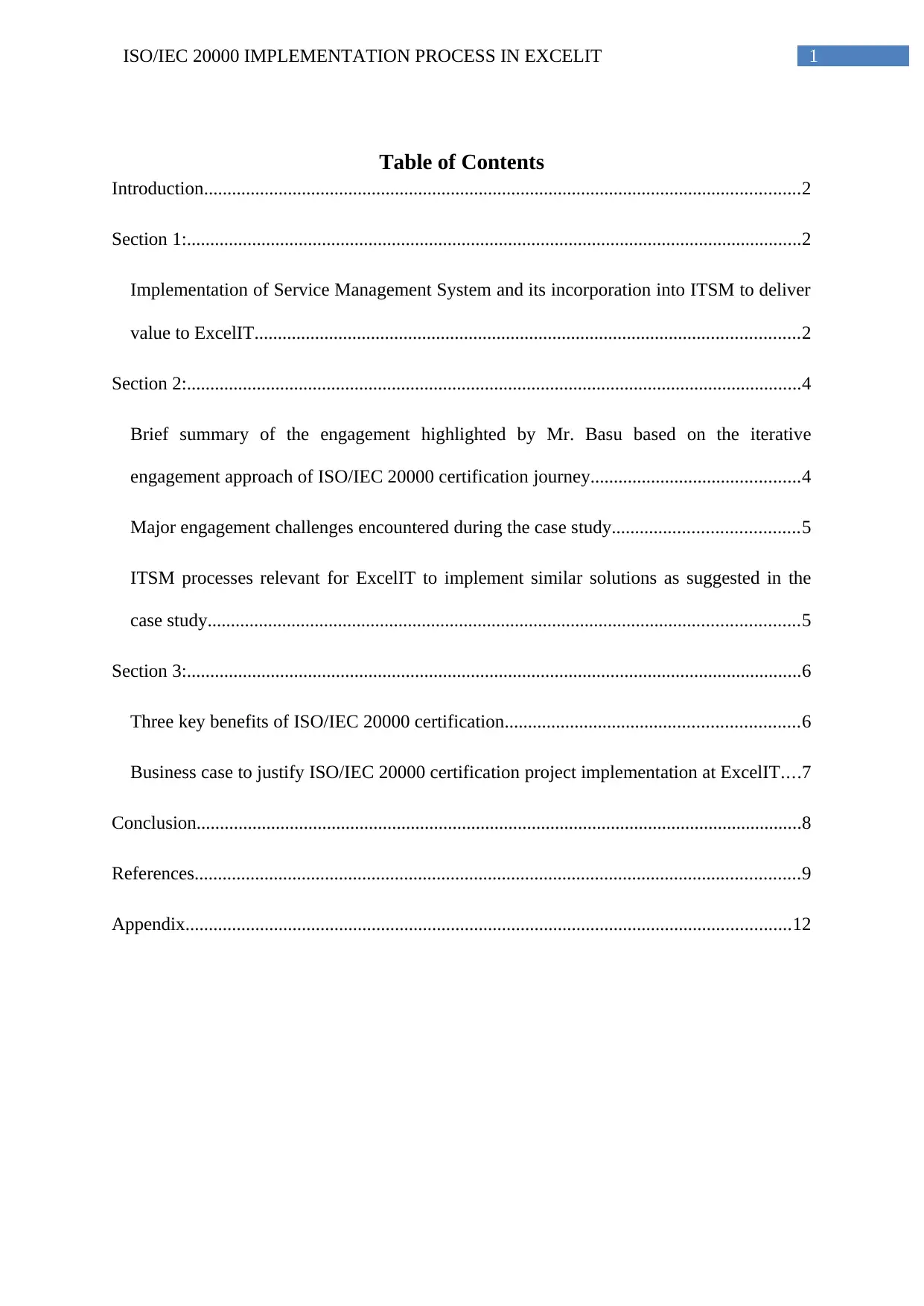
Table of Contents
Introduction................................................................................................................................2
Section 1:....................................................................................................................................2
Implementation of Service Management System and its incorporation into ITSM to deliver
value to ExcelIT.....................................................................................................................2
Section 2:....................................................................................................................................4
Brief summary of the engagement highlighted by Mr. Basu based on the iterative
engagement approach of ISO/IEC 20000 certification journey.............................................4
Major engagement challenges encountered during the case study........................................5
ITSM processes relevant for ExcelIT to implement similar solutions as suggested in the
case study...............................................................................................................................5
Section 3:....................................................................................................................................6
Three key benefits of ISO/IEC 20000 certification...............................................................6
Business case to justify ISO/IEC 20000 certification project implementation at ExcelIT....7
Conclusion..................................................................................................................................8
References..................................................................................................................................9
Appendix..................................................................................................................................12
Table of Contents
Introduction................................................................................................................................2
Section 1:....................................................................................................................................2
Implementation of Service Management System and its incorporation into ITSM to deliver
value to ExcelIT.....................................................................................................................2
Section 2:....................................................................................................................................4
Brief summary of the engagement highlighted by Mr. Basu based on the iterative
engagement approach of ISO/IEC 20000 certification journey.............................................4
Major engagement challenges encountered during the case study........................................5
ITSM processes relevant for ExcelIT to implement similar solutions as suggested in the
case study...............................................................................................................................5
Section 3:....................................................................................................................................6
Three key benefits of ISO/IEC 20000 certification...............................................................6
Business case to justify ISO/IEC 20000 certification project implementation at ExcelIT....7
Conclusion..................................................................................................................................8
References..................................................................................................................................9
Appendix..................................................................................................................................12
2ISO/IEC 20000 IMPLEMENTATION PROCESS IN EXCELIT
Introduction
The international Information Technology standard, which allows a company to
present a proof of their excellent practices in the industry, is the ISO/IEC 20000 standard.
This standard presents the best industry service benchmarks so that the companies to provide
evidence of their own services in comparison to the set benchmarks. This enables a company
to reach a desired height of quality in delivering improved quality of IT services. It has now
become a competitive differentiation between IT service provider companies and has helped
in raising the quality of services provided in the IT organizations (Cortina et al. 2016). In this
particular report, a case study of a webinar explains the functionality and importance of
ISO/IEC 20000 for the IT industry. Further, the report would include discussions about
Service Management Systems and in which way can it be incorporated into ITSM to enhance
the services of ExcelIT. The report would next include a brief summary of the engagement
highlighted by the webinar spokesperson based on the iterative engagement approach of
ISO/IEC 20000 certification journey and discuss major engagement challenges that have
been encountered during the case study described in the webinar. The last part of the report
would hold three key benefits of ISO/IEC 20000 certification.
Section 1:
Implementation of Service Management System and its incorporation into ITSM
to deliver value to ExcelIT
IT Service Management or more commonly known as ITSM are the policy driven
activities of an organization as a whole. The system also involves organization-structured
processes and their supporting procedures that involve providing the best quality of IT
services to the customers (Laudon and Laudon 2016). The Service Management thus means
Introduction
The international Information Technology standard, which allows a company to
present a proof of their excellent practices in the industry, is the ISO/IEC 20000 standard.
This standard presents the best industry service benchmarks so that the companies to provide
evidence of their own services in comparison to the set benchmarks. This enables a company
to reach a desired height of quality in delivering improved quality of IT services. It has now
become a competitive differentiation between IT service provider companies and has helped
in raising the quality of services provided in the IT organizations (Cortina et al. 2016). In this
particular report, a case study of a webinar explains the functionality and importance of
ISO/IEC 20000 for the IT industry. Further, the report would include discussions about
Service Management Systems and in which way can it be incorporated into ITSM to enhance
the services of ExcelIT. The report would next include a brief summary of the engagement
highlighted by the webinar spokesperson based on the iterative engagement approach of
ISO/IEC 20000 certification journey and discuss major engagement challenges that have
been encountered during the case study described in the webinar. The last part of the report
would hold three key benefits of ISO/IEC 20000 certification.
Section 1:
Implementation of Service Management System and its incorporation into ITSM
to deliver value to ExcelIT
IT Service Management or more commonly known as ITSM are the policy driven
activities of an organization as a whole. The system also involves organization-structured
processes and their supporting procedures that involve providing the best quality of IT
services to the customers (Laudon and Laudon 2016). The Service Management thus means
⊘ This is a preview!⊘
Do you want full access?
Subscribe today to unlock all pages.

Trusted by 1+ million students worldwide
3ISO/IEC 20000 IMPLEMENTATION PROCESS IN EXCELIT
for the better implementation of the IT services to meet the needs of a customer and to abide
by the service that they have promised to deliver to their customers. This degree of
implementation of a IT Service Management in an organization is measured by service
providers through an mixture of people consisting of process an information technology. If
the implementation is justified in the basis of discipline, ITSM has a much more similarity
with general management approaches (Cots and Casadesús 2015). These approaches are
Quality Management, Software Engineering and Information Security Management. The
presence of Service Management system in an organization ensures the excellence of the
company’s service provided to the customers.
The ITSM system is being implemented by many organizations worldwide to support
the service providing systems of the business. Since, it represents the way an organization
agrees to manage its services therefore there are many set standards that evaluate the service
management system of the organizations. ExcelIT or Excel Communications Pty Limited was
first found in the year 1991 (Lobban et al. 2017). Since then it has become one of the main
suppliers of the telecommunication products for Samsung providing services all over the
areas of Newcastle, Port Stephens, Central Cost, Hunter region of New South Wales and
Australia wide. The regions the company has been providing services to, were becoming
obsolete with the passing days. However, ExcelIT has been successful in keeping pace with
the changing times (Franco 2015). It provides services for supply, maintenance and
installation of Samsung Communications Solution to the clients in need of value added
services, expertise and ideas. However, in recent times it was found that the customers were
not essentially satisfied with the services provided by the ExcelIT organization. Therefore, it
was very necessary to implement ITSM into the organizational structure because the
organization wanted to adapt the perspective mythology to adapt to the key aspects (Galvan-
Cruz et al. 2017). This would allow the organization to involve the primary performance
for the better implementation of the IT services to meet the needs of a customer and to abide
by the service that they have promised to deliver to their customers. This degree of
implementation of a IT Service Management in an organization is measured by service
providers through an mixture of people consisting of process an information technology. If
the implementation is justified in the basis of discipline, ITSM has a much more similarity
with general management approaches (Cots and Casadesús 2015). These approaches are
Quality Management, Software Engineering and Information Security Management. The
presence of Service Management system in an organization ensures the excellence of the
company’s service provided to the customers.
The ITSM system is being implemented by many organizations worldwide to support
the service providing systems of the business. Since, it represents the way an organization
agrees to manage its services therefore there are many set standards that evaluate the service
management system of the organizations. ExcelIT or Excel Communications Pty Limited was
first found in the year 1991 (Lobban et al. 2017). Since then it has become one of the main
suppliers of the telecommunication products for Samsung providing services all over the
areas of Newcastle, Port Stephens, Central Cost, Hunter region of New South Wales and
Australia wide. The regions the company has been providing services to, were becoming
obsolete with the passing days. However, ExcelIT has been successful in keeping pace with
the changing times (Franco 2015). It provides services for supply, maintenance and
installation of Samsung Communications Solution to the clients in need of value added
services, expertise and ideas. However, in recent times it was found that the customers were
not essentially satisfied with the services provided by the ExcelIT organization. Therefore, it
was very necessary to implement ITSM into the organizational structure because the
organization wanted to adapt the perspective mythology to adapt to the key aspects (Galvan-
Cruz et al. 2017). This would allow the organization to involve the primary performance
Paraphrase This Document
Need a fresh take? Get an instant paraphrase of this document with our AI Paraphraser
4ISO/IEC 20000 IMPLEMENTATION PROCESS IN EXCELIT
indicators. ITSM would provide the integration of the flow of information across all the areas
or on all the premises in the organization. It would thus enhance the integration of the
technological services provided in the organization. ITSM implementation in ExcelIT would
pull together the information via disparate systems for delivering both the consolidation of
events and an effective visualization into a distinct view. It also allows the organization to
resolve problems much faster than the organization could actually do before the
implementation of the system. The ITSM can identify problems much faster and propose an
effective way to resolve the same to aid to the service system of ExcelIT. It makes a
counteractive action. It provides with workflow assessment to streamline the count of a
company asset, change management and problem management. The ITSM system also
implements event analysis and root-cause analysis helps to separate problems and get them to
the proper group for resolution in no time.
Section 2:
Brief summary of the engagement highlighted by Mr. Basu based on the iterative
engagement approach of ISO/IEC 20000 certification journey
As per the case study, there have been a major criteria highlighted by Mr. Basu on the
iterative engagement approach of ISO/IEC 20000 certification journey. Generally, there are
two models of engagement approach of ISO/IEC 20000 certification. They are the Waterfall
engagement model and the Iterative engagement approach (Herrera 2017). In the Waterfall
method, the system of certifying a company with ISO/IEC 20000 certification follows a very
general rule. This includes the planning, auditing and execution of the certification process by
handing over the certificates. This is a manual and irreversible approach into auditing
function of ISO/IES 20000 certification (YouTube, 2018). On the other hand, iterative
approach has an iterated journey with the tasks to perform being broken down to several
indicators. ITSM would provide the integration of the flow of information across all the areas
or on all the premises in the organization. It would thus enhance the integration of the
technological services provided in the organization. ITSM implementation in ExcelIT would
pull together the information via disparate systems for delivering both the consolidation of
events and an effective visualization into a distinct view. It also allows the organization to
resolve problems much faster than the organization could actually do before the
implementation of the system. The ITSM can identify problems much faster and propose an
effective way to resolve the same to aid to the service system of ExcelIT. It makes a
counteractive action. It provides with workflow assessment to streamline the count of a
company asset, change management and problem management. The ITSM system also
implements event analysis and root-cause analysis helps to separate problems and get them to
the proper group for resolution in no time.
Section 2:
Brief summary of the engagement highlighted by Mr. Basu based on the iterative
engagement approach of ISO/IEC 20000 certification journey
As per the case study, there have been a major criteria highlighted by Mr. Basu on the
iterative engagement approach of ISO/IEC 20000 certification journey. Generally, there are
two models of engagement approach of ISO/IEC 20000 certification. They are the Waterfall
engagement model and the Iterative engagement approach (Herrera 2017). In the Waterfall
method, the system of certifying a company with ISO/IEC 20000 certification follows a very
general rule. This includes the planning, auditing and execution of the certification process by
handing over the certificates. This is a manual and irreversible approach into auditing
function of ISO/IES 20000 certification (YouTube, 2018). On the other hand, iterative
approach has an iterated journey with the tasks to perform being broken down to several
5ISO/IEC 20000 IMPLEMENTATION PROCESS IN EXCELIT
pieces of task and then complete each task depending on those segregated models. In case of
the case study, Mr. Basu had clearly stated that the iterative model is based on weekly work
breakdown by several interconnected steps flowing in a series including planning, gap
analysis, team specific customisation, roles distribution, planning, go-live, monitoring,
reporting, signing off and the auditing that follows after.
Major engagement challenges encountered during the case study
Any system implementation process faces challenges during its implementation due to
the internal and external problems arising in the organization (YouTube, 2018). These
problems can be a challenge in implementing ITSM in the system. According to the case
study, the major challenges that have been faced during the case study can be listed down as
follows:
Lack of Management Commitment: This is a major challenge arising due to the
commitment issues that the management faces due to changing priorities and also due to the
organizational changes in the structure halfway through the process.
Organizational Change Concerns: Organization change in structure and in business
process has the ability to create a major problem since this decision relies with the highest
authorities in the organization. Therefore, the people in the lower authorities have very little
involvement in the agenda including the junior and the mid-levelled staff.
These challenges form a level of difficulty during the successful ITSM
implementation in a system.
pieces of task and then complete each task depending on those segregated models. In case of
the case study, Mr. Basu had clearly stated that the iterative model is based on weekly work
breakdown by several interconnected steps flowing in a series including planning, gap
analysis, team specific customisation, roles distribution, planning, go-live, monitoring,
reporting, signing off and the auditing that follows after.
Major engagement challenges encountered during the case study
Any system implementation process faces challenges during its implementation due to
the internal and external problems arising in the organization (YouTube, 2018). These
problems can be a challenge in implementing ITSM in the system. According to the case
study, the major challenges that have been faced during the case study can be listed down as
follows:
Lack of Management Commitment: This is a major challenge arising due to the
commitment issues that the management faces due to changing priorities and also due to the
organizational changes in the structure halfway through the process.
Organizational Change Concerns: Organization change in structure and in business
process has the ability to create a major problem since this decision relies with the highest
authorities in the organization. Therefore, the people in the lower authorities have very little
involvement in the agenda including the junior and the mid-levelled staff.
These challenges form a level of difficulty during the successful ITSM
implementation in a system.
⊘ This is a preview!⊘
Do you want full access?
Subscribe today to unlock all pages.
Trusted by 1+ million students worldwide
6ISO/IEC 20000 IMPLEMENTATION PROCESS IN EXCELIT
ITSM processes relevant for ExcelIT to implement similar solutions as suggested
in the case study
The case study suggests that ExcelIT should implement the Iterative Model to
improve their organizational service providing capability. This approach should start with the
supervision of at least three consultants having no prior engagement to the organization. The
gap analysis should be done to point out the issues with the service management system that
the organization ExcelIT is facing. It needs to be analysed for the next two weeks. Firstly, test
was performed for the existing service system (Lasrado, Vatrapu and Andersen 2015).
Documentation needs to be checked thoroughly including the process documentation and the
policy documentations to make out the situation perfectly. Effectiveness is to be tested next
by analysing the practices of the organization and this is to be done by interviewing all of the
stakeholders in the organization. After gap analysis, the identified problems are solved by
redesigning the people, process, product and partner or the four Ps. The internal and external
design models are to be checked next with the roles of process management, central point of
contact and internal audits. The auditors should be distributed accordingly and ideally, the
iteration approach thus run for almost 12 weeks to flawlessly implement ITSM in ExcelIT
and should be handed over the ISO/IEC 20000 certification.
Section 3:
Three key benefits of ISO/IEC 20000 certification
It is noted that the implementation of ISO/IEC 20000 has resulted in benefitting the
organization it has been certified with (Cots, Casadesús and Marimon 2016). The three key
benefits that the ISO/IEC certificate provides are to be listed as below:
ITSM processes relevant for ExcelIT to implement similar solutions as suggested
in the case study
The case study suggests that ExcelIT should implement the Iterative Model to
improve their organizational service providing capability. This approach should start with the
supervision of at least three consultants having no prior engagement to the organization. The
gap analysis should be done to point out the issues with the service management system that
the organization ExcelIT is facing. It needs to be analysed for the next two weeks. Firstly, test
was performed for the existing service system (Lasrado, Vatrapu and Andersen 2015).
Documentation needs to be checked thoroughly including the process documentation and the
policy documentations to make out the situation perfectly. Effectiveness is to be tested next
by analysing the practices of the organization and this is to be done by interviewing all of the
stakeholders in the organization. After gap analysis, the identified problems are solved by
redesigning the people, process, product and partner or the four Ps. The internal and external
design models are to be checked next with the roles of process management, central point of
contact and internal audits. The auditors should be distributed accordingly and ideally, the
iteration approach thus run for almost 12 weeks to flawlessly implement ITSM in ExcelIT
and should be handed over the ISO/IEC 20000 certification.
Section 3:
Three key benefits of ISO/IEC 20000 certification
It is noted that the implementation of ISO/IEC 20000 has resulted in benefitting the
organization it has been certified with (Cots, Casadesús and Marimon 2016). The three key
benefits that the ISO/IEC certificate provides are to be listed as below:
Paraphrase This Document
Need a fresh take? Get an instant paraphrase of this document with our AI Paraphraser
7ISO/IEC 20000 IMPLEMENTATION PROCESS IN EXCELIT
It aligns and improves the business processes and their practises. The practices and
processes that a business follows may or may not be flawless. This can be a result of
negligence, confusion, or many other factors, which affect the working strategic
structure of an organization (Cots, Casadesús and Marimon 2016). It may be possible
that the organization has failed to satisfy the customers it has been serving to, which is
remodelled by the ITSM implementation.
It build up the relationship between the different departments in the organization, such
as, this makes the business adapt to better clarity in definition and communication,
responsibility and goals.
It helps in revitalising the trust of the customers in the organization by ensuring them
that the organization is reliable, efficient and trustworthy (Cots, Casadesús and
Marimon 2016). This increases the market base since the customers become
increasingly intrigued with the organization itself as it becomes clear to them that
there is no other priority to them as customer service providing. It strengthens the
relationship between the organization and its customers and the organization never
has to think about losing its target customer base.
Business case to justify ISO/IEC 20000 certification project implementation at
ExcelIT
As the situation at the ExcelIT Company suggests, it needs to follow the Iterative
framework model to implement ITSM and get the certification of the ISO/IEC 20000
certification (Ding 2015). This would follow the business case justification for the project
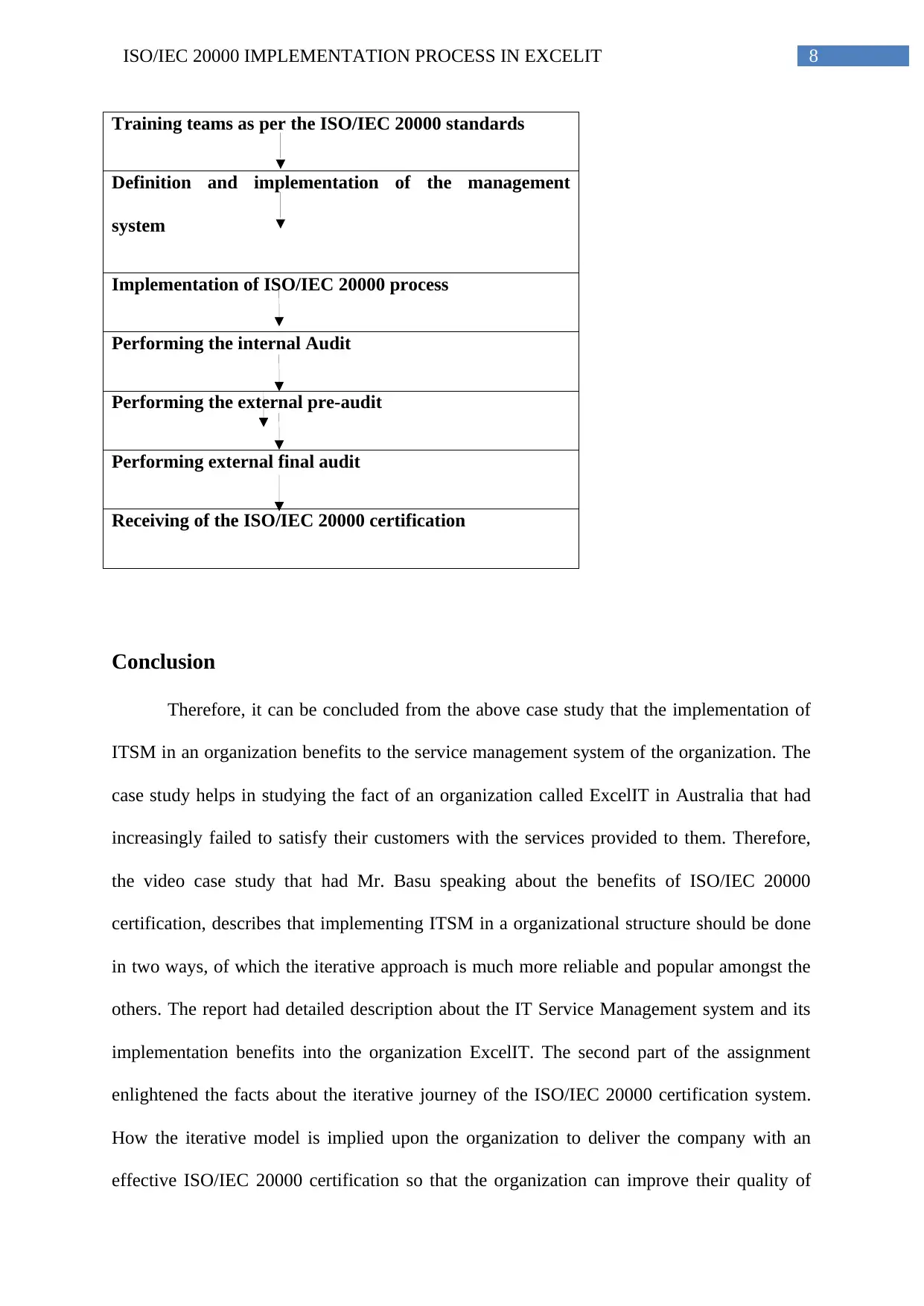
implementation at the organization ExcelIT as listed below:
Evaluation of the current practices
Documentation and the evaluation of the differences
It aligns and improves the business processes and their practises. The practices and
processes that a business follows may or may not be flawless. This can be a result of
negligence, confusion, or many other factors, which affect the working strategic
structure of an organization (Cots, Casadesús and Marimon 2016). It may be possible
that the organization has failed to satisfy the customers it has been serving to, which is
remodelled by the ITSM implementation.
It build up the relationship between the different departments in the organization, such
as, this makes the business adapt to better clarity in definition and communication,
responsibility and goals.
It helps in revitalising the trust of the customers in the organization by ensuring them
that the organization is reliable, efficient and trustworthy (Cots, Casadesús and
Marimon 2016). This increases the market base since the customers become
increasingly intrigued with the organization itself as it becomes clear to them that
there is no other priority to them as customer service providing. It strengthens the
relationship between the organization and its customers and the organization never
has to think about losing its target customer base.
Business case to justify ISO/IEC 20000 certification project implementation at
ExcelIT
As the situation at the ExcelIT Company suggests, it needs to follow the Iterative
framework model to implement ITSM and get the certification of the ISO/IEC 20000
certification (Ding 2015). This would follow the business case justification for the project
implementation at the organization ExcelIT as listed below:
Evaluation of the current practices
Documentation and the evaluation of the differences
8ISO/IEC 20000 IMPLEMENTATION PROCESS IN EXCELIT
Training teams as per the ISO/IEC 20000 standards
Definition and implementation of the management
system
Implementation of ISO/IEC 20000 process
Performing the internal Audit
Performing the external pre-audit
Performing external final audit
Receiving of the ISO/IEC 20000 certification
Conclusion
Therefore, it can be concluded from the above case study that the implementation of
ITSM in an organization benefits to the service management system of the organization. The
case study helps in studying the fact of an organization called ExcelIT in Australia that had
increasingly failed to satisfy their customers with the services provided to them. Therefore,
the video case study that had Mr. Basu speaking about the benefits of ISO/IEC 20000
certification, describes that implementing ITSM in a organizational structure should be done
in two ways, of which the iterative approach is much more reliable and popular amongst the
others. The report had detailed description about the IT Service Management system and its
implementation benefits into the organization ExcelIT. The second part of the assignment
enlightened the facts about the iterative journey of the ISO/IEC 20000 certification system.
How the iterative model is implied upon the organization to deliver the company with an
effective ISO/IEC 20000 certification so that the organization can improve their quality of
Training teams as per the ISO/IEC 20000 standards
Definition and implementation of the management
system
Implementation of ISO/IEC 20000 process
Performing the internal Audit
Performing the external pre-audit
Performing external final audit
Receiving of the ISO/IEC 20000 certification
Conclusion
Therefore, it can be concluded from the above case study that the implementation of
ITSM in an organization benefits to the service management system of the organization. The
case study helps in studying the fact of an organization called ExcelIT in Australia that had
increasingly failed to satisfy their customers with the services provided to them. Therefore,
the video case study that had Mr. Basu speaking about the benefits of ISO/IEC 20000
certification, describes that implementing ITSM in a organizational structure should be done
in two ways, of which the iterative approach is much more reliable and popular amongst the
others. The report had detailed description about the IT Service Management system and its
implementation benefits into the organization ExcelIT. The second part of the assignment
enlightened the facts about the iterative journey of the ISO/IEC 20000 certification system.
How the iterative model is implied upon the organization to deliver the company with an
effective ISO/IEC 20000 certification so that the organization can improve their quality of
⊘ This is a preview!⊘
Do you want full access?
Subscribe today to unlock all pages.
Trusted by 1+ million students worldwide
9ISO/IEC 20000 IMPLEMENTATION PROCESS IN EXCELIT
service management is described in details in the report. In the end, it is suggested that the
before implementation it should be properly researched upon to open quite a vast range of
possibilities serving as the initial idea to further implantations of the ISO/IEC 20000
certification.
References
Cortina, S., Barafort, B., Picard, M. and Renault, A., 2016, September. Using a Process
Assessment Model to Prepare for an ISO/IEC 20000-1 Certification: ISO/IEC 15504-8 or
TIPA for ITIL?. In European Conference on Software Process Improvement (pp. 83-93).
Springer, Cham.
Cots, S. and Casadesús, M., 2015. Exploring the service management standard ISO
20000. Total Quality Management & Business Excellence, 26(5-6), pp.515-533.
Cots, S., Casadesús, M. and Marimon, F., 2016. Benefits of ISO 20000 IT service
management certification. Information Systems and e-Business Management, 14(1), pp.1-18.
Ding, Y., 2015. Service Delivery Standards (ITIL, COBIT, ETOM, ISO/IEC 20000,
Etc.). Wiley Encyclopedia of Management.
Franco, H., 2015. Customer service management system. U.S. Patent 9,224,147.
Galvan-Cruz, S., Mora, M., O'Connor, R., Acosta-Escalante, F. and Álvarez, F., 2017. An
objective compliance analysis of project management process in main agile methodologies
with the ISO/IEC 29110 entry profile. International Journal of Information Technologies and
Systems Approach, 10(1), pp.75-106.
Herrera, P.C., 2017. Innovation in Information Technology Services: Framework to Improve
the Effectiveness and Efficiency of Information Technology Service Management Processes,
service management is described in details in the report. In the end, it is suggested that the
before implementation it should be properly researched upon to open quite a vast range of
possibilities serving as the initial idea to further implantations of the ISO/IEC 20000
certification.
References
Cortina, S., Barafort, B., Picard, M. and Renault, A., 2016, September. Using a Process
Assessment Model to Prepare for an ISO/IEC 20000-1 Certification: ISO/IEC 15504-8 or
TIPA for ITIL?. In European Conference on Software Process Improvement (pp. 83-93).
Springer, Cham.
Cots, S. and Casadesús, M., 2015. Exploring the service management standard ISO
20000. Total Quality Management & Business Excellence, 26(5-6), pp.515-533.
Cots, S., Casadesús, M. and Marimon, F., 2016. Benefits of ISO 20000 IT service
management certification. Information Systems and e-Business Management, 14(1), pp.1-18.
Ding, Y., 2015. Service Delivery Standards (ITIL, COBIT, ETOM, ISO/IEC 20000,
Etc.). Wiley Encyclopedia of Management.
Franco, H., 2015. Customer service management system. U.S. Patent 9,224,147.
Galvan-Cruz, S., Mora, M., O'Connor, R., Acosta-Escalante, F. and Álvarez, F., 2017. An
objective compliance analysis of project management process in main agile methodologies
with the ISO/IEC 29110 entry profile. International Journal of Information Technologies and
Systems Approach, 10(1), pp.75-106.
Herrera, P.C., 2017. Innovation in Information Technology Services: Framework to Improve
the Effectiveness and Efficiency of Information Technology Service Management Processes,
Paraphrase This Document
Need a fresh take? Get an instant paraphrase of this document with our AI Paraphraser
10ISO/IEC 20000 IMPLEMENTATION PROCESS IN EXCELIT
Projects and Decision Support Management. World Academy of Science, Engineering and
Technology, International Journal of Social, Behavioral, Educational, Economic, Business
and Industrial Engineering, 11(8), pp.2003-2010.
Lasrado, L.A., Vatrapu, R. and Andersen, K.N., 2015. Maturity models development in is
research: a literature review. In IRIS Selected Papers of the Information Systems Research
Seminar in Scandinavia 2015. Paper (Vol. 6).
Laudon, K.C. and Laudon, J.P., 2016. Management information system. Pearson Education
India.
Lobban, F., Appleton, V., Appelbe, D., Barraclough, J., Bowland, J., Fisher, N., Foster, S.,
Johnson, S., Lewis, E., Mateus, C. and Mezes, B., 2017. An Iterative Case Study to Identify
Key Factors Impacting on the Implementation of a Web-based Supported Self-Management
Intervention for Relatives of People with Psychosis or Bipolar Experiences in a National
Health Service: A Study Protocol. Implementation Science.
Mesquida, A.L. and Mas, A., 2015. Integrating IT service management requirements into the
organizational management system. Computer standards & interfaces, 37, pp.80-91.
Pardo, C., Pino, F.J. and Garcia, F., 2016. Towards an Integrated Management System (IMS),
harmonizing the ISO/IEC 27001 and ISO/IEC 20000-2 Standards. International Journal of
Software Engineering and Its Applications, 10(9), pp.217-230.
Picard, M., Renault, A. and Barafort, B., 2015, September. A maturity model for ISO/IEC
20000-1 based on the TIPA for ITIL process capability assessment model. In European
Conference on Software Process Improvement (pp. 168-179). Springer, Cham.
Ptak, C.A. and Schragenheim, E., 2016. ERP: tools, techniques, and applications for
integrating the supply chain. Crc Press.
Projects and Decision Support Management. World Academy of Science, Engineering and
Technology, International Journal of Social, Behavioral, Educational, Economic, Business
and Industrial Engineering, 11(8), pp.2003-2010.
Lasrado, L.A., Vatrapu, R. and Andersen, K.N., 2015. Maturity models development in is
research: a literature review. In IRIS Selected Papers of the Information Systems Research
Seminar in Scandinavia 2015. Paper (Vol. 6).
Laudon, K.C. and Laudon, J.P., 2016. Management information system. Pearson Education
India.
Lobban, F., Appleton, V., Appelbe, D., Barraclough, J., Bowland, J., Fisher, N., Foster, S.,
Johnson, S., Lewis, E., Mateus, C. and Mezes, B., 2017. An Iterative Case Study to Identify
Key Factors Impacting on the Implementation of a Web-based Supported Self-Management
Intervention for Relatives of People with Psychosis or Bipolar Experiences in a National
Health Service: A Study Protocol. Implementation Science.
Mesquida, A.L. and Mas, A., 2015. Integrating IT service management requirements into the
organizational management system. Computer standards & interfaces, 37, pp.80-91.
Pardo, C., Pino, F.J. and Garcia, F., 2016. Towards an Integrated Management System (IMS),
harmonizing the ISO/IEC 27001 and ISO/IEC 20000-2 Standards. International Journal of
Software Engineering and Its Applications, 10(9), pp.217-230.
Picard, M., Renault, A. and Barafort, B., 2015, September. A maturity model for ISO/IEC
20000-1 based on the TIPA for ITIL process capability assessment model. In European
Conference on Software Process Improvement (pp. 168-179). Springer, Cham.
Ptak, C.A. and Schragenheim, E., 2016. ERP: tools, techniques, and applications for
integrating the supply chain. Crc Press.
11ISO/IEC 20000 IMPLEMENTATION PROCESS IN EXCELIT
Ünal, A., Karaomer, R.B. and Kaynak, O., 2017, September. Analysis of the Practices for the
CMMI-SVC in an ISO/IEC 20000-1 Certified Organization. In European Conference on
Software Process Improvement (pp. 567-577). Springer, Cham.
YouTube. (2018). Case study: Why you need ISO/IEC 20000 to ensure success?. [online]
Available at: https://youtu.be/iyJLsV64s2k [Accessed 3 Apr. 2018].
Ünal, A., Karaomer, R.B. and Kaynak, O., 2017, September. Analysis of the Practices for the
CMMI-SVC in an ISO/IEC 20000-1 Certified Organization. In European Conference on
Software Process Improvement (pp. 567-577). Springer, Cham.
YouTube. (2018). Case study: Why you need ISO/IEC 20000 to ensure success?. [online]
Available at: https://youtu.be/iyJLsV64s2k [Accessed 3 Apr. 2018].
⊘ This is a preview!⊘
Do you want full access?
Subscribe today to unlock all pages.
Trusted by 1+ million students worldwide

1 out of 13


Related Documents


Your All-in-One AI-Powered Toolkit for Academic Success.
+13062052269
info@desklib.com
Available 24*7 on WhatsApp / Email
![[object Object]](/_next/static/media/star-bottom.7253800d.svg)
Unlock your academic potential
Copyright © 2020–2026 A2Z Services. All Rights Reserved. Developed and managed by ZUCOL.