Exchange Rate Regimes and Economic Growth in Developing Countries
VerifiedAdded on  2023/06/09
|9
|1809
|107
Report
AI Summary
This report investigates the impact of exchange rates on economic growth in developing countries. It explores the rationale for the study, research objectives, and research questions related to exchange rate flexibility and regimes. A literature review examines previous research on the topic, highlighting the mixed results regarding the impact of exchange rate volatility on trade and economic growth. The methodology section details the research philosophy (positivism), approach (deductive), and design (explanatory), as well as the secondary data collection methods used. The report anticipates a positive relationship between exchange rate volatility and economic performance in developing countries, aiming to provide insights into how exchange rate fluctuations affect their economic capabilities. The study uses secondary data from peer-reviewed journals, government reports, and financial reports from developing countries to evaluate the impact of exchange rates on economic growth.
Running head: RESEARCH ENQUIRY
RESEARCH ENQUIRY
Name of the student
Name of the university
Author note
RESEARCH ENQUIRY
Name of the student
Name of the university
Author note
Paraphrase This Document
Need a fresh take? Get an instant paraphrase of this document with our AI Paraphraser

1RESEARCH ENQUIRY
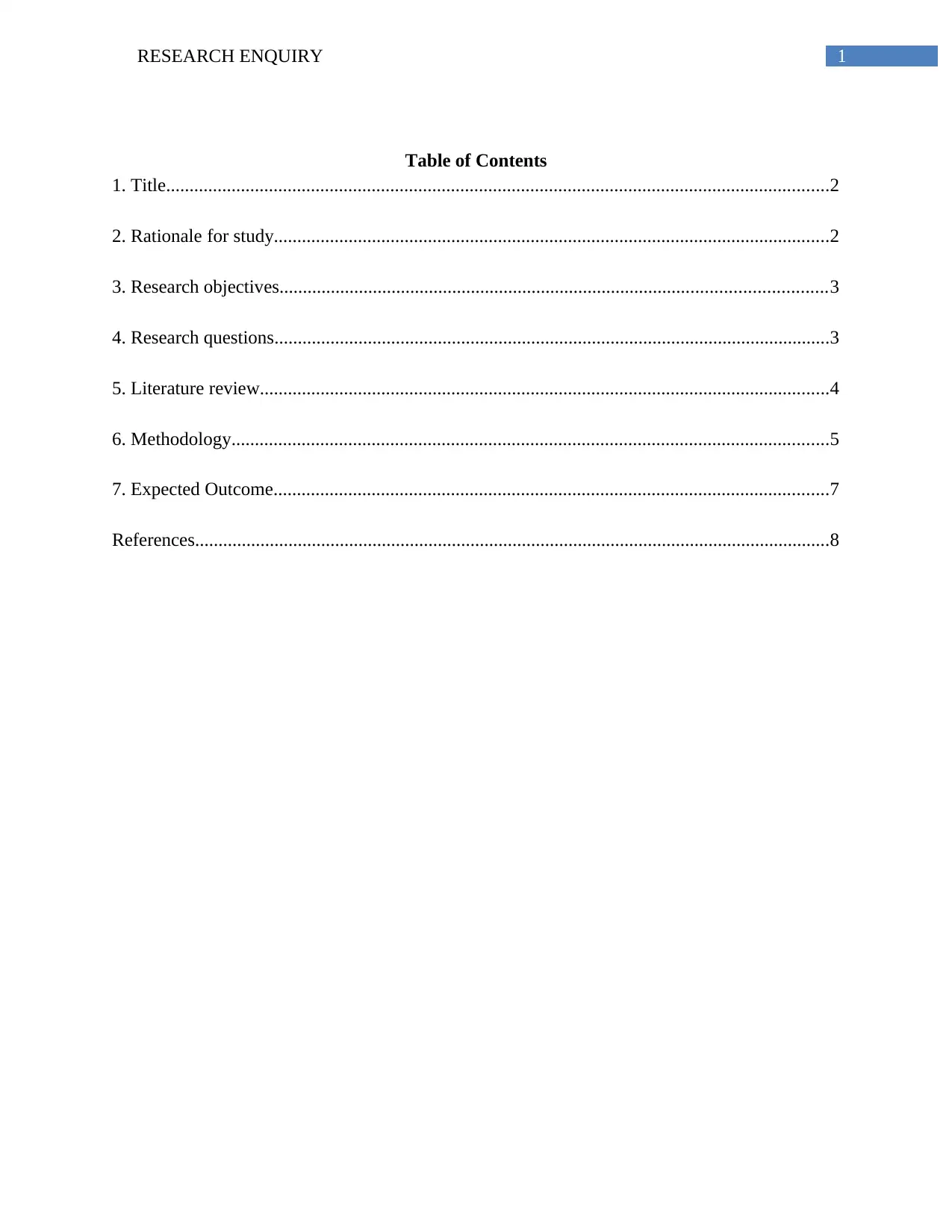
Table of Contents
1. Title..............................................................................................................................................2
2. Rationale for study.......................................................................................................................2
3. Research objectives.....................................................................................................................3
4. Research questions.......................................................................................................................3
5. Literature review..........................................................................................................................4
6. Methodology................................................................................................................................5
7. Expected Outcome.......................................................................................................................7
References........................................................................................................................................8
Table of Contents
1. Title..............................................................................................................................................2
2. Rationale for study.......................................................................................................................2
3. Research objectives.....................................................................................................................3
4. Research questions.......................................................................................................................3
5. Literature review..........................................................................................................................4
6. Methodology................................................................................................................................5
7. Expected Outcome.......................................................................................................................7
References........................................................................................................................................8

2RESEARCH ENQUIRY
Topic: The impact of exchange rate on economic growth in developing countries
1. Title
The aim of undertaking the study is to examine the impact of exchange rate on economic growth
in the developing economies.
2. Rationale for study
The exchange rate imposes an important impact on the economic growth of the
developing economies. Habib, Mileva and Stracca (2017) stated that a strong exchange rate
might be considered as economic strength of the nation. The countries with lower inflation
encounter a strong exchange rate, which helps in improving the economic performance. The
study will aim at understanding the impact of the exchange rate and the exchange rate regimes on
the economic performance of developing nations. The research will help in identifying the
current trends in the exchange rates and the manner in which the Short-term movements and
volatility of the exchange rates affect the economic situation of a developing economy.
The study will focus on the different changes in the economic structure of the developing
countries and thereby identify the manner in which it is affected by the exchange rates. The
research will help in identifying the key concepts relating to the exchange rates and the manner
in which it operates. On the other hand, the identification of the different impacts created by the
fluctuating exchange rates will be discussed in the research. Therefore, the research will
contribute to the understanding of the different aspects of the exchange rate and the manner in
which it affects the economies of the developing economies.
In a research, Ashour and Chen Yong (2018) studied that fixed exchange regime
experienced growth by 1.2% over flexible exchange regime. Therefore, fixed exchange rate
Topic: The impact of exchange rate on economic growth in developing countries
1. Title
The aim of undertaking the study is to examine the impact of exchange rate on economic growth
in the developing economies.
2. Rationale for study
The exchange rate imposes an important impact on the economic growth of the
developing economies. Habib, Mileva and Stracca (2017) stated that a strong exchange rate
might be considered as economic strength of the nation. The countries with lower inflation
encounter a strong exchange rate, which helps in improving the economic performance. The
study will aim at understanding the impact of the exchange rate and the exchange rate regimes on
the economic performance of developing nations. The research will help in identifying the
current trends in the exchange rates and the manner in which the Short-term movements and
volatility of the exchange rates affect the economic situation of a developing economy.
The study will focus on the different changes in the economic structure of the developing
countries and thereby identify the manner in which it is affected by the exchange rates. The
research will help in identifying the key concepts relating to the exchange rates and the manner
in which it operates. On the other hand, the identification of the different impacts created by the
fluctuating exchange rates will be discussed in the research. Therefore, the research will
contribute to the understanding of the different aspects of the exchange rate and the manner in
which it affects the economies of the developing economies.
In a research, Ashour and Chen Yong (2018) studied that fixed exchange regime
experienced growth by 1.2% over flexible exchange regime. Therefore, fixed exchange rate
⊘ This is a preview!⊘
Do you want full access?
Subscribe today to unlock all pages.

Trusted by 1+ million students worldwide

3RESEARCH ENQUIRY
regime helps the developing economies in experiencing growth. The current research will
elaborate the concepts of the operations and the manner in which the exchange rate regimes
influence the economic growth of the developing economies.
3. Research objectives
ï‚· To identify the manner in which exchange rate flexibility has an impact on the economic
growth in developing countries
ï‚· To identify the manner in which exchange rate regime have an impact on the economic
growth in developing countries
ï‚· To examine the extent to which the exchange rate flexibility affect the economic growth
in the developing countries
ï‚· To examine the extent to which the exchange rate regime affect the economic growth in
the developing countries
4. Research questions
ï‚· Does exchange rate flexibility have an impact on the economic growth in developing
countries?
ï‚· Does exchange rate regime have an impact on the economic growth in developing
countries?
ï‚· What is the extent to which the exchange rate flexibility affects the economic growth in
the developing countries?
ï‚· What is the extent to which the exchange rate regime affects the economic growth in the
developing countries?
regime helps the developing economies in experiencing growth. The current research will
elaborate the concepts of the operations and the manner in which the exchange rate regimes
influence the economic growth of the developing economies.
3. Research objectives
ï‚· To identify the manner in which exchange rate flexibility has an impact on the economic
growth in developing countries
ï‚· To identify the manner in which exchange rate regime have an impact on the economic
growth in developing countries
ï‚· To examine the extent to which the exchange rate flexibility affect the economic growth
in the developing countries
ï‚· To examine the extent to which the exchange rate regime affect the economic growth in
the developing countries
4. Research questions
ï‚· Does exchange rate flexibility have an impact on the economic growth in developing
countries?
ï‚· Does exchange rate regime have an impact on the economic growth in developing
countries?
ï‚· What is the extent to which the exchange rate flexibility affects the economic growth in
the developing countries?
ï‚· What is the extent to which the exchange rate regime affects the economic growth in the
developing countries?
Paraphrase This Document
Need a fresh take? Get an instant paraphrase of this document with our AI Paraphraser

4RESEARCH ENQUIRY
5. Literature review
As stated by Habib, Mileva&Stracca, (2017), financial liberalization has exposed
majority of the developing countries to steep fluctuation in exchange rates. Past researches has
focused on analyzing the impact of volatility of the exchange rate on flow of trade in most of the
developing countries which has provided mixed results. Iamsiraroj, (2016) stated that exchange
rates have direct positive influence on the growth of the economy through its impact on the
shock adjustment process. On the contrary, Shin, (2014) states that there is presence of negative
influence on growth of an economy due to the volatility of the exchange rate, for example,
employment, investment and international trade.
As opined by Magud, Reinhart&Vesperoni (2014), exchange rate regimes are considered
as one of the major instruments for evaluating the efficiency and effectiveness of the economy.
Ncube, Anyanwu&Hausken, (2014) argued that as per the exchange rate regime proponents,
economies are able to easily adjust to asymmetric real shocks due to the variability in the
exchange rates. Prices and wages becomes rigid due to asymmetrical real shocks and flexibility
in the exchange rates adjusts the international prices which offsets losses in production.
Shin, (2014) argued that external shocks can be easily be absorbed by exchange rate
volatility by increasing the adaptive capacity. This also facilitates in avoiding adjustments
processes that are economically expensive. Omri, Nguyen &Rault (2014) commented during
economic crisis, countries having flexible exchange rates experience lower production losses
when compared to the countries with fixed exchange rates. On the other hand, exchange rate
regime imposes credibility and discipline on the constraints and monetary policy autonomy. The
domestic economy is stabilized by developing a flexible exchange rate regime which provides
strong capital mobility in the international market.
5. Literature review
As stated by Habib, Mileva&Stracca, (2017), financial liberalization has exposed
majority of the developing countries to steep fluctuation in exchange rates. Past researches has
focused on analyzing the impact of volatility of the exchange rate on flow of trade in most of the
developing countries which has provided mixed results. Iamsiraroj, (2016) stated that exchange
rates have direct positive influence on the growth of the economy through its impact on the
shock adjustment process. On the contrary, Shin, (2014) states that there is presence of negative
influence on growth of an economy due to the volatility of the exchange rate, for example,
employment, investment and international trade.
As opined by Magud, Reinhart&Vesperoni (2014), exchange rate regimes are considered
as one of the major instruments for evaluating the efficiency and effectiveness of the economy.
Ncube, Anyanwu&Hausken, (2014) argued that as per the exchange rate regime proponents,
economies are able to easily adjust to asymmetric real shocks due to the variability in the
exchange rates. Prices and wages becomes rigid due to asymmetrical real shocks and flexibility
in the exchange rates adjusts the international prices which offsets losses in production.
Shin, (2014) argued that external shocks can be easily be absorbed by exchange rate
volatility by increasing the adaptive capacity. This also facilitates in avoiding adjustments
processes that are economically expensive. Omri, Nguyen &Rault (2014) commented during
economic crisis, countries having flexible exchange rates experience lower production losses
when compared to the countries with fixed exchange rates. On the other hand, exchange rate
regime imposes credibility and discipline on the constraints and monetary policy autonomy. The
domestic economy is stabilized by developing a flexible exchange rate regime which provides
strong capital mobility in the international market.

5RESEARCH ENQUIRY
Zhang & Zhang, (2018) states unpredictable fluctuations in the local economy is one of
the cost of developing flexibility in the exchange rate which may result in instability in economy
and finance. The economy is indirectly impacted by the volatility in the exchange rate as it
affects investment, employment and trade flows.Habib, Mileva&Stracca, (2017) states that
volatility of the real exchange rate is dependent on the fluctuation of the prices and nominal
exchange rate. Nominal exchange rates are preferred over the real exchange rates. Shin, (2014)
argued that real or nominal exchange rates does not affect the overall result and they have
evolved in a fashion which is highly correlated.
6. Methodology
6.1 Research Philosophy
The study will be utilizing the Positivism philosophy, which will assist in identifying the
impact of exchange rate on economic growth in developing countries through the utilization of
scientifically proven theories of economics. The utilization of the concepts from economics will
be helping to justify the volatility of the exchange rates and the manner in which it affects the
economic state of developing countries.
6.2 Research Approach
The study will be undertaking a deductive approach, which will assist in scrutinizing the
available models and theories relating to economics. The theories and models of economics will
help in understanding the relation between the exchange rate flexibility and regime with the
economic growth of developing countries. Therefore, in this relation, data will be deduced from
the different economics concepts in order to maintain the efficiency of the operations.
6.3 Research Design
Zhang & Zhang, (2018) states unpredictable fluctuations in the local economy is one of
the cost of developing flexibility in the exchange rate which may result in instability in economy
and finance. The economy is indirectly impacted by the volatility in the exchange rate as it
affects investment, employment and trade flows.Habib, Mileva&Stracca, (2017) states that
volatility of the real exchange rate is dependent on the fluctuation of the prices and nominal
exchange rate. Nominal exchange rates are preferred over the real exchange rates. Shin, (2014)
argued that real or nominal exchange rates does not affect the overall result and they have
evolved in a fashion which is highly correlated.
6. Methodology
6.1 Research Philosophy
The study will be utilizing the Positivism philosophy, which will assist in identifying the
impact of exchange rate on economic growth in developing countries through the utilization of
scientifically proven theories of economics. The utilization of the concepts from economics will
be helping to justify the volatility of the exchange rates and the manner in which it affects the
economic state of developing countries.
6.2 Research Approach
The study will be undertaking a deductive approach, which will assist in scrutinizing the
available models and theories relating to economics. The theories and models of economics will
help in understanding the relation between the exchange rate flexibility and regime with the
economic growth of developing countries. Therefore, in this relation, data will be deduced from
the different economics concepts in order to maintain the efficiency of the operations.
6.3 Research Design
⊘ This is a preview!⊘
Do you want full access?
Subscribe today to unlock all pages.

Trusted by 1+ million students worldwide

6RESEARCH ENQUIRY
The research will undertake an Explanatory research design, which will assist in
describing the cause- effect relationship between exchange rate and economic growth in
developing countries. The study will help in predicting the future outcomes depending on the
fluctuations. The explanatory research design will assist in identifying the volatile nature of the
exchange rates and the manner in which the fluctuations affect the economic capabilities of the
developing economies.
6.4 Secondary Data Collection
The study will be undertaken through a secondary data collection method, which will
assist in retrieving data from different peer reviewed journals, Government reports, industry
reports and financial reports from the different developing countries. The evaluation of the
reports from the developing countries will help in the lucid understanding of the impact of the
impact of exchange rates on the economic growth of the developing countries.
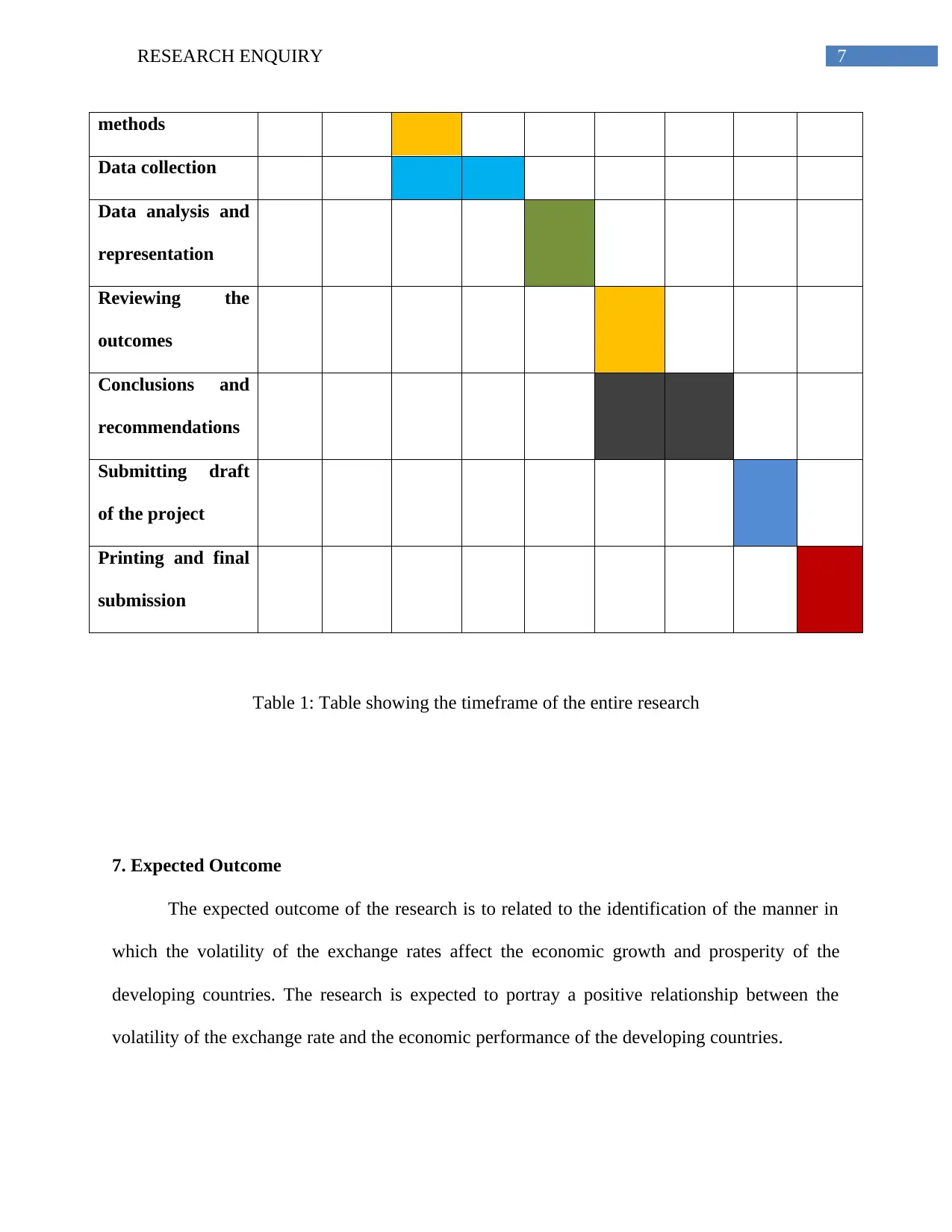
6.5 Time frame
Task Week
1
Week
2
Week
3
Week
4
Week
5
Week
6
Week
7
Week
8
Week
9
Selection of topic
and search for
justification
Constructing
literature
Selecting
appropriate
The research will undertake an Explanatory research design, which will assist in
describing the cause- effect relationship between exchange rate and economic growth in
developing countries. The study will help in predicting the future outcomes depending on the
fluctuations. The explanatory research design will assist in identifying the volatile nature of the
exchange rates and the manner in which the fluctuations affect the economic capabilities of the
developing economies.
6.4 Secondary Data Collection
The study will be undertaken through a secondary data collection method, which will
assist in retrieving data from different peer reviewed journals, Government reports, industry
reports and financial reports from the different developing countries. The evaluation of the
reports from the developing countries will help in the lucid understanding of the impact of the
impact of exchange rates on the economic growth of the developing countries.
6.5 Time frame
Task Week
1
Week
2
Week
3
Week
4
Week
5
Week
6
Week
7
Week
8
Week
9
Selection of topic
and search for
justification
Constructing
literature
Selecting
appropriate
Paraphrase This Document
Need a fresh take? Get an instant paraphrase of this document with our AI Paraphraser

7RESEARCH ENQUIRY
methods
Data collection
Data analysis and
representation
Reviewing the
outcomes
Conclusions and
recommendations
Submitting draft
of the project
Printing and final
submission
Table 1: Table showing the timeframe of the entire research
7. Expected Outcome
The expected outcome of the research is to related to the identification of the manner in
which the volatility of the exchange rates affect the economic growth and prosperity of the
developing countries. The research is expected to portray a positive relationship between the
volatility of the exchange rate and the economic performance of the developing countries.
methods
Data collection
Data analysis and
representation
Reviewing the
outcomes
Conclusions and
recommendations
Submitting draft
of the project
Printing and final
submission
Table 1: Table showing the timeframe of the entire research
7. Expected Outcome
The expected outcome of the research is to related to the identification of the manner in
which the volatility of the exchange rates affect the economic growth and prosperity of the
developing countries. The research is expected to portray a positive relationship between the
volatility of the exchange rate and the economic performance of the developing countries.

8RESEARCH ENQUIRY
References
Ashour, M., & Chen Yong, C. (2018). The impact of exchange rate regimes on economic
growth: Empirical study of a set of developing countries during the period 1974–
2006. The Journal of International Trade & Economic Development, 27(1), 74-90.
Habib, M. M., Mileva, E., &Stracca, L. (2017). The real exchange rate and economic growth:
Revisiting the case using external instruments. Journal of International Money and
Finance, 73, 386-398.
Iamsiraroj, S. (2016). The foreign direct investment–economic growth nexus. International
Review of Economics & Finance, 42, 116-133.
Magud, N. E., Reinhart, C. M., &Vesperoni, E. R. (2014). Capital inflows, exchange rate
flexibility and credit booms. Review of Development Economics, 18(3), 415-430.
Ncube, M., Anyanwu, J. C., &Hausken, K. (2014). Inequality, economic growth and poverty in
the Middle East and North Africa (MENA). African Development Review, 26(3), 435-
453.
Omri, A., Nguyen, D. K., &Rault, C. (2014). Causal interactions between CO2 emissions, FDI,
and economic growth: Evidence from dynamic simultaneous-equation models. Economic
Modelling, 42, 382-389.
Shin, H. S. (2014). The second phase of global liquidity and its impact on emerging economies.
In Volatile capital flows in Korea (pp. 247-257). Palgrave Macmillan, New York.
Zhang, Y., & Zhang, S. (2018). The impacts of GDP, trade structure, exchange rate and FDI
inflows on China's carbon emissions. Energy policy, 120, 347-353.
References
Ashour, M., & Chen Yong, C. (2018). The impact of exchange rate regimes on economic
growth: Empirical study of a set of developing countries during the period 1974–
2006. The Journal of International Trade & Economic Development, 27(1), 74-90.
Habib, M. M., Mileva, E., &Stracca, L. (2017). The real exchange rate and economic growth:
Revisiting the case using external instruments. Journal of International Money and
Finance, 73, 386-398.
Iamsiraroj, S. (2016). The foreign direct investment–economic growth nexus. International
Review of Economics & Finance, 42, 116-133.
Magud, N. E., Reinhart, C. M., &Vesperoni, E. R. (2014). Capital inflows, exchange rate
flexibility and credit booms. Review of Development Economics, 18(3), 415-430.
Ncube, M., Anyanwu, J. C., &Hausken, K. (2014). Inequality, economic growth and poverty in
the Middle East and North Africa (MENA). African Development Review, 26(3), 435-
453.
Omri, A., Nguyen, D. K., &Rault, C. (2014). Causal interactions between CO2 emissions, FDI,
and economic growth: Evidence from dynamic simultaneous-equation models. Economic
Modelling, 42, 382-389.
Shin, H. S. (2014). The second phase of global liquidity and its impact on emerging economies.
In Volatile capital flows in Korea (pp. 247-257). Palgrave Macmillan, New York.
Zhang, Y., & Zhang, S. (2018). The impacts of GDP, trade structure, exchange rate and FDI
inflows on China's carbon emissions. Energy policy, 120, 347-353.
⊘ This is a preview!⊘
Do you want full access?
Subscribe today to unlock all pages.

Trusted by 1+ million students worldwide
1 out of 9
Related Documents
Your All-in-One AI-Powered Toolkit for Academic Success.
 +13062052269
info@desklib.com
Available 24*7 on WhatsApp / Email
Unlock your academic potential
Copyright © 2020–2025 A2Z Services. All Rights Reserved. Developed and managed by ZUCOL.