Exercise Delivery Assessment Report: Performance Analysis
VerifiedAdded on 2021/06/14
|13
|2533
|48
Report
AI Summary
This report assesses the exercise program of a 35-year-old female recreational ice hockey player. The assignment analyzes the player's six-week training regimen, which primarily focused on lower body and core strength, and endurance. The report evaluates the effectiveness of the program by examining the client's performance data, focusing on relative volume and intensity changes in leg strength and core workouts. The analysis highlights the strengths and weaknesses of the existing plan and recommends modifications to enhance the client's endurance and overall performance. The recommendations include adjustments to the workout chart, incorporating new exercises like battle ropes and pull-ups, and modifying the sets, repetitions, and rest periods to maximize muscle hypertrophy and strength gains. The report references multiple research papers to support the findings and recommendations.
Running head: EXERCISE DELIVERY
ASSESSMENT 3: WRITTEN REPORT
Name of the Student
Name of the University
Author note
ASSESSMENT 3: WRITTEN REPORT
Name of the Student
Name of the University
Author note

Paraphrase This Document
Need a fresh take? Get an instant paraphrase of this document with our AI Paraphraser
1EXERCISE DELIVERY
Introduction
Ice hockey is a complex and physically grueling game that requires high activity and complete core endurance as within
fraction of minutes the players are required to move or stand, change directions and receiving and delivering body checks (Nightingale
2014). With endurance, it also requires players to be extremely fit so that accelerations, balance, agility, power and strength can be
maintained and utilized properly while playing (Manners 2004). Due to such reasons, the players require extensive muscle strength,
endurance so that they can lift up their performance in the ground. In this assignment, discussion is related to a 35 year old female
recreational ice hockey player, who is injury free and having aerobic fitness of VO2max 45 ml.kg.min-1, which according to Morris et
al. (2014) is the appropriate aerobic fitness for any hardcore strength requiring sport (Nightingale et al. 2013). She has the height of
1.72 meter and weight is 61.2 kg with no current injury. She has a schedule of one game per week. The primary focus of her training
is on building her lower body and core strength, increasing overall body power and increasing strength or endurance (Park and
Carmont 2013). In this assignment, a review of the client’s last six weeks performance will be evaluated and reviewed and few
necessary recommendations will be provided.
While going through the exercise plan for the client it was seen that throughout the weeks, the focus of training was on leg
strength and core as exercises such as broad jump, box jump, barbell squat (for legs) and farmers walk, planks, seated rows, dead lifts
and bench press (for core strength and endurance) was included in the exercise chart (Haff and Triplett, 2015). Throughout the weeks,
the client followed the excursive chart and worked out for three days a week. The only variation noted in the exercise was
Introduction
Ice hockey is a complex and physically grueling game that requires high activity and complete core endurance as within
fraction of minutes the players are required to move or stand, change directions and receiving and delivering body checks (Nightingale
2014). With endurance, it also requires players to be extremely fit so that accelerations, balance, agility, power and strength can be
maintained and utilized properly while playing (Manners 2004). Due to such reasons, the players require extensive muscle strength,
endurance so that they can lift up their performance in the ground. In this assignment, discussion is related to a 35 year old female
recreational ice hockey player, who is injury free and having aerobic fitness of VO2max 45 ml.kg.min-1, which according to Morris et
al. (2014) is the appropriate aerobic fitness for any hardcore strength requiring sport (Nightingale et al. 2013). She has the height of
1.72 meter and weight is 61.2 kg with no current injury. She has a schedule of one game per week. The primary focus of her training
is on building her lower body and core strength, increasing overall body power and increasing strength or endurance (Park and
Carmont 2013). In this assignment, a review of the client’s last six weeks performance will be evaluated and reviewed and few
necessary recommendations will be provided.
While going through the exercise plan for the client it was seen that throughout the weeks, the focus of training was on leg
strength and core as exercises such as broad jump, box jump, barbell squat (for legs) and farmers walk, planks, seated rows, dead lifts
and bench press (for core strength and endurance) was included in the exercise chart (Haff and Triplett, 2015). Throughout the weeks,
the client followed the excursive chart and worked out for three days a week. The only variation noted in the exercise was
2EXERCISE DELIVERY
modification in core and back strength related exercises that provided a variation in the workout plan (Witard et al. 2013). This
workout plan is appropriate as all the leg related exercises included in the plan such as MB rotational through, split and barbell squat,
box and broad jump has been proved to improve the hamstring and gluts strength, as well as increasing the pressure taking ability of
the knee joint. Further it also enhances the endurance of calf’s muscles that helps to run faster and for longer time. Besides the
workout plan, the exercise order was also critically correct as Barres et al. (2012) mentions the need of muscle recovery and rest
within exercise. As the client performed different jumps and rotational through in the first warm up session, the second movement
should be the barbell squats and seated rows so that overall body power and endurance can be increased. Further the rest period of 2
minutes was included within the exercise so that the client can regain her strength and intensely perform the next session. However, as
per José de et al (2017), the rest periods was critically incorrect as for high intensity active work schedule (playing intense ice hockey
with grueling workout schedule), each muscle of the body starts producing blood and muscular lactate, that affects the bone strength
and delays recovery. Further it is also shown to be decreasing the strength of the person. Therefore the researchers suggested 3 to 4
minutes rest which is known as HIIT or High Intensity Interval Training, which is scientifically known to increase strength and ability
(Witard et al. 2013). It is important for athletes to perform work out with enough rest as their basal metabolic rate is already much
higher than the normal or less active person and hence, if they workout intensely without any rest of breaks, they will lose their muscle
instead of gaining lean muscle mass which ultimately will result in loss of strength (Areta et al. 2013).
Effectiveness of the current program
modification in core and back strength related exercises that provided a variation in the workout plan (Witard et al. 2013). This
workout plan is appropriate as all the leg related exercises included in the plan such as MB rotational through, split and barbell squat,
box and broad jump has been proved to improve the hamstring and gluts strength, as well as increasing the pressure taking ability of
the knee joint. Further it also enhances the endurance of calf’s muscles that helps to run faster and for longer time. Besides the
workout plan, the exercise order was also critically correct as Barres et al. (2012) mentions the need of muscle recovery and rest
within exercise. As the client performed different jumps and rotational through in the first warm up session, the second movement
should be the barbell squats and seated rows so that overall body power and endurance can be increased. Further the rest period of 2
minutes was included within the exercise so that the client can regain her strength and intensely perform the next session. However, as
per José de et al (2017), the rest periods was critically incorrect as for high intensity active work schedule (playing intense ice hockey
with grueling workout schedule), each muscle of the body starts producing blood and muscular lactate, that affects the bone strength
and delays recovery. Further it is also shown to be decreasing the strength of the person. Therefore the researchers suggested 3 to 4
minutes rest which is known as HIIT or High Intensity Interval Training, which is scientifically known to increase strength and ability
(Witard et al. 2013). It is important for athletes to perform work out with enough rest as their basal metabolic rate is already much
higher than the normal or less active person and hence, if they workout intensely without any rest of breaks, they will lose their muscle
instead of gaining lean muscle mass which ultimately will result in loss of strength (Areta et al. 2013).
Effectiveness of the current program
⊘ This is a preview!⊘
Do you want full access?
Subscribe today to unlock all pages.

Trusted by 1+ million students worldwide
3EXERCISE DELIVERY
To understand the effectiveness of the past 6 weeks of the training program of the client, it should be noted that the client only
trained for three days a week and therefore endurance or increase in strength should be noted as per the training program of the client.
In this section the data of relative volume will be assessed and will determine the workouts, which do not contribute towards the goal
or target of the client as well as the trainer (Barres et al. 2012). The first analysis will be done on the leg strength related workouts,
which the client performed all the three days of the week with little or no variation and performed workouts such as barbell and split
squats, medicine ball rotational through and box and broad jumps as warm ups. The volume increase will be proportionate to the
increases weight and repetition of the workout. The workouts will be compared with other workouts in the different session and then
their ability in increasing strength and endurance will be determined (Witard et al. 2013).
session 1 session 2 session 3 session 4 session 5 session 6 session 7 session 8 session 9
0
200
400
600
800
1000
1200
Split Squats and Single Leg Deadlift volume
relative to week 1.
split squat single leg deadlift
To understand the effectiveness of the past 6 weeks of the training program of the client, it should be noted that the client only
trained for three days a week and therefore endurance or increase in strength should be noted as per the training program of the client.
In this section the data of relative volume will be assessed and will determine the workouts, which do not contribute towards the goal
or target of the client as well as the trainer (Barres et al. 2012). The first analysis will be done on the leg strength related workouts,
which the client performed all the three days of the week with little or no variation and performed workouts such as barbell and split
squats, medicine ball rotational through and box and broad jumps as warm ups. The volume increase will be proportionate to the
increases weight and repetition of the workout. The workouts will be compared with other workouts in the different session and then
their ability in increasing strength and endurance will be determined (Witard et al. 2013).
session 1 session 2 session 3 session 4 session 5 session 6 session 7 session 8 session 9
0
200
400
600
800
1000
1200
Split Squats and Single Leg Deadlift volume
relative to week 1.
split squat single leg deadlift
Paraphrase This Document
Need a fresh take? Get an instant paraphrase of this document with our AI Paraphraser
4EXERCISE DELIVERY
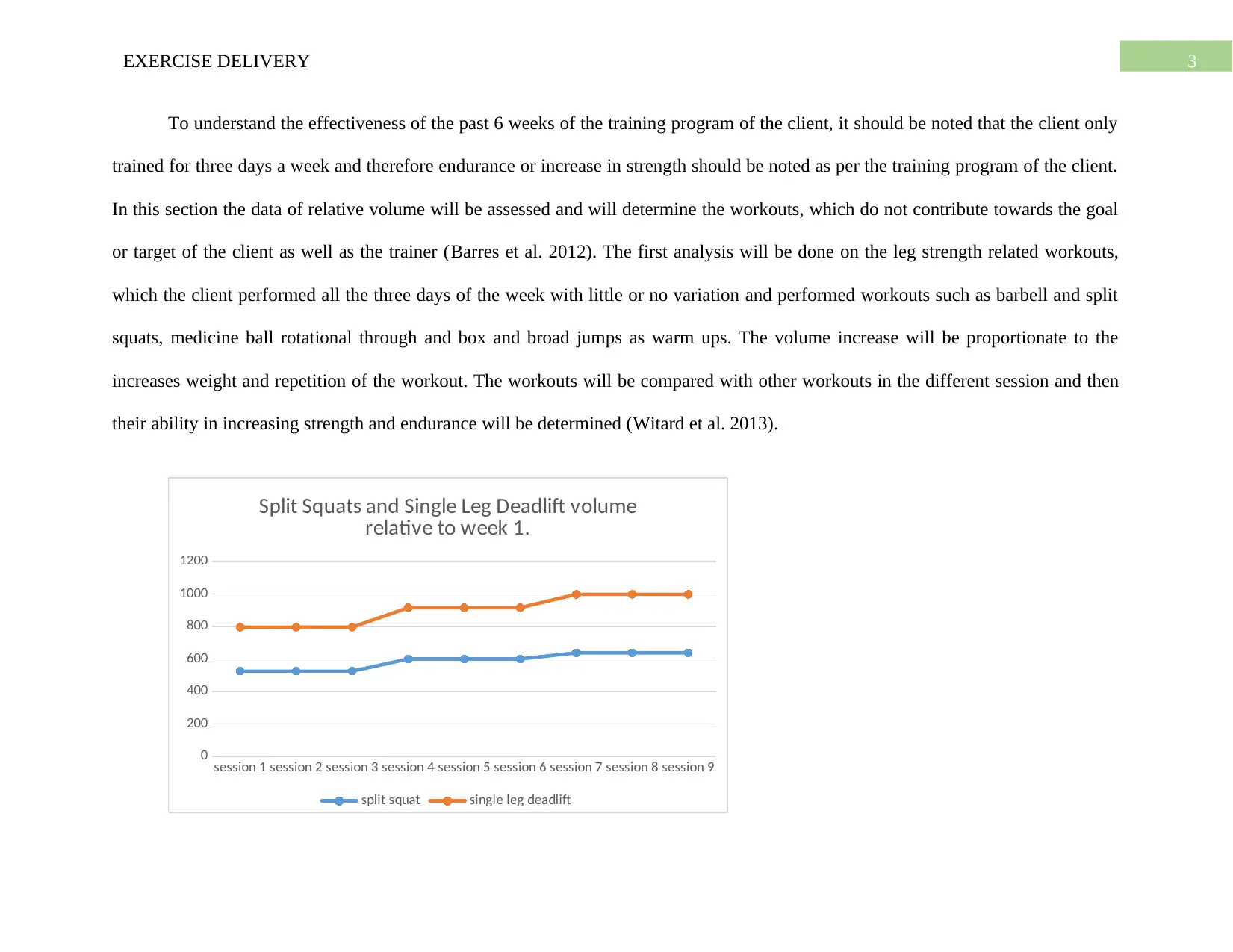
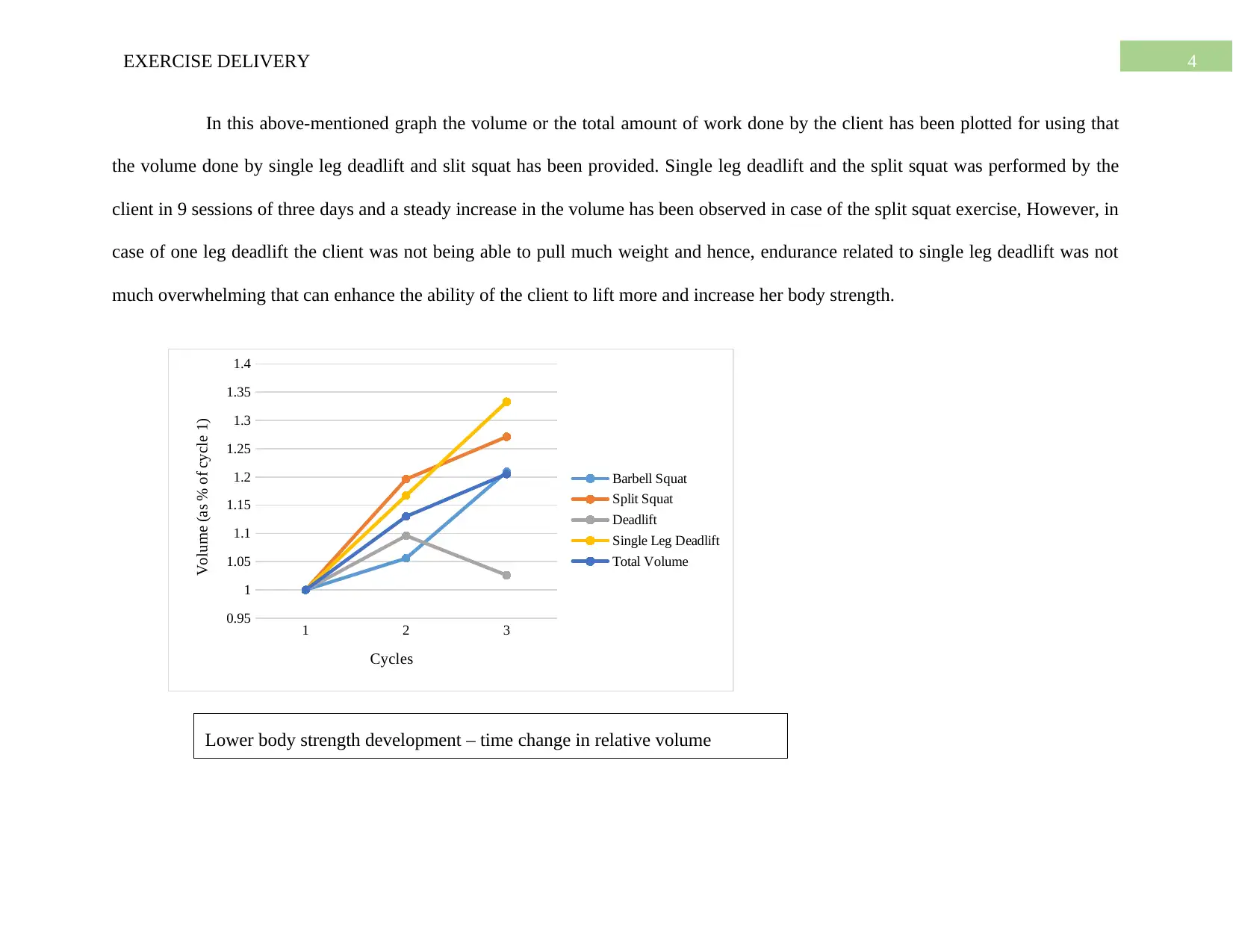
In this above-mentioned graph the volume or the total amount of work done by the client has been plotted for using that
the volume done by single leg deadlift and slit squat has been provided. Single leg deadlift and the split squat was performed by the
client in 9 sessions of three days and a steady increase in the volume has been observed in case of the split squat exercise, However, in
case of one leg deadlift the client was not being able to pull much weight and hence, endurance related to single leg deadlift was not
much overwhelming that can enhance the ability of the client to lift more and increase her body strength.
1 2 3
0.95
1
1.05
1.1
1.15
1.2
1.25
1.3
1.35
1.4
Barbell Squat
Split Squat
Deadlift
Single Leg Deadlift
Total Volume
Cycles
Volume (as % of cycle 1)
Lower body strength development – time change in relative volume
In this above-mentioned graph the volume or the total amount of work done by the client has been plotted for using that
the volume done by single leg deadlift and slit squat has been provided. Single leg deadlift and the split squat was performed by the
client in 9 sessions of three days and a steady increase in the volume has been observed in case of the split squat exercise, However, in
case of one leg deadlift the client was not being able to pull much weight and hence, endurance related to single leg deadlift was not
much overwhelming that can enhance the ability of the client to lift more and increase her body strength.
1 2 3
0.95
1
1.05
1.1
1.15
1.2
1.25
1.3
1.35
1.4
Barbell Squat
Split Squat
Deadlift
Single Leg Deadlift
Total Volume
Cycles
Volume (as % of cycle 1)
Lower body strength development – time change in relative volume
5EXERCISE DELIVERY
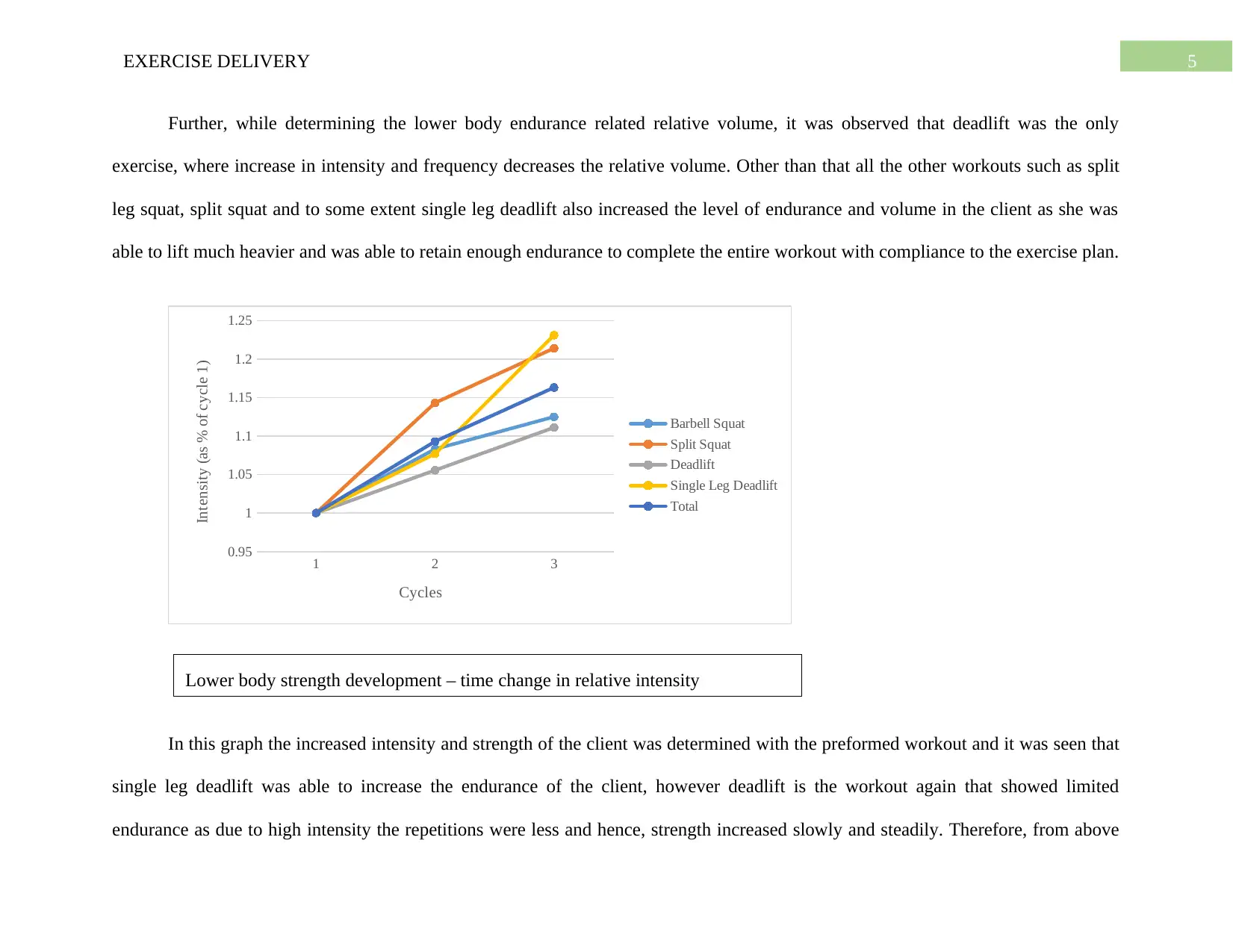
Further, while determining the lower body endurance related relative volume, it was observed that deadlift was the only
exercise, where increase in intensity and frequency decreases the relative volume. Other than that all the other workouts such as split
leg squat, split squat and to some extent single leg deadlift also increased the level of endurance and volume in the client as she was
able to lift much heavier and was able to retain enough endurance to complete the entire workout with compliance to the exercise plan.
1 2 3
0.95
1
1.05
1.1
1.15
1.2
1.25
Barbell Squat
Split Squat
Deadlift
Single Leg Deadlift
Total
Cycles
Intensity (as % of cycle 1)
In this graph the increased intensity and strength of the client was determined with the preformed workout and it was seen that
single leg deadlift was able to increase the endurance of the client, however deadlift is the workout again that showed limited
endurance as due to high intensity the repetitions were less and hence, strength increased slowly and steadily. Therefore, from above
Lower body strength development – time change in relative intensity
Further, while determining the lower body endurance related relative volume, it was observed that deadlift was the only
exercise, where increase in intensity and frequency decreases the relative volume. Other than that all the other workouts such as split
leg squat, split squat and to some extent single leg deadlift also increased the level of endurance and volume in the client as she was
able to lift much heavier and was able to retain enough endurance to complete the entire workout with compliance to the exercise plan.
1 2 3
0.95
1
1.05
1.1
1.15
1.2
1.25
Barbell Squat
Split Squat
Deadlift
Single Leg Deadlift
Total
Cycles
Intensity (as % of cycle 1)
In this graph the increased intensity and strength of the client was determined with the preformed workout and it was seen that
single leg deadlift was able to increase the endurance of the client, however deadlift is the workout again that showed limited
endurance as due to high intensity the repetitions were less and hence, strength increased slowly and steadily. Therefore, from above
Lower body strength development – time change in relative intensity
⊘ This is a preview!⊘
Do you want full access?
Subscribe today to unlock all pages.
Trusted by 1+ million students worldwide
6EXERCISE DELIVERY
mentioned discussion it is evident that more than negative aspects of the workout plan in the client, using the plan the client was able
to gain core and lower body strength and hence, the future exercise plan should also competent the plan and make improvements so
that more focus on endurance can be achieved.
Recommendations
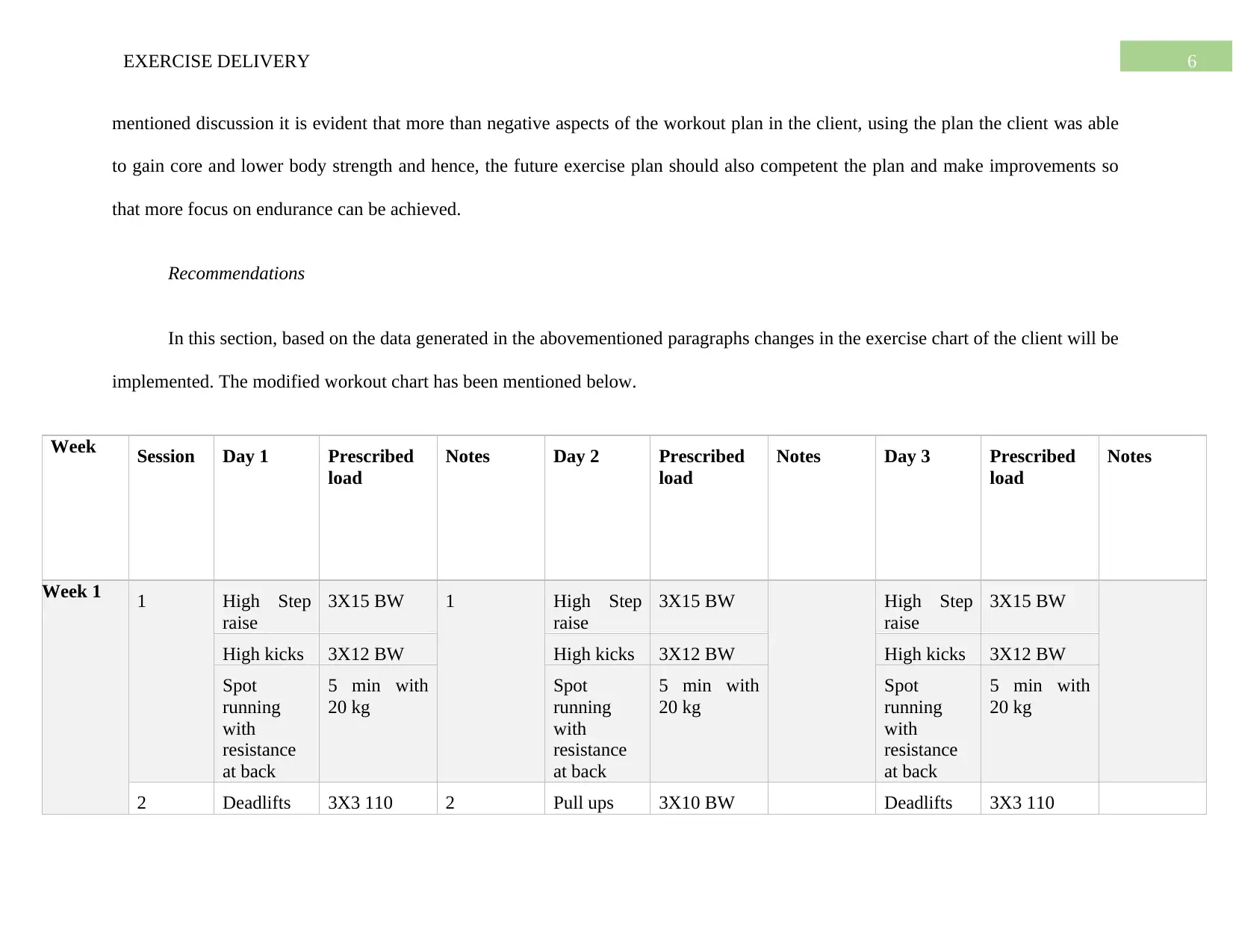
In this section, based on the data generated in the abovementioned paragraphs changes in the exercise chart of the client will be
implemented. The modified workout chart has been mentioned below.
Week Session Day 1 Prescribed
load
Notes Day 2 Prescribed
load
Notes Day 3 Prescribed
load
Notes
Week 1 1 High Step
raise
3X15 BW 1 High Step
raise
3X15 BW High Step
raise
3X15 BW
High kicks 3X12 BW High kicks 3X12 BW High kicks 3X12 BW
Spot
running
with
resistance
at back
5 min with
20 kg
Spot
running
with
resistance
at back
5 min with
20 kg
Spot
running
with
resistance
at back
5 min with
20 kg
2 Deadlifts 3X3 110 2 Pull ups 3X10 BW Deadlifts 3X3 110
mentioned discussion it is evident that more than negative aspects of the workout plan in the client, using the plan the client was able
to gain core and lower body strength and hence, the future exercise plan should also competent the plan and make improvements so
that more focus on endurance can be achieved.
Recommendations
In this section, based on the data generated in the abovementioned paragraphs changes in the exercise chart of the client will be
implemented. The modified workout chart has been mentioned below.
Week Session Day 1 Prescribed
load
Notes Day 2 Prescribed
load
Notes Day 3 Prescribed
load
Notes
Week 1 1 High Step
raise
3X15 BW 1 High Step
raise
3X15 BW High Step
raise
3X15 BW
High kicks 3X12 BW High kicks 3X12 BW High kicks 3X12 BW
Spot
running
with
resistance
at back
5 min with
20 kg
Spot
running
with
resistance
at back
5 min with
20 kg
Spot
running
with
resistance
at back
5 min with
20 kg
2 Deadlifts 3X3 110 2 Pull ups 3X10 BW Deadlifts 3X3 110
Paraphrase This Document
Need a fresh take? Get an instant paraphrase of this document with our AI Paraphraser
7EXERCISE DELIVERY
Bend over
rows
3X8 40 Split squat 3X5 45 kg Bend over
rows
3X8 40
MB Back
extensions
3X12 BW Battle
ropes
2 minutes
high speed
MB Back
extensions
3X12 BW
3 Barbell
squats
3X5 70kg 3 Planks 3X 60
seconds
Barbell
squats
3X5 70kg
Leg presses 3x8 50kg Farmer
walk
3X200 meter
50 kg
Leg presses 3x8 50kg
Bench
press
3X8 40kg Overhead
presses
3X8 35 kg Bench
press
3X8 40kg
Week 2 1 High Step
raise
3X15 BW 1 High Step
raise
3X15 BW High Step
raise
3X15 BW
High kicks 3X12 BW High kicks 3X12 BW High kicks 3X12 BW
Spot
running
with
resistance
at back
10 min with
20 kg
Spot
running
with
resistance
at back
10 min with
20 kg
Spot
running
with
resistance
at back
10 min with
20 kg
2 Pull ups 3X12 BW 2 Deadlifts 3X3 110 Pull ups 3X15 BW
Split squat 3X5 47 kg Bend over
rows
3X8 40 Split squat 3X5 50 kg
Battle
ropes
2 minutes
high speed
MB Back
extensions
3X12 BW Battle
ropes
3 minutes
high speed
3 Planks 3X 60
seconds
3 Barbell
squats
3X5 70kg Planks 3X 70
seconds
Farmer
walk
3X200 meter
50 kg
Leg presses 3x8 50kg Farmer
walk
3X200 meter
55 kg
Bend over
rows
3X8 40 Split squat 3X5 45 kg Bend over
rows
3X8 40
MB Back
extensions
3X12 BW Battle
ropes
2 minutes
high speed
MB Back
extensions
3X12 BW
3 Barbell
squats
3X5 70kg 3 Planks 3X 60
seconds
Barbell
squats
3X5 70kg
Leg presses 3x8 50kg Farmer
walk
3X200 meter
50 kg
Leg presses 3x8 50kg
Bench
press
3X8 40kg Overhead
presses
3X8 35 kg Bench
press
3X8 40kg
Week 2 1 High Step
raise
3X15 BW 1 High Step
raise
3X15 BW High Step
raise
3X15 BW
High kicks 3X12 BW High kicks 3X12 BW High kicks 3X12 BW
Spot
running
with
resistance
at back
10 min with
20 kg
Spot
running
with
resistance
at back
10 min with
20 kg
Spot
running
with
resistance
at back
10 min with
20 kg
2 Pull ups 3X12 BW 2 Deadlifts 3X3 110 Pull ups 3X15 BW
Split squat 3X5 47 kg Bend over
rows
3X8 40 Split squat 3X5 50 kg
Battle
ropes
2 minutes
high speed
MB Back
extensions
3X12 BW Battle
ropes
3 minutes
high speed
3 Planks 3X 60
seconds
3 Barbell
squats
3X5 70kg Planks 3X 70
seconds
Farmer
walk
3X200 meter
50 kg
Leg presses 3x8 50kg Farmer
walk
3X200 meter
55 kg

8EXERCISE DELIVERY
Overhead
presses
3X8 35 kg Bench
press
3X8 40kg Overhead
presses
3X8 40 kg
Overhead
presses
3X8 35 kg Bench
press
3X8 40kg Overhead
presses
3X8 40 kg
⊘ This is a preview!⊘
Do you want full access?
Subscribe today to unlock all pages.
Trusted by 1+ million students worldwide
9EXERCISE DELIVERY
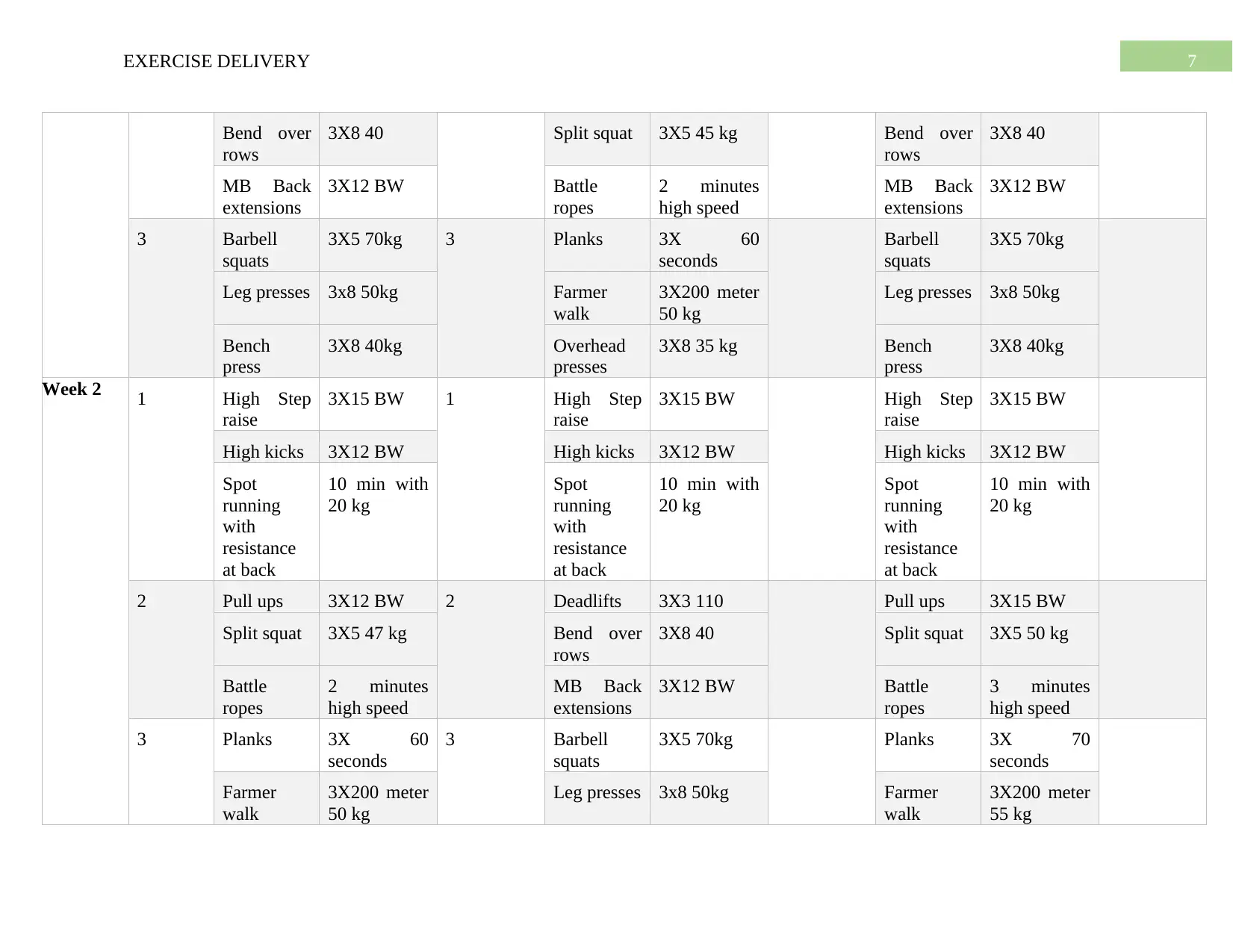
In this above mentioned detailed exercise chart, all the planned exercises has been included for the next two weeks session. In
this the primary changes has been introduced in all the sessions and introduction of several core and endurance related workouts such
as battle ropes, spot running with resistance, back extension and strength building workouts such as bend over rows, pull up and leg
press so that from upper body to lower body, the strength can be properly distributed and the client can build up a higher level of
endurance and agility while working out in the session (Haff and Triplett 2015; Park and Carmont 2013). Further, with such
recommendations, some exercises has been retained as they were able to create a strong base for the sportsperson. Therefore, this way
the strength and endurance of the individual will be developed. Further, the number of sets and repetition has been set to a repetition
range which is proved to increase strength and endurance as per the research of (Trombetti et al. 2016). Heavy weight workout has
been limited for minimal repetition range, whereas workouts with body weight and moderate to little weight has been provided with
little higher repetition range so that muscle hypertrophy can be achieved and strength can be increased (Stark et al. 2012).
In this above mentioned detailed exercise chart, all the planned exercises has been included for the next two weeks session. In
this the primary changes has been introduced in all the sessions and introduction of several core and endurance related workouts such
as battle ropes, spot running with resistance, back extension and strength building workouts such as bend over rows, pull up and leg
press so that from upper body to lower body, the strength can be properly distributed and the client can build up a higher level of
endurance and agility while working out in the session (Haff and Triplett 2015; Park and Carmont 2013). Further, with such
recommendations, some exercises has been retained as they were able to create a strong base for the sportsperson. Therefore, this way
the strength and endurance of the individual will be developed. Further, the number of sets and repetition has been set to a repetition
range which is proved to increase strength and endurance as per the research of (Trombetti et al. 2016). Heavy weight workout has
been limited for minimal repetition range, whereas workouts with body weight and moderate to little weight has been provided with
little higher repetition range so that muscle hypertrophy can be achieved and strength can be increased (Stark et al. 2012).
Paraphrase This Document
Need a fresh take? Get an instant paraphrase of this document with our AI Paraphraser
10EXERCISE DELIVERY
References
Areta, J.L., Burke, L.M., Ross, M.L., Camera, D.M., West, D.W., Broad, E.M., Jeacocke, N.A., Moore, D.R., Stellingwerff, T.,
Phillips, S.M. and Hawley, J.A., 2013. Timing and distribution of protein ingestion during prolonged recovery from resistance
exercise alters myofibrillar protein synthesis. The Journal of physiology, 591(9), pp.2319-2331.
Barres, R., Yan, J., Egan, B., Treebak, J.T., Rasmussen, M., Fritz, T., Caidahl, K., Krook, A., O'Gorman, D.J. and Zierath, J.R., 2012.
Acute exercise remodels promoter methylation in human skeletal muscle. Cell metabolism, 15(3), pp.405-411.
Haff, G.G. and Triplett, N.T. eds., 2015. Essentials of strength training and conditioning 4th edition. Human kinetics.
Hedrick, A., 2002. Training for high-performance collegiate ice hockey. Strength and Conditioning Journal, 24(2), pp.42-52.
Manners, T.W., 2004. Sport-Specific Training for Ice Hockey. Strength & Conditioning Journal, 26(2), pp.16-21.
Menezes Junior, Francisco José de et al. Is the combination of interval and resistance training more effective on physical fitness? A
systematic review and Meta-analysis. Rev. bras. cineantropom. desempenho hum., Florianópolis , v. 19, n. 5, p. 618-629, Oct. 2017
Morris, C., Grada, C.O., Ryan, M., Roche, H.M., De Vito, G., Gibney, M.J., Gibney, E.R. and Brennan, L., 2013. The relationship
between aerobic fitness level and metabolic profiles in healthy adults. Molecular nutrition & food research, 57(7), pp.1246-1254.
References
Areta, J.L., Burke, L.M., Ross, M.L., Camera, D.M., West, D.W., Broad, E.M., Jeacocke, N.A., Moore, D.R., Stellingwerff, T.,
Phillips, S.M. and Hawley, J.A., 2013. Timing and distribution of protein ingestion during prolonged recovery from resistance
exercise alters myofibrillar protein synthesis. The Journal of physiology, 591(9), pp.2319-2331.
Barres, R., Yan, J., Egan, B., Treebak, J.T., Rasmussen, M., Fritz, T., Caidahl, K., Krook, A., O'Gorman, D.J. and Zierath, J.R., 2012.
Acute exercise remodels promoter methylation in human skeletal muscle. Cell metabolism, 15(3), pp.405-411.
Haff, G.G. and Triplett, N.T. eds., 2015. Essentials of strength training and conditioning 4th edition. Human kinetics.
Hedrick, A., 2002. Training for high-performance collegiate ice hockey. Strength and Conditioning Journal, 24(2), pp.42-52.
Manners, T.W., 2004. Sport-Specific Training for Ice Hockey. Strength & Conditioning Journal, 26(2), pp.16-21.
Menezes Junior, Francisco José de et al. Is the combination of interval and resistance training more effective on physical fitness? A
systematic review and Meta-analysis. Rev. bras. cineantropom. desempenho hum., Florianópolis , v. 19, n. 5, p. 618-629, Oct. 2017
Morris, C., Grada, C.O., Ryan, M., Roche, H.M., De Vito, G., Gibney, M.J., Gibney, E.R. and Brennan, L., 2013. The relationship
between aerobic fitness level and metabolic profiles in healthy adults. Molecular nutrition & food research, 57(7), pp.1246-1254.
11EXERCISE DELIVERY
Nightingale, S.C., 2014. A Strength and Conditioning Approach for Ice Hockey. Strength & Conditioning Journal, 36(6), pp.28-36.
Nightingale, S.C., Miller, S. and Turner, A., 2013. The usefulness and reliability of fitness testing protocols for ice hockey players: A
literature review. The Journal of Strength & Conditioning Research, 27(6), pp.1742-1748.
Park, D. and Carmont, M.R., 2013. Mountain, Sky, and Endurance Running. In Adventure and Extreme Sports Injuries(pp. 273-301).
Springer, London.
Stark, M., Lukaszuk, J., Prawitz, A. and Salacinski, A., 2012. Protein timing and its effects on muscular hypertrophy and strength in
individuals engaged in weight-training. Journal of the International Society of Sports Nutrition, 9(1), p.54.
Trombetti, A., Reid, K.F., Hars, M., Herrmann, F.R., Pasha, E., Phillips, E.M. and Fielding, R.A., 2016. Age-associated declines in
muscle mass, strength, power, and physical performance: impact on fear of falling and quality of life. Osteoporosis
international, 27(2), pp.463-471.
Witard, O.C., Jackman, S.R., Breen, L., Smith, K., Selby, A. and Tipton, K.D., 2013. Myofibrillar muscle protein synthesis rates
subsequent to a meal in response to increasing doses of whey protein at rest and after resistance exercise–. The American journal of
clinical nutrition, 99(1), pp.86-95.
Nightingale, S.C., 2014. A Strength and Conditioning Approach for Ice Hockey. Strength & Conditioning Journal, 36(6), pp.28-36.
Nightingale, S.C., Miller, S. and Turner, A., 2013. The usefulness and reliability of fitness testing protocols for ice hockey players: A
literature review. The Journal of Strength & Conditioning Research, 27(6), pp.1742-1748.
Park, D. and Carmont, M.R., 2013. Mountain, Sky, and Endurance Running. In Adventure and Extreme Sports Injuries(pp. 273-301).
Springer, London.
Stark, M., Lukaszuk, J., Prawitz, A. and Salacinski, A., 2012. Protein timing and its effects on muscular hypertrophy and strength in
individuals engaged in weight-training. Journal of the International Society of Sports Nutrition, 9(1), p.54.
Trombetti, A., Reid, K.F., Hars, M., Herrmann, F.R., Pasha, E., Phillips, E.M. and Fielding, R.A., 2016. Age-associated declines in
muscle mass, strength, power, and physical performance: impact on fear of falling and quality of life. Osteoporosis
international, 27(2), pp.463-471.
Witard, O.C., Jackman, S.R., Breen, L., Smith, K., Selby, A. and Tipton, K.D., 2013. Myofibrillar muscle protein synthesis rates
subsequent to a meal in response to increasing doses of whey protein at rest and after resistance exercise–. The American journal of
clinical nutrition, 99(1), pp.86-95.
⊘ This is a preview!⊘
Do you want full access?
Subscribe today to unlock all pages.
Trusted by 1+ million students worldwide

1 out of 13


Related Documents


Your All-in-One AI-Powered Toolkit for Academic Success.
+13062052269
info@desklib.com
Available 24*7 on WhatsApp / Email
![[object Object]](/_next/static/media/star-bottom.7253800d.svg)
Unlock your academic potential
Copyright © 2020–2026 A2Z Services. All Rights Reserved. Developed and managed by ZUCOL.