International Management Report: Expatriate Success, Global Economy
VerifiedAdded on 2023/01/06
|8
|2536
|31
Report
AI Summary
This report delves into the complexities of international management, examining critical evidence surrounding expatriate failure in relation to cultural adjustment. It explores factors that contribute to expatriate success, emphasizing the importance of training, realistic briefings, and organizational support. The report also analyzes the factors that contribute to the notion of a globalized economy, highlighting the significance of ethical and accountable international policies, including labor mobility, enhanced investment, and the role of information and communication technology. The conclusion synthesizes the key findings, reinforcing the importance of effective management practices for international business operations and the integration of ethical considerations in a globalized context. The report underscores the need for businesses to adapt and thrive in the international market by addressing expatriate challenges and contributing to a responsible global economy.

INTERNATIONAL
MANAGEMENT
MANAGEMENT

Paraphrase This Document
Need a fresh take? Get an instant paraphrase of this document with our AI Paraphraser
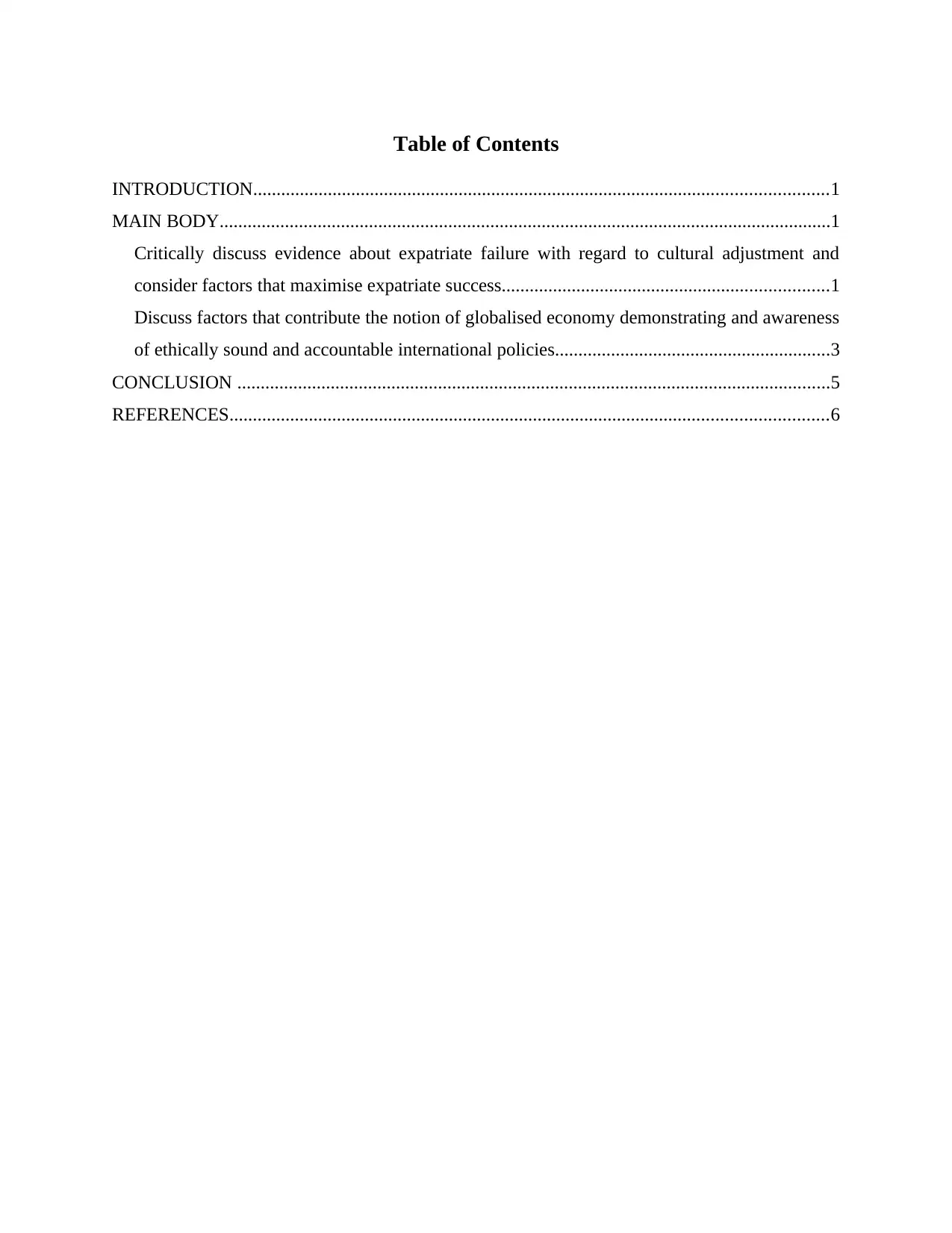
Table of Contents
INTRODUCTION...........................................................................................................................1
MAIN BODY...................................................................................................................................1
Critically discuss evidence about expatriate failure with regard to cultural adjustment and
consider factors that maximise expatriate success......................................................................1
Discuss factors that contribute the notion of globalised economy demonstrating and awareness
of ethically sound and accountable international policies...........................................................3
CONCLUSION ...............................................................................................................................5
REFERENCES................................................................................................................................6
INTRODUCTION...........................................................................................................................1
MAIN BODY...................................................................................................................................1
Critically discuss evidence about expatriate failure with regard to cultural adjustment and
consider factors that maximise expatriate success......................................................................1
Discuss factors that contribute the notion of globalised economy demonstrating and awareness
of ethically sound and accountable international policies...........................................................3
CONCLUSION ...............................................................................................................................5
REFERENCES................................................................................................................................6
INTRODUCTION
International management refers to the management of business operations within the
organisation that serve their market and products and services in more than one country. In
simple words it has international presence within business industry. This term is very helpful to
enhanced the skills and knowledge about operating regulations so that organisation will get the
desired outcome within a specified duration of time. In this human resource management is play
an important role in the success and failure of the international management. It generally
involves the transaction of products and services that will reflects the use of advanced
technology. This project report is based on the critical evidence related to expatriate failure with
regards to culture adjustment and it also involves the factors that helps in maximising the
expatriate success. At last it involves the factors that may contribute to the notion of globalised
economy(Uphoff, 2019).
MAIN BODY
Critically discuss evidence about expatriate failure with regard to cultural adjustment and
consider factors that maximise expatriate success
Expatriate
An expatriate is the person that is residing in the country other than home country for the
purpose of the work. A professional is an expatriate that moves to the new country regarding
some work on a temporary basis. A MNC need an expatriate who is an expert for fulfilling the
goals related to higher success and profits(Shapiro and Hanouna, 2019).
Expatriate process
It refers to the movement of an company employee from another country for completion
o0f the specific task and goals. This objectives is of short term and long term basis and it is
dependent on their position calibre and potential to complete the task and gain higher profits and
revenues.
Evidence regarding expatriate failure with regard to cultural adjustment
Within international management it is very essential for the organisation that they can
understand the effectiveness of the resources that is used in the global market that is suitable for
the supply of the goods and services. In this culture plays an essential role that affect every
expatriate who moves to the global market. In present scenario business environment is very
1
International management refers to the management of business operations within the
organisation that serve their market and products and services in more than one country. In
simple words it has international presence within business industry. This term is very helpful to
enhanced the skills and knowledge about operating regulations so that organisation will get the
desired outcome within a specified duration of time. In this human resource management is play
an important role in the success and failure of the international management. It generally
involves the transaction of products and services that will reflects the use of advanced
technology. This project report is based on the critical evidence related to expatriate failure with
regards to culture adjustment and it also involves the factors that helps in maximising the
expatriate success. At last it involves the factors that may contribute to the notion of globalised
economy(Uphoff, 2019).
MAIN BODY
Critically discuss evidence about expatriate failure with regard to cultural adjustment and
consider factors that maximise expatriate success
Expatriate
An expatriate is the person that is residing in the country other than home country for the
purpose of the work. A professional is an expatriate that moves to the new country regarding
some work on a temporary basis. A MNC need an expatriate who is an expert for fulfilling the
goals related to higher success and profits(Shapiro and Hanouna, 2019).
Expatriate process
It refers to the movement of an company employee from another country for completion
o0f the specific task and goals. This objectives is of short term and long term basis and it is
dependent on their position calibre and potential to complete the task and gain higher profits and
revenues.
Evidence regarding expatriate failure with regard to cultural adjustment
Within international management it is very essential for the organisation that they can
understand the effectiveness of the resources that is used in the global market that is suitable for
the supply of the goods and services. In this culture plays an essential role that affect every
expatriate who moves to the global market. In present scenario business environment is very
1
⊘ This is a preview!⊘
Do you want full access?
Subscribe today to unlock all pages.

Trusted by 1+ million students worldwide
dynamic because it is based on the international transaction that it is enhanced day by day. In this
expatriate may face major challenge regarding the cultural adjustment that demotivated the
employees in their work and due to this targets are not attained on time for which an employees
is being selected to go to another country. The major reason of expatriate failure is being not
flexible and their lack of social skills due to this company may face the issue of not completion
of task on a given time duration. In this expatriate also face the challenge regarding their
expenditure that is more as compare to home country, their difference in culture, healthcare
norms, housing facilities and many more that is the evidence to make better contribution in the
failure of the expatriate employees(Loirat and et. al., 2016). Some of them can be shown below:
Lack of cultural empathy- the major challenge that the expatriate face is the lack of
ability to adjust within the new culture, environment etc. in this they does not make more
emphasize to understand the feeling, thoughts and behaviour of the other members who
are belongs to the different department. Due to this company may face the issue of not
completing the task on the specified period of time.
Lack of social skills- Another main reason of failure of the expatriate is their does not
allow to them to interact with the other people and understand their culture effectiveness.
They are basically an introvert person who only focus on their work but for the expatriate
employees it is very essential to connect with other persons so that task can be achieved
within the other country(Farkas and et. al., 2017).
Factors that maximise expatriate success
It refers to that that aspects that is effective and efficient in adding value to the concept
and process of an expatriate. In the success of the expatriate success organisation is playing a
major role that will results in the development of the task completion and profit maximisation.
In this human resource management is an appropriate concept that will add the value in the
process of success of expatriation that can be based on some stages. In this first step
management of company can select an employees as per their calibre, behaviour and potential.
In this manager also focus on their technical knowledge, ethical skills and according to all this
firm will decide the candidate as an expatriate(Terrault and et. al., 2017). Another step is to to
provide orientation in which proper communication can be done about the task that they can
perform in the another country to get success. And at last organisation can offers the financial
and organisational support to expatriate so that they focus more on their work and achieves the
2
expatriate may face major challenge regarding the cultural adjustment that demotivated the
employees in their work and due to this targets are not attained on time for which an employees
is being selected to go to another country. The major reason of expatriate failure is being not
flexible and their lack of social skills due to this company may face the issue of not completion
of task on a given time duration. In this expatriate also face the challenge regarding their
expenditure that is more as compare to home country, their difference in culture, healthcare
norms, housing facilities and many more that is the evidence to make better contribution in the
failure of the expatriate employees(Loirat and et. al., 2016). Some of them can be shown below:
Lack of cultural empathy- the major challenge that the expatriate face is the lack of
ability to adjust within the new culture, environment etc. in this they does not make more
emphasize to understand the feeling, thoughts and behaviour of the other members who
are belongs to the different department. Due to this company may face the issue of not
completing the task on the specified period of time.
Lack of social skills- Another main reason of failure of the expatriate is their does not
allow to them to interact with the other people and understand their culture effectiveness.
They are basically an introvert person who only focus on their work but for the expatriate
employees it is very essential to connect with other persons so that task can be achieved
within the other country(Farkas and et. al., 2017).
Factors that maximise expatriate success
It refers to that that aspects that is effective and efficient in adding value to the concept
and process of an expatriate. In the success of the expatriate success organisation is playing a
major role that will results in the development of the task completion and profit maximisation.
In this human resource management is an appropriate concept that will add the value in the
process of success of expatriation that can be based on some stages. In this first step
management of company can select an employees as per their calibre, behaviour and potential.
In this manager also focus on their technical knowledge, ethical skills and according to all this
firm will decide the candidate as an expatriate(Terrault and et. al., 2017). Another step is to to
provide orientation in which proper communication can be done about the task that they can
perform in the another country to get success. And at last organisation can offers the financial
and organisational support to expatriate so that they focus more on their work and achieves the
2
Paraphrase This Document
Need a fresh take? Get an instant paraphrase of this document with our AI Paraphraser
target on the set period of time. In this management of the company offers better salary,
incentives to the expatriates and taking regular follow-ups to them so that if expatriate employees
face any issues it can resolved frequently and all this steps are the reason of success of the
expatriate. In this there are some factors that helps in the success of expatriate that can be
elaborates below:
Training to expatriates- It is one of the essential factor that includes the training based
on expatriate pre departure and post departure because it is very helpful to expatriate to
adjust into the new environment and respond on them on quick basis. This training is
based on providing the knowledge regarding culture and language of that country. It is
very effective to create an awareness in employees regarding climate, values, cultures etc.
so that they will become familiar to the new country. Due to this problem related to
cultural empathy is solved and there is no roadblock is facing by the expatriate in
communicating with different culture people. In this company also provide the training
based on the language used so that expatriate can effectively deal with the problems of
the new country and due to this firm will face higher success(Apte and Kapshe, 2020).
Realistic briefing and induction- It is an essential factor in the success of the expatriate
because it helps in understanding the job profile and making real expectation from that.
This helps in understanding the work and removing the stress effectively. In this
induction is very helpful in identifying and reviewing the problems that are associated
with the assigned task. In this brief discussion can be done related to finance, cost of
finance, education, work demands etc. For expatriate family issues is a major problem
and in this management can take decisions regarding their family members in which they
decide whether expatriate employee take off their family to host country or not(Machlis
and Tichnell, 2019).
Discuss factors that contribute the notion of globalised economy demonstrating and awareness of
ethically sound and accountable international policies
Globalisation refers to the integration between the people, organisation and the
government in the worldwide nature. It is an effective term for enhancing the interdependencies
of the world economy. It is a continuous process that will grow and develops according to the
environment and their surrounded resources. In this globalisation is occur when a business
enterprise can move into the international market for capturing more opportunities and eliminates
3
incentives to the expatriates and taking regular follow-ups to them so that if expatriate employees
face any issues it can resolved frequently and all this steps are the reason of success of the
expatriate. In this there are some factors that helps in the success of expatriate that can be
elaborates below:
Training to expatriates- It is one of the essential factor that includes the training based
on expatriate pre departure and post departure because it is very helpful to expatriate to
adjust into the new environment and respond on them on quick basis. This training is
based on providing the knowledge regarding culture and language of that country. It is
very effective to create an awareness in employees regarding climate, values, cultures etc.
so that they will become familiar to the new country. Due to this problem related to
cultural empathy is solved and there is no roadblock is facing by the expatriate in
communicating with different culture people. In this company also provide the training
based on the language used so that expatriate can effectively deal with the problems of
the new country and due to this firm will face higher success(Apte and Kapshe, 2020).
Realistic briefing and induction- It is an essential factor in the success of the expatriate
because it helps in understanding the job profile and making real expectation from that.
This helps in understanding the work and removing the stress effectively. In this
induction is very helpful in identifying and reviewing the problems that are associated
with the assigned task. In this brief discussion can be done related to finance, cost of
finance, education, work demands etc. For expatriate family issues is a major problem
and in this management can take decisions regarding their family members in which they
decide whether expatriate employee take off their family to host country or not(Machlis
and Tichnell, 2019).
Discuss factors that contribute the notion of globalised economy demonstrating and awareness of
ethically sound and accountable international policies
Globalisation refers to the integration between the people, organisation and the
government in the worldwide nature. It is an effective term for enhancing the interdependencies
of the world economy. It is a continuous process that will grow and develops according to the
environment and their surrounded resources. In this globalisation is occur when a business
enterprise can move into the international market for capturing more opportunities and eliminates
3
the blockages in the practice of operation of the organisation. It includes the various factors that
notion to globalised outcome while demonstrating the awareness in terms of ethical and
accountable policies that are based on globalisation. In this expatriation can develops the family
environment to the new place where they can work and and make full efforts to integrate the
economy so that high results can be attained. In this they can capture more new opportunities and
resources that gives the efficient results in an appropriate manner. This discussion is based on
the globalisation concept and their idea because it gives the positive results to the economy,
country and the organisation(Spratt and et. al., 2017). It involves various factors that contributes
in the notion of globalised economy and some factors can be shown below by including the
ethical, accountable global policies of work and development that helps inn gaining the high
benefits in terms of international management.
Motion of labour and human capital- In this human resource that are experts and
professionals are migrated from their domestic place to the international place which is
totally new for their work and gaining higher profits and revenues to them. At the time of
integrating with the international market expatriates safety is more essential and in this
government may imposed some rules and regulations that helps in their safety. In this
policies related to equality in society, equal pay and business settings will support the
notion of the global integration and due to this productive results can be gained by the
organisation due to this economy of the country will also enhanced(Ilankoon and et. al.,
2018).
Enhanced investment- In this integration between global economy has considered
number of benefits that will lead to the enhancement of the idea of international trading
by supporting the notion. Due to globalisation organisations get more new resources and
in this they need to invest more that will offer the support to international business
practices. This notion includes the needs and awareness because of strict ethical,
accountable and social policies based on the international trade. This helps in securing the
fraud and risk in the name of globalisation(Beamish and Lupton, 2016).
Emerging information and communication technology- It is one of the most essential
notion that may involves the growth of international economy and also support the
business that are done their operations globally. The information is flow by using
telephone that easily and effectively pass the information in every situation. In this
4
notion to globalised outcome while demonstrating the awareness in terms of ethical and
accountable policies that are based on globalisation. In this expatriation can develops the family
environment to the new place where they can work and and make full efforts to integrate the
economy so that high results can be attained. In this they can capture more new opportunities and
resources that gives the efficient results in an appropriate manner. This discussion is based on
the globalisation concept and their idea because it gives the positive results to the economy,
country and the organisation(Spratt and et. al., 2017). It involves various factors that contributes
in the notion of globalised economy and some factors can be shown below by including the
ethical, accountable global policies of work and development that helps inn gaining the high
benefits in terms of international management.
Motion of labour and human capital- In this human resource that are experts and
professionals are migrated from their domestic place to the international place which is
totally new for their work and gaining higher profits and revenues to them. At the time of
integrating with the international market expatriates safety is more essential and in this
government may imposed some rules and regulations that helps in their safety. In this
policies related to equality in society, equal pay and business settings will support the
notion of the global integration and due to this productive results can be gained by the
organisation due to this economy of the country will also enhanced(Ilankoon and et. al.,
2018).
Enhanced investment- In this integration between global economy has considered
number of benefits that will lead to the enhancement of the idea of international trading
by supporting the notion. Due to globalisation organisations get more new resources and
in this they need to invest more that will offer the support to international business
practices. This notion includes the needs and awareness because of strict ethical,
accountable and social policies based on the international trade. This helps in securing the
fraud and risk in the name of globalisation(Beamish and Lupton, 2016).
Emerging information and communication technology- It is one of the most essential
notion that may involves the growth of international economy and also support the
business that are done their operations globally. The information is flow by using
telephone that easily and effectively pass the information in every situation. In this
4
⊘ This is a preview!⊘
Do you want full access?
Subscribe today to unlock all pages.
Trusted by 1+ million students worldwide
thinking of globalisation helps in motivating the business to enhanced their transactions
in the benefits of the global economic. In this complex international trade policies can
able the regulations of available information for the effective and positive use that will be
effective for the organisation in terms of getting higher success in their operations. In this
process of expatriate can supports the technology so that they can set the working
environment according to themselves and this will helps in enhancing the economy of
country and profits of the business enterprises.
Economic factor- Global economy is an effective term that has better trade policies,
reducing barriers and flexible working environment. Global trade includes the economic
factor that helps the organisation to present the offers that are less complicated. IN this
notion of trade practice are in the favour of the economy and due to this globalisation is
to be developed. In this protection is very important because it eliminates the unfair trade
practices and methods that affect the globalisation and fair trade practices.
CONCLUSION
From the above report it is to be concluded that international management is an effective
term that is being adopted by the businesses to manage and operate their operations and
enhancing their position within the international business market. In this several components are
to the addressed on the expatriate that helps in overcoming them from the failure and maximising
the success in an effective and efficient way. In this cultural adjustment play an essential role to
enhancing the productivity of the employees within international market so that output would be
achieved. At last it inculcates the different factors that focused on the contribution of notion of
globalised economy that is fully based on the terms of code of conducts.
5
in the benefits of the global economic. In this complex international trade policies can
able the regulations of available information for the effective and positive use that will be
effective for the organisation in terms of getting higher success in their operations. In this
process of expatriate can supports the technology so that they can set the working
environment according to themselves and this will helps in enhancing the economy of
country and profits of the business enterprises.
Economic factor- Global economy is an effective term that has better trade policies,
reducing barriers and flexible working environment. Global trade includes the economic
factor that helps the organisation to present the offers that are less complicated. IN this
notion of trade practice are in the favour of the economy and due to this globalisation is
to be developed. In this protection is very important because it eliminates the unfair trade
practices and methods that affect the globalisation and fair trade practices.
CONCLUSION
From the above report it is to be concluded that international management is an effective
term that is being adopted by the businesses to manage and operate their operations and
enhancing their position within the international business market. In this several components are
to the addressed on the expatriate that helps in overcoming them from the failure and maximising
the success in an effective and efficient way. In this cultural adjustment play an essential role to
enhancing the productivity of the employees within international market so that output would be
achieved. At last it inculcates the different factors that focused on the contribution of notion of
globalised economy that is fully based on the terms of code of conducts.
5
Paraphrase This Document
Need a fresh take? Get an instant paraphrase of this document with our AI Paraphraser
REFERENCES
Books and Journals
Apte, P.G. and Kapshe, S., 2020. International Financial Management|. McGraw-Hill
Education.
Beamish, P.W. and Lupton, N.C., 2016. Cooperative strategies in international business and
management: Reflections on the past 50 years and future directions. Journal of World
Business. 51(1). pp.163-175.
Brunstein, I. ed., 2016. Human resource management in Western Europe (Vol. 68). Walter de
Gruyter GmbH & Co KG.
Farkas, H. and et. al., 2017. International consensus on the diagnosis and management of
pediatric patients with hereditary angioedema with C1 inhibitor
deficiency. Allergy. 72(2). pp.300-313.
Ilankoon, I.M.S.K. and et. al., 2018. E-waste in the international context–A review of trade
flows, regulations, hazards, waste management strategies and technologies for value
recovery. Waste Management. 82. pp.258-275.
Loirat, C., and et. al., 2016. An international consensus approach to the management of atypical
hemolytic uremic syndrome in children. Pediatric nephrology. 31(1). pp.15-39.
Machlis, G.E. and Tichnell, D.L., 2019. The state of the world's parks: An international
assessment for resource management, policy, and research. Routledge.
Shapiro, A.C. and Hanouna, P., 2019. Multinational financial management. John Wiley & Sons.
Sinclair, A.J. and et. al., 2018. An international position statement on the management of frailty
in diabetes mellitus: summary of recommendations 2017. The Journal of frailty &
aging. 7(1). pp.10-20.
Spratt, D.E. and et. al., 2017. An integrated multidisciplinary algorithm for the management of
spinal metastases: an International Spine Oncology Consortium report. The Lancet
Oncology. 18(12). pp.e720-e730.
Terrault, N.A. and et. al., 2017. International liver transplantation society consensus statement on
hepatitis C management in liver transplant candidates. Transplantation. 101(5). pp.945-
955.
Uphoff, N., 2019. Improving international irrigation management with farmer participation:
Getting the process right. Routledge.
6
Books and Journals
Apte, P.G. and Kapshe, S., 2020. International Financial Management|. McGraw-Hill
Education.
Beamish, P.W. and Lupton, N.C., 2016. Cooperative strategies in international business and
management: Reflections on the past 50 years and future directions. Journal of World
Business. 51(1). pp.163-175.
Brunstein, I. ed., 2016. Human resource management in Western Europe (Vol. 68). Walter de
Gruyter GmbH & Co KG.
Farkas, H. and et. al., 2017. International consensus on the diagnosis and management of
pediatric patients with hereditary angioedema with C1 inhibitor
deficiency. Allergy. 72(2). pp.300-313.
Ilankoon, I.M.S.K. and et. al., 2018. E-waste in the international context–A review of trade
flows, regulations, hazards, waste management strategies and technologies for value
recovery. Waste Management. 82. pp.258-275.
Loirat, C., and et. al., 2016. An international consensus approach to the management of atypical
hemolytic uremic syndrome in children. Pediatric nephrology. 31(1). pp.15-39.
Machlis, G.E. and Tichnell, D.L., 2019. The state of the world's parks: An international
assessment for resource management, policy, and research. Routledge.
Shapiro, A.C. and Hanouna, P., 2019. Multinational financial management. John Wiley & Sons.
Sinclair, A.J. and et. al., 2018. An international position statement on the management of frailty
in diabetes mellitus: summary of recommendations 2017. The Journal of frailty &
aging. 7(1). pp.10-20.
Spratt, D.E. and et. al., 2017. An integrated multidisciplinary algorithm for the management of
spinal metastases: an International Spine Oncology Consortium report. The Lancet
Oncology. 18(12). pp.e720-e730.
Terrault, N.A. and et. al., 2017. International liver transplantation society consensus statement on
hepatitis C management in liver transplant candidates. Transplantation. 101(5). pp.945-
955.
Uphoff, N., 2019. Improving international irrigation management with farmer participation:
Getting the process right. Routledge.
6

1 out of 8


Related Documents


Your All-in-One AI-Powered Toolkit for Academic Success.
+13062052269
info@desklib.com
Available 24*7 on WhatsApp / Email
![[object Object]](/_next/static/media/star-bottom.7253800d.svg)
Unlock your academic potential
Copyright © 2020–2026 A2Z Services. All Rights Reserved. Developed and managed by ZUCOL.