Business Report: Experiences Economy, Customer Trends, and Hotels
VerifiedAdded on 2023/01/19
|10
|2773
|99
Report
AI Summary
This business report delves into the Experiences Economy, focusing on Pine and Gilmore's framework and its relevance to the hospitality industry. It explores the theory of economic progression, emphasizing the shift from commodities and services to experiences. The report analyzes current customer trends, highlighting the increasing demand for personalized and authentic experiences, and the impact of these trends on the hotel market. It discusses the forces of customization and commoditization, and how these have shaped customer expectations. The report then critically reflects on how hotels have adapted to these changing customer sensibilities, examining the importance of creating unique and memorable experiences to meet evolving demands. The analysis covers how established brands are offering personalized services to stay competitive. The report concludes with a summary of the key findings and implications for the future of the hospitality sector.
Business Report

Paraphrase This Document
Need a fresh take? Get an instant paraphrase of this document with our AI Paraphraser
EXECUTIVE SUMMARY
Progress Economy is an important concept in today's world impacting upon the working
ways and survival of an organisation. The assignment will focus and make its discussion about
the Pine and Gilmore's Experiences Economy, theory of economic progression, current
customers trends in market and impacts and the changes which have been in hotel market due to
changes in preferences of customers. Discussion has been made about increased knowledge of
customers behind economic progression and regular changes in customer trends because of
increased expectations of customers related to better customer experiences.
Progress Economy is an important concept in today's world impacting upon the working
ways and survival of an organisation. The assignment will focus and make its discussion about
the Pine and Gilmore's Experiences Economy, theory of economic progression, current
customers trends in market and impacts and the changes which have been in hotel market due to
changes in preferences of customers. Discussion has been made about increased knowledge of
customers behind economic progression and regular changes in customer trends because of
increased expectations of customers related to better customer experiences.
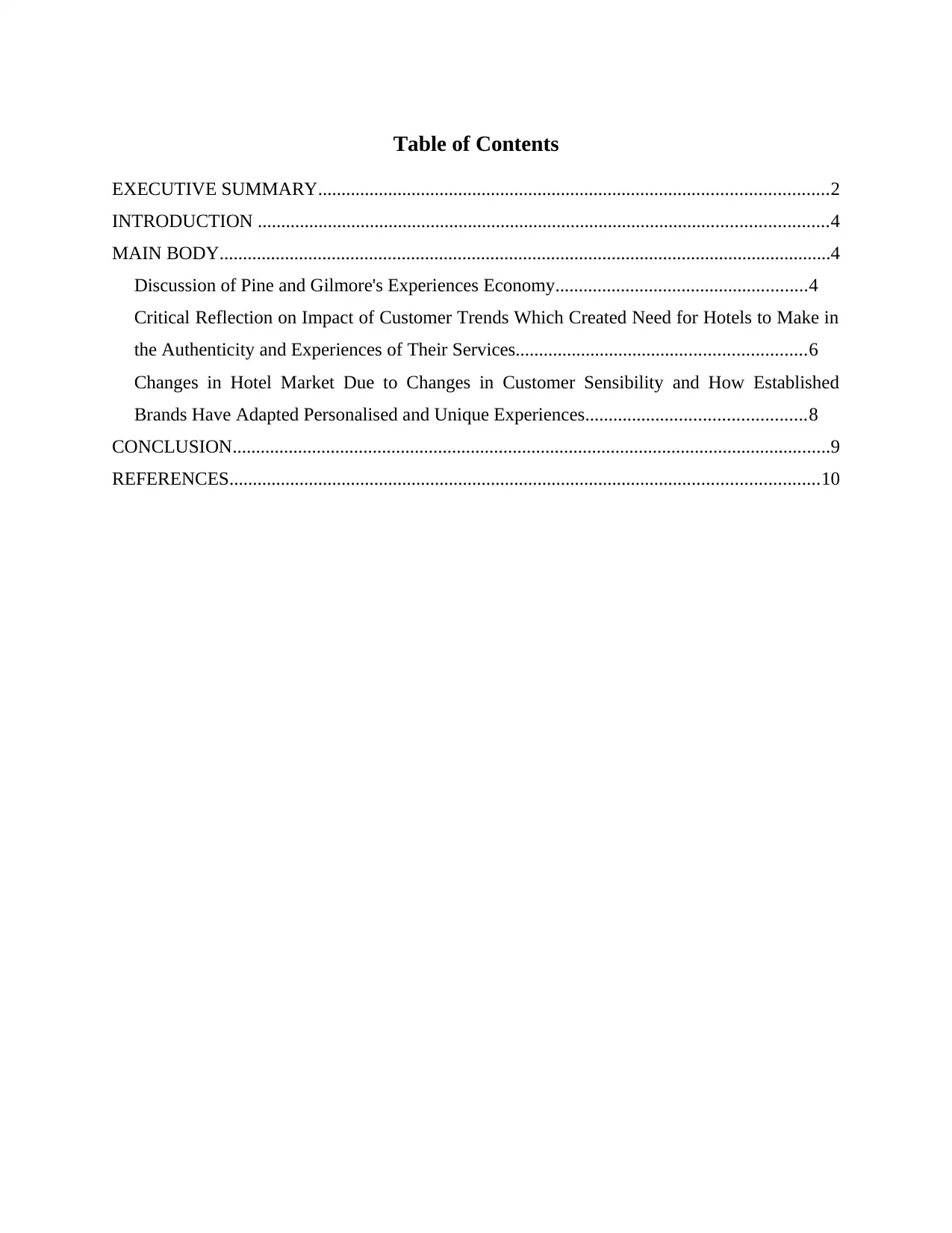
Table of Contents
EXECUTIVE SUMMARY.............................................................................................................2
INTRODUCTION ..........................................................................................................................4
MAIN BODY...................................................................................................................................4
Discussion of Pine and Gilmore's Experiences Economy......................................................4
Critical Reflection on Impact of Customer Trends Which Created Need for Hotels to Make in
the Authenticity and Experiences of Their Services..............................................................6
Changes in Hotel Market Due to Changes in Customer Sensibility and How Established
Brands Have Adapted Personalised and Unique Experiences...............................................8
CONCLUSION................................................................................................................................9
REFERENCES..............................................................................................................................10
EXECUTIVE SUMMARY.............................................................................................................2
INTRODUCTION ..........................................................................................................................4
MAIN BODY...................................................................................................................................4
Discussion of Pine and Gilmore's Experiences Economy......................................................4
Critical Reflection on Impact of Customer Trends Which Created Need for Hotels to Make in
the Authenticity and Experiences of Their Services..............................................................6
Changes in Hotel Market Due to Changes in Customer Sensibility and How Established
Brands Have Adapted Personalised and Unique Experiences...............................................8
CONCLUSION................................................................................................................................9
REFERENCES..............................................................................................................................10
⊘ This is a preview!⊘
Do you want full access?
Subscribe today to unlock all pages.

Trusted by 1+ million students worldwide
INTRODUCTION
Hospitality Industry refers to the industry which provides the customers with different
types of accommodation services, food facilities, and many more services for the satisfaction of
their customers along with providing specific experiences to them (Radder and Han, 2015). The
assignment will also make its focus on the discussion of Pine and Gilmore's Experiences
Economy by making its specific focus on Theory of Progression along with two driver forces
which are Customisation and Commoditization. In addition to this, the discussion will be made
about impact of change in customer behaviour trends on hotels in making changes in their way of
working. Lastly, discussion will be made about the changes made in hospitality sector due to
changes in customers preferences along with discussion about providing personalised and unique
experiences to customers.
MAIN BODY
Discussion of Pine and Gilmore's Experiences Economy
The Experiences Economy, another name of Pine and Gilmore's Experience Economy.
The following article was first published by B. Joseph Pine II and James H. Gilmore describing
about the experiences of next economy. There is a lot of different in between the people of
current times and in ancient times. Earlier, people were not focused about getting satisfaction or
having differentiated experiences from the products and services they are making use of. They
simply buy products and services and make use of it (Song and et. al., 2015). But in current
times, the scenario has changed and along with this, customer trends are also impacted such as
changes in their perspectives which from products and services to experiences. Customers are
ready to pay more for getting differentiated experiences which at that prices is non other is than
them are availing. This was the emerging Experiences Economy.
Theory of Economic Progression
According to this theory, description about the fourth economic offering has been
provided which is experiences and came into existence with the passing of time and due to
changes in the tastes and preferences and behaviour of customers. This theory states that for the
long term survival and growth of an organisation in the market, the focus of companies should be
on differentiation. When an organisation is providing differentiated services, they are providing
Hospitality Industry refers to the industry which provides the customers with different
types of accommodation services, food facilities, and many more services for the satisfaction of
their customers along with providing specific experiences to them (Radder and Han, 2015). The
assignment will also make its focus on the discussion of Pine and Gilmore's Experiences
Economy by making its specific focus on Theory of Progression along with two driver forces
which are Customisation and Commoditization. In addition to this, the discussion will be made
about impact of change in customer behaviour trends on hotels in making changes in their way of
working. Lastly, discussion will be made about the changes made in hospitality sector due to
changes in customers preferences along with discussion about providing personalised and unique
experiences to customers.
MAIN BODY
Discussion of Pine and Gilmore's Experiences Economy
The Experiences Economy, another name of Pine and Gilmore's Experience Economy.
The following article was first published by B. Joseph Pine II and James H. Gilmore describing
about the experiences of next economy. There is a lot of different in between the people of
current times and in ancient times. Earlier, people were not focused about getting satisfaction or
having differentiated experiences from the products and services they are making use of. They
simply buy products and services and make use of it (Song and et. al., 2015). But in current
times, the scenario has changed and along with this, customer trends are also impacted such as
changes in their perspectives which from products and services to experiences. Customers are
ready to pay more for getting differentiated experiences which at that prices is non other is than
them are availing. This was the emerging Experiences Economy.
Theory of Economic Progression
According to this theory, description about the fourth economic offering has been
provided which is experiences and came into existence with the passing of time and due to
changes in the tastes and preferences and behaviour of customers. This theory states that for the
long term survival and growth of an organisation in the market, the focus of companies should be
on differentiation. When an organisation is providing differentiated services, they are providing
Paraphrase This Document
Need a fresh take? Get an instant paraphrase of this document with our AI Paraphraser
their customers with a differentiated experience as well which the customers will not get at any
other place.
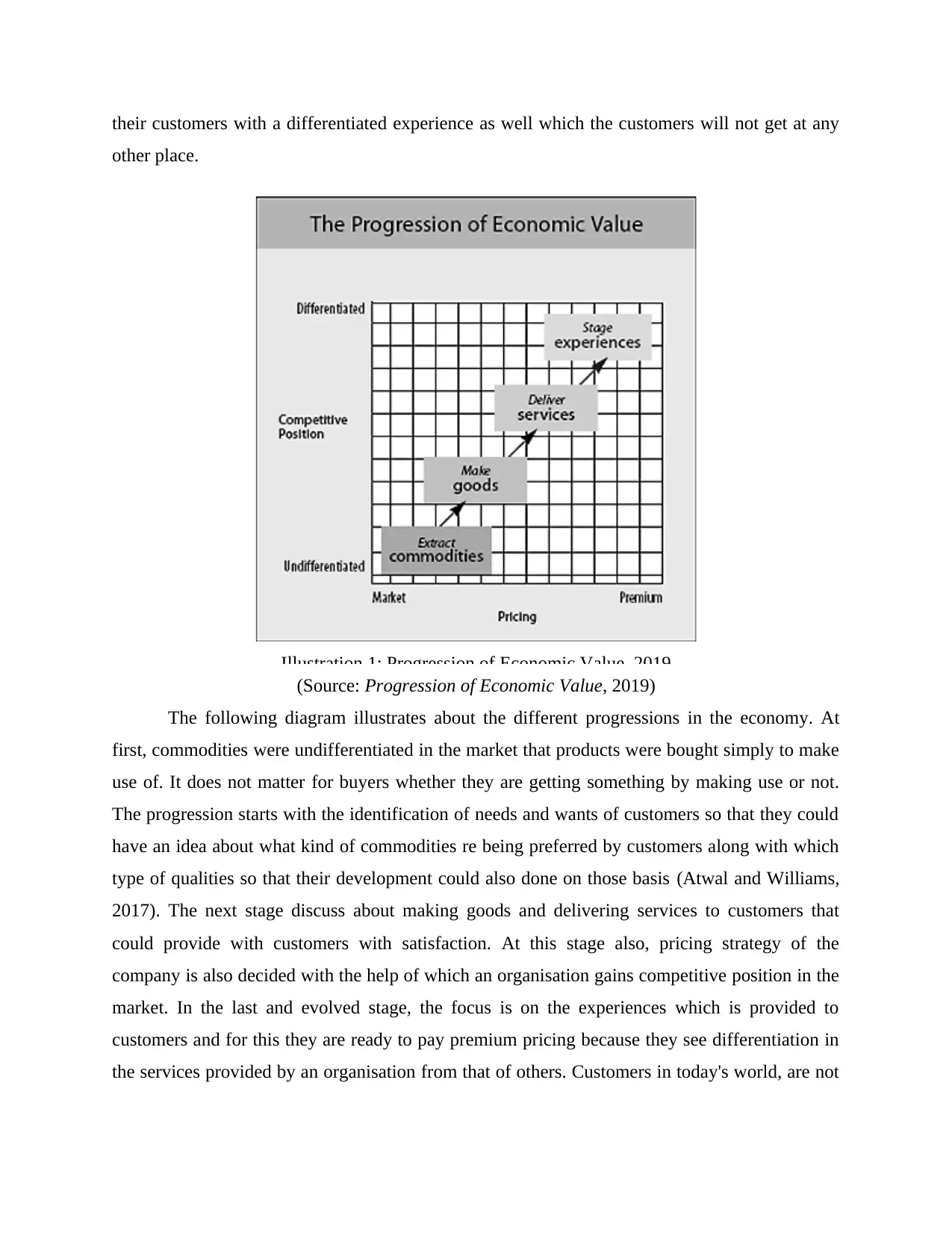
(Source: Progression of Economic Value, 2019)
The following diagram illustrates about the different progressions in the economy. At
first, commodities were undifferentiated in the market that products were bought simply to make
use of. It does not matter for buyers whether they are getting something by making use or not.
The progression starts with the identification of needs and wants of customers so that they could
have an idea about what kind of commodities re being preferred by customers along with which
type of qualities so that their development could also done on those basis (Atwal and Williams,
2017). The next stage discuss about making goods and delivering services to customers that
could provide with customers with satisfaction. At this stage also, pricing strategy of the
company is also decided with the help of which an organisation gains competitive position in the
market. In the last and evolved stage, the focus is on the experiences which is provided to
customers and for this they are ready to pay premium pricing because they see differentiation in
the services provided by an organisation from that of others. Customers in today's world, are not
Illustration 1: Progression of Economic Value, 2019
other place.
(Source: Progression of Economic Value, 2019)
The following diagram illustrates about the different progressions in the economy. At
first, commodities were undifferentiated in the market that products were bought simply to make
use of. It does not matter for buyers whether they are getting something by making use or not.
The progression starts with the identification of needs and wants of customers so that they could
have an idea about what kind of commodities re being preferred by customers along with which
type of qualities so that their development could also done on those basis (Atwal and Williams,
2017). The next stage discuss about making goods and delivering services to customers that
could provide with customers with satisfaction. At this stage also, pricing strategy of the
company is also decided with the help of which an organisation gains competitive position in the
market. In the last and evolved stage, the focus is on the experiences which is provided to
customers and for this they are ready to pay premium pricing because they see differentiation in
the services provided by an organisation from that of others. Customers in today's world, are not
Illustration 1: Progression of Economic Value, 2019
looking only at single aspect but all the aspects are covered and customers makes their focus on
experiencing about the overall offerings provided by the company to their customers.
There are two forces which drives the process of economic progression. These two are
Customisation and Commoditization. The discussion of both of these two forces is being
provided as under:
Customisation: This term relates to modifications in the products and services of an
organisation according to the needs and demands of their customers. The changes in the products
and services are made in relation to the needs and demands of specific group of needs of
customers. This term focuses on marketing and manufacturing products and services by making
combination of flexibility and personalisation of custom made products in order to avail
economies of large production. With the help of this customisation feature, it provide customers
with designing certain features in products according to their needs and demands (Paulauskaite
and et. al., 2017).
Commoditization: It is defined as the process with the help of which raw material is converted
into a useful commodity. It is a fundamental good which is used in commerce and is
interchangeable with other commodities of same type. The follwoing term removes the unique
characteristics in the products, individual charactersitics and the brand identity as well so that
products could be interchanged with other products of same type as well. With the help of this,
competition is made on the basis of price not on the basis of difference in charactersitics of te
products and services. Distinction is provided in between different products on the basis of their
attributes end up becoming their mere commodities in the market and for customers.
This trend is followed in the current times and has also impacted upon the working of not
only hotels but also on other businesses as well. Today customers are not searching for products
ad services but is in search of getting differentiation in products and services to get a
differentiated experiences as well. These two terms are also a part of economic progression as
these two forces drives customer experience.
Critical Reflection on Impact of Customer Trends Which Created Need for Hotels to Make in the
Authenticity and Experiences of Their Services
From past to present, there has been a lot of differences in between the services provided
by Hotels to their customers. One reason is related to global business expansion of business all
over the world and these differentiations has been made in order to make sure about their
experiencing about the overall offerings provided by the company to their customers.
There are two forces which drives the process of economic progression. These two are
Customisation and Commoditization. The discussion of both of these two forces is being
provided as under:
Customisation: This term relates to modifications in the products and services of an
organisation according to the needs and demands of their customers. The changes in the products
and services are made in relation to the needs and demands of specific group of needs of
customers. This term focuses on marketing and manufacturing products and services by making
combination of flexibility and personalisation of custom made products in order to avail
economies of large production. With the help of this customisation feature, it provide customers
with designing certain features in products according to their needs and demands (Paulauskaite
and et. al., 2017).
Commoditization: It is defined as the process with the help of which raw material is converted
into a useful commodity. It is a fundamental good which is used in commerce and is
interchangeable with other commodities of same type. The follwoing term removes the unique
characteristics in the products, individual charactersitics and the brand identity as well so that
products could be interchanged with other products of same type as well. With the help of this,
competition is made on the basis of price not on the basis of difference in charactersitics of te
products and services. Distinction is provided in between different products on the basis of their
attributes end up becoming their mere commodities in the market and for customers.
This trend is followed in the current times and has also impacted upon the working of not
only hotels but also on other businesses as well. Today customers are not searching for products
ad services but is in search of getting differentiation in products and services to get a
differentiated experiences as well. These two terms are also a part of economic progression as
these two forces drives customer experience.
Critical Reflection on Impact of Customer Trends Which Created Need for Hotels to Make in the
Authenticity and Experiences of Their Services
From past to present, there has been a lot of differences in between the services provided
by Hotels to their customers. One reason is related to global business expansion of business all
over the world and these differentiations has been made in order to make sure about their
⊘ This is a preview!⊘
Do you want full access?
Subscribe today to unlock all pages.
Trusted by 1+ million students worldwide
survival and growth in hot countries. In today's world, customers have full knowledge and are
finding experiences not products and services. Due to increment in the knowledge and behaviour
of customer,s it has become important for companies to make changes in the services provided to
them in and according to their needs and wants. It is because the market is not monopoly instead
it is Monopolistic Competition. So in order to ensure their survival in the environment, it is
essential for the companies to develop their services.
As in the current business scenarios, trend has changed to experiences in which the main
focus of customers is related to developing their experiences different from that of others. They
want to have unique experiences by which they could attract more and more customers towards
the services of an organisation (Schuckert, Liu and Law, 2015).
There are many positive and negative impact of these trends such as the improvement in
technology, focusing on development of experiences, social responsibility and economic
obligation and many more which impacts upon the working of an organisation.
So considering the impact of technology, it impacts both positive and negative such it
makes easier to accomplish different tasks and experiences of customers and also
provides competitive advantage to an organisation. On the other hand, it also impacts
negatively as technical things does not work always right and sometimes because of some
technical issue, it does not work properly and destroys customer experiences impacting
negatively on them (Zervas, Proserpio and Byers, 2017).
Another trend is of development of experiences for customers. It is done by analysing
needs and preferences of customers but sometimes, due to wrong analysis the complete
work goes of no value. This is loss for company, on the other hand In case it works than
it will also provide the company with positive consequences.
The trend of social and economic obligation has also become important concern for
organisations. As the fulfilment of which will provide the company with positive results
and non fulfilment will provide negative results (Noe and et. al., 2017). This factor is also
considered by the customers as nowadays not only on single aspect but customers make
use of services of companies looking on its overall working and processes. This makes it
important for companies to work ethically in order to have positive impact on
organisation's working.
finding experiences not products and services. Due to increment in the knowledge and behaviour
of customer,s it has become important for companies to make changes in the services provided to
them in and according to their needs and wants. It is because the market is not monopoly instead
it is Monopolistic Competition. So in order to ensure their survival in the environment, it is
essential for the companies to develop their services.
As in the current business scenarios, trend has changed to experiences in which the main
focus of customers is related to developing their experiences different from that of others. They
want to have unique experiences by which they could attract more and more customers towards
the services of an organisation (Schuckert, Liu and Law, 2015).
There are many positive and negative impact of these trends such as the improvement in
technology, focusing on development of experiences, social responsibility and economic
obligation and many more which impacts upon the working of an organisation.
So considering the impact of technology, it impacts both positive and negative such it
makes easier to accomplish different tasks and experiences of customers and also
provides competitive advantage to an organisation. On the other hand, it also impacts
negatively as technical things does not work always right and sometimes because of some
technical issue, it does not work properly and destroys customer experiences impacting
negatively on them (Zervas, Proserpio and Byers, 2017).
Another trend is of development of experiences for customers. It is done by analysing
needs and preferences of customers but sometimes, due to wrong analysis the complete
work goes of no value. This is loss for company, on the other hand In case it works than
it will also provide the company with positive consequences.
The trend of social and economic obligation has also become important concern for
organisations. As the fulfilment of which will provide the company with positive results
and non fulfilment will provide negative results (Noe and et. al., 2017). This factor is also
considered by the customers as nowadays not only on single aspect but customers make
use of services of companies looking on its overall working and processes. This makes it
important for companies to work ethically in order to have positive impact on
organisation's working.
Paraphrase This Document
Need a fresh take? Get an instant paraphrase of this document with our AI Paraphraser
Notoriety of Brands has removed the hotel brands from list as all the services related to
booking are provided by these companies. So this creates confusion for customers in
making choices about booking and sometimes they book hotel which does not suit their
tastes and preferences.
So the statement can be easily made that there is a lot of improvements which are needed
to make in the processes of hotel organisations and considerations that could provide customers
with better services and experiences. Along with the benefits, it is also important for Hotel
Organisations to consider the negative impacts as well that the organisation could have wile
dealing in the current business world (Vives, Jacob and Payeras, 2018). In this way, it will be
possible to give customers with a differentiated experiences to their customers for the betterment
and growth of their organisations.
Changes in Hotel Market Due to Changes in Customer Sensibility and How Established Brands
Have Adapted Personalised and Unique Experiences
In comparison with past times, there are several improvements which have been made in
the working hotels due to changes in the tastes and preferences of customers as well. Earlier,
customer preferences were related only to have a place to spend over night. But with the passing
of time, changes arrived in the tastes and preferences of customers, along with this, number of
organisations in the industry also tend to increase. So this also impacted upon the working of
organisations as the needs and demands of customers changed and due to this reason it made
organisations to make changes in their services as well according to the needs and demands of
their customers (Sahut, Hikkerova and Pupion, 2016). In the current times also, the competition
in the market has increased to much extent that it has made organisation to develop new and
innovative services that suits demands of customers and only by considering their needs and
demands it will be possible for Hotel organisations to ensure about their proper survival and
growth in which the company could make profits, have sufficient market share and also
contribute towards growth and development of environment as well.
Another reason of customising services is related to increased competition for
Established Brands which face competition not only from international competitors but also from
local competitors as well. Taking an example of Holiday Inn which provides their customers
with customised room services which provides them with competitive advantage over their
competitors in order to increase their revenues and growth. Another example is related to
booking are provided by these companies. So this creates confusion for customers in
making choices about booking and sometimes they book hotel which does not suit their
tastes and preferences.
So the statement can be easily made that there is a lot of improvements which are needed
to make in the processes of hotel organisations and considerations that could provide customers
with better services and experiences. Along with the benefits, it is also important for Hotel
Organisations to consider the negative impacts as well that the organisation could have wile
dealing in the current business world (Vives, Jacob and Payeras, 2018). In this way, it will be
possible to give customers with a differentiated experiences to their customers for the betterment
and growth of their organisations.
Changes in Hotel Market Due to Changes in Customer Sensibility and How Established Brands
Have Adapted Personalised and Unique Experiences
In comparison with past times, there are several improvements which have been made in
the working hotels due to changes in the tastes and preferences of customers as well. Earlier,
customer preferences were related only to have a place to spend over night. But with the passing
of time, changes arrived in the tastes and preferences of customers, along with this, number of
organisations in the industry also tend to increase. So this also impacted upon the working of
organisations as the needs and demands of customers changed and due to this reason it made
organisations to make changes in their services as well according to the needs and demands of
their customers (Sahut, Hikkerova and Pupion, 2016). In the current times also, the competition
in the market has increased to much extent that it has made organisation to develop new and
innovative services that suits demands of customers and only by considering their needs and
demands it will be possible for Hotel organisations to ensure about their proper survival and
growth in which the company could make profits, have sufficient market share and also
contribute towards growth and development of environment as well.
Another reason of customising services is related to increased competition for
Established Brands which face competition not only from international competitors but also from
local competitors as well. Taking an example of Holiday Inn which provides their customers
with customised room services which provides them with competitive advantage over their
competitors in order to increase their revenues and growth. Another example is related to
Premier Inn which also takes feedback of customers at the time of checking out which helps in
knowing about services where they are lacking so as to make possible improvements in their
services to capture more market share (El Haddad, Hallak and Assaker, 2015). Hotel Crown
Plaza has also made changes in the design of their guest rooms and changed them so that the
sales of their services could be increased and growth in revenues could be made. Likewise, Hotel
Marriott is also working upon increasing the number of their rooms as it is working on increasing
the breadth of their hotel rooms.
CONCLUSION
From the above assignment it has been concluded that Hospitality Sector is an important
sector whose proper working ensures about proper growth and development of an economy.
Additionally, the conclusion has also been drawn about the need of customer preferences and
demands which is important for organisations to consider in order to make sure about their
proper survival growth in the business environment. Further, the conclusion has been drawn
about the impact of considering customer trends that helps an organisation to understand and
develop their services according to the needs and demands of customers. Lastly, the
consideration of considering customer preferences will help company in achieving long term
sustainability in the business.
knowing about services where they are lacking so as to make possible improvements in their
services to capture more market share (El Haddad, Hallak and Assaker, 2015). Hotel Crown
Plaza has also made changes in the design of their guest rooms and changed them so that the
sales of their services could be increased and growth in revenues could be made. Likewise, Hotel
Marriott is also working upon increasing the number of their rooms as it is working on increasing
the breadth of their hotel rooms.
CONCLUSION
From the above assignment it has been concluded that Hospitality Sector is an important
sector whose proper working ensures about proper growth and development of an economy.
Additionally, the conclusion has also been drawn about the need of customer preferences and
demands which is important for organisations to consider in order to make sure about their
proper survival growth in the business environment. Further, the conclusion has been drawn
about the impact of considering customer trends that helps an organisation to understand and
develop their services according to the needs and demands of customers. Lastly, the
consideration of considering customer preferences will help company in achieving long term
sustainability in the business.
⊘ This is a preview!⊘
Do you want full access?
Subscribe today to unlock all pages.
Trusted by 1+ million students worldwide
REFERENCES
Books and Journals
Radder, L. and Han, X., 2015. An examination of the museum experience based on Pine and
Gilmore's experience economy realms. Journal of Applied Business Research
(JABR). 31(2). pp.455-470.
Song, H. J. and et. al., 2015. The influence of tourist experience on perceived value and
satisfaction with temple stays: The experience economy theory. Journal of Travel &
Tourism Marketing. 32(4). pp.401-415.
Atwal, G. and Williams, A., 2017. Luxury brand marketing–the experience is everything!.
In Advances in luxury brand management (pp. 43-57). Palgrave Macmillan, Cham.
Paulauskaite, D. and et. al., 2017. Living like a local: Authentic tourism experiences and the
sharing economy. International Journal of Tourism Research. 19(6). pp.619-628.
Zervas, G., Proserpio, D. and Byers, J. W., 2017. The rise of the sharing economy: Estimating
the impact of Airbnb on the hotel industry. Journal of marketing research. 54(5).
pp.687-705.
Schuckert, M., Liu, X. and Law, R., 2015. Hospitality and tourism online reviews: Recent trends
and future directions. Journal of Travel & Tourism Marketing. 32(5). pp.608-621.
Noe, R. A. and et. al., 2017. Human resource management: Gaining a competitive advantage.
New York, NY: McGraw-Hill Education.
El Haddad, R., Hallak, R. and Assaker, G., 2015. Price fairness perceptions and hotel customers’
behavioral intentions. Journal of Vacation Marketing. 21(3). pp.262-276.
Sahut, J. M., Hikkerova, L. and Pupion, P. C., 2016. Perceived unfairness of prices resulting
from yield management practices in hotels. Journal of business research. 69(11).
pp.4901-4906.
Vives, A., Jacob, M. and Payeras, M., 2018. Revenue management and price optimization
techniques in the hotel sector: A critical literature review. Tourism Economics. 24(6).
pp.720-752.
Books and Journals
Radder, L. and Han, X., 2015. An examination of the museum experience based on Pine and
Gilmore's experience economy realms. Journal of Applied Business Research
(JABR). 31(2). pp.455-470.
Song, H. J. and et. al., 2015. The influence of tourist experience on perceived value and
satisfaction with temple stays: The experience economy theory. Journal of Travel &
Tourism Marketing. 32(4). pp.401-415.
Atwal, G. and Williams, A., 2017. Luxury brand marketing–the experience is everything!.
In Advances in luxury brand management (pp. 43-57). Palgrave Macmillan, Cham.
Paulauskaite, D. and et. al., 2017. Living like a local: Authentic tourism experiences and the
sharing economy. International Journal of Tourism Research. 19(6). pp.619-628.
Zervas, G., Proserpio, D. and Byers, J. W., 2017. The rise of the sharing economy: Estimating
the impact of Airbnb on the hotel industry. Journal of marketing research. 54(5).
pp.687-705.
Schuckert, M., Liu, X. and Law, R., 2015. Hospitality and tourism online reviews: Recent trends
and future directions. Journal of Travel & Tourism Marketing. 32(5). pp.608-621.
Noe, R. A. and et. al., 2017. Human resource management: Gaining a competitive advantage.
New York, NY: McGraw-Hill Education.
El Haddad, R., Hallak, R. and Assaker, G., 2015. Price fairness perceptions and hotel customers’
behavioral intentions. Journal of Vacation Marketing. 21(3). pp.262-276.
Sahut, J. M., Hikkerova, L. and Pupion, P. C., 2016. Perceived unfairness of prices resulting
from yield management practices in hotels. Journal of business research. 69(11).
pp.4901-4906.
Vives, A., Jacob, M. and Payeras, M., 2018. Revenue management and price optimization
techniques in the hotel sector: A critical literature review. Tourism Economics. 24(6).
pp.720-752.

1 out of 10


Related Documents


Your All-in-One AI-Powered Toolkit for Academic Success.
+13062052269
info@desklib.com
Available 24*7 on WhatsApp / Email
![[object Object]](/_next/static/media/star-bottom.7253800d.svg)
Unlock your academic potential
Copyright © 2020–2026 A2Z Services. All Rights Reserved. Developed and managed by ZUCOL.