An Analysis of Ambiguity: Structural and Lexical in ESL Grammar
VerifiedAdded on 2023/01/10
|13
|3203
|90
Essay
AI Summary
This essay delves into the concept of ambiguity within the context of English as a Second Language (ESL) grammar. It begins by defining ambiguity as the presence of multiple meanings in a lexical item and then proceeds to explore two primary types: structural and lexical ambiguity. Structural ambiguity, also known as syntactic ambiguity, is examined, highlighting how the arrangement of words and phrases can lead to multiple interpretations of a sentence. Examples are provided to illustrate how sentence structure contributes to this type of ambiguity. The essay then shifts to lexical ambiguity, which arises from words having multiple meanings. This section provides examples of how individual words can create ambiguity within sentences and phrases. The essay provides comprehensive explanations, examples and arguments to explain these terms. The paper concludes by summarizing the key concepts and emphasizing the importance of understanding ambiguity for effective communication in the English language. The essay draws on a variety of sources to support its arguments and provide a comprehensive understanding of the topic.
GRAMMAR IN ESL
GRAMMAR
IN ESL
GRAMMAR
IN ESL

Paraphrase This Document
Need a fresh take? Get an instant paraphrase of this document with our AI Paraphraser
GRAMMAR IN ESL
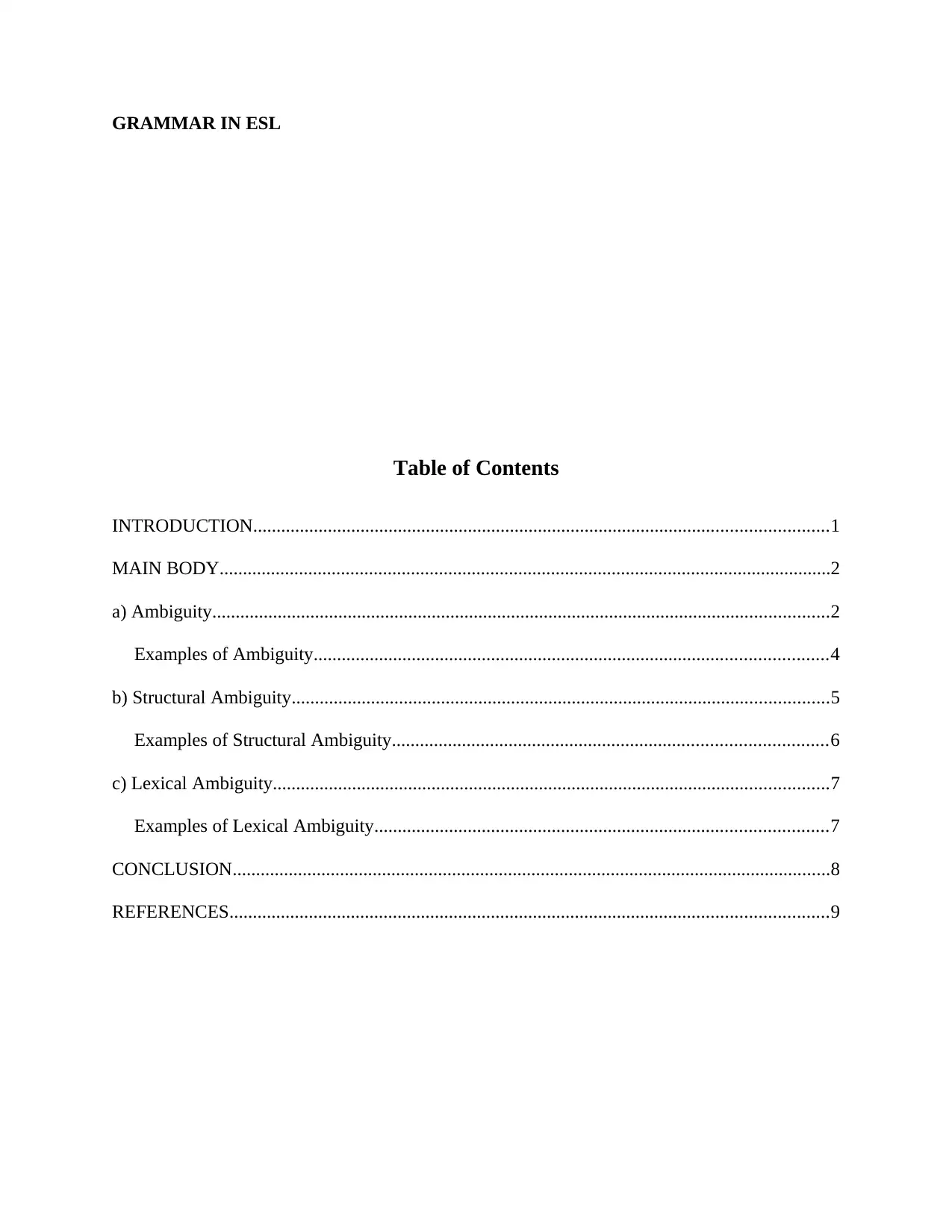
Table of Contents
INTRODUCTION...........................................................................................................................1
MAIN BODY...................................................................................................................................2
a) Ambiguity....................................................................................................................................2
Examples of Ambiguity..............................................................................................................4
b) Structural Ambiguity...................................................................................................................5
Examples of Structural Ambiguity.............................................................................................6
c) Lexical Ambiguity.......................................................................................................................7
Examples of Lexical Ambiguity.................................................................................................7
CONCLUSION................................................................................................................................8
REFERENCES................................................................................................................................9
Table of Contents
INTRODUCTION...........................................................................................................................1
MAIN BODY...................................................................................................................................2
a) Ambiguity....................................................................................................................................2
Examples of Ambiguity..............................................................................................................4
b) Structural Ambiguity...................................................................................................................5
Examples of Structural Ambiguity.............................................................................................6
c) Lexical Ambiguity.......................................................................................................................7
Examples of Lexical Ambiguity.................................................................................................7
CONCLUSION................................................................................................................................8
REFERENCES................................................................................................................................9

GRAMMAR IN ESL
⊘ This is a preview!⊘
Do you want full access?
Subscribe today to unlock all pages.

Trusted by 1+ million students worldwide
GRAMMAR IN ESL
INTRODUCTION
Language is regarded as the most crucial aspect for every person in the day to day life. It is by
way of language that individuals are able to set communication with one another in an effective
manner. It is seen that even deaf and dumb people are able to set interaction with other
individuals by making use of their special sign language (García, Cieslicka & Heredia, 2020). In
this regard, it is seen that people express their views and opinions in front of others by way of
written or spoken language. There are diverse set of language which are used by people across
the global periphery. It is even possible that one country may be home to several languages. It is
by way of sentences that people set communication with one another. It is sometimes seen that
people are not able to properly comprehend what is being said to them. This does not because
they are not able to hear the other person. It happens because sometimes a sentence may have
different more than one meaning. As a result of this, listeners interpret the same sentence in
different ways, causing severe confusion for the listeners.
The misunderstanding in relation to meaning of sentences as explained above is referred to as
ambiguity. Ambiguous sentences are not just found in spoken English but also in written
language within the magazines, journals, books, newspapers etc. Thus, ambiguity is a prominent
issue which is found within the bounds of written as well as spoken language (Jouravlev & Jared,
2020). The current project seeks to explore the terms named Ambiguity, Structural ambiguity
along with Lexical ambiguity. These terms are explained in a detailed manner by giving
examples of the same.
1
INTRODUCTION
Language is regarded as the most crucial aspect for every person in the day to day life. It is by
way of language that individuals are able to set communication with one another in an effective
manner. It is seen that even deaf and dumb people are able to set interaction with other
individuals by making use of their special sign language (García, Cieslicka & Heredia, 2020). In
this regard, it is seen that people express their views and opinions in front of others by way of
written or spoken language. There are diverse set of language which are used by people across
the global periphery. It is even possible that one country may be home to several languages. It is
by way of sentences that people set communication with one another. It is sometimes seen that
people are not able to properly comprehend what is being said to them. This does not because
they are not able to hear the other person. It happens because sometimes a sentence may have
different more than one meaning. As a result of this, listeners interpret the same sentence in
different ways, causing severe confusion for the listeners.
The misunderstanding in relation to meaning of sentences as explained above is referred to as
ambiguity. Ambiguous sentences are not just found in spoken English but also in written
language within the magazines, journals, books, newspapers etc. Thus, ambiguity is a prominent
issue which is found within the bounds of written as well as spoken language (Jouravlev & Jared,
2020). The current project seeks to explore the terms named Ambiguity, Structural ambiguity
along with Lexical ambiguity. These terms are explained in a detailed manner by giving
examples of the same.
1
Paraphrase This Document
Need a fresh take? Get an instant paraphrase of this document with our AI Paraphraser
GRAMMAR IN ESL
MAIN BODY
Language is considered as a literal as well as clear means for accurate communication of views,
ideas and thoughts. Language is the only way with the help of two or more individuals interact
with each other on a constant basis. However, the communication taking place between persons
can be easily misled as there are several phrases or expressions which hold more than one
meanings (Kubanyiova, 2020). Even when the language is used in a literal manner,
misunderstandings tend to arise and meanings tend to get shifted. This ultimately results in to
ambiguity, causing a particular text to hold more than one meaning. The concept of ambiguity is
explored in a detailed manner in the upcoming section of the paper.
a) Ambiguity
People can become ambiguous in an intentional or unintentional way. All the same, in an
instance whereby an individual makes use of a potentially ambiguous expression, phrase or
sentence, the general intention is to communicate only a single meaning. Several words tend to
have apparent meaning, connotation, denotation, implied and/or hidden meaning. Further, it is
well known that individuals make use of words in a figurative manner (Aina, Gulordava &
Boleda, 2019). Even when figurative language is most often witnessed to be put to use within
fiction and/or poetries, this language is still seen to be quite apparently used in ordinary speaking
or writing.
Ambiguity is regarded to be a poetic vehicle. It is considered as the nature of humans to find out
the meanings of words or phrases being used in an exchange of views, thoughts or ideology.
Whenever a text is given to a person, that individual gives their sense of meaning or
interpretation of that text (Palma, Whitford & Titone, 2019). The interpretation is solely as per
2
MAIN BODY
Language is considered as a literal as well as clear means for accurate communication of views,
ideas and thoughts. Language is the only way with the help of two or more individuals interact
with each other on a constant basis. However, the communication taking place between persons
can be easily misled as there are several phrases or expressions which hold more than one
meanings (Kubanyiova, 2020). Even when the language is used in a literal manner,
misunderstandings tend to arise and meanings tend to get shifted. This ultimately results in to
ambiguity, causing a particular text to hold more than one meaning. The concept of ambiguity is
explored in a detailed manner in the upcoming section of the paper.
a) Ambiguity
People can become ambiguous in an intentional or unintentional way. All the same, in an
instance whereby an individual makes use of a potentially ambiguous expression, phrase or
sentence, the general intention is to communicate only a single meaning. Several words tend to
have apparent meaning, connotation, denotation, implied and/or hidden meaning. Further, it is
well known that individuals make use of words in a figurative manner (Aina, Gulordava &
Boleda, 2019). Even when figurative language is most often witnessed to be put to use within
fiction and/or poetries, this language is still seen to be quite apparently used in ordinary speaking
or writing.
Ambiguity is regarded to be a poetic vehicle. It is considered as the nature of humans to find out
the meanings of words or phrases being used in an exchange of views, thoughts or ideology.
Whenever a text is given to a person, that individual gives their sense of meaning or
interpretation of that text (Palma, Whitford & Titone, 2019). The interpretation is solely as per
2
GRAMMAR IN ESL
their thought process. The associations of individuals tend to provide comprehensibility of what
is presented to them.
It is a common characteristic of post modern literature or late 20th century that certainties are
often called into investigation, making the allegory becoming an appropriate form for the
purpose of expressing. Allegory is considered as an effectual example of a double discourse
which tends to avoid establishment of a centre in a particular text as allegory witnesses the unity
of work being given by something which is not there in an explicit manner (Chang, 2019).
As against symbols that are usually used for the purpose of transcending the sign as well as
expressing the universal truth, metaphors along with allegories tend to carry out division of the
sign, thereby unleashing its arbitrariness as a whole (Habib, 2018). So, it can be seen that the
allegorical impulse within the domains of modern literature acts as a demonstration of the post
modern focus over the reader as a co producer, because it tends to call for the proactive
participation of readers in meaning making.
Metaphors are viewed as extensively suitable post modern device as they act as most common
vehicles for causing ambiguity (Saleh, 2017). A living metaphor is usually seen to be carrying
dual meaning, of which one is the literal meaning of the expression while the other is an
utterance or conveyed meaning.
Bible is a special book having its place at the heart of 3 of the most important religions of the
world. This book over the course of time has been subject to extensive and in depth scrutiny in a
bid to to garner meaning and to ascertain the most effectual way of living as well as worshipping
once and for all. The interpretation of this book by the wide variety of scholars, researchers and
academicians have resulted into persecution along with oppression (Do & Paik, 2019). Cathars
3
their thought process. The associations of individuals tend to provide comprehensibility of what
is presented to them.
It is a common characteristic of post modern literature or late 20th century that certainties are
often called into investigation, making the allegory becoming an appropriate form for the
purpose of expressing. Allegory is considered as an effectual example of a double discourse
which tends to avoid establishment of a centre in a particular text as allegory witnesses the unity
of work being given by something which is not there in an explicit manner (Chang, 2019).
As against symbols that are usually used for the purpose of transcending the sign as well as
expressing the universal truth, metaphors along with allegories tend to carry out division of the
sign, thereby unleashing its arbitrariness as a whole (Habib, 2018). So, it can be seen that the
allegorical impulse within the domains of modern literature acts as a demonstration of the post
modern focus over the reader as a co producer, because it tends to call for the proactive
participation of readers in meaning making.
Metaphors are viewed as extensively suitable post modern device as they act as most common
vehicles for causing ambiguity (Saleh, 2017). A living metaphor is usually seen to be carrying
dual meaning, of which one is the literal meaning of the expression while the other is an
utterance or conveyed meaning.
Bible is a special book having its place at the heart of 3 of the most important religions of the
world. This book over the course of time has been subject to extensive and in depth scrutiny in a
bid to to garner meaning and to ascertain the most effectual way of living as well as worshipping
once and for all. The interpretation of this book by the wide variety of scholars, researchers and
academicians have resulted into persecution along with oppression (Do & Paik, 2019). Cathars
3
⊘ This is a preview!⊘
Do you want full access?
Subscribe today to unlock all pages.
Trusted by 1+ million students worldwide
GRAMMAR IN ESL
and Huguenots were critiqued as their interpretation of the sacred Bible were treated as heresy.
This happened mainly owing to the ambiguity of the language which proved to be a curse for
them. Their interpretations were distinguished as the same Bible was interpreted by other
individuals in a diverse manner (Aina, Gulordava & Boleda, 2019). Thus, it is not just now, but
with the passage of time that ambiguity has become a major part of the every day lives of
individuals prevailing as a part of society.
It it thus summarised to be prevalence of 2 or more apparent meanings of a particular text
(phrase, expression, statement etc.) The other commonly used terms in the place of ambiguity are
recognised to be amphibologia, amphibolia, semantic ambiguity and so on (Degani & et. al.,
2016). Along with this, ambiguity is often considered as a fallacy (most commonly referred to as
equivocation) whereby the same term is put to use in more than one ways (Lu, 2017).
Examples of Ambiguity
Ambiguity is the most prominent part of the common or the day to day English language. In this
relation, some of the most common examples of ambiguity within the bounds of the language
spoken by individuals in their day to day lives are given as follows:-
Martha got the bath ready for her daughter wearing a red tutu.
Ambiguity: Hereby, the ambiguity is related to the person wearing the tutu, if it is Martha or her
daughter.
I have surely never tasted a grilled chicken like that ever before!
Ambiguity: Hereby, the ambiguity is related to the grilled chicken being good or bad.
Call me a taxi, please.
4
and Huguenots were critiqued as their interpretation of the sacred Bible were treated as heresy.
This happened mainly owing to the ambiguity of the language which proved to be a curse for
them. Their interpretations were distinguished as the same Bible was interpreted by other
individuals in a diverse manner (Aina, Gulordava & Boleda, 2019). Thus, it is not just now, but
with the passage of time that ambiguity has become a major part of the every day lives of
individuals prevailing as a part of society.
It it thus summarised to be prevalence of 2 or more apparent meanings of a particular text
(phrase, expression, statement etc.) The other commonly used terms in the place of ambiguity are
recognised to be amphibologia, amphibolia, semantic ambiguity and so on (Degani & et. al.,
2016). Along with this, ambiguity is often considered as a fallacy (most commonly referred to as
equivocation) whereby the same term is put to use in more than one ways (Lu, 2017).
Examples of Ambiguity
Ambiguity is the most prominent part of the common or the day to day English language. In this
relation, some of the most common examples of ambiguity within the bounds of the language
spoken by individuals in their day to day lives are given as follows:-
Martha got the bath ready for her daughter wearing a red tutu.
Ambiguity: Hereby, the ambiguity is related to the person wearing the tutu, if it is Martha or her
daughter.
I have surely never tasted a grilled chicken like that ever before!
Ambiguity: Hereby, the ambiguity is related to the grilled chicken being good or bad.
Call me a taxi, please.
4
Paraphrase This Document
Need a fresh take? Get an instant paraphrase of this document with our AI Paraphraser

GRAMMAR IN ESL
Ambiguity: Hereby, it is not clear whether the speaker is asking someone to hail them a taxi or
they want themselves to be called a taxi.
Stop trying to push the envelop.
Ambiguity: Hereby, it is not clear whether someone is intending to push the limits in a particular
circumstance or actually pushing an envelop across the desk.
She saw somebody on the hilltop with a telescope.
Ambiguity: Hereby, the ambiguity is in relation to the meaning that she saw somebody having a
telescope on the hilltop or she used a telescope to see somebody on the hilltop.
b) Structural Ambiguity
Structural ambiguity also commonly referred to as syntactic ambiguity is the potential of
deriving several interpretations via a piece of spoken or written language owing to the manner in
which phrases or words are effectually organized (Lu, 2017). Linguistic ambiguity tends to make
it complex for a human being or an Artificial Intelligence system, for example- NLP (Natural
Language Processing) program, in determining the meaning in the absence of any kind of
additional information that is capable of clarifying the context of the text (Al-Sulaimaan & Al-
Me'mary, 2017).
Some structural ambiguity is even acknowledged to be the outcome of writing errors, like
misplaced modifier. An example from Tom Sant’s book Persuasive Business Proposals:
“Featuring plug-in circuit boards, we can strongly endorse this server’s flexibility and growth
potential.” That sentence might be intended to mean that the server has plug-in circuit boards,
and a human would be likely to understand tha (Al-Sulaimaan & Al-Me'mary, 2017). However,
the way it’s organized, the sentence actually means that the writer features plug-in circuit boards,
5
Ambiguity: Hereby, it is not clear whether the speaker is asking someone to hail them a taxi or
they want themselves to be called a taxi.
Stop trying to push the envelop.
Ambiguity: Hereby, it is not clear whether someone is intending to push the limits in a particular
circumstance or actually pushing an envelop across the desk.
She saw somebody on the hilltop with a telescope.
Ambiguity: Hereby, the ambiguity is in relation to the meaning that she saw somebody having a
telescope on the hilltop or she used a telescope to see somebody on the hilltop.
b) Structural Ambiguity
Structural ambiguity also commonly referred to as syntactic ambiguity is the potential of
deriving several interpretations via a piece of spoken or written language owing to the manner in
which phrases or words are effectually organized (Lu, 2017). Linguistic ambiguity tends to make
it complex for a human being or an Artificial Intelligence system, for example- NLP (Natural
Language Processing) program, in determining the meaning in the absence of any kind of
additional information that is capable of clarifying the context of the text (Al-Sulaimaan & Al-
Me'mary, 2017).
Some structural ambiguity is even acknowledged to be the outcome of writing errors, like
misplaced modifier. An example from Tom Sant’s book Persuasive Business Proposals:
“Featuring plug-in circuit boards, we can strongly endorse this server’s flexibility and growth
potential.” That sentence might be intended to mean that the server has plug-in circuit boards,
and a human would be likely to understand tha (Al-Sulaimaan & Al-Me'mary, 2017). However,
the way it’s organized, the sentence actually means that the writer features plug-in circuit boards,
5
GRAMMAR IN ESL
and software would be likely to require word sense disambiguation (WSD) to understand that is
not the intended meaning.
The term “structural ambiguity” is set into contrast with lexical ambiguity (word related), that
tends to arise owing to more than one meaning held by the words (Boleda, Gulordava & Aina,
2019). Both of them are considered as the instances of linguistic ambiguity, that also arise as a
consequence of other aspects such as vagueness as well as figurative language (Degani & et. al.,
2016).
Examples of Structural Ambiguity
Structural ambiguity arising from varied meaning of a particular clause or sentence is very
common within English language (Jackson, 2020). With reference to this, some of the examples
of structural ambiguity are given as follows:-
The professor said on Monday he would give an exam.
Ambiguity: This statement either implies that it was on Monday that the professor told the class
about the exam or that the exam would be given on Monday.
The chicken is ready to eat.
Ambiguity: This sentence implies either that the chicken is cooked and can be eaten now or that
chicken is ready to be fed.
The burglar threatened the student with the knife.
Ambiguity: This sentence implies that either a knife wielding burglar threatened a student or the
student threatened by the burglar threatened was carrying a knife.
Visiting relatives can be boring.
6
and software would be likely to require word sense disambiguation (WSD) to understand that is
not the intended meaning.
The term “structural ambiguity” is set into contrast with lexical ambiguity (word related), that
tends to arise owing to more than one meaning held by the words (Boleda, Gulordava & Aina,
2019). Both of them are considered as the instances of linguistic ambiguity, that also arise as a
consequence of other aspects such as vagueness as well as figurative language (Degani & et. al.,
2016).
Examples of Structural Ambiguity
Structural ambiguity arising from varied meaning of a particular clause or sentence is very
common within English language (Jackson, 2020). With reference to this, some of the examples
of structural ambiguity are given as follows:-
The professor said on Monday he would give an exam.
Ambiguity: This statement either implies that it was on Monday that the professor told the class
about the exam or that the exam would be given on Monday.
The chicken is ready to eat.
Ambiguity: This sentence implies either that the chicken is cooked and can be eaten now or that
chicken is ready to be fed.
The burglar threatened the student with the knife.
Ambiguity: This sentence implies that either a knife wielding burglar threatened a student or the
student threatened by the burglar threatened was carrying a knife.
Visiting relatives can be boring.
6
⊘ This is a preview!⊘
Do you want full access?
Subscribe today to unlock all pages.
Trusted by 1+ million students worldwide
GRAMMAR IN ESL
Ambiguity: This sentence implies that either means the act of visiting relatives is a boring
activity or that visiting relatives can be a boring company for someone.
c) Lexical Ambiguity
Lexical ambiguity can be referred to as a form of ambiguity whereby a word has two or more
meanings. This is also commonly referred to as semantic ambiguity. Lexical ambiguity is often
witnessed within puns and other such kinds of word play (Cahyani & Islam, 2020). It is owing to
lexical terms that a specific clause or statement can be interpreted by different individuals in
distinct ways. This tends to give rise to complexities in English language.
Examples of Lexical Ambiguity
Lexical ambiguity arises because of a single word having multiple meanings in the literal sense
of English language (Kubanyiova, 2020). In context of this, some of the most common examples
of lexical ambiguity are given as follows:-
"Do you believe in clubs for young people?" someone asked W.C. Fields. "Only when
kindness fails," he replied.
Ambiguity: Hereby, the lexical ambiguity underlies in the premise that the speaker was
indicating the reference to night clubs whereas Fields - kiddingly – considered it as something
along the lines of a wooden bat.
"We saw her duck.”
Ambiguity: Hereby, the lexical ambiguity is that this has two meanings : we saw her lower
down her head or we saw the duck belonging to her. As both of these statements are not
paraphrases of one another, it implies that the statement is lexically ambiguous on the basis of
the term “duck”.
7
Ambiguity: This sentence implies that either means the act of visiting relatives is a boring
activity or that visiting relatives can be a boring company for someone.
c) Lexical Ambiguity
Lexical ambiguity can be referred to as a form of ambiguity whereby a word has two or more
meanings. This is also commonly referred to as semantic ambiguity. Lexical ambiguity is often
witnessed within puns and other such kinds of word play (Cahyani & Islam, 2020). It is owing to
lexical terms that a specific clause or statement can be interpreted by different individuals in
distinct ways. This tends to give rise to complexities in English language.
Examples of Lexical Ambiguity
Lexical ambiguity arises because of a single word having multiple meanings in the literal sense
of English language (Kubanyiova, 2020). In context of this, some of the most common examples
of lexical ambiguity are given as follows:-
"Do you believe in clubs for young people?" someone asked W.C. Fields. "Only when
kindness fails," he replied.
Ambiguity: Hereby, the lexical ambiguity underlies in the premise that the speaker was
indicating the reference to night clubs whereas Fields - kiddingly – considered it as something
along the lines of a wooden bat.
"We saw her duck.”
Ambiguity: Hereby, the lexical ambiguity is that this has two meanings : we saw her lower
down her head or we saw the duck belonging to her. As both of these statements are not
paraphrases of one another, it implies that the statement is lexically ambiguous on the basis of
the term “duck”.
7
Paraphrase This Document
Need a fresh take? Get an instant paraphrase of this document with our AI Paraphraser
GRAMMAR IN ESL
CONCLUSION
On the basis of above discussion, it can be summarised that ambiguity is one of the most
common phenomena within the bounds of English language. Language can not exist within
ambiguity and this is considered as a curse as well as blessing by people over the course of time.
In literal sense, it can be referred to as the phenomenon whereby a lexical item in the form of
clauses, phrases, words or sentences have 2 or more than two meanings. Ambiguity is prevalent
within the bounds of all kinds of human languages. This tends to create a lot of issue as the same
text can be interpreted by diverse set of individuals in different ways. In this relation, metaphors,
allegory are some of the most common vehicles which lead to generation of ambiguity in
interpretation of a text.
With reference to English language, it can be comprehensively said that there are mainly two
types of ambiguity, namely, structural ambiguity as well as lexical ambiguity. In addition to this,
it is inferred that lexical ambiguity is when ambiguity lies in one word. Contrary to this, it has
been acknowledged that structural or syntactic ambiguity occurs when ambiguity is within a
clause or any sentence. No matter what is the type of ambiguity, ambiguity in communication is
a serious challenge. Over the course of time, many scholars and researchers have also been
critiques for misinterpreting and presenting the wrong meaning of the text in front of the public
at large.
8
CONCLUSION
On the basis of above discussion, it can be summarised that ambiguity is one of the most
common phenomena within the bounds of English language. Language can not exist within
ambiguity and this is considered as a curse as well as blessing by people over the course of time.
In literal sense, it can be referred to as the phenomenon whereby a lexical item in the form of
clauses, phrases, words or sentences have 2 or more than two meanings. Ambiguity is prevalent
within the bounds of all kinds of human languages. This tends to create a lot of issue as the same
text can be interpreted by diverse set of individuals in different ways. In this relation, metaphors,
allegory are some of the most common vehicles which lead to generation of ambiguity in
interpretation of a text.
With reference to English language, it can be comprehensively said that there are mainly two
types of ambiguity, namely, structural ambiguity as well as lexical ambiguity. In addition to this,
it is inferred that lexical ambiguity is when ambiguity lies in one word. Contrary to this, it has
been acknowledged that structural or syntactic ambiguity occurs when ambiguity is within a
clause or any sentence. No matter what is the type of ambiguity, ambiguity in communication is
a serious challenge. Over the course of time, many scholars and researchers have also been
critiques for misinterpreting and presenting the wrong meaning of the text in front of the public
at large.
8
GRAMMAR IN ESL
REFERENCES
Books and Journals
Aina, L., Gulordava, K., & Boleda, G. (2019). Putting words in context: LSTM language models
and lexical ambiguity. arXiv preprint arXiv:1906.05149.
Aina, L., Gulordava, K., & Boleda, G. (2019). Putting words in context: LSTM language models
and lexical ambiguity. arXiv preprint arXiv:1906.05149.
Al-Sulaimaan, M. M. D., & Al-Me'mary, R. I. (2017). Syntactic Ambiguity in English-Arabic
Translation. International Journal of Social Sciences & Humanities, 1(1), 99-124.
Boleda, G., Gulordava, K., & Aina, L. (2019). Putting words in context: LSTM language models
and lexical ambiguity. In Proceedings of the 57th Annual Meeting of the Association for
Computational Linguistics; 2019 Jul 28-Aug 2; Florence, Italy. Stroudsburg (PA):
ACL; 2019. p. 3342–8.. ACL (Association for Computational Linguistics).
Cahyani, D. A., & Islam, A. F. (2020). THE AMBIGUITY OF ENGLISH
ADVERTISEMENT. Jo-ELT (Journal of English Language Teaching) Fakultas
Pendidikan Bahasa & Seni Prodi Pendidikan Bahasa Inggris IKIP, 4(1), 49-62.
Chang, Y. H. (2019). The effect of ambiguity tolerance on learning English with computer-
mediated dictionaries. Computer Assisted Language Learning, 1-21.
Degani, T., Prior, A., Eddington, C. M., da Luz Fontes, A. B. A., & Tokowicz, N. (2016).
Determinants of translation ambiguity: A within and cross-language
comparison. Linguistic approaches to bilingualism, 6(3), 290-307.
9
REFERENCES
Books and Journals
Aina, L., Gulordava, K., & Boleda, G. (2019). Putting words in context: LSTM language models
and lexical ambiguity. arXiv preprint arXiv:1906.05149.
Aina, L., Gulordava, K., & Boleda, G. (2019). Putting words in context: LSTM language models
and lexical ambiguity. arXiv preprint arXiv:1906.05149.
Al-Sulaimaan, M. M. D., & Al-Me'mary, R. I. (2017). Syntactic Ambiguity in English-Arabic
Translation. International Journal of Social Sciences & Humanities, 1(1), 99-124.
Boleda, G., Gulordava, K., & Aina, L. (2019). Putting words in context: LSTM language models
and lexical ambiguity. In Proceedings of the 57th Annual Meeting of the Association for
Computational Linguistics; 2019 Jul 28-Aug 2; Florence, Italy. Stroudsburg (PA):
ACL; 2019. p. 3342–8.. ACL (Association for Computational Linguistics).
Cahyani, D. A., & Islam, A. F. (2020). THE AMBIGUITY OF ENGLISH
ADVERTISEMENT. Jo-ELT (Journal of English Language Teaching) Fakultas
Pendidikan Bahasa & Seni Prodi Pendidikan Bahasa Inggris IKIP, 4(1), 49-62.
Chang, Y. H. (2019). The effect of ambiguity tolerance on learning English with computer-
mediated dictionaries. Computer Assisted Language Learning, 1-21.
Degani, T., Prior, A., Eddington, C. M., da Luz Fontes, A. B. A., & Tokowicz, N. (2016).
Determinants of translation ambiguity: A within and cross-language
comparison. Linguistic approaches to bilingualism, 6(3), 290-307.
9
⊘ This is a preview!⊘
Do you want full access?
Subscribe today to unlock all pages.
Trusted by 1+ million students worldwide

1 out of 13


Related Documents


Your All-in-One AI-Powered Toolkit for Academic Success.
+13062052269
info@desklib.com
Available 24*7 on WhatsApp / Email
![[object Object]](/_next/static/media/star-bottom.7253800d.svg)
Unlock your academic potential
Copyright © 2020–2026 A2Z Services. All Rights Reserved. Developed and managed by ZUCOL.