UOB MBA Project: Export Tariffs' Influence on Retail Productivity
VerifiedAdded on 2022/08/13
|15
|3276
|21
Report
AI Summary
This MBA project report investigates the impact of export tariffs on the retail industry, using Starbucks as a case study. The report begins with an introduction outlining the research background, rationale, scope, aims, objectives, and research questions. A comprehensive literature review explores the concepts of exports, tariffs, classical trade theory (including mercantilism, absolute advantage, and comparative advantage), and the impact of export tariffs on productivity. The methodology section details the research philosophy (positivism), design (explorative), approach (deductive), data collection methods (secondary), and analysis techniques. Potential outcomes and a conceptual framework are also presented. The study aims to assess how tariffs influence Starbucks' brand awareness, export strategies, and overall productivity, providing recommendations for improving export tariff standards and supply chain networks. The report also addresses ethical considerations and includes a detailed timeline for the project.
Running head: MANAGEMENT
Export tariffs: A boon or bane for retail industry
Name of the student:
Name of the university:
Author note:
Export tariffs: A boon or bane for retail industry
Name of the student:
Name of the university:
Author note:

Paraphrase This Document
Need a fresh take? Get an instant paraphrase of this document with our AI Paraphraser
1
MANAGEMENT
Table of contents
1.0 Introduction..........................................................................................................................2
1.1 Background of the research..............................................................................................2
1.2 Rationale of the research..................................................................................................2
1.3 Scope of the project..........................................................................................................2
1.4 Research aim....................................................................................................................3
1.5 Research objectives..........................................................................................................3
1.6 Research questions...........................................................................................................3
2.0 Literature review..................................................................................................................3
2.1 Concept of Exports...........................................................................................................3
2.2 Concept of tariffs..............................................................................................................4
2.3 Classical trade theory.......................................................................................................4
2.3.1 Theory of mercantilism.............................................................................................5
2.3.2 Theory of absolute advantage...................................................................................5
2.3.3 Theory of comparative advantage.............................................................................5
2.4 Impact of export tariffs on productivity...........................................................................6
2.5 Conceptual framework.....................................................................................................6
3.0 Methodology........................................................................................................................8
3.1 Research philosophy........................................................................................................8
3.2 Research design................................................................................................................8
3.3 Research approach...........................................................................................................8
3.4 Data collection.................................................................................................................9
3.5 Data analysis....................................................................................................................9
3.6 Reliability and validity.....................................................................................................9
3.7 Ethical considerations....................................................................................................10
3.8 Timeline.........................................................................................................................10
4.0 Potential outcomes.............................................................................................................11
References................................................................................................................................12
Bibliography.............................................................................................................................14
MANAGEMENT
Table of contents
1.0 Introduction..........................................................................................................................2
1.1 Background of the research..............................................................................................2
1.2 Rationale of the research..................................................................................................2
1.3 Scope of the project..........................................................................................................2
1.4 Research aim....................................................................................................................3
1.5 Research objectives..........................................................................................................3
1.6 Research questions...........................................................................................................3
2.0 Literature review..................................................................................................................3
2.1 Concept of Exports...........................................................................................................3
2.2 Concept of tariffs..............................................................................................................4
2.3 Classical trade theory.......................................................................................................4
2.3.1 Theory of mercantilism.............................................................................................5
2.3.2 Theory of absolute advantage...................................................................................5
2.3.3 Theory of comparative advantage.............................................................................5
2.4 Impact of export tariffs on productivity...........................................................................6
2.5 Conceptual framework.....................................................................................................6
3.0 Methodology........................................................................................................................8
3.1 Research philosophy........................................................................................................8
3.2 Research design................................................................................................................8
3.3 Research approach...........................................................................................................8
3.4 Data collection.................................................................................................................9
3.5 Data analysis....................................................................................................................9
3.6 Reliability and validity.....................................................................................................9
3.7 Ethical considerations....................................................................................................10
3.8 Timeline.........................................................................................................................10
4.0 Potential outcomes.............................................................................................................11
References................................................................................................................................12
Bibliography.............................................................................................................................14
2
MANAGEMENT
1.0 Introduction
1.1 Background of the research
Tariff is something, which is imposed by the government for ensuring the smoothness
in the operations. It is usually implemented on the import and export activities. The countries
intending to maximize their supply chain usually avert the compliance with the export duties.
In some of the cases, countries adopt transit duties for expanding into the markets of other
countries (Cockx and Francken 2016). Imposition of the tariffs adversely affects the pricing
strategies and mechanisms of the products, acting as an obstacle in the international trade
mechanisms. There are different types of tariffs, which the brands acquire in terms of
enhancing the efficiency in the operations. This research would attempt to examine whether
export tariffs are a boon or bane for the retail industry brand, Starbucks.
1.2 Rationale of the research
Most of the businesses acquire legislations for ensuring that the operations are
conducted in a fair manner. This acquisition results in the increase of sales revenue and profit
margin, acting assistance in terms of accumulating greater market share. However, Candau
and Le Cacheux (2018) is of the view that, in some of the cases, illegal trades are conducted,
which degrade the stability in the public relation between the countries. This degradation
adversely affects the culture of brands like Starbucks, indicative of effective negotiation
strategies, so that productive labour can be extracted.
1.3 Scope of the project
The research intends to extend towards the retail industry brands, especially Starbucks
for gaining an insight into the contribution of export tariffs. However, comparison is also
established with the other retail brands for assessing the approach towards compliance with
the export tariffs (Bas et al. 2016). The scope of this research project attains value, the
measurability of which lies in the data collection process. The scope of the research project
MANAGEMENT
1.0 Introduction
1.1 Background of the research
Tariff is something, which is imposed by the government for ensuring the smoothness
in the operations. It is usually implemented on the import and export activities. The countries
intending to maximize their supply chain usually avert the compliance with the export duties.
In some of the cases, countries adopt transit duties for expanding into the markets of other
countries (Cockx and Francken 2016). Imposition of the tariffs adversely affects the pricing
strategies and mechanisms of the products, acting as an obstacle in the international trade
mechanisms. There are different types of tariffs, which the brands acquire in terms of
enhancing the efficiency in the operations. This research would attempt to examine whether
export tariffs are a boon or bane for the retail industry brand, Starbucks.
1.2 Rationale of the research
Most of the businesses acquire legislations for ensuring that the operations are
conducted in a fair manner. This acquisition results in the increase of sales revenue and profit
margin, acting assistance in terms of accumulating greater market share. However, Candau
and Le Cacheux (2018) is of the view that, in some of the cases, illegal trades are conducted,
which degrade the stability in the public relation between the countries. This degradation
adversely affects the culture of brands like Starbucks, indicative of effective negotiation
strategies, so that productive labour can be extracted.
1.3 Scope of the project
The research intends to extend towards the retail industry brands, especially Starbucks
for gaining an insight into the contribution of export tariffs. However, comparison is also
established with the other retail brands for assessing the approach towards compliance with
the export tariffs (Bas et al. 2016). The scope of this research project attains value, the
measurability of which lies in the data collection process. The scope of the research project
⊘ This is a preview!⊘
Do you want full access?
Subscribe today to unlock all pages.

Trusted by 1+ million students worldwide
3
MANAGEMENT
also extends towards the development of the aims, objectives and questions for delving
deeper into the retail mechanisms of the brand, Starbucks.
1.4 Research aim
This research aims to assess the impact of the export tariffs on the productivity of the
retail industry brand, Starbucks.
1.5 Research objectives
To assess the impact of tariffs on the brand awareness programs of the retail industry
brand, Starbucks
To examine the strategies adopted by Starbucks for exporting the products for
concretizing the investments of the customers
To investigate the impact of the tariffs on the productivity of the retail brand
Starbucks
To suggest recommendations for improvising on the standards and protocols of the
export tariffs for expanding the scope and arena of the supply chain network
1.6 Research questions
What impact do tariffs have on the brand awareness programs of Starbucks?
What strategies are adopted by Starbucks for exporting the products?
To what extent the tariffs affect the productivity of Starbucks?
What recommendations can be proposed for standardizing the transactions in
Starbucks to expand the scope and arena of the supply chain network?
2.0 Literature review
2.1 Concept of Exports
Brands export their products and services for expanding the scope and arena of the
supply chain network. This practice is effective for expanding the customer rates. According
to the basic nature of the export, the services are globalized into the foreign markets. Chen
(2019) states that custom authorities are an integral part of the export activities. The major
MANAGEMENT
also extends towards the development of the aims, objectives and questions for delving
deeper into the retail mechanisms of the brand, Starbucks.
1.4 Research aim
This research aims to assess the impact of the export tariffs on the productivity of the
retail industry brand, Starbucks.
1.5 Research objectives
To assess the impact of tariffs on the brand awareness programs of the retail industry
brand, Starbucks
To examine the strategies adopted by Starbucks for exporting the products for
concretizing the investments of the customers
To investigate the impact of the tariffs on the productivity of the retail brand
Starbucks
To suggest recommendations for improvising on the standards and protocols of the
export tariffs for expanding the scope and arena of the supply chain network
1.6 Research questions
What impact do tariffs have on the brand awareness programs of Starbucks?
What strategies are adopted by Starbucks for exporting the products?
To what extent the tariffs affect the productivity of Starbucks?
What recommendations can be proposed for standardizing the transactions in
Starbucks to expand the scope and arena of the supply chain network?
2.0 Literature review
2.1 Concept of Exports
Brands export their products and services for expanding the scope and arena of the
supply chain network. This practice is effective for expanding the customer rates. According
to the basic nature of the export, the services are globalized into the foreign markets. Chen
(2019) states that custom authorities are an integral part of the export activities. The major
Paraphrase This Document
Need a fresh take? Get an instant paraphrase of this document with our AI Paraphraser
4
MANAGEMENT
mediums of exporting the products and services are couriers, hand delivery, mail, air
shopping, vessel shipping, online marketing, email attachments and fax among others. The
barriers in the export process are government laws, policy and practices. The approach of the
personnel is to protect the products from the foreign competitions and artificial simulation of
the exports in case of the domestic products. According to Hübler and Pothen (2017),
restrictions are imposed on the activities of export, which are not accounted within the trade
barriers. Typical barriers in the export activities are that of the governmental interventions
and policies. Exporting is adopted by most of the brands, as it is exempted from the
substantial cost of manufacturing in the host country. Along with this, exporting is effective
in terms of achieving curve effects and locational economies.
2.2 Concept of tariffs
Tariffs are an integral part of the legislative mechanisms, which maintains the
smoothness in the activities of the import and exports. Usually, tariffs are considered to be an
obstacle in the process of import and export (Larrain and Stumpner 2017). Tactful approach
is exposed under the situation of the collapsing domestic output in case of the imports from
the foreign competitors. Strategic management is assistance in terms of retaining the
production capabilities, which helps in coping up with the tariff impositions. Hastiadi, (2019)
is of the view that tariffs adversely reduce the capabilities towards efficient production. One
of the main issues with tariffs is that of dumping, which degrades the public relations
between two countries, as there is no profit on the return on investments.
2.3 Classical trade theory
This theory provides an insight into the dynamics of the trade, which intends to
globalize the operations for expanding the scope and arena of the supply chain network.
McCaig and Pavcnik (2018) states that indulging in the foreign trade processes helps in
improving the focus of the business through the means of human resource management.
MANAGEMENT
mediums of exporting the products and services are couriers, hand delivery, mail, air
shopping, vessel shipping, online marketing, email attachments and fax among others. The
barriers in the export process are government laws, policy and practices. The approach of the
personnel is to protect the products from the foreign competitions and artificial simulation of
the exports in case of the domestic products. According to Hübler and Pothen (2017),
restrictions are imposed on the activities of export, which are not accounted within the trade
barriers. Typical barriers in the export activities are that of the governmental interventions
and policies. Exporting is adopted by most of the brands, as it is exempted from the
substantial cost of manufacturing in the host country. Along with this, exporting is effective
in terms of achieving curve effects and locational economies.
2.2 Concept of tariffs
Tariffs are an integral part of the legislative mechanisms, which maintains the
smoothness in the activities of the import and exports. Usually, tariffs are considered to be an
obstacle in the process of import and export (Larrain and Stumpner 2017). Tactful approach
is exposed under the situation of the collapsing domestic output in case of the imports from
the foreign competitors. Strategic management is assistance in terms of retaining the
production capabilities, which helps in coping up with the tariff impositions. Hastiadi, (2019)
is of the view that tariffs adversely reduce the capabilities towards efficient production. One
of the main issues with tariffs is that of dumping, which degrades the public relations
between two countries, as there is no profit on the return on investments.
2.3 Classical trade theory
This theory provides an insight into the dynamics of the trade, which intends to
globalize the operations for expanding the scope and arena of the supply chain network.
McCaig and Pavcnik (2018) states that indulging in the foreign trade processes helps in
improving the focus of the business through the means of human resource management.
5
MANAGEMENT
Technology is the main agent, which enhances the standards and quality of the production.
The assumptions of this theory are:
There are two countries producing two goods
Size of the economies for these countries are equal
Equality prevails in the mobility factors of these two countries (Beverelli, Fiorini and
Hoekman 2017)
Transportation cost for these two countries is ignored
There is equal division of resources in the countries, which assists in the production of
goods
2.3.1 Theory of mercantilism
According to this theory, export adds to the economy of a country. Balance of export
is the main factor, adding to the country’s wealth. Governmental intervention is vital for
exporting the products to the foreign market in an efficient and effective manner. This is
through the means of imposing subsidy taxes (Hastiadi, 2019).
2.3.2 Theory of absolute advantage
According to the assumptions of this theory, specialization towards the production of
the products in which the capability is higher, enhances the efficiency. Labour is the agent,
which adds value to the production. Assess to the citizens regarding the goods and the
services is effective for adding to the wealth of a country. Exportation by a country and
practising lower cost for the production than the other countries, enhances the efficiency in
the trade practices of that country (Hübler and Pothen 2017).
2.3.3 Theory of comparative advantage
Absolute advantage enhances the stability in the public relation of the countries. In
this context, the condition is that the country needs to have absolute advantage in all of the
specialized products and the other country should not have absolute advantage in any of the
MANAGEMENT
Technology is the main agent, which enhances the standards and quality of the production.
The assumptions of this theory are:
There are two countries producing two goods
Size of the economies for these countries are equal
Equality prevails in the mobility factors of these two countries (Beverelli, Fiorini and
Hoekman 2017)
Transportation cost for these two countries is ignored
There is equal division of resources in the countries, which assists in the production of
goods
2.3.1 Theory of mercantilism
According to this theory, export adds to the economy of a country. Balance of export
is the main factor, adding to the country’s wealth. Governmental intervention is vital for
exporting the products to the foreign market in an efficient and effective manner. This is
through the means of imposing subsidy taxes (Hastiadi, 2019).
2.3.2 Theory of absolute advantage
According to the assumptions of this theory, specialization towards the production of
the products in which the capability is higher, enhances the efficiency. Labour is the agent,
which adds value to the production. Assess to the citizens regarding the goods and the
services is effective for adding to the wealth of a country. Exportation by a country and
practising lower cost for the production than the other countries, enhances the efficiency in
the trade practices of that country (Hübler and Pothen 2017).
2.3.3 Theory of comparative advantage
Absolute advantage enhances the stability in the public relation of the countries. In
this context, the condition is that the country needs to have absolute advantage in all of the
specialized products and the other country should not have absolute advantage in any of the
⊘ This is a preview!⊘
Do you want full access?
Subscribe today to unlock all pages.
Trusted by 1+ million students worldwide
6
MANAGEMENT
products. As per the arguments of Bas et al. (2016), Labour is the agent, which makes the
production possible in both of the countries, which is accompanied with the transportation
cost, no trade barriers.
2.4 Impact of export tariffs on productivity
Reduction in the input tariffs is crucial in terms of creating a pro-competitive effect.
Disaggregated transactional data is a central doctrine for comparing the input tariff reductions
and requirements. Pro-competitive channels pressurizes the firms, which adds vulnerability to
the market position. Import tariffs increases the product surplus in the market, which is
inversely proportional to the conditions of the export country markets. Cockx and Francken,
(2016) highlights that export tariffs is an offset for the infrastructural inadequacies and the
associated costs, which strains the budget. High export intensity, employment potential and
export competitiveness are the tags, which are attached to the export types, which is
accounted as an important legislative aspect. Complying with these aspects is effective for
averting the instances of illegal trades, which can degrade the reputation of the firms (Candau
and Le Cacheux 2018).
2.5 Conceptual framework
Stage 1: Export or not? Stage 2: How successful are the exports?
No
E
Export
propensi
ty Yes Export
propensity
Institutional factors (political
instabilities, theories of
competitive advantage and
theory of merchantilism
Firm capabilities (skilled labour, access
to the advanced technologies, managerial
experience)
MANAGEMENT
products. As per the arguments of Bas et al. (2016), Labour is the agent, which makes the
production possible in both of the countries, which is accompanied with the transportation
cost, no trade barriers.
2.4 Impact of export tariffs on productivity
Reduction in the input tariffs is crucial in terms of creating a pro-competitive effect.
Disaggregated transactional data is a central doctrine for comparing the input tariff reductions
and requirements. Pro-competitive channels pressurizes the firms, which adds vulnerability to
the market position. Import tariffs increases the product surplus in the market, which is
inversely proportional to the conditions of the export country markets. Cockx and Francken,
(2016) highlights that export tariffs is an offset for the infrastructural inadequacies and the
associated costs, which strains the budget. High export intensity, employment potential and
export competitiveness are the tags, which are attached to the export types, which is
accounted as an important legislative aspect. Complying with these aspects is effective for
averting the instances of illegal trades, which can degrade the reputation of the firms (Candau
and Le Cacheux 2018).
2.5 Conceptual framework
Stage 1: Export or not? Stage 2: How successful are the exports?
No
E
Export
propensi
ty Yes Export
propensity
Institutional factors (political
instabilities, theories of
competitive advantage and
theory of merchantilism
Firm capabilities (skilled labour, access
to the advanced technologies, managerial
experience)
Paraphrase This Document
Need a fresh take? Get an instant paraphrase of this document with our AI Paraphraser

7
MANAGEMENT
MANAGEMENT
8
MANAGEMENT
3.0 Methodology
3.1 Research philosophy
The philosophies implemented for conducting a research are of three types:
positivism, post positivism and interpretivism. Positivism is the philosophy, which requires
the development of scientific and objective knowledge related to the subject matter. Post-
positivism relates to the assessment of the consequences of applying this knowledge on the
assumptions. Interpretivism indicates the interpretation of the facts from the collected and
available knowledge and ideas (Edson, Henning and Sankaran 2016). In this research, the
researcher would adopt positivism philosophy for developing the scientific and objective
knowledge and facts related to the contribution of export tariffs in terms of enhancing the
productivity of the retail industry brands like Starbucks.
3.2 Research design
Researches are conducted through the application of a particular design, which are of
three types: exploratory, explanatory and descriptive. Explorative design indicates the
exploration of the unexplored realms, which expands the scope and arena of the research
topic. Explanatory requires the researcher to explain every detailed fact related to the subject
matter of the research (Moser and Korstjens 2018). Descriptive design is applied for
describing the relevant facts to cover all of the aspects. In this research, the researcher would
select explorative design for exploring the factors, which enhance the productivity of the
firms through the implementation of the export tariffs.
3.3 Research approach
Every research is conducted from a particular approach, which are mainly of two
types: inductive and deductive. Inductive approach requires the researcher to induce new
theories from the available and collected facts, which are not always applicable and can be
hypothetical. On the contrary, deductive approaches are used for deducing relevant facts and
conclusions from the available and gathered facts (Taherdoost 2016). The researcher would
MANAGEMENT
3.0 Methodology
3.1 Research philosophy
The philosophies implemented for conducting a research are of three types:
positivism, post positivism and interpretivism. Positivism is the philosophy, which requires
the development of scientific and objective knowledge related to the subject matter. Post-
positivism relates to the assessment of the consequences of applying this knowledge on the
assumptions. Interpretivism indicates the interpretation of the facts from the collected and
available knowledge and ideas (Edson, Henning and Sankaran 2016). In this research, the
researcher would adopt positivism philosophy for developing the scientific and objective
knowledge and facts related to the contribution of export tariffs in terms of enhancing the
productivity of the retail industry brands like Starbucks.
3.2 Research design
Researches are conducted through the application of a particular design, which are of
three types: exploratory, explanatory and descriptive. Explorative design indicates the
exploration of the unexplored realms, which expands the scope and arena of the research
topic. Explanatory requires the researcher to explain every detailed fact related to the subject
matter of the research (Moser and Korstjens 2018). Descriptive design is applied for
describing the relevant facts to cover all of the aspects. In this research, the researcher would
select explorative design for exploring the factors, which enhance the productivity of the
firms through the implementation of the export tariffs.
3.3 Research approach
Every research is conducted from a particular approach, which are mainly of two
types: inductive and deductive. Inductive approach requires the researcher to induce new
theories from the available and collected facts, which are not always applicable and can be
hypothetical. On the contrary, deductive approaches are used for deducing relevant facts and
conclusions from the available and gathered facts (Taherdoost 2016). The researcher would
⊘ This is a preview!⊘
Do you want full access?
Subscribe today to unlock all pages.
Trusted by 1+ million students worldwide
9
MANAGEMENT
select deductive approach for deducing relevant conclusions regarding compliance with the
export tariffs for enhancing the productivity of firms like that of Starbucks.
3.4 Data collection
Data needed for a research is collected through primary and secondary methods,
whicha are further divided into qualitative and quantitative. In primary qualitative, data is
collected through surveys and in case of qualitative, data is collected through the means of
interviews. In case of secondary methods, data is collected from the case studies, journals,
government websites and articles (Bell, Bryman and Harley 2018). In this research,
secondary data collection method would be applied by the researcher for gaining relevant
data on the impact of export tariffs on enhancement of productivity.
3.5 Data analysis
The data collected is analysed through the primary and secondary methods, which are
further classified into primary and secondary. In the primary qualitative, the collected data is
analysed through the means of survey questionnaires. The responses are measured through
the creation of tables, charts and graphs. On the other hand, in the secondary methods,
relevant themes are developed for analysing the collected data (Mohajan 2017). In this
research, the researcher would adopt secondary data analysis method for analysing the
collected data. Themes relevant to the export tariffs and the enhancement of productivity
would be developed for analysing the collected data.
3.6 Reliability and validity
Reliability and validity are crucial in the process of conducting research. Inclusion
and exclusion criteria develops reliability and validity in the research propositions. This is
applicable in case of the sources considered for gaining the necessary data (Moser and
Korstjens 2018). In this research, the researcher would consider those sources, which has
been published in the last 10 years.
MANAGEMENT
select deductive approach for deducing relevant conclusions regarding compliance with the
export tariffs for enhancing the productivity of firms like that of Starbucks.
3.4 Data collection
Data needed for a research is collected through primary and secondary methods,
whicha are further divided into qualitative and quantitative. In primary qualitative, data is
collected through surveys and in case of qualitative, data is collected through the means of
interviews. In case of secondary methods, data is collected from the case studies, journals,
government websites and articles (Bell, Bryman and Harley 2018). In this research,
secondary data collection method would be applied by the researcher for gaining relevant
data on the impact of export tariffs on enhancement of productivity.
3.5 Data analysis
The data collected is analysed through the primary and secondary methods, which are
further classified into primary and secondary. In the primary qualitative, the collected data is
analysed through the means of survey questionnaires. The responses are measured through
the creation of tables, charts and graphs. On the other hand, in the secondary methods,
relevant themes are developed for analysing the collected data (Mohajan 2017). In this
research, the researcher would adopt secondary data analysis method for analysing the
collected data. Themes relevant to the export tariffs and the enhancement of productivity
would be developed for analysing the collected data.
3.6 Reliability and validity
Reliability and validity are crucial in the process of conducting research. Inclusion
and exclusion criteria develops reliability and validity in the research propositions. This is
applicable in case of the sources considered for gaining the necessary data (Moser and
Korstjens 2018). In this research, the researcher would consider those sources, which has
been published in the last 10 years.
Paraphrase This Document
Need a fresh take? Get an instant paraphrase of this document with our AI Paraphraser
10
MANAGEMENT
3.7 Ethical considerations
Ethics are important in terms of achieving loyalty, trust and dependence from the
clients and customers. In research, ethical considerations implies, liberal approach towards
the needs of samples, acknowledging every source used, protecting the information shared by
the samples. In this research, the researcher would use Data Protection Act (1998) for
protecting the responses of the samples from commercialization (Edson, Henning and
Sankaran 2016). Along with this, the researcher would acknowledge every source for
averting the instances of plagiarism and collusion.
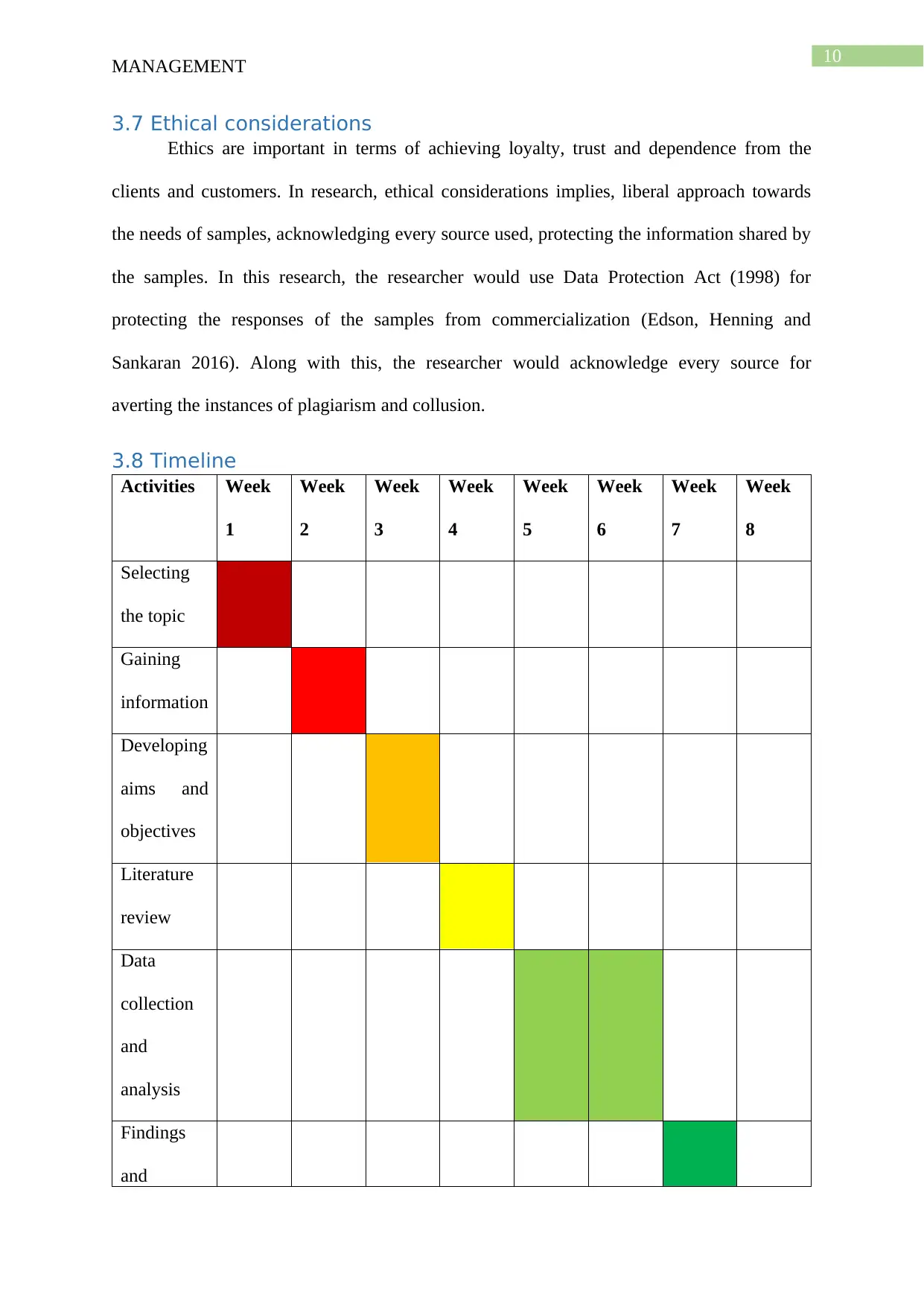
3.8 Timeline
Activities Week
1
Week
2
Week
3
Week
4
Week
5
Week
6
Week
7
Week
8
Selecting
the topic
Gaining
information
Developing
aims and
objectives
Literature
review
Data
collection
and
analysis
Findings
and
MANAGEMENT
3.7 Ethical considerations
Ethics are important in terms of achieving loyalty, trust and dependence from the
clients and customers. In research, ethical considerations implies, liberal approach towards
the needs of samples, acknowledging every source used, protecting the information shared by
the samples. In this research, the researcher would use Data Protection Act (1998) for
protecting the responses of the samples from commercialization (Edson, Henning and
Sankaran 2016). Along with this, the researcher would acknowledge every source for
averting the instances of plagiarism and collusion.
3.8 Timeline
Activities Week
1
Week
2
Week
3
Week
4
Week
5
Week
6
Week
7
Week
8
Selecting
the topic
Gaining
information
Developing
aims and
objectives
Literature
review
Data
collection
and
analysis
Findings
and
11
MANAGEMENT
conclusion
Evaluation
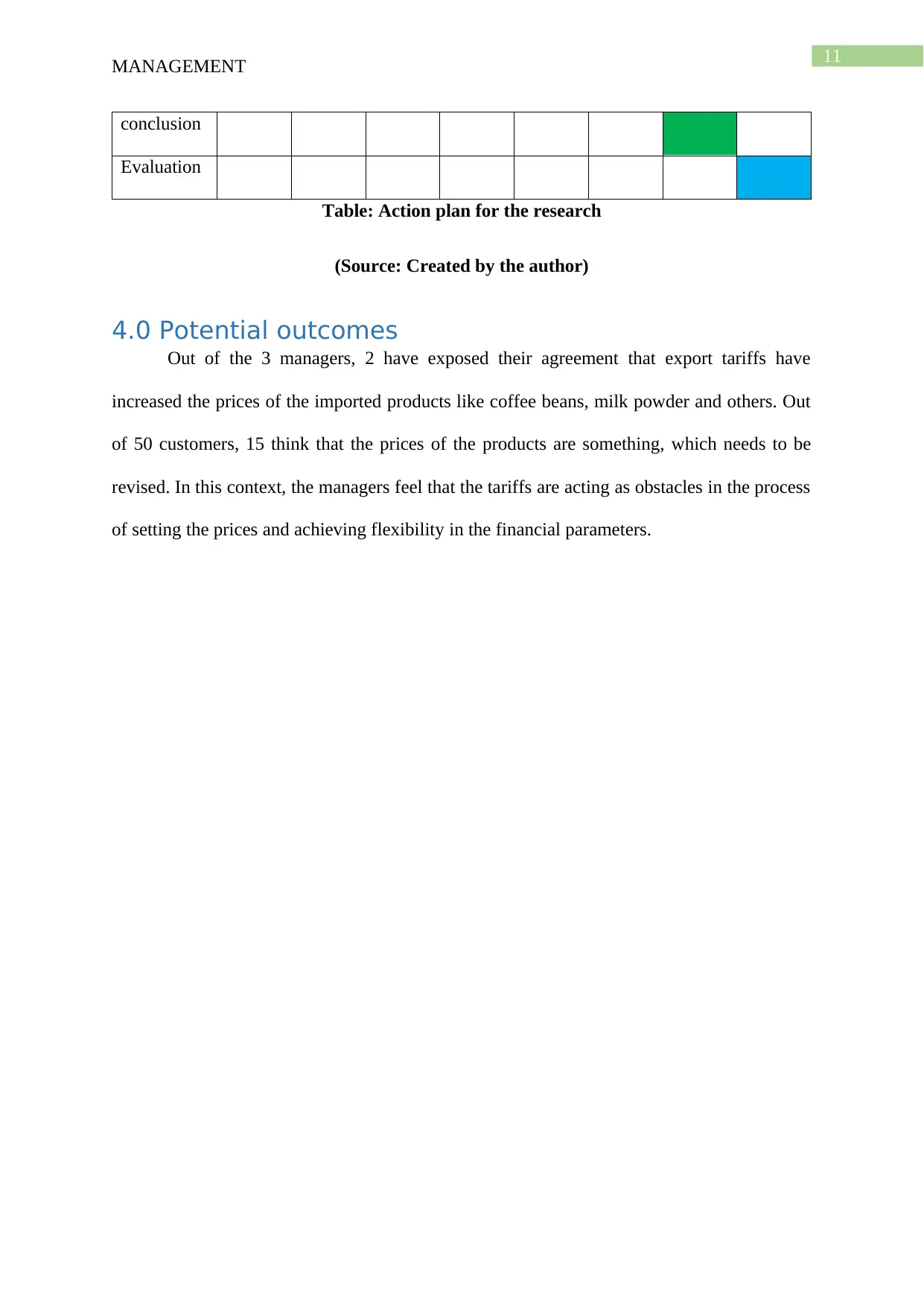
Table: Action plan for the research
(Source: Created by the author)
4.0 Potential outcomes
Out of the 3 managers, 2 have exposed their agreement that export tariffs have
increased the prices of the imported products like coffee beans, milk powder and others. Out
of 50 customers, 15 think that the prices of the products are something, which needs to be
revised. In this context, the managers feel that the tariffs are acting as obstacles in the process
of setting the prices and achieving flexibility in the financial parameters.
MANAGEMENT
conclusion
Evaluation
Table: Action plan for the research
(Source: Created by the author)
4.0 Potential outcomes
Out of the 3 managers, 2 have exposed their agreement that export tariffs have
increased the prices of the imported products like coffee beans, milk powder and others. Out
of 50 customers, 15 think that the prices of the products are something, which needs to be
revised. In this context, the managers feel that the tariffs are acting as obstacles in the process
of setting the prices and achieving flexibility in the financial parameters.
⊘ This is a preview!⊘
Do you want full access?
Subscribe today to unlock all pages.
Trusted by 1+ million students worldwide

1 out of 15


Your All-in-One AI-Powered Toolkit for Academic Success.
+13062052269
info@desklib.com
Available 24*7 on WhatsApp / Email
![[object Object]](/_next/static/media/star-bottom.7253800d.svg)
Unlock your academic potential
Copyright © 2020–2026 A2Z Services. All Rights Reserved. Developed and managed by ZUCOL.