Can Extensive Reading Help EFL/ESL Students Succeed Academically?
VerifiedAdded on 2022/11/14
|7
|1478
|97
Essay
AI Summary
This essay investigates the effectiveness of extensive reading (ER) for English as a Foreign Language (EFL) and English as a Second Language (ESL) students, specifically within the context of the University of Auckland in New Zealand. The study begins by highlighting the importance of reading skills for language acquisition and the potential of ER to enhance comprehension and vocabulary development. A literature review explores the benefits of ER, such as increased enjoyment and improved reading comprehension, and its effects on language proficiency. The essay identifies a gap in the current research regarding the application of ER at the university level and outlines the purpose of the study, which is to examine the current ER practices at the University of Auckland. The value of the study lies in its potential to improve students' reading abilities and promote ER as a key component of language learning. The essay references several studies that support the idea that extensive reading can greatly improve the success of the student in their academic journey.
Running head: EXTENSIVE READING 1
Extensive Reading
Name
Institution
Extensive Reading
Name
Institution
Paraphrase This Document
Need a fresh take? Get an instant paraphrase of this document with our AI Paraphraser

EXTENSIVE READING 2
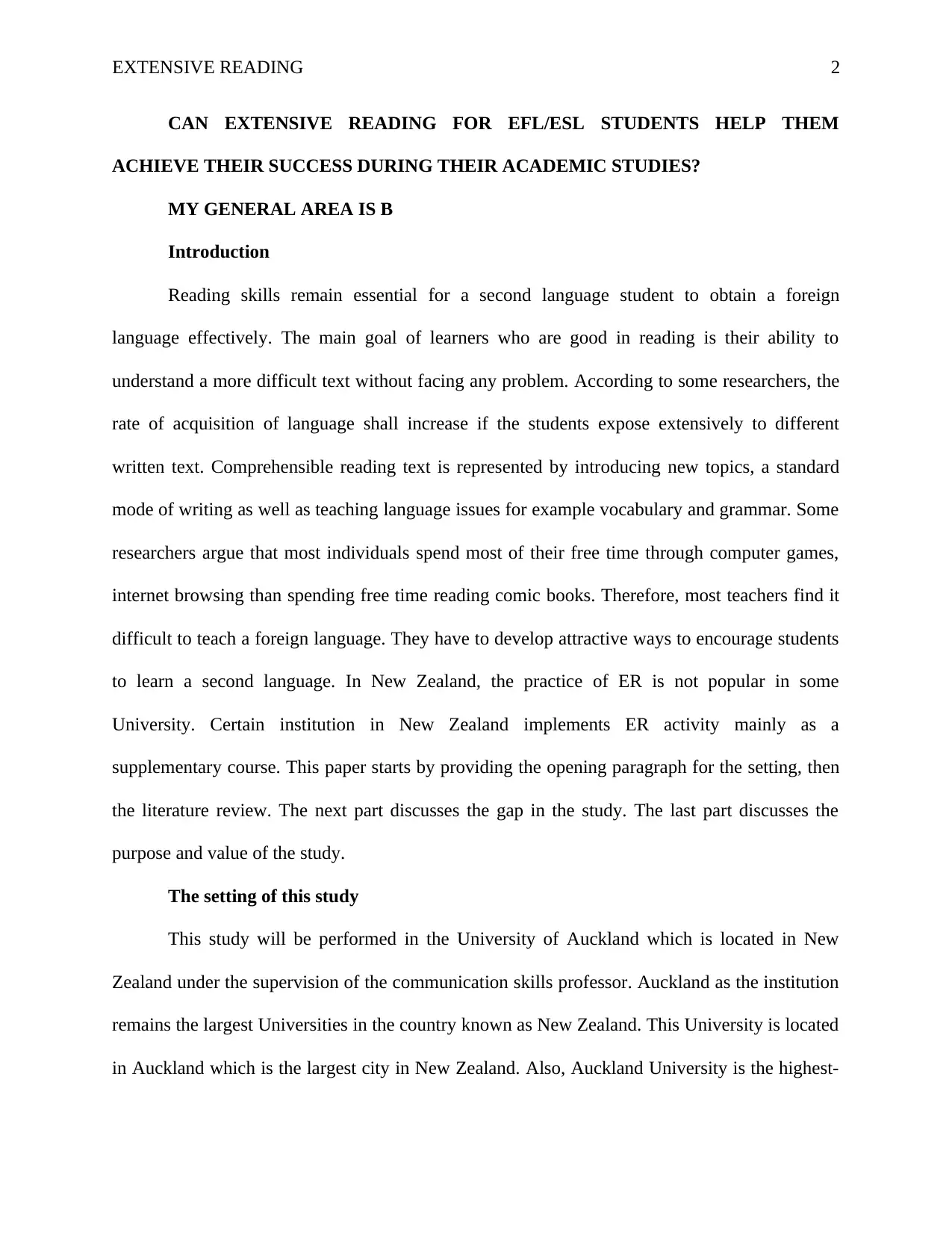
CAN EXTENSIVE READING FOR EFL/ESL STUDENTS HELP THEM
ACHIEVE THEIR SUCCESS DURING THEIR ACADEMIC STUDIES?
MY GENERAL AREA IS B
Introduction
Reading skills remain essential for a second language student to obtain a foreign
language effectively. The main goal of learners who are good in reading is their ability to
understand a more difficult text without facing any problem. According to some researchers, the
rate of acquisition of language shall increase if the students expose extensively to different
written text. Comprehensible reading text is represented by introducing new topics, a standard
mode of writing as well as teaching language issues for example vocabulary and grammar. Some
researchers argue that most individuals spend most of their free time through computer games,
internet browsing than spending free time reading comic books. Therefore, most teachers find it
difficult to teach a foreign language. They have to develop attractive ways to encourage students
to learn a second language. In New Zealand, the practice of ER is not popular in some
University. Certain institution in New Zealand implements ER activity mainly as a
supplementary course. This paper starts by providing the opening paragraph for the setting, then
the literature review. The next part discusses the gap in the study. The last part discusses the
purpose and value of the study.
The setting of this study
This study will be performed in the University of Auckland which is located in New
Zealand under the supervision of the communication skills professor. Auckland as the institution
remains the largest Universities in the country known as New Zealand. This University is located
in Auckland which is the largest city in New Zealand. Also, Auckland University is the highest-
CAN EXTENSIVE READING FOR EFL/ESL STUDENTS HELP THEM
ACHIEVE THEIR SUCCESS DURING THEIR ACADEMIC STUDIES?
MY GENERAL AREA IS B
Introduction
Reading skills remain essential for a second language student to obtain a foreign
language effectively. The main goal of learners who are good in reading is their ability to
understand a more difficult text without facing any problem. According to some researchers, the
rate of acquisition of language shall increase if the students expose extensively to different
written text. Comprehensible reading text is represented by introducing new topics, a standard
mode of writing as well as teaching language issues for example vocabulary and grammar. Some
researchers argue that most individuals spend most of their free time through computer games,
internet browsing than spending free time reading comic books. Therefore, most teachers find it
difficult to teach a foreign language. They have to develop attractive ways to encourage students
to learn a second language. In New Zealand, the practice of ER is not popular in some
University. Certain institution in New Zealand implements ER activity mainly as a
supplementary course. This paper starts by providing the opening paragraph for the setting, then
the literature review. The next part discusses the gap in the study. The last part discusses the
purpose and value of the study.
The setting of this study
This study will be performed in the University of Auckland which is located in New
Zealand under the supervision of the communication skills professor. Auckland as the institution
remains the largest Universities in the country known as New Zealand. This University is located
in Auckland which is the largest city in New Zealand. Also, Auckland University is the highest-

EXTENSIVE READING 3
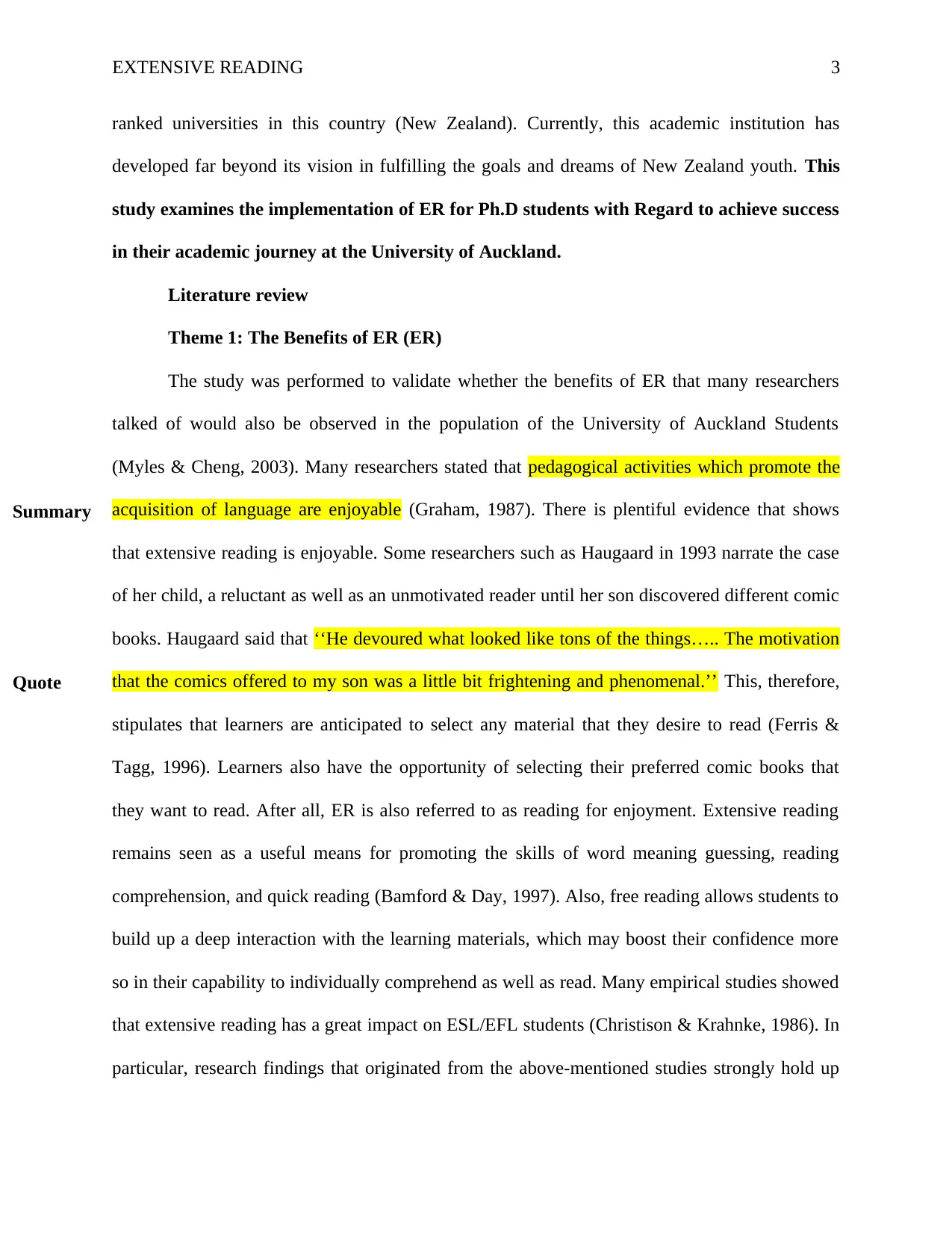
ranked universities in this country (New Zealand). Currently, this academic institution has
developed far beyond its vision in fulfilling the goals and dreams of New Zealand youth. This
study examines the implementation of ER for Ph.D students with Regard to achieve success
in their academic journey at the University of Auckland.
Literature review
Theme 1: The Benefits of ER (ER)
The study was performed to validate whether the benefits of ER that many researchers
talked of would also be observed in the population of the University of Auckland Students
(Myles & Cheng, 2003). Many researchers stated that pedagogical activities which promote the
acquisition of language are enjoyable (Graham, 1987). There is plentiful evidence that shows
that extensive reading is enjoyable. Some researchers such as Haugaard in 1993 narrate the case
of her child, a reluctant as well as an unmotivated reader until her son discovered different comic
books. Haugaard said that ‘‘He devoured what looked like tons of the things….. The motivation
that the comics offered to my son was a little bit frightening and phenomenal.’’ This, therefore,
stipulates that learners are anticipated to select any material that they desire to read (Ferris &
Tagg, 1996). Learners also have the opportunity of selecting their preferred comic books that
they want to read. After all, ER is also referred to as reading for enjoyment. Extensive reading
remains seen as a useful means for promoting the skills of word meaning guessing, reading
comprehension, and quick reading (Bamford & Day, 1997). Also, free reading allows students to
build up a deep interaction with the learning materials, which may boost their confidence more
so in their capability to individually comprehend as well as read. Many empirical studies showed
that extensive reading has a great impact on ESL/EFL students (Christison & Krahnke, 1986). In
particular, research findings that originated from the above-mentioned studies strongly hold up
Summary
Quote
ranked universities in this country (New Zealand). Currently, this academic institution has
developed far beyond its vision in fulfilling the goals and dreams of New Zealand youth. This
study examines the implementation of ER for Ph.D students with Regard to achieve success
in their academic journey at the University of Auckland.
Literature review
Theme 1: The Benefits of ER (ER)
The study was performed to validate whether the benefits of ER that many researchers
talked of would also be observed in the population of the University of Auckland Students
(Myles & Cheng, 2003). Many researchers stated that pedagogical activities which promote the
acquisition of language are enjoyable (Graham, 1987). There is plentiful evidence that shows
that extensive reading is enjoyable. Some researchers such as Haugaard in 1993 narrate the case
of her child, a reluctant as well as an unmotivated reader until her son discovered different comic
books. Haugaard said that ‘‘He devoured what looked like tons of the things….. The motivation
that the comics offered to my son was a little bit frightening and phenomenal.’’ This, therefore,
stipulates that learners are anticipated to select any material that they desire to read (Ferris &
Tagg, 1996). Learners also have the opportunity of selecting their preferred comic books that
they want to read. After all, ER is also referred to as reading for enjoyment. Extensive reading
remains seen as a useful means for promoting the skills of word meaning guessing, reading
comprehension, and quick reading (Bamford & Day, 1997). Also, free reading allows students to
build up a deep interaction with the learning materials, which may boost their confidence more
so in their capability to individually comprehend as well as read. Many empirical studies showed
that extensive reading has a great impact on ESL/EFL students (Christison & Krahnke, 1986). In
particular, research findings that originated from the above-mentioned studies strongly hold up
Summary
Quote
⊘ This is a preview!⊘
Do you want full access?
Subscribe today to unlock all pages.

Trusted by 1+ million students worldwide

EXTENSIVE READING 4
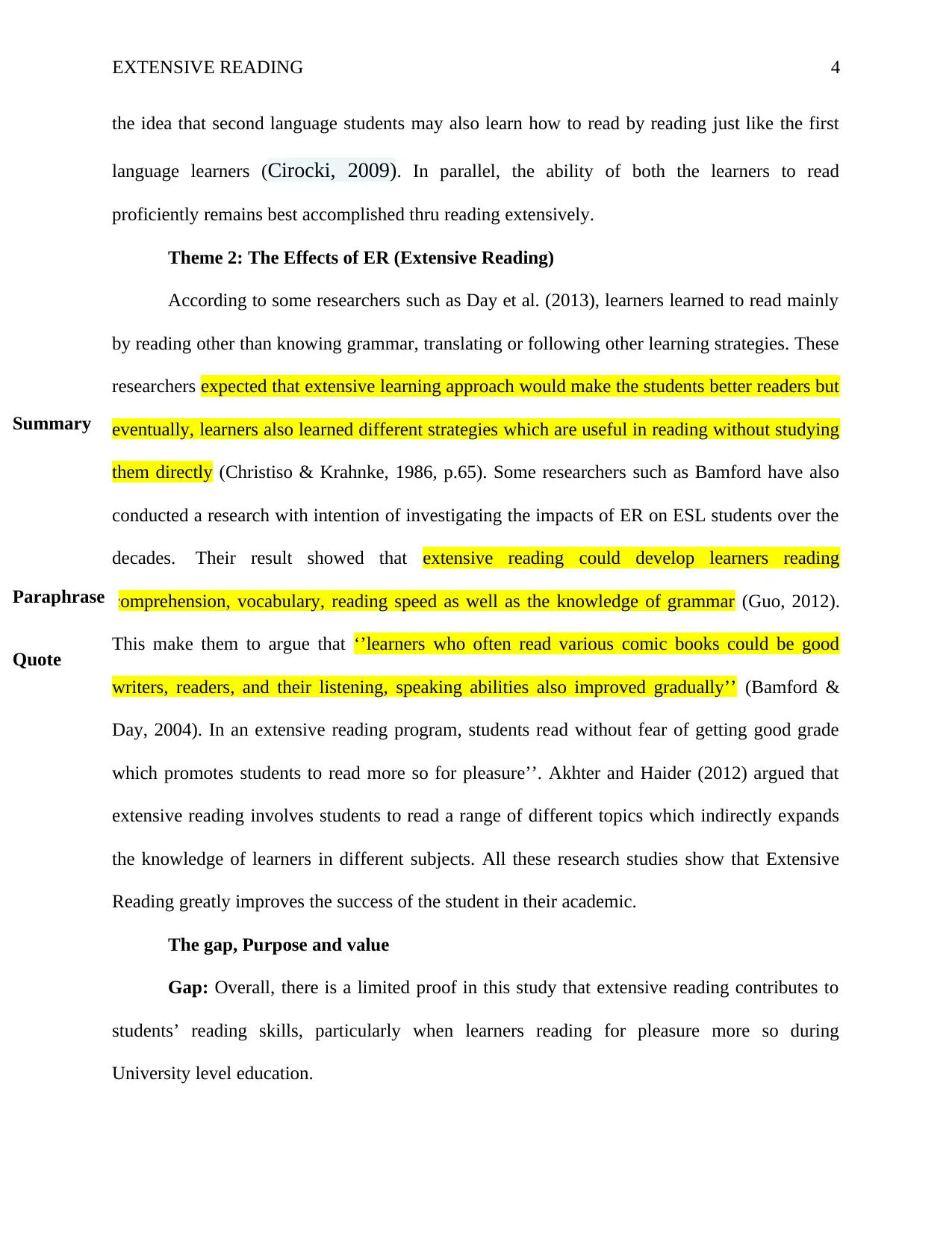
the idea that second language students may also learn how to read by reading just like the first
language learners (Cirocki, 2009). In parallel, the ability of both the learners to read
proficiently remains best accomplished thru reading extensively.
Theme 2: The Effects of ER (Extensive Reading)
According to some researchers such as Day et al. (2013), learners learned to read mainly
by reading other than knowing grammar, translating or following other learning strategies. These
researchers expected that extensive learning approach would make the students better readers but
eventually, learners also learned different strategies which are useful in reading without studying
them directly (Christiso & Krahnke, 1986, p.65). Some researchers such as Bamford have also
conducted a research with intention of investigating the impacts of ER on ESL students over the
decades. Their result showed that extensive reading could develop learners reading
comprehension, vocabulary, reading speed as well as the knowledge of grammar (Guo, 2012).
This make them to argue that ‘’learners who often read various comic books could be good
writers, readers, and their listening, speaking abilities also improved gradually’’ (Bamford &
Day, 2004). In an extensive reading program, students read without fear of getting good grade
which promotes students to read more so for pleasure’’. Akhter and Haider (2012) argued that
extensive reading involves students to read a range of different topics which indirectly expands
the knowledge of learners in different subjects. All these research studies show that Extensive
Reading greatly improves the success of the student in their academic.
The gap, Purpose and value
Gap: Overall, there is a limited proof in this study that extensive reading contributes to
students’ reading skills, particularly when learners reading for pleasure more so during
University level education.
Summary
Quote
Paraphrase
the idea that second language students may also learn how to read by reading just like the first
language learners (Cirocki, 2009). In parallel, the ability of both the learners to read
proficiently remains best accomplished thru reading extensively.
Theme 2: The Effects of ER (Extensive Reading)
According to some researchers such as Day et al. (2013), learners learned to read mainly
by reading other than knowing grammar, translating or following other learning strategies. These
researchers expected that extensive learning approach would make the students better readers but
eventually, learners also learned different strategies which are useful in reading without studying
them directly (Christiso & Krahnke, 1986, p.65). Some researchers such as Bamford have also
conducted a research with intention of investigating the impacts of ER on ESL students over the
decades. Their result showed that extensive reading could develop learners reading
comprehension, vocabulary, reading speed as well as the knowledge of grammar (Guo, 2012).
This make them to argue that ‘’learners who often read various comic books could be good
writers, readers, and their listening, speaking abilities also improved gradually’’ (Bamford &
Day, 2004). In an extensive reading program, students read without fear of getting good grade
which promotes students to read more so for pleasure’’. Akhter and Haider (2012) argued that
extensive reading involves students to read a range of different topics which indirectly expands
the knowledge of learners in different subjects. All these research studies show that Extensive
Reading greatly improves the success of the student in their academic.
The gap, Purpose and value
Gap: Overall, there is a limited proof in this study that extensive reading contributes to
students’ reading skills, particularly when learners reading for pleasure more so during
University level education.
Summary
Quote
Paraphrase
Paraphrase This Document
Need a fresh take? Get an instant paraphrase of this document with our AI Paraphraser

EXTENSIVE READING 5
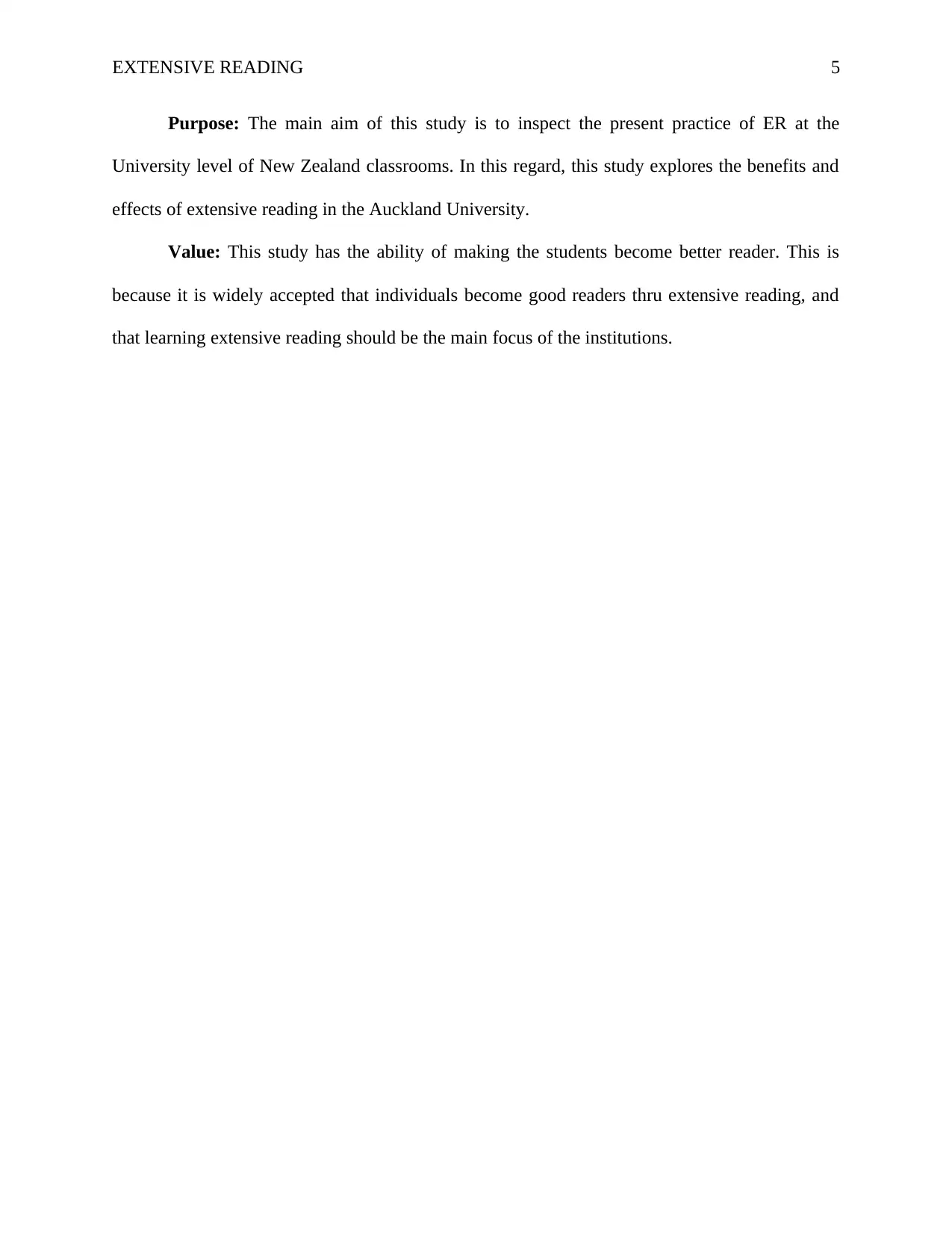
Purpose: The main aim of this study is to inspect the present practice of ER at the
University level of New Zealand classrooms. In this regard, this study explores the benefits and
effects of extensive reading in the Auckland University.
Value: This study has the ability of making the students become better reader. This is
because it is widely accepted that individuals become good readers thru extensive reading, and
that learning extensive reading should be the main focus of the institutions.
Purpose: The main aim of this study is to inspect the present practice of ER at the
University level of New Zealand classrooms. In this regard, this study explores the benefits and
effects of extensive reading in the Auckland University.
Value: This study has the ability of making the students become better reader. This is
because it is widely accepted that individuals become good readers thru extensive reading, and
that learning extensive reading should be the main focus of the institutions.

EXTENSIVE READING 6
References
Bamford, J., & Day, R. R. (1997). Extensive reading: What is it? Why bother? Language
Teacher-Kyoto-Jalt-, 21, 6-8.
Bamford, J., & Day, R. R. (2004). Extensive reading activities for language teaching. New York.
Cirocki, A. (2009). The place and role of literary texts in language education: A historical
overview. In A. Cirocki (Ed.), Extensive reading in English language teaching(pp. 157-
170). Munich, Germany: Lincom.
Christison, M.A, & Krahnke, K.J,(1986). Students’ perceptions of academic language study.
TESOL Quartely 20(1) 61-81.
Day, R., Bassett, J., Bowler, B., Parminter, S., Bullard, N., Furr, M., Prentice, N.,..Robb, T.
(2013). Bringing Extensive Reading into to the Classroom.
Ferris, D. & Tagg, T. (1996). Academic listening/speaking tasks for ESL students: problems,
suggestions and implications. TESOL Quarterly 30 (2): 297-317.
Guo, S. C. (2012). Using Authentic Materials for Extensive Reading to Promote English
Proficiency. English Language Teaching, 5(8), 196-206.
Graham, j. G. (1987). English language proficiency and the prediction of academic success.
TESOL Quarterly 21 (3): 505-521.
Haider, M. Z. & Akhter, E. (2012). Extensive Reading in EFL Classroom at Secondary Schools
in Bangladesh: Current Practices and Future Possibilities. International Education
Studies, 5(3), 126-133. Doi: 10.5539/ies.v5n3p126
Haugaard, K. (1973). Comic Books: Conduits to Culture. Reading teacher, 27(1), 54-55.
References
Bamford, J., & Day, R. R. (1997). Extensive reading: What is it? Why bother? Language
Teacher-Kyoto-Jalt-, 21, 6-8.
Bamford, J., & Day, R. R. (2004). Extensive reading activities for language teaching. New York.
Cirocki, A. (2009). The place and role of literary texts in language education: A historical
overview. In A. Cirocki (Ed.), Extensive reading in English language teaching(pp. 157-
170). Munich, Germany: Lincom.
Christison, M.A, & Krahnke, K.J,(1986). Students’ perceptions of academic language study.
TESOL Quartely 20(1) 61-81.
Day, R., Bassett, J., Bowler, B., Parminter, S., Bullard, N., Furr, M., Prentice, N.,..Robb, T.
(2013). Bringing Extensive Reading into to the Classroom.
Ferris, D. & Tagg, T. (1996). Academic listening/speaking tasks for ESL students: problems,
suggestions and implications. TESOL Quarterly 30 (2): 297-317.
Guo, S. C. (2012). Using Authentic Materials for Extensive Reading to Promote English
Proficiency. English Language Teaching, 5(8), 196-206.
Graham, j. G. (1987). English language proficiency and the prediction of academic success.
TESOL Quarterly 21 (3): 505-521.
Haider, M. Z. & Akhter, E. (2012). Extensive Reading in EFL Classroom at Secondary Schools
in Bangladesh: Current Practices and Future Possibilities. International Education
Studies, 5(3), 126-133. Doi: 10.5539/ies.v5n3p126
Haugaard, K. (1973). Comic Books: Conduits to Culture. Reading teacher, 27(1), 54-55.
⊘ This is a preview!⊘
Do you want full access?
Subscribe today to unlock all pages.

Trusted by 1+ million students worldwide

EXTENSIVE READING 7
Myles, J. & Cheng, L. (2003). The social and cultural life of non-native English speaking
international graduate students at a Canadian University. Journal of English for Academic
purposes 2: 247-263.
Myles, J. & Cheng, L. (2003). The social and cultural life of non-native English speaking
international graduate students at a Canadian University. Journal of English for Academic
purposes 2: 247-263.
1 out of 7
Related Documents
Your All-in-One AI-Powered Toolkit for Academic Success.
+13062052269
info@desklib.com
Available 24*7 on WhatsApp / Email
Unlock your academic potential
Copyright © 2020–2025 A2Z Services. All Rights Reserved. Developed and managed by ZUCOL.