External Auditor Independence: Risks, Implications, and Examples
VerifiedAdded on 2020/04/13
|13
|3071
|77
Report
AI Summary
This report delves into the crucial topic of external auditor independence, examining its definition, significance, and the importance of objectivity in financial auditing. It explores various risks to auditor objectivity, including social pressure, economic interests, personal associations, and cognitive biases. The report also outlines the practical implications for external auditors in fulfilling their responsibilities, emphasizing the role of audits in maintaining investor confidence and ensuring the reliability of financial statements. Furthermore, the report provides real-world examples of ethical breaches, such as those observed at KPMG, highlighting the consequences of compromised auditor independence. The report underscores the need for strong corporate governance and ethical standards to safeguard the integrity of the auditing process and protect the interests of stakeholders.
Running head: EXTERNAL AUDITOR INDEPENDENCE
External Auditor Independence
University Name
Student Name
Authors’ Note
External Auditor Independence
University Name
Student Name
Authors’ Note

Paraphrase This Document
Need a fresh take? Get an instant paraphrase of this document with our AI Paraphraser
2EXTERNAL AUDITOR INDEPENDENCE
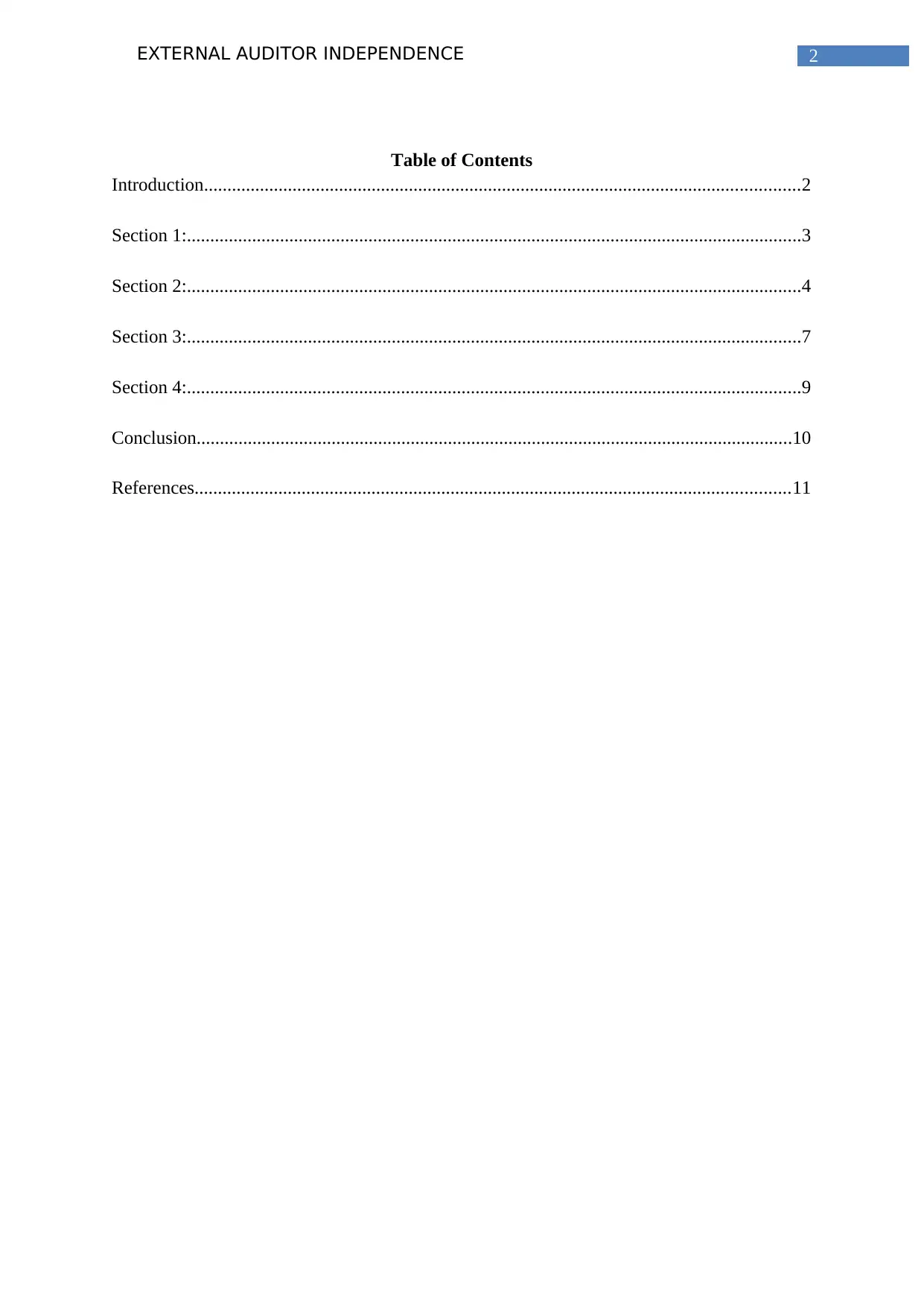
Table of Contents
Introduction................................................................................................................................2
Section 1:....................................................................................................................................3
Section 2:....................................................................................................................................4
Section 3:....................................................................................................................................7
Section 4:....................................................................................................................................9
Conclusion................................................................................................................................10
References................................................................................................................................11
Table of Contents
Introduction................................................................................................................................2
Section 1:....................................................................................................................................3
Section 2:....................................................................................................................................4
Section 3:....................................................................................................................................7
Section 4:....................................................................................................................................9
Conclusion................................................................................................................................10
References................................................................................................................................11
3EXTERNAL AUDITOR INDEPENDENCE
Introduction
The independence as well as objectivity of particularly internal as well as external assessors
can be observed both in auditing as specific attributes of strong corporate governance along
with public sector financial management. Auditor independence indicates towards
independence of specifically internal assessor else wise that of external auditor from specific
parties that might have financial interest in the operations of the business.
The current study intends to elucidate illustratively the definition and significance of
independence of auditors in the role of external auditors. In addition to this, the study also
explains in detail the areas of risk to objectivity of external auditor and practical implications
for the external auditor in satisfying the demands of this specific aspect of the role of auditor.
Moving further, the current section also presents exhaustively two real world instances of
specific situations where the assessors of public corporations can be found to have breached
ethical responsibilities.
Section 1:
Meaning of external auditor independence and importance of external auditor
independence
Meaning:
The external auditor independence indicates towards independence of specific external
assessor that is necessary to the provision of an objective opinion on specifically truth and
fairness of financial assertions. The assessors also have the need to be independent from the
client corporation so that the audit opinion will not be influenced by association between
them (Arens et al. 2012). The assessors are anticipated to provide an unbiased along with
honest expert opinion on financial declarations to the shareholders.
Introduction
The independence as well as objectivity of particularly internal as well as external assessors
can be observed both in auditing as specific attributes of strong corporate governance along
with public sector financial management. Auditor independence indicates towards
independence of specifically internal assessor else wise that of external auditor from specific
parties that might have financial interest in the operations of the business.
The current study intends to elucidate illustratively the definition and significance of
independence of auditors in the role of external auditors. In addition to this, the study also
explains in detail the areas of risk to objectivity of external auditor and practical implications
for the external auditor in satisfying the demands of this specific aspect of the role of auditor.
Moving further, the current section also presents exhaustively two real world instances of
specific situations where the assessors of public corporations can be found to have breached
ethical responsibilities.
Section 1:
Meaning of external auditor independence and importance of external auditor
independence
Meaning:
The external auditor independence indicates towards independence of specific external
assessor that is necessary to the provision of an objective opinion on specifically truth and
fairness of financial assertions. The assessors also have the need to be independent from the
client corporation so that the audit opinion will not be influenced by association between
them (Arens et al. 2012). The assessors are anticipated to provide an unbiased along with
honest expert opinion on financial declarations to the shareholders.
⊘ This is a preview!⊘
Do you want full access?
Subscribe today to unlock all pages.

Trusted by 1+ million students worldwide
4EXTERNAL AUDITOR INDEPENDENCE
Importance:
The assessor have the need to be independent from mainly the client corporation in order to
ensure that audit opinion can be properly influenced by any kind of association between the
two. In addition to this, the assessors are also expected to provide an unbiased along with
honest professional viewpoint on the financial assertions to all the shareholders. However,
doubts are sometimes expressed as regards the independence of different external assessors
(William Jr et al. 2016). Thus, it can hereby be argued that until and unless proper corporate
governance dimensions are instituted, a firm of assessors might arrive at audit opinions as
well as judgements that are deeply influenced by the aspiration to maintain good associations
with the client corporation. Essentially, if this happens, the assessor can no longer be
regarded to be independent and the shareholders might fail to depend on their role. Arens et
al. (2016) asserts that accounting corporations might participate in the process of setting fees
for audit at a rate lower than the market rate and make for the insufficiency by delivering
non-audit services, for example, management consultancy along with tax guidance.
Accordingly, some audit corporations also have commercial interests that have the need to be
protected as well. Essentially, this raises concerns that the assessor’s interests to shield
shareholders of a corporation and conflict interests might conflict with one another.
According to Arens et al. (2015), an assessor is a scrutiny of the specific accounts by a
qualified assessor that undertakes the operation of reviewing the figures. This activity can
help in establishing the fact whether specific accounts reflect a true as well as fair view of the
outcomes together with the financial position of the corporation. As per the views of Toy and
Hay (2014), auditor independence indicates towards the attitude of the mind that is chiefly
characterised by factors of integrity and an objective approach to the entire audit procedure.
Ge et al. (2016) mention that independent auditing can be considered to be a significant part
of the corporate monitoring process since the period of 1930s. Council (2013) put forward he
Importance:
The assessor have the need to be independent from mainly the client corporation in order to
ensure that audit opinion can be properly influenced by any kind of association between the
two. In addition to this, the assessors are also expected to provide an unbiased along with
honest professional viewpoint on the financial assertions to all the shareholders. However,
doubts are sometimes expressed as regards the independence of different external assessors
(William Jr et al. 2016). Thus, it can hereby be argued that until and unless proper corporate
governance dimensions are instituted, a firm of assessors might arrive at audit opinions as
well as judgements that are deeply influenced by the aspiration to maintain good associations
with the client corporation. Essentially, if this happens, the assessor can no longer be
regarded to be independent and the shareholders might fail to depend on their role. Arens et
al. (2016) asserts that accounting corporations might participate in the process of setting fees
for audit at a rate lower than the market rate and make for the insufficiency by delivering
non-audit services, for example, management consultancy along with tax guidance.
Accordingly, some audit corporations also have commercial interests that have the need to be
protected as well. Essentially, this raises concerns that the assessor’s interests to shield
shareholders of a corporation and conflict interests might conflict with one another.
According to Arens et al. (2015), an assessor is a scrutiny of the specific accounts by a
qualified assessor that undertakes the operation of reviewing the figures. This activity can
help in establishing the fact whether specific accounts reflect a true as well as fair view of the
outcomes together with the financial position of the corporation. As per the views of Toy and
Hay (2014), auditor independence indicates towards the attitude of the mind that is chiefly
characterised by factors of integrity and an objective approach to the entire audit procedure.
Ge et al. (2016) mention that independent auditing can be considered to be a significant part
of the corporate monitoring process since the period of 1930s. Council (2013) put forward he
Paraphrase This Document
Need a fresh take? Get an instant paraphrase of this document with our AI Paraphraser
5EXTERNAL AUDITOR INDEPENDENCE
view that lack of independence of the external auditor might adversely affect the entire
process of audit in several ways. Essentially, the independence of specifically external
assessors is hereby brought into light owing to bad accounting exercises and the lack of
independences of the assessor. As rightly indicated by Castelo Branco et al. (2014), the
independence of particularly external assessors is brought under consideration due to the
potential influence of the corporations on the assessors. This is mainly used to be the liability
of the chief financial officer of the corporations to hire and employ an external assessor.
Thus, in case if the assessor’s report was not specifically favourable for the CFO, then the
CFO could also take a decision to terminate them and instead select an auditor who would
rather present a desirable view of the financial condition of the firm.
Section 2:
Areas of risk to external auditor objectivity
There are situations in which several categories of threats to objectivity are extant. For
instance, there are several internal auditors that deliver control self-assessment services that
include proper working with the audit client representatives and assisting the process of
assessment of risks and controls. Again, there are also numbers of threats that can crop up
from the circumstances, namely self-review intimidation in case if an assessor acts as a
catalyst and consequently can be assigned to assess the controls that was the subject of
assessment practice (Sonnerfeldt and Pontoppidan 2017). In addition to this, there are also
social pressure threats that might take place in case if the facilitating assessor feels the stress
to not violate the trust placed in the procedure of self-assessment by diverse partakers who
can bluntly reveals system faults. Particularly, in this particular context, an assessor might
remain concerned about the fact that future self-evaluation procedures can necessarily
undermine by the negative audit observations. Moreover, at the time when a specific auditor
view that lack of independence of the external auditor might adversely affect the entire
process of audit in several ways. Essentially, the independence of specifically external
assessors is hereby brought into light owing to bad accounting exercises and the lack of
independences of the assessor. As rightly indicated by Castelo Branco et al. (2014), the
independence of particularly external assessors is brought under consideration due to the
potential influence of the corporations on the assessors. This is mainly used to be the liability
of the chief financial officer of the corporations to hire and employ an external assessor.
Thus, in case if the assessor’s report was not specifically favourable for the CFO, then the
CFO could also take a decision to terminate them and instead select an auditor who would
rather present a desirable view of the financial condition of the firm.
Section 2:
Areas of risk to external auditor objectivity
There are situations in which several categories of threats to objectivity are extant. For
instance, there are several internal auditors that deliver control self-assessment services that
include proper working with the audit client representatives and assisting the process of
assessment of risks and controls. Again, there are also numbers of threats that can crop up
from the circumstances, namely self-review intimidation in case if an assessor acts as a
catalyst and consequently can be assigned to assess the controls that was the subject of
assessment practice (Sonnerfeldt and Pontoppidan 2017). In addition to this, there are also
social pressure threats that might take place in case if the facilitating assessor feels the stress
to not violate the trust placed in the procedure of self-assessment by diverse partakers who
can bluntly reveals system faults. Particularly, in this particular context, an assessor might
remain concerned about the fact that future self-evaluation procedures can necessarily
undermine by the negative audit observations. Moreover, at the time when a specific auditor
6EXTERNAL AUDITOR INDEPENDENCE
assumes the role of a facilitator and is consequently assigned the role of reviewing risks as
well as controls that were necessarily subject of the assessment practice. In addition to this,
social pressure threats might also arise in case if the aiding assessor feels pressure to not
violate the trust placed in the procedure of self-assessment by the participants who openly
reveal weakness (Dewing and Russell 2014). In case if an assessor might be dealing with
individual threats, there might be multiple threats, mitigating facets in diverse situations.
Factors affecting objectivity include the following:
Social Pressure:
Social Pressure can be considered to be an important factor of threat that an auditor might
encounter at time when they are exposed to pressures from diverse external parties. Also,
pressure from clients can drive the assessor to overlook different suspicious items. Again,
social pressure can also take place when a team member of the assessment process becomes
reluctant to counter a normally held view on the part of the team of audit else wise from the
clients (Curtis et al. 2016).
Economic Interest:
Threats might also crop up at the time when assessor possesses an economic stake in the
overall performance of the business concern. However, an assessor might fear that
considerable negative observations, namely discovery of illegal actions can endanger the
overall future, therefore, the assessor’s own interests as a member of the staff of the business
concern (DeFond and Zhang 2014).
Personal Association:
The threats might arise at the time when an assessor happens to be a close friend or else close
relative of the manager else wise a member of the staff of the audit client. In this case, the
assumes the role of a facilitator and is consequently assigned the role of reviewing risks as
well as controls that were necessarily subject of the assessment practice. In addition to this,
social pressure threats might also arise in case if the aiding assessor feels pressure to not
violate the trust placed in the procedure of self-assessment by the participants who openly
reveal weakness (Dewing and Russell 2014). In case if an assessor might be dealing with
individual threats, there might be multiple threats, mitigating facets in diverse situations.
Factors affecting objectivity include the following:
Social Pressure:
Social Pressure can be considered to be an important factor of threat that an auditor might
encounter at time when they are exposed to pressures from diverse external parties. Also,
pressure from clients can drive the assessor to overlook different suspicious items. Again,
social pressure can also take place when a team member of the assessment process becomes
reluctant to counter a normally held view on the part of the team of audit else wise from the
clients (Curtis et al. 2016).
Economic Interest:
Threats might also crop up at the time when assessor possesses an economic stake in the
overall performance of the business concern. However, an assessor might fear that
considerable negative observations, namely discovery of illegal actions can endanger the
overall future, therefore, the assessor’s own interests as a member of the staff of the business
concern (DeFond and Zhang 2014).
Personal Association:
The threats might arise at the time when an assessor happens to be a close friend or else close
relative of the manager else wise a member of the staff of the audit client. In this case, the
⊘ This is a preview!⊘
Do you want full access?
Subscribe today to unlock all pages.
Trusted by 1+ million students worldwide
7EXTERNAL AUDITOR INDEPENDENCE
assessor might fail to notice, soften, or else delay reporting negative audit observations to
avert embarrassing the friend else wise relative (DeFond and Zhang 2014).
Familiarity:
The threat might crop up owing to long term association with the assessor with the client of
the audit. Essentially, familiarity might perhaps direct the way towards losing objectivity of
auditor during an assessment van (Twist et al. 2015). This can be carried out by making the
assessor exceedingly understanding to the client.
Cultural, Racial as well as gender bias:
The threat might possibly stem from cultural, racial else wise gender unfairness. For instance,
in a multidivisional corporation, a regionally based assessor might be biased or else
prejudiced against audit clients situated in different foreign locations (Mio 2016).
Cognitive Bias:
The threat might also stem from unconscious and unintended psychological bias in the
process of inferring information depending on role of a person in a specific situation (Mio
2016). For instance, in case if someone undertakes a critical audit viewpoint, they might fail
to notice positive information.
Self-Review:
Self-review threats might occur at the time when the assessor reviews their own work
undertaken during a prior audit else wise consulting engagement. For instance, an assessor
might assess a specific department continually else wise in consecutive years. However, the
assessor might deliver consulting services in association with system execution (Curtis et al.
2016).
assessor might fail to notice, soften, or else delay reporting negative audit observations to
avert embarrassing the friend else wise relative (DeFond and Zhang 2014).
Familiarity:
The threat might crop up owing to long term association with the assessor with the client of
the audit. Essentially, familiarity might perhaps direct the way towards losing objectivity of
auditor during an assessment van (Twist et al. 2015). This can be carried out by making the
assessor exceedingly understanding to the client.
Cultural, Racial as well as gender bias:
The threat might possibly stem from cultural, racial else wise gender unfairness. For instance,
in a multidivisional corporation, a regionally based assessor might be biased or else
prejudiced against audit clients situated in different foreign locations (Mio 2016).
Cognitive Bias:
The threat might also stem from unconscious and unintended psychological bias in the
process of inferring information depending on role of a person in a specific situation (Mio
2016). For instance, in case if someone undertakes a critical audit viewpoint, they might fail
to notice positive information.
Self-Review:
Self-review threats might occur at the time when the assessor reviews their own work
undertaken during a prior audit else wise consulting engagement. For instance, an assessor
might assess a specific department continually else wise in consecutive years. However, the
assessor might deliver consulting services in association with system execution (Curtis et al.
2016).
Paraphrase This Document
Need a fresh take? Get an instant paraphrase of this document with our AI Paraphraser
8EXTERNAL AUDITOR INDEPENDENCE
Intimidation Threat:
Intimidation threat occurs at the time when assessors is deterred from acting objectively by
means of threats that can be actual or else perceived else wise overtly coerced by clients of
the audit and other concerned parties.
Advocacy Threat:
Advocacy threat arise at the when assessors act in a biased manner to promote or advocate in
favour or else against the audit client in a way that can compromise the overall objectivity of
the client (Curtis et al. 2016).
Section 3:
Practical Implications for the external auditor in satisfying demands of this aspect of
audit role
Auditors necessarily play a very important role in making certain that the investors can
become confident, aware and informed at time of arriving at investment decisions. Superior
quality audit can help in maintaining higher quality financial statements and facilitate
financiers to depend on the independent assessment of financial statements by the auditors.
The practical implications for the external audit include that it shields the interest particularly
financial interest of individuals who are related to management of business entity irrespective
of whether they are partners else shareholders. In itself, external audit acts as a process of
investigation process on the members of the staff from undertaking misappropriation. In
addition to this, audited pecuniary assertions of accounts can also help in settling tax liability,
negotiating borrowed loans and for the purpose of determining the purchase considerations
for a corporation (Curtis et al. 2016). Furthermore, the audit process can prove to be effective
for settling different disputes of trade for higher amounts of wages else bonuses along with
Intimidation Threat:
Intimidation threat occurs at the time when assessors is deterred from acting objectively by
means of threats that can be actual or else perceived else wise overtly coerced by clients of
the audit and other concerned parties.
Advocacy Threat:
Advocacy threat arise at the when assessors act in a biased manner to promote or advocate in
favour or else against the audit client in a way that can compromise the overall objectivity of
the client (Curtis et al. 2016).
Section 3:
Practical Implications for the external auditor in satisfying demands of this aspect of
audit role
Auditors necessarily play a very important role in making certain that the investors can
become confident, aware and informed at time of arriving at investment decisions. Superior
quality audit can help in maintaining higher quality financial statements and facilitate
financiers to depend on the independent assessment of financial statements by the auditors.
The practical implications for the external audit include that it shields the interest particularly
financial interest of individuals who are related to management of business entity irrespective
of whether they are partners else shareholders. In itself, external audit acts as a process of
investigation process on the members of the staff from undertaking misappropriation. In
addition to this, audited pecuniary assertions of accounts can also help in settling tax liability,
negotiating borrowed loans and for the purpose of determining the purchase considerations
for a corporation (Curtis et al. 2016). Furthermore, the audit process can prove to be effective
for settling different disputes of trade for higher amounts of wages else bonuses along with
9EXTERNAL AUDITOR INDEPENDENCE
claims with regard to damage suffered by property, fire else wise certain other disaster.
Moreover, the external audit process might also help in the process of identification of
wastages along with losses to reflect the variant ways by which these factors might be
examined.
In itself, the external audit procedure also helps in ascertaining whether the obligatory books
of accounts along with allied records have been appropriately maintained and aids clients in
making good deficiencies else wise inadequacies in this regard. Nevertheless, as an appraisal
function, audit assists in reviewing the overall existence as well as operations of different
controls in the business concern and registers weaknesses as well as insufficiencies. Again,
audited items and accounts are of immense help in the process of settlement of accounts at
the time of admittance or demise of partner (DeFond and Zhang 2014). Yet again,
government might possibly require assessed and certified pronouncements before it provides
assistance or else issues a business license for a specific trade.
Section 4:
Identification of two real world examples of situations of breach of ethical
responsibilities
Ethical standards particularly at British audit firms are said to be under examination after the
Financial Reporting Council (FRC) mentioned that it had observed substantiation that the
violations it exposed at KPMG might be more widespread. In essence, FRC also declared a
double assessment into KPMG and whether the same had violated the ethical standards of the
profession. A specific part of the probe was mainly founded on the appointment of the
chairman of Pendragon that is one of the clients of the big four firms. Again, the other part of
the probe wanted to understand whether KPMG has committed an ethical violation in
association to the non-timely disposal of the shareholding in a client concern. Again, FRC
claims with regard to damage suffered by property, fire else wise certain other disaster.
Moreover, the external audit process might also help in the process of identification of
wastages along with losses to reflect the variant ways by which these factors might be
examined.
In itself, the external audit procedure also helps in ascertaining whether the obligatory books
of accounts along with allied records have been appropriately maintained and aids clients in
making good deficiencies else wise inadequacies in this regard. Nevertheless, as an appraisal
function, audit assists in reviewing the overall existence as well as operations of different
controls in the business concern and registers weaknesses as well as insufficiencies. Again,
audited items and accounts are of immense help in the process of settlement of accounts at
the time of admittance or demise of partner (DeFond and Zhang 2014). Yet again,
government might possibly require assessed and certified pronouncements before it provides
assistance or else issues a business license for a specific trade.
Section 4:
Identification of two real world examples of situations of breach of ethical
responsibilities
Ethical standards particularly at British audit firms are said to be under examination after the
Financial Reporting Council (FRC) mentioned that it had observed substantiation that the
violations it exposed at KPMG might be more widespread. In essence, FRC also declared a
double assessment into KPMG and whether the same had violated the ethical standards of the
profession. A specific part of the probe was mainly founded on the appointment of the
chairman of Pendragon that is one of the clients of the big four firms. Again, the other part of
the probe wanted to understand whether KPMG has committed an ethical violation in
association to the non-timely disposal of the shareholding in a client concern. Again, FRC
⊘ This is a preview!⊘
Do you want full access?
Subscribe today to unlock all pages.
Trusted by 1+ million students worldwide
10EXTERNAL AUDITOR INDEPENDENCE
also ordered an overall enhancement in ethical standards mentioning that it was asking for
recognition of further instances of events that explains violation of the ethical standards. In
this connection it was mentioned that FRC also discovered violations counting efforts for
cross selling different non-audit services to specific audit clients (DeFond and Zhang 2014).
This also indicated the failure to acquire proper clearance for specific contingent fee
arrangement and examples of incidents where details of shareholding in audited business
entities were not predisposed on a timely manner.
Another case that indicates towards the breach of the ethical standards by the auditors include
the “Fraud and Loss at Adelphia: A Wall Street Story”. The company presented further
misrepresentations in company’s public declarations and filings in a bid to maintain
appearance and create transactions along with fictitious documents to prove that the debts are
necessarily repaid. In this, Deloitte is the external assessor of the firm Adelphia that
suspended their work of audit during the year 200. This is because they necessarily made
claims that practically could not depend on the information delivered by the management.
They also needed an overall expansion of the audit scope (DeFond and Zhang 2014).
Thereafter, the auditor Deloitte was necessarily dismissed by the firm Adelphia. In addition
to this, SEC also charged the accounting firm Deloitte for undertaking professional
negligence, violation of the contract, acts of fraud and failure to identify the massive acts of
fraud at the corporation Adelphia during the financial year 1999-2000.
Conclusion
In conclusion, it can be hereby mentioned that the current study helps in gaining
comprehensive understanding as regards the meaning and significance of independence of
external auditor. In addition to this, the current segment also highlights and elucidates
illustratively specific factors such as social pressure, economic interest, personal association,
also ordered an overall enhancement in ethical standards mentioning that it was asking for
recognition of further instances of events that explains violation of the ethical standards. In
this connection it was mentioned that FRC also discovered violations counting efforts for
cross selling different non-audit services to specific audit clients (DeFond and Zhang 2014).
This also indicated the failure to acquire proper clearance for specific contingent fee
arrangement and examples of incidents where details of shareholding in audited business
entities were not predisposed on a timely manner.
Another case that indicates towards the breach of the ethical standards by the auditors include
the “Fraud and Loss at Adelphia: A Wall Street Story”. The company presented further
misrepresentations in company’s public declarations and filings in a bid to maintain
appearance and create transactions along with fictitious documents to prove that the debts are
necessarily repaid. In this, Deloitte is the external assessor of the firm Adelphia that
suspended their work of audit during the year 200. This is because they necessarily made
claims that practically could not depend on the information delivered by the management.
They also needed an overall expansion of the audit scope (DeFond and Zhang 2014).
Thereafter, the auditor Deloitte was necessarily dismissed by the firm Adelphia. In addition
to this, SEC also charged the accounting firm Deloitte for undertaking professional
negligence, violation of the contract, acts of fraud and failure to identify the massive acts of
fraud at the corporation Adelphia during the financial year 1999-2000.
Conclusion
In conclusion, it can be hereby mentioned that the current study helps in gaining
comprehensive understanding as regards the meaning and significance of independence of
external auditor. In addition to this, the current segment also highlights and elucidates
illustratively specific factors such as social pressure, economic interest, personal association,
Paraphrase This Document
Need a fresh take? Get an instant paraphrase of this document with our AI Paraphraser
11EXTERNAL AUDITOR INDEPENDENCE
familiarity, cultural, racial as well as gender biases, cognitive biases, self review and
intimidation threat. Thereafter, the present segment also aids in understanding specific
implications for the external auditor in satisfying various demands of this particular aspect of
the audit role. Furthermore, the current paper also illuminates the cases of violation of ethical
responsibilities by KPMG for Pendragon and Deloitte for Adelphia.
familiarity, cultural, racial as well as gender biases, cognitive biases, self review and
intimidation threat. Thereafter, the present segment also aids in understanding specific
implications for the external auditor in satisfying various demands of this particular aspect of
the audit role. Furthermore, the current paper also illuminates the cases of violation of ethical
responsibilities by KPMG for Pendragon and Deloitte for Adelphia.
12EXTERNAL AUDITOR INDEPENDENCE
References
Arens, A.A., Best, P., Shailer, G., Fiedler, B., Elder, R.J. and Beasley, M., 2016. Auditing
and assurance services in Australia: an integrated approach. Pearson Education Australia.
Arens, A.A., Elder, R.J. and Mark, B., 2012. Auditing and assurance services: an integrated
approach. Boston: Prentice Hall.
Arens, A.A., Elder, R.J., Beasley, M.S. and Jenkins, G.J., 2015. Essentials of Auditing and
Assurance Services: An Integrated Approach. New Jersey: Prentice Hall.
Castelo Branco, M., Delgado, C., Ferreira Gomes, S. and Cristina Pereira Eugénio, T., 2014.
Factors influencing the assurance of sustainability reports in the context of the economic
crisis in Portugal. Managerial Auditing Journal, 29(3), pp.237-252.
Council, F.R., 2013. International Standard on Auditing (UK and Ireland) 610. Using the
work of internal auditors.
Curtis, E., Humphrey, C. and Turley, W.S., 2016. Standards of innovation in
auditing. Auditing: A Journal of Practice & Theory, 35(3), pp.75-98.
DeFond, M. and Zhang, J., 2014. A review of archival auditing research. Journal of
Accounting and Economics, 58(2), pp.275-326.
Dewing, I. and Russell, P., 2014. Auditing Standards. Europe and the Governance of Global
Finance, p.97.
Ge, Q., Simnett, R. and Zhou, S., 2016. Ethical and Quality Control Requirements When
Undertaking Assurance Engagements.
Mio, C. ed., 2016. Integrated Reporting: A New Accounting Disclosure. Springer.
References
Arens, A.A., Best, P., Shailer, G., Fiedler, B., Elder, R.J. and Beasley, M., 2016. Auditing
and assurance services in Australia: an integrated approach. Pearson Education Australia.
Arens, A.A., Elder, R.J. and Mark, B., 2012. Auditing and assurance services: an integrated
approach. Boston: Prentice Hall.
Arens, A.A., Elder, R.J., Beasley, M.S. and Jenkins, G.J., 2015. Essentials of Auditing and
Assurance Services: An Integrated Approach. New Jersey: Prentice Hall.
Castelo Branco, M., Delgado, C., Ferreira Gomes, S. and Cristina Pereira Eugénio, T., 2014.
Factors influencing the assurance of sustainability reports in the context of the economic
crisis in Portugal. Managerial Auditing Journal, 29(3), pp.237-252.
Council, F.R., 2013. International Standard on Auditing (UK and Ireland) 610. Using the
work of internal auditors.
Curtis, E., Humphrey, C. and Turley, W.S., 2016. Standards of innovation in
auditing. Auditing: A Journal of Practice & Theory, 35(3), pp.75-98.
DeFond, M. and Zhang, J., 2014. A review of archival auditing research. Journal of
Accounting and Economics, 58(2), pp.275-326.
Dewing, I. and Russell, P., 2014. Auditing Standards. Europe and the Governance of Global
Finance, p.97.
Ge, Q., Simnett, R. and Zhou, S., 2016. Ethical and Quality Control Requirements When
Undertaking Assurance Engagements.
Mio, C. ed., 2016. Integrated Reporting: A New Accounting Disclosure. Springer.
⊘ This is a preview!⊘
Do you want full access?
Subscribe today to unlock all pages.
Trusted by 1+ million students worldwide

1 out of 13


Related Documents


Your All-in-One AI-Powered Toolkit for Academic Success.
+13062052269
info@desklib.com
Available 24*7 on WhatsApp / Email
![[object Object]](/_next/static/media/star-bottom.7253800d.svg)
Unlock your academic potential
Copyright © 2020–2026 A2Z Services. All Rights Reserved. Developed and managed by ZUCOL.