Economics of Dog Ownership: Externalities and Market Intervention
VerifiedAdded on 2020/02/03
|8
|2110
|108
Report
AI Summary
This report delves into the economics of dog ownership, examining both the positive and negative externalities associated with it. Positive externalities include improved health and social benefits, while negative externalities encompass emotional attachment, costs, and potential dangers. The report explores why governments may intervene in the dog market, such as to address unfair pricing and black market activities. It discusses interventions like public education campaigns to promote responsible dog ownership and illustrates the effects of government actions on supply, demand, and market equilibrium using supply and demand diagrams. The report concludes that while dog ownership offers numerous benefits, government oversight is crucial to mitigate negative impacts and ensure fair market practices.
EXTERNALITY QUESTION

Paraphrase This Document
Need a fresh take? Get an instant paraphrase of this document with our AI Paraphraser
Table of Contents
.........................................................................................................................................................2
INTRODUCTION...........................................................................................................................3
TASK 1............................................................................................................................................3
2.1Explain the nature of externalities and explain the difference between a positive and a
negative externality.....................................................................................................................3
2.2Explain why governments would intervene in the market for dogs using externality theory4
2.3 Discuss one type of intervention that governments can use to encourage dog ownership...5
2.4 Show on a correctly labelled supply and demand diagram the private market for dogs.
Then show the effects of.............................................................................................................5
the government intervention on quantity traded and price.........................................................5
CONCLUSION................................................................................................................................6
REFRENCES ..................................................................................................................................7
.........................................................................................................................................................2
INTRODUCTION...........................................................................................................................3
TASK 1............................................................................................................................................3
2.1Explain the nature of externalities and explain the difference between a positive and a
negative externality.....................................................................................................................3
2.2Explain why governments would intervene in the market for dogs using externality theory4
2.3 Discuss one type of intervention that governments can use to encourage dog ownership...5
2.4 Show on a correctly labelled supply and demand diagram the private market for dogs.
Then show the effects of.............................................................................................................5
the government intervention on quantity traded and price.........................................................5
CONCLUSION................................................................................................................................6
REFRENCES ..................................................................................................................................7
INTRODUCTION
The following report has been prepared to understand the benefits of having a dog in house.
Scientist has discovered that the dog ownership improves health of an individual. Although both
the owner and the dog do not actually realise how they are benefited from one another they are
giving benefits to each other. From the report the reader will learn how government can
intervene in the dog market and how it can encourage people to increase dog ownership (Clark
Cline,2010).
TASK 1
2.1Explain the nature of externalities and explain the difference between a positive and a
negative externality.
Externalities in the dog ownership is the result of having a dog as a pet. It is a combination of
both positive and negative impact for the dog owner.
Positive externalities- Dog ownership has various constructive evidences as all the family
members are benefited when their is a dog in their house as a pet. Scientist discovered that
indirectly they contribute in keeping individual busy which help those - who do not have any
work to do. They can spend their full day with dogs as he is the best companion for those who
don't have any other person with them. Their positive effects may be understood better in detail
further in different heads like:
1. Reduce risk of obesity- As dogs are very active in nature they keep their owner
occupied with themselves. Dogs need to be taken out for walk and in this way the
dog owner also moves out from his house and walks with his dog. This develops a
culture of exercises on regular basis at a fix time. This gives much help to those
who are suffering from obesity problem(Lail McCormack and Rock 2011). A
small walk is also very effective from them as it makes them more active than
being lethargic. Dogs have the tendency to build regular habits therefore once
they starts doing some physical activity they do it on a regular basis. This brings
continuity in physical work of the as well as of the owner.
2. Reduce risk of allergy-It is observed that children growing up with dog as a pet in
their house develops a strong immune system. They are less prone to get
The following report has been prepared to understand the benefits of having a dog in house.
Scientist has discovered that the dog ownership improves health of an individual. Although both
the owner and the dog do not actually realise how they are benefited from one another they are
giving benefits to each other. From the report the reader will learn how government can
intervene in the dog market and how it can encourage people to increase dog ownership (Clark
Cline,2010).
TASK 1
2.1Explain the nature of externalities and explain the difference between a positive and a
negative externality.
Externalities in the dog ownership is the result of having a dog as a pet. It is a combination of
both positive and negative impact for the dog owner.
Positive externalities- Dog ownership has various constructive evidences as all the family
members are benefited when their is a dog in their house as a pet. Scientist discovered that
indirectly they contribute in keeping individual busy which help those - who do not have any
work to do. They can spend their full day with dogs as he is the best companion for those who
don't have any other person with them. Their positive effects may be understood better in detail
further in different heads like:
1. Reduce risk of obesity- As dogs are very active in nature they keep their owner
occupied with themselves. Dogs need to be taken out for walk and in this way the
dog owner also moves out from his house and walks with his dog. This develops a
culture of exercises on regular basis at a fix time. This gives much help to those
who are suffering from obesity problem(Lail McCormack and Rock 2011). A
small walk is also very effective from them as it makes them more active than
being lethargic. Dogs have the tendency to build regular habits therefore once
they starts doing some physical activity they do it on a regular basis. This brings
continuity in physical work of the as well as of the owner.
2. Reduce risk of allergy-It is observed that children growing up with dog as a pet in
their house develops a strong immune system. They are less prone to get
⊘ This is a preview!⊘
Do you want full access?
Subscribe today to unlock all pages.

Trusted by 1+ million students worldwide
infectious or allergic to a particular thing. This prevents an individual from
getting sick again and again.
3. Improves cardiovascular health- As the dogs keep their owners occupied in
different physical activities it improves the blood pressure problems and the other
cholesterol problems. These are the problems which are majorly noticed in men.
4. Develops empathetic nature- Surveys conducted in the schools resulted that
students who has pet at their homes are kind and generous in nature. Also they get
popularity in schools from other children.
5. Less depression- It is observed that people having dog as a pet are less victim's of
depression. They recover from any stress or grief in less time in comparison to
others as dogs becomes their best friend and interacts with them with total love
and affection (Herzog,2011).
Negative externalities- It is the cost suffered due to the ownership of dogs by people who keeps
dogs at their place. Apart from the dog owner, society also face many problems because of this
culture of dog keeping. It can be understood better in different heads:
1.Emotional attachment- People get too attached with the dogs when they keep them at their
place for a long time. They become a family member for them and in case of any miss
happening to the dog it leads to major depression in the pet owners. They find it very difficult
to accept the fact of permanent loss of their pet which leads to their major mood swings.
2.High maintenance cost- These days keeping an expensive dog at homes has become a part of
fashion. People invest high amount on buying the intentional dogs which is not just a onetime
expense but it further increases with the maintenance of it. Expensive dogs requires high
maintenance therefore it is a waste of money as it it can be used for some other productive
purpose also.
3.Responsibility- Once people start keeping a pet it becomes their responsibility. They have to
care of their pet as a child and therefore they cannot think of leaving it at home alone for a
long time. He needs food on time and for this someone has to take the responsibility. This
bounds the dog owner to move freely outside as he will always keep thinking about him
even if is far away (Rijkenand van, 2011).
getting sick again and again.
3. Improves cardiovascular health- As the dogs keep their owners occupied in
different physical activities it improves the blood pressure problems and the other
cholesterol problems. These are the problems which are majorly noticed in men.
4. Develops empathetic nature- Surveys conducted in the schools resulted that
students who has pet at their homes are kind and generous in nature. Also they get
popularity in schools from other children.
5. Less depression- It is observed that people having dog as a pet are less victim's of
depression. They recover from any stress or grief in less time in comparison to
others as dogs becomes their best friend and interacts with them with total love
and affection (Herzog,2011).
Negative externalities- It is the cost suffered due to the ownership of dogs by people who keeps
dogs at their place. Apart from the dog owner, society also face many problems because of this
culture of dog keeping. It can be understood better in different heads:
1.Emotional attachment- People get too attached with the dogs when they keep them at their
place for a long time. They become a family member for them and in case of any miss
happening to the dog it leads to major depression in the pet owners. They find it very difficult
to accept the fact of permanent loss of their pet which leads to their major mood swings.
2.High maintenance cost- These days keeping an expensive dog at homes has become a part of
fashion. People invest high amount on buying the intentional dogs which is not just a onetime
expense but it further increases with the maintenance of it. Expensive dogs requires high
maintenance therefore it is a waste of money as it it can be used for some other productive
purpose also.
3.Responsibility- Once people start keeping a pet it becomes their responsibility. They have to
care of their pet as a child and therefore they cannot think of leaving it at home alone for a
long time. He needs food on time and for this someone has to take the responsibility. This
bounds the dog owner to move freely outside as he will always keep thinking about him
even if is far away (Rijkenand van, 2011).
Paraphrase This Document
Need a fresh take? Get an instant paraphrase of this document with our AI Paraphraser
4.Danger to neighbours- As the dogs do not give wild reactions to the people he knows in
this case the people residing in the near by areas suffer a great loss. At times when the
dogs are left without their owner they can can harm the other people.
5. Harm to guests- When strangers visit their relatives who keep dogs as pet they get
frighten as the dogs react wildly to the strangers. In this case they may be harmed if they
do not react calmly to the dog.
2.2Explain why governments would intervene in the market for dogs using externality theory
With the increase in culture of owning a dog government intervention becomes necessary to
protect the and also the dog owners from the adverse effects of this culture. People without
getting the knowledge about the dog starts keeping them at their place therefore government took
the initiative so that people do not harm the society as well as themselves by the habit of keeping
pets. There are other reasons also why the government intervention was required like:
1. Price Ceilings- It happens when the government keeps control over the price of
different products that are sold in the market. This help in limiting the price of the
dogs as people charge the price which are not actually worth it.
2. Black market- Even the dogs market is not free from the practice of black market.
Dogs are imported and exported across countries at an unfair price. Therefore
government intervention is required to control these practices (Davlinand Von
Ville,2012).
2.3 Discuss one type of intervention that governments can use to encourage dog ownership
Government can promote the dog ownership in the public by making them educate about the
positive impacts of having a dog. People can be made aware about how dogs can help in
developing good habits. Advertisements can be given by demonstrating how dogs has helped
people in improving their health and also helped in their tough times to overcome the grief or
like situations. There are people who have the habit of keeping pets as a burden in that case they
will get to know about the positive point of dogs. (Antonacopoulos and Pychyl 2010 ).
this case the people residing in the near by areas suffer a great loss. At times when the
dogs are left without their owner they can can harm the other people.
5. Harm to guests- When strangers visit their relatives who keep dogs as pet they get
frighten as the dogs react wildly to the strangers. In this case they may be harmed if they
do not react calmly to the dog.
2.2Explain why governments would intervene in the market for dogs using externality theory
With the increase in culture of owning a dog government intervention becomes necessary to
protect the and also the dog owners from the adverse effects of this culture. People without
getting the knowledge about the dog starts keeping them at their place therefore government took
the initiative so that people do not harm the society as well as themselves by the habit of keeping
pets. There are other reasons also why the government intervention was required like:
1. Price Ceilings- It happens when the government keeps control over the price of
different products that are sold in the market. This help in limiting the price of the
dogs as people charge the price which are not actually worth it.
2. Black market- Even the dogs market is not free from the practice of black market.
Dogs are imported and exported across countries at an unfair price. Therefore
government intervention is required to control these practices (Davlinand Von
Ville,2012).
2.3 Discuss one type of intervention that governments can use to encourage dog ownership
Government can promote the dog ownership in the public by making them educate about the
positive impacts of having a dog. People can be made aware about how dogs can help in
developing good habits. Advertisements can be given by demonstrating how dogs has helped
people in improving their health and also helped in their tough times to overcome the grief or
like situations. There are people who have the habit of keeping pets as a burden in that case they
will get to know about the positive point of dogs. (Antonacopoulos and Pychyl 2010 ).
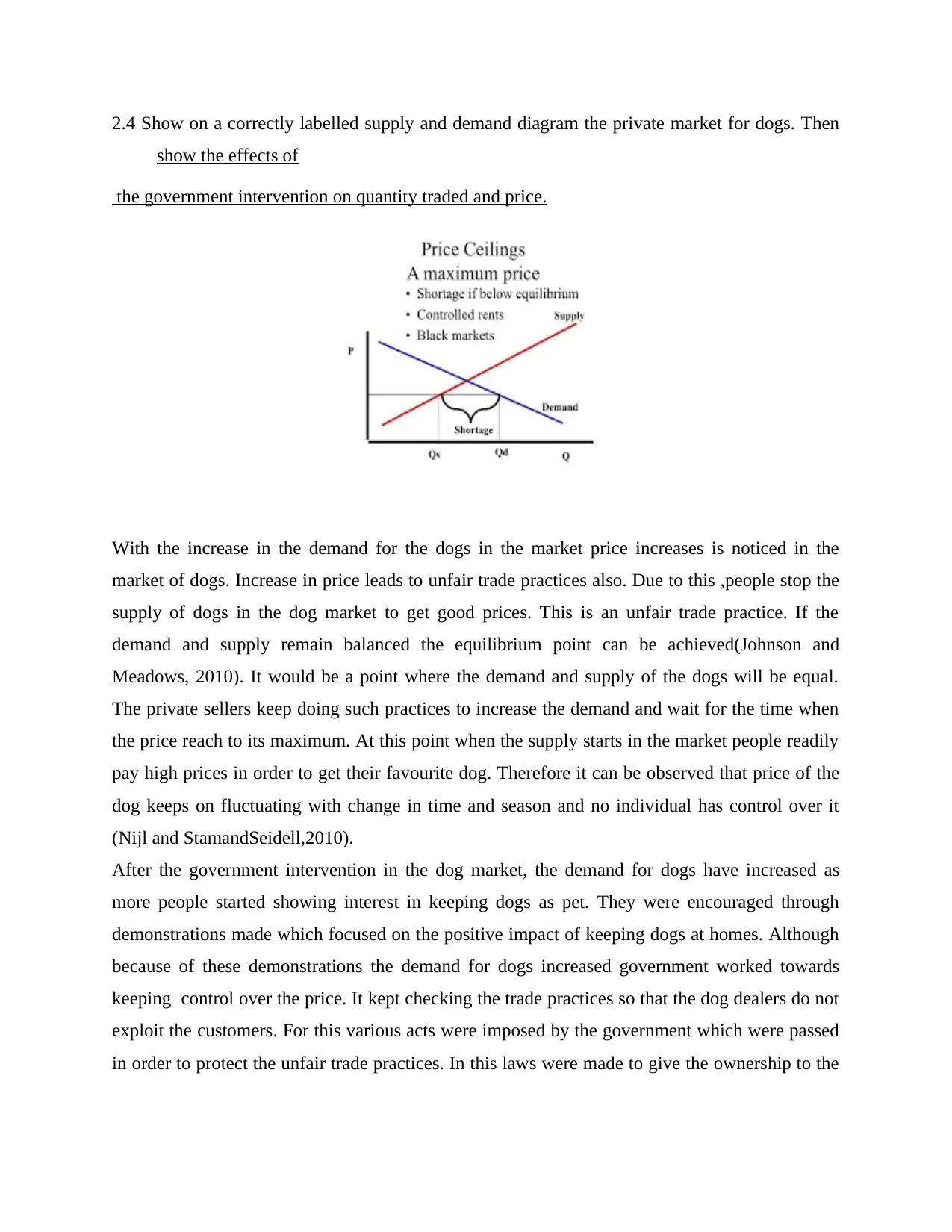
2.4 Show on a correctly labelled supply and demand diagram the private market for dogs. Then
show the effects of
the government intervention on quantity traded and price.
With the increase in the demand for the dogs in the market price increases is noticed in the
market of dogs. Increase in price leads to unfair trade practices also. Due to this ,people stop the
supply of dogs in the dog market to get good prices. This is an unfair trade practice. If the
demand and supply remain balanced the equilibrium point can be achieved(Johnson and
Meadows, 2010). It would be a point where the demand and supply of the dogs will be equal.
The private sellers keep doing such practices to increase the demand and wait for the time when
the price reach to its maximum. At this point when the supply starts in the market people readily
pay high prices in order to get their favourite dog. Therefore it can be observed that price of the
dog keeps on fluctuating with change in time and season and no individual has control over it
(Nijl and StamandSeidell,2010).
After the government intervention in the dog market, the demand for dogs have increased as
more people started showing interest in keeping dogs as pet. They were encouraged through
demonstrations made which focused on the positive impact of keeping dogs at homes. Although
because of these demonstrations the demand for dogs increased government worked towards
keeping control over the price. It kept checking the trade practices so that the dog dealers do not
exploit the customers. For this various acts were imposed by the government which were passed
in order to protect the unfair trade practices. In this laws were made to give the ownership to the
show the effects of
the government intervention on quantity traded and price.
With the increase in the demand for the dogs in the market price increases is noticed in the
market of dogs. Increase in price leads to unfair trade practices also. Due to this ,people stop the
supply of dogs in the dog market to get good prices. This is an unfair trade practice. If the
demand and supply remain balanced the equilibrium point can be achieved(Johnson and
Meadows, 2010). It would be a point where the demand and supply of the dogs will be equal.
The private sellers keep doing such practices to increase the demand and wait for the time when
the price reach to its maximum. At this point when the supply starts in the market people readily
pay high prices in order to get their favourite dog. Therefore it can be observed that price of the
dog keeps on fluctuating with change in time and season and no individual has control over it
(Nijl and StamandSeidell,2010).
After the government intervention in the dog market, the demand for dogs have increased as
more people started showing interest in keeping dogs as pet. They were encouraged through
demonstrations made which focused on the positive impact of keeping dogs at homes. Although
because of these demonstrations the demand for dogs increased government worked towards
keeping control over the price. It kept checking the trade practices so that the dog dealers do not
exploit the customers. For this various acts were imposed by the government which were passed
in order to protect the unfair trade practices. In this laws were made to give the ownership to the
⊘ This is a preview!⊘
Do you want full access?
Subscribe today to unlock all pages.
Trusted by 1+ million students worldwide
customers so that proper record can be maintained as who owns a particular dog and also the
ownership was given to only those who are capable enough of keeping them.
CONCLUSION
From the above report it can be concluded that dog ownership has contributed much in
improving health conditions of an individual. Although the ownership has some disadvantages
also but due to more advantage they are supported by government also. The government has
taken various steps towards promoting the culture of dog keeping among the public for which it
took help of the advertisement (Johnson and Meadows,2010). The private market of dog runs on
the demand for the same as the price of dogs keeps on fluctuating with the change in time.
Although government took initiative to control such unfair trade practices it could not be
controlled to the full extent.
ownership was given to only those who are capable enough of keeping them.
CONCLUSION
From the above report it can be concluded that dog ownership has contributed much in
improving health conditions of an individual. Although the ownership has some disadvantages
also but due to more advantage they are supported by government also. The government has
taken various steps towards promoting the culture of dog keeping among the public for which it
took help of the advertisement (Johnson and Meadows,2010). The private market of dog runs on
the demand for the same as the price of dogs keeps on fluctuating with the change in time.
Although government took initiative to control such unfair trade practices it could not be
controlled to the full extent.
Paraphrase This Document
Need a fresh take? Get an instant paraphrase of this document with our AI Paraphraser
REFRENCES
Books and Journals
Clark Cline, K.M., 2010. Psychological effects of dog ownership: Role strain, role enhancement,
and depression. The Journal of social psychology. 150(2). pp.117-131.
Lail, P., McCormack, G.R. and Rock, M., 2011. Does dog-ownership influence seasonal patterns
of neighbourhood-based walking among adults? A longitudinal study. BMC Public Health.
11(1). p.148.
Herzog, H., 2011. The impact of pets on human health and psychological well-being: fact,
fiction, or hypothesis?. Current Directions in Psychological Science. 20(4). pp.236-239.
Rijken, M. and van Beek, S., 2011. About cats and dogs… Reconsidering the relationship
between pet ownership and health related outcomes in community-dwelling elderly. Social
Indicators Research. 102(3). pp.373-388.
Davlin, S.L. and VonVille, H.M., 2012. Canine rabies vaccination and domestic dog population
characteristics in the developing world: a systematic review. Vaccine, 30(24), pp.3492-3502.
Antonacopoulos, N.M.D. and Pychyl, T.A., 2010. An examination of the potential role of pet
ownership, human social support and pet attachment in the psychological health of individuals
living alone. Anthrozoös. 23(1). pp.37-54.
Nijland, M.L., Stam, F. and Seidell, J.C., 2010. Overweight in dogs, but not in cats, is related to
overweight in their owners. Public health nutrition. 13(01). pp.102-106.
Johnson, R.A. and Meadows, R.L., 2010. Dog-walking: motivation for adherence to a walking
program. Clinical nursing research.
(Online)
Dog walking: Its association with physical activity guideline adherence and its correlates
2011[ONLINE] available
through<http://www.sciencedirect.com/science/article/pii/S0091743510004317>assessed on [9th
May 2017].
Books and Journals
Clark Cline, K.M., 2010. Psychological effects of dog ownership: Role strain, role enhancement,
and depression. The Journal of social psychology. 150(2). pp.117-131.
Lail, P., McCormack, G.R. and Rock, M., 2011. Does dog-ownership influence seasonal patterns
of neighbourhood-based walking among adults? A longitudinal study. BMC Public Health.
11(1). p.148.
Herzog, H., 2011. The impact of pets on human health and psychological well-being: fact,
fiction, or hypothesis?. Current Directions in Psychological Science. 20(4). pp.236-239.
Rijken, M. and van Beek, S., 2011. About cats and dogs… Reconsidering the relationship
between pet ownership and health related outcomes in community-dwelling elderly. Social
Indicators Research. 102(3). pp.373-388.
Davlin, S.L. and VonVille, H.M., 2012. Canine rabies vaccination and domestic dog population
characteristics in the developing world: a systematic review. Vaccine, 30(24), pp.3492-3502.
Antonacopoulos, N.M.D. and Pychyl, T.A., 2010. An examination of the potential role of pet
ownership, human social support and pet attachment in the psychological health of individuals
living alone. Anthrozoös. 23(1). pp.37-54.
Nijland, M.L., Stam, F. and Seidell, J.C., 2010. Overweight in dogs, but not in cats, is related to
overweight in their owners. Public health nutrition. 13(01). pp.102-106.
Johnson, R.A. and Meadows, R.L., 2010. Dog-walking: motivation for adherence to a walking
program. Clinical nursing research.
(Online)
Dog walking: Its association with physical activity guideline adherence and its correlates
2011[ONLINE] available
through<http://www.sciencedirect.com/science/article/pii/S0091743510004317>assessed on [9th
May 2017].

1 out of 8


Your All-in-One AI-Powered Toolkit for Academic Success.
+13062052269
info@desklib.com
Available 24*7 on WhatsApp / Email
![[object Object]](/_next/static/media/star-bottom.7253800d.svg)
Unlock your academic potential
Copyright © 2020–2025 A2Z Services. All Rights Reserved. Developed and managed by ZUCOL.