Eysenck's Trait Theory: An Outline, Evaluation, and Critique
VerifiedAdded on 2023/04/17
|10
|1868
|227
Essay
AI Summary
This essay provides an outline and evaluation of Eysenck's trait theory of personality, discussing its relevance to understanding personality structure and individual differences. It begins by introducing Eysenck's theory, emphasizing the dimensions of personality such as extraversion, neuroticism, and psychoticism, and their biological basis. The essay critically analyzes the theory, addressing challenges from both within scientific psychology, such as the debate between nature and nurture, and from outside positivist psychology, including concerns about the social context and potential for labeling. The conclusion summarizes Eysenck's contributions and acknowledges the criticisms, ultimately recognizing his significant impact on personality psychology.
Essay on Eysenck's trait theory of
personality
personality

Paraphrase This Document
Need a fresh take? Get an instant paraphrase of this document with our AI Paraphraser
Table of Contents
Relevance Theory..............................................................................................................3
Eysenck Theory.................................................................................................................3
Introduction.....................................................................................................................3
Personality and Psychology...........................................................................................4
Critical Analysis..............................................................................................................5
Challenges from inside Scientific, Positivist Psychology...............................................7
Challenges from Outside Positivist Psychology.............................................................8
Conclusion......................................................................................................................8
Resources:...................................................................................................................10
Relevance Theory..............................................................................................................3
Eysenck Theory.................................................................................................................3
Introduction.....................................................................................................................3
Personality and Psychology...........................................................................................4
Critical Analysis..............................................................................................................5
Challenges from inside Scientific, Positivist Psychology...............................................7
Challenges from Outside Positivist Psychology.............................................................8
Conclusion......................................................................................................................8
Resources:...................................................................................................................10
Relevance Theory
Relevance theory is a proposition by Dan Sperber and Deirdre Wilson that looks to
clarify the second strategy for correspondence: one that considers certain inferences.
[clarification needed] It contends that the "listener/peruser/crowd will hunt down
importance in any given correspondence circumstance and having discovered implying
that fits their desire of pertinence, will quit handling.
Relevance theory is a system for the investigation of perception, proposed
fundamentally with a specific end goal to give a mentally practical record of
correspondence. is paper i) presents Relevance theory's focal responsibilities in detail
and clarifies the hypothetical inspirations driving them; and ii) demonstrates a portion of
the courses in which these center standards are offered as a powerful influence for
experimental issues. e center of pertinence theory can be partitioned into two
arrangements of presumptions. Suspicions identifying with perception when all is said in
done incorporate the meaning of Relevance as an exchange off amongst exertion and
impacts, and the claim that cognizance has a tendency to amplify importance.
Suppositions about correspondence incorporate the cases that understanding an
articulation involves surmising the speaker's open and instructive goals; and that the
informative rule of pertinence and the assumption of ideal importance command the
Relevance theoretic appreciation technique, a heuristic that aides the hunt down the
proposed translation of expressions. Pertinence scholars model correspondence
regarding the working of this cognizance strategy. ere are, furthermore, a few systems
that guide the clarification of marvels in pertinence theory, including: i) a more grounded
type of Grice's Modified Occam's Razor, ii) the likelihood of partitioning what is
etymologically encoded amongst reasonable and procedural data; iii) the
interpretive/graphic qualification; iv) the utilization of impromptu ideas
Eysenck Theory
Introduction
Relevance theory is a proposition by Dan Sperber and Deirdre Wilson that looks to
clarify the second strategy for correspondence: one that considers certain inferences.
[clarification needed] It contends that the "listener/peruser/crowd will hunt down
importance in any given correspondence circumstance and having discovered implying
that fits their desire of pertinence, will quit handling.
Relevance theory is a system for the investigation of perception, proposed
fundamentally with a specific end goal to give a mentally practical record of
correspondence. is paper i) presents Relevance theory's focal responsibilities in detail
and clarifies the hypothetical inspirations driving them; and ii) demonstrates a portion of
the courses in which these center standards are offered as a powerful influence for
experimental issues. e center of pertinence theory can be partitioned into two
arrangements of presumptions. Suspicions identifying with perception when all is said in
done incorporate the meaning of Relevance as an exchange off amongst exertion and
impacts, and the claim that cognizance has a tendency to amplify importance.
Suppositions about correspondence incorporate the cases that understanding an
articulation involves surmising the speaker's open and instructive goals; and that the
informative rule of pertinence and the assumption of ideal importance command the
Relevance theoretic appreciation technique, a heuristic that aides the hunt down the
proposed translation of expressions. Pertinence scholars model correspondence
regarding the working of this cognizance strategy. ere are, furthermore, a few systems
that guide the clarification of marvels in pertinence theory, including: i) a more grounded
type of Grice's Modified Occam's Razor, ii) the likelihood of partitioning what is
etymologically encoded amongst reasonable and procedural data; iii) the
interpretive/graphic qualification; iv) the utilization of impromptu ideas
Eysenck Theory
Introduction
⊘ This is a preview!⊘
Do you want full access?
Subscribe today to unlock all pages.

Trusted by 1+ million students worldwide
This exposition endeavors to highlight what I consider to be some of Eysenck's principle
commitments to the investigation of personality, and his effect on psychology all in all.
The initial segment of the paper plots his theory and explains on some key topics,
including the measurements of personality, and the develop of attributes and its
Relevance for individual contrast psychology. Subsequent to thinking of some as parts
of research on personality, I then swing to investigate a portion of the principle feedback
of his work, both from inside his own particular hypothetical casing of reference, and
from the individuals who work from outside of it.
Personality and Psychology
To Eysenck, the logical investigation of "˜personality' is of most extreme Relevance to
general logical psychology (Corr, 2007; Costa and McCrae, 1986). Personality, a
speculative build, is here characterized as an "example of profoundly inserted mental
characteristics"â that are, generally, "non-conscious"â, not effortlessly subjected to
adjustment, and "communicating consequently in practically every feature of
functioning"â (Millon and Davis, 1996, refered to in Haslam, Bastian and Bissett, 2004,
p. 1662).
Not at all like some of his associates in the Behaviorist custom, he considers personality
to be enveloping more than simply detectable conduct; the last mentioned, obviously,
could be relatively effortlessly controlled and changed (Eysenck, 1985, refered to in
Eysenck, 1991). Rather, the individual's personality harbors and "reflects central mind
behavioral systems"â which effectsly affect the individual, and turns out to be (relatively)
perpetual after some time (Corr, 2007, p. 667). These exceptionally same procedures,
the last creator proceeds, are seen by Eysenck as being at the center of the personality,
and are in charge of individual contrasts (in the same place.).
Despite the fact that the earth and social procedures are conjectured as occurring
outside the distinct individual, Eysenck does not see these as immaterial in forming and
impacting his/her personality working (Boeree, 2006). In any case, Eysenck sees these
as working at a separation from the focal point of personality. Accordingly they are not
critically vital to the study and working of individual contrast psychology. Rather,
Eysenck trusts singular contrasts to be driven principally by inalienable organic
procedures (Claridge, 1986).
commitments to the investigation of personality, and his effect on psychology all in all.
The initial segment of the paper plots his theory and explains on some key topics,
including the measurements of personality, and the develop of attributes and its
Relevance for individual contrast psychology. Subsequent to thinking of some as parts
of research on personality, I then swing to investigate a portion of the principle feedback
of his work, both from inside his own particular hypothetical casing of reference, and
from the individuals who work from outside of it.
Personality and Psychology
To Eysenck, the logical investigation of "˜personality' is of most extreme Relevance to
general logical psychology (Corr, 2007; Costa and McCrae, 1986). Personality, a
speculative build, is here characterized as an "example of profoundly inserted mental
characteristics"â that are, generally, "non-conscious"â, not effortlessly subjected to
adjustment, and "communicating consequently in practically every feature of
functioning"â (Millon and Davis, 1996, refered to in Haslam, Bastian and Bissett, 2004,
p. 1662).
Not at all like some of his associates in the Behaviorist custom, he considers personality
to be enveloping more than simply detectable conduct; the last mentioned, obviously,
could be relatively effortlessly controlled and changed (Eysenck, 1985, refered to in
Eysenck, 1991). Rather, the individual's personality harbors and "reflects central mind
behavioral systems"â which effectsly affect the individual, and turns out to be (relatively)
perpetual after some time (Corr, 2007, p. 667). These exceptionally same procedures,
the last creator proceeds, are seen by Eysenck as being at the center of the personality,
and are in charge of individual contrasts (in the same place.).
Despite the fact that the earth and social procedures are conjectured as occurring
outside the distinct individual, Eysenck does not see these as immaterial in forming and
impacting his/her personality working (Boeree, 2006). In any case, Eysenck sees these
as working at a separation from the focal point of personality. Accordingly they are not
critically vital to the study and working of individual contrast psychology. Rather,
Eysenck trusts singular contrasts to be driven principally by inalienable organic
procedures (Claridge, 1986).
Paraphrase This Document
Need a fresh take? Get an instant paraphrase of this document with our AI Paraphraser
Critical Analysis
Eysenck (1952, 1967, 1982) built up an extremely compelling model of personality. In
view of the consequences of variable investigations of reactions on personality polls he
recognized three measurements of personality: extraversion, neuroticism and
psychoticism.
Amid 1940s Eysenck was working at the Maudsley psychiatric healing facility in London.
His occupation was to make an underlying evaluation of every patient before their
mental issue was analyzed by a specialist.
Through this position he assembled a battery of inquiries regarding conduct, which he
later connected to 700 officers who were being dealt with for masochist issue at the
healing center (Eysenck (1947).
He found that the fighters' answers appeared to connect actually with each other,
recommending that there were various diverse personality qualities which were being
uncovered by the officer's answers. He called these first request personality qualities
He utilized a strategy called calculate examination. This procedure diminishes conduct
to various components which can be gathered together under partitioned headings,
called measurements.
Eysenck (1947) found that their conduct could be spoken to by two measurements:
Introversion/Extroversion (E); Neuroticism/Stability (N). Eysenck called these second-
arrange personality characteristics.
Eysenck (1952, 1967, 1982) built up an extremely compelling model of personality. In
view of the consequences of variable investigations of reactions on personality polls he
recognized three measurements of personality: extraversion, neuroticism and
psychoticism.
Amid 1940s Eysenck was working at the Maudsley psychiatric healing facility in London.
His occupation was to make an underlying evaluation of every patient before their
mental issue was analyzed by a specialist.
Through this position he assembled a battery of inquiries regarding conduct, which he
later connected to 700 officers who were being dealt with for masochist issue at the
healing center (Eysenck (1947).
He found that the fighters' answers appeared to connect actually with each other,
recommending that there were various diverse personality qualities which were being
uncovered by the officer's answers. He called these first request personality qualities
He utilized a strategy called calculate examination. This procedure diminishes conduct
to various components which can be gathered together under partitioned headings,
called measurements.
Eysenck (1947) found that their conduct could be spoken to by two measurements:
Introversion/Extroversion (E); Neuroticism/Stability (N). Eysenck called these second-
arrange personality characteristics.
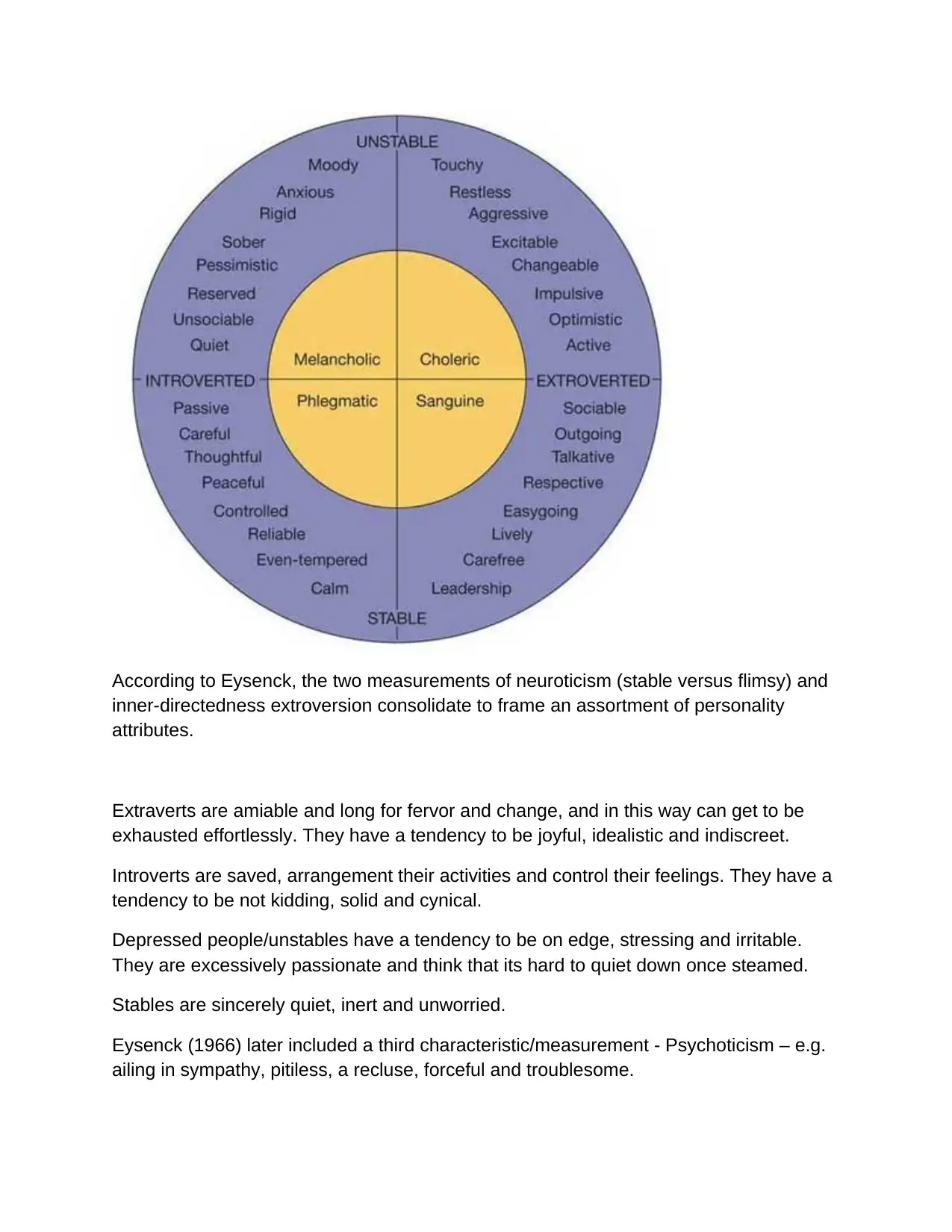
According to Eysenck, the two measurements of neuroticism (stable versus flimsy) and
inner-directedness extroversion consolidate to frame an assortment of personality
attributes.
Extraverts are amiable and long for fervor and change, and in this way can get to be
exhausted effortlessly. They have a tendency to be joyful, idealistic and indiscreet.
Introverts are saved, arrangement their activities and control their feelings. They have a
tendency to be not kidding, solid and cynical.
Depressed people/unstables have a tendency to be on edge, stressing and irritable.
They are excessively passionate and think that its hard to quiet down once steamed.
Stables are sincerely quiet, inert and unworried.
Eysenck (1966) later included a third characteristic/measurement - Psychoticism – e.g.
ailing in sympathy, pitiless, a recluse, forceful and troublesome.
inner-directedness extroversion consolidate to frame an assortment of personality
attributes.
Extraverts are amiable and long for fervor and change, and in this way can get to be
exhausted effortlessly. They have a tendency to be joyful, idealistic and indiscreet.
Introverts are saved, arrangement their activities and control their feelings. They have a
tendency to be not kidding, solid and cynical.
Depressed people/unstables have a tendency to be on edge, stressing and irritable.
They are excessively passionate and think that its hard to quiet down once steamed.
Stables are sincerely quiet, inert and unworried.
Eysenck (1966) later included a third characteristic/measurement - Psychoticism – e.g.
ailing in sympathy, pitiless, a recluse, forceful and troublesome.
⊘ This is a preview!⊘
Do you want full access?
Subscribe today to unlock all pages.
Trusted by 1+ million students worldwide
Eysenck related the personality of a person to the working of the autonomic sensory
system (ANS). Personality is reliant on the harmony amongst excitation and restraint
procedure of the sensory system. Hypochondriac people have an ANS that reacts
rapidly to stretch.
Challenges from inside Scientific, Positivist Psychology
Leading is the ever-present and long-standing verbal confrontation in psychology of
whether the (outside) environment or inward properties, (for example, personality)
assume a more vital part in deciding and forming singular conduct (Haynes and
Uchigakiuchi, 1993). B.F. Skinner, a curve behaviorist, trusts that molding (natural)
procedures to be much more major in such manner than say, physiological ones
(Boeree, 2006). Despite the fact that numerous personality therapists take the center
street and offer interactional models which attempt to give rise to noticeable quality to
both personality and natural procedures, followers of both models are "hesitant to
supporter change in conduct to sources outside their embraced paradigm"â (Haynes
and Uchigakiuchi, 1993, p. 73).
This identifies with the critical issue of personality (and by suggestion, social) change. In
Skinner's reasoning, for example, people learn the majority of their conduct and, on a
basic level, can consequently unlearn pessimistic practices and learn new and elevating
ones. This is not so for characteristic therapists like Eysenck. In the event that
characteristics are basically organically based and hereditarily acquired, and
subsequently wellsprings of consistency crosswise over space and time, in what
capacity can people change? As it were, characteristic theory does not intrinsically give
a medium of personality change (Heffner, 2002, p.6). Thusly, attribute psychology is
dishonor by some for its hostile to human position, in a manner of speaking: it practically
rules out the practice of through and through freedom and decision (Smith, 1978;
Hardin, 1956).
On another level, large portions of Eysenck's partners in the behaviorist camp have an
aversion for ideas which, to them, bear a resemblance to informal, subjective
psychology. Personality itself is something not specifically noticeable, they contend, and
subsequently not subject to experimentation, coordinate control, estimation, and control
(Smith, 1978). Builds which allude to an "interior entity"â (Haynes and Uchigakiuchi,
1993, p. 76), are sketchy for motivations behind increasing bad-to-the-bone actualities
in science since they are interested in "equivocal definitions"â and other "semantic"â
vulnerabilities (in the same place.).
system (ANS). Personality is reliant on the harmony amongst excitation and restraint
procedure of the sensory system. Hypochondriac people have an ANS that reacts
rapidly to stretch.
Challenges from inside Scientific, Positivist Psychology
Leading is the ever-present and long-standing verbal confrontation in psychology of
whether the (outside) environment or inward properties, (for example, personality)
assume a more vital part in deciding and forming singular conduct (Haynes and
Uchigakiuchi, 1993). B.F. Skinner, a curve behaviorist, trusts that molding (natural)
procedures to be much more major in such manner than say, physiological ones
(Boeree, 2006). Despite the fact that numerous personality therapists take the center
street and offer interactional models which attempt to give rise to noticeable quality to
both personality and natural procedures, followers of both models are "hesitant to
supporter change in conduct to sources outside their embraced paradigm"â (Haynes
and Uchigakiuchi, 1993, p. 73).
This identifies with the critical issue of personality (and by suggestion, social) change. In
Skinner's reasoning, for example, people learn the majority of their conduct and, on a
basic level, can consequently unlearn pessimistic practices and learn new and elevating
ones. This is not so for characteristic therapists like Eysenck. In the event that
characteristics are basically organically based and hereditarily acquired, and
subsequently wellsprings of consistency crosswise over space and time, in what
capacity can people change? As it were, characteristic theory does not intrinsically give
a medium of personality change (Heffner, 2002, p.6). Thusly, attribute psychology is
dishonor by some for its hostile to human position, in a manner of speaking: it practically
rules out the practice of through and through freedom and decision (Smith, 1978;
Hardin, 1956).
On another level, large portions of Eysenck's partners in the behaviorist camp have an
aversion for ideas which, to them, bear a resemblance to informal, subjective
psychology. Personality itself is something not specifically noticeable, they contend, and
subsequently not subject to experimentation, coordinate control, estimation, and control
(Smith, 1978). Builds which allude to an "interior entity"â (Haynes and Uchigakiuchi,
1993, p. 76), are sketchy for motivations behind increasing bad-to-the-bone actualities
in science since they are interested in "equivocal definitions"â and other "semantic"â
vulnerabilities (in the same place.).
Paraphrase This Document
Need a fresh take? Get an instant paraphrase of this document with our AI Paraphraser
Challenges from Outside Positivist Psychology
The Positivist or Essentialist meta-hypothetical worldview educating much
contemporary psychology are generally liable of slighting the social setting of human life
(Smith, 1978, Tolman, 2009, Igarashi, 2006). In this vein Eysenck's psychology is
likewise blameworthy as personality/mental procedures are considered as in a general
sense detached from its social setting (Igarashi, 2006). Bigger social procedures which
shape and spur the individual's conduct, for example, sexual orientation, class and
additionally race elements get to be clouded or consigned as immaterial foundation
clamor. Thus, for instance, if and when ladies diversely give off an impression of being
socially bashful, coy or pulled back, it has little to do with purported natural introverted
qualities, however to a great extent to do with widespread sex convictions and social
developments of men and ladies.
Igarashi (2006) among others, remarks on the contrary impacts of a lot of attribute
psychology as it is halfway in charge of creating marks about people which have a
tendency to have destroying individual and social impacts. He brings up that numerous
psychotherapy customers and others, for example, have a tendency to be relegated
analytic marks "", for example, "˜abnormal', "˜inferior', or "˜pathologically introverted' that
regularly bring about agony and death toll openings (Igarashi, 2006,). Along these lines
a lot of contemporary psychology, including characteristic psychology, needs regard for
the subjectivity of its subject: the individual (Tolman, 2009). Lamiell (2007) recommends
that contemporary standard personality therapists, including those under Eysencks'
impact, ought to genuinely and fundamentally look at "the paradigmatic responsibilities
that have formed, and keep on dominating, standard contemplating what a logical
psychology of personality ought to be"â (p.170).
Conclusion
In this paper I began off by highlighting parts of Eysenck's theory, particularly his
emphasis on the significance of the idea of personality for psychology. The discourse
then quickly explained on related topics, for example, the real personality
measurements, the idea of characteristics and the general significance of cerebrum
behavioral procedures and its significance to individual contrasts. In the wake of
highlighting a few parts of research on personality, I then swing to some basic remarks
about Eysenck's theory. I think any reasonable person would agree that despite the fact
The Positivist or Essentialist meta-hypothetical worldview educating much
contemporary psychology are generally liable of slighting the social setting of human life
(Smith, 1978, Tolman, 2009, Igarashi, 2006). In this vein Eysenck's psychology is
likewise blameworthy as personality/mental procedures are considered as in a general
sense detached from its social setting (Igarashi, 2006). Bigger social procedures which
shape and spur the individual's conduct, for example, sexual orientation, class and
additionally race elements get to be clouded or consigned as immaterial foundation
clamor. Thus, for instance, if and when ladies diversely give off an impression of being
socially bashful, coy or pulled back, it has little to do with purported natural introverted
qualities, however to a great extent to do with widespread sex convictions and social
developments of men and ladies.
Igarashi (2006) among others, remarks on the contrary impacts of a lot of attribute
psychology as it is halfway in charge of creating marks about people which have a
tendency to have destroying individual and social impacts. He brings up that numerous
psychotherapy customers and others, for example, have a tendency to be relegated
analytic marks "", for example, "˜abnormal', "˜inferior', or "˜pathologically introverted' that
regularly bring about agony and death toll openings (Igarashi, 2006,). Along these lines
a lot of contemporary psychology, including characteristic psychology, needs regard for
the subjectivity of its subject: the individual (Tolman, 2009). Lamiell (2007) recommends
that contemporary standard personality therapists, including those under Eysencks'
impact, ought to genuinely and fundamentally look at "the paradigmatic responsibilities
that have formed, and keep on dominating, standard contemplating what a logical
psychology of personality ought to be"â (p.170).
Conclusion
In this paper I began off by highlighting parts of Eysenck's theory, particularly his
emphasis on the significance of the idea of personality for psychology. The discourse
then quickly explained on related topics, for example, the real personality
measurements, the idea of characteristics and the general significance of cerebrum
behavioral procedures and its significance to individual contrasts. In the wake of
highlighting a few parts of research on personality, I then swing to some basic remarks
about Eysenck's theory. I think any reasonable person would agree that despite the fact

that his theory, as most different speculations, can be insulted for its deficiencies,
Eysenck unquestionably left a noteworthy check in his commitments on personality
psychology specifically, and on psychology when all is said in done.
Eysenck unquestionably left a noteworthy check in his commitments on personality
psychology specifically, and on psychology when all is said in done.
⊘ This is a preview!⊘
Do you want full access?
Subscribe today to unlock all pages.
Trusted by 1+ million students worldwide
Resources:
Boeree, C.G (2006). Personality Theories. Hans Eysenck and Other Temperament Theorists.
Retrieved September 6, 2009, from http://webspace.ship.edu/cgboer/eysenck.html
Coleridge, G. (1986) Eysenck's Contribution to Personality Psychology. In Sohan Modgil and
Celia Modgil (Eds) Hans Eysenck: Consensus and Controversy, The Falmer Press: USA
Corr, P.J. (2007). Personality and Psychology. Hans Eysenck's Unifying Themes. Hans Eysenck
Memorial Lecture, Psychology, 11, 7, 666-669
Allport, G. W. (1937). Personality: A psychological interpretation. New York: H. Holt and.
Company.
Eysenck, H. J. (1952). The scientific study of personality.
Eysenck, H. J. (1967). The biological basis of personality (Vol. 689). Transaction publishers.
Eysenck, H. J. (1966). Personality and experimental psychology. Bulletin of the British
Psychological Society.
Boeree, C.G (2006). Personality Theories. Hans Eysenck and Other Temperament Theorists.
Retrieved September 6, 2009, from http://webspace.ship.edu/cgboer/eysenck.html
Coleridge, G. (1986) Eysenck's Contribution to Personality Psychology. In Sohan Modgil and
Celia Modgil (Eds) Hans Eysenck: Consensus and Controversy, The Falmer Press: USA
Corr, P.J. (2007). Personality and Psychology. Hans Eysenck's Unifying Themes. Hans Eysenck
Memorial Lecture, Psychology, 11, 7, 666-669
Allport, G. W. (1937). Personality: A psychological interpretation. New York: H. Holt and.
Company.
Eysenck, H. J. (1952). The scientific study of personality.
Eysenck, H. J. (1967). The biological basis of personality (Vol. 689). Transaction publishers.
Eysenck, H. J. (1966). Personality and experimental psychology. Bulletin of the British
Psychological Society.

1 out of 10


Your All-in-One AI-Powered Toolkit for Academic Success.
+13062052269
info@desklib.com
Available 24*7 on WhatsApp / Email
![[object Object]](/_next/static/media/star-bottom.7253800d.svg)
Unlock your academic potential
Copyright © 2020–2025 A2Z Services. All Rights Reserved. Developed and managed by ZUCOL.