Facebook Data Breach: Three Ethical Perspectives - Charles Sturt Uni
VerifiedAdded on 2023/06/10
|6
|2595
|217
Essay
AI Summary
This essay provides a comprehensive analysis of the Facebook data breach, examining the ethical implications through three distinct perspectives of applied ethics: professional ethics, philosophical ethics, and sociological/descriptive ethics. The author discusses how the Cambridge Analytica scandal, involving the unauthorized access of data from millions of Facebook users, violates principles of professional conduct, moral virtues, and social responsibility. The analysis draws upon ethical theories and concepts to argue that Facebook's failure to protect user data was both unprofessional and unethical from multiple standpoints. The essay references various academic sources to support its claims and provides a structured argument for understanding the ethical complexities of the Facebook data breach within the framework of applied ethics. Desklib provides a platform for students to access this and other solved assignments.
SCHOOL OF COMPUTING AND MATHS, Charles Sturt University
Facebook Data Breach
Assignment 1: Three Distinct Perspectives of Applied Ethics
Your Name
Student Number
Word Count: 1500
Facebook Data Breach
Assignment 1: Three Distinct Perspectives of Applied Ethics
Your Name
Student Number
Word Count: 1500

Paraphrase This Document
Need a fresh take? Get an instant paraphrase of this document with our AI Paraphraser
Facebook Data Breach
1. Introduction
Ethics is defined as the most important and vital division of philosophy that significantly involves
systematization, defending and then subsequently recommending the several important concepts of
right as well as wrong conducts (Durkheim, 2013). Three most fundamental areas of ethics are the
applied ethics, normative ethics and Meta ethics. The Meta ethics mainly concerns with the
references as well as theoretical meanings of moral propositions and how all of these truth values
can be easily and promptly determined. The next area is the normative ethics, which significantly
concerns with the practical or non theoretical means for the purpose of determining the several
moralised courses of action. The final area is the applied ethics, which mainly concerns about what a
specific person is permitted or obligated to do within any significant domain of situation or action.
Three most important theories are being followed in the applied ethics (Niebuhr, 2013). These are
the utilitarianism theory, virtue ethics and the deontology theory. These three distinct theories are
collectively known as the specific modern approach within applied ethics. This ethics is solely
defined as the dealing matter for value, consisting of the significant philosophy branch of axiology.
The three perspectives of applied ethics are professional ethics perspective; philosophical ethics
perspective and sociological or descriptive ethics perspective. The following report will be outlining a
detailed discussion on the latest information and communication technology case study of data
breaching in Facebook, in terms of the three distinct perspectives of the applied ethics. During April
2018, it came into notice that the vital data of about 87 millions of users of the social networking
site, Facebook were under threat (Badshah, 2018). The entire scandal of data of the social
networking site of Facebook solely included the complete collection of all the personal identifiable
information of the affected users. Relevant as well as important details will be given in the report.
2. Professional Ethics Perspectives
A popular and significant firm of data mining called Cambridge Analytica was eventually responsible
for the improper access of the data of several users of the most famous social networking site of
Facebook through the third party quiz application and hence has used all these data to build several
important psychological profiles for the purpose of targeting the voters with their political
advertisements (Badshah, 2018). This was done for their own benefit within business. A whistle
blower however leaked the news in public and thus the scandal came into vision for Facebook and
other respective users. The first and the most important perspective of the applied ethics is the
professional ethics perspective. The professional ethics mainly encompasses the typical personal as
well as corporate standard of behaviour, which is subsequently expected by several professionals.
These professionals as well as those people, who are allegedly working within the recognized
professions significantly, exercise the specialized skills and knowledge. This proper and perfect use
of the knowledge is then governed if any of the specific service will be given to the respective public
for the sole purpose to consider a respective moral issue and therefore is termed as the perspective
of professional ethics (Lacan, 2013). This important type of applied ethics perspective consists of all
the capabilities to take the various decisions, to make judgments, to reach to the significant
decisions within several situations and finally to apply the several skills.
The significant and important elements of the perspective of professional ethics are confidentiality,
honesty, integrity, accountability, loyalty, transparency, respect, objectivity and obedience to law.
Your Name
1. Introduction
Ethics is defined as the most important and vital division of philosophy that significantly involves
systematization, defending and then subsequently recommending the several important concepts of
right as well as wrong conducts (Durkheim, 2013). Three most fundamental areas of ethics are the
applied ethics, normative ethics and Meta ethics. The Meta ethics mainly concerns with the
references as well as theoretical meanings of moral propositions and how all of these truth values
can be easily and promptly determined. The next area is the normative ethics, which significantly
concerns with the practical or non theoretical means for the purpose of determining the several
moralised courses of action. The final area is the applied ethics, which mainly concerns about what a
specific person is permitted or obligated to do within any significant domain of situation or action.
Three most important theories are being followed in the applied ethics (Niebuhr, 2013). These are
the utilitarianism theory, virtue ethics and the deontology theory. These three distinct theories are
collectively known as the specific modern approach within applied ethics. This ethics is solely
defined as the dealing matter for value, consisting of the significant philosophy branch of axiology.
The three perspectives of applied ethics are professional ethics perspective; philosophical ethics
perspective and sociological or descriptive ethics perspective. The following report will be outlining a
detailed discussion on the latest information and communication technology case study of data
breaching in Facebook, in terms of the three distinct perspectives of the applied ethics. During April
2018, it came into notice that the vital data of about 87 millions of users of the social networking
site, Facebook were under threat (Badshah, 2018). The entire scandal of data of the social
networking site of Facebook solely included the complete collection of all the personal identifiable
information of the affected users. Relevant as well as important details will be given in the report.
2. Professional Ethics Perspectives
A popular and significant firm of data mining called Cambridge Analytica was eventually responsible
for the improper access of the data of several users of the most famous social networking site of
Facebook through the third party quiz application and hence has used all these data to build several
important psychological profiles for the purpose of targeting the voters with their political
advertisements (Badshah, 2018). This was done for their own benefit within business. A whistle
blower however leaked the news in public and thus the scandal came into vision for Facebook and
other respective users. The first and the most important perspective of the applied ethics is the
professional ethics perspective. The professional ethics mainly encompasses the typical personal as
well as corporate standard of behaviour, which is subsequently expected by several professionals.
These professionals as well as those people, who are allegedly working within the recognized
professions significantly, exercise the specialized skills and knowledge. This proper and perfect use
of the knowledge is then governed if any of the specific service will be given to the respective public
for the sole purpose to consider a respective moral issue and therefore is termed as the perspective
of professional ethics (Lacan, 2013). This important type of applied ethics perspective consists of all
the capabilities to take the various decisions, to make judgments, to reach to the significant
decisions within several situations and finally to apply the several skills.
The significant and important elements of the perspective of professional ethics are confidentiality,
honesty, integrity, accountability, loyalty, transparency, respect, objectivity and obedience to law.
Your Name
Facebook Data Breach
All of these typical elements help all the specific individuals for the identification of the few ethical
approaches. The specific implementation of this perspective of professional ethics is thus highly
needed for all the typical case studies. All of these kinds of ethical elements are solely responsible to
prevent each and every kind of exploitation for the respective client and even in the preservation of
the professional integrity (Crane & Matten, 2016). This particular perspective not only is responsible
for checking the advantages of their client, but even is responsible for helping for the advantages of
all those, who are solely attached to that specific profession.
This particular case study of data breaching in Facebook solely states that the personal data of about
87 millions of users were being hacked by a typical firm of data mining, known as Cambridge
Analytica for the core reason of their own few political advertisements. The social networking site of
Facebook was majorly responsible to save all the data or information of their users, as this is the
most utilized and famous social networking site within the world (Fromm, 2013). But, this particular
phenomenon did not take place and hence Facebook was not successful to save their data of the
users. Hence, according to the perspective of professional ethics of the applied ethics, this specific
case study related to ICT is completely unprofessional as well as unethical.
3. Philosophical Ethics Perspectives
The next important perspective of the applied ethics is called the philosophical ethics. This
particular perspective of philosophical ethics mainly concerns with the right or wrong, good
or evil for the conduct of the human beings (Frank, 2013). This type of philosophical ethics is
known as those projects, which attempt in utilizing the perfect reasoning to answer all the typical
types of ethical questions. These moral principles and ethics of all the typical groups, individuals as
well as traditions are being checked by the help of the perspective of philosophical ethics. This kind
of ethics subsequently is different from the personal, legal, religious and cultural approaches to the
ethics through easily seeking in conducting the complete study of ethics as well as morality through
the rational and secular outlooks. The main advantage of this philosophical approach to ethics can
be defined as that this particular approach subsequently avoids the perfect authoritarian basis of law
and religion and also the arbitrariness, subjectivity and irrationality to characterize the personal as
well as the cultural moral views. There are two specific traditions within the modern approach of
philosophical ethics about how the ethical character of action can be easily determined (Noddings,
2013). When any one is arguing that the actions comprises of no intrinsic ethical characters but also
acquires the respective moral status from each and every consequence, which flow from these. The
next respective tradition solely claims that the actions are intrinsically correct or incorrect, such as
stealing, lying, cheating and many others.
The entire case study of data breaching in Facebook subsequently talks regarding the
breaching of data of all the 87 millions of users in the entire world. The respective moral
virtues as well as the human activities in this case study were being completely shaken, when the
data mining firm of Cambridge Analytica accessed the information or data of the users of Facebook
(Nussbaum, 2013). Therefore, according to the philosophical ethics, the complete case study of the
data breaching of Facebook is completely unethical and absolutely non philosophical in nature.
4. Sociological/Descriptive Ethics Perspectives
Your Name
All of these typical elements help all the specific individuals for the identification of the few ethical
approaches. The specific implementation of this perspective of professional ethics is thus highly
needed for all the typical case studies. All of these kinds of ethical elements are solely responsible to
prevent each and every kind of exploitation for the respective client and even in the preservation of
the professional integrity (Crane & Matten, 2016). This particular perspective not only is responsible
for checking the advantages of their client, but even is responsible for helping for the advantages of
all those, who are solely attached to that specific profession.
This particular case study of data breaching in Facebook solely states that the personal data of about
87 millions of users were being hacked by a typical firm of data mining, known as Cambridge
Analytica for the core reason of their own few political advertisements. The social networking site of
Facebook was majorly responsible to save all the data or information of their users, as this is the
most utilized and famous social networking site within the world (Fromm, 2013). But, this particular
phenomenon did not take place and hence Facebook was not successful to save their data of the
users. Hence, according to the perspective of professional ethics of the applied ethics, this specific
case study related to ICT is completely unprofessional as well as unethical.
3. Philosophical Ethics Perspectives
The next important perspective of the applied ethics is called the philosophical ethics. This
particular perspective of philosophical ethics mainly concerns with the right or wrong, good
or evil for the conduct of the human beings (Frank, 2013). This type of philosophical ethics is
known as those projects, which attempt in utilizing the perfect reasoning to answer all the typical
types of ethical questions. These moral principles and ethics of all the typical groups, individuals as
well as traditions are being checked by the help of the perspective of philosophical ethics. This kind
of ethics subsequently is different from the personal, legal, religious and cultural approaches to the
ethics through easily seeking in conducting the complete study of ethics as well as morality through
the rational and secular outlooks. The main advantage of this philosophical approach to ethics can
be defined as that this particular approach subsequently avoids the perfect authoritarian basis of law
and religion and also the arbitrariness, subjectivity and irrationality to characterize the personal as
well as the cultural moral views. There are two specific traditions within the modern approach of
philosophical ethics about how the ethical character of action can be easily determined (Noddings,
2013). When any one is arguing that the actions comprises of no intrinsic ethical characters but also
acquires the respective moral status from each and every consequence, which flow from these. The
next respective tradition solely claims that the actions are intrinsically correct or incorrect, such as
stealing, lying, cheating and many others.
The entire case study of data breaching in Facebook subsequently talks regarding the
breaching of data of all the 87 millions of users in the entire world. The respective moral
virtues as well as the human activities in this case study were being completely shaken, when the
data mining firm of Cambridge Analytica accessed the information or data of the users of Facebook
(Nussbaum, 2013). Therefore, according to the philosophical ethics, the complete case study of the
data breaching of Facebook is completely unethical and absolutely non philosophical in nature.
4. Sociological/Descriptive Ethics Perspectives
Your Name
⊘ This is a preview!⊘
Do you want full access?
Subscribe today to unlock all pages.

Trusted by 1+ million students worldwide
Facebook Data Breach
The final or the third perspective of the applied ethics is called the sociological or descriptive ethics
perspective. This descriptive ethics is defined as the complete study of several peoples’ beliefs and
disbeliefs about morality (Peters, 2015). The social responsibility is termed as the division of the
ethical theory, in which where all the individuals are subsequently accountable for fulfilling each and
every civic duty. The several activities of the typical individual must be advantageous to his or her
society and thus there exists a perfect balancing in the economic growths and welfare of society.
Whenever this particular equilibrium is being maintained, the respective social responsibility could
be promptly and easily be accomplished (Sorokin, 2017). This theory of the perspective of the
sociological ethics is absolutely built over the ethical system, in which each and every decision and
action must be validated ethically even before taking place whenever the action or decision is
causing damage to their society. This is considered to be socially irresponsible.
The several moral values that are intrinsic in the society to create the proper distinction within right
and wrong are being checked with the social fairness (Tavani, 2015). Each and every individual
consist of the major responsibility to act within such a manner, which is beneficial to not only to
society and but also to that specific individual. This kind of sociological ethics is further being
incorporated to the regular actions and decisions to have the major effect over the person as well as
the environment. The daily communications with the remaining members of this society are needed
for the proper and successful application of the sociological ethics. The important maintenance of
this social responsibility in any particular company helps in ensuring the integrity as well as
confidentiality of the society and the environment is done securely and safely (Crane & Matten,
2016). The respective implications of ethics of any specific decision or action are being notified to
obtain the advantages.
This case study of data breaching in Facebook majorly defines regarding the perspective of
sociological ethics. Facebook was eventually guilty for not completing its duty perfectly and then
saving their users’ data (Fromm, 2013). Thus, this was a major failure to fulfil the few social duties
and hence a failure within sociological ethics. Thus, according to the sociological ethics, this specific
case study is unethical in nature.
5. References
Badshah, N. (2018). Facebook to contact 87 million users affected by data breach. Retrieved from
https://www.theguardian.com/technology/2018/apr/08/facebook-to-contact-the-87-million-users-
affected-by-data-breach
Crane, A., & Matten, D. (2016). Business ethics: Managing corporate citizenship and sustainability in
the age of globalization. Oxford University Press.
Durkheim, E. (2013). Professional ethics and civic morals. Routledge.
Frank, A. W. (2013). The wounded storyteller: Body, illness, and ethics. University of Chicago Press.
Fromm, E. (2013). Man for himself: An inquiry into the psychology of ethics. Routledge.
Lacan, J. (2013). The ethics of psychoanalysis 1959-1960: The seminar of Jacques Lacan. Routledge.
Niebuhr, R. (2013). Moral man and immoral society: A study in ethics and politics. Westminster John
Knox Press.
Your Name
The final or the third perspective of the applied ethics is called the sociological or descriptive ethics
perspective. This descriptive ethics is defined as the complete study of several peoples’ beliefs and
disbeliefs about morality (Peters, 2015). The social responsibility is termed as the division of the
ethical theory, in which where all the individuals are subsequently accountable for fulfilling each and
every civic duty. The several activities of the typical individual must be advantageous to his or her
society and thus there exists a perfect balancing in the economic growths and welfare of society.
Whenever this particular equilibrium is being maintained, the respective social responsibility could
be promptly and easily be accomplished (Sorokin, 2017). This theory of the perspective of the
sociological ethics is absolutely built over the ethical system, in which each and every decision and
action must be validated ethically even before taking place whenever the action or decision is
causing damage to their society. This is considered to be socially irresponsible.
The several moral values that are intrinsic in the society to create the proper distinction within right
and wrong are being checked with the social fairness (Tavani, 2015). Each and every individual
consist of the major responsibility to act within such a manner, which is beneficial to not only to
society and but also to that specific individual. This kind of sociological ethics is further being
incorporated to the regular actions and decisions to have the major effect over the person as well as
the environment. The daily communications with the remaining members of this society are needed
for the proper and successful application of the sociological ethics. The important maintenance of
this social responsibility in any particular company helps in ensuring the integrity as well as
confidentiality of the society and the environment is done securely and safely (Crane & Matten,
2016). The respective implications of ethics of any specific decision or action are being notified to
obtain the advantages.
This case study of data breaching in Facebook majorly defines regarding the perspective of
sociological ethics. Facebook was eventually guilty for not completing its duty perfectly and then
saving their users’ data (Fromm, 2013). Thus, this was a major failure to fulfil the few social duties
and hence a failure within sociological ethics. Thus, according to the sociological ethics, this specific
case study is unethical in nature.
5. References
Badshah, N. (2018). Facebook to contact 87 million users affected by data breach. Retrieved from
https://www.theguardian.com/technology/2018/apr/08/facebook-to-contact-the-87-million-users-
affected-by-data-breach
Crane, A., & Matten, D. (2016). Business ethics: Managing corporate citizenship and sustainability in
the age of globalization. Oxford University Press.
Durkheim, E. (2013). Professional ethics and civic morals. Routledge.
Frank, A. W. (2013). The wounded storyteller: Body, illness, and ethics. University of Chicago Press.
Fromm, E. (2013). Man for himself: An inquiry into the psychology of ethics. Routledge.
Lacan, J. (2013). The ethics of psychoanalysis 1959-1960: The seminar of Jacques Lacan. Routledge.
Niebuhr, R. (2013). Moral man and immoral society: A study in ethics and politics. Westminster John
Knox Press.
Your Name
Paraphrase This Document
Need a fresh take? Get an instant paraphrase of this document with our AI Paraphraser
Facebook Data Breach
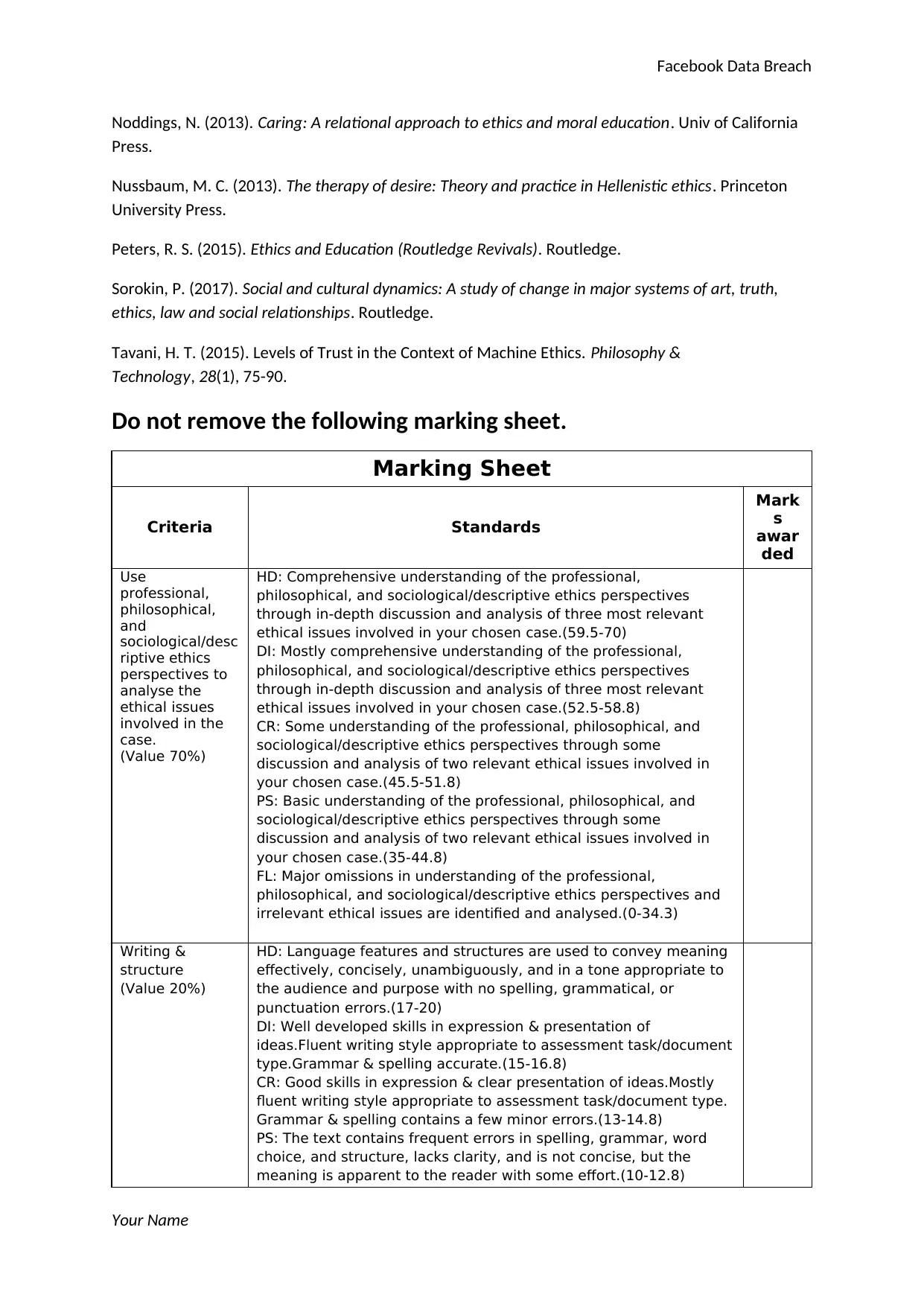
Noddings, N. (2013). Caring: A relational approach to ethics and moral education. Univ of California
Press.
Nussbaum, M. C. (2013). The therapy of desire: Theory and practice in Hellenistic ethics. Princeton
University Press.
Peters, R. S. (2015). Ethics and Education (Routledge Revivals). Routledge.
Sorokin, P. (2017). Social and cultural dynamics: A study of change in major systems of art, truth,
ethics, law and social relationships. Routledge.
Tavani, H. T. (2015). Levels of Trust in the Context of Machine Ethics. Philosophy &
Technology, 28(1), 75-90.
Do not remove the following marking sheet.
Marking Sheet
Criteria Standards
Mark
s
awar
ded
Use
professional,
philosophical,
and
sociological/desc
riptive ethics
perspectives to
analyse the
ethical issues
involved in the
case.
(Value 70%)
HD: Comprehensive understanding of the professional,
philosophical, and sociological/descriptive ethics perspectives
through in-depth discussion and analysis of three most relevant
ethical issues involved in your chosen case.(59.5-70)
DI: Mostly comprehensive understanding of the professional,
philosophical, and sociological/descriptive ethics perspectives
through in-depth discussion and analysis of three most relevant
ethical issues involved in your chosen case.(52.5-58.8)
CR: Some understanding of the professional, philosophical, and
sociological/descriptive ethics perspectives through some
discussion and analysis of two relevant ethical issues involved in
your chosen case.(45.5-51.8)
PS: Basic understanding of the professional, philosophical, and
sociological/descriptive ethics perspectives through some
discussion and analysis of two relevant ethical issues involved in
your chosen case.(35-44.8)
FL: Major omissions in understanding of the professional,
philosophical, and sociological/descriptive ethics perspectives and
irrelevant ethical issues are identified and analysed.(0-34.3)
Writing &
structure
(Value 20%)
HD: Language features and structures are used to convey meaning
effectively, concisely, unambiguously, and in a tone appropriate to
the audience and purpose with no spelling, grammatical, or
punctuation errors.(17-20)
DI: Well developed skills in expression & presentation of
ideas.Fluent writing style appropriate to assessment task/document
type.Grammar & spelling accurate.(15-16.8)
CR: Good skills in expression & clear presentation of ideas.Mostly
fluent writing style appropriate to assessment task/document type.
Grammar & spelling contains a few minor errors.(13-14.8)
PS: The text contains frequent errors in spelling, grammar, word
choice, and structure, lacks clarity, and is not concise, but the
meaning is apparent to the reader with some effort.(10-12.8)
Your Name
Noddings, N. (2013). Caring: A relational approach to ethics and moral education. Univ of California
Press.
Nussbaum, M. C. (2013). The therapy of desire: Theory and practice in Hellenistic ethics. Princeton
University Press.
Peters, R. S. (2015). Ethics and Education (Routledge Revivals). Routledge.
Sorokin, P. (2017). Social and cultural dynamics: A study of change in major systems of art, truth,
ethics, law and social relationships. Routledge.
Tavani, H. T. (2015). Levels of Trust in the Context of Machine Ethics. Philosophy &
Technology, 28(1), 75-90.
Do not remove the following marking sheet.
Marking Sheet
Criteria Standards
Mark
s
awar
ded
Use
professional,
philosophical,
and
sociological/desc
riptive ethics
perspectives to
analyse the
ethical issues
involved in the
case.
(Value 70%)
HD: Comprehensive understanding of the professional,
philosophical, and sociological/descriptive ethics perspectives
through in-depth discussion and analysis of three most relevant
ethical issues involved in your chosen case.(59.5-70)
DI: Mostly comprehensive understanding of the professional,
philosophical, and sociological/descriptive ethics perspectives
through in-depth discussion and analysis of three most relevant
ethical issues involved in your chosen case.(52.5-58.8)
CR: Some understanding of the professional, philosophical, and
sociological/descriptive ethics perspectives through some
discussion and analysis of two relevant ethical issues involved in
your chosen case.(45.5-51.8)
PS: Basic understanding of the professional, philosophical, and
sociological/descriptive ethics perspectives through some
discussion and analysis of two relevant ethical issues involved in
your chosen case.(35-44.8)
FL: Major omissions in understanding of the professional,
philosophical, and sociological/descriptive ethics perspectives and
irrelevant ethical issues are identified and analysed.(0-34.3)
Writing &
structure
(Value 20%)
HD: Language features and structures are used to convey meaning
effectively, concisely, unambiguously, and in a tone appropriate to
the audience and purpose with no spelling, grammatical, or
punctuation errors.(17-20)
DI: Well developed skills in expression & presentation of
ideas.Fluent writing style appropriate to assessment task/document
type.Grammar & spelling accurate.(15-16.8)
CR: Good skills in expression & clear presentation of ideas.Mostly
fluent writing style appropriate to assessment task/document type.
Grammar & spelling contains a few minor errors.(13-14.8)
PS: The text contains frequent errors in spelling, grammar, word
choice, and structure, lacks clarity, and is not concise, but the
meaning is apparent to the reader with some effort.(10-12.8)
Your Name
Facebook Data Breach
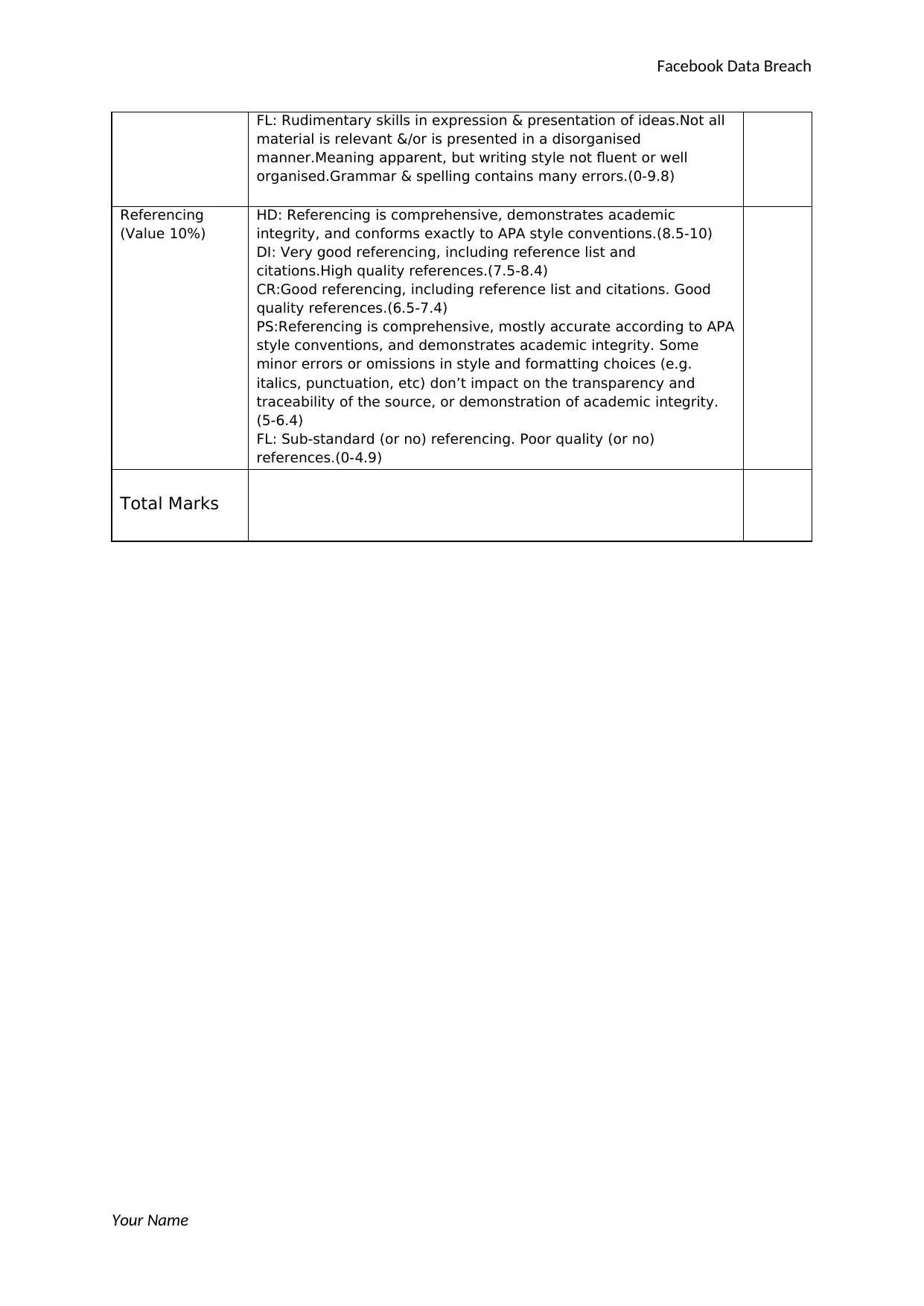
FL: Rudimentary skills in expression & presentation of ideas.Not all
material is relevant &/or is presented in a disorganised
manner.Meaning apparent, but writing style not fluent or well
organised.Grammar & spelling contains many errors.(0-9.8)
Referencing
(Value 10%)
HD: Referencing is comprehensive, demonstrates academic
integrity, and conforms exactly to APA style conventions.(8.5-10)
DI: Very good referencing, including reference list and
citations.High quality references.(7.5-8.4)
CR:Good referencing, including reference list and citations. Good
quality references.(6.5-7.4)
PS:Referencing is comprehensive, mostly accurate according to APA
style conventions, and demonstrates academic integrity. Some
minor errors or omissions in style and formatting choices (e.g.
italics, punctuation, etc) don’t impact on the transparency and
traceability of the source, or demonstration of academic integrity.
(5-6.4)
FL: Sub-standard (or no) referencing. Poor quality (or no)
references.(0-4.9)
Total Marks
Your Name
FL: Rudimentary skills in expression & presentation of ideas.Not all
material is relevant &/or is presented in a disorganised
manner.Meaning apparent, but writing style not fluent or well
organised.Grammar & spelling contains many errors.(0-9.8)
Referencing
(Value 10%)
HD: Referencing is comprehensive, demonstrates academic
integrity, and conforms exactly to APA style conventions.(8.5-10)
DI: Very good referencing, including reference list and
citations.High quality references.(7.5-8.4)
CR:Good referencing, including reference list and citations. Good
quality references.(6.5-7.4)
PS:Referencing is comprehensive, mostly accurate according to APA
style conventions, and demonstrates academic integrity. Some
minor errors or omissions in style and formatting choices (e.g.
italics, punctuation, etc) don’t impact on the transparency and
traceability of the source, or demonstration of academic integrity.
(5-6.4)
FL: Sub-standard (or no) referencing. Poor quality (or no)
references.(0-4.9)
Total Marks
Your Name
⊘ This is a preview!⊘
Do you want full access?
Subscribe today to unlock all pages.
Trusted by 1+ million students worldwide

1 out of 6


Related Documents


Your All-in-One AI-Powered Toolkit for Academic Success.
+13062052269
info@desklib.com
Available 24*7 on WhatsApp / Email
![[object Object]](/_next/static/media/star-bottom.7253800d.svg)
Unlock your academic potential
Copyright © 2020–2026 A2Z Services. All Rights Reserved. Developed and managed by ZUCOL.