Business and Financial Analysis: Facebook Case Study Report, 2017
VerifiedAdded on 2020/02/24
|7
|1414
|276
Case Study
AI Summary
This case study report provides a comprehensive analysis of Facebook's financial performance and strategic positioning. The report begins with an examination of key financial data points for Facebook, sourced from Mint Global databases, including outstanding shares, stock exchanges, major shareholders, financial forecasts, and employee numbers. The study then delves into the identification of four key success factors behind Facebook's competitive strategy, analyzing factors such as people-to-people interaction, the pace of innovation, user engagement, and application availability. Furthermore, the report offers an in-depth discussion of Facebook's IPO, outlining three key advantages, such as capital generation, business opportunities, and a liquid market for selling ownership shares, and three disadvantages, including lack of control, pressure to meet investor expectations, and increased costs. Finally, the report discusses the role of underwriters in IPOs, highlighting their function in regulatory compliance, connecting with potential buyers, and determining initial public offering prices. The report concludes with a list of cited references, providing a robust foundation for the analysis.
Assessment 1 Semester 2, 2017
Assessment 1:Individual assignment - Written case study report
Case study: Facebook case study (Case study – Facebook.pdf)
Due date:see VU Collaborate
Submission: viaVU Collaborate ->Assessment ->Assignment 1 dropbox
Type:Individual assignment
Assessment 1:Individual assignment - Written case study report
Case study: Facebook case study (Case study – Facebook.pdf)
Due date:see VU Collaborate
Submission: viaVU Collaborate ->Assessment ->Assignment 1 dropbox
Type:Individual assignment
Paraphrase This Document
Need a fresh take? Get an instant paraphrase of this document with our AI Paraphraser

Assessment 1 Semester 2, 2017
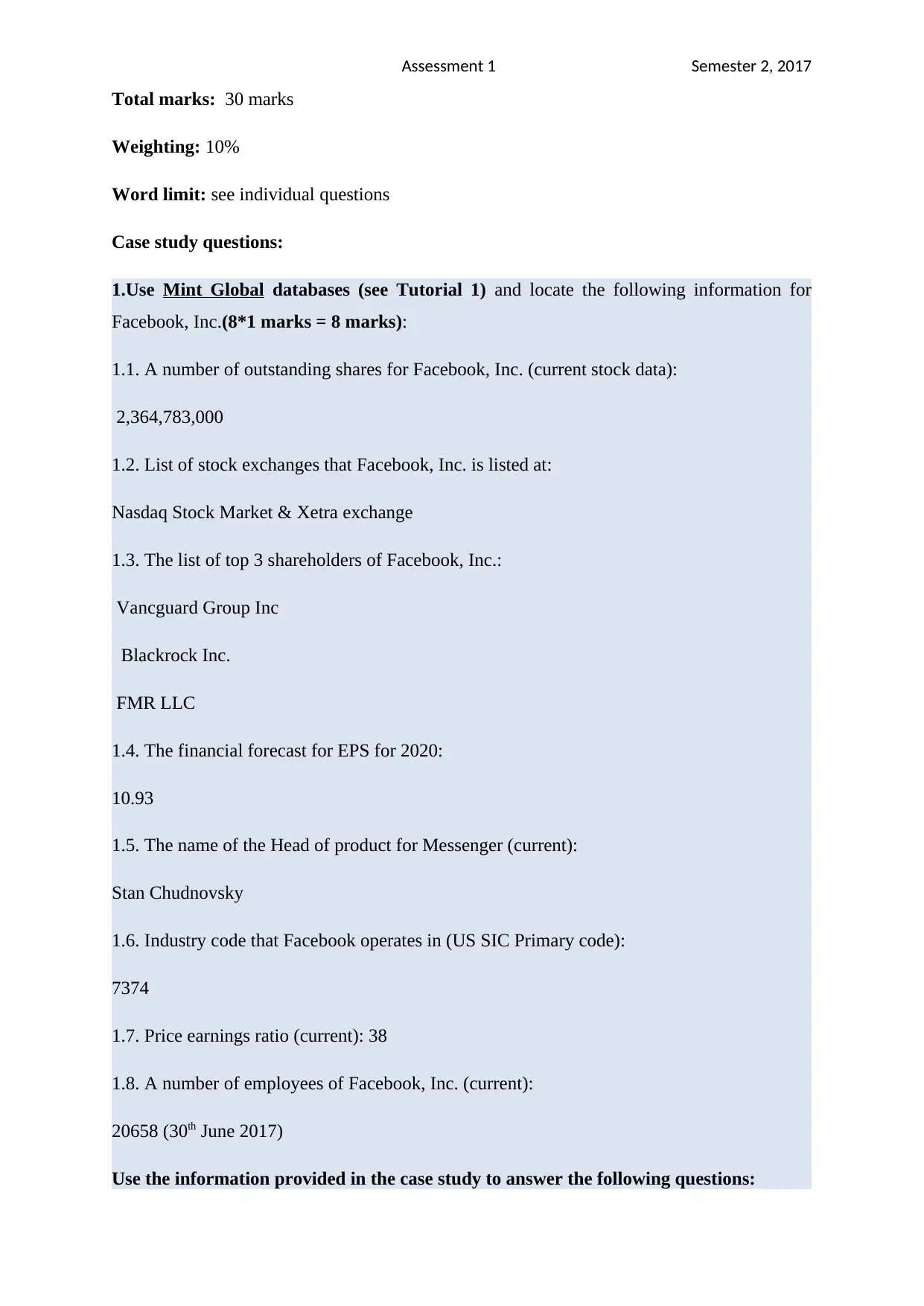
Total marks: 30 marks
Weighting: 10%
Word limit: see individual questions
Case study questions:
1.Use Mint Global databases (see Tutorial 1) and locate the following information for
Facebook, Inc.(8*1 marks = 8 marks):
1.1. A number of outstanding shares for Facebook, Inc. (current stock data):
2,364,783,000
1.2. List of stock exchanges that Facebook, Inc. is listed at:
Nasdaq Stock Market & Xetra exchange
1.3. The list of top 3 shareholders of Facebook, Inc.:
Vancguard Group Inc
Blackrock Inc.
FMR LLC
1.4. The financial forecast for EPS for 2020:
10.93
1.5. The name of the Head of product for Messenger (current):
Stan Chudnovsky
1.6. Industry code that Facebook operates in (US SIC Primary code):
7374
1.7. Price earnings ratio (current): 38
1.8. A number of employees of Facebook, Inc. (current):
20658 (30th June 2017)
Use the information provided in the case study to answer the following questions:
Total marks: 30 marks
Weighting: 10%
Word limit: see individual questions
Case study questions:
1.Use Mint Global databases (see Tutorial 1) and locate the following information for
Facebook, Inc.(8*1 marks = 8 marks):
1.1. A number of outstanding shares for Facebook, Inc. (current stock data):
2,364,783,000
1.2. List of stock exchanges that Facebook, Inc. is listed at:
Nasdaq Stock Market & Xetra exchange
1.3. The list of top 3 shareholders of Facebook, Inc.:
Vancguard Group Inc
Blackrock Inc.
FMR LLC
1.4. The financial forecast for EPS for 2020:
10.93
1.5. The name of the Head of product for Messenger (current):
Stan Chudnovsky
1.6. Industry code that Facebook operates in (US SIC Primary code):
7374
1.7. Price earnings ratio (current): 38
1.8. A number of employees of Facebook, Inc. (current):
20658 (30th June 2017)
Use the information provided in the case study to answer the following questions:

Assessment 1 Semester 2, 2017
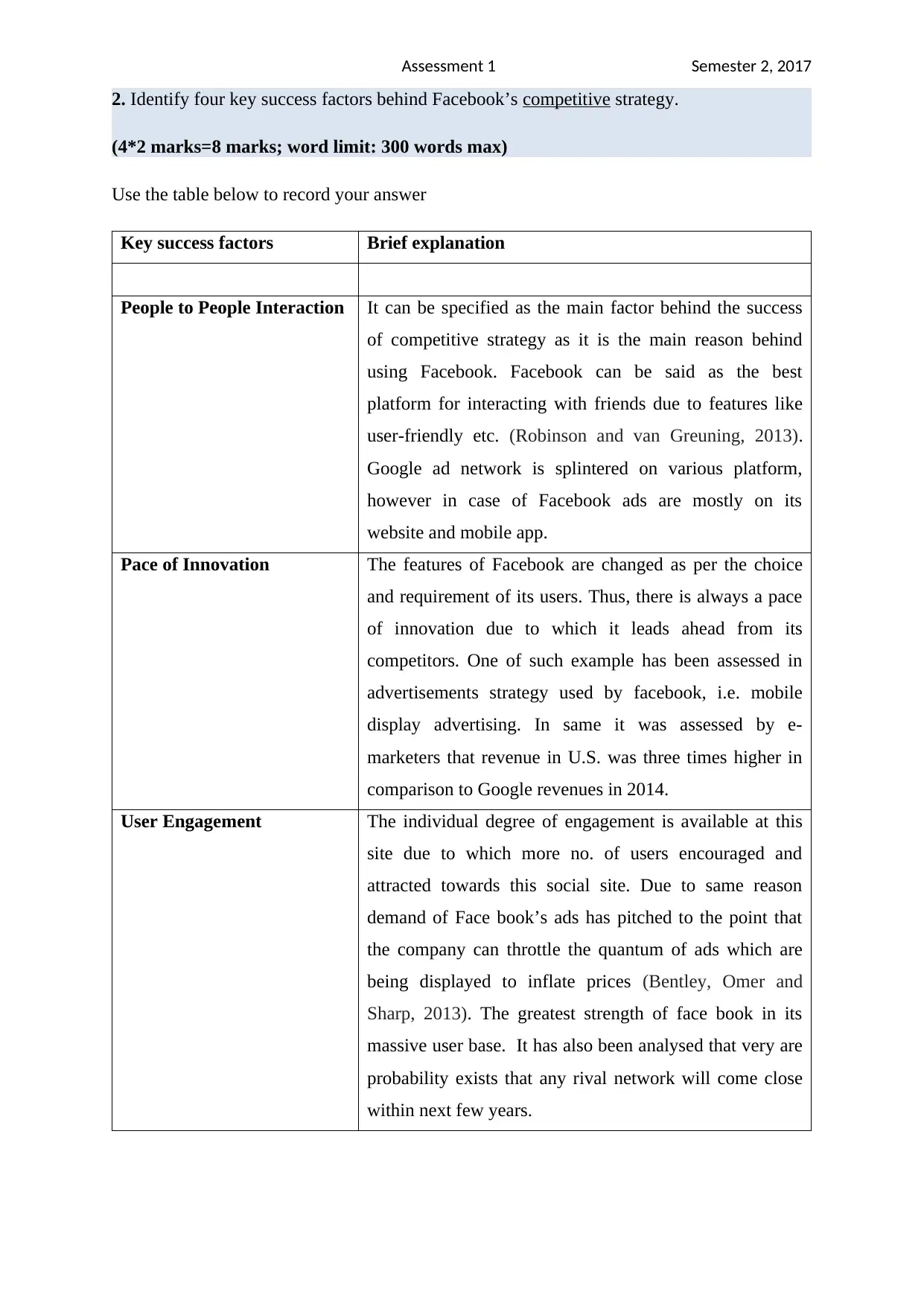
2. Identify four key success factors behind Facebook’s competitive strategy.
(4*2 marks=8 marks; word limit: 300 words max)
Use the table below to record your answer
Key success factors Brief explanation
People to People Interaction It can be specified as the main factor behind the success
of competitive strategy as it is the main reason behind
using Facebook. Facebook can be said as the best
platform for interacting with friends due to features like
user-friendly etc. (Robinson and van Greuning, 2013).
Google ad network is splintered on various platform,
however in case of Facebook ads are mostly on its
website and mobile app.
Pace of Innovation The features of Facebook are changed as per the choice
and requirement of its users. Thus, there is always a pace
of innovation due to which it leads ahead from its
competitors. One of such example has been assessed in
advertisements strategy used by facebook, i.e. mobile
display advertising. In same it was assessed by e-
marketers that revenue in U.S. was three times higher in
comparison to Google revenues in 2014.
User Engagement The individual degree of engagement is available at this
site due to which more no. of users encouraged and
attracted towards this social site. Due to same reason
demand of Face book’s ads has pitched to the point that
the company can throttle the quantum of ads which are
being displayed to inflate prices (Bentley, Omer and
Sharp, 2013). The greatest strength of face book in its
massive user base. It has also been analysed that very are
probability exists that any rival network will come close
within next few years.
2. Identify four key success factors behind Facebook’s competitive strategy.
(4*2 marks=8 marks; word limit: 300 words max)
Use the table below to record your answer
Key success factors Brief explanation
People to People Interaction It can be specified as the main factor behind the success
of competitive strategy as it is the main reason behind
using Facebook. Facebook can be said as the best
platform for interacting with friends due to features like
user-friendly etc. (Robinson and van Greuning, 2013).
Google ad network is splintered on various platform,
however in case of Facebook ads are mostly on its
website and mobile app.
Pace of Innovation The features of Facebook are changed as per the choice
and requirement of its users. Thus, there is always a pace
of innovation due to which it leads ahead from its
competitors. One of such example has been assessed in
advertisements strategy used by facebook, i.e. mobile
display advertising. In same it was assessed by e-
marketers that revenue in U.S. was three times higher in
comparison to Google revenues in 2014.
User Engagement The individual degree of engagement is available at this
site due to which more no. of users encouraged and
attracted towards this social site. Due to same reason
demand of Face book’s ads has pitched to the point that
the company can throttle the quantum of ads which are
being displayed to inflate prices (Bentley, Omer and
Sharp, 2013). The greatest strength of face book in its
massive user base. It has also been analysed that very are
probability exists that any rival network will come close
within next few years.
⊘ This is a preview!⊘
Do you want full access?
Subscribe today to unlock all pages.

Trusted by 1+ million students worldwide

Assessment 1 Semester 2, 2017
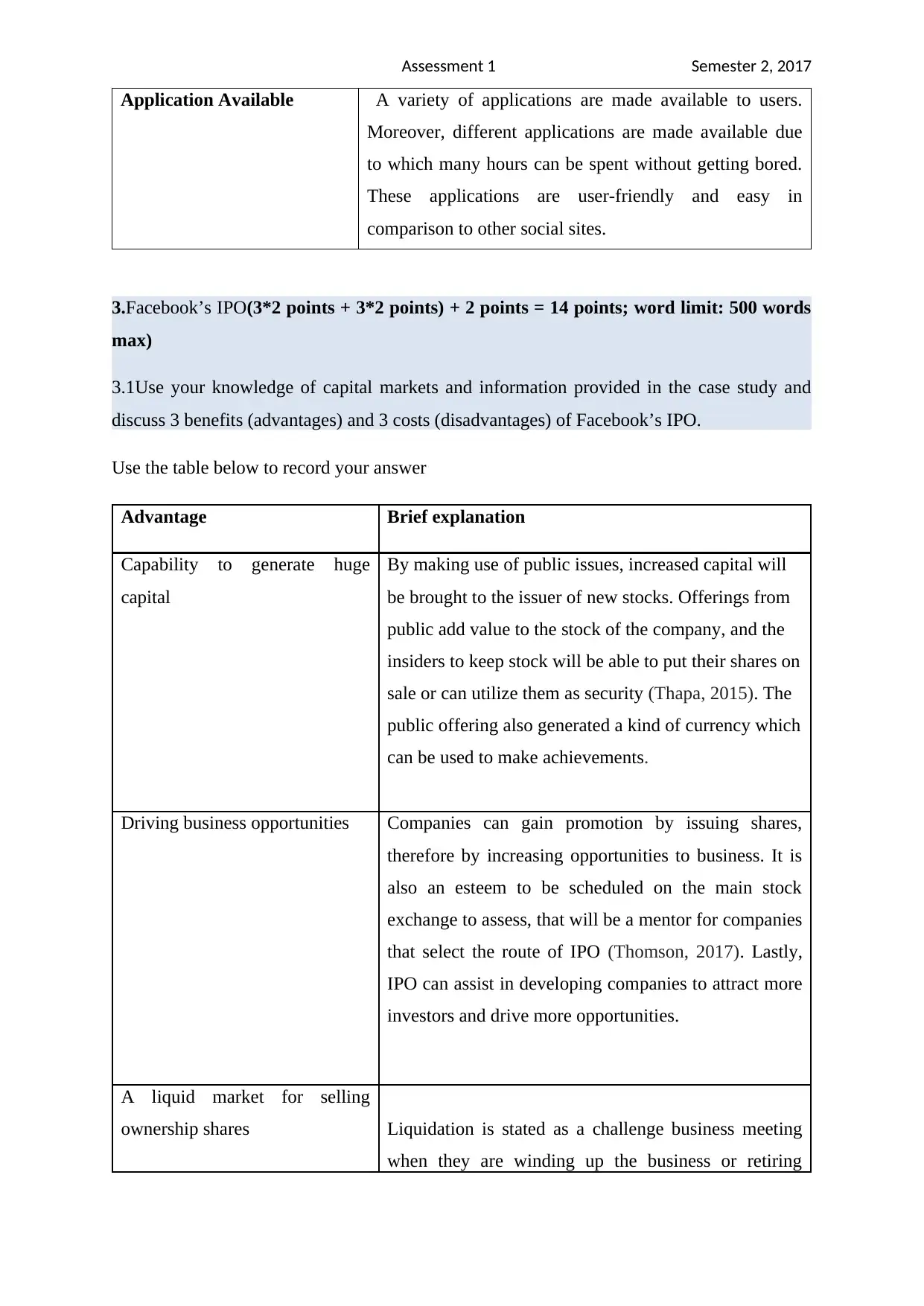
Application Available A variety of applications are made available to users.
Moreover, different applications are made available due
to which many hours can be spent without getting bored.
These applications are user-friendly and easy in
comparison to other social sites.
3.Facebook’s IPO(3*2 points + 3*2 points) + 2 points = 14 points; word limit: 500 words
max)
3.1Use your knowledge of capital markets and information provided in the case study and
discuss 3 benefits (advantages) and 3 costs (disadvantages) of Facebook’s IPO.
Use the table below to record your answer
Advantage Brief explanation
Capability to generate huge
capital
By making use of public issues, increased capital will
be brought to the issuer of new stocks. Offerings from
public add value to the stock of the company, and the
insiders to keep stock will be able to put their shares on
sale or can utilize them as security (Thapa, 2015). The
public offering also generated a kind of currency which
can be used to make achievements.
Driving business opportunities Companies can gain promotion by issuing shares,
therefore by increasing opportunities to business. It is
also an esteem to be scheduled on the main stock
exchange to assess, that will be a mentor for companies
that select the route of IPO (Thomson, 2017). Lastly,
IPO can assist in developing companies to attract more
investors and drive more opportunities.
A liquid market for selling
ownership shares Liquidation is stated as a challenge business meeting
when they are winding up the business or retiring
Application Available A variety of applications are made available to users.
Moreover, different applications are made available due
to which many hours can be spent without getting bored.
These applications are user-friendly and easy in
comparison to other social sites.
3.Facebook’s IPO(3*2 points + 3*2 points) + 2 points = 14 points; word limit: 500 words
max)
3.1Use your knowledge of capital markets and information provided in the case study and
discuss 3 benefits (advantages) and 3 costs (disadvantages) of Facebook’s IPO.
Use the table below to record your answer
Advantage Brief explanation
Capability to generate huge
capital
By making use of public issues, increased capital will
be brought to the issuer of new stocks. Offerings from
public add value to the stock of the company, and the
insiders to keep stock will be able to put their shares on
sale or can utilize them as security (Thapa, 2015). The
public offering also generated a kind of currency which
can be used to make achievements.
Driving business opportunities Companies can gain promotion by issuing shares,
therefore by increasing opportunities to business. It is
also an esteem to be scheduled on the main stock
exchange to assess, that will be a mentor for companies
that select the route of IPO (Thomson, 2017). Lastly,
IPO can assist in developing companies to attract more
investors and drive more opportunities.
A liquid market for selling
ownership shares Liquidation is stated as a challenge business meeting
when they are winding up the business or retiring
Paraphrase This Document
Need a fresh take? Get an instant paraphrase of this document with our AI Paraphraser

Assessment 1 Semester 2, 2017
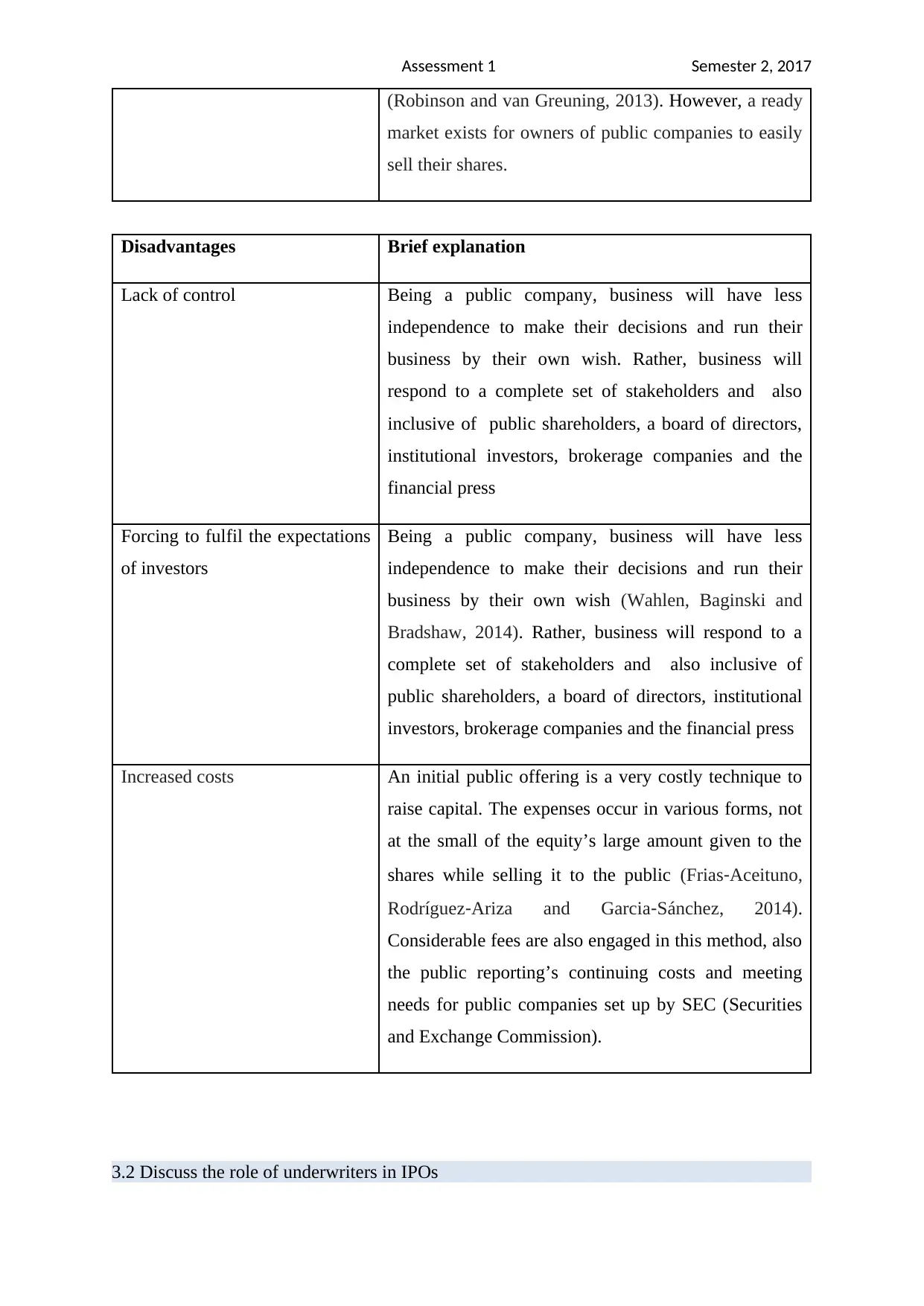
(Robinson and van Greuning, 2013). However, a ready
market exists for owners of public companies to easily
sell their shares.
Disadvantages Brief explanation
Lack of control Being a public company, business will have less
independence to make their decisions and run their
business by their own wish. Rather, business will
respond to a complete set of stakeholders and also
inclusive of public shareholders, a board of directors,
institutional investors, brokerage companies and the
financial press
Forcing to fulfil the expectations
of investors
Being a public company, business will have less
independence to make their decisions and run their
business by their own wish (Wahlen, Baginski and
Bradshaw, 2014). Rather, business will respond to a
complete set of stakeholders and also inclusive of
public shareholders, a board of directors, institutional
investors, brokerage companies and the financial press
Increased costs An initial public offering is a very costly technique to
raise capital. The expenses occur in various forms, not
at the small of the equity’s large amount given to the
shares while selling it to the public (Frias‐Aceituno,
Rodríguez‐Ariza and Garcia‐Sánchez, 2014).
Considerable fees are also engaged in this method, also
the public reporting’s continuing costs and meeting
needs for public companies set up by SEC (Securities
and Exchange Commission).
3.2 Discuss the role of underwriters in IPOs
(Robinson and van Greuning, 2013). However, a ready
market exists for owners of public companies to easily
sell their shares.
Disadvantages Brief explanation
Lack of control Being a public company, business will have less
independence to make their decisions and run their
business by their own wish. Rather, business will
respond to a complete set of stakeholders and also
inclusive of public shareholders, a board of directors,
institutional investors, brokerage companies and the
financial press
Forcing to fulfil the expectations
of investors
Being a public company, business will have less
independence to make their decisions and run their
business by their own wish (Wahlen, Baginski and
Bradshaw, 2014). Rather, business will respond to a
complete set of stakeholders and also inclusive of
public shareholders, a board of directors, institutional
investors, brokerage companies and the financial press
Increased costs An initial public offering is a very costly technique to
raise capital. The expenses occur in various forms, not
at the small of the equity’s large amount given to the
shares while selling it to the public (Frias‐Aceituno,
Rodríguez‐Ariza and Garcia‐Sánchez, 2014).
Considerable fees are also engaged in this method, also
the public reporting’s continuing costs and meeting
needs for public companies set up by SEC (Securities
and Exchange Commission).
3.2 Discuss the role of underwriters in IPOs

Assessment 1 Semester 2, 2017
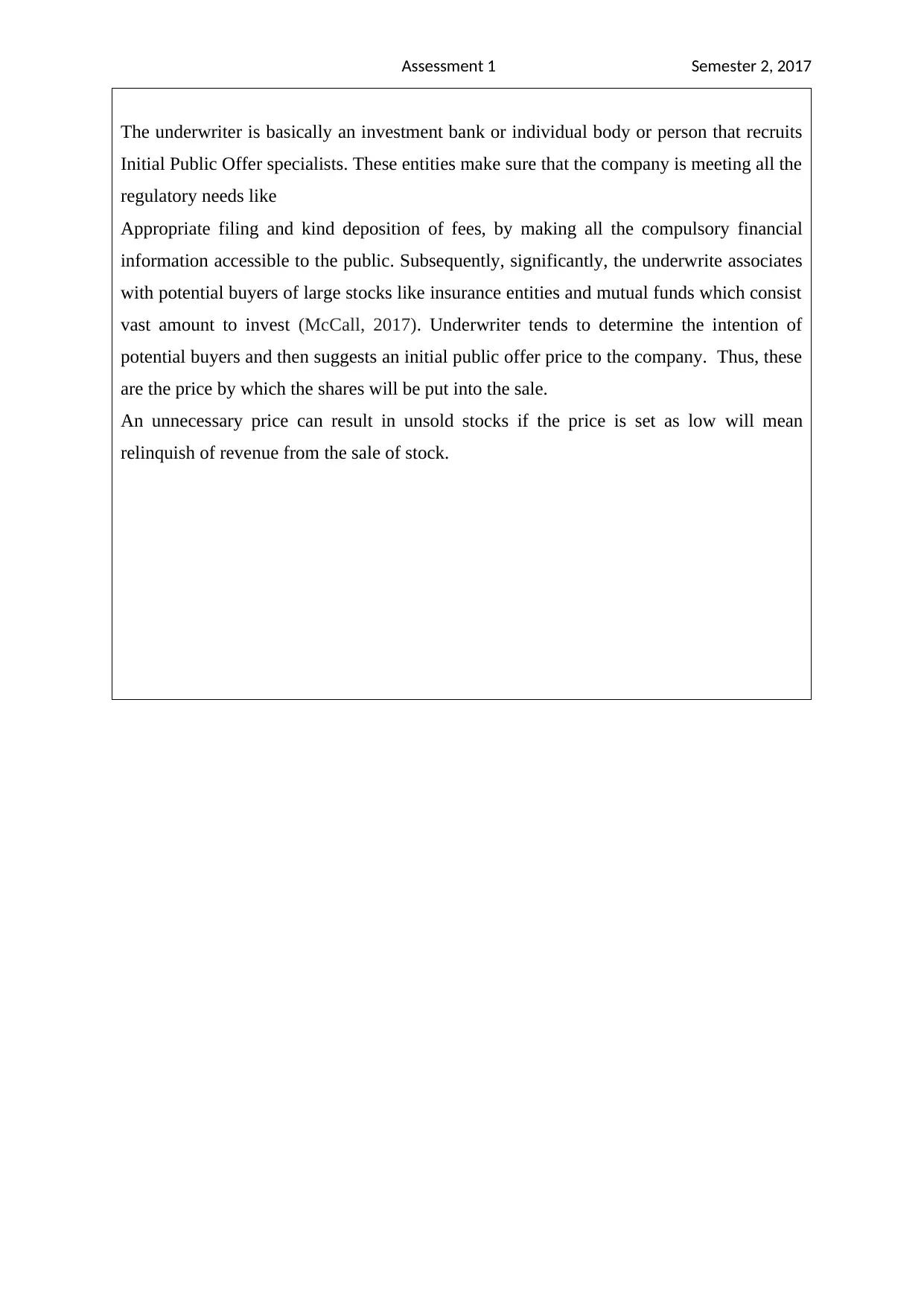
The underwriter is basically an investment bank or individual body or person that recruits
Initial Public Offer specialists. These entities make sure that the company is meeting all the
regulatory needs like
Appropriate filing and kind deposition of fees, by making all the compulsory financial
information accessible to the public. Subsequently, significantly, the underwrite associates
with potential buyers of large stocks like insurance entities and mutual funds which consist
vast amount to invest (McCall, 2017). Underwriter tends to determine the intention of
potential buyers and then suggests an initial public offer price to the company. Thus, these
are the price by which the shares will be put into the sale.
An unnecessary price can result in unsold stocks if the price is set as low will mean
relinquish of revenue from the sale of stock.
The underwriter is basically an investment bank or individual body or person that recruits
Initial Public Offer specialists. These entities make sure that the company is meeting all the
regulatory needs like
Appropriate filing and kind deposition of fees, by making all the compulsory financial
information accessible to the public. Subsequently, significantly, the underwrite associates
with potential buyers of large stocks like insurance entities and mutual funds which consist
vast amount to invest (McCall, 2017). Underwriter tends to determine the intention of
potential buyers and then suggests an initial public offer price to the company. Thus, these
are the price by which the shares will be put into the sale.
An unnecessary price can result in unsold stocks if the price is set as low will mean
relinquish of revenue from the sale of stock.
⊘ This is a preview!⊘
Do you want full access?
Subscribe today to unlock all pages.

Trusted by 1+ million students worldwide

Assessment 1 Semester 2, 2017
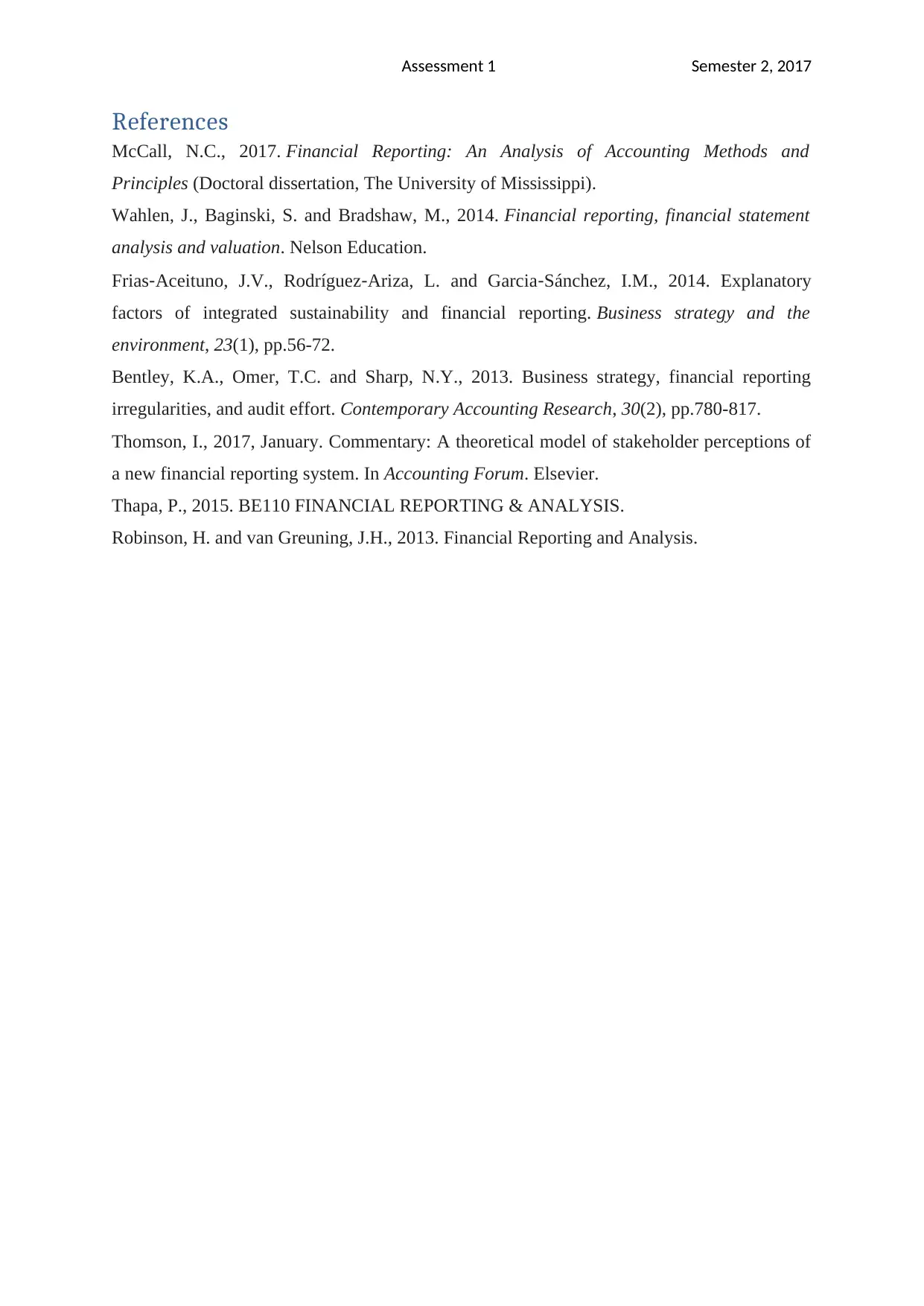
References
McCall, N.C., 2017. Financial Reporting: An Analysis of Accounting Methods and
Principles (Doctoral dissertation, The University of Mississippi).
Wahlen, J., Baginski, S. and Bradshaw, M., 2014. Financial reporting, financial statement
analysis and valuation. Nelson Education.
Frias‐Aceituno, J.V., Rodríguez‐Ariza, L. and Garcia‐Sánchez, I.M., 2014. Explanatory
factors of integrated sustainability and financial reporting. Business strategy and the
environment, 23(1), pp.56-72.
Bentley, K.A., Omer, T.C. and Sharp, N.Y., 2013. Business strategy, financial reporting
irregularities, and audit effort. Contemporary Accounting Research, 30(2), pp.780-817.
Thomson, I., 2017, January. Commentary: A theoretical model of stakeholder perceptions of
a new financial reporting system. In Accounting Forum. Elsevier.
Thapa, P., 2015. BE110 FINANCIAL REPORTING & ANALYSIS.
Robinson, H. and van Greuning, J.H., 2013. Financial Reporting and Analysis.
References
McCall, N.C., 2017. Financial Reporting: An Analysis of Accounting Methods and
Principles (Doctoral dissertation, The University of Mississippi).
Wahlen, J., Baginski, S. and Bradshaw, M., 2014. Financial reporting, financial statement
analysis and valuation. Nelson Education.
Frias‐Aceituno, J.V., Rodríguez‐Ariza, L. and Garcia‐Sánchez, I.M., 2014. Explanatory
factors of integrated sustainability and financial reporting. Business strategy and the
environment, 23(1), pp.56-72.
Bentley, K.A., Omer, T.C. and Sharp, N.Y., 2013. Business strategy, financial reporting
irregularities, and audit effort. Contemporary Accounting Research, 30(2), pp.780-817.
Thomson, I., 2017, January. Commentary: A theoretical model of stakeholder perceptions of
a new financial reporting system. In Accounting Forum. Elsevier.
Thapa, P., 2015. BE110 FINANCIAL REPORTING & ANALYSIS.
Robinson, H. and van Greuning, J.H., 2013. Financial Reporting and Analysis.
1 out of 7
Related Documents
Your All-in-One AI-Powered Toolkit for Academic Success.
+13062052269
info@desklib.com
Available 24*7 on WhatsApp / Email
Unlock your academic potential
Copyright © 2020–2025 A2Z Services. All Rights Reserved. Developed and managed by ZUCOL.