Open Innovation Strategies: Comparing Facebook and Philips' Approaches
VerifiedAdded on 2023/01/17
|15
|3304
|41
Report
AI Summary
This report provides a comparative analysis of the open innovation strategies employed by Facebook and Philips. It begins with an introduction to open innovation, defining its core principles and highlighting its significance in modern business. The report then presents brief profiles of both companies, detailing their distinct approaches to open innovation. Facebook's strategy centers on internal events like hackathons to foster employee-driven innovation, while Philips utilizes a physical campus to encourage collaboration with other firms. The effectiveness of each strategy is then evaluated by comparing organizational practices, drawing on open innovation and strategic innovation theories. The analysis extends to a comprehensive examination of the companies' financial results, including profitability, liquidity, asset efficiency, and capital structure ratios. These financial metrics are used to support the qualitative analysis of their innovation strategies. A table summarizes the key findings, followed by a conclusion that synthesizes the evidence and offers insights into the relative strengths and weaknesses of each company's approach. The report emphasizes the importance of open innovation in driving technological advancements and organizational growth, providing a detailed overview of how different companies implement these strategies and the impact on their financial performance.
Open Innovation

Paraphrase This Document
Need a fresh take? Get an instant paraphrase of this document with our AI Paraphraser
1
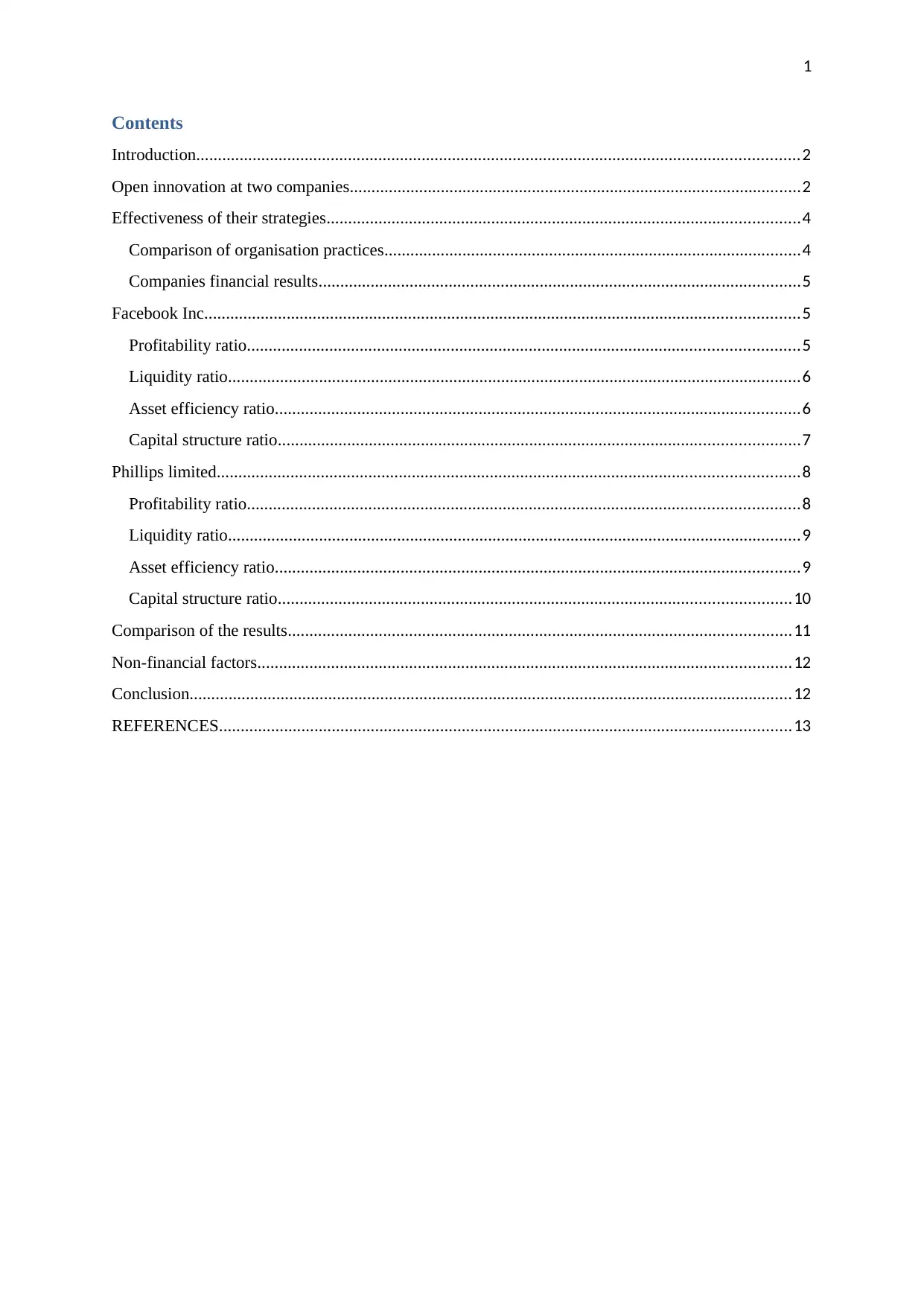
Contents
Introduction...........................................................................................................................................2
Open innovation at two companies........................................................................................................2
Effectiveness of their strategies.............................................................................................................4
Comparison of organisation practices................................................................................................4
Companies financial results...............................................................................................................5
Facebook Inc.........................................................................................................................................5
Profitability ratio...............................................................................................................................5
Liquidity ratio....................................................................................................................................6
Asset efficiency ratio.........................................................................................................................6
Capital structure ratio........................................................................................................................7
Phillips limited......................................................................................................................................8
Profitability ratio...............................................................................................................................8
Liquidity ratio....................................................................................................................................9
Asset efficiency ratio.........................................................................................................................9
Capital structure ratio......................................................................................................................10
Comparison of the results....................................................................................................................11
Non-financial factors...........................................................................................................................12
Conclusion...........................................................................................................................................12
REFERENCES....................................................................................................................................13
Contents
Introduction...........................................................................................................................................2
Open innovation at two companies........................................................................................................2
Effectiveness of their strategies.............................................................................................................4
Comparison of organisation practices................................................................................................4
Companies financial results...............................................................................................................5
Facebook Inc.........................................................................................................................................5
Profitability ratio...............................................................................................................................5
Liquidity ratio....................................................................................................................................6
Asset efficiency ratio.........................................................................................................................6
Capital structure ratio........................................................................................................................7
Phillips limited......................................................................................................................................8
Profitability ratio...............................................................................................................................8
Liquidity ratio....................................................................................................................................9
Asset efficiency ratio.........................................................................................................................9
Capital structure ratio......................................................................................................................10
Comparison of the results....................................................................................................................11
Non-financial factors...........................................................................................................................12
Conclusion...........................................................................................................................................12
REFERENCES....................................................................................................................................13
2
Introduction
Open innovation strategy acts a paradigm which assumes that an organisation can and should
use internal and external ideas as well as internal and external paths to market as the
organisation searches for making advancements in their technology. It is a distributed
innovation process that relies on purposively managed knowledge flows throughout
organisational peripheries utilising pecuniary and non-pecuniary mechanism in line with the
business model of the firm (Morikawa, 2016). This kind of innovation is not only firm -
centric but also involves communities of user innovators and creative consumers. There are
many big firms that are using this strategy for their growth. Philips and Facebook are the two
big companies that are using open innovation strategy for making innovations in their
business. This report highlights the open innovation strategy used by Philips and Facebook
and also evaluates its effectiveness by comparing organisation practices using open
innovation and strategic innovation theory. It also compares the financial results to support
the analysis.
Open innovation at two companies
Among the different companies Facebook and Philips are the ones who have a very different
kinds of open innovation strategy used for their growth and innovation.
Philips
Philips is using very different types of open innovation activities. It is having the challenges,
the platform and it triggers own workers to think openly. As a part of the strategy, company
has opened innovation campus at Eindhoven in the year 2003. This high tech campus is
widely open for different types of firms to work for. It provides them with tools to assist
accelerating their research projects and their business (Arrigo, 2012). Such type of open
innovation strategy has helped the company to work with other firms and hence utilise most
of their projects.
The campus runs autonomously but there is presence of Philips helps them in providing
facilities and resources that helps in open innovation. This gives them an opportunity where
there is presence of more than 140 companies where all of them work inside a physical
campus. A better innovation eco-system is created where the ideas of the companies are
being shared with each other (Seebode, Jeanrenaud & Bessant, 2012). Creativity and
knowledge of different companies are being used for developing products that are for the
Introduction
Open innovation strategy acts a paradigm which assumes that an organisation can and should
use internal and external ideas as well as internal and external paths to market as the
organisation searches for making advancements in their technology. It is a distributed
innovation process that relies on purposively managed knowledge flows throughout
organisational peripheries utilising pecuniary and non-pecuniary mechanism in line with the
business model of the firm (Morikawa, 2016). This kind of innovation is not only firm -
centric but also involves communities of user innovators and creative consumers. There are
many big firms that are using this strategy for their growth. Philips and Facebook are the two
big companies that are using open innovation strategy for making innovations in their
business. This report highlights the open innovation strategy used by Philips and Facebook
and also evaluates its effectiveness by comparing organisation practices using open
innovation and strategic innovation theory. It also compares the financial results to support
the analysis.
Open innovation at two companies
Among the different companies Facebook and Philips are the ones who have a very different
kinds of open innovation strategy used for their growth and innovation.
Philips
Philips is using very different types of open innovation activities. It is having the challenges,
the platform and it triggers own workers to think openly. As a part of the strategy, company
has opened innovation campus at Eindhoven in the year 2003. This high tech campus is
widely open for different types of firms to work for. It provides them with tools to assist
accelerating their research projects and their business (Arrigo, 2012). Such type of open
innovation strategy has helped the company to work with other firms and hence utilise most
of their projects.
The campus runs autonomously but there is presence of Philips helps them in providing
facilities and resources that helps in open innovation. This gives them an opportunity where
there is presence of more than 140 companies where all of them work inside a physical
campus. A better innovation eco-system is created where the ideas of the companies are
being shared with each other (Seebode, Jeanrenaud & Bessant, 2012). Creativity and
knowledge of different companies are being used for developing products that are for the
⊘ This is a preview!⊘
Do you want full access?
Subscribe today to unlock all pages.

Trusted by 1+ million students worldwide
3
future of the society. Such type of physical space gives the company a space where there is
larger possibility to bring great open innovation. This is also because a greater force is
created between the companies where they share their technologies to open up firm’s
innovation to the masses. In one-on-one close collaboration physical proximity is still a major
factor. Even though physical proximity is not necessary still staying close helps in creating
personal bond which is necessary for benefitting society (Gardien, Djajadiningrat, Hummels
& Brombacher, 2014).
Facebook
In Facebook, for promoting open innovation company utilises events such as hackathons for
their employees. The aim behind this hackathons event is that the workers generate new
innovation and ideas and create initial version of it. This type of event is not only conducted
for developers but for anyone within the firm. The idea behind is this strategy is that
employees of the firm work with something that they do not work on regular basis. The
motive behind this is that when an employee does things outside then their day-to-day work
they express their ideas and creativity (King & Lakhani, 2013). They enjoy their differences
and works with each other to generate ideas that are called out of the box thinking. This
strategy also helps the company in identifying new talents and also helps the company in
finding the new skills and knowledge present in their employees. Since the developers and
designers have specific way to thinking about the problems hence such events will bring new
talents within the firm. This works very well for finance and marketing department. When the
employees from different department meet, they share tactical knowledge with each other
(Morikawa, 2016).
At the same time, it creates a sense of team spirit throughout the firm and creates a
meaningful relationship within the firm. All the employees come together for innovating and
creating something new for the firm. Due to this type of collaboration, it is easier for the
organisation to generate product-innovation centred culture within the firm (Jung & Lee,
2011). The success of this event can be seen with the example of the product features such as
live chat, Facebook timelines, like buttons. The pride flag feature which permitted Facebook
to modify their profile picture for supporting LGBTQ community and the idea was given by
two interns of Facebook. Hackathon helped it in spreading at both internal and external
levels. This strategy also helps in building multiple skills in the company.
future of the society. Such type of physical space gives the company a space where there is
larger possibility to bring great open innovation. This is also because a greater force is
created between the companies where they share their technologies to open up firm’s
innovation to the masses. In one-on-one close collaboration physical proximity is still a major
factor. Even though physical proximity is not necessary still staying close helps in creating
personal bond which is necessary for benefitting society (Gardien, Djajadiningrat, Hummels
& Brombacher, 2014).
In Facebook, for promoting open innovation company utilises events such as hackathons for
their employees. The aim behind this hackathons event is that the workers generate new
innovation and ideas and create initial version of it. This type of event is not only conducted
for developers but for anyone within the firm. The idea behind is this strategy is that
employees of the firm work with something that they do not work on regular basis. The
motive behind this is that when an employee does things outside then their day-to-day work
they express their ideas and creativity (King & Lakhani, 2013). They enjoy their differences
and works with each other to generate ideas that are called out of the box thinking. This
strategy also helps the company in identifying new talents and also helps the company in
finding the new skills and knowledge present in their employees. Since the developers and
designers have specific way to thinking about the problems hence such events will bring new
talents within the firm. This works very well for finance and marketing department. When the
employees from different department meet, they share tactical knowledge with each other
(Morikawa, 2016).
At the same time, it creates a sense of team spirit throughout the firm and creates a
meaningful relationship within the firm. All the employees come together for innovating and
creating something new for the firm. Due to this type of collaboration, it is easier for the
organisation to generate product-innovation centred culture within the firm (Jung & Lee,
2011). The success of this event can be seen with the example of the product features such as
live chat, Facebook timelines, like buttons. The pride flag feature which permitted Facebook
to modify their profile picture for supporting LGBTQ community and the idea was given by
two interns of Facebook. Hackathon helped it in spreading at both internal and external
levels. This strategy also helps in building multiple skills in the company.
Paraphrase This Document
Need a fresh take? Get an instant paraphrase of this document with our AI Paraphraser
4
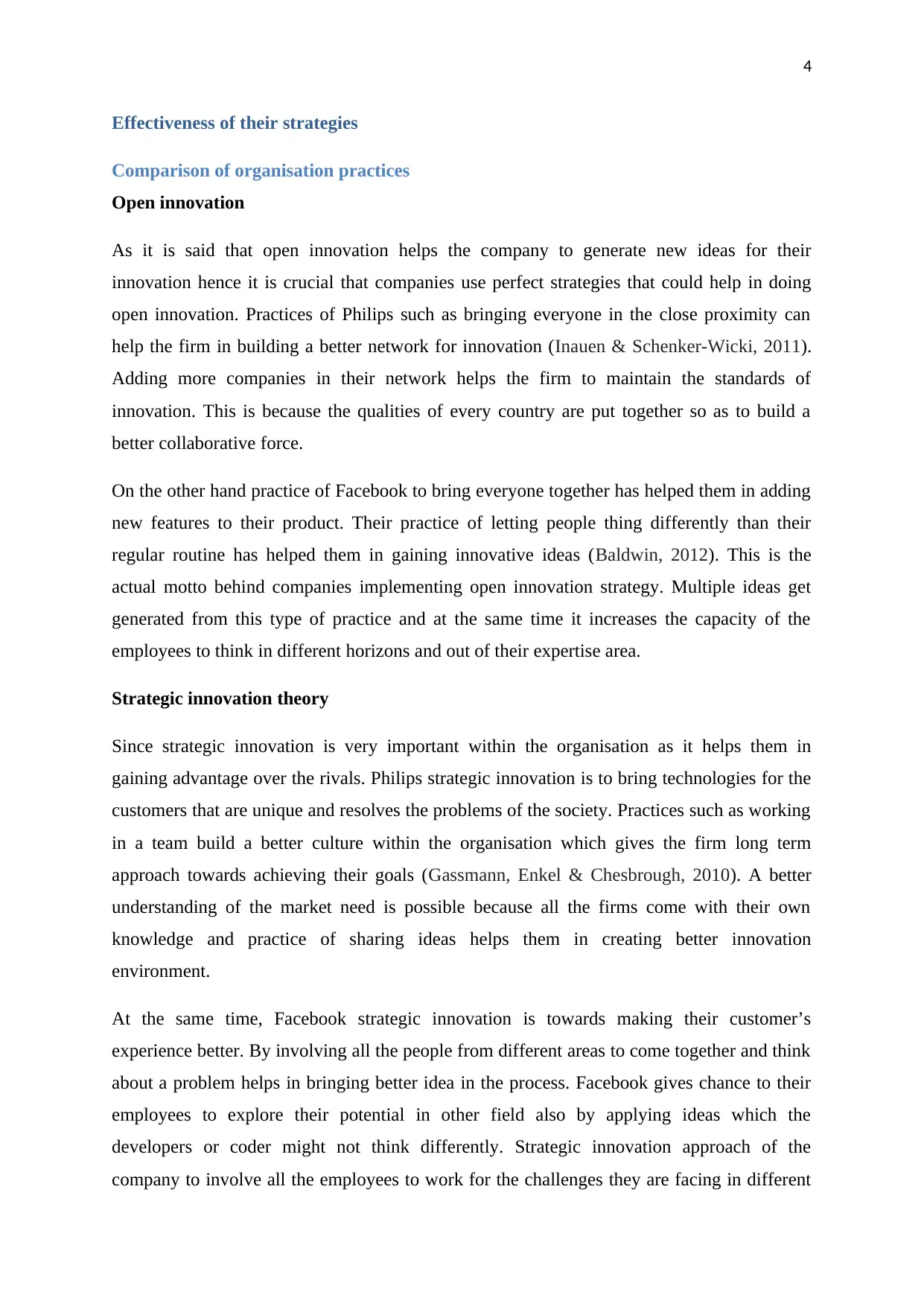
Effectiveness of their strategies
Comparison of organisation practices
Open innovation
As it is said that open innovation helps the company to generate new ideas for their
innovation hence it is crucial that companies use perfect strategies that could help in doing
open innovation. Practices of Philips such as bringing everyone in the close proximity can
help the firm in building a better network for innovation (Inauen & Schenker-Wicki, 2011).
Adding more companies in their network helps the firm to maintain the standards of
innovation. This is because the qualities of every country are put together so as to build a
better collaborative force.
On the other hand practice of Facebook to bring everyone together has helped them in adding
new features to their product. Their practice of letting people thing differently than their
regular routine has helped them in gaining innovative ideas (Baldwin, 2012). This is the
actual motto behind companies implementing open innovation strategy. Multiple ideas get
generated from this type of practice and at the same time it increases the capacity of the
employees to think in different horizons and out of their expertise area.
Strategic innovation theory
Since strategic innovation is very important within the organisation as it helps them in
gaining advantage over the rivals. Philips strategic innovation is to bring technologies for the
customers that are unique and resolves the problems of the society. Practices such as working
in a team build a better culture within the organisation which gives the firm long term
approach towards achieving their goals (Gassmann, Enkel & Chesbrough, 2010). A better
understanding of the market need is possible because all the firms come with their own
knowledge and practice of sharing ideas helps them in creating better innovation
environment.
At the same time, Facebook strategic innovation is towards making their customer’s
experience better. By involving all the people from different areas to come together and think
about a problem helps in bringing better idea in the process. Facebook gives chance to their
employees to explore their potential in other field also by applying ideas which the
developers or coder might not think differently. Strategic innovation approach of the
company to involve all the employees to work for the challenges they are facing in different
Effectiveness of their strategies
Comparison of organisation practices
Open innovation
As it is said that open innovation helps the company to generate new ideas for their
innovation hence it is crucial that companies use perfect strategies that could help in doing
open innovation. Practices of Philips such as bringing everyone in the close proximity can
help the firm in building a better network for innovation (Inauen & Schenker-Wicki, 2011).
Adding more companies in their network helps the firm to maintain the standards of
innovation. This is because the qualities of every country are put together so as to build a
better collaborative force.
On the other hand practice of Facebook to bring everyone together has helped them in adding
new features to their product. Their practice of letting people thing differently than their
regular routine has helped them in gaining innovative ideas (Baldwin, 2012). This is the
actual motto behind companies implementing open innovation strategy. Multiple ideas get
generated from this type of practice and at the same time it increases the capacity of the
employees to think in different horizons and out of their expertise area.
Strategic innovation theory
Since strategic innovation is very important within the organisation as it helps them in
gaining advantage over the rivals. Philips strategic innovation is to bring technologies for the
customers that are unique and resolves the problems of the society. Practices such as working
in a team build a better culture within the organisation which gives the firm long term
approach towards achieving their goals (Gassmann, Enkel & Chesbrough, 2010). A better
understanding of the market need is possible because all the firms come with their own
knowledge and practice of sharing ideas helps them in creating better innovation
environment.
At the same time, Facebook strategic innovation is towards making their customer’s
experience better. By involving all the people from different areas to come together and think
about a problem helps in bringing better idea in the process. Facebook gives chance to their
employees to explore their potential in other field also by applying ideas which the
developers or coder might not think differently. Strategic innovation approach of the
company to involve all the employees to work for the challenges they are facing in different
5
areas helps them in ensuring that new ideas come to their business at the same time ensures
the privacy of their strategic affairs (Mergel, 2012). As it does not involve external people
hence privacy can be maintained in the strategic affair which is necessary in the modern day
competitive business.
Companies financial results
Financial performance and position evaluation is important for the stakeholders in
order to measure the investment level and profitability position of the business. Here, the
financial performance evaluation has done over Facebook and Phillips to measure the
performance of each of the company.
Facebook Inc:
Profitability ratio:
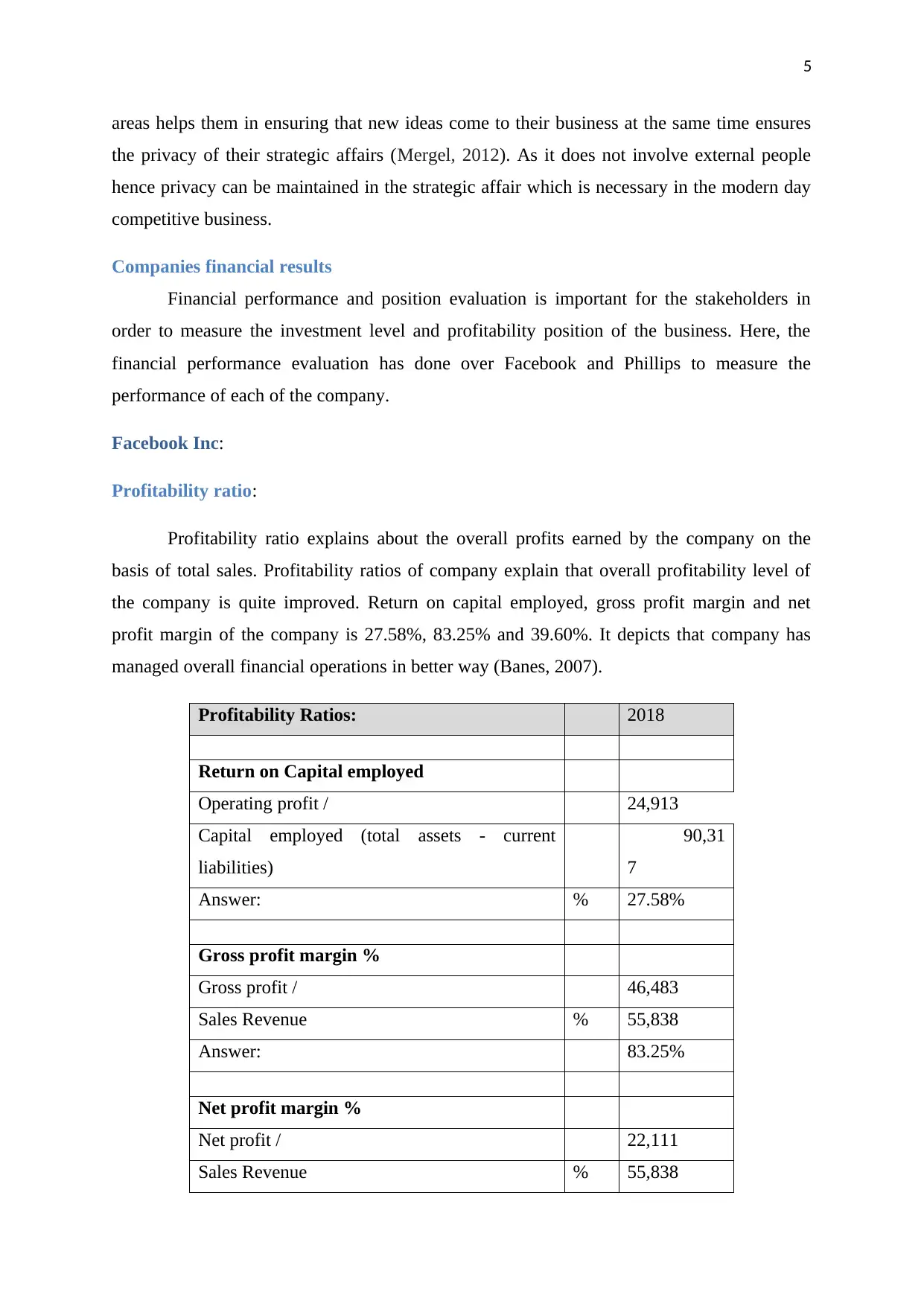
Profitability ratio explains about the overall profits earned by the company on the
basis of total sales. Profitability ratios of company explain that overall profitability level of
the company is quite improved. Return on capital employed, gross profit margin and net
profit margin of the company is 27.58%, 83.25% and 39.60%. It depicts that company has
managed overall financial operations in better way (Banes, 2007).
Profitability Ratios: 2018
Return on Capital employed
Operating profit / 24,913
Capital employed (total assets - current
liabilities)
90,31
7
Answer: % 27.58%
Gross profit margin %
Gross profit / 46,483
Sales Revenue % 55,838
Answer: 83.25%
Net profit margin %
Net profit / 22,111
Sales Revenue % 55,838
areas helps them in ensuring that new ideas come to their business at the same time ensures
the privacy of their strategic affairs (Mergel, 2012). As it does not involve external people
hence privacy can be maintained in the strategic affair which is necessary in the modern day
competitive business.
Companies financial results
Financial performance and position evaluation is important for the stakeholders in
order to measure the investment level and profitability position of the business. Here, the
financial performance evaluation has done over Facebook and Phillips to measure the
performance of each of the company.
Facebook Inc:
Profitability ratio:
Profitability ratio explains about the overall profits earned by the company on the
basis of total sales. Profitability ratios of company explain that overall profitability level of
the company is quite improved. Return on capital employed, gross profit margin and net
profit margin of the company is 27.58%, 83.25% and 39.60%. It depicts that company has
managed overall financial operations in better way (Banes, 2007).
Profitability Ratios: 2018
Return on Capital employed
Operating profit / 24,913
Capital employed (total assets - current
liabilities)
90,31
7
Answer: % 27.58%
Gross profit margin %
Gross profit / 46,483
Sales Revenue % 55,838
Answer: 83.25%
Net profit margin %
Net profit / 22,111
Sales Revenue % 55,838
⊘ This is a preview!⊘
Do you want full access?
Subscribe today to unlock all pages.
Trusted by 1+ million students worldwide
6
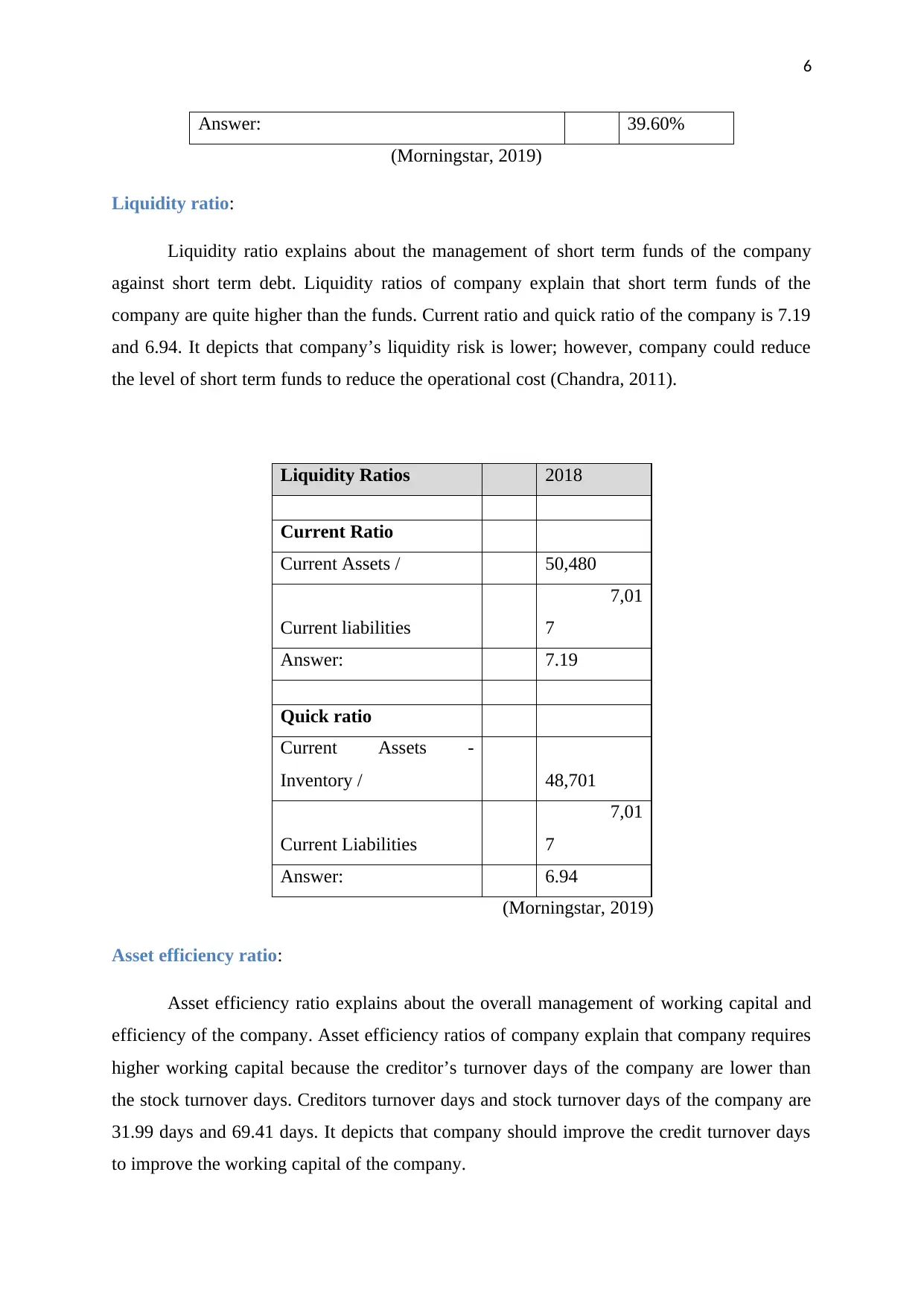
Answer: 39.60%
(Morningstar, 2019)
Liquidity ratio:
Liquidity ratio explains about the management of short term funds of the company
against short term debt. Liquidity ratios of company explain that short term funds of the
company are quite higher than the funds. Current ratio and quick ratio of the company is 7.19
and 6.94. It depicts that company’s liquidity risk is lower; however, company could reduce
the level of short term funds to reduce the operational cost (Chandra, 2011).
Liquidity Ratios 2018
Current Ratio
Current Assets / 50,480
Current liabilities
7,01
7
Answer: 7.19
Quick ratio
Current Assets -
Inventory / 48,701
Current Liabilities
7,01
7
Answer: 6.94
(Morningstar, 2019)
Asset efficiency ratio:
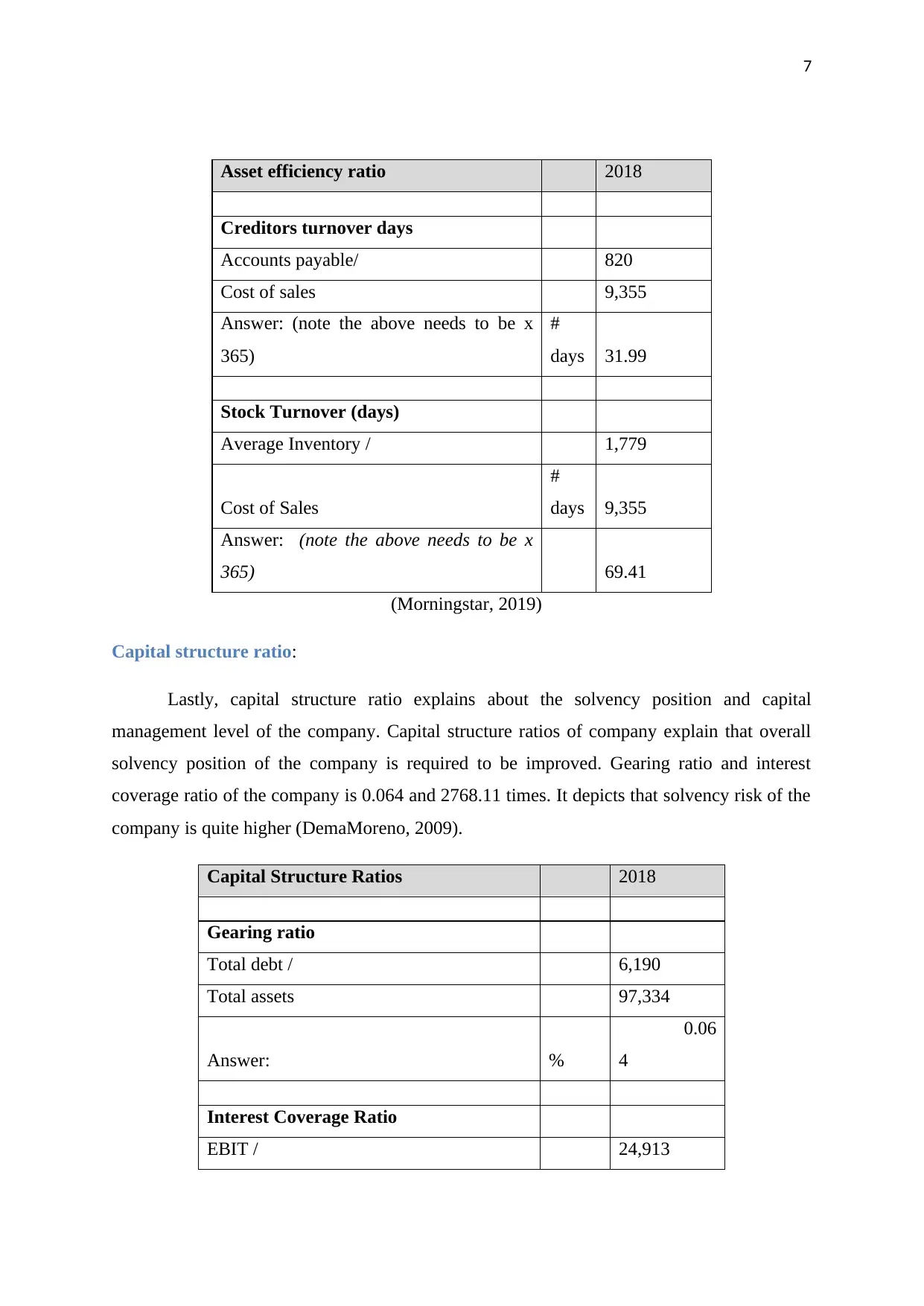
Asset efficiency ratio explains about the overall management of working capital and
efficiency of the company. Asset efficiency ratios of company explain that company requires
higher working capital because the creditor’s turnover days of the company are lower than
the stock turnover days. Creditors turnover days and stock turnover days of the company are
31.99 days and 69.41 days. It depicts that company should improve the credit turnover days
to improve the working capital of the company.
Answer: 39.60%
(Morningstar, 2019)
Liquidity ratio:
Liquidity ratio explains about the management of short term funds of the company
against short term debt. Liquidity ratios of company explain that short term funds of the
company are quite higher than the funds. Current ratio and quick ratio of the company is 7.19
and 6.94. It depicts that company’s liquidity risk is lower; however, company could reduce
the level of short term funds to reduce the operational cost (Chandra, 2011).
Liquidity Ratios 2018
Current Ratio
Current Assets / 50,480
Current liabilities
7,01
7
Answer: 7.19
Quick ratio
Current Assets -
Inventory / 48,701
Current Liabilities
7,01
7
Answer: 6.94
(Morningstar, 2019)
Asset efficiency ratio:
Asset efficiency ratio explains about the overall management of working capital and
efficiency of the company. Asset efficiency ratios of company explain that company requires
higher working capital because the creditor’s turnover days of the company are lower than
the stock turnover days. Creditors turnover days and stock turnover days of the company are
31.99 days and 69.41 days. It depicts that company should improve the credit turnover days
to improve the working capital of the company.
Paraphrase This Document
Need a fresh take? Get an instant paraphrase of this document with our AI Paraphraser
7
Asset efficiency ratio 2018
Creditors turnover days
Accounts payable/ 820
Cost of sales 9,355
Answer: (note the above needs to be x
365)
#
days 31.99
Stock Turnover (days)
Average Inventory / 1,779
Cost of Sales
#
days 9,355
Answer: (note the above needs to be x
365) 69.41
(Morningstar, 2019)
Capital structure ratio:
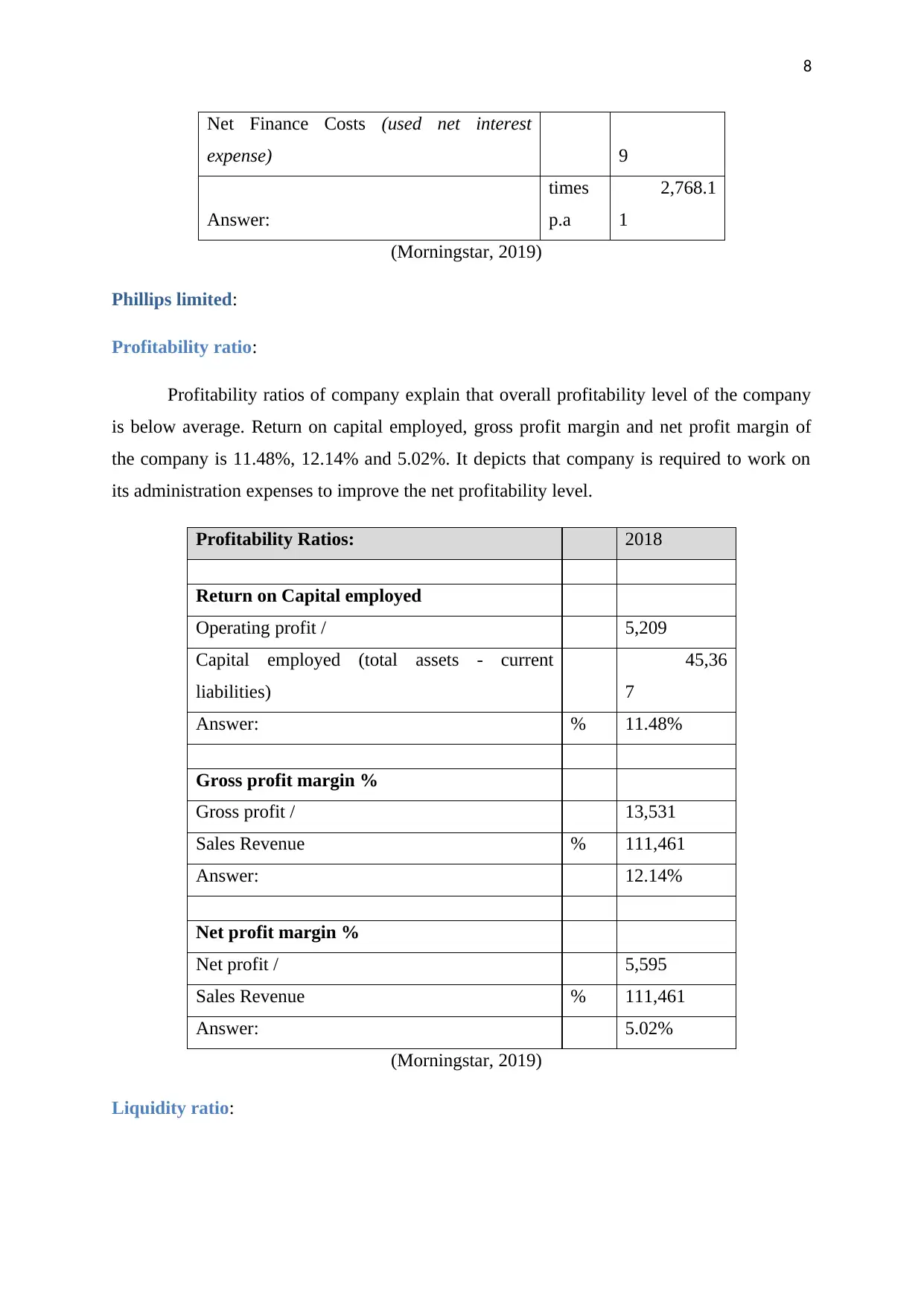
Lastly, capital structure ratio explains about the solvency position and capital
management level of the company. Capital structure ratios of company explain that overall
solvency position of the company is required to be improved. Gearing ratio and interest
coverage ratio of the company is 0.064 and 2768.11 times. It depicts that solvency risk of the
company is quite higher (DemaMoreno, 2009).
Capital Structure Ratios 2018
Gearing ratio
Total debt / 6,190
Total assets 97,334
Answer: %
0.06
4
Interest Coverage Ratio
EBIT / 24,913
Asset efficiency ratio 2018
Creditors turnover days
Accounts payable/ 820
Cost of sales 9,355
Answer: (note the above needs to be x
365)
#
days 31.99
Stock Turnover (days)
Average Inventory / 1,779
Cost of Sales
#
days 9,355
Answer: (note the above needs to be x
365) 69.41
(Morningstar, 2019)
Capital structure ratio:
Lastly, capital structure ratio explains about the solvency position and capital
management level of the company. Capital structure ratios of company explain that overall
solvency position of the company is required to be improved. Gearing ratio and interest
coverage ratio of the company is 0.064 and 2768.11 times. It depicts that solvency risk of the
company is quite higher (DemaMoreno, 2009).
Capital Structure Ratios 2018
Gearing ratio
Total debt / 6,190
Total assets 97,334
Answer: %
0.06
4
Interest Coverage Ratio
EBIT / 24,913
8
Net Finance Costs (used net interest
expense) 9
Answer:
times
p.a
2,768.1
1
(Morningstar, 2019)
Phillips limited:
Profitability ratio:
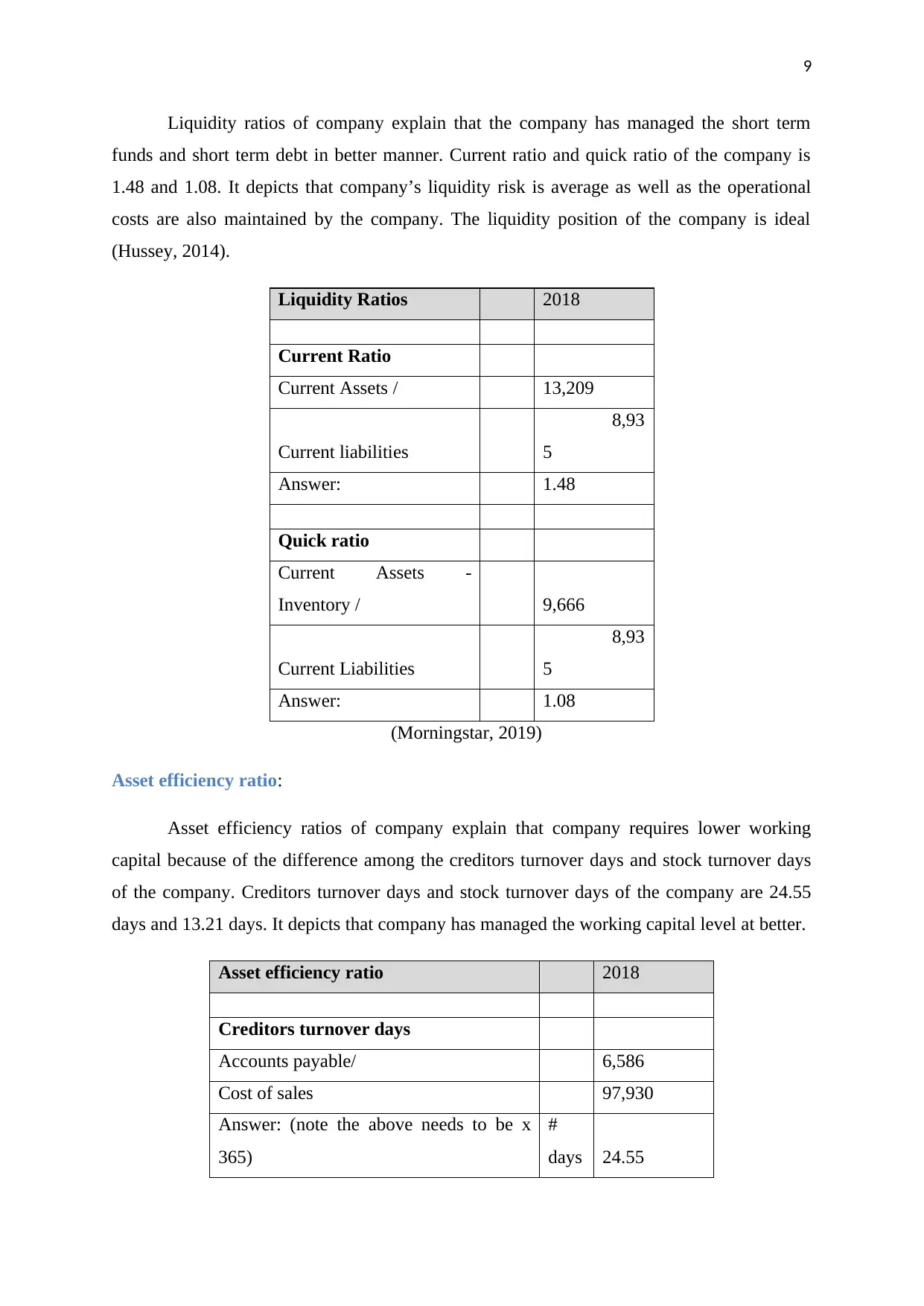
Profitability ratios of company explain that overall profitability level of the company
is below average. Return on capital employed, gross profit margin and net profit margin of
the company is 11.48%, 12.14% and 5.02%. It depicts that company is required to work on
its administration expenses to improve the net profitability level.
Profitability Ratios: 2018
Return on Capital employed
Operating profit / 5,209
Capital employed (total assets - current
liabilities)
45,36
7
Answer: % 11.48%
Gross profit margin %
Gross profit / 13,531
Sales Revenue % 111,461
Answer: 12.14%
Net profit margin %
Net profit / 5,595
Sales Revenue % 111,461
Answer: 5.02%
(Morningstar, 2019)
Liquidity ratio:
Net Finance Costs (used net interest
expense) 9
Answer:
times
p.a
2,768.1
1
(Morningstar, 2019)
Phillips limited:
Profitability ratio:
Profitability ratios of company explain that overall profitability level of the company
is below average. Return on capital employed, gross profit margin and net profit margin of
the company is 11.48%, 12.14% and 5.02%. It depicts that company is required to work on
its administration expenses to improve the net profitability level.
Profitability Ratios: 2018
Return on Capital employed
Operating profit / 5,209
Capital employed (total assets - current
liabilities)
45,36
7
Answer: % 11.48%
Gross profit margin %
Gross profit / 13,531
Sales Revenue % 111,461
Answer: 12.14%
Net profit margin %
Net profit / 5,595
Sales Revenue % 111,461
Answer: 5.02%
(Morningstar, 2019)
Liquidity ratio:
⊘ This is a preview!⊘
Do you want full access?
Subscribe today to unlock all pages.
Trusted by 1+ million students worldwide
9
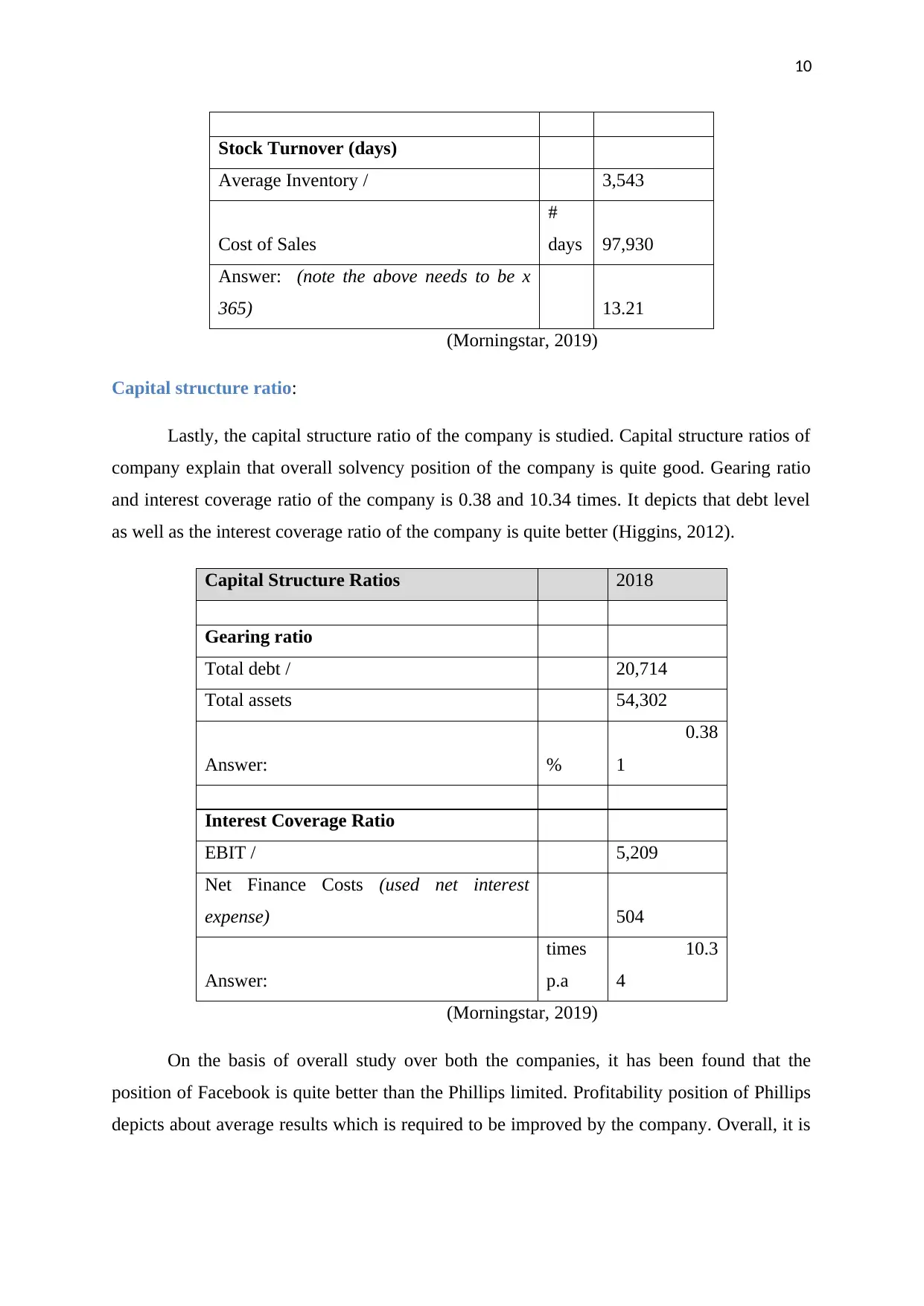
Liquidity ratios of company explain that the company has managed the short term
funds and short term debt in better manner. Current ratio and quick ratio of the company is
1.48 and 1.08. It depicts that company’s liquidity risk is average as well as the operational
costs are also maintained by the company. The liquidity position of the company is ideal
(Hussey, 2014).
Liquidity Ratios 2018
Current Ratio
Current Assets / 13,209
Current liabilities
8,93
5
Answer: 1.48
Quick ratio
Current Assets -
Inventory / 9,666
Current Liabilities
8,93
5
Answer: 1.08
(Morningstar, 2019)
Asset efficiency ratio:
Asset efficiency ratios of company explain that company requires lower working
capital because of the difference among the creditors turnover days and stock turnover days
of the company. Creditors turnover days and stock turnover days of the company are 24.55
days and 13.21 days. It depicts that company has managed the working capital level at better.
Asset efficiency ratio 2018
Creditors turnover days
Accounts payable/ 6,586
Cost of sales 97,930
Answer: (note the above needs to be x
365)
#
days 24.55
Liquidity ratios of company explain that the company has managed the short term
funds and short term debt in better manner. Current ratio and quick ratio of the company is
1.48 and 1.08. It depicts that company’s liquidity risk is average as well as the operational
costs are also maintained by the company. The liquidity position of the company is ideal
(Hussey, 2014).
Liquidity Ratios 2018
Current Ratio
Current Assets / 13,209
Current liabilities
8,93
5
Answer: 1.48
Quick ratio
Current Assets -
Inventory / 9,666
Current Liabilities
8,93
5
Answer: 1.08
(Morningstar, 2019)
Asset efficiency ratio:
Asset efficiency ratios of company explain that company requires lower working
capital because of the difference among the creditors turnover days and stock turnover days
of the company. Creditors turnover days and stock turnover days of the company are 24.55
days and 13.21 days. It depicts that company has managed the working capital level at better.
Asset efficiency ratio 2018
Creditors turnover days
Accounts payable/ 6,586
Cost of sales 97,930
Answer: (note the above needs to be x
365)
#
days 24.55
Paraphrase This Document
Need a fresh take? Get an instant paraphrase of this document with our AI Paraphraser
10
Stock Turnover (days)
Average Inventory / 3,543
Cost of Sales
#
days 97,930
Answer: (note the above needs to be x
365) 13.21
(Morningstar, 2019)
Capital structure ratio:
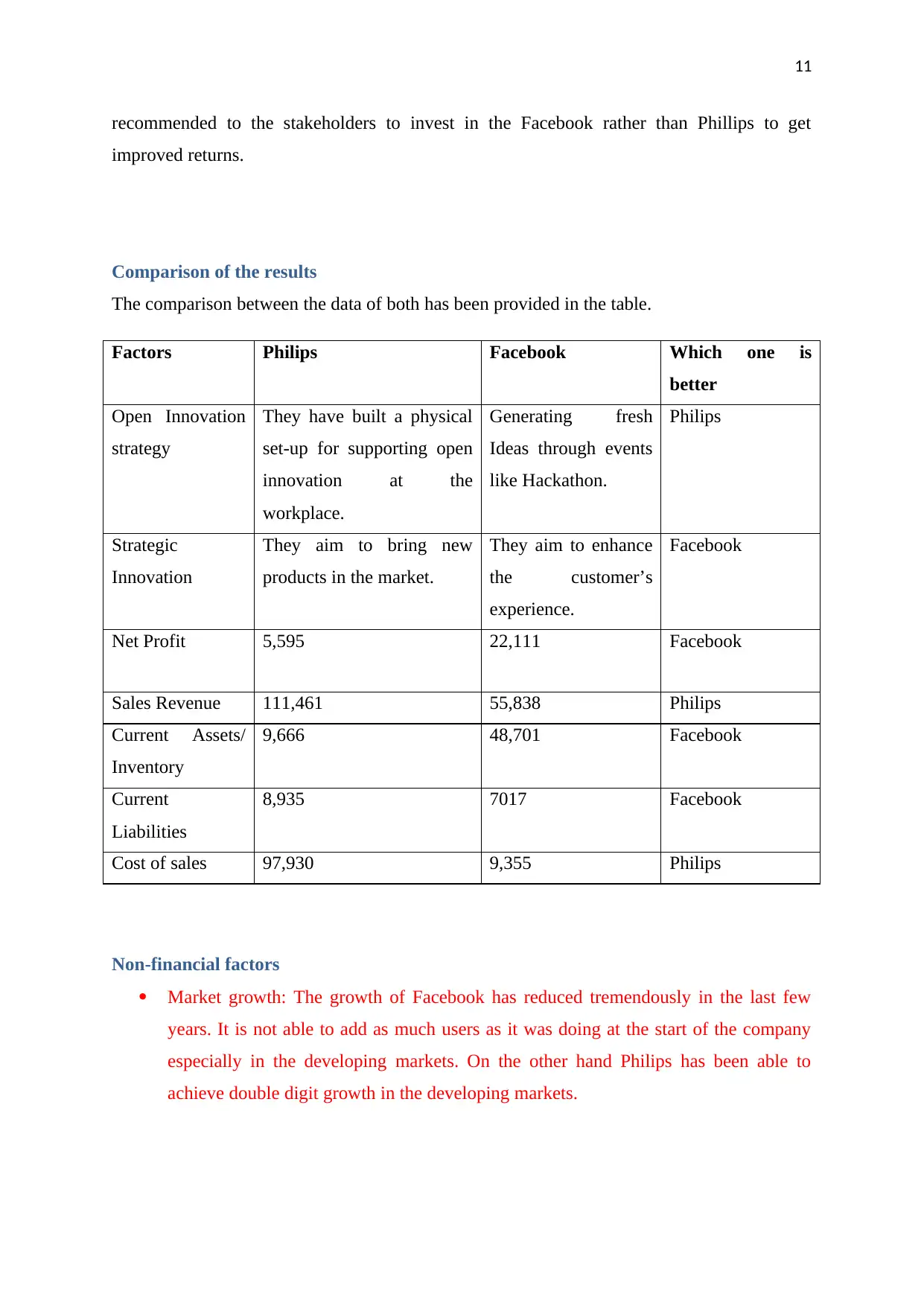
Lastly, the capital structure ratio of the company is studied. Capital structure ratios of
company explain that overall solvency position of the company is quite good. Gearing ratio
and interest coverage ratio of the company is 0.38 and 10.34 times. It depicts that debt level
as well as the interest coverage ratio of the company is quite better (Higgins, 2012).
Capital Structure Ratios 2018
Gearing ratio
Total debt / 20,714
Total assets 54,302
Answer: %
0.38
1
Interest Coverage Ratio
EBIT / 5,209
Net Finance Costs (used net interest
expense) 504
Answer:
times
p.a
10.3
4
(Morningstar, 2019)
On the basis of overall study over both the companies, it has been found that the
position of Facebook is quite better than the Phillips limited. Profitability position of Phillips
depicts about average results which is required to be improved by the company. Overall, it is
Stock Turnover (days)
Average Inventory / 3,543
Cost of Sales
#
days 97,930
Answer: (note the above needs to be x
365) 13.21
(Morningstar, 2019)
Capital structure ratio:
Lastly, the capital structure ratio of the company is studied. Capital structure ratios of
company explain that overall solvency position of the company is quite good. Gearing ratio
and interest coverage ratio of the company is 0.38 and 10.34 times. It depicts that debt level
as well as the interest coverage ratio of the company is quite better (Higgins, 2012).
Capital Structure Ratios 2018
Gearing ratio
Total debt / 20,714
Total assets 54,302
Answer: %
0.38
1
Interest Coverage Ratio
EBIT / 5,209
Net Finance Costs (used net interest
expense) 504
Answer:
times
p.a
10.3
4
(Morningstar, 2019)
On the basis of overall study over both the companies, it has been found that the
position of Facebook is quite better than the Phillips limited. Profitability position of Phillips
depicts about average results which is required to be improved by the company. Overall, it is
11
recommended to the stakeholders to invest in the Facebook rather than Phillips to get
improved returns.
Comparison of the results
The comparison between the data of both has been provided in the table.
Factors Philips Facebook Which one is
better
Open Innovation
strategy
They have built a physical
set-up for supporting open
innovation at the
workplace.
Generating fresh
Ideas through events
like Hackathon.
Philips
Strategic
Innovation
They aim to bring new
products in the market.
They aim to enhance
the customer’s
experience.
Facebook
Net Profit 5,595 22,111 Facebook
Sales Revenue 111,461 55,838 Philips
Current Assets/
Inventory
9,666 48,701 Facebook
Current
Liabilities
8,935 7017 Facebook
Cost of sales 97,930 9,355 Philips
Non-financial factors
Market growth: The growth of Facebook has reduced tremendously in the last few
years. It is not able to add as much users as it was doing at the start of the company
especially in the developing markets. On the other hand Philips has been able to
achieve double digit growth in the developing markets.
recommended to the stakeholders to invest in the Facebook rather than Phillips to get
improved returns.
Comparison of the results
The comparison between the data of both has been provided in the table.
Factors Philips Facebook Which one is
better
Open Innovation
strategy
They have built a physical
set-up for supporting open
innovation at the
workplace.
Generating fresh
Ideas through events
like Hackathon.
Philips
Strategic
Innovation
They aim to bring new
products in the market.
They aim to enhance
the customer’s
experience.
Net Profit 5,595 22,111 Facebook
Sales Revenue 111,461 55,838 Philips
Current Assets/
Inventory
9,666 48,701 Facebook
Current
Liabilities
8,935 7017 Facebook
Cost of sales 97,930 9,355 Philips
Non-financial factors
Market growth: The growth of Facebook has reduced tremendously in the last few
years. It is not able to add as much users as it was doing at the start of the company
especially in the developing markets. On the other hand Philips has been able to
achieve double digit growth in the developing markets.
⊘ This is a preview!⊘
Do you want full access?
Subscribe today to unlock all pages.
Trusted by 1+ million students worldwide

1 out of 15


Related Documents


Your All-in-One AI-Powered Toolkit for Academic Success.
+13062052269
info@desklib.com
Available 24*7 on WhatsApp / Email
![[object Object]](/_next/static/media/star-bottom.7253800d.svg)
Unlock your academic potential
Copyright © 2020–2026 A2Z Services. All Rights Reserved. Developed and managed by ZUCOL.