Analysis of Facial Recognition: A Psychology Lab Report

Verified

Added on  2023/01/17

|7
|834
|76
Report
AI Summary
This psychology lab report investigates facial recognition, focusing on gender differences in memory and visual perception. The report includes an introduction to facial recognition technology and its applications, followed by a description of the methods used in an online experiment. The experiment involved participants completing facial recognition tasks with adult and child faces from Sweden and Bangladesh. The results section presents the data, comparing the performance of men and women using a t-test to analyze the statistical significance of the differences. The discussion interprets the findings, highlighting that women demonstrated superior facial recognition abilities compared to men. The report concludes with a list of cited references in APA format, including articles on facial recognition and gender differences in memory.
Document Page
Running head: PSYCHOLOGY
Topic: PSYCHOLOGY
Name of the Student:
Name of the University:
Author’s Note:
tabler-icon-diamond-filled.svg

Paraphrase This Document

Need a fresh take? Get an instant paraphrase of this document with our AI Paraphraser
Document Page
1PSYCHOLOGY
Introduction
Facial recognition has been one of the rising phases of software and technology. It is a
kind of biometric software which is involved in mapping the facial features of individuals
mathematically and storing the data as face prints. Such intricate learning algorithms has been
used for comparison of digital images for verification of identity of any individual. Various
research was done on this basis where faces were recorded and patients viewed them creating
two Visual Evoked Potentials (VEPs). Such results were challenged with the software
involving facial identification which was mapped in 130-200 ms range (Bellman et al.,
2017).Contemporary advancements in this respect demonstrated reliable sex differences
where women were shown to have better memorizing power than men. Women would excel
in verbal materials like words, pictures and objects whereas men had better memory power
where substantial amount of visuospatial components were considered (Rehnman & Herlitz,
2007).
Method
The methodologies would involve facial recognition studies through online databases.
First step involves the use of databases which store faces of various subjects who have
volunteered to participate in the study. Such pictures would be without any external features
like facial hair or accessories. Portrayed volunteers would have a neutral expression. The
subjects of Sweden and Bangladesh were chosen for creating a contrast in the outward
appearances. Participants had to complete two facial recognition tasks, one involving adults
and other involving children. Participants had to closely watch the faces and had to give a
comprehensive test based on the recognition abilities.
Document Page
2PSYCHOLOGY
Results
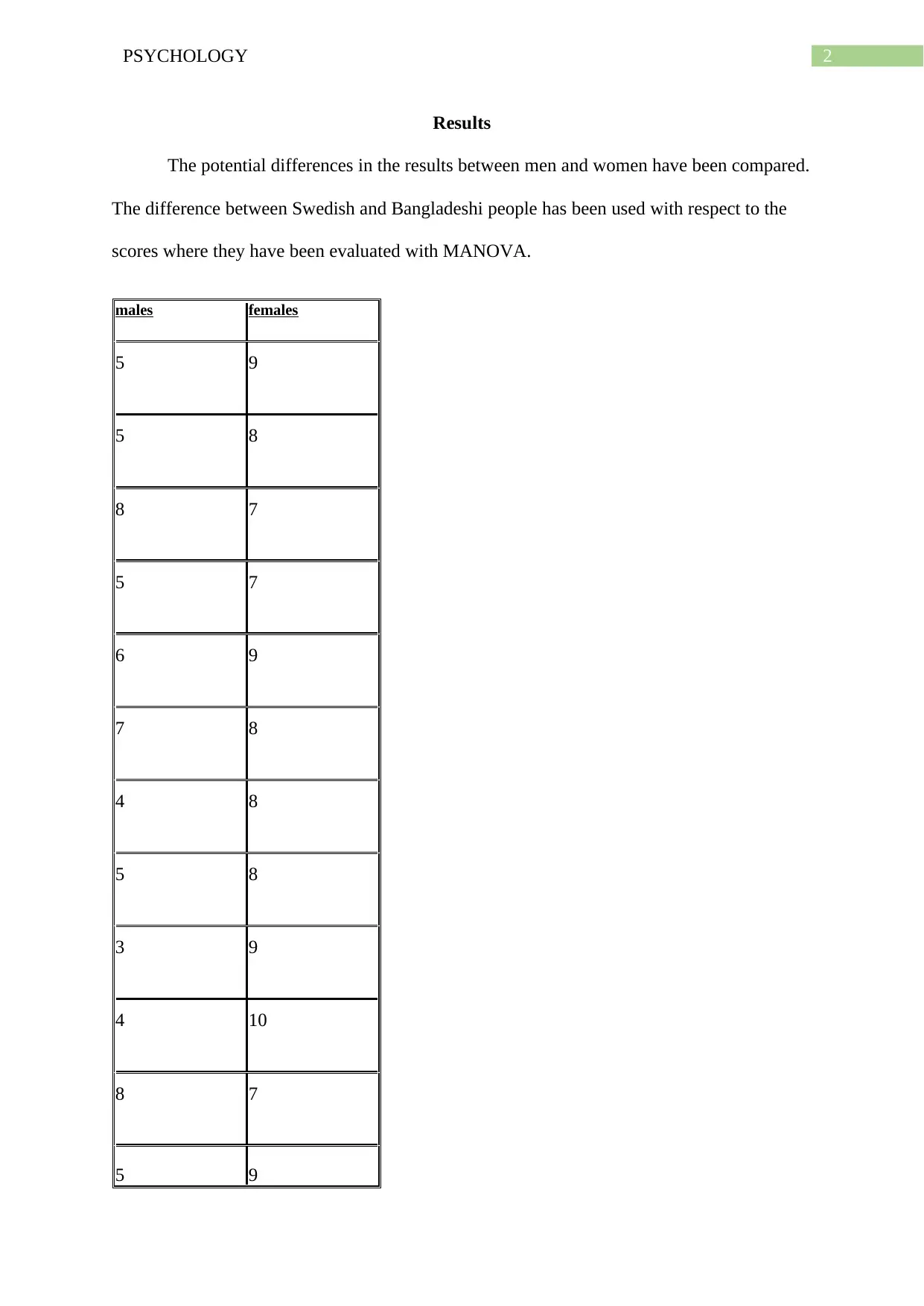
The potential differences in the results between men and women have been compared.
The difference between Swedish and Bangladeshi people has been used with respect to the
scores where they have been evaluated with MANOVA.
males females
5 9
5 8
8 7
5 7
6 9
7 8
4 8
5 8
3 9
4 10
8 7
5 9
Document Page
3PSYCHOLOGY
10 8
6 9
5 7
5 9
8 8
7 7
5 9
6 7
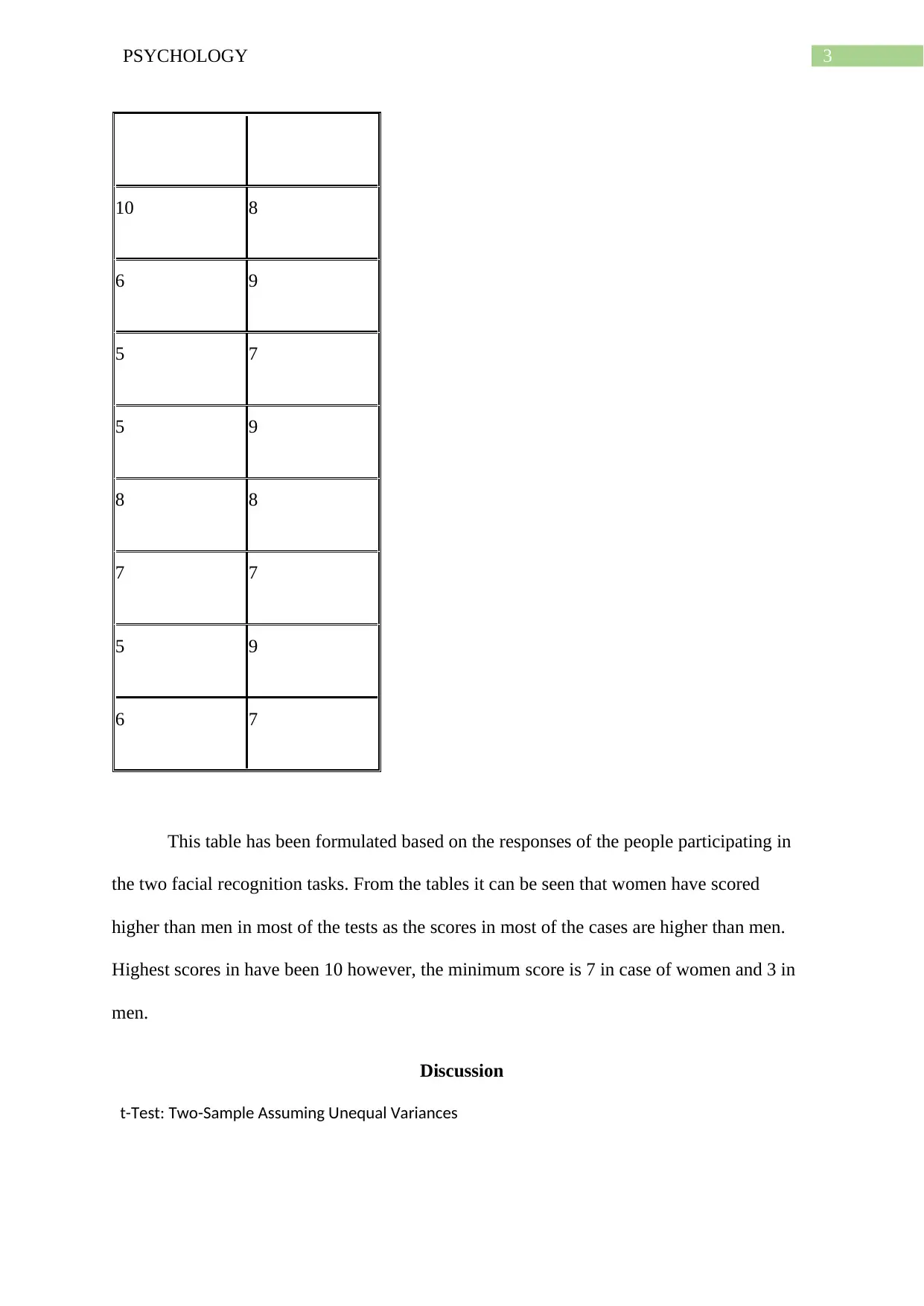
This table has been formulated based on the responses of the people participating in
the two facial recognition tasks. From the tables it can be seen that women have scored
higher than men in most of the tests as the scores in most of the cases are higher than men.
Highest scores in have been 10 however, the minimum score is 7 in case of women and 3 in
men.
Discussion
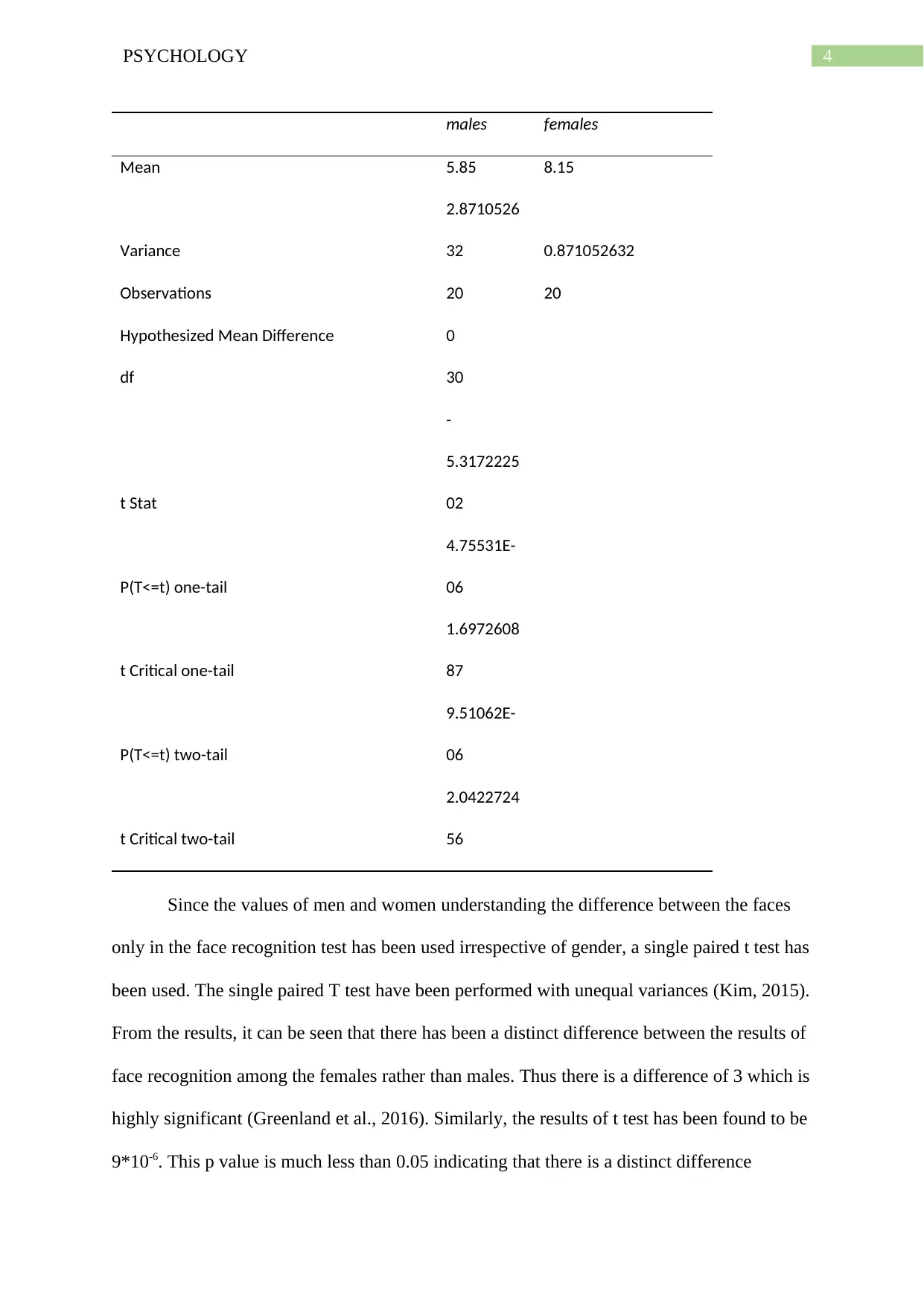
t-Test: Two-Sample Assuming Unequal Variances
tabler-icon-diamond-filled.svg

Paraphrase This Document

Need a fresh take? Get an instant paraphrase of this document with our AI Paraphraser
Document Page
4PSYCHOLOGY
males females
Mean 5.85 8.15
Variance
2.8710526
32 0.871052632
Observations 20 20
Hypothesized Mean Difference 0
df 30
t Stat
-
5.3172225
02
P(T<=t) one-tail
4.75531E-
06
t Critical one-tail
1.6972608
87
P(T<=t) two-tail
9.51062E-
06
t Critical two-tail
2.0422724
56
Since the values of men and women understanding the difference between the faces
only in the face recognition test has been used irrespective of gender, a single paired t test has
been used. The single paired T test have been performed with unequal variances (Kim, 2015).
From the results, it can be seen that there has been a distinct difference between the results of
face recognition among the females rather than males. Thus there is a difference of 3 which is
highly significant (Greenland et al., 2016). Similarly, the results of t test has been found to be
9*10-6. This p value is much less than 0.05 indicating that there is a distinct difference
Document Page
5PSYCHOLOGY
between the capabilities of recognition between males and females on the basis of single T
tests.
Document Page
6PSYCHOLOGY
References
Bellman, C., Vargas Martin, M., Liscano, R., Alomari, R., & MacDonald, S. (2017). Excuse
me, Do I know you from somewhere? Unaware facial recognition using brain-
computer interfaces.
Rehnman, J., & Herlitz, A. (2007). Women remember more faces than men do. Acta
psychologica, 124(3), 344-355.
Kim, T. K. (2015). T test as a parametric statistic. Korean journal of anesthesiology, 68(6),
540.
Greenland, S., Senn, S. J., Rothman, K. J., Carlin, J. B., Poole, C., Goodman, S. N., &
Altman, D. G. (2016). Statistical tests, P values, confidence intervals, and power: a
guide to misinterpretations. European journal of epidemiology, 31(4), 337-350.
chevron_up_icon
1 out of 7
circle_padding
hide_on_mobile
zoom_out_icon
[object Object]