Facilities Management: Developing Employee Performance Strategies
VerifiedAdded on 2023/06/03
|9
|2121
|249
Report
AI Summary
This report provides a comprehensive overview of strategies and plans for Australian Property Management Company, focusing on key areas of employee management. It suggests detailed strategies for reward and recognition, including tangible rewards and public acknowledgment, ensuring alignment with organizational guidelines and employee preferences. The report addresses poor performance by emphasizing the importance of clear performance expectations, timely discussions, and the development of performance improvement plans tailored to individual needs. It also outlines strategies for sanction and discipline, emphasizing adherence to organizational procedures, statutory requirements, and the principles of natural justice, including the right to appeal. Finally, the report covers termination procedures, stressing the importance of following proper processes, conducting thorough investigations, and avoiding discrimination. The conclusion highlights the need for fairness, transparency, and effective communication in all aspects of employee management to foster a positive and productive work environment.
Running head: FACILITIES MANAGEMENT
Facilities Management
Assessment task 3
Name of Student:
Name of College:
Authors Note:
1
Facilities Management
Assessment task 3
Name of Student:
Name of College:
Authors Note:
1

Paraphrase This Document
Need a fresh take? Get an instant paraphrase of this document with our AI Paraphraser
FACILITIES MANAGEMENT
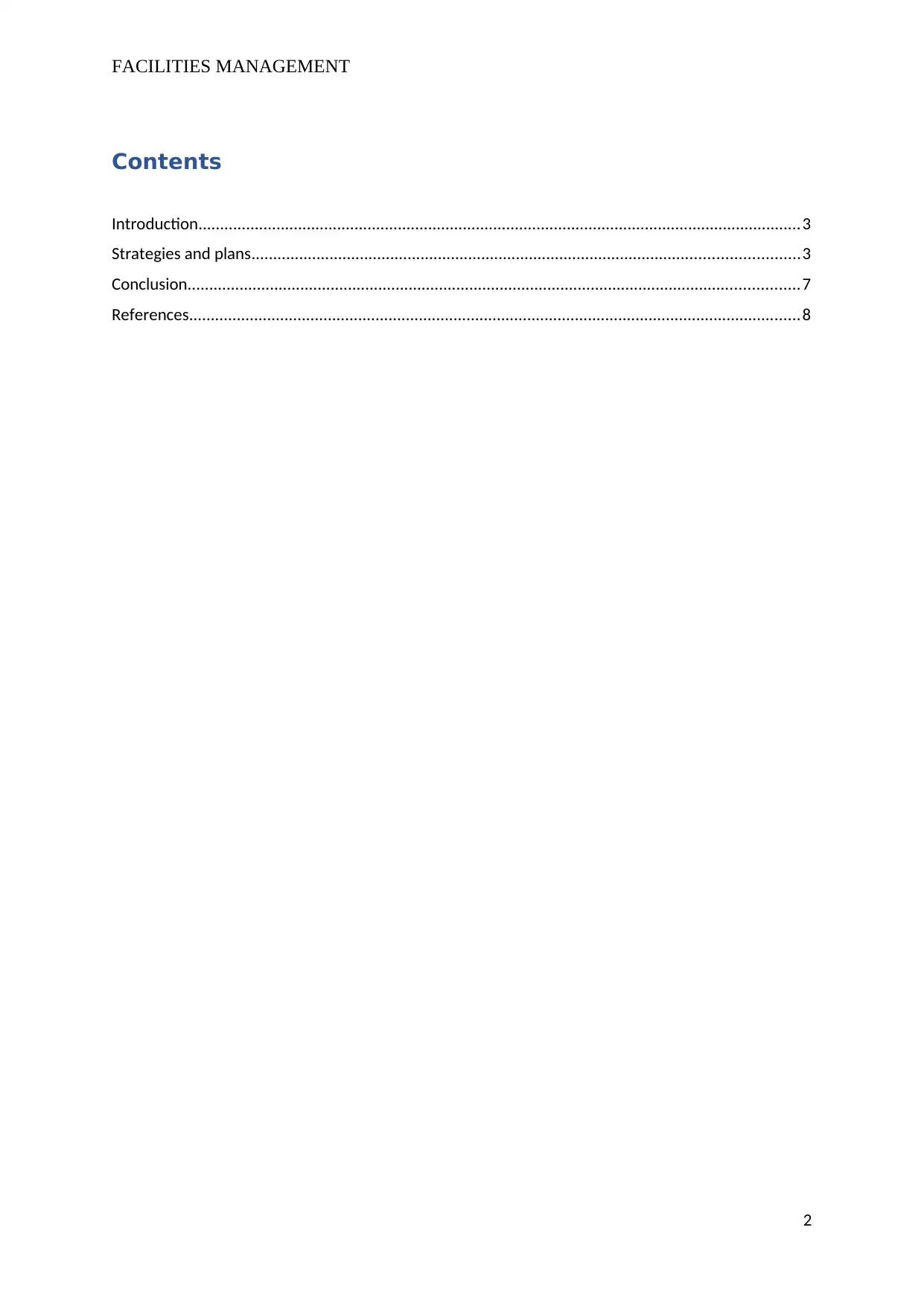
Contents
Introduction...........................................................................................................................................3
Strategies and plans..............................................................................................................................3
Conclusion.............................................................................................................................................7
References.............................................................................................................................................8
2
Contents
Introduction...........................................................................................................................................3
Strategies and plans..............................................................................................................................3
Conclusion.............................................................................................................................................7
References.............................................................................................................................................8
2
FACILITIES MANAGEMENT
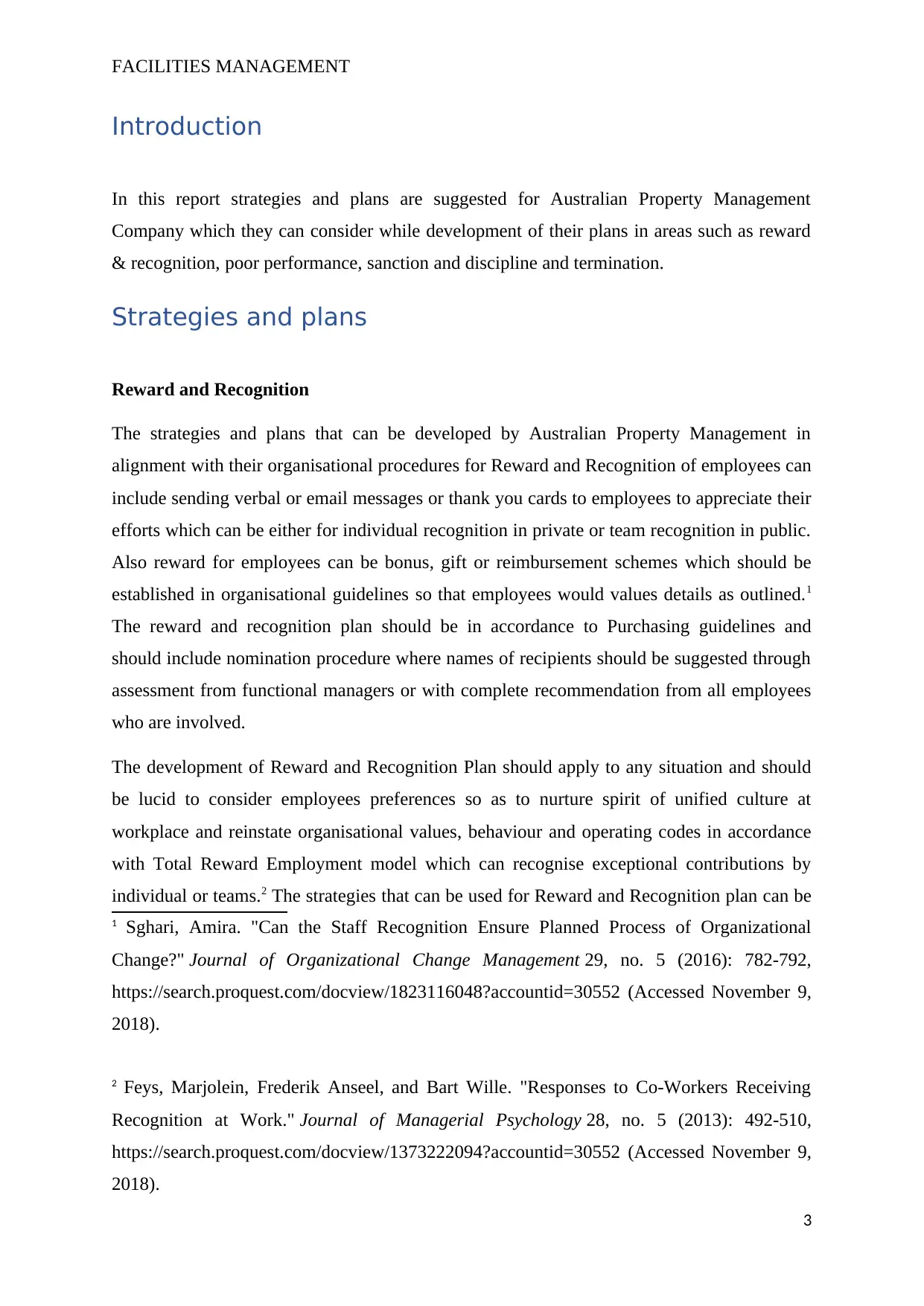
Introduction
In this report strategies and plans are suggested for Australian Property Management
Company which they can consider while development of their plans in areas such as reward
& recognition, poor performance, sanction and discipline and termination.
Strategies and plans
Reward and Recognition
The strategies and plans that can be developed by Australian Property Management in
alignment with their organisational procedures for Reward and Recognition of employees can
include sending verbal or email messages or thank you cards to employees to appreciate their
efforts which can be either for individual recognition in private or team recognition in public.
Also reward for employees can be bonus, gift or reimbursement schemes which should be
established in organisational guidelines so that employees would values details as outlined.1
The reward and recognition plan should be in accordance to Purchasing guidelines and
should include nomination procedure where names of recipients should be suggested through
assessment from functional managers or with complete recommendation from all employees
who are involved.
The development of Reward and Recognition Plan should apply to any situation and should
be lucid to consider employees preferences so as to nurture spirit of unified culture at
workplace and reinstate organisational values, behaviour and operating codes in accordance
with Total Reward Employment model which can recognise exceptional contributions by
individual or teams.2 The strategies that can be used for Reward and Recognition plan can be
1 Sghari, Amira. "Can the Staff Recognition Ensure Planned Process of Organizational
Change?" Journal of Organizational Change Management 29, no. 5 (2016): 782-792,
https://search.proquest.com/docview/1823116048?accountid=30552 (Accessed November 9,
2018).
2 Feys, Marjolein, Frederik Anseel, and Bart Wille. "Responses to Co-Workers Receiving
Recognition at Work." Journal of Managerial Psychology 28, no. 5 (2013): 492-510,
https://search.proquest.com/docview/1373222094?accountid=30552 (Accessed November 9,
2018).
3
Introduction
In this report strategies and plans are suggested for Australian Property Management
Company which they can consider while development of their plans in areas such as reward
& recognition, poor performance, sanction and discipline and termination.
Strategies and plans
Reward and Recognition
The strategies and plans that can be developed by Australian Property Management in
alignment with their organisational procedures for Reward and Recognition of employees can
include sending verbal or email messages or thank you cards to employees to appreciate their
efforts which can be either for individual recognition in private or team recognition in public.
Also reward for employees can be bonus, gift or reimbursement schemes which should be
established in organisational guidelines so that employees would values details as outlined.1
The reward and recognition plan should be in accordance to Purchasing guidelines and
should include nomination procedure where names of recipients should be suggested through
assessment from functional managers or with complete recommendation from all employees
who are involved.
The development of Reward and Recognition Plan should apply to any situation and should
be lucid to consider employees preferences so as to nurture spirit of unified culture at
workplace and reinstate organisational values, behaviour and operating codes in accordance
with Total Reward Employment model which can recognise exceptional contributions by
individual or teams.2 The strategies that can be used for Reward and Recognition plan can be
1 Sghari, Amira. "Can the Staff Recognition Ensure Planned Process of Organizational
Change?" Journal of Organizational Change Management 29, no. 5 (2016): 782-792,
https://search.proquest.com/docview/1823116048?accountid=30552 (Accessed November 9,
2018).
2 Feys, Marjolein, Frederik Anseel, and Bart Wille. "Responses to Co-Workers Receiving
Recognition at Work." Journal of Managerial Psychology 28, no. 5 (2013): 492-510,
https://search.proquest.com/docview/1373222094?accountid=30552 (Accessed November 9,
2018).
3
⊘ This is a preview!⊘
Do you want full access?
Subscribe today to unlock all pages.

Trusted by 1+ million students worldwide
FACILITIES MANAGEMENT
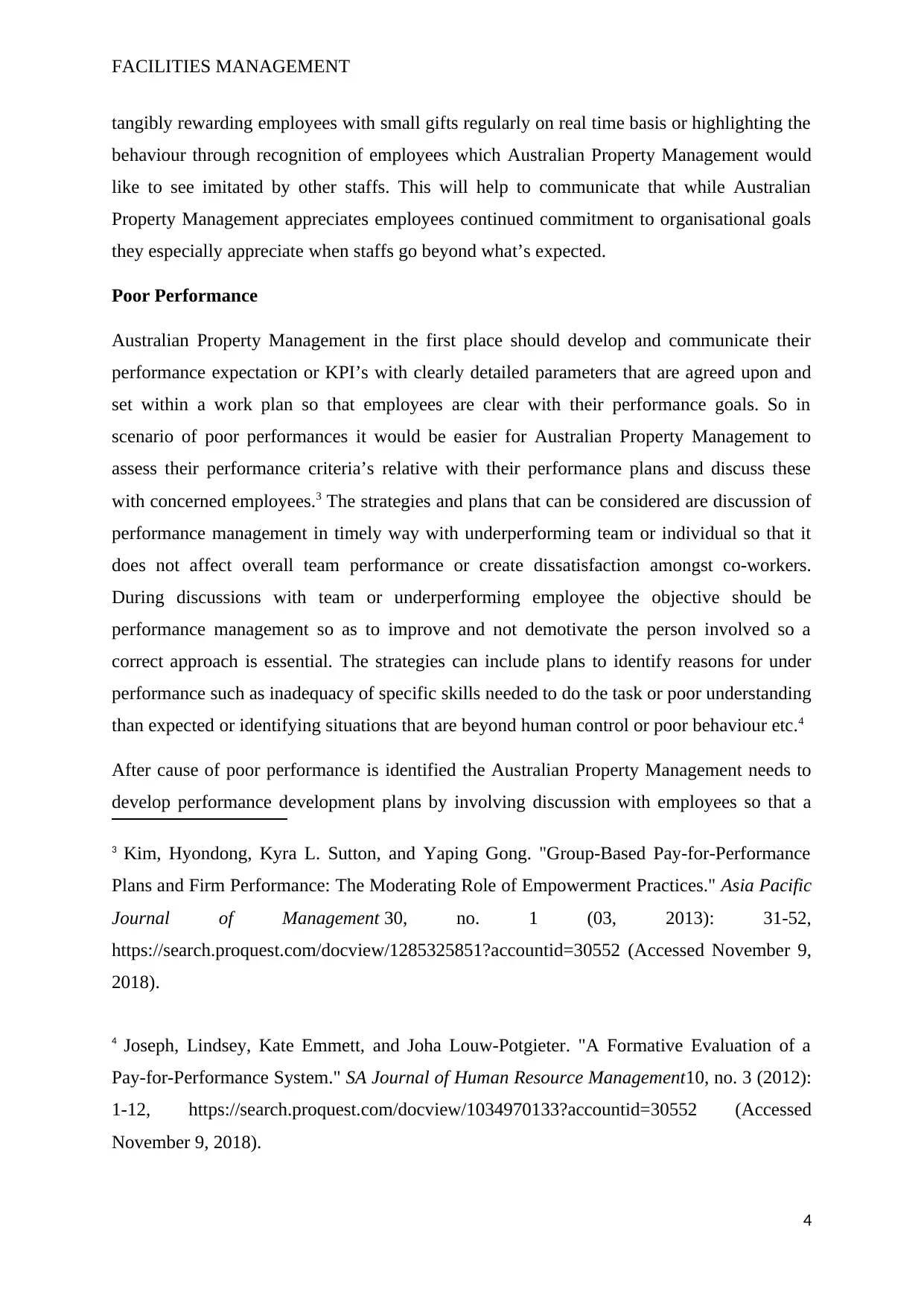
tangibly rewarding employees with small gifts regularly on real time basis or highlighting the
behaviour through recognition of employees which Australian Property Management would
like to see imitated by other staffs. This will help to communicate that while Australian
Property Management appreciates employees continued commitment to organisational goals
they especially appreciate when staffs go beyond what’s expected.
Poor Performance
Australian Property Management in the first place should develop and communicate their
performance expectation or KPI’s with clearly detailed parameters that are agreed upon and
set within a work plan so that employees are clear with their performance goals. So in
scenario of poor performances it would be easier for Australian Property Management to
assess their performance criteria’s relative with their performance plans and discuss these
with concerned employees.3 The strategies and plans that can be considered are discussion of
performance management in timely way with underperforming team or individual so that it
does not affect overall team performance or create dissatisfaction amongst co-workers.
During discussions with team or underperforming employee the objective should be
performance management so as to improve and not demotivate the person involved so a
correct approach is essential. The strategies can include plans to identify reasons for under
performance such as inadequacy of specific skills needed to do the task or poor understanding
than expected or identifying situations that are beyond human control or poor behaviour etc.4
After cause of poor performance is identified the Australian Property Management needs to
develop performance development plans by involving discussion with employees so that a
3 Kim, Hyondong, Kyra L. Sutton, and Yaping Gong. "Group-Based Pay-for-Performance
Plans and Firm Performance: The Moderating Role of Empowerment Practices." Asia Pacific
Journal of Management 30, no. 1 (03, 2013): 31-52,
https://search.proquest.com/docview/1285325851?accountid=30552 (Accessed November 9,
2018).
4 Joseph, Lindsey, Kate Emmett, and Joha Louw-Potgieter. "A Formative Evaluation of a
Pay-for-Performance System." SA Journal of Human Resource Management10, no. 3 (2012):
1-12, https://search.proquest.com/docview/1034970133?accountid=30552 (Accessed
November 9, 2018).
4
tangibly rewarding employees with small gifts regularly on real time basis or highlighting the
behaviour through recognition of employees which Australian Property Management would
like to see imitated by other staffs. This will help to communicate that while Australian
Property Management appreciates employees continued commitment to organisational goals
they especially appreciate when staffs go beyond what’s expected.
Poor Performance
Australian Property Management in the first place should develop and communicate their
performance expectation or KPI’s with clearly detailed parameters that are agreed upon and
set within a work plan so that employees are clear with their performance goals. So in
scenario of poor performances it would be easier for Australian Property Management to
assess their performance criteria’s relative with their performance plans and discuss these
with concerned employees.3 The strategies and plans that can be considered are discussion of
performance management in timely way with underperforming team or individual so that it
does not affect overall team performance or create dissatisfaction amongst co-workers.
During discussions with team or underperforming employee the objective should be
performance management so as to improve and not demotivate the person involved so a
correct approach is essential. The strategies can include plans to identify reasons for under
performance such as inadequacy of specific skills needed to do the task or poor understanding
than expected or identifying situations that are beyond human control or poor behaviour etc.4
After cause of poor performance is identified the Australian Property Management needs to
develop performance development plans by involving discussion with employees so that a
3 Kim, Hyondong, Kyra L. Sutton, and Yaping Gong. "Group-Based Pay-for-Performance
Plans and Firm Performance: The Moderating Role of Empowerment Practices." Asia Pacific
Journal of Management 30, no. 1 (03, 2013): 31-52,
https://search.proquest.com/docview/1285325851?accountid=30552 (Accessed November 9,
2018).
4 Joseph, Lindsey, Kate Emmett, and Joha Louw-Potgieter. "A Formative Evaluation of a
Pay-for-Performance System." SA Journal of Human Resource Management10, no. 3 (2012):
1-12, https://search.proquest.com/docview/1034970133?accountid=30552 (Accessed
November 9, 2018).
4
Paraphrase This Document
Need a fresh take? Get an instant paraphrase of this document with our AI Paraphraser
FACILITIES MANAGEMENT
plan is developed in agreement that outlines set of actions and timelines to improve poor
performances. The plan should be developed by considering facts that can involve behaviour,
actions, responses of employees to tasks and roles, skills and knowledge, training and
coaching so that their expectations and needs are addressed with adequate performance plans
that consider actions essential to reduce issues.5 The plans should include new opportunities
for development suited to employees and should give their direction and flexibility to take
initiative to reach to their expected targets and performance criteria.
Sanction and discipline
The strategies and plan that can be considered by Australian Property Management in context
to sanctions should include alignment with organisational procedures in accordance with
Code of Practices and disciplinary process. These should also follow statutory procedure in
case situation includes dismissal of employee or imposing some form of penalty such as
suspension without pay or demotion. The statuary procedure for sanctioning should be fair
and should include a written statement of alleged behaviour of employee, discussion of
situation in meeting with concerned employee and right to appeal.6 The sanctioning and
disciplinary process should include minimum standards that employment tribunal directs all
employers including Australian Property Management so as to remain fair and reasonable and
this process should include discussion between employer and employee before sanction stage
through counselling. Also the disciplinary process should include rules for timekeeping,
absence, health & safety, usage of organisational facilities, discrimination, bullying or
harassment and gross misconduct. The plan for sanction and discipline should include
process for need of natural justice and should be put forward to alleged employee with
5 Majeed, Abdul. "Application of Business Process through Talent Management: An
Empirical Study." Journal of Marketing and Management 4, no. 2 (11, 2013): 46-68,
https://search.proquest.com/docview/1524878842?accountid=30552 (Accessed November 9,
2018).
6 Landry, Joseph R. "FAIR RESPONSES TO UNFAIR LABOR PRACTICES: ENFORCING
FEDERAL LABOR LAW THROUGH NONTRADITIONAL FORMS OF LABOR
ACTION." Columbia Law Review 116, no. 1 (01, 2016): 147-194,
https://search.proquest.com/docview/1823023093?accountid=30552 (Accessed November 9,
2018).
5
plan is developed in agreement that outlines set of actions and timelines to improve poor
performances. The plan should be developed by considering facts that can involve behaviour,
actions, responses of employees to tasks and roles, skills and knowledge, training and
coaching so that their expectations and needs are addressed with adequate performance plans
that consider actions essential to reduce issues.5 The plans should include new opportunities
for development suited to employees and should give their direction and flexibility to take
initiative to reach to their expected targets and performance criteria.
Sanction and discipline
The strategies and plan that can be considered by Australian Property Management in context
to sanctions should include alignment with organisational procedures in accordance with
Code of Practices and disciplinary process. These should also follow statutory procedure in
case situation includes dismissal of employee or imposing some form of penalty such as
suspension without pay or demotion. The statuary procedure for sanctioning should be fair
and should include a written statement of alleged behaviour of employee, discussion of
situation in meeting with concerned employee and right to appeal.6 The sanctioning and
disciplinary process should include minimum standards that employment tribunal directs all
employers including Australian Property Management so as to remain fair and reasonable and
this process should include discussion between employer and employee before sanction stage
through counselling. Also the disciplinary process should include rules for timekeeping,
absence, health & safety, usage of organisational facilities, discrimination, bullying or
harassment and gross misconduct. The plan for sanction and discipline should include
process for need of natural justice and should be put forward to alleged employee with
5 Majeed, Abdul. "Application of Business Process through Talent Management: An
Empirical Study." Journal of Marketing and Management 4, no. 2 (11, 2013): 46-68,
https://search.proquest.com/docview/1524878842?accountid=30552 (Accessed November 9,
2018).
6 Landry, Joseph R. "FAIR RESPONSES TO UNFAIR LABOR PRACTICES: ENFORCING
FEDERAL LABOR LAW THROUGH NONTRADITIONAL FORMS OF LABOR
ACTION." Columbia Law Review 116, no. 1 (01, 2016): 147-194,
https://search.proquest.com/docview/1823023093?accountid=30552 (Accessed November 9,
2018).
5
FACILITIES MANAGEMENT
supporting evidences during discussion or counselling. Also employees should be given
chances to challenge allegations before decisions are made and should be given opportunity
to appeal. 7These plans should be put in written document and should be communicated and
applied to all non-discriminatorily and should be addressed with speed. Also information
should be allowed to be kept confidential and employees should be told the disciplinary
actions that may be taken for breach. Also the misconduct incidences should be thoroughly
investigated and employees should be given explanation for any sanction and be allowed to
appeal against actions.
Termination
Australian Property Management should follow a proper termination procedure in alignment
with their organisational process and federal and state laws during termination process of
employees. Before terminating employee for insubordination, breaking of rules or for
misconduct, the Australian Property Management should follow strategies where it should
include documenting the issue, applying fair rules and process and investigation of incident
thoroughly.8 Also in first place every employee should be communicated about termination
policies and rules of what not to do, why, and how to practice rules to give clear information.
Also immediate actions like suspension or termination should be avoided as it can create
trouble for business and proper investigation needs to be conducted to maintain termination
procedures effectively as per legal standards. 9Also it should be taken care that discrimination
7 Carden, Lila L. and Raphael O. Boyd. "WORKPLACE BULLYING: UTILIZING A RISK
MANAGEMENT FRAMEWORK TO ADDRESS BULLYING IN THE
WORKPLACE." Southern Journal of Business and Ethics 5, (2013): 8-17,
https://search.proquest.com/docview/1467933254?accountid=30552 (Accessed November 9,
2018).
8 Gely, Rafael, Robin A. Cheramie, and Timothy D. Chandler. "An Empirical Assessment of
the Contract Based Exception to the Employment-at-Will Rule." Employee Responsibilities
and Rights Journal 28, no. 1 (03, 2016): 63-78,
https://search.proquest.com/docview/1761207767?accountid=30552 (Accessed November 9,
2018).
9 Signoretto, Camille. "Mutually Agreed Termination, Job Destruction and
Dismissals." International Journal of Manpower 37, no. 8 (2016): 1365-1386,
6
supporting evidences during discussion or counselling. Also employees should be given
chances to challenge allegations before decisions are made and should be given opportunity
to appeal. 7These plans should be put in written document and should be communicated and
applied to all non-discriminatorily and should be addressed with speed. Also information
should be allowed to be kept confidential and employees should be told the disciplinary
actions that may be taken for breach. Also the misconduct incidences should be thoroughly
investigated and employees should be given explanation for any sanction and be allowed to
appeal against actions.
Termination
Australian Property Management should follow a proper termination procedure in alignment
with their organisational process and federal and state laws during termination process of
employees. Before terminating employee for insubordination, breaking of rules or for
misconduct, the Australian Property Management should follow strategies where it should
include documenting the issue, applying fair rules and process and investigation of incident
thoroughly.8 Also in first place every employee should be communicated about termination
policies and rules of what not to do, why, and how to practice rules to give clear information.
Also immediate actions like suspension or termination should be avoided as it can create
trouble for business and proper investigation needs to be conducted to maintain termination
procedures effectively as per legal standards. 9Also it should be taken care that discrimination
7 Carden, Lila L. and Raphael O. Boyd. "WORKPLACE BULLYING: UTILIZING A RISK
MANAGEMENT FRAMEWORK TO ADDRESS BULLYING IN THE
WORKPLACE." Southern Journal of Business and Ethics 5, (2013): 8-17,
https://search.proquest.com/docview/1467933254?accountid=30552 (Accessed November 9,
2018).
8 Gely, Rafael, Robin A. Cheramie, and Timothy D. Chandler. "An Empirical Assessment of
the Contract Based Exception to the Employment-at-Will Rule." Employee Responsibilities
and Rights Journal 28, no. 1 (03, 2016): 63-78,
https://search.proquest.com/docview/1761207767?accountid=30552 (Accessed November 9,
2018).
9 Signoretto, Camille. "Mutually Agreed Termination, Job Destruction and
Dismissals." International Journal of Manpower 37, no. 8 (2016): 1365-1386,
6
⊘ This is a preview!⊘
Do you want full access?
Subscribe today to unlock all pages.
Trusted by 1+ million students worldwide
FACILITIES MANAGEMENT
of any form is not practiced in termination actions and decisions and enough documentation
is provided.
Conclusion
From the discussion it can be concluded that strategies in context to reward, recognition,
performance management, termination, sanction and disciplinary procedure should include
understanding of expectations, communication and actions in timely manner with adequate
monitoring and control so that it does not affect employees negatively and create
dissatisfaction. Hence organisations should maintain adequate fairness and transparency in
these areas to remain and direct effective rules and procedures.
References
Carden, Lila L. and Raphael O. Boyd. "WORKPLACE BULLYING: UTILIZING A RISK
MANAGEMENT FRAMEWORK TO ADDRESS BULLYING IN THE
WORKPLACE." Southern Journal of Business and Ethics 5, (2013): 8-17,
https://search.proquest.com/docview/1841759201?accountid=30552 (Accessed November 9,
2018).
7
of any form is not practiced in termination actions and decisions and enough documentation
is provided.
Conclusion
From the discussion it can be concluded that strategies in context to reward, recognition,
performance management, termination, sanction and disciplinary procedure should include
understanding of expectations, communication and actions in timely manner with adequate
monitoring and control so that it does not affect employees negatively and create
dissatisfaction. Hence organisations should maintain adequate fairness and transparency in
these areas to remain and direct effective rules and procedures.
References
Carden, Lila L. and Raphael O. Boyd. "WORKPLACE BULLYING: UTILIZING A RISK
MANAGEMENT FRAMEWORK TO ADDRESS BULLYING IN THE
WORKPLACE." Southern Journal of Business and Ethics 5, (2013): 8-17,
https://search.proquest.com/docview/1841759201?accountid=30552 (Accessed November 9,
2018).
7
Paraphrase This Document
Need a fresh take? Get an instant paraphrase of this document with our AI Paraphraser
FACILITIES MANAGEMENT
https://search.proquest.com/docview/1467933254?accountid=30552 (Accessed November 9,
2018).
Feys, Marjolein, Frederik Anseel, and Bart Wille. "Responses to Co-Workers Receiving
Recognition at Work." Journal of Managerial Psychology 28, no. 5 (2013): 492-510,
https://search.proquest.com/docview/1373222094?accountid=30552 (Accessed November 9,
2018).
Gely, Rafael, Robin A. Cheramie, and Timothy D. Chandler. "An Empirical Assessment of
the Contract Based Exception to the Employment-at-Will Rule." Employee Responsibilities
and Rights Journal 28, no. 1 (03, 2016): 63-78,
https://search.proquest.com/docview/1761207767?accountid=30552 (Accessed November 9,
2018).
Joseph, Lindsey, Kate Emmett, and Joha Louw-Potgieter. "A Formative Evaluation of a Pay-
for-Performance System." SA Journal of Human Resource Management10, no. 3 (2012): 1-
12, https://search.proquest.com/docview/1034970133?accountid=30552 (Accessed
November 9, 2018).
Kim, Hyondong, Kyra L. Sutton, and Yaping Gong. "Group-Based Pay-for-Performance
Plans and Firm Performance: The Moderating Role of Empowerment Practices." Asia Pacific
Journal of Management 30, no. 1 (03, 2013): 31-52,
https://search.proquest.com/docview/1285325851?accountid=30552 (Accessed November 9,
2018).
Landry, Joseph R. "FAIR RESPONSES TO UNFAIR LABOR PRACTICES: ENFORCING
FEDERAL LABOR LAW THROUGH NONTRADITIONAL FORMS OF LABOR
ACTION." Columbia Law Review 116, no. 1 (01, 2016): 147-194,
https://search.proquest.com/docview/1823023093?accountid=30552 (Accessed November 9,
2018).
Majeed, Abdul. "Application of Business Process through Talent Management: An Empirical
Study." Journal of Marketing and Management 4, no. 2 (11, 2013): 46-68,
https://search.proquest.com/docview/1524878842?accountid=30552 (Accessed November 9,
2018).
Sghari, Amira. "Can the Staff Recognition Ensure Planned Process of Organizational
Change?" Journal of Organizational Change Management 29, no. 5 (2016): 782-792,
8
https://search.proquest.com/docview/1467933254?accountid=30552 (Accessed November 9,
2018).
Feys, Marjolein, Frederik Anseel, and Bart Wille. "Responses to Co-Workers Receiving
Recognition at Work." Journal of Managerial Psychology 28, no. 5 (2013): 492-510,
https://search.proquest.com/docview/1373222094?accountid=30552 (Accessed November 9,
2018).
Gely, Rafael, Robin A. Cheramie, and Timothy D. Chandler. "An Empirical Assessment of
the Contract Based Exception to the Employment-at-Will Rule." Employee Responsibilities
and Rights Journal 28, no. 1 (03, 2016): 63-78,
https://search.proquest.com/docview/1761207767?accountid=30552 (Accessed November 9,
2018).
Joseph, Lindsey, Kate Emmett, and Joha Louw-Potgieter. "A Formative Evaluation of a Pay-
for-Performance System." SA Journal of Human Resource Management10, no. 3 (2012): 1-
12, https://search.proquest.com/docview/1034970133?accountid=30552 (Accessed
November 9, 2018).
Kim, Hyondong, Kyra L. Sutton, and Yaping Gong. "Group-Based Pay-for-Performance
Plans and Firm Performance: The Moderating Role of Empowerment Practices." Asia Pacific
Journal of Management 30, no. 1 (03, 2013): 31-52,
https://search.proquest.com/docview/1285325851?accountid=30552 (Accessed November 9,
2018).
Landry, Joseph R. "FAIR RESPONSES TO UNFAIR LABOR PRACTICES: ENFORCING
FEDERAL LABOR LAW THROUGH NONTRADITIONAL FORMS OF LABOR
ACTION." Columbia Law Review 116, no. 1 (01, 2016): 147-194,
https://search.proquest.com/docview/1823023093?accountid=30552 (Accessed November 9,
2018).
Majeed, Abdul. "Application of Business Process through Talent Management: An Empirical
Study." Journal of Marketing and Management 4, no. 2 (11, 2013): 46-68,
https://search.proquest.com/docview/1524878842?accountid=30552 (Accessed November 9,
2018).
Sghari, Amira. "Can the Staff Recognition Ensure Planned Process of Organizational
Change?" Journal of Organizational Change Management 29, no. 5 (2016): 782-792,
8
FACILITIES MANAGEMENT
https://search.proquest.com/docview/1823116048?accountid=30552 (Accessed November 9,
2018).
Signoretto, Camille. "Mutually Agreed Termination, Job Destruction and
Dismissals." International Journal of Manpower 37, no. 8 (2016): 1365-1386,
https://search.proquest.com/docview/1841759201?accountid=30552 (Accessed November 9,
2018).
9
https://search.proquest.com/docview/1823116048?accountid=30552 (Accessed November 9,
2018).
Signoretto, Camille. "Mutually Agreed Termination, Job Destruction and
Dismissals." International Journal of Manpower 37, no. 8 (2016): 1365-1386,
https://search.proquest.com/docview/1841759201?accountid=30552 (Accessed November 9,
2018).
9
⊘ This is a preview!⊘
Do you want full access?
Subscribe today to unlock all pages.
Trusted by 1+ million students worldwide

1 out of 9


Related Documents


Your All-in-One AI-Powered Toolkit for Academic Success.
+13062052269
info@desklib.com
Available 24*7 on WhatsApp / Email
![[object Object]](/_next/static/media/star-bottom.7253800d.svg)
Unlock your academic potential
Copyright © 2020–2026 A2Z Services. All Rights Reserved. Developed and managed by ZUCOL.