Salford Business School: Facility Managers & Project Delivery Process
VerifiedAdded on 2023/04/21
|118
|22303
|144
Thesis and Dissertation
AI Summary
This dissertation, submitted to the University of Salford for an MSc in Project Management, investigates the crucial role of facility managers in the project delivery process, from the design phase through construction management. The research explores how facility managers can contribute to sustainable and cost-effective building projects by providing operational feedback during the design stage. It examines the relationship between project design and facility management, assessing the impact of facility managers' involvement on delivering sustainable projects. The study employs a mixed-method approach, including questionnaires and interviews, to gather primary data and relies on secondary data from books, journals, and online resources. The findings emphasize the importance of integrating facility management expertise early in the project lifecycle to ensure that design considerations align with efficient operation and maintenance, ultimately leading to cost-effective and sustainable outcomes. The research recommends that experienced facility managers collaborate with design teams and that their involvement is considered during project tendering, particularly for large projects. The study concludes that facility managers play a vital role in project delivery, especially during the design phase. The study also covers topics like design considerations, environmental concerns, maintenance, and construction management.
Salford Business School
Evaluating the role of facility managers in the project
delivery process from project design to the construction
management.
Mahmoud D. ABAKAR
Student ID: @00474238
Total word count: 15506
A dissertation is submitted in partial fulfilment of the requirements of The University of
Salford for the degree of MSc Project Management.
January 2019
Evaluating the role of facility managers in the project
delivery process from project design to the construction
management.
Mahmoud D. ABAKAR
Student ID: @00474238
Total word count: 15506
A dissertation is submitted in partial fulfilment of the requirements of The University of
Salford for the degree of MSc Project Management.
January 2019

Paraphrase This Document
Need a fresh take? Get an instant paraphrase of this document with our AI Paraphraser
DESIGN AND CONSTRUCTION MANAGEMENT
Abstract
This research study aims to evaluate the role of building facility managers in the project
delivery process at the design stage. Facility managers can play vital roles during the
design time in delivering projects that are sustainable and easy to maintain. That’s
because facility managers are accountable for planning, operating and also cost-
effectively maintaining the buildings after construction. It is therefore required to have
the operational feedbacks from the facility managers at the design phase to deliver a
project that’s easy to operate and maintain.
The paper aims to discuss the relationship between project design and facility
management. It assesses the role of facility managers at the design stage and how their
involvement can have impacts on delivering sustainable projects.
The research relied on books, journals, and online resources for the secondary data to
analyze the roles of facilities as well as the construction management, and linking these
roles with the project design process. To gather the primary data, a total of 94
participants requested to provide their views through questionnaires where 12 of the
participants were interviewed. The respondents were asked to offer their opinions if the
facility manager’s involvement at the project design stage is essential, and whether his
inputs will lead to a sustainable project. The researcher used a mixed method for
analyzing the data.
The conclusion from the study is that the facility manager’s participation in the project
delivery process should lead to a design that’s sustainable to run and maintain. The
research confirms facilities managers can have valuable roles to play in the project
delivery process at the design phase. The analysis of the information revealed that
design considerations made at the project design stages have led to a facility that is
cost-effective to operate and maintain. These design considerations should take the
facilities management's functions into account at the design stage to ensure delivering a
project that's cost-effective and efficient to run. Although the majority of the facility
managers can contribute to the project delivery process; the research study
recommends to consider only those with adequate experience to work with the design
team. Heravi, Coffey, and Trigunarsyah (2015) stated that inaccurate understanding of
key concepts related to sustainability, lack of the practical experiences provide negative
impacts on the efficiency of the sustainable practices in the design of the facility
management. It's also suggested to integrate the involvement of facility management
expertise at the time of project tendering, particularly for large or complex development
projects, so that contractors who neglect to include facility management professionals in
their proposals be disqualified.
Keywords: Construction management, facilities management, facility manager,
construction work, project defects, project briefing.
Page ii
Abstract
This research study aims to evaluate the role of building facility managers in the project
delivery process at the design stage. Facility managers can play vital roles during the
design time in delivering projects that are sustainable and easy to maintain. That’s
because facility managers are accountable for planning, operating and also cost-
effectively maintaining the buildings after construction. It is therefore required to have
the operational feedbacks from the facility managers at the design phase to deliver a
project that’s easy to operate and maintain.
The paper aims to discuss the relationship between project design and facility
management. It assesses the role of facility managers at the design stage and how their
involvement can have impacts on delivering sustainable projects.
The research relied on books, journals, and online resources for the secondary data to
analyze the roles of facilities as well as the construction management, and linking these
roles with the project design process. To gather the primary data, a total of 94
participants requested to provide their views through questionnaires where 12 of the
participants were interviewed. The respondents were asked to offer their opinions if the
facility manager’s involvement at the project design stage is essential, and whether his
inputs will lead to a sustainable project. The researcher used a mixed method for
analyzing the data.
The conclusion from the study is that the facility manager’s participation in the project
delivery process should lead to a design that’s sustainable to run and maintain. The
research confirms facilities managers can have valuable roles to play in the project
delivery process at the design phase. The analysis of the information revealed that
design considerations made at the project design stages have led to a facility that is
cost-effective to operate and maintain. These design considerations should take the
facilities management's functions into account at the design stage to ensure delivering a
project that's cost-effective and efficient to run. Although the majority of the facility
managers can contribute to the project delivery process; the research study
recommends to consider only those with adequate experience to work with the design
team. Heravi, Coffey, and Trigunarsyah (2015) stated that inaccurate understanding of
key concepts related to sustainability, lack of the practical experiences provide negative
impacts on the efficiency of the sustainable practices in the design of the facility
management. It's also suggested to integrate the involvement of facility management
expertise at the time of project tendering, particularly for large or complex development
projects, so that contractors who neglect to include facility management professionals in
their proposals be disqualified.
Keywords: Construction management, facilities management, facility manager,
construction work, project defects, project briefing.
Page ii
DESIGN AND CONSTRUCTION MANAGEMENT
Acknowledgement
Conducting this research has been one of the most enriching experiences of my life.
The contribution of this research to enhance my knowledge base and analytical skill has
been paramount. It gave me the opportunity to face challenges in the process and
overcome them. This would not have been possible without the valuable guidance of my
professors, peers and all the people who have contributed to this enriching experience. I
want to take this opportunity to thank my supervisor Mr. David Wheeler for the constant
guidance and support provided to me during the process of this research. It would not
be justified if I did not thank my academic guides for their essential and valuable
assistance and encouragement throughout the research process. I would also like to
thank my friends who had provided me with help and support for collecting primary data
and valuable resources. Finally, I would like to thank the professionals from various
organizations who have participated in the research survey and provided with useful
inputs into the subject. The support of all these people has been inspiring and
enlightening throughout the process of research in the matter.
Heartfelt thanks and warmest wishes
Yours Sincerely,
Page iii
Acknowledgement
Conducting this research has been one of the most enriching experiences of my life.
The contribution of this research to enhance my knowledge base and analytical skill has
been paramount. It gave me the opportunity to face challenges in the process and
overcome them. This would not have been possible without the valuable guidance of my
professors, peers and all the people who have contributed to this enriching experience. I
want to take this opportunity to thank my supervisor Mr. David Wheeler for the constant
guidance and support provided to me during the process of this research. It would not
be justified if I did not thank my academic guides for their essential and valuable
assistance and encouragement throughout the research process. I would also like to
thank my friends who had provided me with help and support for collecting primary data
and valuable resources. Finally, I would like to thank the professionals from various
organizations who have participated in the research survey and provided with useful
inputs into the subject. The support of all these people has been inspiring and
enlightening throughout the process of research in the matter.
Heartfelt thanks and warmest wishes
Yours Sincerely,
Page iii
⊘ This is a preview!⊘
Do you want full access?
Subscribe today to unlock all pages.

Trusted by 1+ million students worldwide
DESIGN AND CONSTRUCTION MANAGEMENT
Declaration
Programme & Year MSc Project Management, January 2019
Module Dissertation
Supervisor Mr. David Wheeler
Briefly, unfair means in assessed work is likely to fall into one or more of the following
categories:
Plagiarism.
Plagiarism involves taking the work of another person or source and using it as if it were
one’s own. Work includes, but is not restricted to, written work, ideas, musical
compositions, computer programs, laboratory or survey results, diagrams, graphs,
drawings and designs.
Collusion.
Collusion involves working with others on tasks that should be carried out on an
individual basis. Collusion should not be confused with collaborative work which is
sometimes used as a means of learning. It will be clearly stated when collaborative work
is permitted in an assessment. Unless advised otherwise, any work which is submitted
for assessment must be produced by individual students.
Falsifying experimental or other investigative results.
This could involve a range of things that make it appear that information has been
collected by scientific investigation, the compilation of questionnaire results, etc.
whereas in reality it has been made up or altered to provide a more favorable result.
Contracting another to write a piece of assessed work.
Page 1
Declaration
Programme & Year MSc Project Management, January 2019
Module Dissertation
Supervisor Mr. David Wheeler
Briefly, unfair means in assessed work is likely to fall into one or more of the following
categories:
Plagiarism.
Plagiarism involves taking the work of another person or source and using it as if it were
one’s own. Work includes, but is not restricted to, written work, ideas, musical
compositions, computer programs, laboratory or survey results, diagrams, graphs,
drawings and designs.
Collusion.
Collusion involves working with others on tasks that should be carried out on an
individual basis. Collusion should not be confused with collaborative work which is
sometimes used as a means of learning. It will be clearly stated when collaborative work
is permitted in an assessment. Unless advised otherwise, any work which is submitted
for assessment must be produced by individual students.
Falsifying experimental or other investigative results.
This could involve a range of things that make it appear that information has been
collected by scientific investigation, the compilation of questionnaire results, etc.
whereas in reality it has been made up or altered to provide a more favorable result.
Contracting another to write a piece of assessed work.
Page 1
Paraphrase This Document
Need a fresh take? Get an instant paraphrase of this document with our AI Paraphraser
DESIGN AND CONSTRUCTION MANAGEMENT
This involves any means whereby a person does work on behalf of another. It includes
assessments done for someone else in full or in part by a fellow student, a friend or
family member. It includes sitting an examination for someone else. It also covers
obtaining material from Internet ‘cheat sites’ or other sources of work. Penalties for this
type of unfair means are likely to apply both to a student who does work on behalf of
another and one who has work done for him/her.
By submitting my work here I declare that:
this work is my own
if this is a group project, each student has contributed to the work in accordance
with the set criteria
the work of others used in its completion has been duly acknowledged
experimental or other investigative results have not been falsified
I have read and understood the University Policy on the Conduct of Assessed
Work (Academic Misconduct Procedure) -
http://www.salford.ac.uk/__data/assets/pdf_file/0005/653648/AcademicMiscondu
ctProcedure.pdf
It is the student’s responsibility to be aware of this policy and procedure.
Signature _________________________
Name (print) MAHAMOUD DAOUD ABAKAR
ID Number Date @00474238 Date February 25, 2019
Page 2
This involves any means whereby a person does work on behalf of another. It includes
assessments done for someone else in full or in part by a fellow student, a friend or
family member. It includes sitting an examination for someone else. It also covers
obtaining material from Internet ‘cheat sites’ or other sources of work. Penalties for this
type of unfair means are likely to apply both to a student who does work on behalf of
another and one who has work done for him/her.
By submitting my work here I declare that:
this work is my own
if this is a group project, each student has contributed to the work in accordance
with the set criteria
the work of others used in its completion has been duly acknowledged
experimental or other investigative results have not been falsified
I have read and understood the University Policy on the Conduct of Assessed
Work (Academic Misconduct Procedure) -
http://www.salford.ac.uk/__data/assets/pdf_file/0005/653648/AcademicMiscondu
ctProcedure.pdf
It is the student’s responsibility to be aware of this policy and procedure.
Signature _________________________
Name (print) MAHAMOUD DAOUD ABAKAR
ID Number Date @00474238 Date February 25, 2019
Page 2
DESIGN AND CONSTRUCTION MANAGEMENT
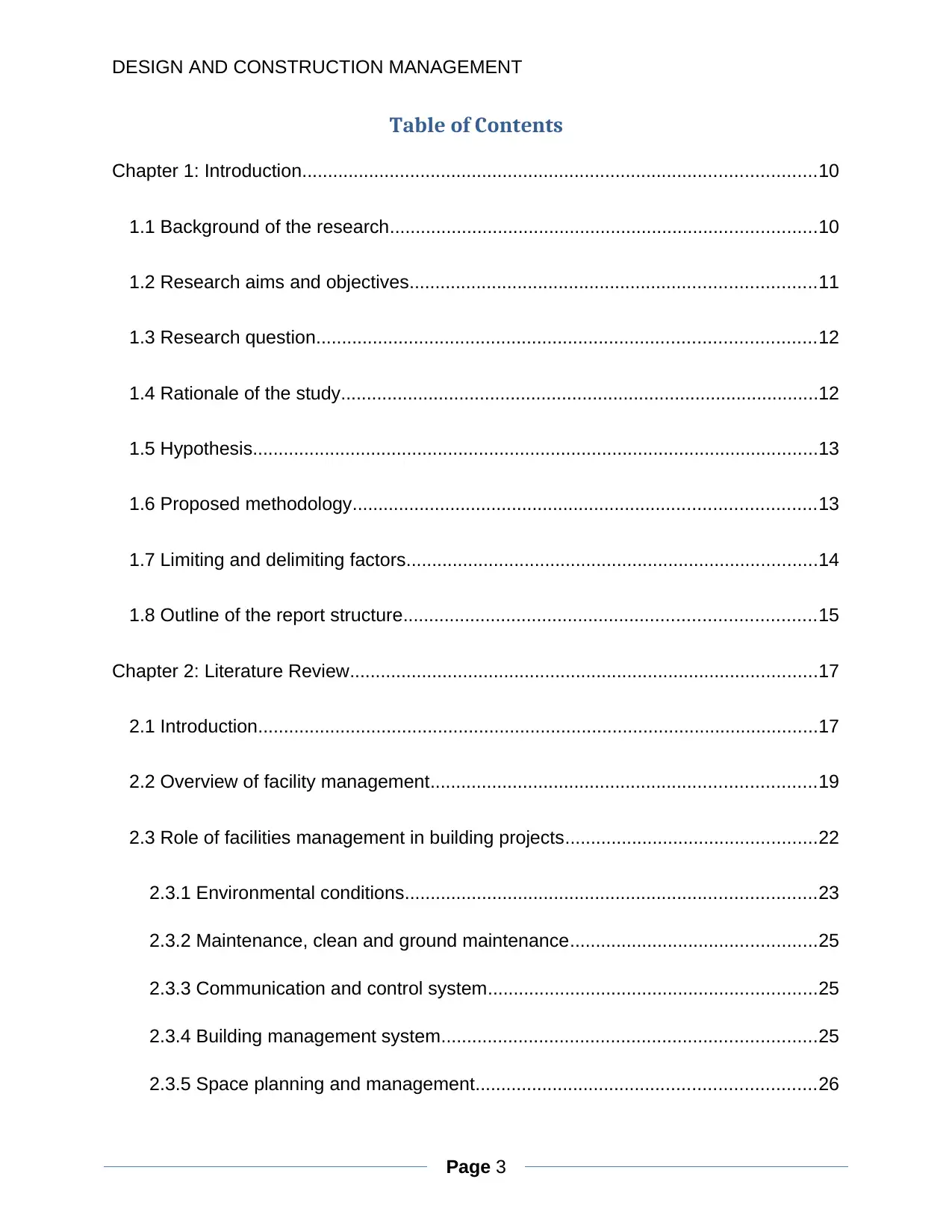
Table of Contents
Chapter 1: Introduction....................................................................................................10
1.1 Background of the research...................................................................................10
1.2 Research aims and objectives...............................................................................11
1.3 Research question.................................................................................................12
1.4 Rationale of the study.............................................................................................12
1.5 Hypothesis..............................................................................................................13
1.6 Proposed methodology..........................................................................................13
1.7 Limiting and delimiting factors................................................................................14
1.8 Outline of the report structure................................................................................15
Chapter 2: Literature Review...........................................................................................17
2.1 Introduction.............................................................................................................17
2.2 Overview of facility management...........................................................................19
2.3 Role of facilities management in building projects.................................................22
2.3.1 Environmental conditions................................................................................23
2.3.2 Maintenance, clean and ground maintenance................................................25
2.3.3 Communication and control system................................................................25
2.3.4 Building management system.........................................................................25
2.3.5 Space planning and management..................................................................26
Page 3
Table of Contents
Chapter 1: Introduction....................................................................................................10
1.1 Background of the research...................................................................................10
1.2 Research aims and objectives...............................................................................11
1.3 Research question.................................................................................................12
1.4 Rationale of the study.............................................................................................12
1.5 Hypothesis..............................................................................................................13
1.6 Proposed methodology..........................................................................................13
1.7 Limiting and delimiting factors................................................................................14
1.8 Outline of the report structure................................................................................15
Chapter 2: Literature Review...........................................................................................17
2.1 Introduction.............................................................................................................17
2.2 Overview of facility management...........................................................................19
2.3 Role of facilities management in building projects.................................................22
2.3.1 Environmental conditions................................................................................23
2.3.2 Maintenance, clean and ground maintenance................................................25
2.3.3 Communication and control system................................................................25
2.3.4 Building management system.........................................................................25
2.3.5 Space planning and management..................................................................26
Page 3
⊘ This is a preview!⊘
Do you want full access?
Subscribe today to unlock all pages.
Trusted by 1+ million students worldwide
DESIGN AND CONSTRUCTION MANAGEMENT
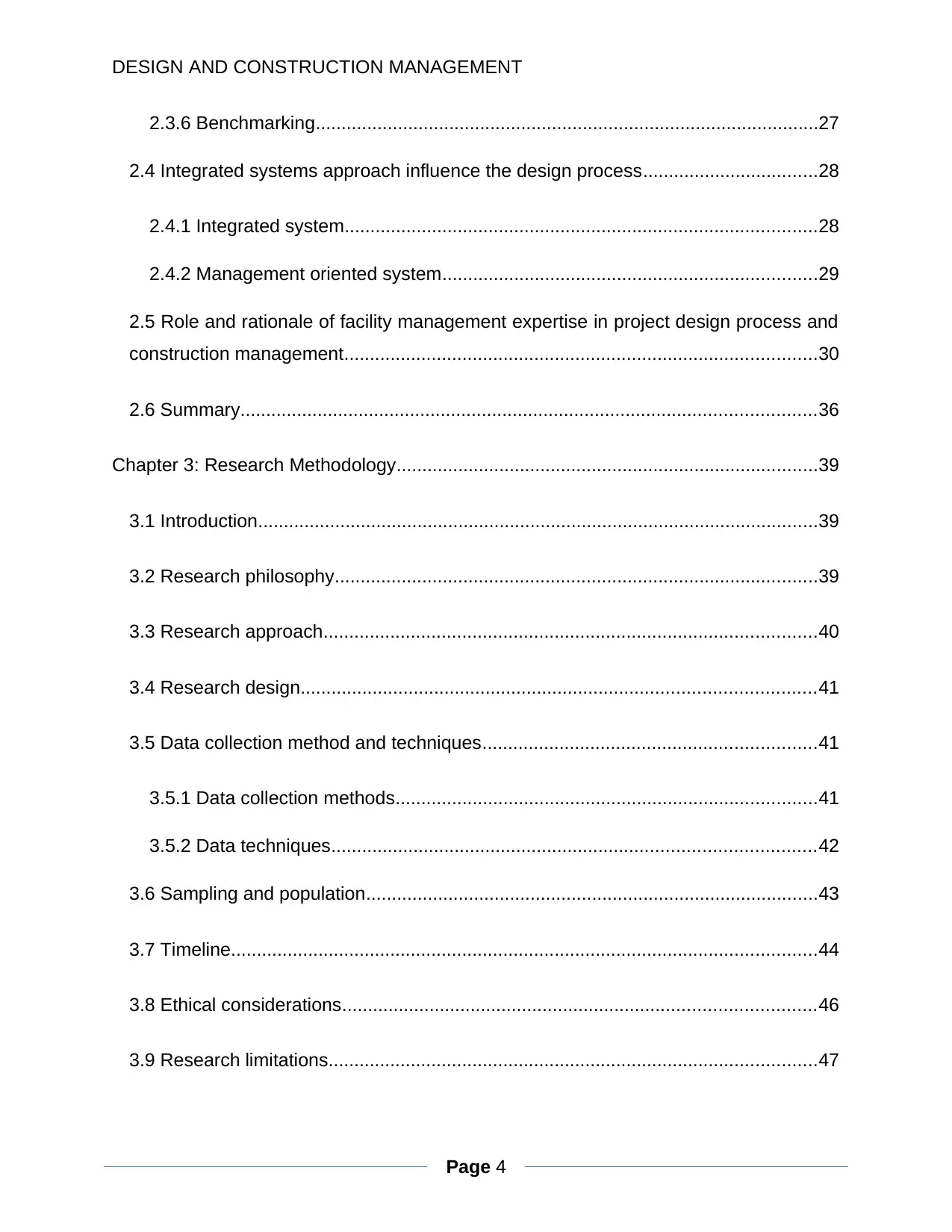
2.3.6 Benchmarking..................................................................................................27
2.4 Integrated systems approach influence the design process..................................28
2.4.1 Integrated system............................................................................................28
2.4.2 Management oriented system.........................................................................29
2.5 Role and rationale of facility management expertise in project design process and
construction management............................................................................................30
2.6 Summary................................................................................................................36
Chapter 3: Research Methodology..................................................................................39
3.1 Introduction.............................................................................................................39
3.2 Research philosophy..............................................................................................39
3.3 Research approach................................................................................................40
3.4 Research design....................................................................................................41
3.5 Data collection method and techniques.................................................................41
3.5.1 Data collection methods..................................................................................41
3.5.2 Data techniques..............................................................................................42
3.6 Sampling and population........................................................................................43
3.7 Timeline..................................................................................................................44
3.8 Ethical considerations............................................................................................46
3.9 Research limitations...............................................................................................47
Page 4
2.3.6 Benchmarking..................................................................................................27
2.4 Integrated systems approach influence the design process..................................28
2.4.1 Integrated system............................................................................................28
2.4.2 Management oriented system.........................................................................29
2.5 Role and rationale of facility management expertise in project design process and
construction management............................................................................................30
2.6 Summary................................................................................................................36
Chapter 3: Research Methodology..................................................................................39
3.1 Introduction.............................................................................................................39
3.2 Research philosophy..............................................................................................39
3.3 Research approach................................................................................................40
3.4 Research design....................................................................................................41
3.5 Data collection method and techniques.................................................................41
3.5.1 Data collection methods..................................................................................41
3.5.2 Data techniques..............................................................................................42
3.6 Sampling and population........................................................................................43
3.7 Timeline..................................................................................................................44
3.8 Ethical considerations............................................................................................46
3.9 Research limitations...............................................................................................47
Page 4
Paraphrase This Document
Need a fresh take? Get an instant paraphrase of this document with our AI Paraphraser
DESIGN AND CONSTRUCTION MANAGEMENT
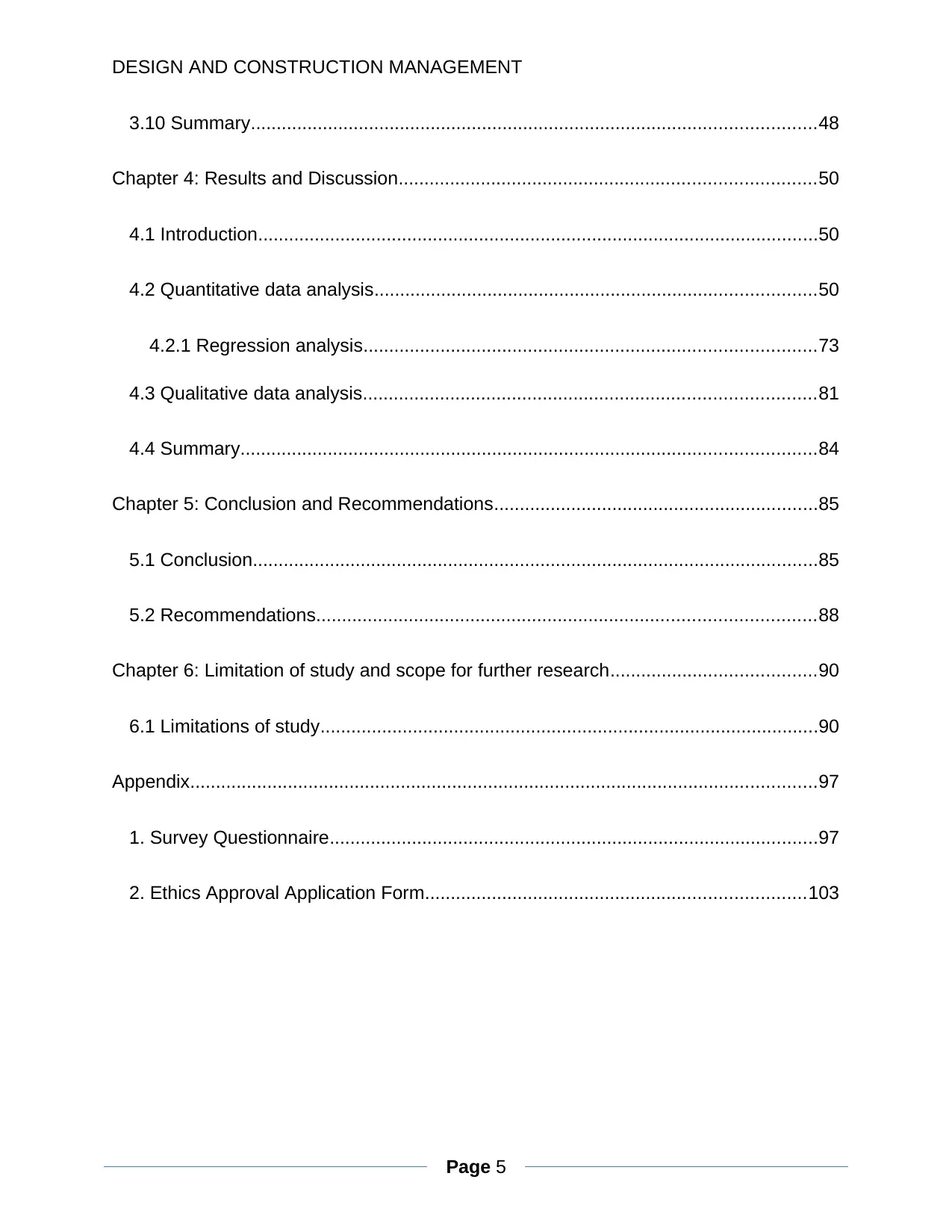
3.10 Summary..............................................................................................................48
Chapter 4: Results and Discussion.................................................................................50
4.1 Introduction.............................................................................................................50
4.2 Quantitative data analysis......................................................................................50
4.2.1 Regression analysis........................................................................................73
4.3 Qualitative data analysis........................................................................................81
4.4 Summary................................................................................................................84
Chapter 5: Conclusion and Recommendations...............................................................85
5.1 Conclusion..............................................................................................................85
5.2 Recommendations.................................................................................................88
Chapter 6: Limitation of study and scope for further research........................................90
6.1 Limitations of study.................................................................................................90
Appendix..........................................................................................................................97
1. Survey Questionnaire...............................................................................................97
2. Ethics Approval Application Form..........................................................................103
Page 5
3.10 Summary..............................................................................................................48
Chapter 4: Results and Discussion.................................................................................50
4.1 Introduction.............................................................................................................50
4.2 Quantitative data analysis......................................................................................50
4.2.1 Regression analysis........................................................................................73
4.3 Qualitative data analysis........................................................................................81
4.4 Summary................................................................................................................84
Chapter 5: Conclusion and Recommendations...............................................................85
5.1 Conclusion..............................................................................................................85
5.2 Recommendations.................................................................................................88
Chapter 6: Limitation of study and scope for further research........................................90
6.1 Limitations of study.................................................................................................90
Appendix..........................................................................................................................97
1. Survey Questionnaire...............................................................................................97
2. Ethics Approval Application Form..........................................................................103
Page 5
DESIGN AND CONSTRUCTION MANAGEMENT
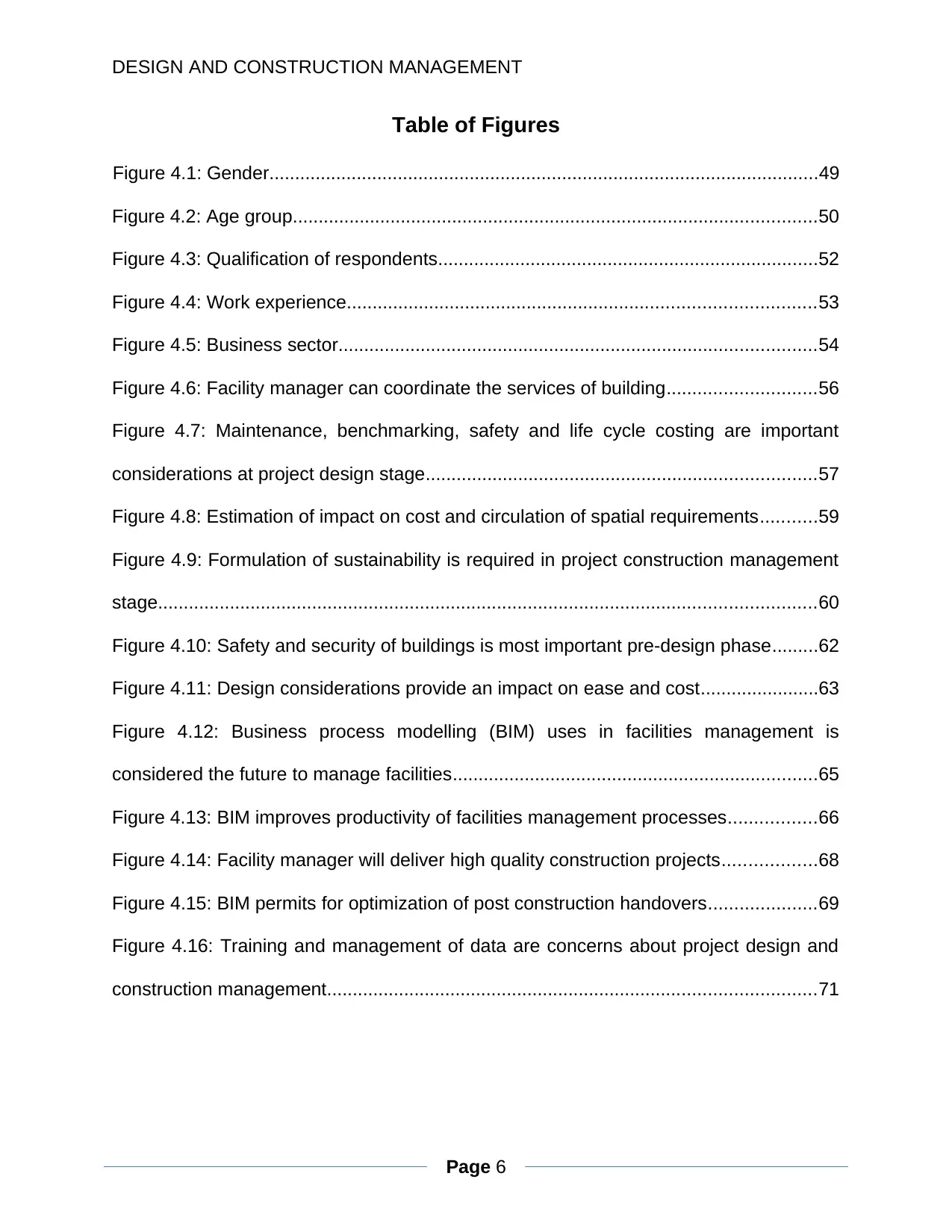
Table of Figures
Figure 4.1: Gender...........................................................................................................49
Figure 4.2: Age group......................................................................................................50
Figure 4.3: Qualification of respondents..........................................................................52
Figure 4.4: Work experience...........................................................................................53
Figure 4.5: Business sector.............................................................................................54
Figure 4.6: Facility manager can coordinate the services of building.............................56
Figure 4.7: Maintenance, benchmarking, safety and life cycle costing are important
considerations at project design stage............................................................................57
Figure 4.8: Estimation of impact on cost and circulation of spatial requirements...........59
Figure 4.9: Formulation of sustainability is required in project construction management
stage................................................................................................................................60
Figure 4.10: Safety and security of buildings is most important pre-design phase.........62
Figure 4.11: Design considerations provide an impact on ease and cost.......................63
Figure 4.12: Business process modelling (BIM) uses in facilities management is
considered the future to manage facilities.......................................................................65
Figure 4.13: BIM improves productivity of facilities management processes.................66
Figure 4.14: Facility manager will deliver high quality construction projects..................68
Figure 4.15: BIM permits for optimization of post construction handovers.....................69
Figure 4.16: Training and management of data are concerns about project design and
construction management...............................................................................................71
Page 6
Table of Figures
Figure 4.1: Gender...........................................................................................................49
Figure 4.2: Age group......................................................................................................50
Figure 4.3: Qualification of respondents..........................................................................52
Figure 4.4: Work experience...........................................................................................53
Figure 4.5: Business sector.............................................................................................54
Figure 4.6: Facility manager can coordinate the services of building.............................56
Figure 4.7: Maintenance, benchmarking, safety and life cycle costing are important
considerations at project design stage............................................................................57
Figure 4.8: Estimation of impact on cost and circulation of spatial requirements...........59
Figure 4.9: Formulation of sustainability is required in project construction management
stage................................................................................................................................60
Figure 4.10: Safety and security of buildings is most important pre-design phase.........62
Figure 4.11: Design considerations provide an impact on ease and cost.......................63
Figure 4.12: Business process modelling (BIM) uses in facilities management is
considered the future to manage facilities.......................................................................65
Figure 4.13: BIM improves productivity of facilities management processes.................66
Figure 4.14: Facility manager will deliver high quality construction projects..................68
Figure 4.15: BIM permits for optimization of post construction handovers.....................69
Figure 4.16: Training and management of data are concerns about project design and
construction management...............................................................................................71
Page 6
⊘ This is a preview!⊘
Do you want full access?
Subscribe today to unlock all pages.
Trusted by 1+ million students worldwide
DESIGN AND CONSTRUCTION MANAGEMENT
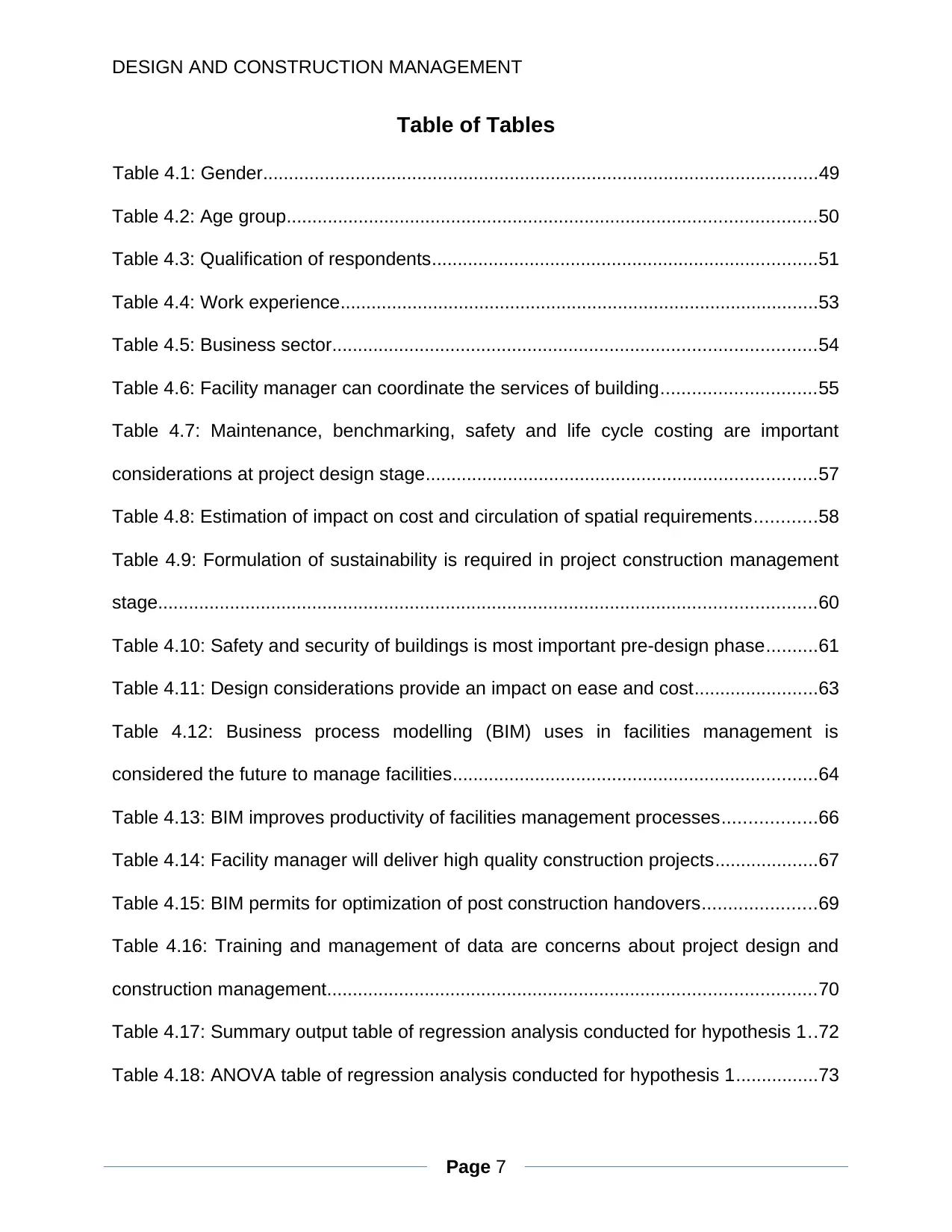
Table of Tables
Table 4.1: Gender............................................................................................................49
Table 4.2: Age group.......................................................................................................50
Table 4.3: Qualification of respondents...........................................................................51
Table 4.4: Work experience.............................................................................................53
Table 4.5: Business sector..............................................................................................54
Table 4.6: Facility manager can coordinate the services of building..............................55
Table 4.7: Maintenance, benchmarking, safety and life cycle costing are important
considerations at project design stage............................................................................57
Table 4.8: Estimation of impact on cost and circulation of spatial requirements............58
Table 4.9: Formulation of sustainability is required in project construction management
stage................................................................................................................................60
Table 4.10: Safety and security of buildings is most important pre-design phase..........61
Table 4.11: Design considerations provide an impact on ease and cost........................63
Table 4.12: Business process modelling (BIM) uses in facilities management is
considered the future to manage facilities.......................................................................64
Table 4.13: BIM improves productivity of facilities management processes..................66
Table 4.14: Facility manager will deliver high quality construction projects....................67
Table 4.15: BIM permits for optimization of post construction handovers......................69
Table 4.16: Training and management of data are concerns about project design and
construction management...............................................................................................70
Table 4.17: Summary output table of regression analysis conducted for hypothesis 1..72
Table 4.18: ANOVA table of regression analysis conducted for hypothesis 1................73
Page 7
Table of Tables
Table 4.1: Gender............................................................................................................49
Table 4.2: Age group.......................................................................................................50
Table 4.3: Qualification of respondents...........................................................................51
Table 4.4: Work experience.............................................................................................53
Table 4.5: Business sector..............................................................................................54
Table 4.6: Facility manager can coordinate the services of building..............................55
Table 4.7: Maintenance, benchmarking, safety and life cycle costing are important
considerations at project design stage............................................................................57
Table 4.8: Estimation of impact on cost and circulation of spatial requirements............58
Table 4.9: Formulation of sustainability is required in project construction management
stage................................................................................................................................60
Table 4.10: Safety and security of buildings is most important pre-design phase..........61
Table 4.11: Design considerations provide an impact on ease and cost........................63
Table 4.12: Business process modelling (BIM) uses in facilities management is
considered the future to manage facilities.......................................................................64
Table 4.13: BIM improves productivity of facilities management processes..................66
Table 4.14: Facility manager will deliver high quality construction projects....................67
Table 4.15: BIM permits for optimization of post construction handovers......................69
Table 4.16: Training and management of data are concerns about project design and
construction management...............................................................................................70
Table 4.17: Summary output table of regression analysis conducted for hypothesis 1..72
Table 4.18: ANOVA table of regression analysis conducted for hypothesis 1................73
Page 7
Paraphrase This Document
Need a fresh take? Get an instant paraphrase of this document with our AI Paraphraser
DESIGN AND CONSTRUCTION MANAGEMENT
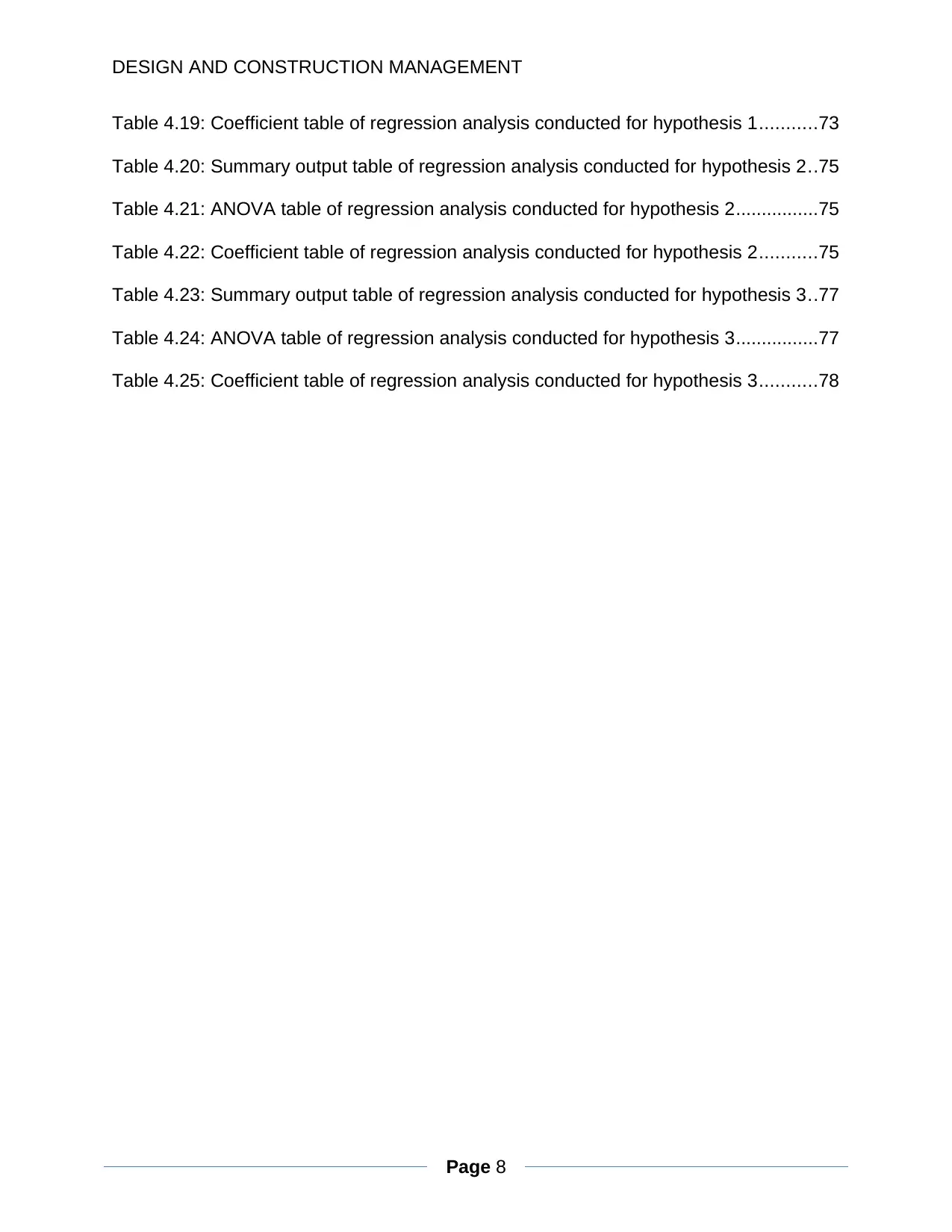
Table 4.19: Coefficient table of regression analysis conducted for hypothesis 1...........73
Table 4.20: Summary output table of regression analysis conducted for hypothesis 2..75
Table 4.21: ANOVA table of regression analysis conducted for hypothesis 2................75
Table 4.22: Coefficient table of regression analysis conducted for hypothesis 2...........75
Table 4.23: Summary output table of regression analysis conducted for hypothesis 3..77
Table 4.24: ANOVA table of regression analysis conducted for hypothesis 3................77
Table 4.25: Coefficient table of regression analysis conducted for hypothesis 3...........78
Page 8
Table 4.19: Coefficient table of regression analysis conducted for hypothesis 1...........73
Table 4.20: Summary output table of regression analysis conducted for hypothesis 2..75
Table 4.21: ANOVA table of regression analysis conducted for hypothesis 2................75
Table 4.22: Coefficient table of regression analysis conducted for hypothesis 2...........75
Table 4.23: Summary output table of regression analysis conducted for hypothesis 3..77
Table 4.24: ANOVA table of regression analysis conducted for hypothesis 3................77
Table 4.25: Coefficient table of regression analysis conducted for hypothesis 3...........78
Page 8
DESIGN AND CONSTRUCTION MANAGEMENT
Chapter 1: Introduction
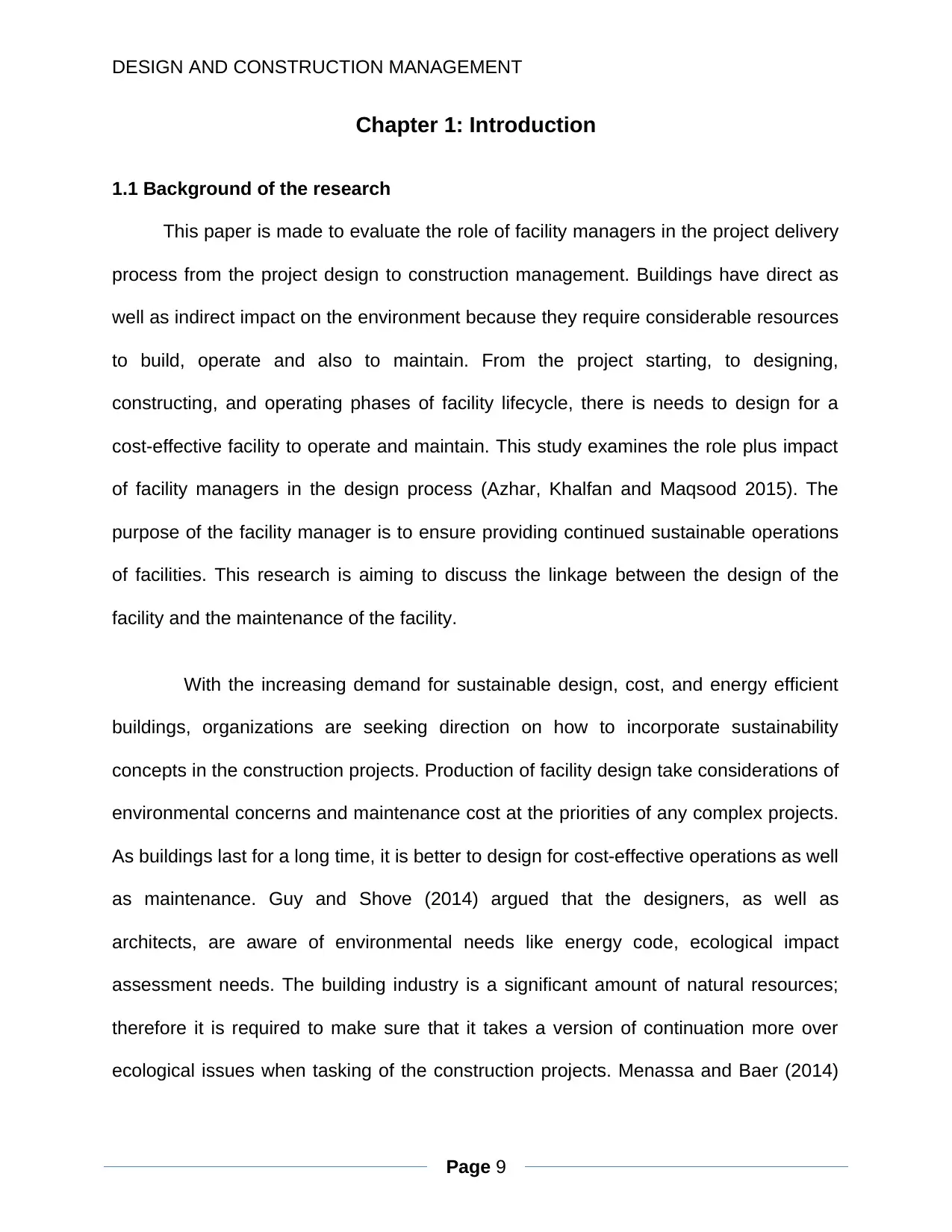
1.1 Background of the research
This paper is made to evaluate the role of facility managers in the project delivery
process from the project design to construction management. Buildings have direct as
well as indirect impact on the environment because they require considerable resources
to build, operate and also to maintain. From the project starting, to designing,
constructing, and operating phases of facility lifecycle, there is needs to design for a
cost-effective facility to operate and maintain. This study examines the role plus impact
of facility managers in the design process (Azhar, Khalfan and Maqsood 2015). The
purpose of the facility manager is to ensure providing continued sustainable operations
of facilities. This research is aiming to discuss the linkage between the design of the
facility and the maintenance of the facility.
With the increasing demand for sustainable design, cost, and energy efficient
buildings, organizations are seeking direction on how to incorporate sustainability
concepts in the construction projects. Production of facility design take considerations of
environmental concerns and maintenance cost at the priorities of any complex projects.
As buildings last for a long time, it is better to design for cost-effective operations as well
as maintenance. Guy and Shove (2014) argued that the designers, as well as
architects, are aware of environmental needs like energy code, ecological impact
assessment needs. The building industry is a significant amount of natural resources;
therefore it is required to make sure that it takes a version of continuation more over
ecological issues when tasking of the construction projects. Menassa and Baer (2014)
Page 9
Chapter 1: Introduction
1.1 Background of the research
This paper is made to evaluate the role of facility managers in the project delivery
process from the project design to construction management. Buildings have direct as
well as indirect impact on the environment because they require considerable resources
to build, operate and also to maintain. From the project starting, to designing,
constructing, and operating phases of facility lifecycle, there is needs to design for a
cost-effective facility to operate and maintain. This study examines the role plus impact
of facility managers in the design process (Azhar, Khalfan and Maqsood 2015). The
purpose of the facility manager is to ensure providing continued sustainable operations
of facilities. This research is aiming to discuss the linkage between the design of the
facility and the maintenance of the facility.
With the increasing demand for sustainable design, cost, and energy efficient
buildings, organizations are seeking direction on how to incorporate sustainability
concepts in the construction projects. Production of facility design take considerations of
environmental concerns and maintenance cost at the priorities of any complex projects.
As buildings last for a long time, it is better to design for cost-effective operations as well
as maintenance. Guy and Shove (2014) argued that the designers, as well as
architects, are aware of environmental needs like energy code, ecological impact
assessment needs. The building industry is a significant amount of natural resources;
therefore it is required to make sure that it takes a version of continuation more over
ecological issues when tasking of the construction projects. Menassa and Baer (2014)
Page 9
⊘ This is a preview!⊘
Do you want full access?
Subscribe today to unlock all pages.
Trusted by 1+ million students worldwide

1 out of 118


Related Documents


Your All-in-One AI-Powered Toolkit for Academic Success.
+13062052269
info@desklib.com
Available 24*7 on WhatsApp / Email
![[object Object]](/_next/static/media/star-bottom.7253800d.svg)
Unlock your academic potential
Copyright © 2020–2026 A2Z Services. All Rights Reserved. Developed and managed by ZUCOL.