Factors Impacting Communication in Today's Workplace - MNG81001

Verified

Added on  2023/04/11

|3
|596
|212
Report
AI Summary
This report, prepared for MNG81001, examines the key factors impacting communication in today's workplace, as requested by the Director of Communications. The analysis, based on research from academic and industry journals, focuses on three primary influences: technological advancements, globalization, and the increasing use of social media. The report highlights how technology facilitates virtual communication, collaboration, and remote work, while also acknowledging challenges like language barriers and the importance of interpersonal relationships. It then discusses how globalization leads to multicultural workplaces, necessitating tailored communication strategies to accommodate diverse preferences. Finally, it explores the transformative role of social media in internal and external communications, emphasizing the importance of policies to manage privacy risks. The report emphasizes effective communication processes as essential to overall business functions and provides a comprehensive overview of these factors.
Document Page
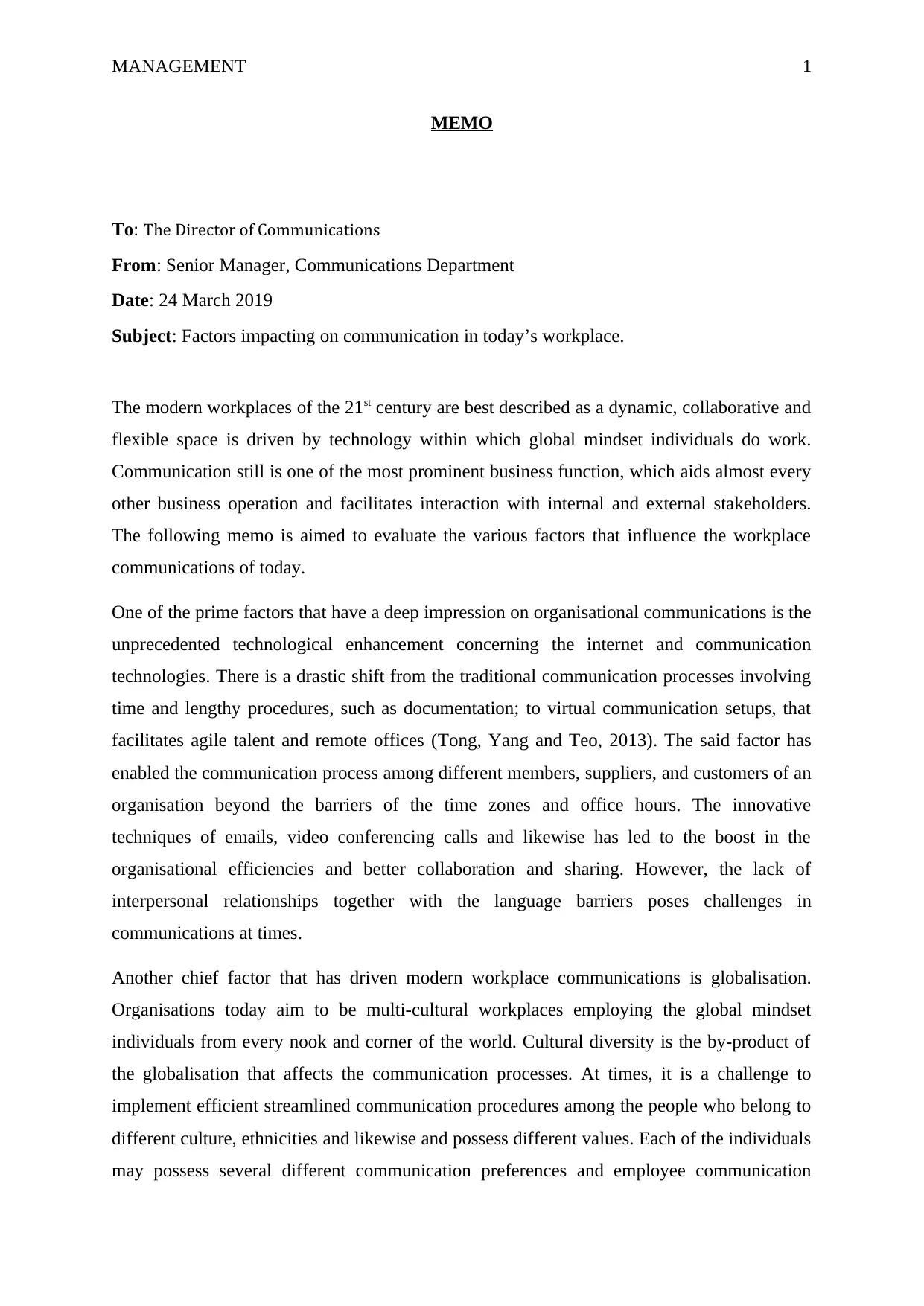
MANAGEMENT 1
MEMO
To: The Director of Communications
From: Senior Manager, Communications Department
Date: 24 March 2019
Subject: Factors impacting on communication in today’s workplace.
The modern workplaces of the 21st century are best described as a dynamic, collaborative and
flexible space is driven by technology within which global mindset individuals do work.
Communication still is one of the most prominent business function, which aids almost every
other business operation and facilitates interaction with internal and external stakeholders.
The following memo is aimed to evaluate the various factors that influence the workplace
communications of today.
One of the prime factors that have a deep impression on organisational communications is the
unprecedented technological enhancement concerning the internet and communication
technologies. There is a drastic shift from the traditional communication processes involving
time and lengthy procedures, such as documentation; to virtual communication setups, that
facilitates agile talent and remote offices (Tong, Yang and Teo, 2013). The said factor has
enabled the communication process among different members, suppliers, and customers of an
organisation beyond the barriers of the time zones and office hours. The innovative
techniques of emails, video conferencing calls and likewise has led to the boost in the
organisational efficiencies and better collaboration and sharing. However, the lack of
interpersonal relationships together with the language barriers poses challenges in
communications at times.
Another chief factor that has driven modern workplace communications is globalisation.
Organisations today aim to be multi-cultural workplaces employing the global mindset
individuals from every nook and corner of the world. Cultural diversity is the by-product of
the globalisation that affects the communication processes. At times, it is a challenge to
implement efficient streamlined communication procedures among the people who belong to
different culture, ethnicities and likewise and possess different values. Each of the individuals
may possess several different communication preferences and employee communication
tabler-icon-diamond-filled.svg

Paraphrase This Document

Need a fresh take? Get an instant paraphrase of this document with our AI Paraphraser
Document Page
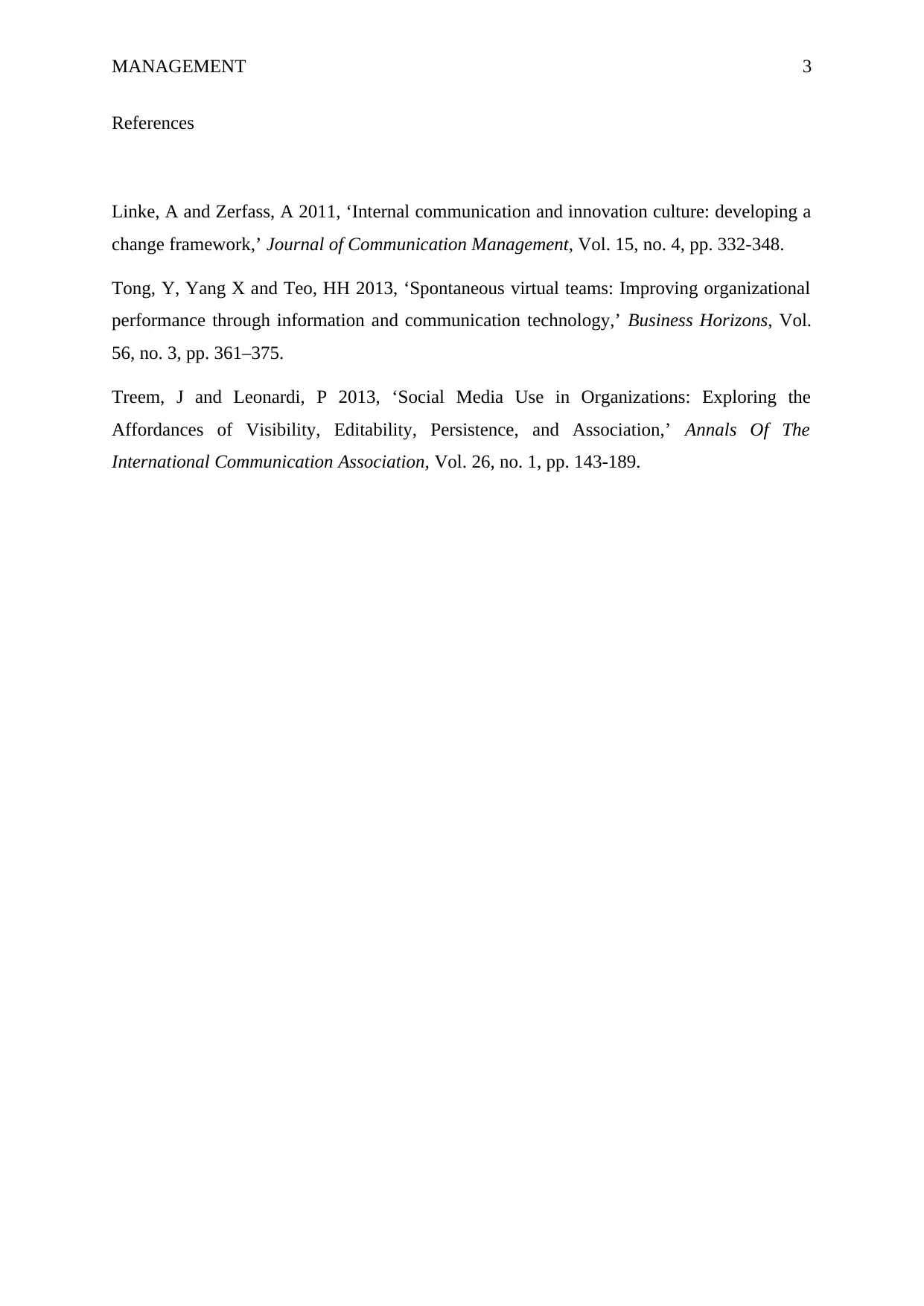
MANAGEMENT 2
becomes crucial in maintaining the employer-employee relationship (Linke and Zerfass,
2011). It is significant to tailor management communications in a way that guide and
motivate diverse individuals considering their needs.
In addition to the above, one major factor that has transformed the workplace
communications in the wake of globalisation is the increased use of social media in internal
and external communication channels. Social media has not only transformed the promotion,
branding and marketing activities in terms of external procedures, but also is stated to be a
means of employee motivation by facilitating socialization, building relationships, employee
retention, engagement and effective distribution of data in the corporate climate, as accorded
by (Treem and Leonardi, 2013). However, the barriers in the form of risks of privacy
breaches govern social media use at the workplace. Devising the communication policies at
the workplace to govern the extent of use would aid in the security of sensitive information
about the company.
As per the discussions carried on in the previous parts, it can be accorded that communication
processes have transformed significantly and a number of factors have been influencing the
same. It can be stated that effective communication processes are essential to aid the overall
business functions.
Document Page
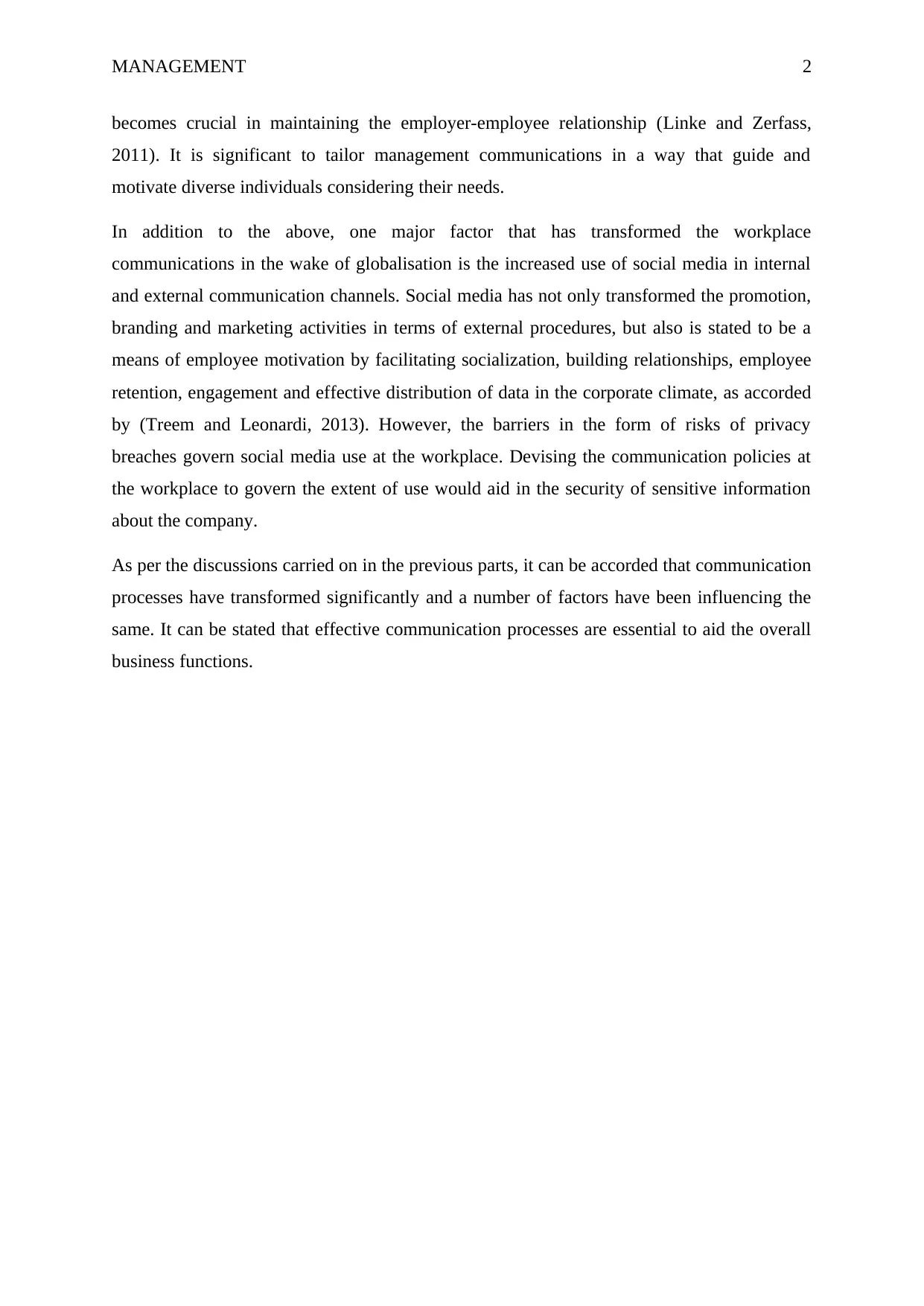
MANAGEMENT 3
References
Linke, A and Zerfass, A 2011, ‘Internal communication and innovation culture: developing a
change framework,’ Journal of Communication Management, Vol. 15, no. 4, pp. 332-348.
Tong, Y, Yang X and Teo, HH 2013, ‘Spontaneous virtual teams: Improving organizational
performance through information and communication technology,’ Business Horizons, Vol.
56, no. 3, pp. 361–375.
Treem, J and Leonardi, P 2013, ‘Social Media Use in Organizations: Exploring the
Affordances of Visibility, Editability, Persistence, and Association,’ Annals Of The
International Communication Association, Vol. 26, no. 1, pp. 143-189.
chevron_up_icon
1 out of 3
circle_padding
hide_on_mobile
zoom_out_icon
[object Object]