Factors Responsible for Delay in Large Construction Projects Report
VerifiedAdded on 2023/06/07
|41
|7496
|153
Report
AI Summary
This report delves into the critical factors responsible for delays in large construction projects, a pervasive issue within the rapidly growing global construction industry. The study identifies key factors contributing to project delays, such as lack of resources, design changes, poor communication, and ineffective project management, which often lead to cost and time overruns. Through a comprehensive literature review and analysis, the report explores the impact of delays, including disputes, litigation, and abandonment. Furthermore, it investigates the role of project management in mitigating these delays, emphasizing the importance of planning, organization, and control. The research objectives include identifying delay factors and analyzing how project management can reduce delays, aiming to provide valuable insights for construction industry professionals and future researchers seeking to improve project efficiency and success.
Factors Responsible for Delay in
Large Construction Projects
1
Large Construction Projects
1

Paraphrase This Document
Need a fresh take? Get an instant paraphrase of this document with our AI Paraphraser
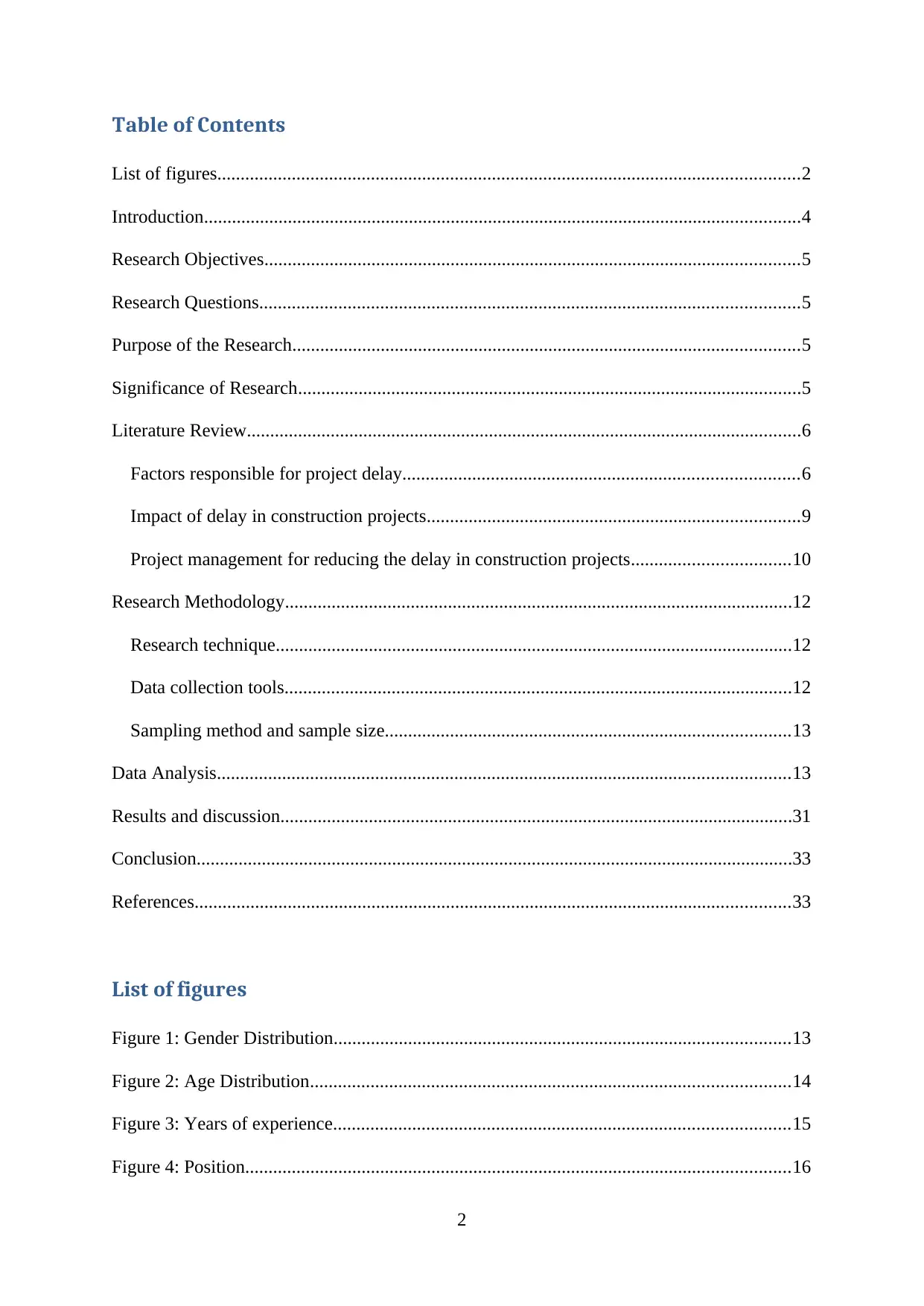
Table of Contents
List of figures.............................................................................................................................2
Introduction................................................................................................................................4
Research Objectives...................................................................................................................5
Research Questions....................................................................................................................5
Purpose of the Research.............................................................................................................5
Significance of Research............................................................................................................5
Literature Review.......................................................................................................................6
Factors responsible for project delay.....................................................................................6
Impact of delay in construction projects................................................................................9
Project management for reducing the delay in construction projects..................................10
Research Methodology.............................................................................................................12
Research technique...............................................................................................................12
Data collection tools.............................................................................................................12
Sampling method and sample size.......................................................................................13
Data Analysis...........................................................................................................................13
Results and discussion..............................................................................................................31
Conclusion................................................................................................................................33
References................................................................................................................................33
List of figures
Figure 1: Gender Distribution..................................................................................................13
Figure 2: Age Distribution.......................................................................................................14
Figure 3: Years of experience..................................................................................................15
Figure 4: Position.....................................................................................................................16
2
List of figures.............................................................................................................................2
Introduction................................................................................................................................4
Research Objectives...................................................................................................................5
Research Questions....................................................................................................................5
Purpose of the Research.............................................................................................................5
Significance of Research............................................................................................................5
Literature Review.......................................................................................................................6
Factors responsible for project delay.....................................................................................6
Impact of delay in construction projects................................................................................9
Project management for reducing the delay in construction projects..................................10
Research Methodology.............................................................................................................12
Research technique...............................................................................................................12
Data collection tools.............................................................................................................12
Sampling method and sample size.......................................................................................13
Data Analysis...........................................................................................................................13
Results and discussion..............................................................................................................31
Conclusion................................................................................................................................33
References................................................................................................................................33
List of figures
Figure 1: Gender Distribution..................................................................................................13
Figure 2: Age Distribution.......................................................................................................14
Figure 3: Years of experience..................................................................................................15
Figure 4: Position.....................................................................................................................16
2
Figure 5....................................................................................................................................17
Figure 6....................................................................................................................................18
Figure 7....................................................................................................................................19
Figure 8....................................................................................................................................20
Figure 9....................................................................................................................................21
Figure 10..................................................................................................................................22
Figure 11..................................................................................................................................23
Figure 12..................................................................................................................................24
Figure 13..................................................................................................................................25
Figure 14..................................................................................................................................26
Figure 15..................................................................................................................................27
Figure 16..................................................................................................................................28
Figure 17..................................................................................................................................29
Figure 18..................................................................................................................................30
Figure 19..................................................................................................................................31
3
Figure 6....................................................................................................................................18
Figure 7....................................................................................................................................19
Figure 8....................................................................................................................................20
Figure 9....................................................................................................................................21
Figure 10..................................................................................................................................22
Figure 11..................................................................................................................................23
Figure 12..................................................................................................................................24
Figure 13..................................................................................................................................25
Figure 14..................................................................................................................................26
Figure 15..................................................................................................................................27
Figure 16..................................................................................................................................28
Figure 17..................................................................................................................................29
Figure 18..................................................................................................................................30
Figure 19..................................................................................................................................31
3
⊘ This is a preview!⊘
Do you want full access?
Subscribe today to unlock all pages.

Trusted by 1+ million students worldwide
Introduction
The building construction industry is growing at a fast pace worldwide. There is a lack of
understanding in construction industry related to the managing the projects in efficient
manner. This results in the inconsistency in the performance of the project of construction
and this issue is growing rapidly. The failure of the building projects is noticed in
construction industry. The project failure in construction industry is mainly due to the
ineffective performance. It is also noticed that the delays in the project is main reason of
project failure in the building construction industry (Agu & Ibe, 2016). The project efficiency
can be measured in terms of timely completion of the construction project. Although,
construction process rely upon different factors such as the availability of the resources,
performance of the party involved, contractual conditions and the site conditions (Mansfield,
Ugwu, & Doran, 2013). It is important to determine main factors that affect the projects
delays of the building construction industry. Developing the relationship among the critical
attributes for the purpose of evaluating the impact of the factors of delay is essential. Along
with this, it is important to identify how the project management can help in reducing delay
of projects. Project management is a practice that helps in managing the projects of all types
in an effective and efficient manner (Chan & Kumarasivamy, 2007). It involves the planning
and controlling of the project activities to attain project success. Project management can help
in accomplishing the projects on time and within the budget through effective planning.
Hence, this research study will also investigate the contribution of the project management in
reducing construction project delays.
4
The building construction industry is growing at a fast pace worldwide. There is a lack of
understanding in construction industry related to the managing the projects in efficient
manner. This results in the inconsistency in the performance of the project of construction
and this issue is growing rapidly. The failure of the building projects is noticed in
construction industry. The project failure in construction industry is mainly due to the
ineffective performance. It is also noticed that the delays in the project is main reason of
project failure in the building construction industry (Agu & Ibe, 2016). The project efficiency
can be measured in terms of timely completion of the construction project. Although,
construction process rely upon different factors such as the availability of the resources,
performance of the party involved, contractual conditions and the site conditions (Mansfield,
Ugwu, & Doran, 2013). It is important to determine main factors that affect the projects
delays of the building construction industry. Developing the relationship among the critical
attributes for the purpose of evaluating the impact of the factors of delay is essential. Along
with this, it is important to identify how the project management can help in reducing delay
of projects. Project management is a practice that helps in managing the projects of all types
in an effective and efficient manner (Chan & Kumarasivamy, 2007). It involves the planning
and controlling of the project activities to attain project success. Project management can help
in accomplishing the projects on time and within the budget through effective planning.
Hence, this research study will also investigate the contribution of the project management in
reducing construction project delays.
4
Paraphrase This Document
Need a fresh take? Get an instant paraphrase of this document with our AI Paraphraser
Research Objectives
The research objectives for the study are:
To identify the factors which are responsible for large construction projects delay
To analyse how project management can help in reducing the delay in the project
of construction projects.
Research Questions
1. What factors are responsible for delay in large projects of construction?
2. How project management can help in reducing the delay?
Purpose of the Research
The aim of research is to identify factors that responsible for construction project delay. The
construction projects are considered as successful when they are completed within the
estimated cost and the time. The problem of the delay in the construction project is the issue
faced by this industry and the people of this industry (Odeh & Battaineh, 2005). The delay in
the project affects the project cost highly. It is important to identify the factors that cause the
delay in the project to reduce chances of the delays in large projects of construction. This
research study will also help in determining the methods in which the project management
can help in reducing delays of projects of construction.
Significance of Research
The research study will help in identifying the factors causing delay in the construction
project, which will eventually provide the support to the construction industry. The
investigation related to the contribution of the project management in reducing delays in the
construction project will also help the construction industry and provide with the knowledge
5
The research objectives for the study are:
To identify the factors which are responsible for large construction projects delay
To analyse how project management can help in reducing the delay in the project
of construction projects.
Research Questions
1. What factors are responsible for delay in large projects of construction?
2. How project management can help in reducing the delay?
Purpose of the Research
The aim of research is to identify factors that responsible for construction project delay. The
construction projects are considered as successful when they are completed within the
estimated cost and the time. The problem of the delay in the construction project is the issue
faced by this industry and the people of this industry (Odeh & Battaineh, 2005). The delay in
the project affects the project cost highly. It is important to identify the factors that cause the
delay in the project to reduce chances of the delays in large projects of construction. This
research study will also help in determining the methods in which the project management
can help in reducing delays of projects of construction.
Significance of Research
The research study will help in identifying the factors causing delay in the construction
project, which will eventually provide the support to the construction industry. The
investigation related to the contribution of the project management in reducing delays in the
construction project will also help the construction industry and provide with the knowledge
5
to the project managers in context of managing the projects in an effective manner. This
research study will contribute in providing the knowledge and the information to the future
researchers to conduct the research on this topic and will also help the construction industry
to a great extent.
Literature Review
Factors responsible for project delay
Construction industry is rapidly developing industry everywhere throughout the world.
Delays are the most serious issue in the construction projects. The construction project delays
can be recognized as late accomplishment of construction project. It is essential to identify
the reasons behind the delay in projects for reducing the same. A research study was
conducted by Naikwadi & Khare (2016) with the aim to identify causes of delays in
construction, impacts of delays and techniques for limiting the delays in construction. There
are numerous components working behind the delay in projects, some of reasons identified
are: absence of assets, changes in drawings, absence of viable communication and poor
project management. It is suggested by the authors that satisfactory construction budget,
issuing of the drawings and the information related to the building construction project on
time, efficient project management abilities ought to be the fundamental focal point of
procurement process of project (Naikwadi & Khare, 2016).
Construction industry is a significant part of the socio-economic advancement of developing
nation. Construction time fills in as a standard for evaluating the execution of any project.
The unforeseen issues experienced at the time of planning, construction and conception stage
results in uncertain and undesirable delay in the completion of construction projects.
Hammadi & Nawab (2016) conducted a survey in Saudi Arabia to identify the aspects
responsible for delay in construction projects. The authors accomplished this by analysing the
6
research study will contribute in providing the knowledge and the information to the future
researchers to conduct the research on this topic and will also help the construction industry
to a great extent.
Literature Review
Factors responsible for project delay
Construction industry is rapidly developing industry everywhere throughout the world.
Delays are the most serious issue in the construction projects. The construction project delays
can be recognized as late accomplishment of construction project. It is essential to identify
the reasons behind the delay in projects for reducing the same. A research study was
conducted by Naikwadi & Khare (2016) with the aim to identify causes of delays in
construction, impacts of delays and techniques for limiting the delays in construction. There
are numerous components working behind the delay in projects, some of reasons identified
are: absence of assets, changes in drawings, absence of viable communication and poor
project management. It is suggested by the authors that satisfactory construction budget,
issuing of the drawings and the information related to the building construction project on
time, efficient project management abilities ought to be the fundamental focal point of
procurement process of project (Naikwadi & Khare, 2016).
Construction industry is a significant part of the socio-economic advancement of developing
nation. Construction time fills in as a standard for evaluating the execution of any project.
The unforeseen issues experienced at the time of planning, construction and conception stage
results in uncertain and undesirable delay in the completion of construction projects.
Hammadi & Nawab (2016) conducted a survey in Saudi Arabia to identify the aspects
responsible for delay in construction projects. The authors accomplished this by analysing the
6
⊘ This is a preview!⊘
Do you want full access?
Subscribe today to unlock all pages.
Trusted by 1+ million students worldwide
literature and conducting a survey by involving advisors, project managers and designers or
the engineers engaged with construction projects and gathering their feedbacks. The
significance of the role of project owner, financing, contractor, and materials and design
archives factors have been referred to as the principle delay factors. The reasons for cost and
time overruns were compared with different past research conducted in Asia and Africa. It
provided the author with 7 major factors behind delay in projects: lack of constraint and
slowness, design, incompetence, market and estimate; lack of skills in workers or the
unavailability of the worker and financial ability (Hammadi & Nawab, 2016).
In Jordan, the most important economic sector is construction sector. Cost and time overrun
issues are faced by this industry. A research study was conducted by Samarah & Bekr (2016)
with the aim to identify key reasons for delays in Jordan’s public projects and, to discover
impacts of delay on the execution of projects. The authors attained the aim by a concentrated
review of literature and a field investigation was used to discover the impression of
significant parties taking an interest in the execution of the construction projects in the nation.
There were three divisions in the survey questionnaire: introductory part, reasons uncovered
by (55 causes) literature review were classified into four sets and the impact of reasons upon
the execution of the project. The authors collected the responses of 146 members including
customers, experts and contractors. The assessment helped out through the identification of
the recurrence of event, seriousness and significance of all 55 reasons for delay. The analysis
presented positioning of the critical elements for specific group and after that, the critical
components of the entire survey. Along with this, the investigation exhibited the impact of
the reasons of delays on the execution of the project (Samarah & Bekr, 2016).
Delay is commonly known as most general, complex, costly and highly risky problem in the
construction projects. It is also the major source of disputes among the contractors and
owners. The delays occur in all types of construction projects however, the degree of delays
7
the engineers engaged with construction projects and gathering their feedbacks. The
significance of the role of project owner, financing, contractor, and materials and design
archives factors have been referred to as the principle delay factors. The reasons for cost and
time overruns were compared with different past research conducted in Asia and Africa. It
provided the author with 7 major factors behind delay in projects: lack of constraint and
slowness, design, incompetence, market and estimate; lack of skills in workers or the
unavailability of the worker and financial ability (Hammadi & Nawab, 2016).
In Jordan, the most important economic sector is construction sector. Cost and time overrun
issues are faced by this industry. A research study was conducted by Samarah & Bekr (2016)
with the aim to identify key reasons for delays in Jordan’s public projects and, to discover
impacts of delay on the execution of projects. The authors attained the aim by a concentrated
review of literature and a field investigation was used to discover the impression of
significant parties taking an interest in the execution of the construction projects in the nation.
There were three divisions in the survey questionnaire: introductory part, reasons uncovered
by (55 causes) literature review were classified into four sets and the impact of reasons upon
the execution of the project. The authors collected the responses of 146 members including
customers, experts and contractors. The assessment helped out through the identification of
the recurrence of event, seriousness and significance of all 55 reasons for delay. The analysis
presented positioning of the critical elements for specific group and after that, the critical
components of the entire survey. Along with this, the investigation exhibited the impact of
the reasons of delays on the execution of the project (Samarah & Bekr, 2016).
Delay is commonly known as most general, complex, costly and highly risky problem in the
construction projects. It is also the major source of disputes among the contractors and
owners. The delays occur in all types of construction projects however, the degree of delays
7
Paraphrase This Document
Need a fresh take? Get an instant paraphrase of this document with our AI Paraphraser
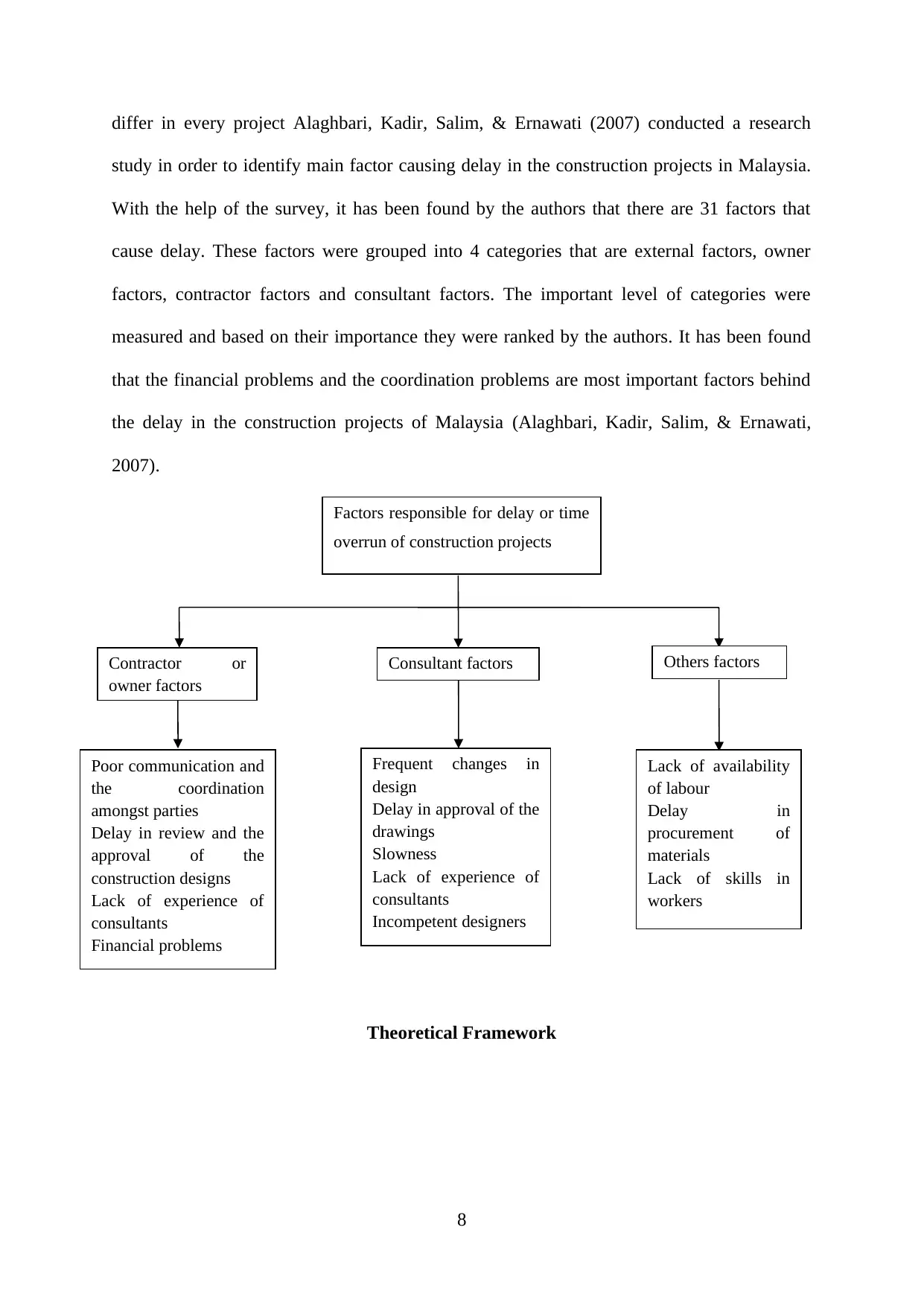
differ in every project Alaghbari, Kadir, Salim, & Ernawati (2007) conducted a research
study in order to identify main factor causing delay in the construction projects in Malaysia.
With the help of the survey, it has been found by the authors that there are 31 factors that
cause delay. These factors were grouped into 4 categories that are external factors, owner
factors, contractor factors and consultant factors. The important level of categories were
measured and based on their importance they were ranked by the authors. It has been found
that the financial problems and the coordination problems are most important factors behind
the delay in the construction projects of Malaysia (Alaghbari, Kadir, Salim, & Ernawati,
2007).
Theoretical Framework
8
Factors responsible for delay or time
overrun of construction projects
Contractor or
owner factors
Consultant factors Others factors
Poor communication and
the coordination
amongst parties
Delay in review and the
approval of the
construction designs
Lack of experience of
consultants
Financial problems
Frequent changes in
design
Delay in approval of the
drawings
Slowness
Lack of experience of
consultants
Incompetent designers
Lack of availability
of labour
Delay in
procurement of
materials
Lack of skills in
workers
study in order to identify main factor causing delay in the construction projects in Malaysia.
With the help of the survey, it has been found by the authors that there are 31 factors that
cause delay. These factors were grouped into 4 categories that are external factors, owner
factors, contractor factors and consultant factors. The important level of categories were
measured and based on their importance they were ranked by the authors. It has been found
that the financial problems and the coordination problems are most important factors behind
the delay in the construction projects of Malaysia (Alaghbari, Kadir, Salim, & Ernawati,
2007).
Theoretical Framework
8
Factors responsible for delay or time
overrun of construction projects
Contractor or
owner factors
Consultant factors Others factors
Poor communication and
the coordination
amongst parties
Delay in review and the
approval of the
construction designs
Lack of experience of
consultants
Financial problems
Frequent changes in
design
Delay in approval of the
drawings
Slowness
Lack of experience of
consultants
Incompetent designers
Lack of availability
of labour
Delay in
procurement of
materials
Lack of skills in
workers
Impact of delay in construction projects
In the research by Sambasivan & Soon (2007), it has been found that the six effects of delays
in construction project are disputes, cost and time overruns, litigation, arbitration, total
abandonment (Sambasivan & Soon, 2007).
A research study was conducted by Kikwasi (2012), with the aim to identify causes and
effects of the delays and disruptions on the construction projects. With the help of the
different techniques, it has been found by the author that negative social impact, time
overrun, cost overrun, disputes and idling resources are effects of delays in the construction
projects. It is recommended by the author that estimation of accurate budget for construction,
finalization of design, timely issuing of the information and project management skills are
highly important in order reduce effect of the delay in the construction projects (Kikwasi,
2012).
According to Hasseb, Xinhai-Lu, Bibi, Dyian & Rabbani (2011), the general consequences of
delay in construction projects are loss of capacity, wealth and time. For owner, delay in
construction projects means unavailability of facilities and loss of income. For contractor,
delay in the construction projects means loss of materials, loss of money used for hiring
labour, further investment on materials and equipment and loss of time (Haseeb, Xinhai-Lu,
Bibi, Maloof-ud-Dyian, & Rabbani, 2011).
According to Pourrostam & Ismail (2012) the delays in the construction projects can result in
several negative outcomes and effects. The six effects, as identified by the author through the
review of the literature that are (1) disputes, (2) time overrun, (3) total abandonment, (4)
litigation, (5) cost overrun, and (6) arbitration. It is important to focus upon the practices for
reducing chances of delays in the construction projects of all types. The effective use and
adoption of the practices can help in avoiding the unwanted delay in construction projects
(Pourrostam & Ismail, 2012).
9
In the research by Sambasivan & Soon (2007), it has been found that the six effects of delays
in construction project are disputes, cost and time overruns, litigation, arbitration, total
abandonment (Sambasivan & Soon, 2007).
A research study was conducted by Kikwasi (2012), with the aim to identify causes and
effects of the delays and disruptions on the construction projects. With the help of the
different techniques, it has been found by the author that negative social impact, time
overrun, cost overrun, disputes and idling resources are effects of delays in the construction
projects. It is recommended by the author that estimation of accurate budget for construction,
finalization of design, timely issuing of the information and project management skills are
highly important in order reduce effect of the delay in the construction projects (Kikwasi,
2012).
According to Hasseb, Xinhai-Lu, Bibi, Dyian & Rabbani (2011), the general consequences of
delay in construction projects are loss of capacity, wealth and time. For owner, delay in
construction projects means unavailability of facilities and loss of income. For contractor,
delay in the construction projects means loss of materials, loss of money used for hiring
labour, further investment on materials and equipment and loss of time (Haseeb, Xinhai-Lu,
Bibi, Maloof-ud-Dyian, & Rabbani, 2011).
According to Pourrostam & Ismail (2012) the delays in the construction projects can result in
several negative outcomes and effects. The six effects, as identified by the author through the
review of the literature that are (1) disputes, (2) time overrun, (3) total abandonment, (4)
litigation, (5) cost overrun, and (6) arbitration. It is important to focus upon the practices for
reducing chances of delays in the construction projects of all types. The effective use and
adoption of the practices can help in avoiding the unwanted delay in construction projects
(Pourrostam & Ismail, 2012).
9
⊘ This is a preview!⊘
Do you want full access?
Subscribe today to unlock all pages.
Trusted by 1+ million students worldwide
Project management for reducing the delay in construction projects
In order to make construction project successful, it is important to understand the project
management theory. Project management theory is considered as the collection of effective
practices that can help in the management of all kinds of project. The main function of
management includes planning, organizing, controlling and staffing. Project management
competency was presented by Chen and Partington in the year 2006 in three hierarchical
levels. In the first level, planning and the controlling of the tasks were included. In the second
level, organization of the activities of a project was incorporated and in the third level,
evaluation and management of the problems was included. It is argued by Chen and
Partington, most competent are third- level managers and least competent are first- level
managers in the project management of construction projects. The standards are utilized in
order to evaluate as well as develop the competence related to the project management. It has
been highlighted by Chen and Partington that the training to the managers is essential to fulfil
the lacked attributes in the managers of all three hierarchical levels. This can help in attaining
the effective management practices for the successful completion of projects (Chen &
Partington, 2006).
The main goal of the project management is to accomplish the project within the available
budget and time. This has been defined by PMI through analysing the practices related to the
management for the successful projects. PMBOK by PMI includes the different area of
management. It mainly includes the areas associated with the project time management and
project cost management. It offers useful principles that facilitate the project managers in
reducing schedule delays and cost overruns. Project manager can implement the process
groups that are introduced in PMBOK by PMI. The five groups that are defined in PMBOK
related to the project process are initiation, planning, executing, monitoring and controlling
and closing. Along with this, ten knowledge areas are also introduced by PMI that includes
10
In order to make construction project successful, it is important to understand the project
management theory. Project management theory is considered as the collection of effective
practices that can help in the management of all kinds of project. The main function of
management includes planning, organizing, controlling and staffing. Project management
competency was presented by Chen and Partington in the year 2006 in three hierarchical
levels. In the first level, planning and the controlling of the tasks were included. In the second
level, organization of the activities of a project was incorporated and in the third level,
evaluation and management of the problems was included. It is argued by Chen and
Partington, most competent are third- level managers and least competent are first- level
managers in the project management of construction projects. The standards are utilized in
order to evaluate as well as develop the competence related to the project management. It has
been highlighted by Chen and Partington that the training to the managers is essential to fulfil
the lacked attributes in the managers of all three hierarchical levels. This can help in attaining
the effective management practices for the successful completion of projects (Chen &
Partington, 2006).
The main goal of the project management is to accomplish the project within the available
budget and time. This has been defined by PMI through analysing the practices related to the
management for the successful projects. PMBOK by PMI includes the different area of
management. It mainly includes the areas associated with the project time management and
project cost management. It offers useful principles that facilitate the project managers in
reducing schedule delays and cost overruns. Project manager can implement the process
groups that are introduced in PMBOK by PMI. The five groups that are defined in PMBOK
related to the project process are initiation, planning, executing, monitoring and controlling
and closing. Along with this, ten knowledge areas are also introduced by PMI that includes
10
Paraphrase This Document
Need a fresh take? Get an instant paraphrase of this document with our AI Paraphraser
(a) project scope management, (b) project integration management (c) project time
management, (d) project quality management, (e) project cost management, (f) project
communication management, (g) project risk management, (h) project human resources
management (i) project stakeholder management, and (j) project procurement
management(PMI, 2013). Project managers need to practice multiple knowledge area in order
to manage the projects. It can support the project manager to interface and interact with 10
knowledge areas in process group. The success of a project can be determined through the
techniques of project management. The issues related to delay in the project can be resolved
with the help of the practices of project management (PMI, 2013). Project management
practices let project managers to manage activities of the project in a systematic manner,
which eventually contributes in accomplishing the project on time without any delay
(Whatley, 2014). The project success is determined in terms of project management, as to
whether the project is accomplished by the project manager within the available time and
budget or not (Sears, Sears, Clough, Rounds, & Segner, 2015).
The issue of time overruns or delay in the project completion is posing a serious challenge
ahead of the construction industry. The project management proficiency is important for
enhancing the performance of projects. The appropriate skills and abilities to manage the
project, through implementing the practices and the strategies of the project management can
help in reducing the issue of project delay in an effective manner. The effective planning and
control upon the activities of the project is helpful in managing the project in an efficient
manner. Project manager should know how to make his team work so that the objectives of
the project can be attained within the available time (Burnett, 2012). The effective
implementation of the theories and the practices of project management are important in
order to eliminate the issue or problem of delay in the construction projects. The effective
training related to managing the project is the most important aspect, which can help in
11
management, (d) project quality management, (e) project cost management, (f) project
communication management, (g) project risk management, (h) project human resources
management (i) project stakeholder management, and (j) project procurement
management(PMI, 2013). Project managers need to practice multiple knowledge area in order
to manage the projects. It can support the project manager to interface and interact with 10
knowledge areas in process group. The success of a project can be determined through the
techniques of project management. The issues related to delay in the project can be resolved
with the help of the practices of project management (PMI, 2013). Project management
practices let project managers to manage activities of the project in a systematic manner,
which eventually contributes in accomplishing the project on time without any delay
(Whatley, 2014). The project success is determined in terms of project management, as to
whether the project is accomplished by the project manager within the available time and
budget or not (Sears, Sears, Clough, Rounds, & Segner, 2015).
The issue of time overruns or delay in the project completion is posing a serious challenge
ahead of the construction industry. The project management proficiency is important for
enhancing the performance of projects. The appropriate skills and abilities to manage the
project, through implementing the practices and the strategies of the project management can
help in reducing the issue of project delay in an effective manner. The effective planning and
control upon the activities of the project is helpful in managing the project in an efficient
manner. Project manager should know how to make his team work so that the objectives of
the project can be attained within the available time (Burnett, 2012). The effective
implementation of the theories and the practices of project management are important in
order to eliminate the issue or problem of delay in the construction projects. The effective
training related to managing the project is the most important aspect, which can help in
11
developing the ability within the project managers to manage project and accomplish project
within the estimated project time. Developing an effective and competence project team is
important; the team members should have the knowledge about how to manage the project
activities in an effective manner. The effective understanding and the coordination among the
team can help in reducing the delays in construction projects (Simushi, 2017).
Research Methodology
In this research study, both types of research methods are used that are primary research
method and secondary research method. The secondary research method has been used to
collect the data and the information related to the research topic from the previously
conducted research studies (Kuada, 2012). The secondary sources of information that are
used in this research study to obtain the data and the information are journal articles, reports,
books, conference proceedings, newspapers and websites. The primary research methods help
in obtaining the first -hand and original data (Kothari, 2004). In order to collect the primary
data mixed approach has been used.
Research technique
In this research study, techniques that have been used for primary data collection is
qualitative and quantitative techniques. For collecting the data in the numerical form
quantitative technique has been used in the research (Kumar, 2014). It is easier to analyse the
data collected in numerical form (Achari, 2014). For obtaining in-depth information, the
qualitative technique is used (Lim & Ting, 2013; Daniel & Sam, 2011). The quantitative
approach is used in this research, so that the useful and in-depth information can be obtained.
Data collection tools
For the purpose of collecting quantitative data, survey questionnaire has been used. The
survey helps in collecting the data in the numerical form (Flick, 2015). It contains the
12
within the estimated project time. Developing an effective and competence project team is
important; the team members should have the knowledge about how to manage the project
activities in an effective manner. The effective understanding and the coordination among the
team can help in reducing the delays in construction projects (Simushi, 2017).
Research Methodology
In this research study, both types of research methods are used that are primary research
method and secondary research method. The secondary research method has been used to
collect the data and the information related to the research topic from the previously
conducted research studies (Kuada, 2012). The secondary sources of information that are
used in this research study to obtain the data and the information are journal articles, reports,
books, conference proceedings, newspapers and websites. The primary research methods help
in obtaining the first -hand and original data (Kothari, 2004). In order to collect the primary
data mixed approach has been used.
Research technique
In this research study, techniques that have been used for primary data collection is
qualitative and quantitative techniques. For collecting the data in the numerical form
quantitative technique has been used in the research (Kumar, 2014). It is easier to analyse the
data collected in numerical form (Achari, 2014). For obtaining in-depth information, the
qualitative technique is used (Lim & Ting, 2013; Daniel & Sam, 2011). The quantitative
approach is used in this research, so that the useful and in-depth information can be obtained.
Data collection tools
For the purpose of collecting quantitative data, survey questionnaire has been used. The
survey helps in collecting the data in the numerical form (Flick, 2015). It contains the
12
⊘ This is a preview!⊘
Do you want full access?
Subscribe today to unlock all pages.
Trusted by 1+ million students worldwide

1 out of 41


Related Documents


Your All-in-One AI-Powered Toolkit for Academic Success.
+13062052269
info@desklib.com
Available 24*7 on WhatsApp / Email
![[object Object]](/_next/static/media/star-bottom.7253800d.svg)
Unlock your academic potential
Copyright © 2020–2026 A2Z Services. All Rights Reserved. Developed and managed by ZUCOL.