Impulse Purchasing Factors: Online Food Delivery, Gen Y in Malaysia
VerifiedAdded on 2021/02/19
|24
|6348
|45
Project
AI Summary
This project investigates the factors influencing impulse purchasing behavior in online food delivery services among Generation Y in Malaysia. The research explores the impact of customer reviews, online advertising, sales promotions, and website design on impulsive buying decisions. The study aims to understand how these factors contribute to Gen Y's overspending habits and provides insights for marketers to develop effective strategies to enhance sales performance. The project reviews existing literature on impulse purchasing, social influence, and marketing tools, and outlines research objectives and questions to guide the investigation. The findings of this research can help businesses better understand the online purchasing patterns of millennials and create targeted marketing campaigns.
Factors Affecting Impulse Purchasing in Online Food Delivery among Gen Y in Malaysia
1.0 Introduction
1.1 Background of research
Over the few years, an advancement in technology has driven the world into the digital
era causing consumer have a new option of shopping which is an online shopping. Many large
and small businesses utilize internet technology to boost their sales and reduce costs. Gradually,
the percentage of online shoppers in Malaysia has been increased over time. The recent survey
by Malaysian Communications and Multimedia Commission showed that people at the age
range of 20’s and 30’s were the highest number of internet user while the percentage of online
shoppers among internet users raised to 53.3% in 2018. Thus, these evidences support the belief
that Generation Y is an essential group of people who contributes to the growth of e-commerce
market in Malaysia by online purchase (San, et al., 2015).
Since the change in consumer lifestyles have shifted to be more time-saving and
convenience-oriented for meal occasions, Malaysians tend to have less energy and time to
prepare meals at home (Agriculture and Agri-Food Canada, 2014). In order to satisfy the
mentioned lifestyles, especially in busy individuals, an online food ordering service has become
popular. It is offering more choices and convenience by allowing customers to order from
various restaurants via internet platforms (Hirschberg, Rajko, Schumacher & Wrulich, 2016). In
other word, one of the product Generation Y mostly purchase is food (Valentine & Power, 2013).
However, during the purchasing decision process, consumers may engage an impulsive
state. According to Khawaja (2018), an impulse purchase illustrates an unplanned and immediate
purchase. It happens when consumers experience a sudden but powerful stimulation to purchase
product offers immediately (Aruna & Santhi, 2015). Apparently, Gen Y are oversending and
indulge in impulse purchasing. UOB Malaysia managing director and country head of
personal financial services Ronnie Lim said millennials’ spending habits would dictate
and shape the consumer market as they would soon make up the largest consumer
demographic.
There are various potential factors influencing impulse purchase behavior. Firstly, Gen Y
are likely to rely on the opinion from their friends and electronic word or mouth when they are
making a decision to buy a particular product (Valentine & Power, 2013). Secondly, a marketing
tool as an online adverting can be used to establish and maintain interaction with consumers.
Nevertheless, online advertising is not the only way to communicate with consumers. Another
communication channel is website. It has been suggested in many studies that website design
should be concerned seriously in order to enhance impulse purchasing behavior in online stores
(Chen, Yeh & Lo, 2017). Lastly, many customers are triggered by a good deal due to economic
reason and perceive of value.
Therefore, this research attempts to examine these factors that could stimulate
impulse purchasing behavior in online ordering food among Generation Y in Malaysia.
1.0 Introduction
1.1 Background of research
Over the few years, an advancement in technology has driven the world into the digital
era causing consumer have a new option of shopping which is an online shopping. Many large
and small businesses utilize internet technology to boost their sales and reduce costs. Gradually,
the percentage of online shoppers in Malaysia has been increased over time. The recent survey
by Malaysian Communications and Multimedia Commission showed that people at the age
range of 20’s and 30’s were the highest number of internet user while the percentage of online
shoppers among internet users raised to 53.3% in 2018. Thus, these evidences support the belief
that Generation Y is an essential group of people who contributes to the growth of e-commerce
market in Malaysia by online purchase (San, et al., 2015).
Since the change in consumer lifestyles have shifted to be more time-saving and
convenience-oriented for meal occasions, Malaysians tend to have less energy and time to
prepare meals at home (Agriculture and Agri-Food Canada, 2014). In order to satisfy the
mentioned lifestyles, especially in busy individuals, an online food ordering service has become
popular. It is offering more choices and convenience by allowing customers to order from
various restaurants via internet platforms (Hirschberg, Rajko, Schumacher & Wrulich, 2016). In
other word, one of the product Generation Y mostly purchase is food (Valentine & Power, 2013).
However, during the purchasing decision process, consumers may engage an impulsive
state. According to Khawaja (2018), an impulse purchase illustrates an unplanned and immediate
purchase. It happens when consumers experience a sudden but powerful stimulation to purchase
product offers immediately (Aruna & Santhi, 2015). Apparently, Gen Y are oversending and
indulge in impulse purchasing. UOB Malaysia managing director and country head of
personal financial services Ronnie Lim said millennials’ spending habits would dictate
and shape the consumer market as they would soon make up the largest consumer
demographic.
There are various potential factors influencing impulse purchase behavior. Firstly, Gen Y
are likely to rely on the opinion from their friends and electronic word or mouth when they are
making a decision to buy a particular product (Valentine & Power, 2013). Secondly, a marketing
tool as an online adverting can be used to establish and maintain interaction with consumers.
Nevertheless, online advertising is not the only way to communicate with consumers. Another
communication channel is website. It has been suggested in many studies that website design
should be concerned seriously in order to enhance impulse purchasing behavior in online stores
(Chen, Yeh & Lo, 2017). Lastly, many customers are triggered by a good deal due to economic
reason and perceive of value.
Therefore, this research attempts to examine these factors that could stimulate
impulse purchasing behavior in online ordering food among Generation Y in Malaysia.

Paraphrase This Document
Need a fresh take? Get an instant paraphrase of this document with our AI Paraphraser
1.2 Problem statements
In these past few years, there have been many news report that Malaysian Millennials
experiencing financial problem as debt caused by impulse purchasing behavior. According to
Asian Institute of Finance (AIF), most of Gen Y-respondents engaged high-cost borrowing, with
47% of them taking expensive credit card borrowing and 38% relying on personal loans. This
survey showed that the majority of Malaysian Gen Y experience overspending from impulse
purchases. As a result, they are warned to be conscious on the danger of impulse purchases
which could be triggered by manipulative marketing practices (Surendra, 2017).
Meanwhile, the internet also allows consumers to find information about the products
easily. These information can discourage their impulse purchases. For instance, the internet
allows consumers to compare the prices, products and reviews with the competitor easily.
Moreover, there are many consumers refuse to shop online as they only see the image of the
products. Retail Dive (2017) contributed that the most reason why consumers choose physical
store over online store is the ability to touch, see and feel the actual products. Therefore, they
can control their impulsive purchasing behavior better causing them to delay their purchasing
decision (Moe and Fader, 2004).
On the other hand, online food delivery service is rising and eating at restaurant is no
longer an occasion for the Gen Y’s. This is mainly due to the popularity of food delivery apps.
Millennial professionals like to work harder and relax harder as well. Since lifestyle changes,
prompt and convenient solutions like online food delivery becoming both necessary and
affordable.
According to a report by the NPD group (2017), 1.7 billion food service visits
represented by the delivery in 2017 while millennia’s are the heavy users. The report made a
comparison that 29% of delivery orders made by millennia’s within a week while less than 50%
of boomers and older use delivery services not more than once in 2 months. This higher
percentage is a main reason for doing this research on Generation Y. Generation Y is also
estimated to have higher purchasing power compared to their parents ever had.
According to Deloitte (2018), convenience plays an important role for millennials in their
frantic lifestyle. Online shopping and online food delivery seen a growth due to the factor lack of
time. Food delivery services play an important role in the Gen Y lifestyle as they remove the
time barrier and guarantee to deliver the food at specific time. However, this also influences
them to overspend on food delivery. Hence, there is a need for this research to find out the
factors that influence the millennials to impulse purchase on online food delivery.
1.3 Research gap
Most of the researches did not focus on a specific product. There is few researches about
impulse purchase in online food ordering especially in Millennials. Instead of it, many studies
highlighted the focused products such as fast food, apparel and luxury goods. Another major gap
is factors being tested. They likely to focus on possible factors affect impulse purchase in
In these past few years, there have been many news report that Malaysian Millennials
experiencing financial problem as debt caused by impulse purchasing behavior. According to
Asian Institute of Finance (AIF), most of Gen Y-respondents engaged high-cost borrowing, with
47% of them taking expensive credit card borrowing and 38% relying on personal loans. This
survey showed that the majority of Malaysian Gen Y experience overspending from impulse
purchases. As a result, they are warned to be conscious on the danger of impulse purchases
which could be triggered by manipulative marketing practices (Surendra, 2017).
Meanwhile, the internet also allows consumers to find information about the products
easily. These information can discourage their impulse purchases. For instance, the internet
allows consumers to compare the prices, products and reviews with the competitor easily.
Moreover, there are many consumers refuse to shop online as they only see the image of the
products. Retail Dive (2017) contributed that the most reason why consumers choose physical
store over online store is the ability to touch, see and feel the actual products. Therefore, they
can control their impulsive purchasing behavior better causing them to delay their purchasing
decision (Moe and Fader, 2004).
On the other hand, online food delivery service is rising and eating at restaurant is no
longer an occasion for the Gen Y’s. This is mainly due to the popularity of food delivery apps.
Millennial professionals like to work harder and relax harder as well. Since lifestyle changes,
prompt and convenient solutions like online food delivery becoming both necessary and
affordable.
According to a report by the NPD group (2017), 1.7 billion food service visits
represented by the delivery in 2017 while millennia’s are the heavy users. The report made a
comparison that 29% of delivery orders made by millennia’s within a week while less than 50%
of boomers and older use delivery services not more than once in 2 months. This higher
percentage is a main reason for doing this research on Generation Y. Generation Y is also
estimated to have higher purchasing power compared to their parents ever had.
According to Deloitte (2018), convenience plays an important role for millennials in their
frantic lifestyle. Online shopping and online food delivery seen a growth due to the factor lack of
time. Food delivery services play an important role in the Gen Y lifestyle as they remove the
time barrier and guarantee to deliver the food at specific time. However, this also influences
them to overspend on food delivery. Hence, there is a need for this research to find out the
factors that influence the millennials to impulse purchase on online food delivery.
1.3 Research gap
Most of the researches did not focus on a specific product. There is few researches about
impulse purchase in online food ordering especially in Millennials. Instead of it, many studies
highlighted the focused products such as fast food, apparel and luxury goods. Another major gap
is factors being tested. They likely to focus on possible factors affect impulse purchase in
physical store or socio-demographic. Meanwhile, some variables have not been mentioned often
in many paper such as review from customers and online advertising. Lastly, there are few gaps
have been found under methodology part in the past researches. Although the chosen factors in
this study have been done in the previous study, the researchers used qualitative method.
1.4 Rationale of research
In this competitive market, a traditional way of running business might not be enough to
survive in this digital era. In order to adjust into a current situation, the marketers need to focus
on a new potential target market as Gen Y. It is crucial for foodservice businesses to understand
the online purchasing patterns of millennials to improve their current marketing strategy. If the
foodservice providers obtain a better understanding of the determinants that urge online impulse
purchasing behavior, it would be a great opportunity for the businesses to enhance their sales
performance and attract more customers. Therefore, this research attempts to provide useful
information that help the marketers create a marketing campaign successfully.
1.5 Research objectives
1. To examine the relationship between reviews from customers and impulse
purchases in online food delivery among Gen Y.
2. To determine the effective online advertising towards impulse purchases in online
food delivery among Gen Y.
3. To analyze the effect of sales promotions towards impulse purchase in online food
delivery among Gen Y.
4. To identify the impact of website design on impulse purchases in online food
delivery among Gen Y.
1.6 Research questions
Q1: Does social influence affect impulse purchase of Gen Y?
Q2: What online advertising practices affect impulse purchase of Gen Y?
Q3: What sales promotions enhance impulse purchase of Gen Y?
Q4: Will website designs influence impulse purchase of Gen Y?
1.7 Benefit of the research
Besides, the information would be beneficial for other business industries if the
information is adapted properly. Furthermore, the marketers will be able to design and strengthen
a right marketing campaign which is able to enhance impulse purchasing behavior effectively.
As a result, their marketing strategies will become a competitive advantage over their
competitors.
in many paper such as review from customers and online advertising. Lastly, there are few gaps
have been found under methodology part in the past researches. Although the chosen factors in
this study have been done in the previous study, the researchers used qualitative method.
1.4 Rationale of research
In this competitive market, a traditional way of running business might not be enough to
survive in this digital era. In order to adjust into a current situation, the marketers need to focus
on a new potential target market as Gen Y. It is crucial for foodservice businesses to understand
the online purchasing patterns of millennials to improve their current marketing strategy. If the
foodservice providers obtain a better understanding of the determinants that urge online impulse
purchasing behavior, it would be a great opportunity for the businesses to enhance their sales
performance and attract more customers. Therefore, this research attempts to provide useful
information that help the marketers create a marketing campaign successfully.
1.5 Research objectives
1. To examine the relationship between reviews from customers and impulse
purchases in online food delivery among Gen Y.
2. To determine the effective online advertising towards impulse purchases in online
food delivery among Gen Y.
3. To analyze the effect of sales promotions towards impulse purchase in online food
delivery among Gen Y.
4. To identify the impact of website design on impulse purchases in online food
delivery among Gen Y.
1.6 Research questions
Q1: Does social influence affect impulse purchase of Gen Y?
Q2: What online advertising practices affect impulse purchase of Gen Y?
Q3: What sales promotions enhance impulse purchase of Gen Y?
Q4: Will website designs influence impulse purchase of Gen Y?
1.7 Benefit of the research
Besides, the information would be beneficial for other business industries if the
information is adapted properly. Furthermore, the marketers will be able to design and strengthen
a right marketing campaign which is able to enhance impulse purchasing behavior effectively.
As a result, their marketing strategies will become a competitive advantage over their
competitors.
⊘ This is a preview!⊘
Do you want full access?
Subscribe today to unlock all pages.

Trusted by 1+ million students worldwide
CHAPTER 2: LITERATURE REVIEWS
2.1 Review from customers (200 words)
According to Cheng and Ho (2015), online reviews from customers are part of social
influence. Social influence promote impulse purchasing behavior (Moser, Schoenebeck &
Resnick, 2019). It can be defined as “the processes whereby people directly or indirectly
influence the thoughts, feelings and actions of others” (Turner, 1991). Social influence is about
sharing information with others and not necessarily happens only in face-to-face interactions
(Trusov et al., 2010). Marston (2010) stated in his book that Millennials are peer-oriented and
they tend to rely on others’ opinion in decision making.
In the Gen Y’s time, it has broadened due to the social media networks (Kwahk & Ge,
2012). Millennials do not only use Social Media to stay connected with their friends and family,
but also to find information about products, services, promotions, and sales foodservices
offering to them (George, 2011). Although social media serves as rich source of information, it
highly impacts on consumer decision making from the information and opinions retrieved from
the connections (Power & PhilipsWrens, 2011). Likewise, online ratings have become another
most trustful source to customers as a personal recommendation when they are taking
purchasing decision (BrightLocal 2014). Kim, et al. (2017), explained that these forms online
customer reviews are Electronic Word of Mouth (eWoM) which influences customers’
purchasing decision.
eWoM
https://www.sciencedirect.com/science/article/abs/pii/S0148296314004007
https://www.researchgate.net/publication/
306526906_The_Effect_of_Online_Customer_Reviews'_Cha racteristics_on_Sales
https://www.brightlocal.com/wp-content/uploads/2014/07/Local-Consumer-Review-Survey-
20141.pdf
https://www.researchgate.net/publication/
309855994_The_Impact_of_Electronic_Word-of-
Mouth_on_Online_Impulse_Buying_Behavior_The_Moderating_role_of_Big_5_Personali
ty_Traits
https://www.researchgate.net/publication/
306526906_The_Effect_of_Online_Customer_Reviews'_Cha racteristics_on_Sales
2.2 Online advertising
Advertising plays an important role in encouraging impulse purchases in online shopping
(Mendenhall, 2015). Marketers use advertising as a communication tool to convey information
2.1 Review from customers (200 words)
According to Cheng and Ho (2015), online reviews from customers are part of social
influence. Social influence promote impulse purchasing behavior (Moser, Schoenebeck &
Resnick, 2019). It can be defined as “the processes whereby people directly or indirectly
influence the thoughts, feelings and actions of others” (Turner, 1991). Social influence is about
sharing information with others and not necessarily happens only in face-to-face interactions
(Trusov et al., 2010). Marston (2010) stated in his book that Millennials are peer-oriented and
they tend to rely on others’ opinion in decision making.
In the Gen Y’s time, it has broadened due to the social media networks (Kwahk & Ge,
2012). Millennials do not only use Social Media to stay connected with their friends and family,
but also to find information about products, services, promotions, and sales foodservices
offering to them (George, 2011). Although social media serves as rich source of information, it
highly impacts on consumer decision making from the information and opinions retrieved from
the connections (Power & PhilipsWrens, 2011). Likewise, online ratings have become another
most trustful source to customers as a personal recommendation when they are taking
purchasing decision (BrightLocal 2014). Kim, et al. (2017), explained that these forms online
customer reviews are Electronic Word of Mouth (eWoM) which influences customers’
purchasing decision.
eWoM
https://www.sciencedirect.com/science/article/abs/pii/S0148296314004007
https://www.researchgate.net/publication/
306526906_The_Effect_of_Online_Customer_Reviews'_Cha racteristics_on_Sales
https://www.brightlocal.com/wp-content/uploads/2014/07/Local-Consumer-Review-Survey-
20141.pdf
https://www.researchgate.net/publication/
309855994_The_Impact_of_Electronic_Word-of-
Mouth_on_Online_Impulse_Buying_Behavior_The_Moderating_role_of_Big_5_Personali
ty_Traits
https://www.researchgate.net/publication/
306526906_The_Effect_of_Online_Customer_Reviews'_Cha racteristics_on_Sales
2.2 Online advertising
Advertising plays an important role in encouraging impulse purchases in online shopping
(Mendenhall, 2015). Marketers use advertising as a communication tool to convey information
Paraphrase This Document
Need a fresh take? Get an instant paraphrase of this document with our AI Paraphraser

and encourage an audience to make a purchasing decision of product or service (Ryans, 1996).
The product information, its benefits and brand name of products can be known to customers
through the advertisement (Ingavale, 2013). In many case at the purchase time, the customer buy
The product information, its benefits and brand name of products can be known to customers
through the advertisement (Ingavale, 2013). In many case at the purchase time, the customer buy
products due to advertisement recall (Khalid, 2016) According to a study by Joshi (2012), people
prefer online advertisement as a good promotional tool for knowing about the local brands and
global brands as well. According to Marston (2011), Millennials are more technology savvy and
interest in Social Media rather than Baby Bloomer. Thus, this tremendous rise of internet has
also advanced the advertisement to another level Deloitte, 2015).
Online advertising has its own strengths as it offers different forms of advertisement such
as text, photo, audio & video and multimedia effects (Khong, 2010). These new variety of
contents have also bridge the relationship gap between advertisers and target audiences, from
traditional form of one way communication to interactive communication (Tang and Chang,
2017). The research done by Pawar (2014) showed that although online advertising includes all
the features available in offline advertising, it gives more advantage compared to offline
advertising due to the high level of scope and its global reach through internet. Some examples
of online advertising such as social media ads, banner ads, email newsletters, hunt engine results
pages, pop-ups, contextual ads and spyware (Suryawanshi and Khandare, 2016).
Besides, Anusha (2016) explained that online provides the option of even late chances
while the ad campaign is going on, but also customization feature that can be done in online ad
campaigns and it is cheaper than print advertising. Online ad campaigns mostly include banner
advertisements which are smaller boxes of ads which can be seen in many web sites. Such ads
can create product awareness and can bring traffic to the business website. The online advertisers
have easy control over the target market with banner ads such as demographic targeting,
geographical targeting, behavioral targeting and site based targeting. These are the usual ways
that online advertisers can pick their target which is a major win for them.
Furthermore, online advertising offers topical and recent information and even news
about the business through interactive and colorful catalogue (Tavor, 2011). According to a
study by Sakarya and Soyer (2013), there are cultural differences in online shopping behaviors of
consumers between utilitarian and hedonic online shoppers while they also share similar
consumption values.
https://www.researchgate.net/publication/
261031147_Impact_of_Advertisements_on_Purchase_Decisi
on_of_Youth_with_reference_to_Consumer_Goods
2.3 Sales promotions
According to Balaghar et al., (2012), Sales promotion is the most ideal tool next to
advertising. Totten & Block (1994) explained that sales promotions refers to many type of sales
techniques and incentives that generates quick or short term effects in Sales. Lehman and Winer
(2002) and Walsh (2000), argues that sales promotions are related to special offers which is
focused on creating demand at the given period in which they are fixed. According to Balaghar
et al., (2012), Sales promotion is the most ideal tool next to advertising. Blattberg et al., (1981)
argued that sales promotion boost the acceleration of purchases in terms of quantity bought.
prefer online advertisement as a good promotional tool for knowing about the local brands and
global brands as well. According to Marston (2011), Millennials are more technology savvy and
interest in Social Media rather than Baby Bloomer. Thus, this tremendous rise of internet has
also advanced the advertisement to another level Deloitte, 2015).
Online advertising has its own strengths as it offers different forms of advertisement such
as text, photo, audio & video and multimedia effects (Khong, 2010). These new variety of
contents have also bridge the relationship gap between advertisers and target audiences, from
traditional form of one way communication to interactive communication (Tang and Chang,
2017). The research done by Pawar (2014) showed that although online advertising includes all
the features available in offline advertising, it gives more advantage compared to offline
advertising due to the high level of scope and its global reach through internet. Some examples
of online advertising such as social media ads, banner ads, email newsletters, hunt engine results
pages, pop-ups, contextual ads and spyware (Suryawanshi and Khandare, 2016).
Besides, Anusha (2016) explained that online provides the option of even late chances
while the ad campaign is going on, but also customization feature that can be done in online ad
campaigns and it is cheaper than print advertising. Online ad campaigns mostly include banner
advertisements which are smaller boxes of ads which can be seen in many web sites. Such ads
can create product awareness and can bring traffic to the business website. The online advertisers
have easy control over the target market with banner ads such as demographic targeting,
geographical targeting, behavioral targeting and site based targeting. These are the usual ways
that online advertisers can pick their target which is a major win for them.
Furthermore, online advertising offers topical and recent information and even news
about the business through interactive and colorful catalogue (Tavor, 2011). According to a
study by Sakarya and Soyer (2013), there are cultural differences in online shopping behaviors of
consumers between utilitarian and hedonic online shoppers while they also share similar
consumption values.
https://www.researchgate.net/publication/
261031147_Impact_of_Advertisements_on_Purchase_Decisi
on_of_Youth_with_reference_to_Consumer_Goods
2.3 Sales promotions
According to Balaghar et al., (2012), Sales promotion is the most ideal tool next to
advertising. Totten & Block (1994) explained that sales promotions refers to many type of sales
techniques and incentives that generates quick or short term effects in Sales. Lehman and Winer
(2002) and Walsh (2000), argues that sales promotions are related to special offers which is
focused on creating demand at the given period in which they are fixed. According to Balaghar
et al., (2012), Sales promotion is the most ideal tool next to advertising. Blattberg et al., (1981)
argued that sales promotion boost the acceleration of purchases in terms of quantity bought.
⊘ This is a preview!⊘
Do you want full access?
Subscribe today to unlock all pages.
Trusted by 1+ million students worldwide
Discount offer is the simple way to directly reduce the purchase price with offer clearly labeled
at the time of purchase. According to Ndubisi (2005), discount offer plays vital role in
influencing consumer trial behavior of a product/service. This was also supported by Osman et
al., (2011), but they also argue that increases short term sale. Mittal and Sethi (2011) argues that,
price discounts are more effective in purchase acceleration, brand switching, reducing stock
piling and new product trial.
A recent study investigated that online promotions had a positive significant effect on
online impulsive purchasing behavior (Lai, 2017). Applebaum (1995) developed the concept
that unplanned purchase does not need to occur before entering the store, but it could be
resulted from the exposure to a stimulus created by a sales promotion in the store. In this way,
Stern (1962) explained that a planned impulse purchase occurs when a customer enters the store
with the intention to buy a particular product in mind, while expecting to make other buys
depending on promotions and sales. Therefore, sales promotions are also the most influencing
factors on online food ordering (Rathore & Chaudhary, 2018).
Likewise, price discount is a well-known marketing strategy for attracting consumers by
offering an incentive or extra value that stimulate consumers to buy the products in discount
straight away (Ying and Huang, 2014). Tu et al. (2017) proposed that online promotions are used
to enhance customers’ perceived value in order to drive impulsive purchasing behavior.
Furthermore, Yang and Mao (2014) described that price discount is perception of consumer for
saving, the higher discount rate they could get, the more they could save from purchasing a
specific product. These studies support the conclusion of Blatterberg et al. (1981) that price
reduction strongly effects on unit sales.
Rungrakulchai (2013 and Huang et al. (2014) discovered in their studies that there is a
positive relationship between high price discount and perception of high product qualityPrice
discount plays a significant role in impacting customers searching intention (Grewal et a., 1998).
Consumers perform lot of search in different E-commerce website or online stores; evaluate the
prices offered by different vendors, prior to make the purchase order (Wakefield and Inman,
2003). Therefore, online promotion activities could capture consumers’ attention as well as
positively influence their perceived value, they increase their impulsive buying behavior (Tu, et
al, 2017).
2.4 Website design
Website quality consists of customization, interactivity, cultivation, choice, character,
community and convenience (Srinivasan et al. 2002); appearance, specific content, content
quality and technical adequacy (Liao et al.2006). According to Cho and Park (2001), website
design is one of the important factors that influence customer satisfaction in online business.
Therefore, Stegelin (2007) suggested that the food industry must build an effective marketing
communication to the Millenials and delivery a sufficient level of message consistently to
at the time of purchase. According to Ndubisi (2005), discount offer plays vital role in
influencing consumer trial behavior of a product/service. This was also supported by Osman et
al., (2011), but they also argue that increases short term sale. Mittal and Sethi (2011) argues that,
price discounts are more effective in purchase acceleration, brand switching, reducing stock
piling and new product trial.
A recent study investigated that online promotions had a positive significant effect on
online impulsive purchasing behavior (Lai, 2017). Applebaum (1995) developed the concept
that unplanned purchase does not need to occur before entering the store, but it could be
resulted from the exposure to a stimulus created by a sales promotion in the store. In this way,
Stern (1962) explained that a planned impulse purchase occurs when a customer enters the store
with the intention to buy a particular product in mind, while expecting to make other buys
depending on promotions and sales. Therefore, sales promotions are also the most influencing
factors on online food ordering (Rathore & Chaudhary, 2018).
Likewise, price discount is a well-known marketing strategy for attracting consumers by
offering an incentive or extra value that stimulate consumers to buy the products in discount
straight away (Ying and Huang, 2014). Tu et al. (2017) proposed that online promotions are used
to enhance customers’ perceived value in order to drive impulsive purchasing behavior.
Furthermore, Yang and Mao (2014) described that price discount is perception of consumer for
saving, the higher discount rate they could get, the more they could save from purchasing a
specific product. These studies support the conclusion of Blatterberg et al. (1981) that price
reduction strongly effects on unit sales.
Rungrakulchai (2013 and Huang et al. (2014) discovered in their studies that there is a
positive relationship between high price discount and perception of high product qualityPrice
discount plays a significant role in impacting customers searching intention (Grewal et a., 1998).
Consumers perform lot of search in different E-commerce website or online stores; evaluate the
prices offered by different vendors, prior to make the purchase order (Wakefield and Inman,
2003). Therefore, online promotion activities could capture consumers’ attention as well as
positively influence their perceived value, they increase their impulsive buying behavior (Tu, et
al, 2017).
2.4 Website design
Website quality consists of customization, interactivity, cultivation, choice, character,
community and convenience (Srinivasan et al. 2002); appearance, specific content, content
quality and technical adequacy (Liao et al.2006). According to Cho and Park (2001), website
design is one of the important factors that influence customer satisfaction in online business.
Therefore, Stegelin (2007) suggested that the food industry must build an effective marketing
communication to the Millenials and delivery a sufficient level of message consistently to
Paraphrase This Document
Need a fresh take? Get an instant paraphrase of this document with our AI Paraphraser

sustain desired levels of comprehension, interest and awareness. Consequently, marketers are
required to
required to
improve their website design attributes to urge impulsive purchasing behavior of Gen Y (Shin et
al. 2015).
Suhud amd Herstanity (2017) concluded that a positive emotion significantly affects online
impulse purchases among young shoppers. Also, Tarawich discovered that “the overall
enjoyment of user experience” relates to the aesthetics of web design. Typically, the components
of website design relate to images, color, shapes, fonts and use of photographs can provide a
sense of aesthetic and emotional appeal to the users (Garrett, 2003; Tranctinsky, 2003; Cyr et al.,
2009; Zhang, 2013) According to Liu et al. (2013), visual appeal and ease of use are crucial
online cues for online impulse purchasing behavior.
According to Desmet and Hekker (2007), a good website should not only look neat and
appealing, but also should be in high level of usability as it impacts the user’s affective state.
Hence, higher level of usability should be ensured in a well designed website (Cristobal, 2006).
Nielsen (1994) defines website usability as the ease of how user can manage the website system
and understand its functions, the website’s efficiency, level of error avoidance and the user
satisfaction. Especially, when a powerful searching engine is provided in the website, it creates
more information to online users (Koufaris, 2002). However, McKinney et al. (2002) addressed
that “It does not matter how perfect the information content of website has been provided, if an
online user experiences the difficulty in searching and obtaining the needed information, he tends
to leave the website”.
2.5 Price of products
Pricing strategy defined as process at which product within the market tends to get sold.
In order to establish the selling price of commodities there are several pricing strategies as
penetration pricing, price skimming, product life cycle pricing and competitive pricing etc.
Henceforth, it is the crucial factor that aids to attract the customer towards commodities.
Additionally, Suhud amd Herstanity (2017) stated that pricing of the commodity can be termed
out as something differ its price. It is the art of art of translating in the quantitative terms the
value of product to customer at point of time. Herein, it can be stated that key to pricing is to
build value into the commodity and price accordingly. In contrary to Liu et al. (2013),
stated that pricing termed out as different price of product for differ customers and varied prices
for the same customer at different times. Thus, if entity adopts the skimming method that the
price of the commodity would be generally high in initial period. If the entity adopts market
penetration, the price of the commodity would be normally law.
2.6 Service delivery
The service delivery system can be termed out as configuration of technical advancement
and enterprise networks that has to be designed in order to deliver and to satisfy the needs, wants
al. 2015).
Suhud amd Herstanity (2017) concluded that a positive emotion significantly affects online
impulse purchases among young shoppers. Also, Tarawich discovered that “the overall
enjoyment of user experience” relates to the aesthetics of web design. Typically, the components
of website design relate to images, color, shapes, fonts and use of photographs can provide a
sense of aesthetic and emotional appeal to the users (Garrett, 2003; Tranctinsky, 2003; Cyr et al.,
2009; Zhang, 2013) According to Liu et al. (2013), visual appeal and ease of use are crucial
online cues for online impulse purchasing behavior.
According to Desmet and Hekker (2007), a good website should not only look neat and
appealing, but also should be in high level of usability as it impacts the user’s affective state.
Hence, higher level of usability should be ensured in a well designed website (Cristobal, 2006).
Nielsen (1994) defines website usability as the ease of how user can manage the website system
and understand its functions, the website’s efficiency, level of error avoidance and the user
satisfaction. Especially, when a powerful searching engine is provided in the website, it creates
more information to online users (Koufaris, 2002). However, McKinney et al. (2002) addressed
that “It does not matter how perfect the information content of website has been provided, if an
online user experiences the difficulty in searching and obtaining the needed information, he tends
to leave the website”.
2.5 Price of products
Pricing strategy defined as process at which product within the market tends to get sold.
In order to establish the selling price of commodities there are several pricing strategies as
penetration pricing, price skimming, product life cycle pricing and competitive pricing etc.
Henceforth, it is the crucial factor that aids to attract the customer towards commodities.
Additionally, Suhud amd Herstanity (2017) stated that pricing of the commodity can be termed
out as something differ its price. It is the art of art of translating in the quantitative terms the
value of product to customer at point of time. Herein, it can be stated that key to pricing is to
build value into the commodity and price accordingly. In contrary to Liu et al. (2013),
stated that pricing termed out as different price of product for differ customers and varied prices
for the same customer at different times. Thus, if entity adopts the skimming method that the
price of the commodity would be generally high in initial period. If the entity adopts market
penetration, the price of the commodity would be normally law.
2.6 Service delivery
The service delivery system can be termed out as configuration of technical advancement
and enterprise networks that has to be designed in order to deliver and to satisfy the needs, wants
⊘ This is a preview!⊘
Do you want full access?
Subscribe today to unlock all pages.
Trusted by 1+ million students worldwide
of the customers. Henceforth, online food ordering market inclusive of food prepared by
restaurant, prepared by individual people and the groceries that being order online and then
picked up or to deliver. It is defined as process of ordering food from any local restaurant or any
web page that offer service of deliver at the door step. Hence, order must get inspected by the
drivers, meals that handed from restaurant to the driver. Thus, service as online food delivery is
one of the fastest growing industry. Therefore, it can be termed out as online food delivery is one
of the innovation that is beneficial in terms to enhance the growth of food market.
2.5 Impulse purchase
Impulse buying behaviours defined as factor that affects choice and decision of
customers. According to the view of Suhud amd Herstanity (2017) stated that the income is one
of the major component that affects the impulse buying. There are number of factor that can
impulse behaviours of customers as discount, combo offers, innovation, changing trends and
advertisement etc. In the current scenario, the people buy things on impulse behavior that is
without giving much consideration over the factors as price, quality and time. As per the view of
to Liu et al. (2013), stated that women have more impulsive behavior rather than man. Thus,
atmosphere of the store also influences the buying behavior of customers. Thus, online delivery
of the food services is one of the factors that impulse the behavior of the customer at huge level.
Online services provide ease of services as the people get their food at their food step. In the
current scenario, the customers get influenced with the outside scenario and changes in current
trends. Thus, promotional strategies that are carried out by the enterprise are mainly influences
the purchasing pattern of customers.
3.1 Research hypothesis development
Reviews from customers:
H1: There is significant or positive relationship between social influence and purchasing
intention of Gen Y.
Online advertising:
H2: There is significant or positive relationship between online advertising and impulse
purchase of Gen Y.
Website design:
H3: There is positive relationship between website design and impulse purchase of Gen Y.
restaurant, prepared by individual people and the groceries that being order online and then
picked up or to deliver. It is defined as process of ordering food from any local restaurant or any
web page that offer service of deliver at the door step. Hence, order must get inspected by the
drivers, meals that handed from restaurant to the driver. Thus, service as online food delivery is
one of the fastest growing industry. Therefore, it can be termed out as online food delivery is one
of the innovation that is beneficial in terms to enhance the growth of food market.
2.5 Impulse purchase
Impulse buying behaviours defined as factor that affects choice and decision of
customers. According to the view of Suhud amd Herstanity (2017) stated that the income is one
of the major component that affects the impulse buying. There are number of factor that can
impulse behaviours of customers as discount, combo offers, innovation, changing trends and
advertisement etc. In the current scenario, the people buy things on impulse behavior that is
without giving much consideration over the factors as price, quality and time. As per the view of
to Liu et al. (2013), stated that women have more impulsive behavior rather than man. Thus,
atmosphere of the store also influences the buying behavior of customers. Thus, online delivery
of the food services is one of the factors that impulse the behavior of the customer at huge level.
Online services provide ease of services as the people get their food at their food step. In the
current scenario, the customers get influenced with the outside scenario and changes in current
trends. Thus, promotional strategies that are carried out by the enterprise are mainly influences
the purchasing pattern of customers.
3.1 Research hypothesis development
Reviews from customers:
H1: There is significant or positive relationship between social influence and purchasing
intention of Gen Y.
Online advertising:
H2: There is significant or positive relationship between online advertising and impulse
purchase of Gen Y.
Website design:
H3: There is positive relationship between website design and impulse purchase of Gen Y.
Paraphrase This Document
Need a fresh take? Get an instant paraphrase of this document with our AI Paraphraser
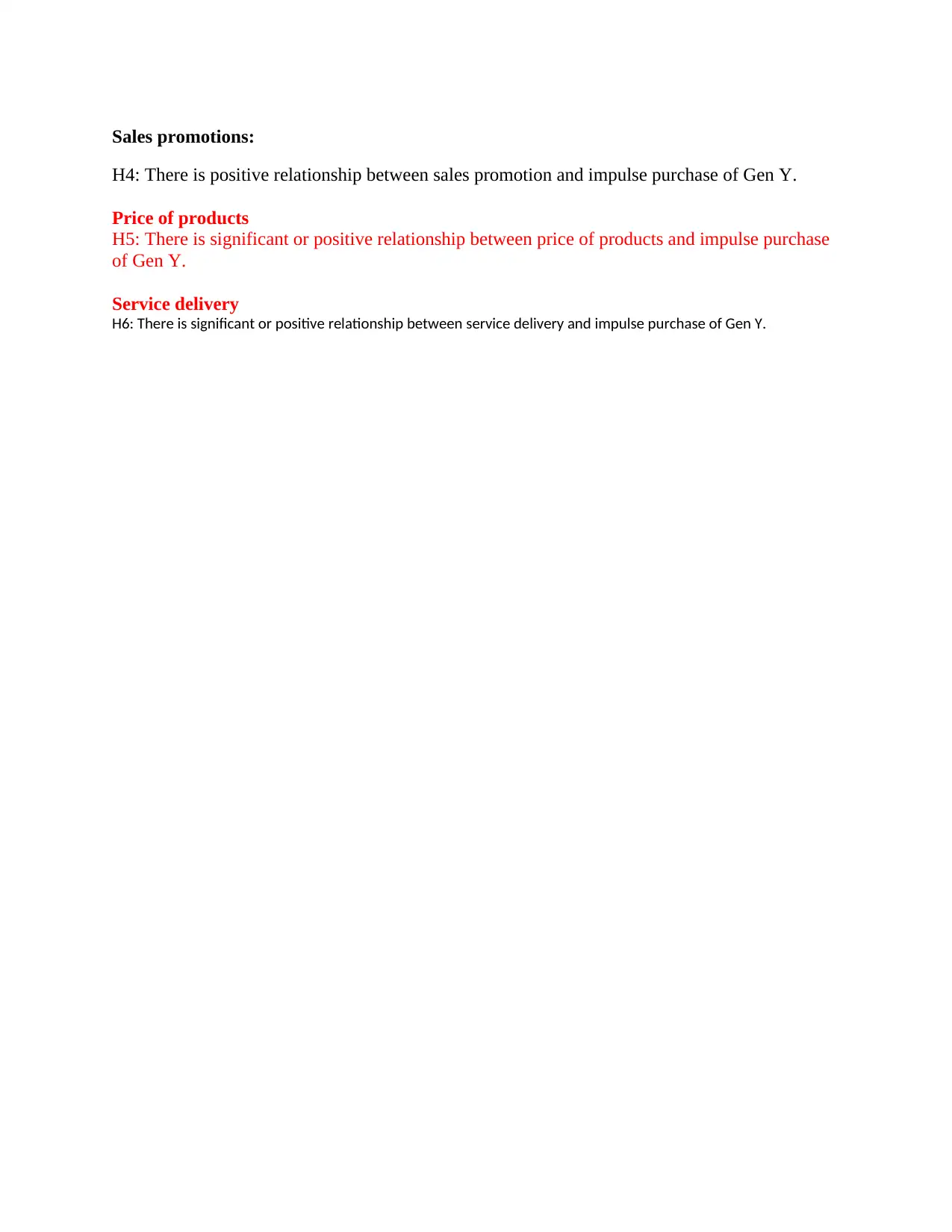
Sales promotions:
H4: There is positive relationship between sales promotion and impulse purchase of Gen Y.
Price of products
H5: There is significant or positive relationship between price of products and impulse purchase
of Gen Y.
Service delivery
H6: There is significant or positive relationship between service delivery and impulse purchase of Gen Y.
H4: There is positive relationship between sales promotion and impulse purchase of Gen Y.
Price of products
H5: There is significant or positive relationship between price of products and impulse purchase
of Gen Y.
Service delivery
H6: There is significant or positive relationship between service delivery and impulse purchase of Gen Y.
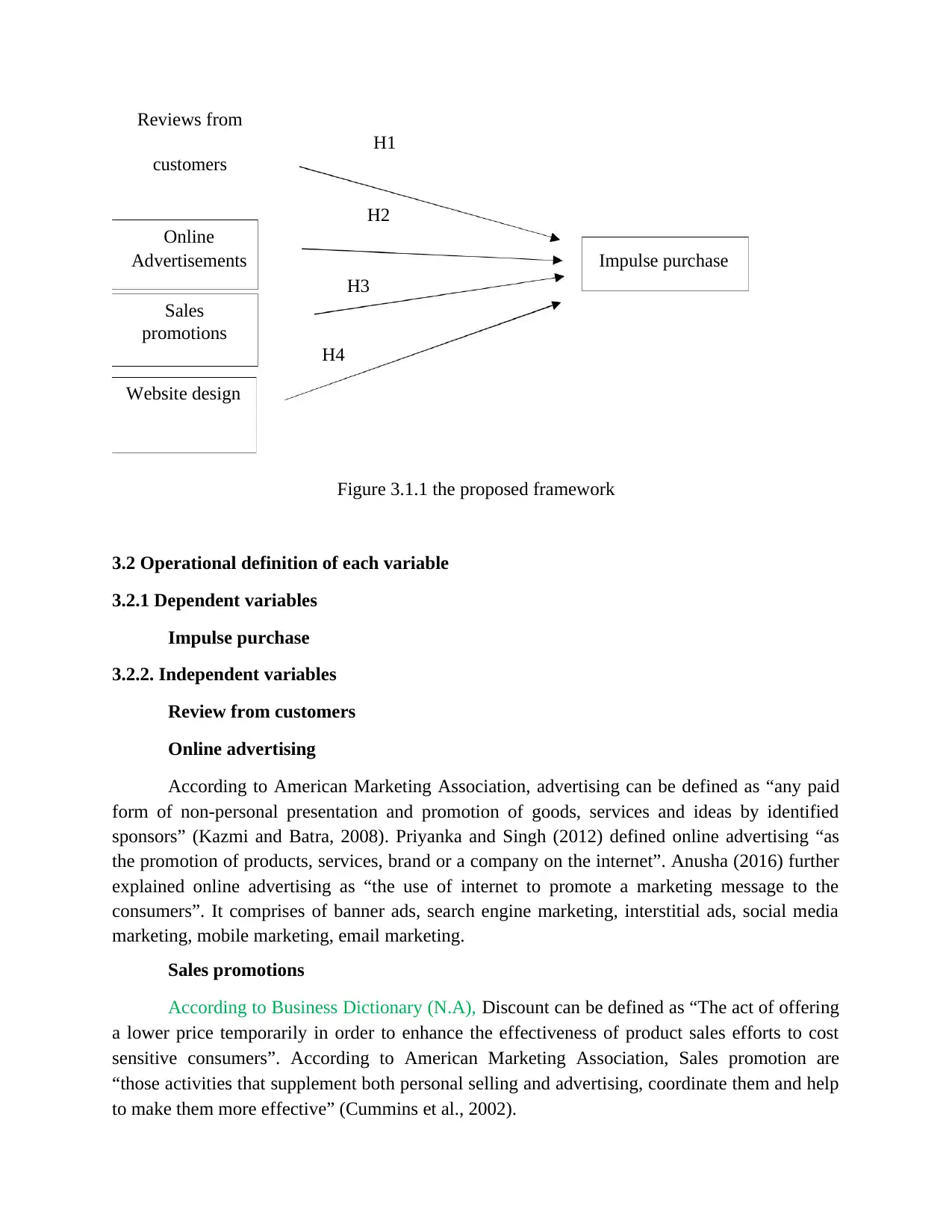
Reviews from
H1
customers
Online
H2
Impulse purchaseAdvertisements
H3
Sales
promotions
H4
Website design
Figure 3.1.1 the proposed framework
3.2 Operational definition of each variable
3.2.1 Dependent variables
Impulse purchase
3.2.2. Independent variables
Review from customers
Online advertising
According to American Marketing Association, advertising can be defined as “any paid
form of non-personal presentation and promotion of goods, services and ideas by identified
sponsors” (Kazmi and Batra, 2008). Priyanka and Singh (2012) defined online advertising “as
the promotion of products, services, brand or a company on the internet”. Anusha (2016) further
explained online advertising as “the use of internet to promote a marketing message to the
consumers”. It comprises of banner ads, search engine marketing, interstitial ads, social media
marketing, mobile marketing, email marketing.
Sales promotions
According to Business Dictionary (N.A), Discount can be defined as “The act of offering
a lower price temporarily in order to enhance the effectiveness of product sales efforts to cost
sensitive consumers”. According to American Marketing Association, Sales promotion are
“those activities that supplement both personal selling and advertising, coordinate them and help
to make them more effective” (Cummins et al., 2002).
H1
customers
Online
H2
Impulse purchaseAdvertisements
H3
Sales
promotions
H4
Website design
Figure 3.1.1 the proposed framework
3.2 Operational definition of each variable
3.2.1 Dependent variables
Impulse purchase
3.2.2. Independent variables
Review from customers
Online advertising
According to American Marketing Association, advertising can be defined as “any paid
form of non-personal presentation and promotion of goods, services and ideas by identified
sponsors” (Kazmi and Batra, 2008). Priyanka and Singh (2012) defined online advertising “as
the promotion of products, services, brand or a company on the internet”. Anusha (2016) further
explained online advertising as “the use of internet to promote a marketing message to the
consumers”. It comprises of banner ads, search engine marketing, interstitial ads, social media
marketing, mobile marketing, email marketing.
Sales promotions
According to Business Dictionary (N.A), Discount can be defined as “The act of offering
a lower price temporarily in order to enhance the effectiveness of product sales efforts to cost
sensitive consumers”. According to American Marketing Association, Sales promotion are
“those activities that supplement both personal selling and advertising, coordinate them and help
to make them more effective” (Cummins et al., 2002).
⊘ This is a preview!⊘
Do you want full access?
Subscribe today to unlock all pages.
Trusted by 1+ million students worldwide

1 out of 24


Your All-in-One AI-Powered Toolkit for Academic Success.
+13062052269
info@desklib.com
Available 24*7 on WhatsApp / Email
![[object Object]](/_next/static/media/star-bottom.7253800d.svg)
Unlock your academic potential
Copyright © 2020–2026 A2Z Services. All Rights Reserved. Developed and managed by ZUCOL.